When this South Side doughnut shop opened in 1972, the apple fritter wasn’t even on the menu. But over the last decade, the now-beloved treat has become synonymous with the neighborhood institution (that’s owner Buritt Bulloch left). The fritters are made fresh every morning using leftover dough scraps, resulting in a mammoth confection — each one clocks in at around a pound — that’s stuffed with warm chunks of apple, flavored with cinnamon, sweetened with a glaze, and, if you ask for it, sprinkled with chopped pecans. $4; 11248 S. Michigan Ave., Roseland
Visiting this Mexico City–style taqueria, which is attached to a corner grocery store, is a joy, from the colorful papel picado decorations to the housemade pineapple tepache. But all that is just a preamble to the food, and while it’s hard to argue against any of the tacos on the menu, the lengua is justifiably the standout. Taquero Cesar Castillo serves up thin slices of beef tongue that nearly cover the entire El Milagro tortilla. The meat is fatty and tender, topped with a shower of chopped white onions and cilantro, and finished with a squeeze of lime. The trio of salsas on your table add a final worthy accent. $3; 2500 S. Whipple St., Little Village
Images of the World Trade Center towers collapsing in New York were still fresh in the minds of the first American troops arriving in Afghanistan, as the United States launched an invasion targeting the Afghanistan-based al-Qaida leaders who plotted the attacks of Sept. 11, 2001.
More than 800,000 U.S. troops have served in the Central Asian country since then in a war that quickly expanded to confronting Afghanistan’s Taliban and to nation-building.
Now, the top U.S. commander in Afghanistan, Gen. Scott Miller, has relinquished his command in Kabul, underscoring the winding down of America’s longest war.
One-third of the roughly four million troops who served in the post-9/11 wars in Afghanistan and Iraq served multiple tours, some in well-secured bases in times of comparative quiet, others facing improvised explosive devices on the roads, mortar and rocket attacks on their positions, and firefights. While the United States quickly succeeded in quelling the al-Qaida fighters behind the 9/11 attacks, Americans leave with the Taliban rapidly claiming fresh territory. Many Afghans fear the return of civil war,or strict Taliban rule with the Western troops’ departure.
Here’s what some U.S. veterans of the war with Afghanistan say as the United States withdraws after nearly 20 years:
ANDREW BRENNAN
ARMY VETERAN
U.S. Army veteran Andrew Brennan.Julio Cortez / AP
For Andrew Brennan, 36, of Baltimore, it’s the days the painful memories subside that bother him.
A former Army captain who flew combat missions, Brennan lost one of his closest friends, pilot Bryan Nichols, when his Chinook helicopter was shot down in 2011, killing 30 Americans, seven Afghan soldiers and one interpreter. It was the single deadliest day for U.S. troops during the war.
Brennan spent a week helping recover the bodies.
“As much as I hate admitting it, there are days that go by when I don’t think about Bryan, our crew and the team guys on the back of that aircraft,” Brennan says. “And if I don’t think about it and I was that close to it, what do most Americans think?”
Brennan honors those who gave their lives in the war. He has worn a “Killed in Action” bracelet in honor of Nichols for nearly a decade. And he has worked to get a memorial wall built for 9/11 veterans.
Still, he says he believes it was a senseless war.
“What have we ended up with at the end of it, other than trillions spent, 7,000-plus Americans dead and more than two broken generations of warriors?
“The only stakeholder group that learned anything through this entire period were politicians: They learned that the American population is so removed from their modern-day ‘legions’ that they can do anything with our nation’s all-volunteer military, and no one will pay attention or care enough to change it.”
JENNIFER BROFER
MARINE VETERAN
Marine Corps veteran Jennifer Brofer outside her apartment in Los Angeles.Damian Dovarganes / AP
Marine veteran Jennifer Brofer will never forget the loud, popping noise.
It was on a hot July afternoon in 2010 when her convoy rolled over an IED on a road in Helmand Province four months into her deployment to Afghanistan. Her heart froze as she and her fellow Marines stopped and realized what had happened. But what followed were only the sounds of daily life.
This was a lucky day.
“For some reason, it did not detonate,” the former staff sergeant says.
It was a defining moment to be that close to death, says Brofer, who was one of the comparatively few female Marines to serve in America’s longest war and now is a producer and actress in Los Angeles.
As a Marine Corps public affairs officer, Brofer’s job was to document the stories of troops.
“Those moments in Afghanistan really put everything into perspective for me. Because I really didn’t fully appreciate all of the luxuries that I had been afforded prior to my deployment,” she says — like hugs from loved ones, hot showers and driving down a road without fear of her vehicle exploding.
Brofer, 38, who works in the television and film industries in Hollywood, says she’s proud to have served “shoulder-to-shoulder with my male Marine counterparts” in a time of war.
Still, Brofer says she can’t say whether the war was worth it.
“War is ugly,” she says. “And sometimes it’s necessary. And it’s not like we can go back and change anything. We can only change how we respond in the future.
“When I was deployed, it was already considered then the longest war. And I think it’s about time that our men and women came home.”
ERAN HARRILL
NATIONAL GUARD
The names of servicemen who died when their Chinook helicopter was shot down in 2011 in Afghanistan are seen on a liquor bottle.Julio Cortez / AP
After the United States launched a second war, in Iraq, in 2003, Oklahoma National Guard Sgt. Eran Harrill was one of hundreds of thousands of guard members called to duty as an all-volunteer U.S. military strained to fight two wars simultaneously.
Harrill fought in 2011 as part of a combat unit in Afghanistan’s Laghman Province, as the United States surged troops in hopes of crippling Afghanistan’s Taliban. A marketing director and business development executive in Oklahoma City, he patrolled alongside a mechanic, a K-9 police officer, students and other Oklahomans.
“The very first firefight we got in was certainly an ‘aha’ moment” for the citizen soldiers, says Harrill, 38, who had always wanted to serve in the military, even as some guard colleagues had seen it just as a way to bring in money for college. “I think we did some good there, maybe helped some people and prevented some loss of life. Was it worth the loss of life we had? I don’t know. That’s for someone else to answer.”
Back home, Harrill leads Oklahoma City’s Black Chamber of Commerce. He’s developing a directory aimed at identifying which employers are most suitable for members of the military, like National Guard members.
That’s after seeing guard members struggle with bosses unhappy over time away for training and deployment, including managers who reached out to a deployed guard member in the field to threaten him with firing if he didn’t return.
“We have a bad habit in this country of putting little yellow ribbons, ‘support our troops,’ in the window,” Harrill says. “But we don’t really support our troops as to how it affects us when the rubber hits the road.”
The Chicago Cubs are reeling. Quite frankly, they are really in a tailspin right now.
After once leading the NL Central a month and a half ago or so, the Cubs are now tied for the league’s worst record over their last 10 games. What once looked like a promising season now appears to have been a mirage as reality sets in.
The MLB trade deadline is just 17 days away now, and the Cubs are selling — without a doubt. There is no chance Chicago buys now, and Jed Hoyer knows it.
“You know, life comes at you fast,” Hoyer says. “Eleven days ago, this is not where we were mentally. Obviously, 11 games certainly changes a lot of things.” (The Score)
It feels like a lifetime ago the Cubs were considering buying at the deadline. But, in actuality, it was only days. Now, the team faces a crossroads with the core that helped win a World Series a few seasons ago. One of those key core pieces who could leave? Let’s just say fans would be distraught.
Chicago Cubs first baseman Anthony Rizzo may end up in another uniform sooner or later.
At the end of this season, Anthony Rizzo will be a free agent. So, he may end up leaving Chicago regardless. The big question right now is, do the Cubs attempt to trade him prior to this year’s deadline?
One team that’s been rumored as a landing spot for Rizzo this month is the team who originally drafted him, the Boston Red Sox. As the Red Sox continue their strong 2021 campaign, one more bat and an excellent fielder could make all the difference in the world.
The Red Sox will be buyers, but will they want Rizzo? If so, how much would Rizzo cost?
If you ask MLB Network insider Jon Heyman, Rizzo might not return exactly what the Cubs would want in a deal. Therefore, it’s easy to see a world where Chicago keeps Rizzo for the remainder of the season. In fact, Heyman believes Rizzo could stick around long-term, even.
“Rizzo, I still don’t believe that they’ll trade him,” Heyman said. “I think that he’s a Cub. We shall see. Maybe he doesn’t mind at this point the way the Cubs are doing, if he wants to try to win this year. Maybe he’ll be OK with it. But I just feel like they’re going to keep Rizzo long term. We shall see, no guarantees here.” (WBBM)
Well, now that we’re all confused, the only thing left to do is wait.
It would be a dark reality that sets in if the Cubs were to deal Rizzo, along with guys like Kris Bryant or Javier Baez. Most of us already know that Craig Kimbrel is as good as dealt, but one or more of the Cubs’ “big three” could be on their way out as well.
The Cubs would be doing themselves a favor keeping Rizzo around for the next rebuild, as he’s become such a leader in the clubhouse. But, if the Ricketts do not wish to spend long-term (even if it is the team’s unquestioned leader), a world without Rizzo in Chicago is not too far fetched to imagine.
Izzy Reidy specializes in the kind of intimate indie rock where you can hear the sound of fingertips squeaking along guitar strings. They launched their band, Izzy True, while living in upstate New York, but these days Reidy lives in Chicago and plays with drummer Sam Goldstein and multi-instrumentalist Curtis Oren. Izzy True’s new third album, Our Beautiful Baby World (Don Giovanni), melds homespun rock and relaxed country swagger; on “Angel Band,” Oren dispenses a spry walking bass line that boosts Reidy’s intensifying vocals toward the song’s fiery, calamitous closing notes. As a front person, Reidy balances stage-ready poise with down-to-earth informality, exuding a quiet grace that amplifies their incandescent whispers. Our Beautiful Baby World conjures an inviting sense of comfort while sending out lightning bolts at just the right moments–and each shock makes it clear that this is a band to see in the flesh. v
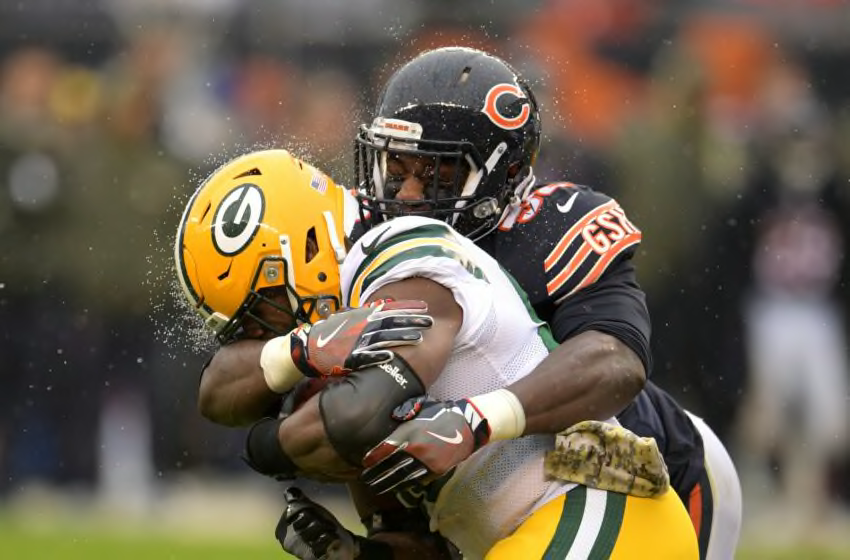
The entire offseason has been defined by one position for the Chicago Bears. Regardless of other signings and draft picks made, it is all about the quarterback.
But, that shouldn’t come as a surprise. It’s always about the quarterback — or lack thereof — in Chicago.
There is no question fans are most excited to see rookie Justin Fields, more than any other player, when the Bears open training camp in a few weeks. Finally, the franchise has legitimate hope when it comes to the most important position.
What about other positions, though? The Bears added several new names throughout the past few months, and a couple of key positions have gotten better. On the flip side, some positions became more of a question mark.
Aside from the big names, there are many worthy players to watch at Chicago Bears training camp.
Over the past few months, general manager Ryan Pace has done a nice job taking fliers on veteran players looking for new homes. He’s always open to the 1-year, prove-it type of contract.
This year, Pace took a gamble on a few specific free agents who come into training camp flying under the radar. If the Bears are to become a better football team as a whole, some of these players will need to step up and solidify their place on the roster.
There are five players, in particular, whom fans should look out for at camp. These guys will be out to prove they not only belong, but can make a difference within the Bears’ quest for a postseason run.
The writer-director Eli Roth is on a small boat where a fisherman has pulled a Mako shark from the waters. Roth tries to negotiate for the shark’s life — he’ll pay for it if they just let it go — but the fisherman uses a baseball bat (not unlike the weapon wielded by Roth’s Sgt. Donny Donowitz in “Inglorious Basterds”) to kill the shark. Roth is clearly shaken by the experience — and so are we, and not for the last time in the sometimes difficult to watch but invaluable and insightful documentary titled “Fin,” streaming globally on Discovery+.
Pilgrim Media Group presents a documentary directed by Eli Roth. No MPAA rating. Running time: 100 minutes. Available Tuesday on Discovery+.
If it’s mid-summer, that means it’s time for the annual “Shark Week” festival on Discovery and Discovery+ plus a myriad of “SharkFest” offerings on NatGeo — with some 45 hours of shark-related unscripted specials on the former and another 21 hours of fresh programming on the latter. I urge you to place “Fin” on the top of your shark-viewing list.
“Fin” writer-director-producer-star Roth is best known for horror films such as “Cabin Fever” (2003) and the “Hostel” movies (I’m a big fan of his bat-bleep crazy, Keanu Reeves-starring erotic thriller “Knock Knock”) but he describes this documentary as “the most terrifying film I’ve ever made,” and that’s no hyperbole.
With photographer Michael Muller delivering visuals that alternate between the breathtakingly beautiful and the horrifyingly brutal, Roth travels the world for an in-depth look at the vast and sometimes criminal network of fishermen, suppliers, sellers and buyers involved in the mass slaughter of sharks — all because of demand for shark fin soup and other supposedly “exotic” dishes. (Shark flesh, cartilage, skin and livers are also used to make supplements, makeup and skincare products.) We’re told some 100 million sharks are slaughtered every year, leaving a number of species threatened with extinction.
Shark finning is a horrific practice. The shark is often still alive when its fins are sliced off — and then the mutilated shark is tossed back into the water, where it will suffocate or bleed to death or be killed. The passionate and empathetic and committed-to-the-cause Roth talks to the fishermen in poor seaside villages who have almost no other way of making a living; the sometimes shady shopkeepers in Hong Kong selling all manner of shark fins; activists and oceanographers who have dedicated themselves to educating the public about sharks and saving them from mass slaughter, and a food writer and a restaurateur who talk about how shark fin soup became a symbol of wealth and status in Chinese culture, often served at weddings at other gatherings, because it was a dish favored by the imperial family.
The reality is shark fin soup is garbage soup. As “Fin” shows in graphic detail, shark fins are often piled up by the thousands in unsanitary conditions — and they’re essentially tasteless. The flavor, such as it is, comes from the broth and from additives. Myths about shark fins curing cancer or boosting sexual potency are just that: myths. (Thankfully, many in the younger generation of Chinese find shark fin soup to be out of fashion. Meanwhile, the sale of shark fins has been banned in Illinois since 2013.)
For all its sobering reporting and imagery, “Fin” also has moments of pure beauty, as when Roth literally swims among sharks, who greet him with mild curiosity and a benign approach. Despite the handful of stories every year about a shark attacking a human, we know the truth: We’re the predators, and they’re the prey.
One person was killed, and eight others were wounded in shootings Monday in Chicago, including a man who was killed in a shooting in Englewood on the South Side.
Officers responded to reports of shots fired about 10:40 p.m. in the 6000 block of South Racine Avenue and found the 35-year-old with multiple gunshot wounds in the street, Chicago police said. The man was taken to St. Bernard Hospital, where he was pronounced dead. His name hasn’t been released.
Two people were wounded, one critically, in South Chicago. A 35-year-old man and a 20-year-old woman were walking about 9:20 p.m. in the 8400 block of South Muskegon Avenue when someone opened fire, police said. The man was struck in the neck and taken to the University of Chicago Medical Center in critical condition. The woman was shot in the arm and took herself to Trinity Hospital, where she was in good condition.
A 3-year-old boy was hurt in a shooting in Lawndale on the West Side. He was riding in a vehicle driven by a 24-year-old woman about 3:55 p.m. in the 3700 block of West 16th Street when someone unleashed gunfire, police said. A bullet grazed the boy in the lower back. The woman drove to Loretto Hospital, where the boy was in good condition.
A 15-year-old girl was shot and seriously wounded while riding in a car in Englewood on the South Side. The car was headed west in the 6900 block of South Halsted Street when shots were fired around 11:20 a.m., police said. The girl was hit in the upper leg and was taken to Comer Children’s Hospital in critical condition. The car struck another car before coming to a stop. No one was in custody.
Four others were wounded in shootings across Chicago.
Thirteen people were killed, and thirty-three people were wounded last weekend in citywide.



:no_upscale()/cdn.vox-cdn.com/uploads/chorus_asset/file/22714489/merlin_98994184.jpg)
:no_upscale()/cdn.vox-cdn.com/uploads/chorus_asset/file/22714457/merlin_98994202.jpg)
:no_upscale()/cdn.vox-cdn.com/uploads/chorus_asset/file/22714507/merlin_98994192.jpg)