Videos

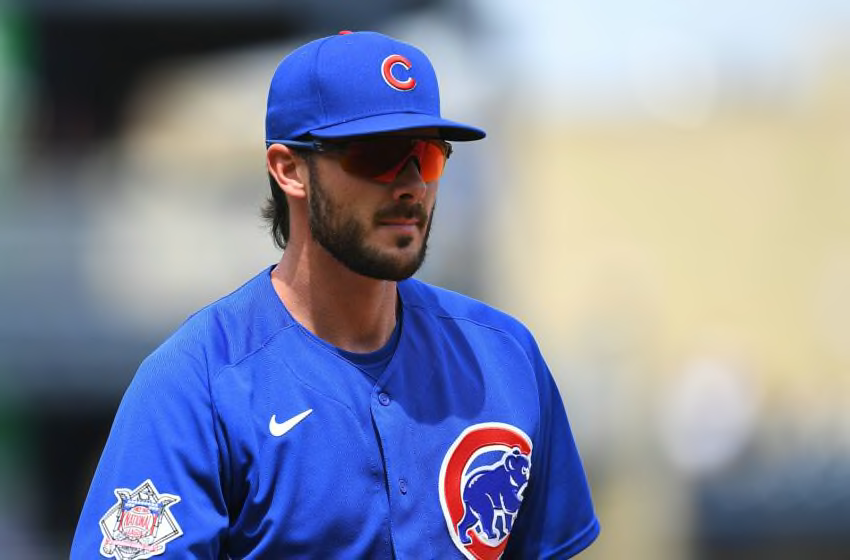
3 players Chicago Cubs could trade and still remain competitiveVincent Pariseon July 19, 2021 at 6:54 pm

Read More

3 players Chicago Cubs could trade and still remain competitiveVincent Pariseon July 19, 2021 at 6:54 pm Read More »

Check out these nontouristy local gemson July 19, 2021 at 7:12 pm

Retired in Chicago

Check out these nontouristy local gems

Read More

Check out these nontouristy local gemson July 19, 2021 at 7:12 pm Read More »

Weekend violence: Six children wounded over nine hours as Chicago continues to see more young victims of shootingsDavid Struetton July 19, 2021 at 6:16 pm

A late party outside a home. An afternoon drive. A stop at a gas station.

They were all scenes of shootings that wounded six children over nine hours this past weekend as Chicago continues to see more young victims of gun violence than last year.

At least 91 children 15 years of age and younger have been wounded so far this year, 11 of them fatally, according to Sun-Times records. That’s seven more than the same time last year when 84 children had been shot, 12 of them fatally.

The children wounded over the weekend were in neighborhoods that experienced the most shootings between Friday evening and late Sunday: Gresham on the South Side and Austin on the West Side.

The police districts that cover those neighborhoods accounted for at least 25 of the 60 people shot overall. Many of the 10 homicides also occurred there.

The pace of gun violence in the city continues to be higher than last year’s record level.

Chicago recorded at least 2,254 shootings through July 17, according to the city’s most recent data, up 10.3 percent from the same time last year, and 60 percent compared to 2019.

Police Supt. David Brown was pressed about the increasing violence against children during a Monday news conference on a new team of about 50 officers that will target gun traffickers.

He responded by saying people should use a tip line being set up for the team.

“Our children are worth giving these people up,” he said. “Give these people up. Turn them in, whether for a payout … or give them up out of the goodness of your heart.”

Among the weekend attacks:

12-year-old, 4 teenagers hurt in Austin mass shooting

Six people were shot outside a party late Saturday in Austin on the West Side, including a 12-year-old girl and four teenagers. Five of the victims, ranging in age from 12 to 19 years old, were hospitalized in fair condition, according to police

About 11:40 p.m., they were standing with a group on the sidewalk in the 5000 block of West Ohio Street when someone in a dark-colored SUV fired shots, police said.

The 12-year-old girl was struck in the hand and driven by family members to West Suburban Medical Center, police said.

A 13-year-old girl and a 14-year-old girl both suffered gunshot wounds to the buttocks and were taken to Stroger Hospital, police said.

A 15-year-old girl suffered a graze wound to the head and a gunshot wound to the buttocks, according to police. She was transported to Mount Sinai Hospital. A 19-year-old woman was struck in the back and transported to Stroger Hospital.

A sixth victim, a 25-year-old man, was struck in the buttocks and went to Mount Sinai Hospital where he was treated and released.

Boys 8 and 14 hurt in Gresham shootings

Early Sunday, an 8-year-old boy and a 28-year-old man were wounded in a shooting in Gresham on the South Side.

Just after 1 a.m., the pair were traveling in a car in the 2000 block of West 83rd Street when someone in a black SUV fired shots, police said.

The boy suffered a gunshot wound to the left leg and was transported to Christ Medical Center in Oak Lawn, where he was listed in good condition, police said. The man was struck in the back and treated and released on scene, according to police.

In another shooting in Gresham, a 14-year-old boy was wounded Saturday. The teen was in a car in the parking lot of a gas station in the 1200 block of 87th Street when someone opened fire about 3:40 p.m., police said.

He was shot in the leg and was transported to Little Company of Mary Hospital, where he was in fair condition, police said.

West Town fatal attack

A man was fatally shot early Monday in the West Town neighborhood.

Just after 1 a.m., the 38-year-old was standing on the sidewalk in the 100 block of North Morgan Street when someone in a silver sedan fired shots, Chicago police said. He suffered multiple gunshot wounds and was transported to Stroger Hospital where he was pronounced dead, police said.

2 killed in Austin shootings

A man was shot and killed Sunday night in Austin on the West Side.

The 31-year-old was standing on the sidewalk in the 900 block of North Lawler Avenue when someone approached and fired, police said. He suffered gunshot wounds to the head and body and was taken to Stroger Hospital where he was pronounced dead, police said. He has not yet been identified.

Another man was fatally wounded Sunday night.

About 7:30 p.m., the 30-year-old was in the 5500 block of West Rice Street when someone approached and fired, police said. He was struck in the shoulder and was taken to Stroger Hospital, where he was pronounced dead, police said.

Greater Grand Crossing fatal attack

A 49-year-old man was fatally shot Sunday night in Greater Grand Crossing on the South Side.

He was speaking to someone in a parked car about 10:25 p.m. when someone inside fired shots in the 7700 block of South Normal Avenue, police said.

He was struck multiple times in the body and was taken to the University of Chicago Medical Center, where he was pronounced dead, police said. The Cook County medical examiner’s office hasn’t identified him.

Gresham homicide

A person was shot to death Sunday afternoon in Gresham on the South Side.

The victim was near the street about 4 p.m. in the 1700 block of West 79th Street when he heard shots and felt pain, police said. He was struck in the stomach and he was taken to Christ Medical Center in Oak Lawn, where he was pronounced dead, police said.

Man killed in Back of the Yards

A man was shot to death early Sunday morning in Back of the Yards on the South Side.

The 30-year-old was walking on the sidewalk in the 5100 block of South Marshfield Avenue about 12:40 a.m. when someone in a gray sedan fired shots, Chicago police said. He suffered gunshot wounds to the chest and was transported to the University of Chicago Medical Center where he was pronounced dead, police said. He has not yet been identified.

2 shot, 1 fatally, in Chatham

One person was killed and another wounded in a shooting Saturday night in Chatham on the South Side.

The pair was standing outside about 11:25 p.m. in the 7600 block of South St. Lawrence Avenue when someone in a black SUV fired shots, police said.

A male suffered gunshot wounds to the body and was taken to the University of Chicago Medical Center where he was pronounced dead, police said. A 27-year-old woman was struck in the right knee and taken to the same hospital in fair condition, police said.

Man fatally shot in East Garfield Park

A man was fatally shot early Saturday during an argument in East Garfield Park.

About 1:45 a.m., the 31-year-old was shot in the head by a man during an argument outside in the 2800 block of West Van Buren Street, police said. He was transported to Mount Sinai Hospital where he was pronounced dead, police said.

The shooter was on the scene when officers arrived and was taken to Area Four headquarters for further investigation, police said.

1 killed, 3 wounded in Austin shooting

One man was killed and three others wounded in a shooting late Friday night in Austin on the West Side.

About 11:55 p.m., the four men were standing outside in the 700 block of North Lockwood Avenue when three people approached them and fired shots, police said. A 29-year-old man was struck in the head and back and pronounced dead at the scene, police said. He has not yet been identified.

A man, 40, suffered gunshot wounds to the hip and leg and another man, 45, was also struck in the leg, police said. Both men were transported to Stroger Hospital in serious condition. A fourth man, 62, suffered a graze wound to the back and was taken to the same hospital in good condition.

West Pullman fatal drive-by

A man was shot to death Friday evening in a drive-by in West Pullman on the Far South Side.

The 26-year-old was on the street about 6:50 p.m. in the 12000 block of South Union Avenue when a vehicle pulled up and someone from inside fired shots, police said. He was struck multiple times on the body and he was taken to Christ Medical Center in Oak Lawn, where he was pronounced dead, police said. The Cook County medical examiner’s office identified him as Antwan Davis.

At least 39 other people were wounded in shootings between 5 p.m. Friday and 5 a.m. Monday.

Last weekend, 13 people were killed and 33 others wounded in shootings citywide.

Contributing: Stefano Esposito

Read More

Weekend violence: Six children wounded over nine hours as Chicago continues to see more young victims of shootingsDavid Struetton July 19, 2021 at 6:16 pm Read More »

Chicago dance-pop duo Drama return to the stage to showcase their pre-pandemic albumJamie Ludwigon July 19, 2021 at 5:00 pm

We’ll never know what might have been for any of us had 2020 turned out a little less soul crushing. But it feels extra bittersweet to imagine the possibilities for Chicago duo Drama, who released their debut album, Dance Without Me (Ghostly International), just before lockdown. Since joining forces in 2014, vocalist Via Rosa and producer Na’el have captured Chicago’s hearts. The sleek, controlled fusions of R&B, dance, and pop on their first release, the 2016 EP Gallows, sounded less like the work of newcomers than like a long-established group reflecting on their journey–especially given reflective quality of Rosa’s teardrop voice. Dance Without Me builds on that energy with dreamy, hypnotic songs about relationships and lost love that feel simultaneously intimate and larger than life. The group’s ace songwriting and production make practically every track feel like it could stand alone as a single. The slow-grooving “Years” describes being there for someone who’s done you wrong, even knowing they’ll do it again, and its anthemic chorus could suit a blockbuster romance. But despite the album’s frequent tangles with heartbreak, it doesn’t sink to groveling–the jubilant, club-ready “Hold On” expresses self-love in the face of rejection. “How could somebody let go of somebody this fine?” Rosa sings. “They must not know what they like.” Pop music often feels plastic and disposable, but the songs on Dance Without Me seem timeless–and now that Drama can perform live again, they seem poised to convert legions of new fans, whether playing to clubgoers at Lincoln Hall or to festival crowds at Lollapalooza. v

Read More

Chicago dance-pop duo Drama return to the stage to showcase their pre-pandemic albumJamie Ludwigon July 19, 2021 at 5:00 pm Read More »

‘The Daily Show’ celebrates 25 years with live-streaming specialMark Kennedy | AP Entertainment Writeron July 19, 2021 at 4:56 pm

NEW YORK — Long before there was fake news, there was a fake news show.

Comedy Central’s “The Daily Show” launched 25 years ago this month, dedicated to skewering journalism and warning viewers about how they take in their news.

“We became the watchdogs of the watchdog,” said co-creator Lizz Winstead. “Nobody had done it before so the world was our oyster.”

Over the years, “The Daily Show” — first hosted by Craig Kilborn, then Jon Stewart and now Trevor Noah — has skewered the left and right by making the media a character and playing it absolutely straight, no matter how ridiculous.

Co-creator Madeleine Smithberg explains their a-ha moment: “What if we pretend we are them? And the more serious we act, the absolute more ridiculous we can be? We can satirize the news industry along with the news.”

Winstead and Smithberg are celebrating the silver anniversary on Monday with a 90-minute streaming celebration that will include special guests, a Q&A and appearances from the first correspondents: A. Whitney Brown, Beth Littleford and Brian Unger. Proceeds will benefit Abortion Access Front.

While Winstead left as head writer before Stewart took over as host in 1999, Smithberg stayed for more than seven years, hiring such key talent as Stephen Colbert, Steve Carell, Ed Helms, Rob Corddry, Mo Rocca and Lewis Black.

The co-creators built a show that would go on to win dozens of Emmys, two Peabody Awards and honors from the Writer’s Guild, the NAACP and GLAAD. They established a format that proved sturdy enough to outlast various hosts.

“They got to just move into the house and not worry about the plumbing and not worry about the roof. What they could just do is start decorating and then start adding to it and then just really having the parties they wanted,” said Winstead.

The show was an evolutionary leap from previous attempts to skewer news like “That Was the Week That Was,” “Weekend Update” on “Saturday Night Live” and HBO’s “Not Necessarily the News.” But despite its popularity and endurance, neither co-creator sees much change in the way TV news operates.

“We couldn’t have handed the media a bigger mirror with which to look at themselves and say, ‘I guess we need to self-correct,'” said Winstead. “And instead, a lot of cable news was like, ‘Oh, what people want in the news is wacky graphics.'”

Winstead had always been a comedian mining social and political humor, but it took the way CNN covered the first Gulf War that led her to “The Daily Show.”

On the first night of the conflict — Winstead was at a bar on an unfortunate blind date — the cable network played martial music, threw up lots of snazzy graphics and seemed to relish the conflict.

This combination photo shows Samantha Bee (from left), Steve Carell, Stephen Colbert and Larry Whitmore, who were all cast members on “The Daily Show with Jon Stewart.”
AP

“There was a purposefulness to making this coverage seem almost like it was a video game or a TV show,” she recalled. “I was thinking, ‘Are they trying to report on a war or try to sell me a war?'”

She later happened to move into the same New York apartment building as Smithberg, who had worked on David Letterman’s late-night show and was producing an MTV show with Stewart. Smithberg asked Winstead if she’d be a segment producer and she agreed. When that show was canceled, the two then went on to create “The Daily Show.”

They pointed to two things that made their job easier. One, Comedy Central gave them a full year to work out the bugs, meaning less pressure for ratings and a workplace guarantee that could attract talent.

Second was the presence of Unger, a former CBS veteran who had become disillusioned with TV journalism. He taught the staff the tricks of the trade: The furrowed brow, the serious listening face, the nodding, the pursing of the lips and the camera turns.

The working title of the show was never intended to be final but won by default. Options included “The Daily Scope,” “The Daily Roundup” and even “The Daily Poop” but nothing felt right.

“We never came up with a better title. Basically, it was always called ‘The Daily Show’ because it was a description of what we were doing,” said Smithberg.

The TV landscape when “The Daily Show” made its debut on July 22, 1996, was evolving. CNN was well-established, MSNBC had just started as a 24-hour network and Fox would follow. With not much to fill all those hours, many turned to prurient topics and became easy fodder for satire.

The show’s long-term legacy as a talent incubator is sterling. It became a launching pad for the likes of Aasif Mandvi, Jon Oliver, Larry Wilmore, Jordan Klepper and Samantha Bee.

Critics have sometimes complained that “The Daily Show” has bred cynicism, a charge the co-creators reject. The show didn’t intend to be a fact-checker or a truth-teller but morphed into one because the TV media devolved, they argue.

“Where people should have channeled their anger is at the media, whose job it is every single day in newspapers and in their 24-hour-news channels to give us a smarter electorate,” said Winstead.

Smithberg points to one moment in particular when the show seemed to turn a corner — the 2000 U.S. election. When Florida became undecided, it triggered a weekslong recount that “The Daily Show” carefully detailed in all its absurdity.

“It was during that time that ‘The Daily Show,’ as you know and love it, emerged,” she said. “That’s when the legitimate media really fell in love with us because we were the only ones that could show how not normal this situation was.”

It ultimately led to fake journalists from “The Daily Show” being interviewed and featured by real journalists: “That was kind of a surreal moment because the show that’s just like poking holes in the media is suddenly the media darling.” said Smithberg.

Read More

‘The Daily Show’ celebrates 25 years with live-streaming specialMark Kennedy | AP Entertainment Writeron July 19, 2021 at 4:56 pm Read More »

Chicago State hires Samford assistant Gerald Gillion as new men’s basketball coachSun-Times staffon July 19, 2021 at 5:19 pm

Chicago State announced it has hired Samford University assistant Gerald Gillion as its new men’s basketball coach.

“Coach Gillion is a tremendously talented recruiter and mentor to students,” Director of Intercollegiate Athletics Elliott Charles said in a statement. “Gerald has proven that academic, career and leadership development and social engagement of student-athletes are at the center of his competitive approach. His track record of focus on the holistic development of student-athletes has benefitted the prospective student recruitment outcomes at all of his previous institutions.”

“We live in a digital age. Nobody has time to wait years for progress when everything around us changes so rapidly,” Gillion said in a statement from the university. “I’m a winner. My staff and I will not accept mediocrity on any level. We need to win now, not next year. We don’t want to rebuild; we want to re-tool. The winning mentality is built to last.”

Read More

Chicago State hires Samford assistant Gerald Gillion as new men’s basketball coachSun-Times staffon July 19, 2021 at 5:19 pm Read More »

‘Sways’ or ‘waves’? Debate over Bruce Springsteen’s ‘Thunder Road’ lyrics about Mary’s dress, has endedBryan Alexander | USA TODAYon July 19, 2021 at 5:24 pm

The fierce debate over Bruce Springsteen’s “Thunder Road” lyrics, and the movement of Mary’s dress in the classic song, is officially over.

The fireworks appropriately started just before Independence Day, when The New York Times journalist Maggie Haberman tweeted the commonly accepted and often-crooned “Thunder Road” opening lyric from Springsteen’s seminal 1975 “Born to Run” album.

“A screen door slams, Mary’s dress sways,” Haberman wrote, with a picture of the empty stage before a “Springsteen on Broadway” performance. That led to a series of Twitter commentators saying Haberman was blinded by the light, and that the lyric is “waves,” not “sways.”

The Los Angeles Times investigated the cresting “waves”/”sways” controversy, stating, “Springsteen is not one of rock’s great enunciators, and because ‘dress’ ends with a sibilant S, ‘suh-ways’ is difficult to distinguish from ‘suh-waves.’ So the topic is up for debate, right?”

E Street guitarist and longtime collaborator Stevie Van Zandt was not touching the issue, telling one Twitter questioner, “Oy vey! Get this Bruce lyric (expletive) outta my feed!”

Springsteen was mum on the issue, but on his official website and in his songbook, the word is “waves.” However, Springsteen uses “sways” on page 220 of his “Born To Run” memoir and in his handwritten lyrics, which were auctioned off by Sotheby’s in 2018.

The New Yorker editor David Remnick entered and ended the debate by emailing longtime Springsteen collaborator and manager Jon Landau, co-producer of “Born to Run.”

“Short of Springsteen himself, no one could answer the question more definitively than Landau,” Remnick wrote in an article published Saturday.

“The word is ‘sways,’ ” Landau wrote back. “That’s the way he wrote it in his original notebooks, that’s the way he sang it on ‘Born to Run,’ in 1975, that’s the way he has always sung it at thousands of shows, and that’s the way he sings it right now on Broadway. Any typos in official Bruce material will be corrected. And, by the way, ‘dresses’ do not know how to ‘wave.’ “

Read more at usatoday.com

Read More

‘Sways’ or ‘waves’? Debate over Bruce Springsteen’s ‘Thunder Road’ lyrics about Mary’s dress, has endedBryan Alexander | USA TODAYon July 19, 2021 at 5:24 pm Read More »

I Was Emotionally Cleansed by a Looping MachineLynette Smithon July 19, 2021 at 4:55 pm

Yesterday I cried because I couldn’t get my Bluetooth speaker to connect to my iPhone. This was very annoying because generally I don’t like to have feelings. I prefer to approach life like that meme of the yellow dog sitting in the middle of a flaming room — a little dazed, but still rocking a jaunty hat and a this-is-fine attitude. My therapist is out on maternity leave and I should be happily ignoring my emotions in peace, dammit! But instead — even with distractions like fully opened restaurants and bars and theaters, the feral dating scene, and life accelerating to a Before Times pace — my pandemic angst is right there.

I know I’m not the only one. So I call up two of my like-minded (read: semirepressed) besties with their own heavy postpandemic torments, and we gather in my living room for a healing session with Davin Youngs. Davin is a vocalist and a musician and will be taking us on a one-of-a-kind sonic immersion using his voice, instruments, looping devices, and electronic beats. He tells us about the tradition of sound as a modality to healing and says that we’re going to hold space for our minds and bodies to take care of whatever bullshit we’ve been ignoring.

After Davin sets up his equipment — modern gear like an electronic board with a looper and an effects pedal mixed with more traditional woo-woo stuff like crystal singing bowls and a clump of chestnut shells on a rope — we take a moment to name where we’re at emotionally. Immediately all three of us are in tears. Davin seems unfazed by what is, for us, a huge emotional outburst. If anything, he’s relaxed and calm, and next thing you know, we’re stretched out on the floor with our eyes closed. The music begins.

First the crystal singing bowls ring. Then Davin starts to layer “personal language” over electronic beats. He’s not using words, just syllables that are meant to evoke speech but without the weight of comprehension. The effect is sort of like the beginning of an Enya song. My thoughts mirror his tone: Sometimes I picture myself twirling in an open field, or lying down at peace. It definitely feels like a journey, sometimes intense, sometimes peaceful. My brain never fully gets quiet, so I try to picture elements of my life that I want to heal and direct energy that way. I’ve been working on vulnerability and being more openhearted, and I let the music take me to a place where I think, What if I didn’t have to be anything other than myself? What if I’m fine just as I am?

This thought floors me.

I can’t say that when it’s over, I’m a different person. But I did feel connected to some essential truth and like I want to be more present for myself. I’m touched by the beauty that is Davin caring for us, creating this art for us with the intention of directing loving energy our way, and all at once I’m reminded that being human isn’t just pandemics, or Capitol riots, or credit card bills, or the COVID weight I easily put on but can’t easily take off. And even if I can’t stay in this space forever, for one hour on my living room floor, it felt great.

Read More

I Was Emotionally Cleansed by a Looping MachineLynette Smithon July 19, 2021 at 4:55 pm Read More »

After weekend negotiations, Lightfoot, police reform advocates reach long-awaited deal on civilian police oversightFran Spielmanon July 19, 2021 at 4:29 pm

After negotiating through the weekend, Mayor Lori Lightfoot and police reform advocates have finally reached agreement that will pave the way for civilian oversight of the Chicago Police Department.

The final language would empower a seven-member commission to take a vote of no-confidence in the Chicago police superintendent, which would need at least 5 votes to pass. The commission also could take no-confidence votes for the chief administrator of the Civilian Office of Police Accountability and any Police Board member.

A no-confidence vote by the commission would trigger a vote by the City Council’s Committee on Public Safety within 14 days — then a full City Council vote at its next monthly meeting. If two-thirds of aldermen agree with the no-confidence vote, the chief administrator of COPA “shall be removed.”

However, no-confidence votes in either the CPD superintendent or Police Board members would not be binding on the mayor. Instead, the mayor “shall respond in writing within 14 days after adoption of the resolution, explaining the actions that the mayor will take in response.”

Even so, a no-confidence vote in the superintendent would be difficult for the mayor to ignore.

As for police policy, the commission would be empowered to “initiate a policy either by drafting a policy itself or making a written request” to the Chicago Police Department, COPA or the Police Board.

CPD, COPA or the Police Board would then have 14 days to “accept or decline. If the answer is no, there must be an explanation in writing. If recommendation is accepted, the policy must be drafted within sixty days.

“If the Department, COPA or the Police Board does not respond, declines the request or accepts the request, but fails to draft a policy within sixty calendar days or any extension thereto, the commission may take its request to the mayor, who shall review the parties’ positions and either direct the superintendent, chief administrator or police board president to take appropriate action or explain why in writing the mayor has concluded that no action is warranted,” the ordinance states.

The Committee on Public Safety will meet at 5 p.m. Tuesday to ratify the agreement. That will be followed by a full City Council vote on Wednesday.

Now that there is an agreement, there should be no problem attracting the 34 votes needed to approve any ordinance involving the Chicago Board of Election Commissioners. The ordinance does just that by electing three-member councils in each of Chicago’s 22 police districts.

Lightfoot has argued repeatedly that she “wears the jacket” for Chicago violence and she’s not about to “outsource” control over CPD to a civilian police oversight commission.

That’s why, when Lightfoot finally got around delivering her own version of civilian oversight, she retained for herself and future mayors the power to hire and fire the superintendent and have the final say in disputes over police policy.

But Lightfoot’s ordinance attracted such tepid support, she pulled it to avoid defeat, setting the stage for the latest round of negotiations.

In the compromise, both sides can claim victory.

The mayor appears to have won by retaining the final say on police policy disputes. But police reform advocates won the right to take a vote of no-confidence in the police superintendent that Lightfoot wanted to avoid, even though she would not be bound by it.

“After a weekend of productive negotiations, we are pleased to announce that the parties have reached an agreement on a proposed substitute ordinance for civilian oversight of the Chicago Police Department, the Civilian Office of Police Accountability, and the Police Board,” Lightfoot and the Empowering Communities for Public Safety Coalition were quoted as saying in a joint statement.

“If passed, this ordinance would bring an historic, transformative and balanced approach to civilian oversight. The Committee on Public Safety is expected to take up the substitute ordinance on Tuesday and we strongly urge the members of City Council to vote to approve this landmark legislation.”

Civilian oversight was a pivotal recommendation by the Task Force on Police Accountability that Lightfoot co-chaired in the furor after the court-ordered release of the Laquan McDonald shooting video.

The mayor has been under heavy political pressure to deliver civilian oversight, particularly after changing her tune on an elected school board bill approved by the Illinois General Assembly over her strenuous objections.

Read More

After weekend negotiations, Lightfoot, police reform advocates reach long-awaited deal on civilian police oversightFran Spielmanon July 19, 2021 at 4:29 pm Read More »

Chicago police create new gun team to target illegal weapons ahead of Biden strike forceFrank Mainon July 19, 2021 at 3:00 pm

Supt. David Brown is creating a new Chicago Police Department team of about 50 officers to target gun traffickers and people who shouldn’t have weapons because their state firearm permits have been revoked, police officials told the Chicago Sun-Times.

The team, based in Homan Square on the West Side, will work under Jason Brown, commander of the police department’s gang investigations and narcotics division, and Elena Gottreich, a former assistant Cook County state’s attorney who, as a prosecutor, focused on gun crimes. Gottreich, a civilian, is the deputy director of prosecutorial strategies for the police department, a new position.

Elena Gottreich.
Elena Gottreich.
LinkedIn

Three groups of 10 officers will investigate gun trafficking and a fourth group of 10 will go after people with revoked Firearm Owner’s Identification cards.

A fifth group of 10 officers will:

  • Help process recovered guns for testing to see whether they’ve been used in other crimes and determine who last owned them.
  • Process officers’ guns used in shootings.
  • And handle alerts from the state police that someone’s FOID card is expired.

They’ll work with the department’s existing unit that already does that.

In addition to the new police gun team, the department has sent a small number of officers to work directly with agents in the U.S. Bureau of Alcohol, Tobacco, Firearms and Explosives on an existing task force, sources said.

The new initiative will focus in part on gun stores in the suburbs and surrounding states that sell firearms to “straw purchasers,” people who are legally authorized to buy guns but then illegally supply them to felons who are barred from buying them.

“We’re going to locate the girl that buys the guns for the Gangster Disciples in Englewood,” said one Chicago cop on the team.

The gun team will also follow up on alerts from the state police about people whose FOID cards are no longer valid because they were convicted of a felony or were institutionalized for mental illness. Officers will try to seize their guns and get back their no-longer-valid FOID cards, an issue that drew attention after a mass shooting in 2019 in Aurora.

“It’s something we’ve been doing all along,” Jason Brown said. “We’re just beefing up our presence. They will do their homework before they go, conduct surveillance before they actually knock on doors. It’s necessary primarily to ensure the wrong people aren’t possessing firearms.”

Police officials said the new gun team has been planned for months. Officers were expected to start working on the new team over the weekend.

They said a Cook County prosecutor will be assigned to work directly with the team. Some cases will be charged in state court, others in federal court.

The initiative, coming amid political concerns that City Hall and government needs to do more about violent crime and guns, follows other law enforcement “surges” in recent years in Chicago to combat illegal gun possession and trafficking.

Under former President Donald Trump — who called Chicago a “war zone” — hundreds of federal agents were sent here last year in Operation Legend, which focused on illegal gun possession and trafficking. Federal cases from that operation are still winding through the federal courts.

Some gang members admitted they were worried about facing federal prosecution under Operation Legend rather than being tried in the Cook County court system, where they were less afraid of getting serious prison time, police said last year.

Trump authorized a similar, smaller, surge against gun offenders in 2017 after threatening to “send in the feds” before he took office. A 2018 Sun-Times analysis found the number of federal gun cases rose in Chicago following that mobilization.

The creation of the new Chicago police gun teams comes as President Joe Biden promises to create federal strike forces in Chicago and other major cities to combat gun crime — a reaction to the soaring numbers of murders over the past two years across the country.

The superintendent was among the law enforcement officials who met with Biden a week ago to discuss the federal anti-crime initiative.

President Joe Biden and Attorney General Merrick Garland discussing gun crime prevention measures.
Kevin Dietsch / Getty Images

Biden pledged during his campaign to spend $300 million to hire cops and provide training for police departments that meet “basic standards of decency.”

Cook County State’s Attorney Kim Foxx and Chief Cook County Judge Tim Evans have been in a war of words with David Brown over who’s responsible for the bloodshed in Chicago. Through July 11, Chicago had 382 killings — up nearly 50% over the same period of 2019 and about even with last year.

The police superintendent blames a growing number of felons being granted bail and getting placed on electronic monitoring to await trial under Evans’ 2017 bail reforms. He has said that, once out of jail, many of those felons are shooting and killing people.

Evans has said the evidence Supt. Brown is using is anecdotal and not backed by statistics.

Foxx said detectives should be locking up more people for shootings and killings.

For decades, detectives have been saying they’re stymied by a “no-snitch” code that keeps witnesses, many tied to gangs, from giving cops information about shootings, resulting in low arrest rates.

Still, the Chicago Police Department is good at getting guns. For years, Chicago cops have recovered more illegal guns than in any other U.S. city, including New York. In 2020, Chicago cops seize more than 11,300 of them and this year are on pace to get even more.

Cook County State's Attorney Kim Foxx.
Cook County State’s Attorney Kim Foxx.
Ashlee Rezin Garcia / Sun-Times

Last month, Foxx’s office released data showing Chicago police arrests for illegal gun possession have increased every year since 2016, while arrests for violent crimes committed with guns — such as robberies, shootings and killings — decreased.

But a smaller and smaller percentage of people have been going to prison for illegal gun possession — and instead are getting sentenced to probation — partly because of a state law that offers probation to first-time gun offenders, according to Foxx’s office.

Cook County prosecutors draw a distinction between the crimes of illegal gun possession and using a gun in a crime. Illegal gun possession is considered “non-violent” in Foxx’s office because no one knows whether someone with a weapon intends to use it in a crime.

Police officials scoff at that, saying the proliferation of guns in Chicago is a big reason for the violence and that many people caught with illegal guns are known by the police to be violent criminals but haven’t been arrested for that because of a lack of evidence.

Robert Tracy, now chief of the Wilmington, Delaware, police department and the former head of the Chicago police department’s crime-fighting strategy, was in the same White House meeting last Monday with David Brown and told the Sun-Times, “We have to have a consequence, a penalty, for illegally carrying a weapon — and that will resonate in the community.”

Read More

Chicago police create new gun team to target illegal weapons ahead of Biden strike forceFrank Mainon July 19, 2021 at 3:00 pm Read More »