Maria Taylor’s time at ESPN has officially come to an end.
Taylor and the network officially parted ways on Wednesday, releasing a joint statement ending speculation that had run rampant for weeks.
“Maria’s remarkable success speaks directly to her abilities and work ethic,” Jimmy Pitaro, Chairman, ESPN and Sports Content said in a statement. “There is no doubt we will miss Maria, but we remain determined to continue to build a deep and skilled talent roster that thoroughly reflects the athletes we cover and the fans we serve. While she chose to pursue a new opportunity, we are proud of the work we’ve done together.”
Taylor’s last assignment for the worldwide leader was Game 6 of the NBA Finals between the Milwaukee Bucks and Phoenix Suns on Tuesday night.
“So thankful to Jimmy and all of my great teammates and friends at the SEC Network, College GameDay, Women’s and Men’s college basketball, and the NBA Countdown family — the people who believed in me, encouraged me, pushed me, and lifted me up. Words are inadequate to express my boundless appreciation, and I hope to make them proud,” Taylor said in a statement.
The 34-year-old Taylor began at ESPN working for the SEC Network, covering college sports, eventually working her way up to “College GameDay.” She began hosting “NBA Countdown” in 2019.
Multiple media outlets have reported in the past few weeks that NBC was courting Taylor to work on their Olympics and NFL coverage.
Taylor’s status with ESPN was in limbo after a July 6 article appeared in The New York Times, when the newspaper obtained the recording of a phone conversation between Rachel Nichols and Adam Mendelsohn, the longtime adviser of the Los Angeles Lakers forward LeBron James.
In the conversation, Nichols praised Taylor but also questioned her position at the network because of its not so flattering record with diversity hires.
As the executive director of the first statewide anti-hunger organization in Illinois, founded in 1988, I want to celebrate the recently passed legislation in California and Maine that will provide all children with free school meals beyond the pandemic. Those states have decided to provide healthy school meals to all students as part of the school day, regardless of household income. It is time that Illinois follows in their footsteps.
SEND LETTERS TO:[email protected]. Please include your neighborhood or hometown and a phone number for verification purposes. Letters should be approximately 350 words or less.
Anti-hunger advocates across the country are applauding these efforts because research shows that school meals help alleviate food insecurity and poverty while providing long-term improvements in educational, behavioral, and overall health outcomes for our nation’s most vulnerable children.
Illinois is an incredibly diverse state, and we know that our immigrant communities and communities of color experience more food insecurity, driven by COVID-19 and long-standing structural racism. Providing school meals to all students is critical for racial equity and justice. It would ensure that Black, Indigenous and Latinx students get the nutrition they need to thrive in the classroom and beyond.
Healthy school meals for all students at no charge would be a game-changer. It would support families, schools, and neighborhoods by ensuring all students are hunger-free and ready to learn.
California and Maine are showing us that this is a viable policy solution and a good investment in the future. We must call upon our congressional leaders to be at the forefront of making healthy school meals for all a reality nationwide.
The Sun-Times editorial regarding ward superintendents makes the case that these jobs are inherently political advisors to the alderpeople, and therefore should be Shakman-exempt.
I can buy that, but then why the hell are they Streets and San employees? They should be paid by the alderpeople they advise.
Steve Bohan, Bourbonnais
Targeting illegal gun sales is not enough
“Chicago police put illegal guns in their sights,” the Sun-Times’ Frank Main reported recently. Why? To stop the gun violence that again this year prompted at least one Chicago-based politician to urge, “Call out the National Guard,” which it seems is an annual call by some Chicago public officials or leaders.
According to the National Shooting Sports Foundation, a firearms industry trade group, legal gun sales in Illinois for 2021 are estimated to be 191,000 guns, including 40,000 guns sold in April of this year alone.
Chicago police seized 9,800 guns last year, up from a yearly average of 7,000 guns.
Clearly, stopping violence by targeting illegal gun sales is like tracking M&M’s to find nuts. Many illegal guns will be found, and some illegals gun sales will be identified, but that number is dwarfed by the number of people with guns in their hands and an urge or reason to shoot.
Eventually, we’ll have no “stop the violence” stones left to turn over but the drug-prohibition stone. We’re almost there.
The Blackhawks have miraculously escaped the Seattle Kraken expansion draft without losing any established NHL players.
The Kraken picked John Quenneville — a pending unrestricted free agent who spent all of the 2021 season in the AHL — from the Hawks on Wednesday, according to multiple reports.
The Hawks had expected to most likely lose bruising defenseman Nikita Zadorov, a pending restricted free agent they left exposed Sunday in favor of Riley Stillman and Caleb Jones, to the Kraken. Reliable fourth-line forward Ryan Carpenter, trade deadline forward addition Adam Gaudette, veteran defenseman Calvin de Haan and well-traveled backup goalie Malcolm Subban were also considered possibilities.
But the Kraken instead prioritized maximizing their available salary cap space, assembling a 30-man draft class (with only their Red Wings pick not yet reported) that barely eclipsed the cap minimum. And when they did choose established NHL players, they did so from other teams with juicier exposed lists. The end result was Kraken general manager Ron Francis essentially passing on the Hawks.
Quenneville, 25, made nine regular-season and two postseason appearances for the Hawks in the 2019-20 season, scoring zero points. He was acquired from the Devils for John Hayden during the 2019 entry draft.
Quenneville then spent all of 2021 with the Rockford IceHogs, scoring two points in 16 games and falling far down the Hawks’ suddenly crowded forward depth chart. His contract expires next week.
He’ll likely be remembered in Chicago for three things: being former coach Joel Quenneville’s nephew, being inexplicably inserted into the lineup (and put on the first line) for the Hawks’ season-ending Game 5 loss to the Golden Knights in the 2020 playoff bubble and being equally inexplicably picked by the Kraken.
The Hawks were relatively unharmed by the 2017 Knights’ expansion draft, when they lost depth defenseman Trevor van Riemsdyk, but will be ever happier with the outcome of this 2021 repeat.
They can now either re-sign Zadorov, maintaining some stability in the defensive unit after sending away Duncan Keith, or trade him for what could be a significant return. While they still have a lot of decisions to make in the coming weeks to narrow down next season’s lineup, the Kraken’s off-the-board decision frees them to make all of those decisions themselves.
At Kasama, Genie Kwon has a way of making familiar desserts new again (take, for instance, her purple yam Basque cake), and this galette’s unusual take on frangipane, a French filling normally made with almonds, sprang from a concern for dietary restrictions. “I love using frangipane, but there’s an increasing demand for pastries without nuts,” Kwon says. “I started using oat flour to get a similar texture and roasted flavor.” Paired with cinnamon-laced first-of-the-season apples, the filling lends a tender, oatmeal-cookie-like chew; in true Kwon fashion, it’s unexpected but just right.
Makes:One 8-inch galette Active time:30 minutes Total time:2 hours 30 minutes
½ cup
Packed dark brown sugar
½ tsp.
Kosher salt
¾ tsp.
Cinnamon
3 Tbsp. plus ½ tsp.
Flour
4
Medium apples (like Granny Smith or Golden Delicious), peeled, cored, and sliced ⅛-inch thick
¼ tsp.
Apple cider vinegar
3½ Tbsp.
Unsalted butter, at room temperature
¼ cup
Granulated sugar
2
Eggs
½ cup
Oat flour (like Bob’s Red Mill)
1
9-inch pie crust, unrolled and chilled
1 Tbsp.
Coarse sugar (like Sugar in the Raw)
In a medium bowl, whisk together brown sugar, salt, cinnamon, and flour. Place apples in a large bowl, sprinkle with vinegar, and toss to coat. Add sugar mixture and toss again. Cover and refrigerate until apples release their juices, at least 1 hour.
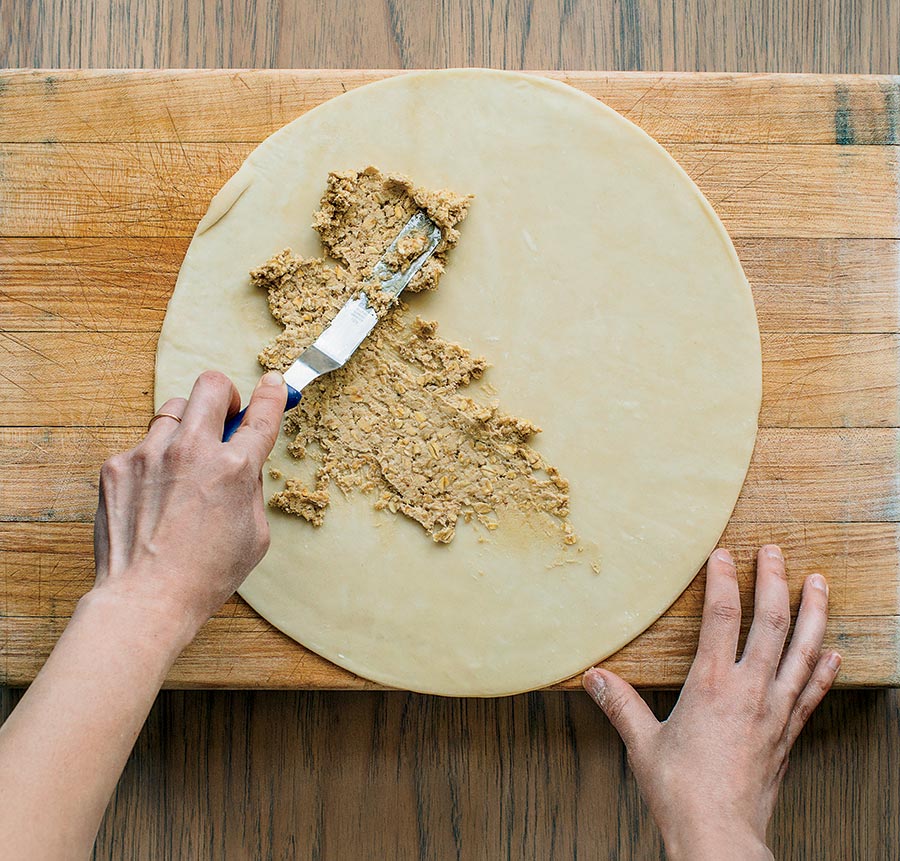
Heat the oven to 350 degrees. Make the frangipane: Mix butter, granulated sugar, one egg, and oat flour by hand or in the bowl of a stand mixer until fully combined. Place pie crust on a parchment-lined baking tray and spread the frangipane on top, leaving a 1-inch border.
Toss the apples again to coat in juice and mound them on the frangipane. Fold the edges of the crust to contain the apples, crimping where edges overlap. Beat remaining egg and brush it onto the crust, then sprinkle it with coarse sugar. Bake until the apples have settled, the filling bubbles, and the crust is golden brown, 50 to 60 minutes.
At the beginning of the pandemic, I became mildly obsessed with a video of Limp Bizkitplaying a Moscow venue in February 2020. I wasn’t drawn to the performance so much as to the sight of front man Fred Durst, who’d been an emblem of white male millennials’ bottomless teenage angst at the turn of the century–like a nu-metal Santa Claus, he wore a gray-and-white beard radiating from his chin. Nothing else has quite crystallized for me how much time has passed since Limp Bizkit could compete with blockbuster boy bands and sell albums by the millions. As Durst barked lyrics about the indescribable anger specific to youth, he looked like an authority figure out to ruin a teenager’s day–except that he was wearing what appeared to be an oversize blue-jean jumpsuit. From a distance it looked a little like pajamas, which did more than Limp Bizkit’s most infantile outbursts to underline the unintentional goofiness running through their rap-rock.
When it comes time to explain pop-music phenomena to future generations, Limp Bizkit provide one of the more confounding challenges. Among the late-90s nu-metal acts to emerge following the pioneering work of KoRn, Limp Bizkit weren’t the most novel (Deftones), the most charismatic (Incubus), or the most worldly (System of a Down). They haven’t left nearly the imprint on pop culture as Linkin Park, and their guttural grooves may be the only popular product of that era that sounds dumber than Kid Rock. But wasn’t that part of the point? Limp Bizkit’s focus on polishing up lowest-common-denominator aggro rock gave them their own lane, where few others did so well–and that, I suppose, is something. When the Jacksonville group issued their breakthrough (and “best”) album, 1999’s Significant Other, most mainstream “alternative rock” was about as daring as white bread, and their sludgy mix of funk, metal, and hip-hop could at least make parents blush. At their height, Limp Bizkit savvily retooled their grimy sound into something catchy that could commingle with lighter radio rock, and Durst relentlessly exploited pop music’s tolerance of puerile lyrics: never forget that in their first big single (“Nookie”), he rhymes the title with “cookie.” (It works . . . for Limp Bizkit.) Their omnipresence now far behind them, Limp Bizkit have followed an odd path over the past decade, yielding one forgettable album (2011’s Gold Cobra), a brief flirtation with Cash Money Records (which begat a Lil Wayne collaboration, 2013’s “Ready to Go”), and rumors of a forthcoming sixth album, Stampede of the Disco Elephants. Given the inevitable fan attrition over the years, Limp Bizkit’s apparently robust legacy is baffling, as is their prominent spot on the Lollapalooza lineup–and that’s perhaps the nicest thing I can say about a group led by a famous Florida man known for his red baseball cap. v
The NBA offseason — if you can call it that — is here. The Milwaukee Bucks officially flipped the league calendar to summer on Tuesday night, capturing their first title in 50 years and turning out the lights on a season that navigated its way through a pandemic to crown a new champion.
There isn’t much of a break, of course.
The NBA Draft, with the Pistons holding the No. 1 pick and presumably the chance to choose Oklahoma State’s Cade Cunningham, is fast-approaching on July 29. Free agency starts in less than two weeks, on Aug. 2. Most new contracts can be signed starting Aug. 6, and summer league opens two days after that.
“We made it. We crowned a champion,” NBA Commissioner Adam Silver said during the trophy ceremony in Milwaukee on Tuesday night. “I have to say playing through a pandemic required enormous resilience from all 30 teams. Thank you to every team and every player in the league for a tremendous season.”
And now, it’s already next season.
The good news is there’s a sense of normalcy, even amid a pandemic, and the NBA plans to continue along that path. Training camps will begin in late September, as is the new normal. Preseason games are back in early October, and the league’s 76th season — even though it’ll be celebrating its 75th anniversary all year long — starts Oct. 19.
That’s not even three months away.
The pandemic was the storyline of the entire season — obviously, since it has been the storyline across the entire planet — and no one in the NBA expects that next season will be able to start without the continued threat of COVID-19. Protocols will remain in place; how many and how strict will depend on the virus and what’s happening in the world in a few months.
“I think the players have a better understanding of sort of what we’re up against in trying to run this business and I think we have a better understanding of the players and what it’s like to travel the amount they do and to the stresses they’re under, the emotional and physical burdens they’re under by competing at this level,” Silver said at the start of the finals. “And hopefully we can continue to build on that.”
Some issues to watch over the coming days and weeks:
INJURIES
Players missing time with injuries was a major issue this season and the offseason already has seen more news on that front.
Kawhi Leonard of the Los Angeles Clippers just had surgery to repair a partially torn ACL; injuries to that ligament, unfortunately, aren’t rare in basketball, but partial tears are not exactly common. The Clippers haven’t said how long they think he’ll be sidelined. ACL reconstruction tends to cost players several months, and that means the start of Leonard’s season is in obvious doubt.
FREE AGENCY
Chris Paul helped Phoenix get to the NBA Finals and now has a decision to make about his $44 million option for next season. He could opt-in and stay, or opt-out — and quite possibly still stay, if he and the Suns work out a new deal.
There will be plenty of seasoned veterans on the market, including Kyle Lowry and Mike Conley. Leonard could be a free agent as well, if so inclined.
An interesting situation to watch will be Victor Oladipo, most recently of Miami and someone who would like to remain with the Heat. He’s coming off another leg surgery and may not be ready to start next season, which could certainly affect his number of suitors — and how much they will be willing to offer him.
THE DRAFT
Detroit picks first, followed by Houston, Cleveland and Toronto. Orlando has two picks in the top eight and Oklahoma City has three picks in the first 18 — the start of the massive haul of draft capital that the Thunder have acquired in recent years.
NEW COACHES
At minimum, seven teams will open next season with new coaches — Washington, New Orleans, Dallas, Indiana, Orlando, Boston and Portland.
Assistant coaches have been hired in some places and the staff shuffling will continue in many NBA cities over the next few weeks. The draft, free agency and summer league will provide the first hints on how the teams with new coaches will change their respective franchise’s approach this coming season.
THE RAPTORS
The NBA still hasn’t said if the Toronto Raptors can truly be the Toronto Raptors again.
The inability for teams to cross the U.S.-Canada border during the pandemic meant the Raptors couldn’t get in or out of their home for games, so this season was spent with them displaced in Tampa, Florida. And while the Raptors spoke highly of Tampa, they don’t want to be back there.
There are good signs in that regard — among them, the Toronto Blue Jays will be playing their home games in Canada again starting July 30 — but there has been no official announcement yet from the league that NBA teams will be able to cross the border this fall.
The Cubs have forged a $100 million partnership with DraftKings that could pave the way for Wrigley Field to house the first stadium sportsbook in Major League Baseball. But, it can’t happen unless the City Council lifts the ban on sports betting in Chicago.
Now, an influential alderman wants to do just that.
At Wednesday’s City Council meeting, Ald. Walter Burnett (27th), whose burgeoning Near West Side ward includes the United Center, introduced an ordinance that would lift Chicago’s home-rule ban on sports betting and establish parameters for the city to issue those licenses and make money from it.
Under the plan, sports betting would be authorized either at Wrigley Field, Guaranteed Rate Field, Soldier Field, the United Center and Wintrust Arena or in a “permanent building or structure located within a five-block radius” of those stadiums.
Sports wagering would also be authorized inside inter-track wagering facilities and inside a Chicago casino, which has been authorized by the Illinois General Assembly but is years away from being built.
No more than 15 kiosks or wagering windows would be allowed at each location unless bettors can also purchase food and drink.
No one under age 21 would be allowed to place a bet. Sports wagering would be prohibited from midnight to 10 a.m., Monday through Thursday; midnight Friday to 9 a.m. Saturday; and 1 a.m. to 9 a.m. on Saturday and Sunday.
The city would issue two types of sports wagering licenses: “primary” and “secondary.” Primary sports licenses would start at $50,000 a year and cost $25,000 for annual renewal. Secondary sports licenses would start at $10,000, with an annual renewal fee of $5,000.
Burnett openly acknowledged his ordinance is likely to trigger a heated debate over the pros and cons of sports betting and the danger that sanctioning sports wagering might somehow encourage Chicagoans who can least afford it to blow their paychecks.
But Burnett said the cold, hard reality is that sports betting has already been legalized by the state.
“Wrigley and the United Center — they’ve both been talking about setting up a spot for it. So this ordinance needs to be passed in order for that to happen. We’ll see where the Council wants to go with it,” said Burnett, chairman of the City Council’s Committee on Pedestrian and Traffic Safety.
“In my community, it’ll bring more people to the United Center. They may spend more money. It helps with the sales tax and also the amusement that these guys pay. So there is some upside. … There’s more benefits for the state, but there’s some auxiliary benefits for the city.”
What about the downside?
“The only downside would be that folks who do it anyway may get addicted to it,” he said.
“But, I can take you to every office in this [City Hall] building. Everybody’s doing squares, pools and all kind of other things in regards to sports [betting]. … And a lot of people are doing sports betting on their telephones,” Burnett said.
“That’s a conversation we can have once we get it introduced. I’m just bringing it to the table so we can all talk about it.”
The
Fans gather in April 2019 at Gallagher Way, the plaza along the west side of Wrigley Field. The Cubs and DraftKings have said they may add a sportsbook betting operation and restaurant complex to an existing building or constructing an entirely new facility near Wrigley. But they need the Chicago City Council to make sportsbooks legal in the city.Getty Images
Construction of a new building or renovation of an existing building would require a change to the planned development that paved the way for the Cubs to renovate Wrigley and develop the land around it. So would sports betting of any kind, since gambling is outlawed in Chicago.
Ald. Tom Tunney (44th), whose ward includes Wrigley, has acknowledged sports betting is a “reality across the country” and, more recently, in Illinois and that, “in one way, shape or form, it’s coming to major league sports and to all of the stadiums.”
Mayor Lori Lightfoot has said she will also insist on “tight restrictions” on sports betting.
“We’re not gonna turn our neighborhoods into the Las Vegas strip,” the mayor has said.
Cubs spokesman Julian Green has said the partners hope to build an addition to the $1 billion Wrigley campus that could be a year-round attraction unto itself, Green said.
“DraftKings says this would be their largest sportsbook in the country … with a food and beverage option and betting. In the winter months, you have Super Bowl. You have March Madness. Having a facility where groups may want to come in and watch the Super Bowl or March Madness — that’s something we could accommodate. We have always had a goal to continue to develop Gallagher Way and have year-round activity around the ballpark,” Green has said.
“Where? We don’t know yet. That would be discussed with the city. … We have a tower where our front office is located. There’s also the space that was part of the planned development over near Sheffield and Addison. The DraftKings club used to be over there… Now we don’t have anything over there on that mini-triangle parcel. We could look at options at the office tower or there.”
Legal sports betting was introduced in Illinois as part of a massive gambling bill signed into law by Gov. J.B. Pritzker two years ago. All 10 of the state’s casinos have launched sportsbooks, as have two racetracks. As it stands, Chicago bettors have to drive to one of those physical locations outside the city to place a wager or register for a mobile betting application.
Large arenas like Wrigley and Soldier Field, with capacities exceeding 17,000, can apply with the Illinois Gaming Board to open books, but none has so far.
Meanwhile, thousands of Chicagoans already place bets on their phones with mobile sports gambling operators — legal or otherwise. Bettors across Illinois have wagered more than $4.6 billion on sports since the first legal bet was placed in March 2020. Black market wagers are still thought to be close to that figure, too.
The Tokyo Olympics open Friday, when the world’s athletes will march behind their flag-bearers. And when they do, the peanut gallery on what they’re wearing will be open, too.
Olympic gear makes for lively social media fodder, starting with the hours-long Parade of Nations. The year-long wait due to the pandemic has given enthusiasts extra time to ponder what they love or hate.
There’s the Czech Republic and its traditional indigo block-print design with matching fans, already the butt of some jokes. It follows the country’s loud umbrellas and neon-blue Wellington boots of 2012 in London, along with its “Beetlejuice” stripes in Rio in 2016.
Israel’s athletes have see-through nylon jackets with huge pockets, while Emporio Armani decked out Italy’s team in track suits with a reinterpretation of Japan’s rising sun in the colors of the Italian flag: red, green and white. Liberia received the gift of designer Telfar Clemens, the buzzy Liberian American who makes sought-after bags and created their kits for the first time.
Things used to be a lot simpler for the athletes, fashion wise. In the beginning, there was no parade, or opening ceremony for that matter. Athletes wore whatever they chose, often walking with the equipment of their sports.
“In the early days it was no big deal,” said David Wallechinksy, executive board member and past president of the International Society of Olympic Historians. “People would just come on. If a team wanted to dress alike they did.”
Wallechinksy unearthed an image in an archival film showing the 1924 British curlers walking in the Winter Games parade in Chamonix, France, their brooms held high.
In the beginning, clothes were optional altogether, during competition anyway, according to scholars. Athletes often performed in the nude in Ancient Greece. In more modern times, parade uniforms often pay homage to a host country, in addition to traditions, athletic feats and patriotic flourishes.
This year, the pandemic has brought on another element: masks.
Australia has on offer for athletes a sand-colored blazer lined with the names of the country’s 320 Olympic gold medalists. For the closing ceremony, Canada’s Olympic organizers teamed with Levi’s to produce a denim “Canadian tuxedo” jacket alive with Japanese street-style graffiti to be worn with white denim pants.
Team Canada will wear this denim jacket during the closing ceremony of the Tokyo Olympics.Hudson’s Bay via AP
“This is the gang that comes after you if you say you tried watching ‘Schitt’s Creek’ but couldn’t get into it,” New York Times culture writer Dave Itzkoff tweeted of the look in April, several months after the jacket was unveiled with Team Canada’s other gear.
Alison Brown, host of the Olympic fans podcast “Keep the Flame Alive,” said outfitting Olympic teams, including those competing in the Paralympics, isn’t easy.
“They have to fit all kinds of body types. Think tiny gymnasts, brawny weightlifters and lanky basketball players. They have to convey something about the nation, honor the host, be serious enough for the solemnity of the occasion but practical enough to be comfortable for hours of standing in the heat,” she said.
Count Brown among the fans of the Czech uniforms, done by Zuzana Osako in Prague. They include the team’s mainstay, a gymnast, built into the design. Men will be in blue vests with white pants and women in blue blouses and white skirts.
“They managed to blend elements of Czech folk tradition, traditional Japanese indigo dying techniques, and a call out to the great Czech gymnast Vera Caslavska, but still keep the outfit wearable and comfortable for the heat,” Brown said.
Of Canada’s denim jackets, she said: “I think I wore something similar in 1987. I wonder if anyone over 12 really wants to wear it.”
Lucia Kinghorn, vice president of design at Hudson’s Bay, which helped created Canada’s uniforms and other Olympic gear, is aware of the scorn.
“For as many naysayers, we have even more fans,” she said. “We’re proud of the thoughtful design behind Team Canada’s clothing and happy that so many people are talking about it.”
Brown was similarly unimpressed by the looks for Team USA. They include blue denim pants for the opening parade and white denim pants for the closing ceremony.
“The U.S. has stayed with the same designer, Ralph Lauren, as it has for years, leading to another yachting look. Yawn,” she said. “Also, it’s expected to be very hot in Tokyo. Jeans, a knit top, scarf and a blazer? Who wants to wear denim in that kind of heat and humidity?”
The denim is lightweight in a stretchy fabric.
Japan’s uniforms harken back to those worn by the Japanese team at the opening ceremony of the last Olympics to be held in Tokyo, in 1964. Back then, jackets were red and trousers were white. The colors are switched this year.
“It’s in line with the many call-backs organizers are including to 1964,” Brown said.
Her favorite parade look so far is Mexico’s. The Mexico Olympic Committee held a national vote online to choose the opening ceremony looks from three designs created by High Life. The winning design honors Oaxaca in a single, brightly colored lapel.
“The blazer includes one floral lapel in traditional Zapotec embroidery. So beautiful without being costumey,” Brown said.
This image provided by High Life Mexico shows the opening ceremony outfits for team Mexico. High Life Mexico via AP
The embroidery was done by Oaxacan artisans, making each lapel among the 150 blazers a different custom design, said Jeannette Haber, marketing director of High Life. The artisans, she said, were “happy to be part of the project, and that their designs and their work could have this worldwide exposure.”
Whole collections for sale to consumers are built around what Olympic athletes wear during opening ceremonies.
“It’s a great moment for these brands to show their team spirit and their innovation in new technologies,” said Ted Stafford, fashion director of Men’s Health magazine and market director for Esquire.
That includes a cooling unit Ralph Lauren built into a white denim jacket for the Team USA flag-bearer.
“It’s the world stage and it sets the tone,” Stafford said. “It’s more than just a big fashion show.”
TOKYO — The Tokyo Olympics should not be judged by the tally of COVID-19 cases that arise because eliminating risk is impossible, the head of the World Health Organization told sports officials Wednesday as events began in Japan.
How infections are handled is what matters most, WHO director general Tedros Adhanom Ghebreyesus said in a speech to an International Olympic Committee meeting.
“The mark of success is making sure that any cases are identified, isolated, traced and cared for as quickly as possible and onward transmission is interrupted,” he said.
The number of Games-linked COVID-19 cases in Japan this month was 79 on Wednesday, with more international athletes testing positive at home and unable to travel.
“The mark of success in the coming fortnight is not zero cases,” Tedros said, noting the athletes who already tested positive in Japan, including at the athletes village in Tokyo Bay, where most of the 11,000 competitors will stay.
Teammates classed as close contacts of infected athletes can continue training and preparing for events under a regime of isolation and extra monitoring.
Health experts in Japan have warned of the Olympics becoming a “super-spreader” event bringing tens of thousands of athletes, officials and workers during a local state of emergency.
“There is no zero risk in life,” said Tedros, who began his keynote speech minutes after the first softball game began in Fukushima, and added Japan was “giving courage to the whole world.”
The WHO leader also had a more critical message and a challenge for leaders of richer countries about sharing vaccines more fairly in the world.
“The pandemic is a test and the world is failing,” Tedros said, predicting more than 100,000 deaths from COVID-19 worldwide before the Olympic flame goes out in Tokyo on Aug. 8.
It was a “horrifying injustice,” he said, that 75% of the vaccine shots delivered globally so far were in only 10 countries.
Tedros warned anyone who believed the pandemic was over because it was under control in their part of the world lived in “a fool’s paradise.”
The world needs to produce 11 billion doses next year and the WHO wanted governments to help reach a target of vaccinating 70% of people in every country by the middle of next year.
“The pandemic will end when the world chooses to end it,” Tedros said. “It is in our hands.”
He’s on the board of trustees at Duke, his alma mater where he played for Mike Krzyzewski. He’s an investor, broadcaster, public speaker, member of the Basketball Hall of Fame, co-owner and vice chairman of the Atlanta Hawks, and a member of the board of directors at the NCAA.
He says no to plenty of things. And then USA Basketball came calling.
That call led to Hill adding one more job to his portfolio. When the Tokyo Olympics end, he will replace Jerry Colangelo and become managing director of USA Basketball’s men’s national team — a most challenging task that he’ll begin with the Americans just a few months away from resuming qualifying for the 2023 Basketball World Cup and with an eye already on the 2024 Paris Olympics.
“Another opportunity to represent your country, to serve your country in this capacity, that was the reason for me,” Hill said. “I think also understanding how important, how significant the Olympic experience was for me back in 1996 and wanting to help recreate for young men who are coming through the NBA and want to be a part of this. It’s almost a calling in a lot of ways.”
Hill will not be in Tokyo for the Olympics, the first one where the U.S. will play under Gregg Popovich after Krzyzewski’s three-Olympics, three-gold-medals run ended. Hill’s absence is only because of logistical challenges; the rules don’t allow for unlimited personnel with a team, even in non-pandemic times, so Hill’s in-person involvement with the team picked for the Tokyo Games was limited to its training camp in Las Vegas.
He spent time whenever he could with Colangelo, picking his brain on whatever came to mind, even squeezing in chats on the team bench just a few minutes before exhibition games.
“I couldn’t be more thrilled to have him be that person,” Colangelo said. “When Coach K and I put things together back in ’05, ’06, we talked about building infrastructure that would carry on after we’re gone. And I believe that’s really what’s transpired.”
It’s not like Hill needed to see what the Olympics are like. He has a gold medal, helping the U.S. win one at the 1996 Atlanta Games.
His mission now: Take the torch from Colangelo and win more, many more.
“Grant has been around us over the years and our training camps, because of relationships with myself, with of course Coach K, his coach in college,” Colangelo said. “He’s very aware. There’s been a lot of conversation. There’ll be plenty more conversation. And it’s not rocket science. It really isn’t. It’s all about relationships, and he’s very good at relationships so I feel very confident in passing this on to Grant Hill.”
Colangelo assumed the managing director role in 2005, after the Americans lost three games in the 2004 Athens Olympics and finished with an extremely disappointing bronze medal. His job since has been to oversee the selection of players and coaches for the senior national team — and he has a chance to end his run with four Olympic golds in four tries.
“No question, these are big shoes to fill,” Hill said. “Jerry has been incredible. His vision, strategic thinking, his will to make this successful. He commands a room with his presence. I’ve seen others who’ve been legends in the game just have such reverence for him, and rightfully so. I mean, I’ve sat with him and just talked about his career. I’m amazed at many things I didn’t know about his various contributions to the game of basketball.”
No matter whether the Americans win or lose in Tokyo, Hill will have to move quickly.
Qualifying for the World Cup will resume in November, almost certainly with G League players. There will be coaching decisions to make, NBA players to start recruiting for the next World Cup, a plan to be hatched on whether to try to have one core group for both the 2023 tournament and the Paris Games.
He’s eager. He believes he’s ready, too.
“I had an incredible run as an athlete,” Hill said. “And now, to still work and serve this particular game in a number of roles, including this, it’s consistent and it’s aligned with what I feel about the game of basketball. It’s an incredible leadership opportunity, an incredible challenge, but it really stems from a love of the game and wanting to continue to work in it and serve it and make it better for those who come after us.”


:no_upscale()/cdn.vox-cdn.com/uploads/chorus_asset/file/19587055/Wrigley_plaza_2019.jpg)
:no_upscale()/cdn.vox-cdn.com/uploads/chorus_asset/file/22731121/AP21202484429652.jpg)
:no_upscale()/cdn.vox-cdn.com/uploads/chorus_asset/file/22731135/AP21201012373349.jpg)