
Videos

Over 1,000 victims, 126 dead, just 2 convictions: 6 years of mass shootings in ChicagoTom Schubaon August 2, 2021 at 10:30 am

Just before dusk on a muggy night in late June, an SUV crept toward a crowd waiting outside a fast food joint on an otherwise quiet commercial strip in South Shore.

A hail of gunfire followed, striking six people before the shooter was whisked away in the passing vehicle.

“They knew who they were looking for,” remarked one person at the scene in the 2000 block of East 71st Street, where fresh blood spatters painted the sidewalk.

While police say the shooters were targeting members of a rival gang, 23-year-old Kristina Grimes — a bystander apparently caught in the fray — was the only one killed, her body riddled with six bullets.

Chicago police work the scene where at least 6 people were shot in the 2000 block of East 71st Street in the South Shore neighborhood, Sunday, June 27, 2021.
Tyler LaRiviere/Sun-Times

About two hours after the shots rang out, an alarming dispatch pierced through police radio: Another mass shooting had just rocked the Marquette Park neighborhood, roughly six miles away.

Three alleged gang members had sprayed bullets at a crowd hanging out in the 6200 block of South Artesian Avenue, enjoying the summer night. Twelve people were hit, among them Nyoka Bowie, 37, who suffered a fatal gunshot wound to her chest. Like Grimes and many other victims of mass shootings — defined by the Sun-Times and some researchers as incidents in which four or more people are wounded — she apparently was not the intended target.

In both cases, there was a large number of witnesses and surviving victims, yet no arrests have been made. That is all too common in Chicago, where police say they do not prioritize the cases despite the especially harsh toll such shootings have on a community.

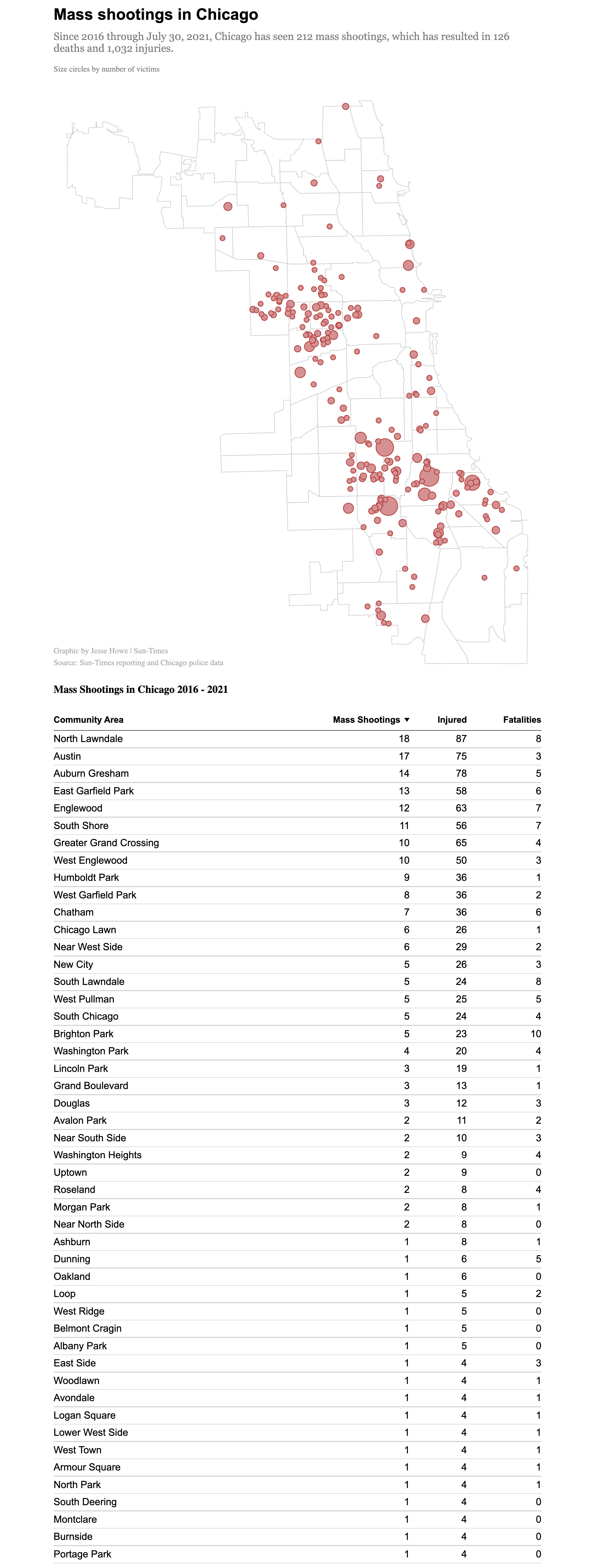
Only one person has been charged in any of the at least 39 mass shootings so far this year, according to a Sun-Times analysis of city data and court records.

That amounts to charges in just 2% of this year’s mass shootings — far below the police department’s dismal 13% clearance rate for shootings overall, which is the lowest of any big city in the nation.

Going back to 2016, the alleged shooters have been charged in just 21 of at least 212 mass shooting incidents — or less than 10% of the cases, the Sun-Times analysis found.

Just two men have been convicted in those attacks, which through Friday night have wounded 1,032 people, 126 of them fatally, records show. Two of the other 21 people who have been charged were ultimately found not guilty, while another suspected shooter had his case dropped, records show.

Year Shootings Wounded Fatalities Charging Info
2016 37 163 21 2 charged in shootings (cases ongoing), 1 charged in connection (pled guilty)
2017 29 135 28 7 charged in shootings (1 case dropped, 2 pled guilty, 4 ongoing)
2018 29 139 16 5 charged in shootings (2 not guilty, 3 ongoing), 1 charged in connection (pled guilty)
2019 30 148 12 3 charged in shootings (all ongoing), 6 charged in connection, including 1 charged separately in a shooting (1 pled guilty, 2 dropped, 3 ongoing)
2020 48 233 25 5 charged in shootings (all ongoing), 4 charged in connection (1 stricken, 3 ongoing)
2021 39 214 24 1 charged in shootings (ongoing), 1 charged in connection (ongoing)
All 212 1032 126 23 charged in shootings (1 dropped, 2 pled guilty, 2 not guilty, 18 ongoing), 13 charged in connection (1 stricken, 2 dropped, 3 pled guilty, 7 ongoing)

Source: Sun-Times analysis of city data and court records

The lack of charges this year is all the more ominous because the number of mass shootings far outpaces each of the last five years, according to the Sun-Times analysis.

This year’s toll through the end of July already surpasses the total number of mass shootings recorded each year between 2016 and 2019, records show. In each of the last two years there were five attacks in which more than 10 people were shot, including a pair of shootings that each wounded 15 people.

The lack of justice in the cases leaves the most reckless shooters out on the streets — and gives neighborhood residents all the more reason to look over their shoulder as many emerge from pandemic lockdowns.

“Go to the parks on the South and West sides on a beautiful day, and you’ll see it. There’s hardly anyone there,” said Steve Gates, a social worker who works in the Roseland and West Pullman neighborhoods for Chicago Beyond. “These are our public spaces, where we should gather. But people have to feel safe.”

A month after Bowie was killed, her friend Sameka Scaife said she doubts the police will ever find the gunmen responsible. “It’s like waiting for something that you know will never come,” Scaife said.

“It’s just gone cold. I don’t even think they’re looking,” she said of the investigation. “I believe the police know which gang is responsible for the shooting and that’s all. I trust the intel, but I don’t trust they’ll follow up and find out who did it.”
image

The daughter of a retired Chicago cop, Scaife said she’s lost all trust in the criminal justice system. Disillusioned by the lack of charges in Bowie’s killings, she has now abandoned her plans to follow in her father’s footsteps and pursue a career in law enforcement.

“I don’t see anything changing with the city of Chicago,” said Scaife, who left her hometown years ago due to the pervasive crime. “It’s almost like the police are stepping back and letting everybody kill each other. It breaks my heart so much.”

Nyoka Bowie was killed June 27 in a mass shooting in Marquette Park that left five others wounded.

Police: Mass shootings not prioritized over other cases

Chicago’s total number of mass shootings in the past five years is more than double that of the next closest city, according to the Gun Violence Archive, a nonprofit research group that catalogs shootings in the United States.

But the mass shootings here rarely resemble the typically more planned attacks that prompt national media attention, outrage and calls for gun control, like the Columbine High School massacre in Colorado or the Pulse nightclub shooting in Florida. Instead, Chicago’s mass shootings are usually sporadic street crimes that center around large outdoor gatherings, making the summer months particularly dangerous.

In an interview, Chief of Detectives Brendan Deenihan said many of the mass shootings in Chicago appear to stem from disputes or arguments, though he acknowledged some are clearly gang-related. Despite the increasing number of mass-victim events, Deenihan said they aren’t prioritized over other shootings.

“The detectives who are assigned to a mass shooting, and then if they’re assigned a shooting later on that week, they’re doing the same thing in order to solve that incident,” he said. “There aren’t any other different tools.”

He acknowledged, however, that investigating a mass shooting requires an “extraordinary” amount of time and more resources than other shootings. Detectives have to interview far more people, both victims and witnesses, and forensic technicians are needed to process sprawling crime scenes, often littered with dozens of bullets.

“It is a lot more work, but I just kind of defer to the detectives and the forensic guys and the beat guys who are out there,” he said. “Everybody is working as hard as they possibly can.”

Police reports obtained by the Sun-Times, though, reflect what appears to show different levels of police response and community cooperation in the incidents.

In a shooting at 4 a.m. June 6 that wounded eight in the 8900 block of South Cottage Grove, the narrative consisted of a handful of sentences with virtually no details.

“All victims related to r/o’s [responding officers] they heard gun fire and then felt pain. Not offender information was given to r/o’s by victims. Unknown witnesses related to r/o’s that they observed two male 1s shooting towards the crowd then fleeing in a silver sedan towards an unknown direction,” the report states.

Nine officers’ names are listed on the report.

Can’t see this police report? Click here.

In Chatham, multiple police officers were already on the scene helping disperse a large crowd when the shooting started on 75th Street in the early hours of June 12, said Marlon Mitchell, owner of Frances’ Lounge, a popular bar just a door down from where the shootings took place.

Footage from the bar’s surveillance camera — which Mitchell turned over to police — shows officers dispersing a crowd of hundreds, issuing tickets and towing illegally parked cars. The camera also shows the two gunmen pulling on masks in an alley east of the bar before bursting into the crowd. Police reports show that cops had a fairly detailed description of the shooters’ clothes, the make and model of the vehicle they drove off in and the direction in which they fled.

Police told community members they have suspects in the shooting, which killed a mother of three and injured nine others, but so far have announced no arrests.

“I don’t know what else they could do,” said Mitchell, who estimated dozens of officers eventually arrived at the scene. “Police were already here when [the shooters] popped out.”

Can’t see this police report? Click here.

Crimes hard to solve, experts say

Experts agree urban mass shootings like the ones that take place in Chicago are among the hardest cases to solve.

Clearance rates have been falling across the country since the 1980s. And Mark Bryant, executive director of the Gun Violence Archive, noted that most mass shootings in other cities also go unsolved.

Tom Scott, a social scientist who has studied clearance rates and investigative practices across the U.S., said shootings where no one is killed — even when multiple people are wounded — tend to get less attention from police because murders are the most closely tracked crime statistic by the media and politicians. (In more than 60% of the 212 mass shootings recorded in Chicago since 2016, no one was killed.)

Mass shootings, he added, tend to lack “solvability factors,” including cooperative witnesses.

“Agencies … prioritize cases they are most likely to solve,” Scott said.

Yet law enforcement tends to respond to spiking violence by adding beat cops instead of detectives.

More robust investigations where officers make concerted efforts to find and interview witnesses can help foster the community trust needed to get more cooperation, Scott and other experts believe.

The Chicago Police Department’s efforts to crack cases have long been hampered by its strained relationship with the communities ravaged by gun violence, areas that have been over-policed and are predominantly Black and Hispanic. In those areas, fear of gangs and distrust of police has created an atmosphere that discourages cooperation, or snitching, striking fear in residents who may otherwise help investigators.

Chicago Police Supt. David Brown (right) and Police Bureau of Detectives Chief Brendan Deenihan appear at a press conference at Chicago Police Department headquarters on June 22, 2020.
Chicago Police Supt. David Brown (right) and Chief of Detectives Brendan Deenihan say a lack of cooperation from witnesses and even victims has hampered police efforts to solve the shootings.
Anthony Vazquez/Sun-Times

Deenihan, the chief of detectives, also noted the lack of cooperation from the “intended targets” of the shootings. Supt. David Brown asserted the culture of silence effectively perpetuates a cycle of violence and emboldens those carrying it out.

“People are not cooperating who are victims, which signals to us, ‘We want revenge, and we don’t want police solving this case because we want revenge, we want to retaliate,'” Brown said during a news conference on July 22, a day after three mass shootings within a four-hour span left two teens dead and at least 17 others wounded.

“That signals to us, when you don’t cooperate, when you are silent, that you prefer street justice,” Brown added. “Street justice is never-ending. The appetite for revenge is never satisfied. It only harms. It only ruins your community.”

Mass shootings traumatize residents of entire neighborhoods who either witness them, are victims or are related to the victims, said Sonya Dinizulu, a psychiatrist at the University of Chicago School of Medicine who has studied trauma.

“People say that communities ‘get used to’ this level of violence, that these shootings don’t faze them after a while,” Dinizulu said. “That is simply not the case, and we do not say that about sexual assault, or about car crashes or all other sorts of trauma.

“But the body remembers. People still have a physiological response, they have post-traumatic stress, and it is very difficult to heal that when the trauma repeats and repeats.”

Indeed, it fosters feelings of hopelessness and depression in young people, which lends itself to the kind of recklessness that might lead to firing into a group of people, heedless of innocents among them, Dinizulu said. That same hopelessness weighs on those who don’t become violent, and entire communities fray when residents are too wary to attend large gatherings or even be outside, she said.

“It’s a cycle. A very destructive and dangerous cycle,” she said. “We focus so much on healing. I think it’s surprising, encouraging, that people are focused on healing. But we know the drivers of violent crime — poverty, disinvestment, lack of educational opportunity — and we have to focus and invest in those as well.”

Police are recovering an increasing number of high-powered firearms, like this weapon police says was found after a report of shots fired in late May on the Southwest Side.
Chicago police

More guns — and more powerful guns — recovered

Experts agree with police officials that another factor is more directly driving the spike in mass shootings: More guns — and more firearms that are high-powered — have flooded the streets.

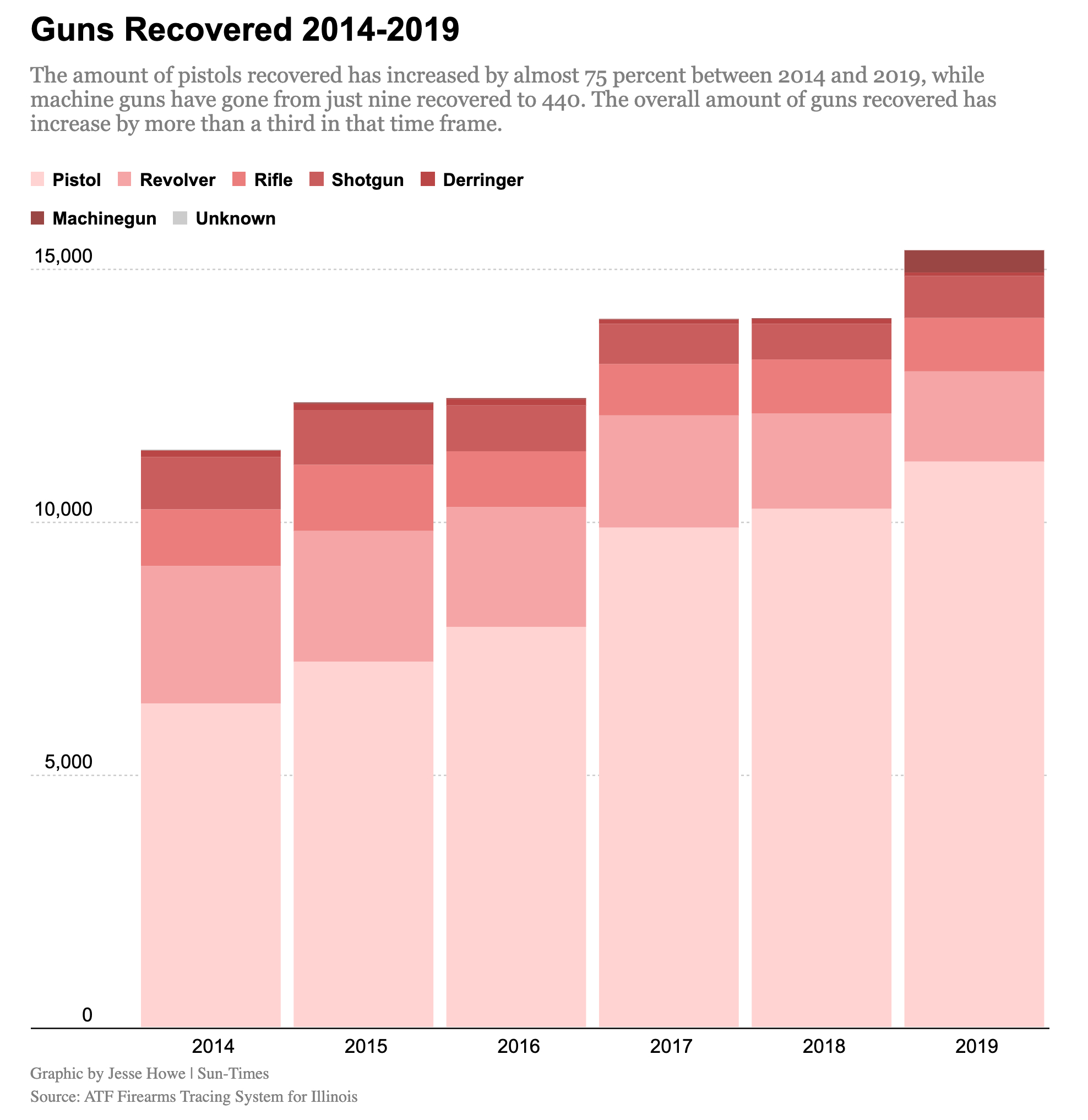
Chicago police have recovered at least 7,289 total guns this year, up from 5,668 at the same point last year. The number of recovered assault weapons has climbed more dramatically over that same period, from 227 to 368.

Statewide, the number of guns recovered steadily rose from 11,568 in 2014 to 15,486 in 2019, the last year of publicly available data compiled by the U.S. Bureau of Alcohol, Tobacco, Firearms and Explosives. More than half were pulled off the streets of Chicago.
CodePen – Weapons recovered Chart

image

Among all those weapons, the number of high-powered, rapid-firing rifles has skyrocketed. There were an average of 18 “machine guns” recovered each year between 2014 and 2018. That number spiked to 440 in 2019 — and the following year the number of mass shootings jumped to 48.

Deenihan said shell casings from handguns have been found at every crime scene where a mass shooting took place, while rifles have been used in just under half of the crimes. In many cases, people in crowds have returned fire — leading to more victims, he said.

Cops investigating mass shootings are also finding extended magazines and switches, which can make semi-automatic pistols fully automatic.

“It’s remarkable firepower,” Deenihan said. “But it also is the fact that when you have that many people — 100, 150 people, 200 people out there — and somebody’s firing a gun, the likelihood of somebody catching one of those bullets goes up dramatically.”
CodePen – Caliber recovered Chart

image

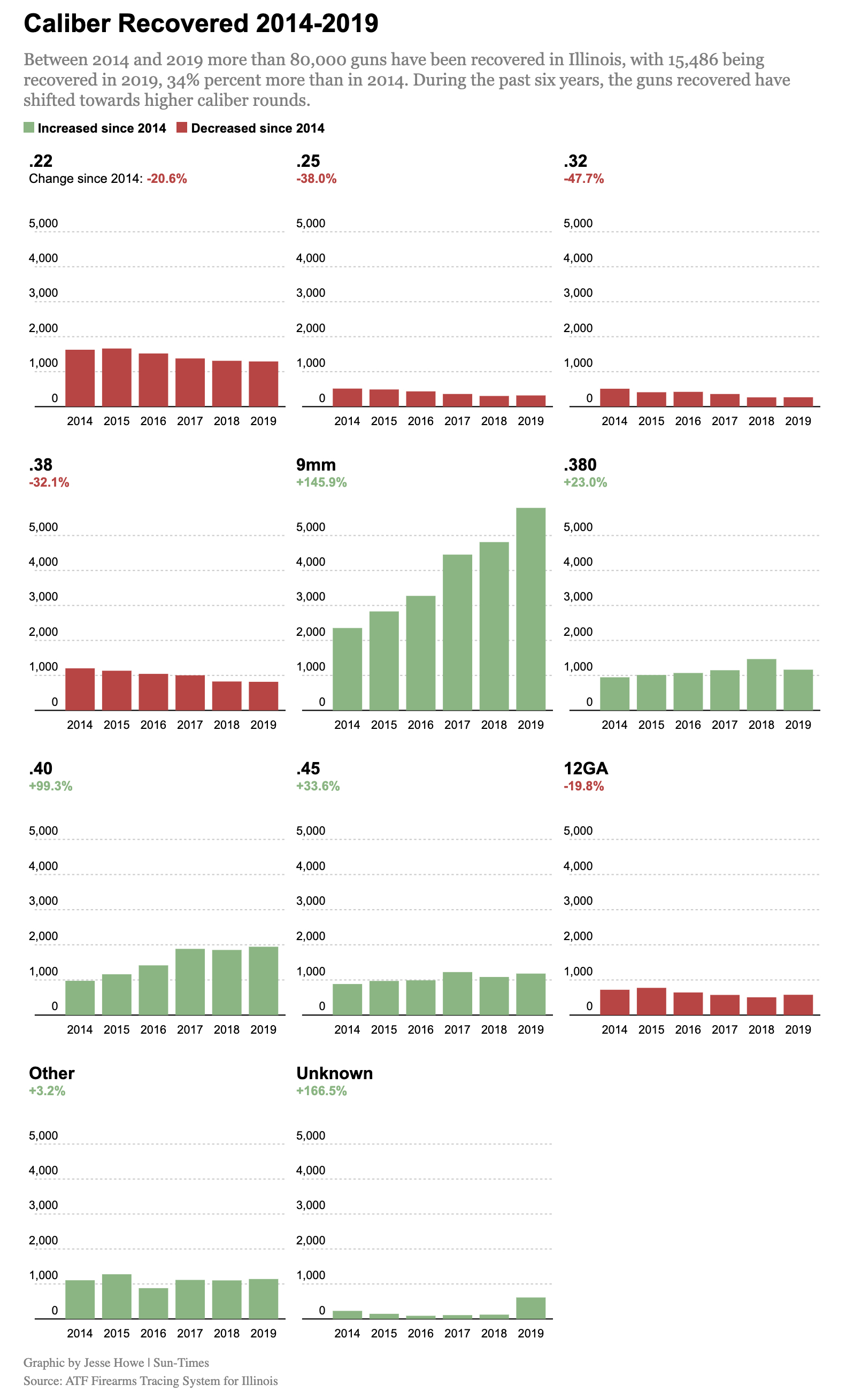
Roseanna Ander, executive director of the University of Chicago Crime Lab, specifically noted that more people in Chicago are toting semiautomatic weapons that can hold high-capacity magazines, raising “the likelihood that you’re going to have multiple victims and that the injuries are going to be more serious.”

Mayor Lori Lightfoot last month lauded a federal initiative aimed at disrupting interstate pipelines for firearms, and her administration has recently launched new efforts to combat the city’s gun problem.

She announced a $1 million reward fund last month for information leading to the seizure of illegal firearms. And since then, a new police team of roughly 50 officers was announced to target gun traffickers and people whose state firearm permits have been revoked.

Will tougher enforcement help?

When Kristina Grimes was slain in the mass shooting in South Shore earlier this summer, her mother Cynthia Carr felt like she had to do something to keep other innocent people from dying.

Grimes, once a standout high school swimmer who dreamed of making it to the Olympics, was apparently on her way to get something to eat when she was fatally shot. “No one knew her. She didn’t know them. She was totally caught off guard and just didn’t see it coming,” her mother said.

She and her husband, Grimes’ stepfather Michael Carr, now want elected officials to get behind measures like implementing stricter bail requirements for some offenders and embracing controversial stop-and-frisk policies. In recent weeks, the grieving mother has started reaching out to policymakers, including members of the Legislative Black Caucus and the state’s two U.S. senators.

Kristina Grimes (center) poses with her stepfather, Michael Carr, and mother, Cynthia Carr, during a family vacation four years ago.

“I don’t believe the political will exists to deal with the problem as is,” Michael Carr said. “And there’s going to have to be some tough solutions and acknowledgment about who’s committing the vast majority of these shootings. And just even saying that will bring howl and outrage among the activist groups.”

A West Side native, Michael Carr was raised near the notorious Rockwell Gardens housing project in East Garfield Park. Fed up with the violence, he left Chicago in his mid-20s, vowing never to return. He and his wife, also a Chicago native, now live in suburban Romeoville and fear for the safety of family members in the city.

While they’re critical of the city’s leadership and deeply concerned about its violent crime, the Carrs said they sympathize with detectives who they believe are inundated with cases.

“How is it humanly possible for a detective to investigate a crime if they have to keep shifting to another crime?” Cynthia Carr asked.

As for the two cases where police made arrests that led to convictions, both took place in 2017 and wounded five people.

Dejuan Moore, now 23, was charged in an attack in South Austin that June. And Kriston Gordon, 29, was charged in a shooting at a West Rogers Park bar early on New Year’s Eve, records show.

They were both hit with multiple charges, including counts of attempted murder, but each pleaded guilty to aggravated battery. Moore was given 10 years in prison, while Gordon got six — relatively light sentences for such brazen shootings.

But enforcing stricter punishments likely won’t do much to decrease violence in the long run, said Linda Teplin, a Northwestern University psychiatrist who has studied urban violence. Mass shootings that take place in suburbs, like Columbine, draw massive attention and drive the national debate on gun laws, but the events themselves are less predictable and are often the acts of isolated, lone-wolf shooters with no criminal records.

But in Chicago and other cities, mass shooters fit a narrower profile: They’re mostly young black males involved in gangs who will have contact with the criminal justice system.

“The irony is, urban violence is more preventable, but we don’t invest the funds,” Teplin said. “What is needed is economic investment, jobs, access to educational opportunities, therapy. We know what needs to be done, but we won’t invest the funds.”

Contributing: Jesse Howe, Andy Boyle, Madeline Kenney, Sophie Sherry

Read More

Over 1,000 victims, 126 dead, just 2 convictions: 6 years of mass shootings in ChicagoTom Schubaon August 2, 2021 at 10:30 am Read More »

Football or powerball? Sizing up a Bears move to Arlington HeightsDavid Roederon August 2, 2021 at 10:30 am

The Chicago Bears have again floated the idea of moving to Arlington Heights. The club has made an offer, competing with several others, for Arlington International Racecourse, a once premier venue whose business is withering and whose owner wants out.

We’ve seen this movie before with Chicago sports teams, including when the Bears in the 1970s talked about Arlington Heights and Mayor Richard J. Daley famously, but probably without basis, said they’d never call themselves the Chicago Bears if they followed through. The Cubs and White Sox also played suburban gambits, and they stayed put, too. Is that going to happen once more?

It’s very early in a process of negotiations, bluster and head fakes, but three questions come to mind.

Are the Bears serious?

The prudent answer is they are, until they aren’t. With Soldier Field needing improvements to keep up with the rest of the league, as the Sun-Times’ Mark Potash has explained, the Bears have incentives to consider a fresh start at the racetrack property.

The site covers 326 acres, slightly more than Six Flags Great America, and it’s in the middle of a wealthy suburban market where the team has a substantial fan base. It could provide all the necessary parking, and there’s even a Metra stop.

Industry consultant Marc Ganis, president of Sportscorp, said based on conversations he’s had with the NFL, he believes the Bears are in earnest. Ganis, who said he has no role in this matter, said the Bears don’t need to purchase such a vast parcel. They could participate as tenants or as part of a group that the seller, Churchill Downs, puts together to develop the property.

Can the Bears anchor a large commercial development?

In considering so roomy a site, the Bears and the NFL may have in mind other recent stadium deals. Some have suggested a suburban baseball stadium built for the Atlanta Braves and surrounded by development as a template. But there’s a flaw in the logic. Major-league baseball teams bring in paying customers 81 dates per year. The Bears play about 10 dates, maybe a couple more with playoffs — we can dream, can’t we?

Allen Sanderson, an economics professor at the University of Chicago who has researched sports stadiums, has a maxim: “There are two things you should never put on a valuable piece of property: a cemetery and a football stadium. They’re closed all the time.”

His view reflects a consensus among economists that sports teams aren’t worth subsidizing because they don’t mean much to a local economy. It has to do with discretionary spending. The amount spent for tickets and concessions supports local jobs, but it otherwise would be spent at stores, restaurants, theaters, you name it.

Michael Leeds, an economics professor at Temple University, researched Chicago’s big five franchises — Bears, Bulls, Blackhawks, White Sox, Cubs — and in 2015 told public radio station KPCC they could all leave town and cost the economy less than 1%.

Sanderson said he believes the Cubs are the only team here with a measurable fiscal impact because they draw attendance from outside the Chicago area. He has another maxim: When stadium promoters estimate their economic benefits, move their decimal point one place to the left to get a truer picture.

A large commercial development in Arlington Heights will need more than the Bears as a trigger. “Something broader will work there whether or not the Bears are part of it,” Ganis said.

Arlington Heights officials have laid down basic rules for what gets built. The village in June approved a zoning overlay district covering the racetrack that prohibits uses it deems undesirable, such as car washes, adult businesses or warehouses.

Charles Witherington-Perkins, the village’s planning director, said the town needed to close loopholes and discourage piecemeal development. A stadium is allowed. Ganis said high-end retail could work there, even in the Amazon era. “Think of it as Oak Brook plus football,” he said.

Do the Bears have leverage?

Politically, yes, but it’s more than outweighed by money. A Chicago mayor doesn’t want to wear the jersey for a team move. Maybe a governor neither. But there are reasons the Bears sit with a generous lease on publicly owned land that can tap a go-to revenue source, hotel taxes, for upgrades. The Illinois Sports Facilities Authority is still using the hotel tax to pay off debt from the 2003 Soldier Field renovation.

A hotel tax wouldn’t amount to much in Arlington Heights. Witherington-Perkins said the village has not authorized a tax increment financing district for the racetrack, a common way to cover infrastructure improvements.

The cost of recent NFL stadiums has started at about $1 billion and spun far higher.

Look for the Bears to stay in Soldier Field and work out the expensive details of refurbishment. The city can open with this negotiating ploy: You get a retractable roof if you start beating Green Bay.

Read More

Football or powerball? Sizing up a Bears move to Arlington HeightsDavid Roederon August 2, 2021 at 10:30 am Read More »

Horoscope for Monday, August 2, 2021Georgia Nicolson August 2, 2021 at 5:01 am

Moon Alert

Avoid shopping or making important decisions from 2:30 to 4 a.m. Chicago time. After that, the moon moves from Taurus into Gemini.

Aries (March 21-April 19)

Something might hamper your social plans. Or perhaps, your responsibilities with children will increase for some reason. In fact, anything to do with the arts, sports and the entertainment world might make greater demands on your life. It’s just for today.

Taurus (April 20-May 20)

Your involvement with a parent might be more important or there might be increased responsibilities regarding taking care of a parent? Perhaps some kind of issue will arise at home in which you feel limited or held back because of certain restrictions. Work with what you’ve got.

Gemini (May 21-June 20)

Plans for a short trip or your involvement with daily contacts including siblings, relatives and neighbors might be hampered by something. Something might restrict you. Someone might tell you why you can’t do something. Hey, don’t let this get you down.

Cancer (June 21-July 22)

Financial matters might be a concern. Your access to finances might be restricted. You might be disappointed in your fair share of something or you might find it difficult to deal with banks, financial institutions or partners. Bide your time.

Leo (July 23-Aug. 22)

You might feel cut off from those who are closest to you. Don’t let this drag you down. Don’t be discouraged because many people feel a bit “removed” from others because the sun is opposite Saturn. (This does not promote cozy relations with anyone!)

Virgo (Aug. 23-Sept. 22)

Don’t be discouraged if you feel cut off from others or even lonely today. This isn’t an illusion but it is certainly a temporary dark cloud on your horizon. Many people feel this way today. It will be gone by tomorrow. Therefore, go with the flow.

Libra (Sept. 23-Oct. 22)

You might be disappointed when relating to groups, clubs and organizations today because something might thwart your attempts to deal with others or push through your ideas. This same minor difficulty might arise in a friendship? It’s temporary — no worries.

Scorpio (Oct. 23-Nov. 21)

This is a poor day to ask the boss or a parent for permission or approval for anything because very likely, their response will be, “Talk to the hand.” Knowing this, table your request for another day. Meanwhile, keep your head down and your powder dry.

Sagittarius (Nov. 22-Dec. 21)

Today you might encounter rules and regulations, which limit your plans or your activities. (This sort of goes with the territory of just being alive.) Go with the flow and don’t make a fuss. Don’t be discouraged. Tomorrow is another day. And a more promising one!

Capricorn (Dec. 22-Jan. 19)

Financial matters might discourage you today. You might especially be disappointed when dealing with partners or others regarding taxes, debt, inheritances and insurance issues. Red-tape limitations, rules and regulations might get in the way. Relax — this is temporary.

Aquarius (Jan. 20-Feb. 18)

Don’t be disappointed if you feel your relations with a close friend or a partner are a bit distant today. Conversations might feel like two ships passing in the night. This influence affects everyone and it is mildly limiting and possibly discouraging. But hey, it is brief!

Pisces (Feb. 19-March 20)

Something to do with your health, your job or even your pet might cause you concerns today. You might have to make an extra effort to get the results you want. Or perhaps you cannot do something because you are limited or you are restricted by some situation. Patience is your best ally.

If Your Birthday Is Today

Actress Mary-Louise Parker (1964) shares your birthday. You are witty and entertaining, which is why people enjoy your company. Personally, you value your independence and have strong opinions. Because of your excellent verbal skills, you are very convincing! This year is more lighthearted and sociable. You might explore pleasing changes to your appearance or your routine or where you live. Others might seek your advice this year.

Read More

Horoscope for Monday, August 2, 2021Georgia Nicolson August 2, 2021 at 5:01 am Read More »

Two wounded — including alleged shooter — following fight on Northwest SideMohammad Samraon August 2, 2021 at 5:10 am

Two people — including the offender — were shot and wounded following a fight in Cragin on the Northwest Side.

Around 9:40 p.m., a man, 35, and the alleged offender were both shot after struggling over a gun the offender possessed, Chicago police said.

The male offender fired one round that exited through the man’s arm and struck the alleged shooter in the jaw, police said.

The man was taken to Illinois Masonic Medical Center where his condition was stabilized, police said.

The offender was taken into custody and transported to Illinois Masonic where he was listed in critical condition, police said.

A weapon was recovered a the scene. Area Five detectives are investigating.

Read more on crime, and track the city’s homicides.

Read More

Two wounded — including alleged shooter — following fight on Northwest SideMohammad Samraon August 2, 2021 at 5:10 am Read More »

Boeing’s Starliner is Ready for Liftoff: How to Watch the OFT-2 Launchon August 2, 2021 at 4:57 am

Cosmic Chicago

Boeing’s Starliner is Ready for Liftoff: How to Watch the OFT-2 Launch

Read More

Boeing’s Starliner is Ready for Liftoff: How to Watch the OFT-2 Launchon August 2, 2021 at 4:57 am Read More »

With 10 men, Fire hold on for draw against UnionSun-Times wireson August 2, 2021 at 4:46 am

CHESTER, Pa. — Przemyslaw Frankowski scored in the 10th minute, but the Philadelphia Union netted the equalizer on a free kick and the Fire, with 10 men for more than 60 minutes, hung on a for a 1-1 draw Sunday.

“I’m proud of what they have done because it’s not easy, the situation where we are, where last week the results didn’t come and then you’re coming here and you’re winning 1-0,” Fire coach Raphael Wicky said. “And then you go down a man and immediately concede the draw, the 1-1, so great reaction, and that’s something I think everyone showed a lot of character.”

Kai Wagner tied it in the 36th minute after the Fire’s Wyatt Omsberg received a red card for contact with Cory Burke. Alejandro Bedoya had made a leading pass to Burke, who was battling Omsberg. When the two came together, Burke was sent into Fire goalkeeper Bobby Shuttleworth, leaving all three worse for wear atop the box.

After a video review, the referee ruled that Omsberg’s foul was worthy of a red card, and the Fire lost him for the rest of game. On the free kick, the Fire (3-9-4) set up a wall, with Fabian Herbers lying behind it. But Wagner whizzed the ball under the jumping Fire players as Herbers rolled away to tie the game.

“I have seen it once. Look, I cannot say much,” Wicky said on the red card issued to Omsberg. “I mean, look, we have VAR. If they review it on VAR with slow motion, with a lot of people, and they think it’s a red card, we need to trust them that it’s a red card.”

The Union (6-4-7) put the pressure on in the second half, which included more than 10 minutes of stoppage time. But the Fire held them off to earn their first road point of the season.

Shuttleworth made four saves, including an excellent diving stop on Jose Martinez’s shot in the 79th minute and a close-range save on Bedoya’s chance in the third minute of second-half stoppage time.

Read More

With 10 men, Fire hold on for draw against UnionSun-Times wireson August 2, 2021 at 4:46 am Read More »

‘The Chi’ Season 4 finale recap: Mayor Douda skips town and communication heals marriages — sort ofEvan F. Mooreon August 2, 2021 at 2:00 am

SPOILER ALERT: This recap of Season 4 finale contains explicit plot details.

Let’s get right to the two questions fans may have had after watching “The Chi’s” episode nine cliffhanger: Did Marcus (Joel Steingold) survive his attack by Mayor Douda? Yes. Did Jake, played by Michael Epps, tell Jemma (Judae’a Brown) what he saw? Yes.

In the aftermath of helping Marcus — and covering his tracks — Trig (Luke James) is aided by Shaad, played by Jason Weaver, whom he was on the outs with.

Marcus’ security system — we last saw in the season four premiere when he watched Kevin as he left Jemma’s room — appears to have rid Chicago of Mayor Douda (Curtiss Cook). Trig tells Douda he has the footage of him attacking Marcus, and tells him to leave the city.

As Douda appears to run, his wife, Roselyn (played by Kandi Burress), seems to be the interim mayor — for now.

As for the rest of the cast:

  • Nina (Tyla Abercrumbie) and Dre (Miriam A. Hyman) got their house order — and welcomed a young girl with a troubled home life, whom Kevin (Alex Hibbert) has taken an interest in.
  • Kiesha (Birgundi Baker) makes her relationship with Christian (Freedom Martin) official.
  • Tracy, played by Tai Davis, overhears Trig’s ultimatum to Douda, and breaks things off with him.
  • While playing cards, Trig and Shaad have a heart-to-heart in which Shaad finds out a friend who owed him money died. He opens up to Trig in a heartbreaking way.
  • Tiff, played by Hannaha Hall, realizes that Dante (Cory Hardrict) isn’t boyfriend material enough to leave Emmett.
  • Emmett, played by Jacob Latimore, and Tiff decide on staying married, promising each other to “do their best” when it comes to their marriage.
  • In a later scene, she’s seen kissing her business partner, played by basketball player Iman Shumpert.
  • Jada (Yolonda Ross) seems to be on the road to recovery, and thanks everyone in her corner during a surprise party Emmett organizes for her.
  • Shaad apologizes to Imani, played by Jasmine Davis. He later defends her — and describes her as family — after an altercation.

The season four finale is named “A Raisin in the Sun” after the 1959 play — and possibly the 1961 film starring Sidney Poitier, Ruby Dee, and Louis Gossett Jr. — written by South Side native Lorraine Hansberry, the first Black woman to have her work performed on Broadway.

Nina, played by Tyla Abercrumbie (left) and Dre (Miriam A. Hyman), agree to work on their marriage.
Showtime

Storylines to think about for season 5 — assuming there is one:

  • What’s next for Douda?
  • How soon will Emmett find out about Tiff?
  • Will Papa continue to try to win back Maisha (Genesis Denise Hale)?
  • What are Roselyn’s plans for the city since it seems she’s taking over for Douda?
  • What’s next for Community Protection?
  • The state of the Williams household dynamic.

Read More

‘The Chi’ Season 4 finale recap: Mayor Douda skips town and communication heals marriages — sort ofEvan F. Mooreon August 2, 2021 at 2:00 am Read More »

Wrigley Field Hot Dogs: A Conspiracy Theoryon August 2, 2021 at 1:04 am

Hot Dog Diaries

Wrigley Field Hot Dogs: A Conspiracy Theory

©2021 CTMG – A Chicago Tribune website –
Crafted by the News Apps team

Read More

Wrigley Field Hot Dogs: A Conspiracy Theoryon August 2, 2021 at 1:04 am Read More »

Surviving the Metra Lollapalooza COVID Expresson August 2, 2021 at 1:48 am

One Cause At A Time

Surviving the Metra Lollapalooza COVID Express

Read More

Surviving the Metra Lollapalooza COVID Expresson August 2, 2021 at 1:48 am Read More »

Crosstown Showdown: White Sox ready to steal every headline that isn’t bolted downSteve Greenbergon August 1, 2021 at 10:14 pm

Sunday afternoon kind of said it all, didn’t it?

At Nationals Park in Washington, Yadiel Hernandez homered off reliever Manuel Rodriguez in the ninth inning to beat the Cubs 6-5 and end a series filled with little-known baseball players doing little-viewed and even-less-talked-about baseball things.

Meanwhile, at Guaranteed Rate Field, the White Sox were throwing their Craig Kimbrel-Liam Hendriks late-inning one-two punch at the Indians, enabling Brian Goodwin to stride to the plate in the bottom of the ninth and put a ball over the wall for a 2-1 walk-off. Tense, urgent, exciting — every pitch. Goodwin’s Andersonesque bat flip seemed to be for himself, for his team and for everyone who has that 2005 feeling all over again.

One team: all but forgotten.

The other: Ready to steal every headline that isn’t bolted down.

So what’ll it look like later this week at Wrigley Field when the Sox and Cubs finally meet head-to-head for the first time this season?

Will it be a total Sox takeover in the stands? One imagines a raucous family reunion spilling into the solemn space of an outdoor funeral.

How sad and empty will all the Cubs fans clad in Kris Bryant, Anthony Rizzo and Javy Baez jerseys feel? Wait, we don’t need to guess at that one — the answer is very much so.

One team: The party is over.

The other: The party is just getting started.

Here’s what’s happening:

Netherlands v United States: Women's Football Quarterfinal - Olympics: Day 7
Megan Rapinoe and Alyssa Naeher celebrate a win against the Netherlands.
Photo by Laurence Griffiths/Getty Images

MON 2

Olympic women’s soccer: U.S. vs. Canada (3 a.m., USA, 7 p.m., Ch. 5)

Canada — which won bronze at the 2012 and 2016 Games — is desperate to knock off No. 1 in this semifinal and still has Christine Sinclair, who has scored more international goals than any woman or man in the sport’s history.

Olympic men’s basketball: U.S. vs. Spain (11:40 p.m., Peacock)

The top two teams in the world rankings meet again in a knockout quarterfinal, which reminds us: Do the Gasol brothers just not realize how old they’ve gotten?

TUE 3

Royals at White Sox (7:10 p.m., NBCSCH)

A second straight start against the Royals? Dylan Cease will take it. Then again, who wouldn’t?

WED 4

Olympic track & field (5 a.m., Peacock, 7 p.m., Ch. 5)

Finals include the 200, 800 and triple jump on the men’s side. What do those triple jumpers have that we don’t, anyway?

New York City at Fire (7 p.m., Ch. 9)

Fifteen games in, NYC had the best goals differential — plus-14 — in the league. The Fire? Hey, let’s not get bogged down in the details.

THU 5

Cubs at Rockies (2:10 p.m., Marquee)

Jake Arrieta is 5-10 with a 6.20 ERA and zero quality starts in his last 11 outings. Other than that, the man is locked in.

Pittsburgh Steelers Training Camp
The Steelers have a potentially great one in Harris.
Photo by Justin K. Aller/Getty Images

Hall of Fame Game: Cowboys vs. Steelers (7 p.m., Fox-32)

Football arrives, folks. Hallelujah, God bless America and just wait until the Yinzers get a load of rookie running back Najee Harris.

Olympic women’s soccer: gold-medal game (9 p.m., USA)

Don’t forget, the mighty Americans failed to medal in 2016 in Rio.

FRI

Olympic track & field (5 a.m., Peacock, 7 p.m., Ch. 5)

Finals include the men’s and women’s 4×100 relays — and a real chance for the Japanese men, who took silver in this event in Rio, to become national heroes.

White Sox at Cubs (1:20 p.m., Marquee, NBCSCH)

Anticlimactic? Not for the Sox and their gung-ho fans, who have no tears to give for the Cubs.

Olympic men’s basketball: gold-medal game (9:30 p.m., Ch. 5, Peacock)

Will a bunch of NBA dudes take the ball, overwhelm a vastly inferior foe and win gold for the fourth Olympics in a row? Gosh, we make it sound so easy.

SAT 31

Olympic men’s soccer: gold-medal game (6:30 a.m., NBCSN)

It’s the Mexico-Brazil winner against the Japan-Spain winner. Your snooty, scarf-clad neighbor and his fellow soccer snobs would love to see Brazil-Spain, but Mexico-Japan would be so much cooler.

Cincinnati Reds v New York Mets
Baez is blending in beautifully with his new team.
Photo by Jim McIsaac/Getty Images

Mets at Phillies (3:05 p.m., FS1)

Don’t miss a chance to check out the Mets’ Javy Baez, who, according to our inside sources, has a chance to be a pretty dang decent second baseman someday.

Olympic women’s basketball: gold-medal game (9:30 p.m., Ch. 5)

A seventh straight gold for the U.S. women? It should be automatic, but that’s easy for us to say.

SUN 2

Olympic closing ceremony (6 a.m., Peacock, 7 p.m., Ch. 5)

Let’s just get to the finish line already so Tokyo — and all of Japan — can finally focus on its massive COVID-19 challenges in earnest. Not that we’re not up to our elbows in problems in this country.

Orlando at Red Stars (5 p.m., Paramount+)

Post-Olympics, the Red Stars will aim to play themselves off the postseason bubble and into the thick of the championship hunt.

White Sox at Cubs (6:08 p.m., Ch. 7)

You know what? These fan bases actually have more in common than meets the eye. For example, neither side of town can wait for the regular season to be over.

Read More

Crosstown Showdown: White Sox ready to steal every headline that isn’t bolted downSteve Greenbergon August 1, 2021 at 10:14 pm Read More »