
Videos

Over 1,000 victims, 126 dead, just 2 convictions: 6 years of mass shootings in ChicagoTom Schubaon August 2, 2021 at 9:04 pm

Just before dusk on a muggy night in late June, an SUV crept toward a crowd waiting outside a fast food joint on an otherwise quiet commercial strip in South Shore.

A hail of gunfire followed, striking six people before the shooter was whisked away in the passing vehicle.

“They knew who they were looking for,” remarked one person at the scene in the 2000 block of East 71st Street, where fresh blood spatters painted the sidewalk.

While police say the shooters were targeting members of a rival gang, 23-year-old Kristina Grimes — a bystander apparently caught in the fray — was the only one killed, her body riddled with six bullets.

Chicago police work the scene where at least 6 people were shot in the 2000 block of East 71st Street in the South Shore neighborhood, Sunday, June 27, 2021.
Tyler LaRiviere/Sun-Times

About two hours after the shots rang out, an alarming dispatch pierced through police radio: Another mass shooting had just rocked the Marquette Park neighborhood, roughly six miles away.

Three alleged gang members had sprayed bullets at a crowd hanging out in the 6200 block of South Artesian Avenue, enjoying the summer night. Twelve people were hit, among them Nyoka Bowie, 37, who suffered a fatal gunshot wound to her chest. Like Grimes and many other victims of mass shootings — defined by the Sun-Times and some researchers as incidents in which four or more people are wounded — she apparently was not the intended target.

In both cases, there was a large number of witnesses and surviving victims, yet no arrests have been made. That is all too common in Chicago, where police say they do not prioritize the cases despite the especially harsh toll such shootings have on a community.

Only one person has been charged in any of the at least 39 mass shootings so far this year, according to a Sun-Times analysis of city data and court records.

That amounts to charges in just 2% of this year’s mass shootings — far below the police department’s dismal 13% clearance rate for shootings overall, which is the lowest of any big city in the nation.

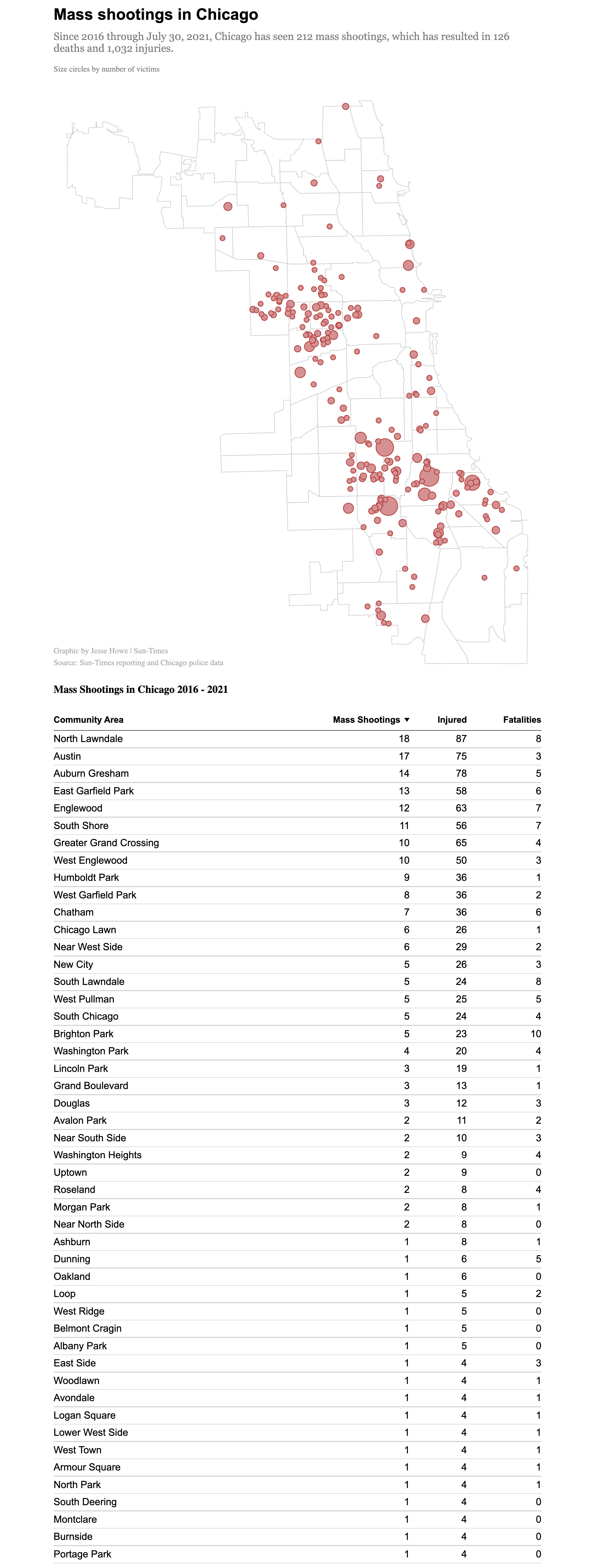
Going back to 2016, the alleged shooters have been charged in just 21 of at least 212 mass shooting incidents — or less than 10% of the cases, the Sun-Times analysis found.

Just two men have been convicted in those attacks, which through Friday night have wounded 1,032 people, 126 of them fatally, records show. Two of the other 21 people who have been charged were ultimately found not guilty, while another suspected shooter had his case dropped, records show.

Year Shootings Wounded Fatalities Charging Info
2016 37 163 21 2 charged in shootings (cases ongoing), 1 charged in connection (pled guilty)
2017 29 135 28 7 charged in shootings (1 case dropped, 2 pled guilty, 4 ongoing)
2018 29 139 16 5 charged in shootings (2 not guilty, 3 ongoing), 1 charged in connection (pled guilty)
2019 30 148 12 3 charged in shootings (all ongoing), 6 charged in connection, including 1 charged separately in a shooting (1 pled guilty, 2 dropped, 3 ongoing)
2020 48 233 25 5 charged in shootings (all ongoing), 4 charged in connection (1 stricken, 3 ongoing)
2021 39 214 24 1 charged in shootings (ongoing), 1 charged in connection (ongoing)
All 212 1032 126 23 charged in shootings (1 dropped, 2 pled guilty, 2 not guilty, 18 ongoing), 13 charged in connection (1 stricken, 2 dropped, 3 pled guilty, 7 ongoing)

Source: Sun-Times analysis of city data and court records

The lack of charges this year is all the more ominous because the number of mass shootings far outpaces each of the last five years, according to the Sun-Times analysis.

This year’s toll through the end of July already surpasses the total number of mass shootings recorded each year between 2016 and 2019, records show. In each of the last two years there were five attacks in which more than 10 people were shot, including a pair of shootings that each wounded 15 people.

The lack of justice in the cases leaves the most reckless shooters out on the streets — and gives neighborhood residents all the more reason to look over their shoulder as many emerge from pandemic lockdowns.

“Go to the parks on the South and West sides on a beautiful day, and you’ll see it. There’s hardly anyone there,” said Steve Gates, a social worker who works in the Roseland and West Pullman neighborhoods for Chicago Beyond. “These are our public spaces, where we should gather. But people have to feel safe.”

A month after Bowie was killed, her friend Sameka Scaife said she doubts the police will ever find the gunmen responsible. “It’s like waiting for something that you know will never come,” Scaife said.

“It’s just gone cold. I don’t even think they’re looking,” she said of the investigation. “I believe the police know which gang is responsible for the shooting and that’s all. I trust the intel, but I don’t trust they’ll follow up and find out who did it.”
image

The daughter of a retired Chicago cop, Scaife said she’s lost all trust in the criminal justice system. Disillusioned by the lack of charges in Bowie’s killings, she has now abandoned her plans to follow in her father’s footsteps and pursue a career in law enforcement.

“I don’t see anything changing with the city of Chicago,” said Scaife, who left her hometown years ago due to the pervasive crime. “It’s almost like the police are stepping back and letting everybody kill each other. It breaks my heart so much.”

Nyoka Bowie was killed June 27 in a mass shooting in Marquette Park that left five others wounded.

Police: Mass shootings not prioritized over other cases

Chicago’s total number of mass shootings in the past five years is more than double that of the next closest city, according to the Gun Violence Archive, a nonprofit research group that catalogs shootings in the United States.

But the mass shootings here rarely resemble the typically more planned attacks that prompt national media attention, outrage and calls for gun control, like the Columbine High School massacre in Colorado or the Pulse nightclub shooting in Florida. Instead, Chicago’s mass shootings are usually sporadic street crimes that center around large outdoor gatherings, making the summer months particularly dangerous.

In an interview, Chief of Detectives Brendan Deenihan said many of the mass shootings in Chicago appear to stem from disputes or arguments, though he acknowledged some are clearly gang-related. Despite the increasing number of mass-victim events, Deenihan said they aren’t prioritized over other shootings.

“The detectives who are assigned to a mass shooting, and then if they’re assigned a shooting later on that week, they’re doing the same thing in order to solve that incident,” he said. “There aren’t any other different tools.”

He acknowledged, however, that investigating a mass shooting requires an “extraordinary” amount of time and more resources than other shootings. Detectives have to interview far more people, both victims and witnesses, and forensic technicians are needed to process sprawling crime scenes, often littered with dozens of bullets.

“It is a lot more work, but I just kind of defer to the detectives and the forensic guys and the beat guys who are out there,” he said. “Everybody is working as hard as they possibly can.”

Police reports obtained by the Sun-Times, though, reflect what appears to show different levels of police response and community cooperation in the incidents.

In a shooting at 4 a.m. June 6 that wounded eight in the 8900 block of South Cottage Grove, the narrative consisted of a handful of sentences with virtually no details.

“All victims related to r/o’s [responding officers] they heard gun fire and then felt pain. Not offender information was given to r/o’s by victims. Unknown witnesses related to r/o’s that they observed two male 1s shooting towards the crowd then fleeing in a silver sedan towards an unknown direction,” the report states.

Nine officers’ names are listed on the report.

Can’t see this police report? Click here.

In Chatham, multiple police officers were already on the scene helping disperse a large crowd when the shooting started on 75th Street in the early hours of June 12, said Marlon Mitchell, owner of Frances’ Lounge, a popular bar just a door down from where the shootings took place.

Footage from the bar’s surveillance camera — which Mitchell turned over to police — shows officers dispersing a crowd of hundreds, issuing tickets and towing illegally parked cars. The camera also shows the two gunmen pulling on masks in an alley east of the bar before bursting into the crowd. Police reports show that cops had a fairly detailed description of the shooters’ clothes, the make and model of the vehicle they drove off in and the direction in which they fled.

Police told community members they have suspects in the shooting, which killed a mother of three and injured nine others, but so far have announced no arrests.

“I don’t know what else they could do,” said Mitchell, who estimated dozens of officers eventually arrived at the scene. “Police were already here when [the shooters] popped out.”

Can’t see this police report? Click here.

Crimes hard to solve, experts say

Experts agree urban mass shootings like the ones that take place in Chicago are among the hardest cases to solve.

Clearance rates have been falling across the country since the 1980s. And Mark Bryant, executive director of the Gun Violence Archive, noted that most mass shootings in other cities also go unsolved.

Tom Scott, a social scientist who has studied clearance rates and investigative practices across the U.S., said shootings where no one is killed — even when multiple people are wounded — tend to get less attention from police because murders are the most closely tracked crime statistic by the media and politicians. (In more than 60% of the 212 mass shootings recorded in Chicago since 2016, no one was killed.)

Mass shootings, he added, tend to lack “solvability factors,” including cooperative witnesses.

“Agencies … prioritize cases they are most likely to solve,” Scott said.

Yet law enforcement tends to respond to spiking violence by adding beat cops instead of detectives.

More robust investigations where officers make concerted efforts to find and interview witnesses can help foster the community trust needed to get more cooperation, Scott and other experts believe.

The Chicago Police Department’s efforts to crack cases have long been hampered by its strained relationship with the communities ravaged by gun violence, areas that have been over-policed and are predominantly Black and Hispanic. In those areas, fear of gangs and distrust of police has created an atmosphere that discourages cooperation, or snitching, striking fear in residents who may otherwise help investigators.

Chicago Police Supt. David Brown (right) and Police Bureau of Detectives Chief Brendan Deenihan appear at a press conference at Chicago Police Department headquarters on June 22, 2020.
Chicago Police Supt. David Brown (right) and Chief of Detectives Brendan Deenihan say a lack of cooperation from witnesses and even victims has hampered police efforts to solve the shootings.
Anthony Vazquez/Sun-Times

Deenihan, the chief of detectives, also noted the lack of cooperation from the “intended targets” of the shootings. Supt. David Brown asserted the culture of silence effectively perpetuates a cycle of violence and emboldens those carrying it out.

“People are not cooperating who are victims, which signals to us, ‘We want revenge, and we don’t want police solving this case because we want revenge, we want to retaliate,'” Brown said during a news conference on July 22, a day after three mass shootings within a four-hour span left two teens dead and at least 17 others wounded.

“That signals to us, when you don’t cooperate, when you are silent, that you prefer street justice,” Brown added. “Street justice is never-ending. The appetite for revenge is never satisfied. It only harms. It only ruins your community.”

Mass shootings traumatize residents of entire neighborhoods who either witness them, are victims or are related to the victims, said Sonya Dinizulu, a psychiatrist at the University of Chicago School of Medicine who has studied trauma.

“People say that communities ‘get used to’ this level of violence, that these shootings don’t faze them after a while,” Dinizulu said. “That is simply not the case, and we do not say that about sexual assault, or about car crashes or all other sorts of trauma.

“But the body remembers. People still have a physiological response, they have post-traumatic stress, and it is very difficult to heal that when the trauma repeats and repeats.”

Indeed, it fosters feelings of hopelessness and depression in young people, which lends itself to the kind of recklessness that might lead to firing into a group of people, heedless of innocents among them, Dinizulu said. That same hopelessness weighs on those who don’t become violent, and entire communities fray when residents are too wary to attend large gatherings or even be outside, she said.

“It’s a cycle. A very destructive and dangerous cycle,” she said. “We focus so much on healing. I think it’s surprising, encouraging, that people are focused on healing. But we know the drivers of violent crime — poverty, disinvestment, lack of educational opportunity — and we have to focus and invest in those as well.”

Police are recovering an increasing number of high-powered firearms, like this weapon police says was found after a report of shots fired in late May on the Southwest Side.
Chicago police

More guns — and more powerful guns — recovered

Experts agree with police officials that another factor is more directly driving the spike in mass shootings: More guns — and more firearms that are high-powered — have flooded the streets.

Chicago police have recovered at least 7,289 total guns this year, up from 5,668 at the same point last year. The number of recovered assault weapons has climbed more dramatically over that same period, from 227 to 368.

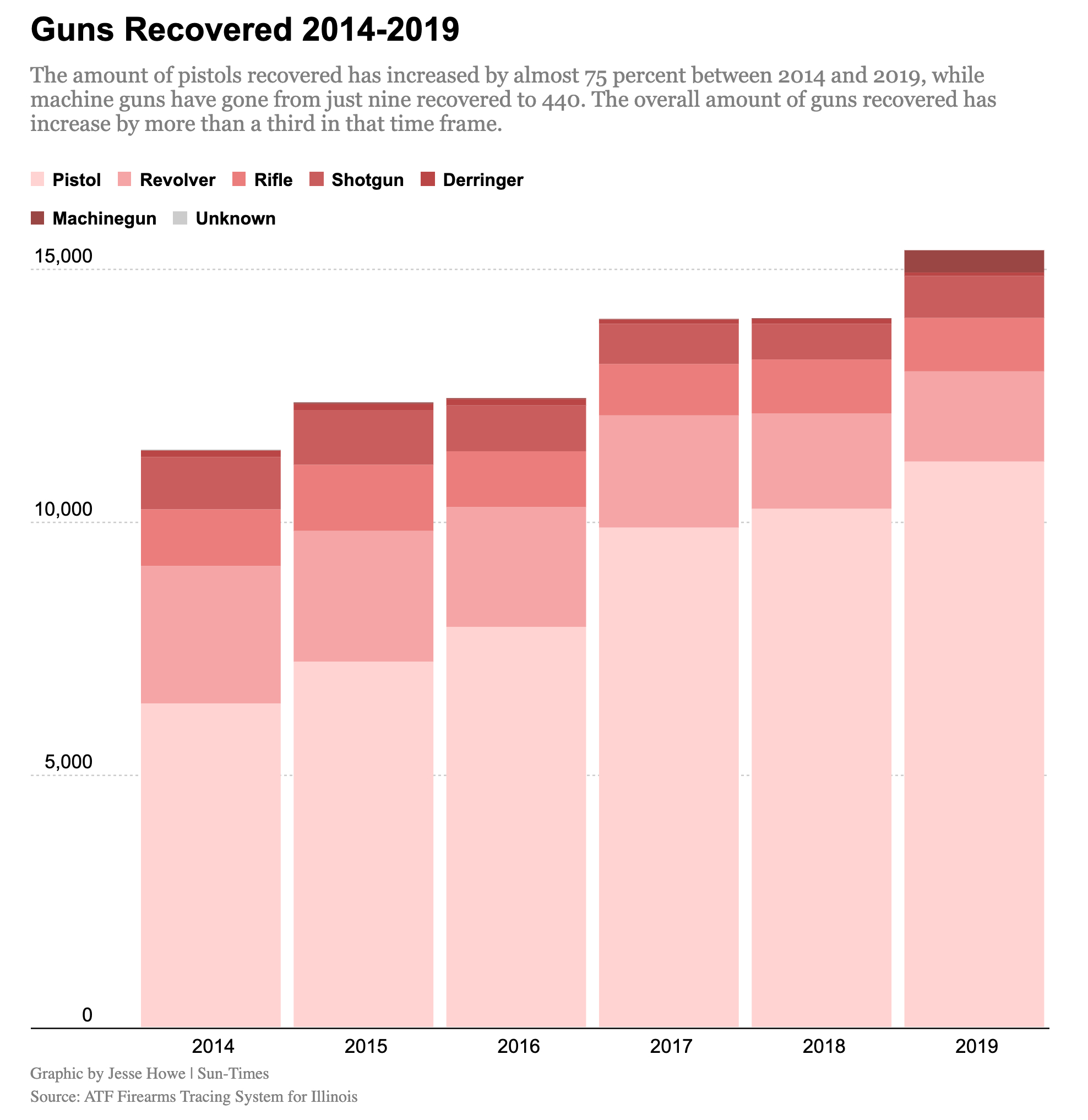
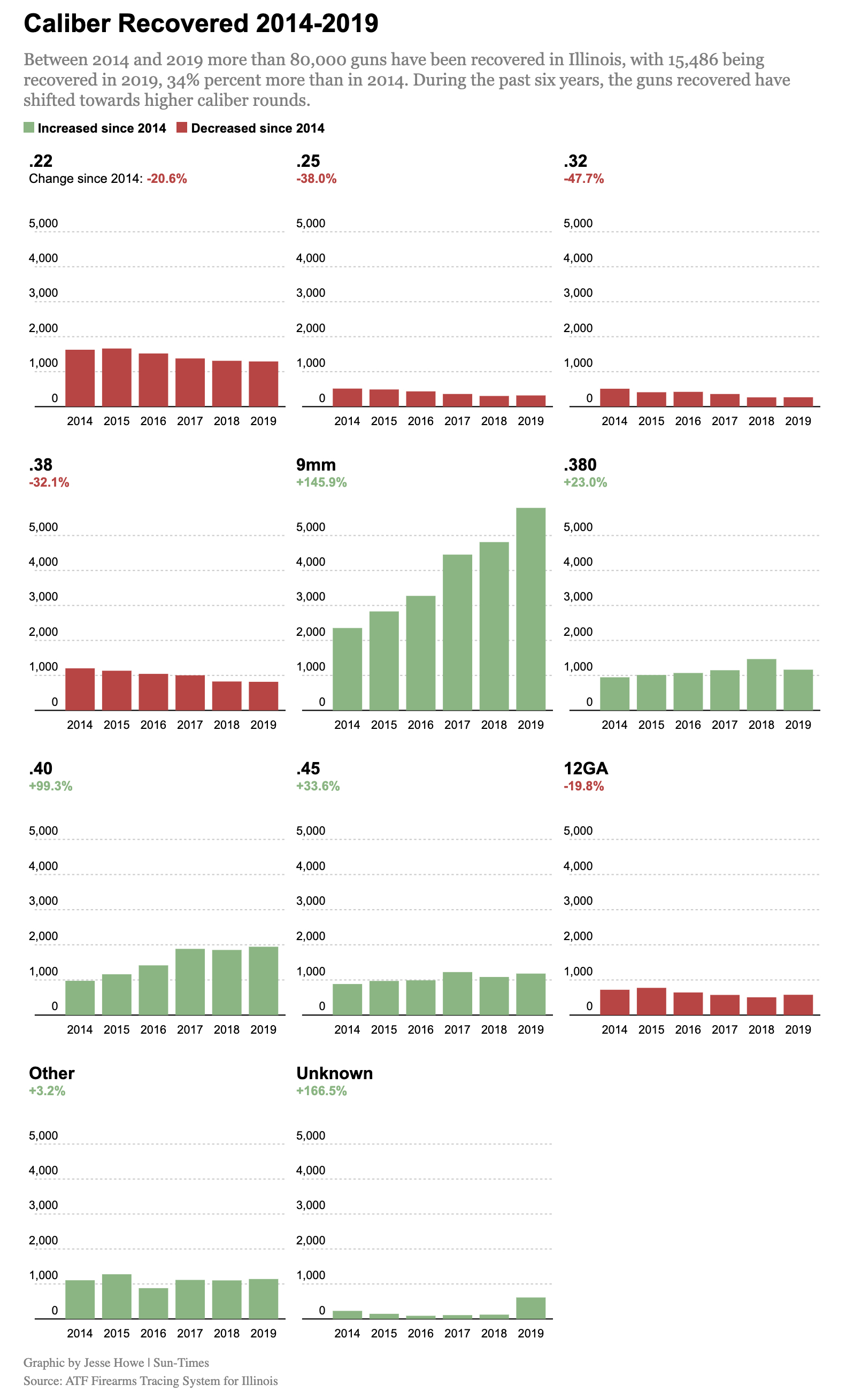
Statewide, the number of guns recovered steadily rose from 11,568 in 2014 to 15,486 in 2019, the last year of publicly available data compiled by the U.S. Bureau of Alcohol, Tobacco, Firearms and Explosives. More than half were pulled off the streets of Chicago.
CodePen – Weapons recovered Chart

image

Among all those weapons, the number of high-powered, rapid-firing rifles has skyrocketed. There were an average of 18 “machine guns” recovered each year between 2014 and 2018. That number spiked to 440 in 2019 — and the following year the number of mass shootings jumped to 48.

Deenihan said shell casings from handguns have been found at every crime scene where a mass shooting took place, while rifles have been used in just under half of the crimes. In many cases, people in crowds have returned fire — leading to more victims, he said.

Cops investigating mass shootings are also finding extended magazines and switches, which can make semi-automatic pistols fully automatic.

“It’s remarkable firepower,” Deenihan said. “But it also is the fact that when you have that many people — 100, 150 people, 200 people out there — and somebody’s firing a gun, the likelihood of somebody catching one of those bullets goes up dramatically.”
CodePen – Caliber recovered Chart

image

Roseanna Ander, executive director of the University of Chicago Crime Lab, specifically noted that more people in Chicago are toting semiautomatic weapons that can hold high-capacity magazines, raising “the likelihood that you’re going to have multiple victims and that the injuries are going to be more serious.”

Mayor Lori Lightfoot last month lauded a federal initiative aimed at disrupting interstate pipelines for firearms, and her administration has recently launched new efforts to combat the city’s gun problem.

She announced a $1 million reward fund last month for information leading to the seizure of illegal firearms. And since then, a new police team of roughly 50 officers was announced to target gun traffickers and people whose state firearm permits have been revoked.

Will tougher enforcement help?

When Kristina Grimes was slain in the mass shooting in South Shore earlier this summer, her mother Cynthia Carr felt like she had to do something to keep other innocent people from dying.

Grimes, once a standout high school swimmer who dreamed of making it to the Olympics, was apparently on her way to get something to eat when she was fatally shot. “No one knew her. She didn’t know them. She was totally caught off guard and just didn’t see it coming,” her mother said.

She and her husband, Grimes’ stepfather Michael Carr, now want elected officials to get behind measures like implementing stricter bail requirements for some offenders and embracing controversial stop-and-frisk policies. In recent weeks, the grieving mother has started reaching out to policymakers, including members of the Legislative Black Caucus and the state’s two U.S. senators.

Kristina Grimes (center) poses with her stepfather, Michael Carr, and mother, Cynthia Carr, during a family vacation four years ago.

“I don’t believe the political will exists to deal with the problem as is,” Michael Carr said. “And there’s going to have to be some tough solutions and acknowledgment about who’s committing the vast majority of these shootings. And just even saying that will bring howl and outrage among the activist groups.”

A West Side native, Michael Carr was raised near the notorious Rockwell Gardens housing project in East Garfield Park. Fed up with the violence, he left Chicago in his mid-20s, vowing never to return. He and his wife, also a Chicago native, now live in suburban Romeoville and fear for the safety of family members in the city.

While they’re critical of the city’s leadership and deeply concerned about its violent crime, the Carrs said they sympathize with detectives who they believe are inundated with cases.

“How is it humanly possible for a detective to investigate a crime if they have to keep shifting to another crime?” Cynthia Carr asked.

As for the two cases where police made arrests that led to convictions, both took place in 2017 and wounded five people.

Dejuan Moore, now 23, was charged in an attack in South Austin that June. And Kriston Gordon, 29, was charged in a shooting at a West Rogers Park bar early on New Year’s Eve, records show.

They were both hit with multiple charges, including counts of attempted murder, but each pleaded guilty to aggravated battery. Moore was given 10 years in prison, while Gordon got six — relatively light sentences for such brazen shootings.

But enforcing stricter punishments likely won’t do much to decrease violence in the long run, said Linda Teplin, a Northwestern University psychiatrist who has studied urban violence. Mass shootings that take place in suburbs, like Columbine, draw massive attention and drive the national debate on gun laws, but the events themselves are less predictable and are often the acts of isolated, lone-wolf shooters with no criminal records.

But in Chicago and other cities, mass shooters fit a narrower profile: They’re mostly young black males involved in gangs who will have contact with the criminal justice system.

“The irony is, urban violence is more preventable, but we don’t invest the funds,” Teplin said. “What is needed is economic investment, jobs, access to educational opportunities, therapy. We know what needs to be done, but we won’t invest the funds.”

Contributing: Jesse Howe, Andy Boyle, Madeline Kenney, Sophie Sherry

Read More

Over 1,000 victims, 126 dead, just 2 convictions: 6 years of mass shootings in ChicagoTom Schubaon August 2, 2021 at 9:04 pm Read More »

White Sox doing well with next men upJared Wyllyson August 2, 2021 at 9:26 pm

Not everything has gone according to plan for Tony La Russa’s White Sox. Injuries are an expected part of a baseball season, but losing four key pieces of the offense before the All-Star break is not usually part of the script, at least not for a winning team. La Russa has yet to fill out the lineup card he must have envisioned in March.

But despite being without two outfielders, a second baseman and a catcher for large swaths of the first few months of the season, the Sox are in first place in their division.

That’s partly thanks to the performances of the players who have filled in for Eloy Jimenez, Luis Robert, Nick Madrigal and Luis Robert. Most recently, catcher Seby Zavala and outfielder Brian Goodwin.

Even in a losing effort Saturday, Zavala made major-league history by hitting his first three career home runs in the same game, including a fourth inning grand slam. Grandal is still working to rehab from a torn left knee tendon that has sidelined him since early July, so Zavala’s services will be required for a while.

“When he gets his stroke going, he can get some hits, and he’s got some carry,” La Russa said. “He had some home runs in Charlotte. But mostly, you just want to make hard contact, and he’s got the kind of stroke that can do that.”

Zavala currently has a modest .235/.316/.559 slash line, but he is trending up lately. Zavala has a 1.400 OPS in his last seven games.

“I always knew I could swing it,” Zavala said Saturday. “But [I’ve been] going through a rough patch for a couple of months. I knew if I kept working something would click, and I feel pretty good at the plate.”

Behind the plate, Zavala is earning the respect of the Sox pitching staff for his game-calling ability.

“We’re very blessed with some smart catchers,” pitcher Dallas Keuchel said. “Guys that really have a feel for not only the scouting report, but also in-game intuition, and he’s no different. He’s a very very quality catcher. You can’t really say enough good things about him behind the plate first and foremost.”

On Sunday, the Sox clinched a series win over the Indians when Goodwin hit a walk-off homer over the right field fence. Goodwin was released by the Pirates the day Robert went down with a torn right hip flexor, and Goodwin signed in Chicago two days later.

Since joining the Sox, Goodwin has been productive at the plate, hitting .248 with six home runs. In the series finale against the Indians with the score tied 1-1 and two outs left before extra innings, Goodwin smacked Nick Wittgren’s 3-1 fastball to give the Sox the win.

“It means the world to get the opportunity, to be able to play with these guys every day,” Goodwin said. “We just got dogs. We got a bunch of dudes that come out and give you everything you want and then some. And no backing down.”

There will be some tough roster decisions to be made, and soon. With Jimenez expected back in the lineup this week, Jake Lamb due to return from his IL stint, and Robert coming back not long after, some of the Sox’ backup heroes will be relegated back to part-time duties or even off of the 40-man roster.

Regardless, some credit is due to guys like Zavala and Goodwin for their roles in getting the Sox to where they are in the standings this late in the season.

“There have been a lot of stories to get to this position,” La Russa said. “We knew we were going to play here without their buddies, and they’ve continued to be productive. The guys who were brought into the organization late, they stepped up.”

SOX VS ROYALS

Tuesday: Dylan Cease (7-6, 4.14) vs. Kris Bubic (3-4, 4.58), 7:10 p.m., NBCSCH, 1000-AM

Wednesday: Lucas Giolito (8-7, 3.67) vs. Carlos Hernandez (2-1, 4.98), 7:10 p.m., NBCSCH, 1000-AM

Thursday: Dallas Keuchel (7-4, 4.51) vs. Daniel Lynch (1-3, 6.95), 7:10 p.m., NBCSCH, 1000-AM

Read More

White Sox doing well with next men upJared Wyllyson August 2, 2021 at 9:26 pm Read More »

US hits 70% vaccination rate — a month late, amid surgeAssociated Presson August 2, 2021 at 9:26 pm

The U.S. on Monday finally reached President Joe Biden’s goal of getting at least one COVID-19 shot into 70% of American adults — a month late and amid a fierce surge by the delta variant that is swamping hospitals and leading to new mask rules and mandatory vaccinations around the country.

In a major retreat in the Deep South, Louisiana ordered nearly everyone, vaccinated or not, to wear masks again in all indoor public settings, including schools and colleges And other cities and states likewise moved to reinstate precautions to counter a crisis blamed on the fast-spreading variant and stubborn resistance to getting the vaccine.

“As quickly as we can discharge them they’re coming in and they’re coming in very sick. We started seeing entire families come down,” lamented Dr. Sergio Segarra, chief medical officer of Baptist Hospital Miami. The Florida medical-center chain reported an increase of over 140% in the past two weeks in the number of people now hospitalized with the virus.

Biden had set a vaccination goal of 70% by the Fourth of July. That figure was the low end of initial government estimates for what would be necessary to achieve herd immunity in the U.S. But that has been rendered insufficient by the highly contagious delta variant, which has enabled the virus to come storming back.

There was was no celebration at the White House on Monday, nor a setting of a new target, as the administration instead struggles to overcome skepticism and outright hostility to the vaccine, especially in the South and other rural and conservative areas.

The U.S. still has not hit the administration’s other goal of fully vaccinating 165 million American adults by July 4. It is about 8.5 million short.

New cases per day in the U.S. have increased sixfold over the past month to an average of nearly 80,000, a level not seen since mid-February. And deaths per day have climbed over the past two weeks from an average of 259 to 360.

Those are still well below the 3,400 deaths and a quarter-million cases per day seen during the worst of the outbreak, in January. But some places around the country are watching caseloads reach their highest levels since the pandemic began. And nearly all deaths and serious illnesses now are in unvaccinated people.

The surge has led states and cities across the U.S. to beat a retreat, just weeks after it looked as if the country was going to see a close-to-normal summer.

Health officials in San Francisco and six other Bay Area counties announced Monday they are reinstating a requirement that everyone — vaccinated or not — wear masks in public indoor spaces.

New York Gov. Andrew Cuomo said New York City airport and transit workers will have to get vaccinated or face weekly testing. He stopped short of mandating either masks or inoculations for the general public, saying he lacks legal authority to do so.

Denver’s mayor said the city will require police officers, firefighters and certain other municipal employees to get vaccinated, along with workers at schools, nursing homes, hospitals and jails.

Minnesota’s public colleges and universities will require masks indoors, regardless of vaccination status. New Jersey said workers at state-run nursing homes, psychiatric hospitals and other such institutions must get the shot or face regular testing.

North Carolina’s governor ordered state employees to cover up indoors if they are not fully vaccinated.

White House press secretary Jen Psaki said a nationwide vaccination requirement “is not on the table,” but noted that employers have the right to take such a step.

The U.S. Senate saw its first disclosed breakthrough case of the virus, with Republican Sen. Lindsey Graham of South Carolina saying he has mild symptoms.

In Florida, it took two months last summer for the number of people in the hospital with COVID-19 to jump from 2,000 to 10,000. It took only 27 days this summer for Florida hospitals to see that same increase, said Florida Hospital Association President Mary Mayhew.

She noted also that this time, 96% of hospitalized COVID-19 patients are unvaccinated and they are far younger, many of them in their 20s and 30s.

Amid the surge, Republican Gov. Ron DeSantis doubled down on his anti-mask, anti-lockdown stance, warning in a fundraising email over the weekend: “They’re coming for your freedom again.”

While setting a national vaccination goal may have been useful for trying to drum up enthusiasm for the shots, 70% of Americans getting one shot was never going to be enough to prevent surges among unvaccinated groups. And when he announced the goal, Biden acknowledged it was just a first step.

It’s the level of vaccinations in a community — not a broad national average — that can slow an outbreak or allow it to flourish.

Vaccination rates in some Southern states are far lower than they are New England. Vermont has fully inoculated nearly 78% of its adult population. Alabama has just cracked 43%.

___

Associated Press writers Kelli Kennedy in Fort Lauderdale, Florida, and Michelle Liu in Columbia, South Carolina, and Gary Robertson in Raleigh, North Carolina, contributed to this report.

Read More

US hits 70% vaccination rate — a month late, amid surgeAssociated Presson August 2, 2021 at 9:26 pm Read More »

1-year-old boy, teen seriously wounded in Gary shootingSun-Times Wireon August 2, 2021 at 9:38 pm

A 1-year-old boy and a 19-year-old man were listed in serious condition following a shooting Monday afternoon in Gary, Indiana.

Just after 1 p.m., officers responded to a call of shots fired in the 800 block of West 25th Avenue and found a female holding the child who had been struck by gunfire, Gary police said.

Witnesses told police the teen was supervising three small children playing in the yard of the home when someone opened fire, according to police.

The boy and the teen were transported to the hospital and listed in serious condition, police said.

This is a developing story. Check back for details.

Read More

1-year-old boy, teen seriously wounded in Gary shootingSun-Times Wireon August 2, 2021 at 9:38 pm Read More »

Afternoon Edition: August 2, 2021Satchel Priceon August 2, 2021 at 8:00 pm

Good afternoon. Here’s the latest news you need to know in Chicago. It’s about a 5-minute read that will brief you on today’s biggest stories.

This afternoon will be partly sunny with a chance of showers and a high near 77 degrees. Tonight will be partly cloudy with a low around 60. Tomorrow will be mostly sunny with a high near 81.

Top story

Football or powerball? Sizing up a Bears move to Arlington Heights

The Chicago Bears have again floated the idea of moving to Arlington Heights. The club has made an offer, competing with several others, for Arlington International Racecourse, a once premier venue whose business is withering and whose owner wants out.

We’ve seen this movie before with Chicago sports teams, including when the Bears in the 1970s talked about Arlington Heights and Mayor Richard J. Daley famously, but probably without basis, said they’d never call themselves the Chicago Bears if they followed through. The Cubs and White Sox also played suburban gambits, and they stayed put, too. Is that going to happen once more?

It’s very early in a process of negotiations, bluster and head fakes, but three questions come to mind.

Are the Bears serious?

The prudent answer is they are, until they aren’t. With Soldier Field needing improvements to keep up with the rest of the league, as the Sun-Times’ Mark Potash has explained, the Bears have incentives to consider a fresh start at the racetrack property.

The site covers 326 acres, slightly more than Six Flags Great America, and it’s in the middle of a wealthy suburban market where the team has a substantial fan base. It could provide all the necessary parking, and there’s even a Metra stop.

Industry consultant Marc Ganis, president of Sportscorp, said based on conversations he’s had with the NFL, he believes the Bears are in earnest. Ganis, who said he has no role in this matter, said the Bears don’t need to purchase such a vast parcel. They could participate as tenants or as part of a group that the seller, Churchill Downs, puts together to develop the property.

Read the rest of business reporter David Roeder’s breakdown of the key questions facing the Bears-to-Arlington Heights move.

More news you need

  1. While we don’t know the effects of Lollapalooza on the pandemic yet, the city says there were fewer arrests, citations and ambulance transports this year compared to 2019. There’s no 2020 data because Lolla wasn’t held in person last year.
  2. Despite the skyrocketing number of mass shootings and the Chicago Police Department’s dismal clearance rate for those cases, CPD says it’s not prioritizing mass shootings over others. Read our special report to learn more about the troubling trend, the causes behind it and authorities’ efforts to address it.
  3. DePaul’s teaming up with Lincoln Park’s Prysm Institute to help students turn their academic ideas into real businesses. The joint effort will offer students access to mentors and investors who can help them become tech entrepreneurs.
  4. Former leaders of the “conversion therapy” movement share their regrets and speak out the harm caused by those efforts in the new Netflix documentary “Pray Away,” which debuts tomorrow. Read Richard Roeper’s review, in which he says, “For all its sobering and poignant moments, ‘Pray Away’ also has its stories of triumph.”
  5. The Taylor Street Little Italy Festival won’t be held for the second straight year due to the pandemic but aims to return in 2022. The head of the organization that typically puts on the event said it’d be irresponsible to do so this year with so many businesses already stretched thin for staff.

A bright one

Community centers partner to create youth storytelling project on South Side

Myra Hernandez has lived in Back of the Yards all her life, but for years was ashamed to admit it. Violence and crime gave it a reputation as a dangerous, gang-ridden neighborhood.

But Hernandez doesn’t focus on the violence. As an artist, she searches for beauty.

“I know a lot of young people that have a lot of amazing talent and skills and just don’t really have a space or an opportunity to be creative,” Hernandez said.

Hernandez wanted to provide that space for young artists across the South Side, so she went to her team at the Catholic community organization The Port Ministries, where she’s an administrative assistant.

Participants of Chicago Stories on the Block gather around guest speaker Simeon Frierson (center) from Free Spirit Media.
Chicago Stories on The Block and The Port Ministries

They created Chicago Stories on the Block, a three-month-long community arts project on the Southwest Side, with community organizations including the Wilburn LUV Institute, the Firehouse Community Art Center and the ABJ Community Center.

“There’s so much attention to the violence, it’s almost oversaturated and romanticized,” said David Gonzales, executive director of Chicago Stories on the Block. “We keep on talking about stopping the violence and putting the guns down, but we’re really not focusing on what we should be picking up.”

Throughout the 12-week program, which began July 6, 40 people, ages 16 to 24, will create a mix of storytelling, visual and performance art. Through the city’s One Summer Chicago jobs program, the participants are paid $14 an hour for their 20-hour workweek.

Cheyanne M. Daniels has more on the project here.

From the press box

Your daily question ?

Our Neil Steinberg says an S. Rosen’s bun is the true star of a Chicago-style hot dog. What’s your favorite part of a Chicago dog?

Reply to this email (please include your first name and where you live) and we might feature your answer in the next Afternoon Edition.`

On Friday, we asked you: What’s your favorite memory from the “Bryzzo” era of Cubs baseball? Here’s what some of you said…

“The third out, 10th inning, Game 7 of the 2016 World Series. Bryant slowly picking up Martinez’s grounder, smiling and throwing the ball to Rizzo, who stuffs it in his back pocket. Heaven.” — Susan Brannigan

“All their time together … they brought happiness and fun to the Cubs … terrible loss.” — Linda Adler

“When Cubs won in the last game of the World Series. Bryant’s grin while throwing the last out to Rizzo! That was priceless!” — Vicki Trinidad

“Wearing PJs on road trips, or doing some type of themed get up. Priceless times.” — Robert Lisowski

“Seriously? Give me time to process and come to terms with this.” — Jennifer Payton

“Everything before they got traded.” — Mickey Vincent

“Everything! I don’t want to talk about it! I’m devastated!” — Barbara Crowley

Thanks for reading the Chicago Afternoon Edition. Got a story you think we missed? Email us here.

Sign up here to get the Afternoon Edition in your inbox every day.

Read More

Afternoon Edition: August 2, 2021Satchel Priceon August 2, 2021 at 8:00 pm Read More »

Richard Jaworowski dies at 78; Catholic school teacher was devoted White Sox fanNichole Shawon August 2, 2021 at 8:00 pm

The first thing someone would notice when walking into Richard Jaworowski’s home was a television blaring some sporting event — most likely the Chicago White Sox — and his voice bellowing helpful instructions at the team.

“He talked about Sox players every single day we saw him, so he was a real die-hard Sox fan,” said Jerry Wilhelm, a senior manager at Standard Parking, where Mr. Jaworowski worked as an attendant during Sox games. “He was one of the guys that groomed me in the business and he found a way to make you laugh everyday.”

Mr. Jaworowski was thrilled when he met Sox legends Minnie Minoso and Carlos May at a 2005 Sox golf event in Plainfield.

He taught social studies for 36 years at St. Jude the Apostle grade school in South Holland until it was consolidated into Christ Our Savior School. He taught his final four years at St. Joseph School in Homewood.

Mr. Jaworowski died at Franciscan Hospital in Dyer, Indiana last month from heart failure, according to his wife. He was 78.

“Mr. J felt like home for all of us,” said Amber Travis, a St. Jude Class of 2001 graduate and a senior digital analyst for JPMorgan Chase in Chicago. “When I was a student, he used to ask me about my younger brother three years before he even taught him. When I reunited with him last March before the pandemic, he still asked about certain former students that he was concerned about.”

That concern for his students had an impact.

“Even though we were junior high kids, he treated us with respect and gave us a sense of purpose,” said Lynn Janusz, another former student at St. Jude. Janusz, now a funeral director, handled Mr. Jaworowski’s services at Thornridge Funeral Home. “It was about bringing our faith into the classroom by looking out for one another and teaching us not to be self-absorbed, thinking about how to make a difference in other people’s lives.”

Richard Jaworowski in 2016 with his youngest grandson, Owen, teaching him about baseball at a high school game in Cedar Lake, Ind.
Provided

Mr. Jaworowski grew up in Bridgeport and Park Forest. To help support his family, young Richard landed his first job at 10, caddying at Idlewild Country Club in Flossmoor. After graduating in 1960 from Bloom High School, he attended Southern Illinois University.

In 1967, he started teaching at St. Jude’s. To keep money coming in during summer breaks, Mr. Jaworowski worked as a park district camp director in South Holland and real estate broker. He also would drive an ice cream truck, coming home after a shift and giving away some of the leftovers to his neighbors.

Mr. Jaworowski was determined to keep kids off the street and started a variety of local sports leagues for boys and girls.

He coached boys in varsity basketball and a baseball league he created for 15- and 16-year-olds who aged out of Little League but wanted to stay involved in sports.

“He would referee these [basketball] games and purposely make foul calls against the leading team so that the game became close at the end,” said Ken Citkowski, a former student who played on both baseball and basketball teams for Mr. Jaworowski. “When it was over, he would always say ‘This was an NBA finish.'”

The Jaworowskis often took students to dinner, especially kids who seemed to need guidance, his wife said. She recalled he once invited his whole homeroom — about 50 students — for dinner. He also brought 20 pounds of ground chuck, so she could make them her famous Sloppy Joes.

“As a father, he really did a lot with a little in terms of resources,” said daughter Lauren Henzel. “I remember when we were young, he’d bring home a movie projector from school and set up a big sheet in the yard. All the neighbors would come over to watch a movie outside. He truly did a lot in what was a shoestring budget, being a Catholic school teacher.”

Many in his family dubbed “YMCA” by the Village People “Uncle Richie’s Dance” because of the way he’d dance awkwardly in the middle of the floor, surrounded by relatives and friends, at family events like weddings and holidays.

“He was the man standing in the corner watching over me to make sure everything was OK for me,” his wife said. “He would never let me walk down the street with me facing the street. He was always in protector mode.”

Mr. Jaworowski’s other survivors include daughters Emilee Biegel and Janet Palkon; siblings Linda, Dan and LeRoy Jaworowski; and 10 grandchildren.

Read More

Richard Jaworowski dies at 78; Catholic school teacher was devoted White Sox fanNichole Shawon August 2, 2021 at 8:00 pm Read More »

3 intriguing names from Cubs’ trade-deadline returnRussell Dorseyon August 2, 2021 at 8:29 pm

DENVER – The Cubs have picked a new lane and with their decision to have a massive fire sale at the trade deadline, they’ve added to both their farm system and

President Jed Hoyer admitted there was no reason to go halfway after the team’s season spiraled to the point of no return and the team’s moves show that.

The Cubs traded Kris Bryant (Giants), Javy Baez and Trevor Williams (Mets), Anthony Rizzo (Yankees), Joc Pederson (Braves), Andrew Chafin (Athletics), Jake Marisnick (Padres), Craig Kimbrel and Ryan Tepera (White Sox) and received 12 players in return.

No one knows if the players who the Cubs acquired will ever make it to the big leagues or impact their next postseason contender, but there are a few names that standout.

Here’s a look at some of three intriguing names from the Cubs’ return at the trade deadline.

CF Pete Crow-Armstrong

Pete Crow-Armstrong was one of the most coveted prep bats in the 2020 MLB Draft. Despite the draft being shortened to five rounds due to the pandemic, the toolsy Crow-Armstrong remained a highly sought after player, leading the Mets to draft him as the 19th overall pick in the first round.

He was off to a fast start to his professional career in 2021, slashing .417/.563/.500 in six games for Single-A St. Lucie before he suffered a GLAD (glenoid labral articular disruption) lesion in his non-throwing shoulder, requiring season-ending surgery.

“He’s a plus center fielder and a very good bet to stick in center field,” an NL talent evaluator told the Sun-Times. “Instincts and jumps stand out more than the arm. Scouts are split on whether power comes, but he should have enough OBP to keep the overall offensive profile above water.”

Obviously, not having two seasons of development (COVID-19 and shoulder surgery) is less than ideal. Still just 19 years old, there’s no rush for Crow-Armstrong to be in Chicago anytime soon. But there’s no doubt the Cubs are hoping the toolsy outfielder bounces back sooner rather than later and his potential starts to show.

2B Nick Madrigal

Nick Madrigal and Codi Heuer, who were the return for Kimbrel from the White Sox, are the two players that will impact the Cubs major-league roster immediately. Madrigal has been one of baseball’s best prospects for the last several seasons and after getting his first taste in the big leagues during last year’s shortened 60-game season, he began showing what he could really do in 2021.

Madrigal was slashing .305/.349/.425 with 10 doubles, four triples and two home runs in 54 games before undergoing surgery in June to repair proximal tendon tears in his right hamstring.

“To get a player like Nick Madrigal, he just really fits what we’re trying to do going forward really well,” president Jed Hoyer said. ” I love how he plays the game. I’ve loved how he played the game t since college and I was envious of the White Sox to get a player like that that fits so well with their boppers in the in the middle of the lineup.”

The 24-year-old second baseman has been touted as an elite defender, but has struggled at times during his brief time in the big leagues and his baserunning decision making has also left a lot to be desired.

RHP Codi Heuer

The Cubs see Heuer as one of their high-leverage arms of the future and have already gotten to see him in action. Heuer threw two scoreless innings in relief in Washington over the weekend.

The right-hander has elite stuff from the right side featuring an upper 90s fastball with a wipeout slider. With the Cubs losing Kimbrel, Chafin and Tepera at the deadline, the young right-hander will get every opportunity in the backend of the Cubs’ pen.

“There’s gonna be a lot of high-leverage situations just like I’ve been doing in the past,” Heuer said. “I think the bullpen is gonna find a lot of their roles. So we’re gonna see how that goes here in the upcoming games.”

Heuer had struggled in 2021 with a 5.12 ERA in 40 appearances with the White Sox. The Cubs feel they have some small adjustments to get him back on track. Don’t be surprised if he’s closing games on the North Side by the end of this season.

“I feel like he’s probably our most dominant right-handed pitcher down there vs. righties,” manager David Ross said. “If we can slot him into the right spot at the back end, I don’t see why it’s not the ninth. But I’m not going to save him for just the closer role.”

Read More

3 intriguing names from Cubs’ trade-deadline returnRussell Dorseyon August 2, 2021 at 8:29 pm Read More »

New comprehensive reform ends ‘deadly loophole’ in Illinois’ gun lawsManny Ramoson August 2, 2021 at 8:43 pm

The state’s gun laws will now require universal background checks on all gun sales — including private sales — under legislation signed into law by Gov. J.B. Pritzker on Monday.

“In an America, where gun violence has become a scourge to so many neighborhoods, Illinois is taking a commonsense approach to reform and we’re doing so with votes from both sides of the aisle,” Pritzker said. “I pray, and I really do pray, that not a day too soon the nation will follow Illinois’ lead.”

The legislation’s key feature of expanding background checks on all gun sales puts an end to what Pritzker called “a deadly loophole” that happens with private sales. These transactions will now have to adhere to federal background checks.

“Prior to this change people with dangerous histories who shouldn’t possess a weapon — and the Illinois State Police denies firearm licenses to thousands of these individuals a year — could avoid detection through a private sale,” Pritzker said. “That’s a deadly loophole, and in Illinois, we are closing that down for good.”

Illinois State Police Director Brendan Kelly said before the legislation a person selling a gun privately would just need to verify a person had a valid Firearm Owners Identification card online.

“That did not cover all the federal requirements that exist when someone goes in to purchase a firearm at a federally licensed firearm dealer,” Kelly said. “What this process does, and with the changes in this legislation, will mirror now those federal requirements.”

Universal background checks for firearm sales will begin in 2024.

The legislation will also invest in community-based mental health programs in communities most impacted by gun violence. It will create a stolen gun database and will require ISP to monitor state and federal databases for prohibited gun buyers.

It also streamlines the FOID card system by allowing ISP to create electronic records that combined FOID and concealed carry licenses. This offers cardholders the opportunity to apply for renewals six months before the expiration date and establishes a professional appeals board.

State Sen. Dave Koehler, D-Peoria, said it was important to strike a balance that kept guns out the hands of dangerous people while also not punishing responsible gun owners.

“As a responsible gun owner myself, I wanted to make sure the FOID renewal process is fair and timely,” said Koehler, a co-sponsor of the bill. “But I think something that we can agree on as a common interest is that we need to make sure that our communities are safer, whether it be rural or urban, upstate or downstate, our communities have to be made safer.”

The bill was signed at the Aurora Police Department in honor of those killed during a 2019 mass shooting at an Aurora factory. Gary Martin, 45, had brought a .40-caliber handgun to work the day he was fired and went on a shooting spree that killed five people and injured six others.

Martin’s gun should’ve been seized years earlier due to a revoked FOID card because of his criminal record.

This legislation will mandate ISP seize revoked FOID cards and remove guns from people who have lost their licenses for gun ownership. It will also help fund ISP’s efforts from FOID card fees.

Illinois House Speaker Emanuel “Chris” Welch said this legislation “will save lives” and will prevent an Aurora-style mass shooting in the future.

“State police will monitor the state and federal crime databases to compare them with our FOID license holders and can initiate revocation proceedings,” Welch said. “This will ensure that those who are a danger to themselves or others will not have a firearm.”

Read More

New comprehensive reform ends ‘deadly loophole’ in Illinois’ gun lawsManny Ramoson August 2, 2021 at 8:43 pm Read More »

NFL Alumni joins with CDC to fight COVID-19 vaccination hesitancyArnie Stapleton | APon August 2, 2021 at 6:53 pm

Marshall Faulk’s high school football coach died of COVID-19 early on in the pandemic. The coronavirus hit home for Rod Woodson when he and his family got sick and his daughter’s boyfriend lost his father.

They are two of 15 Hall of Famers among 40 current and former players who are part of a community outreach and education campaign to help build COVID-19 vaccination confidence.

NFL Alumni Health teamed with the Centers for Disease Control and Prevention to launch the program as vaccination rates have slowed this summer just as the delta variant is causing cases to spike.

“We may be in the proverbial ‘red zone,’ but the fight isn’t over,” said NFL Alumni CEO Beasley Reece. “We hope that the voices of our NFL Alumni will help inspire people who have not yet been vaccinated to explore their concerns with a health care professional, get the facts and decide to protect themselves and others.”

The campaign aims to dispel common myths about the vaccine and encourage the undecided to seek advice from their healthcare professionals to help them make up their minds.

The initiative includes public service announcements, a campaign website and appearances by the former players at vaccination events across the country.

“This is for the people who are on the fence, aren’t sure, and there’s a lot of misinformation out there,” Faulk told The Associated Press. “The beauty of our country is the democracy to do it or not do it. But for the people who are not doing it because of bad information or communication, that’s who we’re trying to help.”

Woodson said he’s sure more people will get jabs in their arms if they ignore the din on social media and ask their healthcare professionals about the vaccine.

“I’m not a person to get the flu shot every year. But this is completely different,” Woodson said. “That’s why I think you’ve got to make the right decision and be educated. I think you should always continue your education no matter what happens. But when a pandemic hits us in our backyard, then we should just listen to the experts and not make this political. This is about life and death.

“We’re saying, ‘Listen to your experts, talk to your local doctors and make the right decision,'” Woodson added. “Make the right decision not just for yourself but for your loved ones, your communities, your families, your team that you’re around on a daily basis.”

Woodson said he and his wife and four of their five children contracted COVID-19 last year. He said he and his wife got vaccinated shortly after their daughter’s boyfriend lost his father, who had diabetes and hypertension, to the virus.

“He got COVID, went into the hospital and never came out,” Woodson said. “When I saw the hurt in my daughter’s boyfriend’s face from his father dying, I mean, that was like, no, I can’t be that guy to do that to somebody else.”

The disease hit home for Faulk when Wayne Reese, his coach at George Washington Carver High School in New Orleans, died at age 74 after contracting COVID-19 in spring 2020 after 49 years of coaching.

“It was just sad. He’s in the hospital with his wife for 50 years at home, he’s in the hospital dying by himself,” Faulk said. “There’s a lot of tragedy around it.”

Faulk and Woodson said their message is the same to the dozens of NFL players who are choosing not to get vaccinated and so must adhere to the strict safety protocols that include daily virus tests and mask mandates.

“If how you lived your life and played your season last year, if that’s OK with you, then continue on,” Faulk said.

Added Woodson: “We’re very fortunate to play a sport, a game, and get paid extremely well for it. And here in America the one thing we deem very necessary is our freedom of choice. And they do get to exercise that freedom by not getting vaccinated.

“But the one thing I love that the NFL did this year was to say, ‘OK, you’re exercising your freedom not to get it, well we’re going to exercise our freedom as a company. If you cause a game to be canceled, you’re going to forfeit that and then we’re going to fine you. And nobody gets paid on either team on top of that,'” Woodson said.

Other Hall of Famers participating in the campaign kicking off this week are: Derrick Brooks, Harry Carson, Cris Carter, Brian Dawkins, Franco Harris, Michael Haynes, Howie Long, Anthony Munoz, John Randle, Andre Reed, Jerry Rice, Will Shields and Andre Tippett.

Read More

NFL Alumni joins with CDC to fight COVID-19 vaccination hesitancyArnie Stapleton | APon August 2, 2021 at 6:53 pm Read More »