Chicago Police have asked the public to provide information in a pair of killings, Chief of Detectives Brendan Deenihan said at a Monday news conference.
Detectives have few leads in the killing of a 50-year-old man who was struck by a bullet as he sat in his truck, heading to work, around 4:30 a.m. on July 31 in the 2600 block of West 23rd Place in Little Village. The man was in the truck with his son when the bullet “came down the block,” Deenihan said.
Area 4 detectives are investigating the shooting.
Police also are seeking tips in the fatal shooting of a 14-year-old who was gunned down as he sat in a car in the 1600 block of West Waseca Place in Morgan Park on the far South Side on July 29.
The teen was struck in the head by a gunshot fired by someone who was shooting from a car coming down the street, Deenihan said.
Anyone with information may submit tips anonymously using the department’s online tip portal, cpdtip.com.
Chicago mayors have talked for decades about putting more cops where calls for service are the highest, only to drop the issue.
No one’s been willing to take the heat for redeploying cops.
Now Chicago police Supt. David Brown is laying that groundwork — but in a politically timid way that will take years to accomplish.
In briefings last week, Chief of Operations Brian McDermott and First Deputy Supt. Eric Carter told aldermen high-crime districts would get more manpower as rookies graduate from the academy and begin 13-month probationary periods.
It would take about two years to get South and West Side police districts — where shootings and drug dealing are worst — the levels of manpower they need.
Sources said a model designed by the University of Chicago Crime Lab called for a more radical approach.
In a recently completed pro-bono study of police manpower, the U of C created a formula that includes calls for service, total violent crime in the area, population size and attrition of retiring officers.
The model called for reassigning veterans and rookies immediately, based on those and other factors. It concluded CPD has the manpower now to staff high-crime districts at proper levels, even after a recent wave of retirements.
The U of C Crime Lab declined to comment, referring questions to the Chicago Police Department. The police department did not respond to repeated requests for comment.
Chicago Police Department Supt. David Brown elbow-bumps Johnnetta Philpotts in South Shore in June 2020 after a weekend of protests, civil unrest and looting across the city. Philpotts had become emotional after officers clashed with hundreds of protesters outside a store that had been looted near East 71st Street and South Chappel Avenue.Ashlee Rezin/Sun-Times
Sources said Brown favors a go-slow approach that amounts to the political path of least resistance.
In a PowerPoint presentation distributed to aldermen, Brown’s approach is called “incremental change” in which “districts will not lose officers.”
“Units are ranked from ‘busiest’ to ‘least busy’ based on call-for-service data,” according to the presentation. “Additional officers are assigned to districts with the busiest units, considering relief factor and unit size.”
The department will continue assigning cops to districts with the busiest beats until “all units spend [less than] 60 percent of time on calls.”
Ald. Jason Ervin (28th), chairman of the City Council’s Black Caucus, said he’d prefer to see the long-awaited reallocation of police manpower accomplished more quickly to stop the gang violence plaguing the West Side.
But Ervin is also a political realist.
“I understand that we can’t just rob Peter to pay Paul. We’ve got to pay everybody. Based on the manpower that comes out [of the police academy] — I can understand them doing it that way,” Ervin said.
“We’re still keeping up with a massive rate of attrition and some other things that have to occur. The department has a huge challenge on its hands. And we can’t just take officers totally out of one place and put them all in another place. It doesn’t solve our challenges overall.”
Ervin said districts like Harrison, Austin, Englewood and South Chicago have “traditionally been training districts.”
“I don’t have an issue with probationary officers or officers fresh out of their probationary period coming into the districts as long as they’re properly supervised and adequately trained,” he said.
A video posted to social media in April 2020 shows dozens of West Side residents in a heated confrontation with Chicago police officers at Madison Street and Springfield Avenue in the Harrison District.Facebook
Ald. George Cardenas (12th), Mayor Lori Lightfoot’s assistant council floor leader, said it’s better to take the path of least resistance than to maintain the status quo.
“Whenever you siphon officers from one district and put ’em in another district, people are gonna cry foul and say, ‘Wait a second. What are you doing?'” Cardenas said.
Far South Side Ald. Anthony Beale (9th), former chairman of the Council’s Committee on Public Safety, has pushed for changes in how beats are staffed since he was first elected in 1999. He said Chicago’s violence requires a “massive reallocation” of officers immediately — not a go-slow approach.
“We can’t wait two years with people dying left and right in the city. We’re taking a very soft, meek approach to a problem that needs major surgery,” Beale said.
“You’re moving those officers around to put fires out here and there. But it won’t have a longstanding impact. They have to be stationed. They have to get to know the community. You can’t keep moving them around. It’s a band-aid approach.”
Beale was equally angry about using rookies to solve the shortage.
“We need officers with experience and knowledge of what’s going on. It needs to be a combination. Don’t just give us all recruits,” he said.
If the go-slow approach was supposed to mitigate opposition from aldermen representing predominately white wards on the North and Northwest Sides, it didn’t work with Ald. Nick Sposato (38th).
He’s already concerned that officers assigned to the overnight watch must ride alone in the 28.5-square-mile Jefferson Park District “because we don’t have the resources to put two-man cars out.”
Sposato added: “225 [officers] isn’t enough for our district. It’s way too big. Way too much ground to cover. Now we’re at 180, 190.”
“I’m gonna have to have a talk with the superintendent and say, ‘You just can’t keep forgetting about us.'”
North Side Ald. Tom Tunney (44th) said the Town Hall district he represents had “close to 400” officers when Mayor Lori Lightfoot took office. It’s down to 335 officers.
“We haven’t had a class since before COVID. And we’ve had retirements. And we’ve had strategic decisions by the superintendent to saturate high-crime areas. He has a new idea every couple months about citywide teams. They have been basically taking resources out of 19 and other safer districts,” the alderman said, referring to Town Hall by its CPD district number.
“How he rearranges the patrol people — that’s up to him,” Tunney said of Brown. “But we’ve been told we’re not getting less.”
Reallocating officers is a perennial issue in Chicago. One of the biggest hurdles to moving veterans from one district to another one is the union contract: based on seniority, cops have the ability to “bid out” of a district they don’t want to work in.
The last study of police manpower cost Chicago taxpayers $150,000, but it just gathered dust on a shelf. Alexander Weiss, former director of the Center for Public Safety at Northwestern University, and Paul Evans, former commissioner of the Boston Police Department, found more squad cars should be added to beats where the number of those calls is the highest.
“If 50% of the calls came in the afternoon shift, 50% of your officers would work on the afternoon shift,” Weiss told the Sun-Times last fall. “Some of the beats have twice as many calls as others.”
Presentation to aldermen by the Chicago Police Department:
After more than a year of pandemic-related lockdowns, people are ready to travel again, but the State Department closed many of its offices last year in an effort to keep employees safe, and that’s created an enormous backlog to get or renew passports.
The department says a backlog of 1.5 million to two million passport requests means that most applications submitted now probably won’t be processed until the fall.
That pent-up demand for passports has swelled wait times to between 12 and 18 weeks, according to the State Department, prompting many to seek expedited appointments at understaffed passport offices. But those now take up to 12 weeks.
Rachel Arndt, deputy assistant secretary of state for passport services, has said the State Department is increasing staffing throughout the United States as pandemic restrictions are eased. But she said Americans needing to apply for or renew a passport should do so at least six months ahead of when they plan to travel.
Those without immediate travel plans are encouraged to renew their passports by mail.
Meanwhile, the State Department and Department of Homeland Security have taken steps to ease issues related to Americans abroad with expired passports who are trying to return home.
The departments announced in May that U.S. citizens who are overseas and whose passports expired on or after Jan. 1, 2020, would be able to use their documents to reenter the United States until Dec. 31, 2021. That provision doesn’t apply to travel between other countries unless it’s a transit stop.
Stan Bowman’s quadruple espresso somehow wore off just in time.
After a frenzied offseason of transforming the Blackhawks’ roster, the general manager appeared just as calm and stoic as usual Monday, discussing the many trades and signings as the action begins to subside.
“What we’re hoping for is a competitive team that’s pushing for playoffs,” Bowman said. “That’s why we all do this. Certainly, some years it’s more likely than others…[and] this year, we’re looking to take a step forward. There’s a lot of reason for excitement and optimism.”
Less than a year ago, Bowman spent a busy week waving the white flag on the team’s aimless 2017-to-2019 maneuverings and committing to a more cohesive, targeted rebuild.
He insists that rebuild is still happening, still building, still the plan. But there’s no denying it drastically changed tone this summer, flipping from the cautious, prospect-oriented method coach Jeremy Colliton led last season to an aggressive, acquisition-oriented, all-hands-on-deck approach moving forward.
Bowman admitted this summer’s spending spree — which has brought in Marc-Andre Fleury, Seth Jones, Caleb Jones, Jake McCabe, Tyler Johnson, Jujhar Khaira and counting — wasn’t exactly “mapped out back in October.” But the Hawks’ offloading then was apparently intended to “set up an environment” to make this possible now.
“We’ve been trying to position ourselves to have flexibility to be nimble enough to make strategic additions at the right time,” he said. “But it doesn’t really change the path we’re on. We still want to…continue to see our young players grow. If anything, we’re trying to surround those players with stronger players, to give our team more confidence that we can grow as a group.”
Indeed, most of those young players are still around — with the notable exception of Pius Suter, for whom Bowman said there “wasn’t really a match” in financial negotiations. But they won’t be the focal points, at least externally, of next season’s expected roster.
In one interesting response, Bowman described Jonathan Toews, Kirby Dach and Johnson as providing a “real solid foundation” of centers to build the forward lines around.
That raised a few follow-up questions. Has Toews’ status changed? It hasn’t, Bowman said, because “things are looking good” but he and the Hawks “don’t know where it’s going to be” in September.
And why wasn’t Dylan Strome, who ended last season disgruntled about his playing time and has spent much of the summer in trade rumors, listed among that group? Bowman admitted Strome has “played probably his best hockey at center” but the Hawks have “a lot of centers — some are going to be playing on the wing, and that’s OK.”
Bowman altogether shot down the theory that the Hawks will need to make a trade to clear salary-cap space now that Fleury’s $7 million hit officially sits on the books.
“We won’t have to make any moves,” he said. “We might make a move if we think it makes sense for the future of the team…but we’re in a good situation relative to the salary cap. We have some flexibility there with how we compose our roster for the opening night.”
He implied Andrew Shaw’s contract will indeed be placed on long-term injured reserve, and his comments also lent credence to the idea that Brett Connolly’s contract could be buried in the AHL — a transaction that would free up an additional $1.075 million.
The Hawks do still need to (and will) re-sign and fit in restricted free agents Brandon Hagel and Alex Nylander. Another move or two can’t be ruled out, either, even as the Hawks’ offseason switches to decaf. But Bowman clearly feels confident about the current state of the team.
“We’re going to have strong goaltending each night, and our defense is going to be much improved,” he said. “When you add that up, it bodes well for our team.”
Complaining about low bail for violent arrestees and an “historic” number of guns on Chicago’s streets, Supt. David Brown on Monday expressed frustration that the city’s violent crime remains at near-record levels for the second year in a row.
Chicago saw 105 murders in the month of July, just two fewer than in July 2020. Year to date, there have been four fewer murders in 2021 than during the first seven months of 2020– though there have been nearly 200 more shootings this year than last.
As he does at most of his weekly press briefings, Brown updated the tally for CPD’s gun-related arrests and offered the record-setting pace of gun seizures as evidence police are doing their part.
Police have made 3,477 firearm-related arrests and so far this year have taken 7,322 guns off the streets — some 1,500 more weapons than during the same period last year and on pace for more than 12,000 seized firearms by year-end.
Brown also noted the department’s efforts at community outreach in July: 143 “youth engagements” including a baseball camp and boat rides with the department’s marine unit; 105 charitable giveaways; and a live concert for seniors.
“You should not be running in place as far as homicides, and you should not be up 10% (in shootings) with all the work that the men and women of the Chicago Police Department have done in recovering guns, which are 90% of what’s happening in relation to violence,” Brown said.
“There are too many guns and too little consequences for repeat, violent offenders.”
Many cities are struggling to reverse dramatic increases in violent crime that began in 2020, a surge experts attribute to the combination of multiple factors: mass unemployment during the pandemic; closure of outreach programs; and lack of trust in law enforcement in the wake of George Floyd’s murder murder by a Minneapolis police officer.
Chicago’s 1% increase in homicides year-to-year is markedly better than the numbers in other large cities. According to data analyst Jeff Asher, who tracks crime data from public sources across the U.S., murders are up by nearly a third in Houston, 25% in Philadelphia, 29% in Los Angeles and 1% in New York.
Brown has frequently touted CPD’s “big swing” into community policing programs and the city’s new, holistic approach to fighting crime with a combination of new policing strategies, violence prevention programs, and outreach and support to those most likely to shoot others or be shot themselves.
Just as frequently, Brown has complained about a Cook County court system he says allows too many offenders back on the street after arrests for weapons or violence charges. Brown cited the example of a defendant in a double-homicide from 2017 who was released on electronic monitoring, one of more than 100 murder defendants who have been released from jail while outfitted with a GPS tracking device.
Chief Judge Timothy Evans has said that 99% of defendants on bond for violent crimes do not pick up a new arrest while free on bond, and 90% make scheduled court dates. State’s Attorney Kim Foxx has pointed to CPD’s dismal solve rate for shootings, noting that her office brings charges in nine out of 10 cases brought to prosecutors by CPD.
Brown compared the “mostly flat” levels of violence to the decline in murders that began after the city’s other recent spike in killings. In 2016, the number of murders reached more than 770, then dropped in each of the following years, with 650 murders in 2017, 561 in 2018, and 490 in 2019. Bond court was reformed in 2017 to allow more defendants to receive affordable bond amounts, and judges have been both more likely to assign lower bail amounts and to order defendants deemed too dangerous to be held with no bond at all.
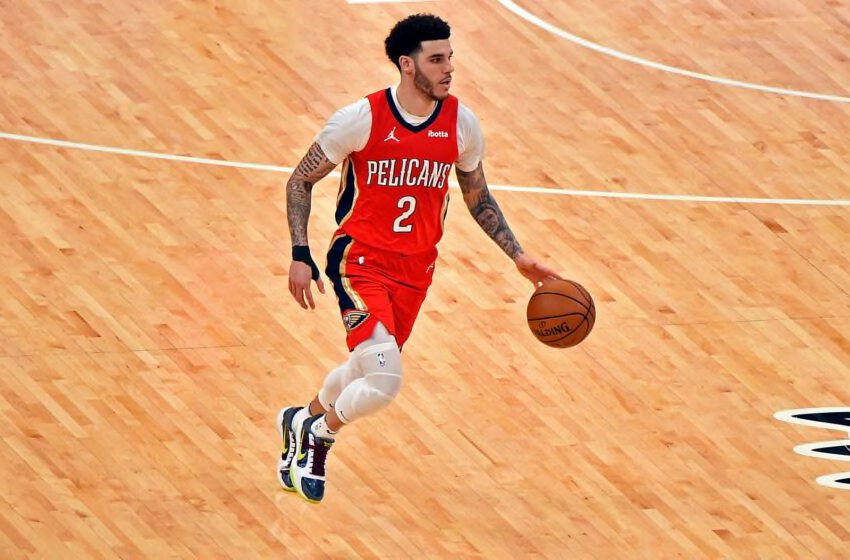
The Chicago Bulls and restricted free agent Lonzo Ball came to terms on a 4 year, 85 million dollar deal immediately once free agency opened on Monday, August 2nd (per Shams Charania). The deal was a sign and trade in which the Bulls sent back Tomas Satoransky, Garrett Temple, and one second-round draft pick for Lonzo Ball.
Chicago Bulls basketball is officially back. Signing Lonzo Ball filled an immediate need at the point guard position.
Ball is the perfect running mate for Zach LaVine in the backcourt.
It’s been a while since Bulls basketball has been something to look forward to, but under the leadership of Arturas Karnisovas and Marc Eversley, the Chicago Bulls finally appear to be moving in the right direction – making me moves to contend instead of always “retooling.”
One of the most glaring issues the Chicago Bulls faced last season was having a true point guard to facilitate the offense. Zach LaVine’s natural role is to be a lethal, efficient scorer. While he can facilitate the offense, his talents are maximized when asked to put the ball in the basket as much as possible. Similarly, Coby White also excels as a scorer off the bench, but often showed his age and inexperience when asked to run the entire offense – even as part of the second unit.
These issues were especially apparent at the end of close, back and forth games, which the Bulls were typically on the losing side of. Without a true point guard to run Billy Donovan’s offense, the Bulls often resorted to hero ball – forcing LaVine to put the entire team on his back down the stretch countless times.
Signing Lonzo Ball will help the Bulls immediately as he’s a gifted facilitator – compared to the likes of Lebron James when he came out of UCLA. Lonzo is only 23 years old but has improved significantly each year in the league. He has become a more consistent scorer year over year, has been amazing at passing the ball, and has improved his three-point shot considerably from when he entered the league in 2017.
The Chicago Bulls were also very fortunate to not have to sacrifice Lauri Markannen or Thaddeus Young in the sign and trade for Lonzo Ball. These are two assets that could help them acquire yet another impact free agent in the coming days.
Ultimately, the Chicago Bulls have gotten off to an amazing start in free agency this year and it’s clear that management believes a strong supporting cast around LaVine, Vucevic, and an emerging Patrick Williams will be enough to be strong competitors in the Eastern Conference for years to come.
There are undoubtedly many moves the Bulls still need to make to create cap space, acquire other impact players, and also extend LaVine, but as of now, the signing of Lonzo Ball shows the arrow is pointed in the right direction.
The Blackhawks finally committed Monday to publicly releasing the findings of an ongoing sexual assault investigation.
CEO Danny Wirtz wrote in an internal memo that the results of the investigation — which began June 28 and is being conducted by the Chicago law firm Jenner & Block — will be shared with employees, partners and fans.
“[We] will promptly implement changes to address the findings and any shortcomings of our organization,” Wirtz added. “We are using this process to engage in the self-reflection necessary to better our organization and ensure that our workplace is safe and inclusive. And while we await the results, we will continue a process of self-evaluation and take important steps to better our organization.”
The investigation stems from two lawsuits claiming the Hawks grossly mishandled an alleged May 2010 sexual assault of a player by former video coach Bradley Aldrich.
The lawsuits claim Hawks management, including then-president John McDonough and current general manager Stan Bowman, was informed of Aldrich’s alleged assault but refused to report the incident to police. They also claim the Hawks later recommended Aldrich for a job at a Michigan high school where he went on to assault a 16-year-old student. The Hawks have filed pending motions to dismiss both lawsuits.
Several key witnesses, including the anonymous assault victim as well as outspoken 2010 defenseman Brent Sopel, had previously said they wouldn’t participate in the investigation unless its findings would be made public.
Bowman reiterated Monday he will “cooperate fully,” saying Wirtz was “very clear on the direction the organization is taking.”
Bowman also addressed his role as GM of the 2022 U.S. Olympic hockey team: “USA Hockey has been in close contact with the Blackhawks on a variety of topics, [but] I’m not really involved in those conversations.”
He has seen his No. 1 jerseys spring up all over the bleachers at training camp, he understands that everything he says or does lights up Twitter and he’s very aware that this fan base is beyond starved for an electric, franchise-altering quarterback.
But he’s telling you the same thing the Bears are: Just wait.
“I’m constantly growing every day,” the rookie quarterback said Monday, trying to gauge where he stands at the moment relative to being ready to take over as the starter. “A lot of people are anxious to see me play, but greatness doesn’t happen overnight.”
His development requires more patience from a city that’s pretty much tapped out of it after decades of the Bears’ pleading. But Fields is progressing. His advances range from thrilling deep shots and wily scrambles to the finer points of perfecting his huddle calls and cadence at the line of scrimmage.
Those little details are boring, but they matter. Nobody cares about cadence until there’s a false start. Nobody cares about going through the proper progressions on a play until the quarterback misses the open receiver underneath on a key play. The Bears drafted Fields to launch rockets for touchdowns and spin through defenders as though their shoelaces are tied together, but those other things also are vital.
Those aspects, along with mastering split-second decisions under duress and decoding defensive disguises, are the difference between coach Matt Nagy declaring 11-year veteran Andy Dalton being ready to start a game right now and Fields acknowledging that he still has work to do before his likely debut in a preseason game against the Dolphins next week.
“That’s when things get real,” Nagy said. “You start putting the pads on and the tempo picks up, [and] now we want to see him execute plays and play fast. That’s probably the biggest thing.”
Fields did plenty of that at Ohio State, where he was the most dominant quarterback in college football other than Trevor Lawrence. But everything’s harder in the NFL, even in practices against second-string players.
Windows open and close much more quickly, and Fields can no longer count on a wide margin between his talent and that of his opponents. Some gambles that paid off in college would be imprudent at this level. The good thing, though, is that it’s easier to harness an aggressive mindset than to teach a cautious, checkdown-happy quarterback to take some shots.
“Yes, 100%” Nagy affirmed.
The good news for the Bears is that although Fields isn’t ready to supplant Dalton, he is absolutely on the right track. He is at or beyond where the team needs him to be at the moment. He said he’s “very happy” with his progress and has seen the value of being Dalton’s understudy.
He has gone from straining to remember plays when he gets the call to visualizing them immediately. And he has been exceptionally level and poised throughout the inevitable choppiness of a rookie quarterback’s first week of training camp.
“I don’t really get upset if I miss a throw because I know I can make that throw,” he said. “So right now I’m more focused on the mental part of the game. With the ups and downs, you can’t really dwell on those. With [mistakes], you just have to learn from them and move on.”
The next month or so is the ideal time for him to work through that turbulence on the field before the Bears shift into regular-season mode and Fields is relegated to mostly learning through observation.
Until then, every peek at his progress is priceless. While the Bears hope Dalton can help them make the playoffs this season, they believe Fields can vault them to championship contention for years. He doesn’t have to live up to that yet, but it’s reassuring to see evidence that he’s headed there.
The old Bulls regime dropped the Ball back in 2019, only kicking the tires on acquiring then-Lakers point guard Lonzo Ball.
With the start of free agency on Monday, the new regime wasted no time getting it done.
The Sun-Times confirmed that the Bulls acquired Lonzo Ball in a sign-and-trade for four years, $85 million, giving them a play-making point guard they have desired for years.
Almost two years in the making.
Back in April of 2019, general manager Gar Forman and vice president of basketball operations John Paxson had made inquiries to the Lakers about Ball, after Ball’s camp leaked that the point guard wanted out of Los Angeles and the Bulls were one of a handful of team’s on his wish list.
Fast forward a few seasons and to a different regime, but the Bulls – and new executive vice president of basketball operations Arturas Karnisovas – then tried acquiring Ball at the trade deadline. When draft compensation couldn’t be agreed on, the Bulls went elsewhere and acquired Nikola Vucevic.
But Ball was always in the plans, especially with how well he fits with a Bulls roster also needing perimeter defenders in the starting lineup.

:no_upscale()/cdn.vox-cdn.com/uploads/chorus_asset/file/22363219/protest_Brown_elbow.jpg)
:no_upscale()/cdn.vox-cdn.com/uploads/chorus_asset/file/19921010/Madison___Springfield_B.png)