The Atlas V rocket with the Starliner spacecraft on top at Space Launch Complex-41. This photo was taken this morning. Credit: ULA
Today’s Atlas V launch with Boeing’s Starliner spacecraft has been scrubbed. The launch will be attempted tomorrow August 4th.
[embedded content]
9:34 am CT Status Update: The launch will conduct a 24 hour recycle. This means that the launch will be attempted tomorrow August 4th at around the same time. When we have more information we will update.
9:29 am CT Status Update: Today’s launch has been scrubbed. Will update this blog when we have more information.
9:21 am CT Status Update: The Atlas V launch countdown has entered a planned 4 hour built in hold. This hold allows controllers time to work any issues that may come up. So far the launch vehicle and Starliner are doing great! The weather forecast for todays launch remains acceptable. No threat of lightning is expected. Chances today remain 50/50.
Fueling of the Atlas V rocket has been completed as well. The Centaur second stage is also fueled and ready to go.
Today’s flight test will demonstrate performance capabilities of the Atlas V Guidance Navigation & Control systems as well as docking, re-entry and landing operations. The Atlas V will deliver Starliner spacecraft into an initial 98 nautical mile sub-orbital trajectory before Starliner’s own engines will burn, taking it the rest of the way to orbit and toward the International Space Station.
This is Boeing’s second Orbital Flight Test mission. Its first mission was cut short due to an internal mission timer anomaly on Starliner. Quick action from ground controllers placed Starliner into a lower but stable orbit. After checking over Starliner systems, NASA and Boeing decided to cancel rendezvous and docking with the Space Station. Although its mission was cut short. Starliner was able to demonstrate better than nominal performance during launch, orbital flight, reentry, and landing.
Today’s flight, Orbital Flight Test – 2 (OFT-2), is expected to fly a full mission profile. Testing Starliner systems from pre-launch to docking, undocking, landing and recovery. Starliner will execute a number of demonstrations on its way to the International Space Station. Examples include its ability to hold docking attitude, receive commands from the ISS, and command holds and retreats during final approach. Once docked Starliner will undergo a number of checkouts like charging the batteries, transferring files through Station for downlink, transferring cargo, and opening and closing the hatch.
(Michael Galindo contributed updates to this blog)
I’m a tiny bit obsessed with space. I’m told it’s an acceptable obsession because I take what I learn and share it with others. If I’m not writing about space, among other things, I’m busy doing science with one of the many student orgs I volunteer with or, advocating to bring more STEM programs to underrepresented students. I miss working in a lab, so invite me out to see yours!
There’s been a lot of media coverage of all the shootings and murders in Chicago lately but all too often these claims are made without presenting much in the way of data. So I always base my annual review of crime in Chicago on the numbers so that we know what we’re dealing with. First, I updated my time series through the end of June – Chicago murders by month along with a 12 month moving average line in red. It does confirm that the number of murders in the city was on the decline up until the pandemic hit and then things turned around – for the worse – hitting a record high for the 20 years we have good history for. For the 12 month period ending in June there were 783 murders in Chicago vs. 592 the last time I checked. That record is largely driven by the surge that occurred in July 2020.
As I always point out the data is highly seasonal with a surge during the warmer months and a decline during the winter. I guess the bitter cold has some benefits.
The number of people getting murdered in Chicago each month started picking up right when the pandemic hit
Chicago Murder Rate By Neighborhood
Of course the murders are not distributed evenly around Chicago as everyone knows. There are some real hotspots. Since everyone wants to know where all the murders are happening I aggregate the data by community area and calculate a murder rate per 100,000 population since more people create more opportunities for people to kill each other and we need to normalize for that. The one thing I can’t normalize for is the fact that certain areas of the city (e.g. The Loop and Near North Side) have a lot of people passing through every day that don’t actually live in the area. So that creates more opportunity for crime but without an increase in population.
The table below sorts the community areas by their murder rate. Depending on your screen or browser you may have to click on the table to enlarge it. The good news is that 12 areas had no murders, which is roughly the number we’ve seen in previous years. The usual high income areas are at the lower end of the spectrum and the lower income areas are at the higher end.
Unfortunately, my neighborhood – West Town – saw a doubling in their murder rate over the last year. Also, several of last year’s community areas with no murders did have a few this year: Kenwood, Hermosa, Clearing, North Park. But on the flip side several communities dropped down significantly with no murders: Edison Park, Montclare, and West Elsdon had a big improvement.
At the other end of the spectrum West Pullman and Fuller Park jumped way up in the rankings while Washington Park moved down quite a bit.
[embedded content]
Map Of Chicago Murders
Of course it’s not enough to simply know which community areas have the highest murder rates. You also need to know where exactly these murders are occurring since these crimes are often concentrated in particular areas. That’s why I’m providing the interactive map below with all of the murders from the 12 month period plotted on top of the community area boundaries. You can click on the balloons and get a few details about each murder. You can also pan, zoom, and share the map. And if you want a bigger version just click on the expansion icon in the upper right corner of the map.
I find the map to be the most useful tool in understanding crime because, as you zoom in, you can get a much better sense of the frequency of these crimes in various parts of the city – block by block if you want to.
[embedded content]
#ChicagoCrime #ChicagoMurder
Gary Lucido is the President of Lucid Realty, the Chicago area’s full service real estate brokerage that offers home buyer rebates and discount commissions. If you want to keep up to date on the Chicago real estate market or get an insider’s view of the seamy underbelly of the real estate industry you can Subscribe to Getting Real by Email using the form below. Please be sure to verify your email address when you receive the verification notice.
After 20 years in the corporate world and running an Internet company, Gary started Lucid Realty with his partner, Sari. The company provides full service, while discounting commissions for sellers and giving buyers rebates.
I once heard an analogy of an inflatable bop bag and how it keeps bouncing back no matter how many times you hit it. I realize that what makes it bounce back is what it is filled with. It is filled with sand to give it weight to withstand all the punches it endures. It is also filled with air to blow it up. So every time the bop bag is hit, the weight of the sand causes it to stand solid while the air causes it to bounce back. My favorite thing about the bop bag is it doesn’t fight back! No matter how many licks it takes, it never returns the blow, instead, it just keeps bouncing back!
When you have a solid foundation, you have more than enough to withstand any hit that comes your way. What you’re build of gives you enough stamina to take a licking and keep on ticking. Remember there’s no need to fight back, just bounce back!
TOKYO — Simone Biles found something a little more manageable than the weight of the world.
Bronze.
The American gymnastics superstar earned her seventh Olympic medal and second in Tokyo with a third-place finish in the balance beam final on Tuesday, a week after she took herself out of several competitions to deal with a mental block that prevented her from twisting while performing.
Biles drilled a slightly watered-down version of her usual routine in front of a crowd that included IOC President Thomas Bach. The bronze — matching the one she captured in Rio de Janeiro five years ago — moved her into a tie with Shannon Miller for the most Olympic medals by an American gymnast.
“This definitely feels sweeter than Rio’s bronze medal on beam because I did a good beam routine,” she said.
Biles, using a double-pike dismount — no twisting required — posted a score of 14.000. That was good enough for bronze behind the Chinese duo of gold medalist Guan Chenchen (14.633) and Tang Xijing (14.233).
“I had nerves but I felt pretty good,” she said.
Olympic all-around champion Sunisa Lee of the United States finished fifth. The 18-year-old Lee won three medals in Tokyo, including silver in the team final and bronze on uneven bars.
Biles pulled out of competition earlier in the Tokyo Games, saying she felt “the weight of the world” on her 4-foot-8 frame. She shoved it aside to reach the podium for the 32nd time in major international competition.
Biles arrived on the floor about 90 minutes before the competition started, wearing a red, white and blue leotard emblazoned with nearly 5,000 crystals. If she was nervous, it hardly showed. She warmed up as if it was just another day back in the gym her family owns in the northern Houston suburbs. Twice she hopped onto the beam to do a run-through of her routine and she stuck her double-pike dismount to applause from the stands and the whir of dozens of cameras.
Biles arrived in Tokyo as the face of the U.S. contingent in Japan and perhaps the Games themselves. Yet the brilliance she’s summoned so easily for so long during her run atop the sport came undone after qualifying on July 25.
She bailed out of her vault during the first rotation of the team finals on July 27, then stunningly removed herself from the competition as a matter of protection because she was having difficulty locating herself in the air. She later described the phenomenon as “the twisties” and subsequently pulled out of the all-around, uneven bars, floor exercise and vault finals.
The decision amplified increased attention on the importance of mental health in sports in general and among Olympians specifically. Add it to the growing list of movements the 24-year-old Biles has become a touchstone for during her rise to stardom.
She’s spent the last week continuing to train and be evaluated by team physician Dr. Marcia Faustin while doubling as lead cheerleader for a U.S. women’s team that has racked up some serious hardware in her absence.
“Put your health and safety first above all things,” Biles said.
Lee became the fifth straight American woman to capture the all-around title and added a bronze on uneven bars. MyKayla Skinner, placed into the vault final after Biles scratched, soared to silver. On Monday, Jade Carey’s long journey to the Olympics ended with a victory on floor exercise after Biles gave her a pep talk following a nightmarish vault performance in which she tripped at the end of the runway and narrowly avoided serious injury.
Her return to competition on beam served as a fitting ending to her Olympic experience. She earned bronze on the event in Brazil five years ago thanks in part by reaching down to grab the 4-inch piece of wood after she slipped. The decision cost her gold but assured her of a fifth medal and the one, in retrospect, she said she’s most proud of.
While she hasn’t officially announced her retirement — she’s hinted that she might want to stick around in some fashion until the 2024 Paris Games to honor coaches Laurent and Cecile Landi, who are both French — a long layoff awaits. She’s headlining a post-Olympic tour through the fall but stressed recently she plans to stay close to the sport.
“I just need to process this Olympics first,” Biles said.
If Tuesday night was her official goodbye, she did it on her terms. Just like she has for most of an eight-year elite career that pushed the boundaries of gymnastics and saw her achieve the kind of crossover success typically reserved for sprinters like Usain Bolt and swimmers like Michael Phelps.
Lauren Underwood had just started the master’s program in public health at Johns Hopkins University when she met fellow student Shalon Irving, whose life and death would ultimately help shape the future congresswoman’s career. “It was the first session, the first day, and Shalon was like, ‘Hey, girl.’ She was really bubbly, really kind.”
Underwood was telling me this during an interview by Zoom in February. I was nervous when the call began because my kids had been home from school for nine months and I was worried they might barge into my “office” in the middle of our interview to complain that their laptop wasn’t working or that we were all out of the good cereal. But Underwood’s direct, down-to-earth conversational style put me at ease; she came across as warm and energized, the same way she described her friend. “Shalon and I were, like, good girlfriends. We would pass notes, you know, go to dinner in Baltimore. We were telling each other about who we were dating.”
At the time, Underwood was 21, with a bachelor’s in nursing from the University of Michigan, and the youngest student in the master’s program. (Now, at 34, she is the youngest African American woman ever to serve in the House of Representatives.) After graduation, Underwood and Irving both went on to careers in public health, Irving as an epidemiologist at the Centers for Disease Control and Prevention and Underwood as a senior adviser at the Department of Health and Human Services, where she worked with the Obama administration on implementing the Affordable Care Act.
In 2016, Underwood learned that Irving was expecting a child. “We were all so excited for her. She’d always wanted to be a mom and …” Underwood’s voice caught, hinting at an upwelling of emotion she seemingly hadn’t expected. She began to speak more slowly, as if keeping her reaction in check. “You know how it is with girlfriends, right? You’re in it with your friends.”
Underwood continued, explaining that when she got the good news about her friend’s baby coming, her federal job was wrapping up and she wasn’t sure what she’d do afterward. While she was mulling her next move, bad news followed the good. “Shalon was due in January, and we didn’t hear anything right away,” she said, “but I figured she was overwhelmed. Then I found out that she had died after giving birth.”
Irving had collapsed at home three weeks postdelivery, her death attributed to complications from the high blood pressure she’d been managing for years. As Underwood described going down to Atlanta for the funeral with a friend, she had to pause and take a deep breath. “It was … unimaginable. Her baby was there, her mom was there, the director of the CDC was there, all of these other uniformed public health officials were there, and everybody was stunned. Just like, How could this happen?”
From left: Underwood suited up to ride along with a medevac team as part of her clinical training in 2008; at a University of Michigan football game in 2009, a year after earning her bachelor’s in nursing at the school Photography: Courtesy of Lauren Underwood
The way Underwood saw it, her friend had done everything right. She was a highly educated woman with excellent insurance who’d received prenatal care from quality providers in the richest country in the world. Her work in the violence prevention division of the CDC had given her intimate knowledge of the extra health risks borne by Black women, who, according to that agency’s data, are up to four times more likely to die from complications related to pregnancy and childbirth than white women. But in the end, none of those advantages had saved her. In late 2017, NPR and ProPublica published a lengthy article that examined Irving’s death through the lens of the health care disparities faced by Black mothers, from biases in pain management and hospital admission to laxity in perinatal care, and pointed to evidence that Irving may have fallen victim to the very inequities she’d dedicated herself to eliminating. (An expert on postpartum care stated in the article that given Irving’s history of hypertension, her doctors should have ordered a full cardiological workup and kept her for monitoring after she developed a hematoma from her C-section.)
In recounting her friend’s death, Underwood, who has been studying racial inequity in health care for years, didn’t draw any explicit conclusions, but she did relate her experience in nursing school: “People would often say things like, ‘Well, there’s something about Black women that makes them more likely to die of these pregnancy-related complications.’ It wasn’t referred to with precision. It wasn’t presented as a deep dive on preeclampsia or some kind of postpartum infection or the role of mental health or specific causes of maternal death. It was just much more broad. … ‘There’s just something about Black women where they’re more likely to die.’ But what I say is, there’s nothing wrong with us genetically. There’s nothing wrong with Black people. This is about racism in our health system.”
By this point, Underwood had abandoned the halting cadence she’d used when recounting the painful memories of her friend’s death and was talking at a brisk clip. She began to enumerate the initiatives she’s championed since being elected to Congress in 2018, specifically the Black Maternal Health Momnibus Act of 2021, which contains provisions addressing inequities in housing, nutrition, and transportation that influence maternal outcomes, as well as plans for eliminating racial bias in the treatment of pregnant women, improving data collection, and bolstering maternal mental health resources.
“There’s nothing wrong with black people,” underwood says. “This is about racism in our health system.”
She noted that the issue of maternal mortality had come up in various ways during Obama’s terms in office, when Underwood was creating policy at the Department of Health and Human Services, but it had never been made a priority. What fledgling programs there were got largely dismantled by the Trump administration. Mothers dying was somehow not an issue that captured the imagination of the political class. This seemed wrong to Underwood. “I think that American people assume that Congress works on the issues that are most important for our country. No, Congress works on the issues that its members raise. And if you do not have a Congress that reflects the lived experiences of the American people, their issues don’t get raised.”
Prompted in part by that observation, I asked the congresswoman at one point if she was planning to have children herself. She opened her mouth to speak but then hesitated, pausing to choose her words carefully. I hadn’t intended it as a loaded question, but I can see now how she might have interpreted it as such.
“Yes,” she said finally, “but I would say that I have not prioritized that. As a woman with agency in her life, I go for what I want, and that has not necessarily been the highest priority.”
“A woman with agency in her life” might strike even a casual observer as an understated description of Underwood. After flipping Illinois’s 14th District — a predominantly white swath of suburbs that favored Donald Trump in 2016 by 4 percentage points — three years ago and then prevailing again in 2020 in a bitterly contested race against a wealthy Trump-aligned conservative, she has emerged as one of the Democratic caucus’s rising stars, and one of the few members of Congress whose education trained them for a solidly middle-class profession like nursing. In 2019, she was named to Time’s “100 Next” list. “Congresswoman Underwood is blazing a trail for a new generation of unbought and unbossed leaders,” wrote Senator Cory Booker in the magazine, “and I know that one day soon, another newly elected Congressperson will look back at her example and be inspired to do the same.”
Underwood seems well suited to thrive in the Biden era. Like the president, she has advanced a liberal agenda without resorting to the kind of incendiary rhetoric and bare-knuckle combat favored by Alexandria Ocasio-Cortez and other members of the so-called Squad. “When I got to Congress, I came in with a class of a lot of big personalities,” Underwood said equably when I asked her about her colleagues. “And being a young woman of color who was there with some stars, I thought it was important for people to get to know me, to understand the district that I represent, and the work that I want to do.”
Part of Underwood’s softer approach is certainly tactical. After all, 49 percent of voters in Underwood’s district — which wraps around the northern and western edges of the Chicago area, stretching as far north as the Wisconsin border and as far south as I-80 — favored her Republican opponent, the dairy magnate Jim Oberweis, in 2020. Her margin wasn’t much bigger in her landmark 2018 victory over Randy Hultgren, a four-term Republican incumbent.
Sometimes Underwood’s play-nice approach can come across as a reluctance to punch back. During a public forum held virtually for the two candidates ahead of the 2020 vote, Oberweis, seated at his desk beside a portrait of Ronald Reagan, attacked Underwood for her “pattern of silence when it comes to the radical ideas of the far left.” At one point, he accused her of having a secret left-wing agenda: “She ran two years ago like a moderate Democrat, but she has governed since then like a radical socialist.” Here Underwood paused, displaying an uncanny ability, one she shares with Joe Biden, to continue smiling even as the arrows fly. “Well,” she said, “my opponent has been using his time to launch character attacks, and I’ve been spending my time as your representative, focused on the issues and focused on serving this community.”
In Underwood’s view, there is a moral cost to delaying immediate remedies in the name of achieving more profound future gains.
I asked veteran Democratic congressman Danny Davis, who has represented parts of downtown Chicago since 1997 and has more than a few liberal bona fides of his own, what he thought of Underwood’s penchant for avoiding the fray. “You can acknowledge and recognize differences that people have, and you can even interact with people who get down in the mud,” he said, “but you don’t have to get down there with them.” He added, “Everyone knows that she represents a congressional district that does not necessarily have a lot of African Americans. It’s conservative. It’s white. … It is so good to see what is going on with her. It helps me to believe that America is becoming the country Dr. Martin Luther King thought we could become.”
Not all the mud is being slung from the right. Underwood has been criticized for, among other things, failing to support Medicare for All, the single-payer national health insurance system advanced most recently by Representatives Pramila Jayapal and Debbie Dingell. Underwood was one of the few House Democrats of the new guard not to cosponsor that bill; instead, she presented a plan that works within the current system, offering an expansion of premium tax credits and ACA coverage to lower-income Americans and to those who have lost work during the pandemic.
Underwood at a get-out-the-vote rally in Chicago before her 2018 victory over Randy Hultgren Photograph: Armando L. Sanchez/Chicago Tribune
“People need help now,” Underwood said when I asked why she’d favored a middle road. “That’s what this legislation does.” In March, her proposal became law, as part of President Biden’s American Rescue Plan Act. Her success in pushing through her legislation reminded me of the old saying that there are no atheists in foxholes, the corollary being that there are no ideological purists in a national health crisis: People can espouse rigid beliefs on Facebook about America and freedom and antifa and the coming class war, but at the end of the day, what they care most about is being able to go to the doctor when they’re sick, being able to make rent, and buy food, and educate their kids.
Underwood seems to take umbrage at those who insist that a national government-run insurance system is a more direct path toward ending health care disparities than a complex system of subsidies and tiered plans. “I’m not an ideological person,” she told me. “And I think the way this debate is framed as single-payer versus ACA is really toxic.”
In Underwood’s view, there is a moral cost to delaying immediate remedies in the name of achieving more profound future gains. She recalled how during a community health rotation in nursing school, she’d go to her patients’ homes to make sure they were taking their medicine. For many of them, the problem was not that they couldn’t remember to take their pills, but that they couldn’t afford to buy them, having to rely instead on the free samples provided to doctors’ offices by pharmaceutical reps. “There were weeks when they couldn’t get enough samples from the pharmacy reps or health providers, and then there was a problem. I would spend time calling to see if a different practice had some extra samples or if the health department had gotten some. I’d advocate for the family. But not everyone has a nurse with a line to the department of health advocating for them.” Relying on free drugs was hardly a sustainable practice, but it helped those people in the moment.
“The framework that I always use is that there is a window of opportunity to make policy change,” Underwood said, “and when the window is open, you, as the advocate, need to be aggressive about making sure that your issue can move, because once folks move on and that window closes, it’ll be gone. And for me, we are in this moment where people understand health equity issues. They understand the need for people to have health care and that my responsibility as a policymaker is to make sure that we’re doing everything we can.”
I asked what she’d say to activists who believe that now is the time to push for more systemic change. She looked exhausted by the question, and was perhaps relieved when she realized we’d reached the end of the time her team had allotted for our first interview.
Later, researching the finer points of her bill, I realized that the new law was going to save me around $200 a month.
A friend of mine who teaches college in Chicago once told me jadedly that whenever a student mentions growing up in Naperville, it’s guaranteed that the next thing they’ll say is how much they love their hometown. Lauren Underwood is no exception. Though the congresswoman studiously avoided talking about her personal and family life over the course of a handful of interviews, she became animated when the subject turned to her growing-up years in Naperville, where she moved with her parents from Mayfield Heights, Ohio, a suburb of Cleveland, when she was 3.
At the time, Naperville — an affluent city on the DuPage River that’s now the fourth largest in Illinois and lies just outside the boundaries of the 14th District — was on its way to becoming a place very different from the one it had been. To give me a sense of this transformation, Underwood told me about a boy she had a crush on in the first grade: “His name was Brian Book, and I thought he was so cool because he lived on Book Road, and Book Road was named after his family because they owned this huge farm. But by the time I got to second grade, the Book family had sold their farm and moved to southern or central Illinois. And now there is no farmland, not even around Book Road.”
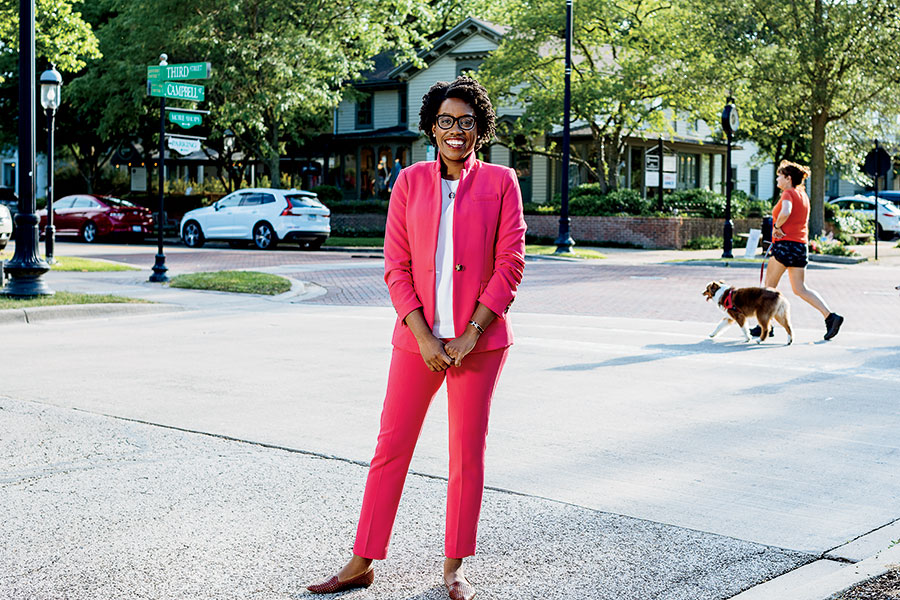
The congresswoman in downtown Geneva, a Fox River suburb in her district
The bucolic landscape that once defined the town had already largely given way to subdivisions, strip malls, and what Underwood described as “all these new, nice things.” The schools were new, the parks were new, the houses were new, the libraries were new. This new Naperville seemed to have everything a middle-class family with high aspirations for their children might want or need.
The new Naperville, like the old one that had grown from a pioneer settlement, was a magnet for upper-income white professionals. Though Underwood readily acknowledged that “there weren’t a lot of other Black people there,” she never described the lack of diversity as an impediment, and pointed to Black classmates of hers who went on to high-profile careers, among them the WNBA star Candace Parker and Underwood’s sister, Lindsey, who works as a senior editor at the New York Times. “We had access to an upper-middle-class community at a time when the national economy was doing very well,” she said. “People invested in their kids.”
Underwood described her participation in a yearlong internship that Naperville’s mayor had created to give teenagers experience in local government. During her junior year at Neuqua Valley High School, she won an appointment on the town’s fair housing commission, which, at the time, was facing legal challenges over a local law that allowed renters to present Section 8 vouchers to landlords as a source of legal income. There weren’t a lot of rental properties in Naperville, and many landlords were refusing prospective tenants who were on public assistance. Underwood remembers her surprise at learning how hard it was for low-income renters to get a lease. “It introduced me to the concept of housing discrimination on a really local level.”
The experience ignited a passion for public policy, but as she neared graduation, she felt pressure to follow a track that guaranteed stability. “No matter where you live,” her parents had always told her, “you always need to be able to support yourself.” It was fortuitous, then, that when she entered nursing school at the University of Michigan, the curriculum was undergoing significant change. “In the past,” Underwood said, “schools of nursing were like, ‘We are Michigan nurses. You will learn to tuck bedsheets the Michigan nurse way. You will be the most competent Michigan nurse and you will only do the things we teach you.’ ” But by the time she began her education, there was far less emphasis on bedsheets and far more on policy and patient advocacy. “These folks were like, ‘No, we want you to be a leader, and we will give you the tools you need to be a leader,’ ” she said of the faculty at Michigan. “And that changed my whole life.”
Lauren Inouye, a nursing school classmate who has remained friends with Underwood and is now the chief program officer at the American Academy of Nursing in Washington, D.C., remembers encountering the future lawmaker on the first day of an 8 a.m. class in health policy. No one was excited to be there, she recalls, with the exception of the freshman from Naperville. “It was winter in Michigan, there was a foot of snow on the ground,” says Inouye. “We had to trudge all the way across campus, and by the time we got there, Lauren was always ready to go.”
Inouye says her friend was invariably energized. For one class assignment, Inouye and Underwood were paired to work on a presentation. “I just remember thinking, Thank God she’s my partner,” Inouye says. “The class focused on honing leadership skills for nurses. Most of us were just starting to think about our career paths — what specialty in nursing we wanted to go into. She already saw herself 10 or 20 years down the road. She always knew she would serve in public office.”
Nursing has not been an established path to political power like law or business, but Inouye sees that changing, with Underwood serving as a sort of advance guard. This called to mind the poll conducted by Gallup each year that ranks Americans’ estimation of various professions in terms of ethics and honesty. Nursing consistently ranks No. 1. (Car salespeople typically come in last, one notch below members of Congress.) It’s tempting to assume that this trust comes from the fact that nursing, unlike law or business or even medicine, is a field traditionally associated with nurturing as opposed to ambition. Underwood’s career seems to suggest that the two needn’t be mutually exclusive.
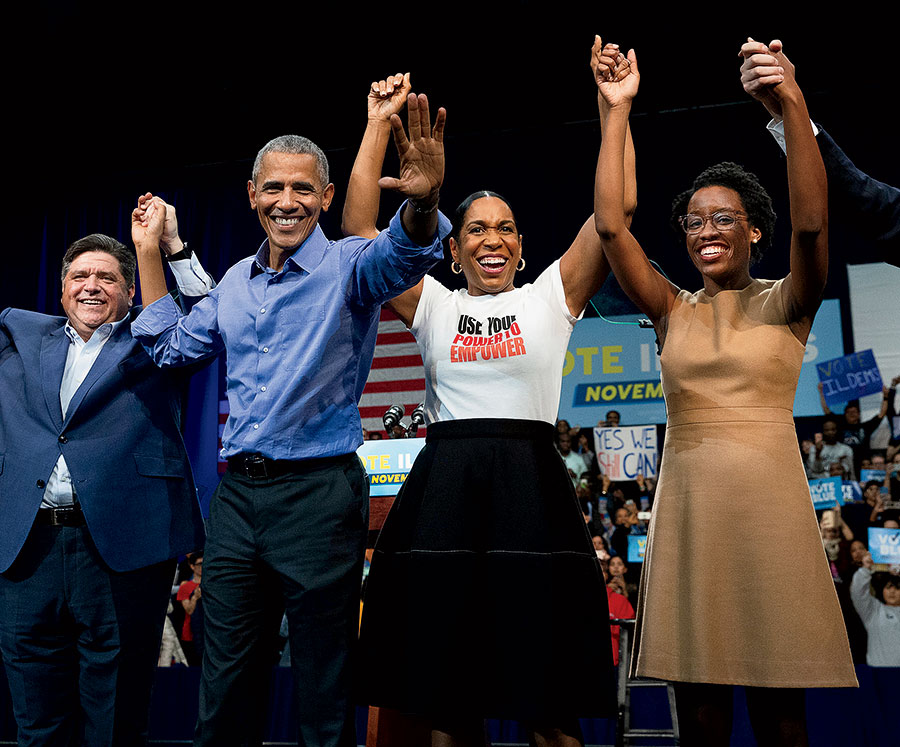
Some observers credited redistricting and high-profile endorsements — including from Joe Biden — for her back-to-back victories. Underwood believes more fundamental changes are at play. “The folks who hold the power have not reflected the values and the lived experience of the American people.” Photograph: Stacey Wescott/Chicago Tribune
When Underwood was 8 years old, her heart began racing so fast during a swimming lesson that she was taken to the emergency room. She was diagnosed with a type of arrhythmia that can require close medical observation over a lifetime. In June 2018, about a year after announcing her surprise candidacy for the 14th District’s congressional seat, she alluded to that diagnosis in a tweet: “I live with a preexisting condition called supraventricular tachycardia. It makes my heart race — and it’s the reason why I’m in this race.”
I knew that health care reform had been the central plank of her political platform, but during one of our conversations I asked the congresswoman to go deeper on what prompted her, a political neophyte, to run for national office in a district that had sent only one Democrat to the House of Representatives in 80 years. By way of answering, she related an anecdote.
In the spring of 2017, she decided to attend a town hall meeting in St. Charles, a suburb in the 14th District, organized by the League of Women Voters for Randy Hultgren, who was hoping to coast to a fifth term as the area’s representative in Congress. Having finished her stint at HHS, Underwood had just moved back to Naperville, commuting to her new job as a regulatory strategist for a Medicaid managed-care company called NextLevel Health. In what would turn out to be his only open-to-the-public event of the campaign, the then-51-year-old congressman — a former aide to onetime House speaker Dennis Hastert, who’d previously held the seat and later admitted to child molestation, serving time for related financial crimes — stated his support for repealing Obamacare. But he vowed that any repeal would not strip away protections for people with preexisting medical conditions. And yet a little more than two weeks later, Hultgren voted for a version of the repeal legislation that would essentially do just that, by making coverage for such people extremely expensive.
Underwood — who was still grappling with the implications of her friend Shalon’s death and had spent the previous three years working to improve Obamacare — was aghast. “That’s when I decided to run for Congress,” she said. “I didn’t know that I would win, but I knew that I could win, and I knew that if I won, I wanted to try to fix this.”
In what the Chicago Tribune called a “stunning upset,” Underwood narrowly defeated Hultgren after besting a field of Democratic primary candidates consisting entirely of white men. She entered the House of Representatives with a freshman class that was historic for its proportion of first-time candidates and for the number of women, many of them young and progressive and many of them people of color.
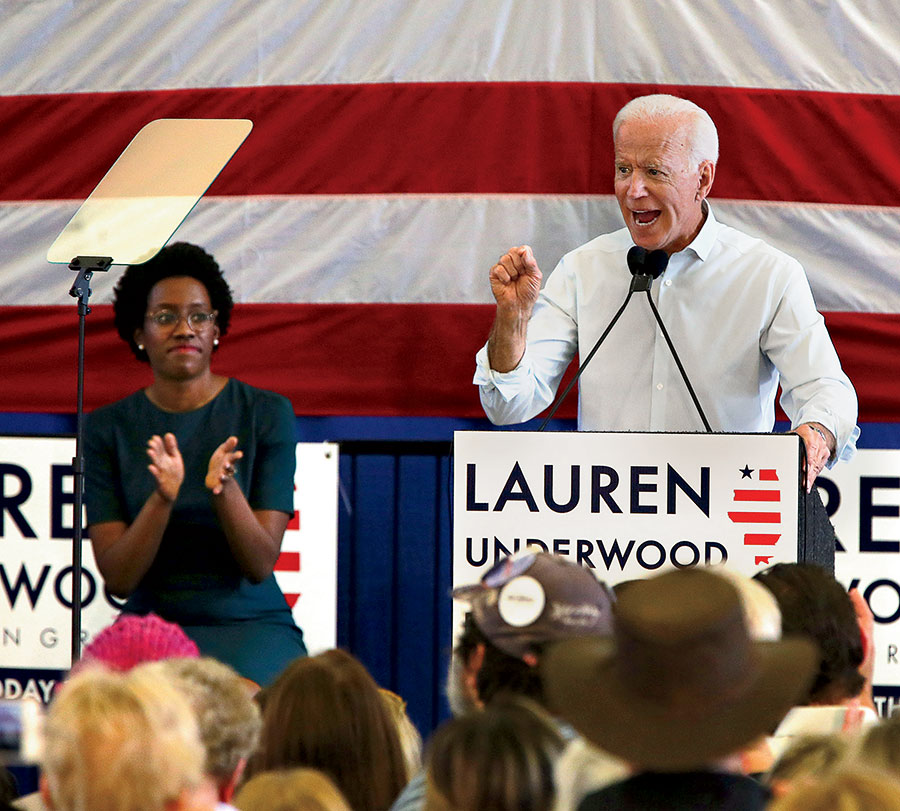
More than a few political analysts attributed Underwood’s win in part to the redrawing of the 14th District’s boundaries in 2010, a move that eliminated much of the district’s rural western portion. Demographic shifts, as well as an endorsement from Biden, were also cited as reasons for Underwood’s razor-thin 2020 victory over Oberweis, who took a page from the Trump playbook by challenging the results in an acrimonious fight that dragged on until May, when the Committee on House Administration found that his claims of election fraud were not credible.
But Underwood believes a more fundamental political awakening is at play, one that allows a newcomer candidate like her to run on critical bread-and-butter issues and win. “My district believes that health care is a right,” she told me. “And I believe the majority of American people believe that.” Then, echoing something she’d said earlier, she added, “The problem is that the folks who hold the power have not reflected the values and the lived experience of the American people. There is a significant misalignment right now.”
Underwood seems confident that she’s got the power to correct that misalignment, even if she may not yet have achieved the kind of cult status that gets you known just by your initials. “Every power dynamic in Washington has basically shifted,” she said. “The loudest and boldest and most powerful voices coming out on Capitol Hill are the voices of women. And with the exception of our speaker, they are women of color. And when you think about power, who holds power, who sets the agenda, who dominates and drives conversations, it has rarely been women.”
The unuttered continuation of that thought might be: At least not the right women. Not the ones who take care of people when the chips are down, when the schools are closed, when someone’s sick, when someone’s hungry, when someone’s lost their way — obligations that have prevented so many women, including the nearly 3 million who dropped out of the workforce during the pandemic, from taking a seat at the table. I’d come to think of this circumstance as the Cinderella problem, because remember, it’s not that Cinderella isn’t invited to the ball, it’s just that before she can go, she has to finish all her chores. Equitable health care alone may not resolve that problem, but it might be enough to give some women — those who, as Shalon Irving did, push themselves to the limit to have both family and career — a chance to go to the dance.
In March I attended a public appearance Underwood made in Woodstock, a city of 25,000 on the semirural fringe of the Chicago metropolitan area. To get there, I drove northwest on I-90, past O’Hare, past the subdivisions and office parks of Schaumburg and Hoffman Estates. Once off the interstate, I saw more than a few Trump signs in front of houses and storefronts, though the election had been certified two months earlier. The window of one gas station just outside of town was draped in a hand-painted sheet imploring passersby to Make America Great Again.
When I arrived, Underwood was taking her place before a lectern that had been set up in a park in the center of town. Flanked by a couple of City Council members and facing a small crowd of residents and a clutch of local reporters, the congresswoman spoke about how the Biden administration’s American Rescue Plan Act, and the provision for health care affordability she had worked to include in it, would provide relief to the city’s families.
When it came time for questions, a woman standing near me raised her hand. I’d noticed her earlier, listening impassively with her arms tightly crossed and her jaw set, her three children playing in the grass behind her. She said she had a friend who’d been trying to hire a home health aide for months. She was offering good money, $15 an hour. But how could her friend compete with Biden’s unemployment benefits? Why would anyone work when the government was paying them to stay home? What was Lauren Underwood going to do about this?
Underwood seems confident she’s got the power to make change happen, even if she’s not yet known just by her initials.
Underwood expressed sympathy for the woman’s friend and, without getting into specifics, offered assurances that the provisions of the new law would help such women get through the crisis —but would also get workers to a place where they could earn enough to support their own families and rebuild what had been lost. The woman listened, then essentially repeated her question-comment, looking angrier than before.
Later, during another Zoom call, I asked Underwood about the exchange. “The pandemic has affected everybody,” she said. “Everybody. And I know that that woman who came to our event was obviously going through something. She was experiencing some kind of pressure or anxiety. But, you know, I suspect that if we were in private and really engaged one another for longer, there would have been some other things going on there, that part of what she’s saying is, you know, ‘Who’s helping us?’ Somebody has a long-term health care challenge, her needs aren’t being met. … And so while her approach is different and her ideas about solutions are different, I don’t see there being this fundamental difference between us.”
I asked if the woman’s demeanor, which verged on openly hostile, had bothered her. “Here’s what I think. I think that woman knew that I would talk to her. She came to the event. She knew that she wouldn’t have to stand on the side and be ignored. She stood there and listened, and she was quiet. And I went to her first. And so to me, that was actually a positive interaction.”
Whatever the characterization of that tense Q&A, it says a lot about the challenges Underwood faces as she heads deeper into her second term — and about the thick skin she’s developed after her first. I remembered that when the woman in Woodstock had pressed on, seemingly oblivious to the answer she’d heard, Underwood had made one more attempt to explain her position. Finally, when that response seemed to fall on deaf ears yet again, the congresswoman nodded, looked out toward the rest of the crowd with a smile, and said, “Next question?”
CHICAGO, ILLINOIS – FEBRUARY 28: Patrick Kane #88 of the Chicago Blackhawks celebrates his 400th career goal in the third period against the Detroit Red Wings at the United Center on February 28, 2021 in Chicago, Illinois. (Photo by Jonathan Daniel/Getty Images)
The Chicago Blackhawks have made some significant moves this offseason. Stan Bowman is a bad GM that has made terrible moves in his day but he is having a good summer. There have been significant trades and signings that should have this team as a playoff contender as soon as this upcoming season. There is a lot to look forward to when it comes to the team on and off the ice.
Of course, the most important thing to a winning hockey team is good goaltending. Most Stanley Cup contenders have very that position locked down on an elite level. Well, the Hawks’ acquisition of Marc-Andre Fleury has them set in that spot for at least a year. He should form a very good tandem with Kevin Lankinen.
Everything that Fleury does well is the type of goaltending that the Hawks have needed for a few years now. They have been bad at giving up high danger chances over the years and Fleury is one of the best in the business at shutting those down.
The Hawks have also tried to do their best at fixing that defense problem that was alluded to. Seth Jones is one of the best defensemen in the NHL and now the Hawks have him. He will be their number one defenseman for the next half-decade or more. Adam Boqvist, who isn’t very good, went back to the Columbus Blue Jackets in the trade for Jones.
They also landed his brother Caleb Jones in the trade that sent Duncan Keith to the Edmonton Oilers. He isn’t what his brother is but he will be a good third pair guy on a team that might actually be pretty deep in that regard. They also added Jake McCabe via free agency which should really help them as well. With those three joining the cast that is already there, it should be formidable.
The ChicagoBlackhawks are hoping that their team plays as well as it looks on paper.
Jonathan Toews is going to be back in the fold as he appears to be healthy. He will be right there with Patrick Kane, Alex DeBrincat, Kirby Dach, and Dominik Kubalik as the team’s best forwards. They also made a trade with the Tampa Bay Lightning for Tyler Johnson. He is going to come in and make a major impact as well.
Whether you like the idea of the trade and his cap hit or not, he is an upgrade to the forward group. He put up decent numbers in his final years with Tampa as his usage started to decrease. He will certainly be used a lot more with Chicago and should thrive. There are not lots of options at the center of the ice. It is going to make a major impact on the offense and how the forwards play in their own end.
With all of these positive vibes in mind, it is fair to be worrisome about the division as well. The Winnipeg Jets, Minnesota Wild, Colorado Avalanche, and Dallas Stars will all be very good as well. It isn’t like the Nashville Predators or St. Louis Blues are bad teams either. They are going to still have their work cut out for them but they certainly are a much better team now with serious playoff aspirations.
With NFL training camps in full swing around the NFL, now is the time where some of the more unfortunate and unexpected injuries begin to happen. Thankfully, the Chicago Bears have yet to see one of their guys endure anything of note.
Other teams, though, aren’t so lucky.
The Indianapolis Colts traded for former Philadelphia Eagles quarterback Carson Wentz this offseason in hopes that reuniting with head coach Frank Reich could help the quarterback find his groove once again.
Already, though, Wentz suffered a foot injury in practice and underwent surgery. Wentz’s recovery is an odd time frame, currently being projected between 5-12 weeks. If the Colts wanted some reinforcement, they could opt to trade for another familiar face to Reich: Nick Foles.
If the ChicagoBears could trade Nick Foles to Indianapolis, it would be a huge win — yet, it is unlikely.
When Wentz initially went down, it was second-year pro Jacob Eason who took over first team reps. Last year’s first-round pick was once looked at as a first or second round guy, but fell to the fourth and became a solid value for Indianapolis.
The Colts also brought in former Green Bay Packer and Arizona Cardinal Brett Hundley, who didn’t play at all last season.
From the looks of it, the Colts will be sticking with Eason and Hundley. There will be no trade for a quarterback, as the Colts appear confident not only in their current passers, but also in Wentz’s recovery.
The Colts are not trading for Foles, Minshew or Mariota at this time. Carson Wentz begins rehabbing his foot after two weeks. He hasn’t been ruled out week 1 but it’s optimistic. If this relatively safe surgery & rehab gets complicated, then another vet QB will be considered.
The most interesting part of this entire saga would be the mental state of Wentz if the Colts traded for Foles. A few years ago, Wentz went down with an injury and it was Foles who took the Eagles all the way to a Super Bowl victory.
I’m not so sure he could handle a Foles trade during a time where he’s attempting to resurrect his career, so to speak.
For the Bears, trading Foles still remains something they would be happy to do. He is their third string quarterback and still being paid over $7 million in 2021. Not many teams keep three quarterbacks on the roster to begin with, let alone a third stringer making that much cash.
It’s tough to put it this way, but Wentz is unlikely to be the only significant quarterback injury this year. If the Bears hung onto Foles, they could probably, eventually trade him.
The other situation to monitor would be the Houston Texans, who have no idea what will happen with quarterback Deshaun Watson at the moment. As evidence continues to mount, the Texans could eventually be without him for the 2021 season, leaving Tyrod Taylor as the starter.
For now, it’s a wait-and-see game for the Bears and Foles. Who knows, maybe the Colts change their tune if Wentz’s recovery takes longer than anticipated.
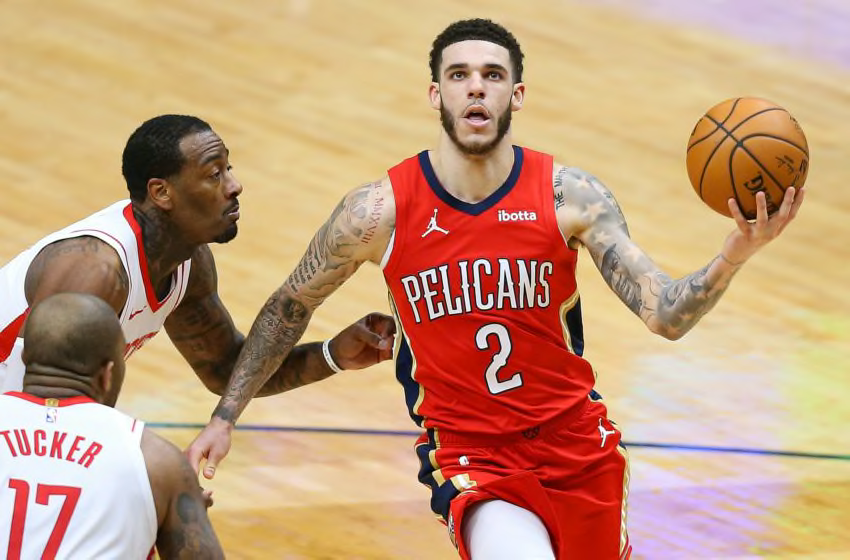
The Chicago Bulls have done it. The team signed Lonzo Ball in part of a sign-and-trade for Tomas Satoransky, Garrett Temple, and a future second-round pick.
The Bulls inked Ball on a four-year $85 million deal as one of the first moves reported by Adrian Wojnarowski and Shams Charania.
The team has been linked to Ball’s name since Arturas Karnisovas offered the Pelicans Lauri Makkanen for Ball back before the trade deadline.
Finally, the day has come in Chicago when the Bulls will get a high-flying, electric point guard that can enhance the team’s play on both sides of the floor.
Lonzo Ball has agreed to a four-year, $85 million deal with the Chicago Bulls, CEO of Klutch Sports Rich Paul tells @TheAthletic@Stadium.
The Chicago Bulls are hoping to see Lonzo Ball continue his development.
If you are not a Ball fan because of the flash and media attention, let me explain to you why you should be happy with the former UCLA point guard running the floor. If there is one word to describe Ball’s four-year career in the NBA, it’s improvement.
Ball has drastically improved since his rookie year in plenty of aspects. Field goal percentage, three-point percentage, free throw percentage, offensive rating, scoring, and playing off-ball are all much better. With Ball’s wide-ranged skill set and insurmountable potential at 23 years old, he will fit like a glove on both sides of the basketball with the Bulls.
His offensive and defensive fit will affect some of the Bulls’ current members. The fact that Ball can work in the full court and can work on the perimeter for defense will have effects on how some players play next season. It will all be up to head coach Billy Donovan to figure out how he fits with the Bulls.
When the gates initially opened up to the NBA free agency period, the Chicago Bulls were off and running. They wasted no time in bringing in their top target, point guard Lonzo Ball, from the New Orleans Pelicans.
The Bulls followed with signing guard Alex Caruso to be a primary 3-and-D guy off the bench, but that move did not close the door on other signings. The Bulls were not done yet.
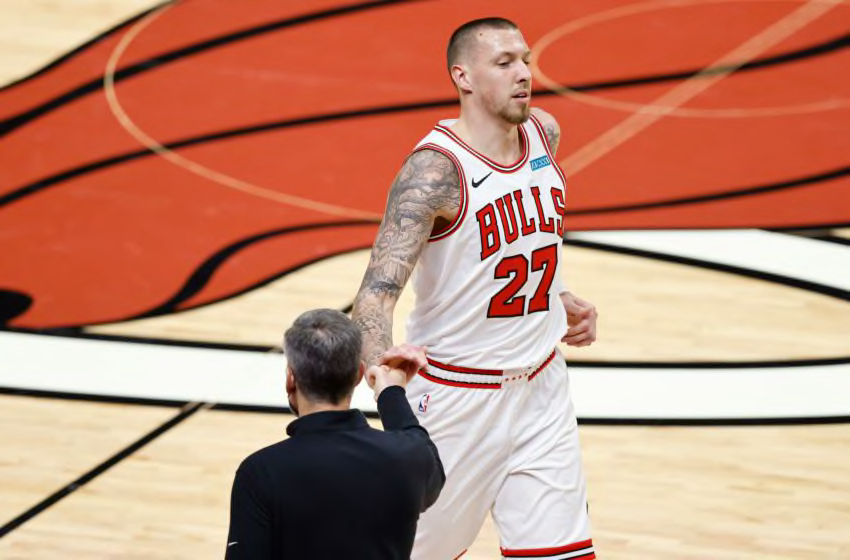
Chicago’s third move of the night came when it first looked like the Houston Rockets were going to sign Daniel Theis away from them. However, Vice President Arturas Karnisovas was able to perform a little wizardry of his own.
The Bulls didn’t just let Theis go for nothing, but ended up trading him to Houston in a sign-and-trade. In return, Chicago received a coveted trade exception. Now, the Bulls really aren’t done.
The Chicago Bulls now have plenty of options after their Daniel Theis trade.
With a trade exception in hand, the Bulls now have the ability to go after a guy like DeMar DeRozan. After they signed Caruso, it looked a bit difficult to still add someone like DeRozan.
Sure, the possibility of trading Thaddeus Young and executing another sign-and-trade with Lauri Markkanen was still there. That would open up some more flexibility. However, receiving a trade exception in the Theis deal now guarantees the Bulls will go after another significant name.
Will it be DeRozan? In all likelihood, yes. The Bulls were rumored to be suitors for DeRozan shortly before the free agency doors were opened on Monday. According to ESPN’s Brian Windhorst, Chicago was seriously looking at adding both Ball and DeRozan. Already with Ball in Chicago, the Bulls could now look to get their hands on their other top target in DeRozan.
The tough part about adding DeRozan, now, is that the Spurs likely don’t have enough space to absorb a Markkanen contract. Markkanen, of course, has had a few suitors interested in his services and the Spurs were one of them.
Chicago may have to get creative now in their quest to get DeRozan away from the Spurs, but they could be the only real suitor left for him since other teams like the Miami Heat have made significant moves already.
In addition to potentially adding DeRozan, the loss of Theis also means Chicago needs to add a backup big. It is still possible they keep both Markkanen and Young on the roster, and if they do, then they will be almost set. However, there is a lot left yet to happen.
For now, the Theis deal looks brilliant. Karnisovas was able to net a crucial, valuable asset for a backup big, and that’s just an example of what great front offices do.
On Day 1 of NBA free agency, the Chicago Bulls made the splash most fans were wanting to see, bringing in point guard Lonzo Ball. In addition to Ball, the Bulls also signed former Los Angeles Lakers guard Alex Caruso.
Following the two signings, Chicago made an incredibly underrated move in trading Daniel Theis to the Houston Rockets, in which they received a coveted trade exception back from Houston.
Now on Day 2, the Bulls are not done.
Vice President Arturas Karnisovas doesn’t seem like the type of guy to make a couple of moves on the first day and then stay quiet going forward. These are not the Bulls of years’ past. Chicago is going to continue making moves, you can bet on that.
The NBA free agent pool is anything but dried up, and the Chicago Bulls have moves left to make.
There are still plenty of names left for the Bulls, but only a few make the most sense. With their current needs, Chicago should look at adding a starting-caliber small forward and another big man. One of these few could make a lot of sense.
DeMar DeRozan
The biggest target still available for the Bulls is San Antonio Spurs small forward DeMar DeRozan. The four-time All Star is still only 31 years old and has plenty of basketball left in him, despite how it might feel.
Last year, DeRozan put up a career-high 6.9 assists while also scoring over 21 points and 4.2 rebounds per game. Because the Spurs were mostly a forgettable team, people slept on DeRozan. Make no mistake — he is still a player who can ball at a high level.
The Bulls would be able to sign-and-trade for DeRozan with the exception they secure in the Daniel Theis deal on Day 1 of free agency, making this the most coveted move left for Bulls fans.
Kelly Oubre Jr.
On the unrestricted market, Kelly Oubre Jr. is likely to get a pretty decent contract. There have been several rumored suitors for Oubre, but some of them may not be able to work out the right money with moves already being made. Oubre would be another candidate for the Bulls to execute the oh-so-popular sign-and-trade with, considering they likely couldn’t sign him outright at this point.
Talen Horton-Tucker
One of the more intriguing players left is Talen Horton-Tucker, a wing who can do a lot of things very well. The one weakness in his game is from beyond the arc, but he is a good defender and puts in a ton of effort all over the floor. It may be tough to project Horton-Tucker to the Bulls, though, considering they likely want a bigger wing at this point.
The former Iowa State standout is a restricted free agent, so the Lakers can match any offer he receives. However, their money is all but dried up at this point.
Andre Drummond
Let’s get real, here. The Lakers can’t bring back everybody, right? It seemed as though every other player rumor popping up yesterday had the Lakers connected in some way. But, the Lakers won’t be able to sign every single player rumored to be on their radar.
While Drummond makes some sense for a team like L.A. trying to win it all, he would also provide the Bulls with an excellent bench big. If he was willing to accept the right money, Drummond would be a solid get.













Leave a comment