A law firm hired to investigate gender equity concerns at NCAA championship events released a blistering report Tuesday that recommended holding the men’s and women’s Final Fours at the same site and offering financial incentives to schools to improve their women’s basketball programs.
The review by Kaplan Hecker & Fink LLP had been highly anticipated. The firm was hired in March after the NCAA failed to provide equal amenities to the teams in the men’s and women’s Division I basketball tournaments.
“With respect to women’s basketball, the NCAA has not lived up to its stated commitment to ‘diversity, inclusion and gender equity among its student-athletes, coaches and administrators,'” the report concludes.
Among other things, female players, coaches and staff criticized the NCAA for not initially providing a full weight training area for the women’s teams in San Antonio earlier this year, noting the men’s teams did not have the same problem in and around Indianapolis.
Because of the the pandemic, the NCAA made the unusual move of playing the entire men’s and women’s basketball tournaments at two sites this year.
By now, everyone knows about the Chicago Cubs and how they dismantled the core that won the World Series in 2016. It was the greatest run in the history of the organization. Now, some of the greatest players in franchise history are gone.
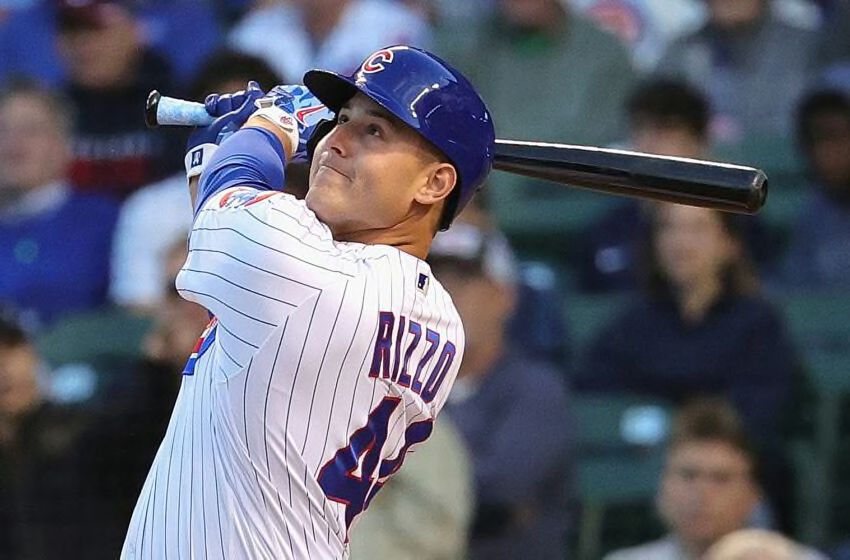
Of course, one of the players he is talking about is former Cubs’ first baseman, Anthony Rizzo. Well, on the very same station the very next day, Anthony Rizzo went on and fired back at Jed Hoyer. He was asked about his response to what Hoyer said and he didn’t seem too happy about it. He wondered why he would even say something like that.
He was also sure to point out that the things that he and his teammates have and can accomplish on the field cost money, implying that the Cubs were not willing to pay that money. He said it was like a bad breakup which is starting to seem that way. Things might have been a little messier in the negotiations than we thought.
Anthony Rizzo went on the radio and talked about the Chicago Cubs trading him.
“There is one common denominator that no one signed.” Anthony Rizzo told David Kaplan and Jonathan Hood during the interview.
It is weird to hear all of these things being said when at one point, it seemed like the Cubs were the new model franchise in Major League Baseball. Now, they are dealing with this sort of thing. Anthony did have some nice things to say about the way things went in Chicago as well during his tenure there. He is happy that this was his home for such a long time and that they had such great success.
Rizzo is not in a race for the playoffs with the New York Yankees. They are out of a playoff spot right now but they are hoping that their new additions can help them increase their chances of competing for one with the Boston Red Sox and Tampa Bay Rays. It is going to be a lot of fun to see Rizzo actually play for a team that has playoff hopes this year. As for the Cubs, they will try to pick up the pieces from this major fallout. It is going to be a long time before they are good again.
WARNING: If you talk to Lou Mongello, author, speaker, consultant, and host of the popular WDW Radio podcast, you are going to come away from that conversation feeling energized and positive. You won’t be able to help it, it will just happen.
In fact, you will feel like you’ve just spent an exhilarating day at the Magic Kingdom and are now on a Disney bus back to your resort at night, with your sleeping child’s head heavy against your chest, and the traditional “lullaby-type” music playing in the background.
Yep, that’s the feeling.
How do I know? Because that’s how I felt after talking with him.
So, with that, below are 20 takeaways from our conversation (slightly edited for length and flow). And, as always, I’m guessing that, after you read them, you’ll want to watch our full conversation.
Takeaway #1:On the gradual “a-ha” that led to his new career. “I was always in the service business, practicing law and with an I.T. consulting company and I wanted to try and make something once and resell it. So, in 2003, I set out to write and publish a book. And the thing I knew most about was Disney World. Since I first went as a kid, I’ve been fascinated by its details, secrets, and stories, so I created a trivia book. I then learned everything I could about the book publishing industry and sent out forty-seven query letters. Finally, it was accepted, which taught me that lesson that ‘all you need is one.’ Then the book turned into a website, which turned into an online community. Then I started podcasting in 2005. Finally, I took a leap of faith, left my job and moved to Florida to give whatever this thing was going to be a shot.”
Takeaway #2:On his fascination with Disney. “When you walk into the Magic Kingdom, something transformative happens and you forget about everything that’s going on in the real world. Some of the best times I had with my family was at Disney World. I was fascinated from an early age wondering what it was about the place that kept drawing us back. I read everything I possibly could. In fact, I still have my first book that I read in the back of the station wagon driving back and forth to Florida from New Jersey. That fascination continued to grow even as I became a teenager and then an adult.”
Takeaway #3:What theme ties his different past and current roles together. “This has been a very circuitous route getting from point A to whatever point I’m in now. And I realize that it always comes down to a desire to help people, whether it was, they needed help from an attorney or optimizing their business. And then eventually, they needed help planning a better Walt Disney World vacation, and so on.”
Takeaway #4:On his family’s reaction to his wanting a career all things Disney. “I wouldn’t be here without the support of my wife, Deanna, and my immediate family. You know, I wrote my book usually from 10:00 at night to two o’clock in the morning when it was nice and quiet. And then, literally, I walked upstairs one time and told my wife that I was thinking that if I really wanted to give this thing a go, I needed to be in Orlando. And the word ‘yes’ didn’t finish coming out of her mouth before I ran downstairs and started packing. I have been very blessed to have a supportive family, both immediate and extended.”
Takeaway#5:On whether he’s always had so much energy. “I actually didn’t. I’m an extroverted introvert, although I talk for a living now. I was very shy as a kid. And the energy, honestly, and I know this sounds like, you know, nonsensical ‘marketing speak,’ but it comes from the fact that I freakin’ love what I do. It gets me up early in the morning, keeps me up late at night, and like there’s times I hate weekends because I can’t get somebody on the phone. But this doesn’t feel like a job. It’s the thing that fuels my fire.”
Takeaway #6:On how and why he stays so positive. “I think positivity is contagious, and negativity is cancerous. One of the things that I love about podcasting and especially live video is that you can’t fake it. Anybody could write a blog post, but you can’t hear it in the voice and see it on their face. You know, I hate that ‘authenticity’ has become a sort of buzzword because we should be authentic all the time, but the transparency that podcasting and live video afford you as a viewer and require of you as the content creator to me is the most important thing.”
Takeaway #7:On Walt and being an entrepreneur. “I think that Walt Disney is the spokesmodel for entrepreneurism, not because of his successes, but because of the challenges and failures he faced. He was not born into anything. He came from a difficult upbringing. He’s gone bankrupt. He had his animators leave. He had work stolen from him. He’s faced all these challenges repeatedly. And, you know, there was always another mountain to climb for Walt. And I think there are there are a lot of lessons there, and I speak about this a lot in terms of lessons that we can learn, not just from the Disney company, but from Walt specifically, that I think you could apply to whether you are a middle schooler or in college or are an entrepreneur.”
Takeaway #8:On whether he has family Disney pictures around the house like I do. “I do. And I have a picture from my first visit in November of 1971, where I… well, you know, listen, I love my mother to death, but, man, she did my outfit, and my haircut was not all that awesome. So, there I was, with my curly hair and 70s clothes, sitting on Main Street. And since then, it was a picture that I would recreate by myself and with friends. And then, of course, when I had kids, I had to plop them there in that same spot.”
Takeaway #9:On his kids knowing about his love for Disney. “They do. In fact, they’ve participated on this journey with me. And don’t tell them this, but I don’t sit them down and say, well, this is the lesson that I want you to learn. I want them to learn by observing and see that you can and should take that thing you love and turn it into what you do. They’ve got the blessing, too, of tools and opportunity that maybe we didn’t know even existed or have as kids. I also want them to see that it doesn’t matter where you are in life, that you can pivot. You know, I didn’t change directions until I was later in life.”
Takeaway #10:On the impact his audience has on him. “Growing up, I did not have a lot of friends and wasn’t a popular kid in school. So, it’s very odd and humbling when somebody comes up and says, ‘Because of you, I did this,’ or ‘Because of you, this happened.’ Or, you know, part of the reasons why I do monthly meetups in the parks is not so people can come meet me but so I can meet them, and they can meet each other. But when somebody looks you in the eye and starts crying and says your podcast did this, or this episode did this, no amount of money can ever top that feeling. I say this to people all the time, whether you’re a podcast or video creator or whatever it might be, you never know who’s listening and you don’t know the positive impact you might have on somebody. And that I believe this has a wonderful ripple effect that hopefully pays itself forward.”
Takeaway #11:On building a business organically and sincerely. “I have never spent a dime on marketing, other than just sort of testing Facebook to see just how it works. I’ve never placed an ad. I don’t have a marketing funnel. I don’t have any of those things because the people who I want to be part of the community, wherever it lives, I want them to be there because they listen and say ‘I like him. This is the kind of community I want to be in.’ Or, they say to their friends, ‘Hey, I really think that you’ll like it here. I think you’ll like the kind of content that’s being put out.’ And again, forget about me being proud for not having spent money. I’m prouder of the fact, especially now, that I have no moderators in our [WDW Radio Clubhouse] Facebook group because we don’t need them. It’s a self-moderating, self-policing group, because the people who are there want to be there and came in for the right reasons.”
Takeaway #12:On having an emotional reaction like I recently wrote about after riding “Flight of Passage” and hearing from many others who felt the same way: “The same thing happened to me. Look, that’s the thing about Disney, right? It’s not the highest, fastest, longest, whatever roller coaster, it’s the way this place makes us feel, the way the movies make us feel, the way the things we read make us feel. It’s one thing for me to go and cry when I see the Millennium Falcon at Galaxy’s Edge for the first time, thinking back to watching Star Wars when it came out with my dad. But it’s different when I ride Flight of Passage and I am wiping tears away − because I have no emotional connection to the film, Avatar. The way that attraction made me feel I was flying, I had the sensation that I had never felt before. That’s the Disney difference, right? It’s the exceeding of expectations and pulling out those emotions from you that you sometimes didn’t realize you have.”
Takeaway #13:On how he went from an extroverted introvert to public speaking. “As I was sharing my career story with people, some would say, ‘You need to get up there and tell your story.’ Eventually I started speaking professionally at conferences, corporate events and events like that, whether it was about the pursuit of passion, leadership lessons we can learn from Walt Disney, exceptional customer service lessons we can learn from the Disney parks or even just practical things about content creation, podcasting, live video, and so on. I also continued to get emails from people, and met others, who said, ‘I’m trying to turn this idea that I love into this thing that I do.’ And as somebody who wants to help people, I started my own Momentum Retreat “unconference” five years ago – to work with people to help them do the same thing that I’m doing. Not specifically, but in terms of taking that thing that they are passionate about and letting it be some become something that they do full time, because I think life is too short not to do what you love every day.”
Takeaway #14:What he has seen in his workshops as the greatest barrier to someone becoming an entrepreneur. “It’s just overall, the fear comes in. Many different forms of fear – it might be the fear of rejection, the fear of failure. Plus, entrepreneurs often must work by themselves. And feeling isolated and alone is very scary. So, my workshops are not just for support, but for accountability, too.”
Takeaway #15:His Favorite Disney park: “Magic Kingdom. There’s still something unique and special about that place.”
Takeaway #16:His Favorite Disney character: “Peter Pan. He never has to grow up. He lives on this beautiful island, like hanging out with his friends. All the mermaids love him. He gets to fight pirates and wins. Oh, and by the way, he can fly.”
Takeaway #18:His Favorite Disney food: “ I love certain specific restaurants and whether it’s for the cuisine or the location. But I’ll give you the simple, albeit lame answer, grabbing a bucket of popcorn and just sitting on Main Street in the Magic Kingdom and watching people go by.”
Takeaway #19:What coincidences led him to where he is. “There are countless ones. You know, there’s the adage that everything happens for a reason. I think that that’s true. Even if that reason does not necessarily become apparent when it happens, I will tell you that the people that have come into my life because of this journey are the people who I now consider my closest friends and my extended family. Again, coming full circle from somebody who didn’t have a lot of friends. I now feel that one of the greatest blessings is that I have many friends, both physically close by as well as literally from around the world. All those people have positively impacted my journey, whether they realize it or not, one way or the other.”
His answer: “It all started with an idea. Whether it’s a dream, daydream, or a single idea, you know, Walt’s journey started with a single idea that predates Mickey Mouse. And however small or insignificant you might think that idea might be, you never know where it’s going to lead, whether it’s Walt and a character turning into the Disney company that is today or a lawyer in New Jersey who has an idea to write a book. It’s that thing that you have written down on a piece of paper, that you keep coming back to, that keeps gnawing at you. You never know where that might lead. And you will only find out by starting to take those first steps.”
Comments Note: All comments are reviewed. Any that are considered to beLou a personal attack or hate speech will be removed. In my blog, I always try to be respectful. I expect the same from my readers, both in responses to me, and about or to each other. And, again, thank you for reading.
James Warda, author of “Where Are We Going So Fast?”, is a keynote speaker who focuses on connecting to each other, and ourselves, through our moments. His background also includes being a writer and speaker for Chicken Soup for the Soul Enterprises, and a columnist for the “Chicago Tribune” and Pioneer Press.
Music fans heading to upcoming shows at the Metro will be required to show proof of vaccination in order to enter the Wrigleyville concert hall.
The popular indie and alternative music venue announced the new policy Tuesday amid concern over rising COVID-19 numbers in Chicago and other parts of the country due to the Delta variant and slowing vaccination rates.
Unlike Lollapalooza, which allowed unvaccinated attendees to enter by providing a current negative COVID-19 test, Metro says it won’t allow anyone into the venue who cannot show proof of vaccination. Everyone will also be required to show a government-issued photo ID, and it’s recommended that all patrons wear masks.
It’s possible the mask recommendation also becomes a requirement in the near future, as Metro noted “these policies are subject to change based on city and state guidelines.” Health officials are currently recommending that everyone above the age of 2 — vaccinated or not — wear masks indoors to limit spread of the Delta variant of the coronavirus.
The commissioners of the Pac-12 and Big 12 met Tuesday to discuss how the conferences might benefit from working together or maybe even merging.
Two people with knowledge of the meeting said Big 12 Commissioner Bob Bowlsby and George Kliavkoff from the Pac-12 were discussing the potential for strategic planning between the two conferences.
The people spoke to The Associated Press on condition of anonymity because the leagues were not immediately sharing details of internal discussions. The Athletic was first to report the meeting.
The remaining eight Big 12 schools — Texas Tech, TCU, Baylor, Kansas, Kansas State, Iowa State, Oklahoma State and West Virginia — are facing a huge drop in the value of their next television contract without Texas and Oklahoma in the conference.
The Big 12’s current TV deal runs out in 2025. Bowlsby told Texas lawmakers at a hearing in Austin on Monday that losing Texas and Oklahoma could slash the conference’s television revenue by about 50%. He said the TV deals accounted for about $280 million in revenue distributed to the schools.
The Pac-12’s current television deal is similar in value to the Big 12’s and expires in 2024.
Kilavkoff, a former MGM executive who took over as Pac-12 commissioner on July 1, has said the conference is in no rush to add members to a 12-member league that includes Southern California, Oregon, Stanford and Washington.
A full merger of the Big 12 and Pac-12 would create a 20-team conference.
The conferences could also consider a scheduling agreement or alliance that creates regular nonconference matchups in the high-profile sports of football and basketball as a way of potentially increasing the value of each league’s next TV deals, one of the people familiar with the meeting told AP.
A man was fatally shot Tuesday morning in East Garfield Park.
The 21-year-old was in a parking lot about 11:46 a.m. in the 3300 block of West Warren Boulevard when someone fired shots from a gray sedan, Chicago police said.
The man was struck multiple times and taken to Stroger Hospital, where he was pronounced dead, police said. He hasn’t been identified.
A professional skateboarding star from California has been charged with murder after he beat and kicked a man at a Comfort Suites in Oakbrook Terrace last week.
Terry Kennedy is being held without bond on first-degree murder charges in the death of Josiah Kassahun, 23, according to the DuPage County state’s attorney’s office.
Prosecutors allege Kennedy punched Kassahun in the head just after 11 a.m. on July 27 at the motel at 17W445 Roosevelt Road in the western suburb, causing him to fall to the ground and hit his head on the pavement.
Kennedy then kicked Kassahun, prosecutors said.
Terry Kennedy DuPage County sheriff’s office
Kassahun, from Wheaton, died Sunday at Rush University Medical Center. An autopsy found he died of blunt force injuries to his head, and the medical examiner’s office ruled the death a homicide.
At a hearing Tuesday morning, Judge Michael Reidy ordered Kennedy held without bail while he hires an attorney. The hearing was to resume Aug. 9.
Kennedy, from Long Beach, California had initially been charged with aggravated battery in a public place, threatening a public official and theft, according to court records.
Kennedy, also known as “Compton-Ass Terry,” is known for his appearances in video games and TV shows like “Viva La Bam” and “Rob Dyrdek’s Fantasy Factory.” He also has had cameo appearances in music videos featuring artists like Snoop Dogg and Pharrell.
It is understandable, at the same time, why witnesses will not put themselves in danger and cooperate with a criminal investigation.
It is not the fault of police investigators that an atmosphere of fear has been created by predators, resulting in the guilty going unpunished. Such results are further frustrated by the “bail reform” that puts shooters back on the street.
Terry Takash, Western Springs
SEND LETTERS TO:[email protected]. Please include your neighborhood or hometown and a phone number for verification purposes. Letters should be approximately 350 words or less.
Time to address failing weed management systems on Illinois farms
In the late 1990s, most Illinois farmers successfully managed weeds with just one herbicide application. Now farmers need two or three different herbicides, and some must be sprayed more than once. Why the big change in the herbicide fire-power needed to get a crop through the production season?
The reason is clear — the emergence and spread of weeds that have become resistant to herbicides. The simple and effective weed control systems used on most Illinois farms since the late 1990s have been unraveling in recent years. More herbicides mean higher costs, and more chemicals flowing into Illinois streams and rivers, and reaching drinking water resources.
Public health concerns also are rising. Two relatively high-risk herbicides — 2,4-D and dicamba — are among those farmers are turning to more regularly. Both are “possible human carcinogens” and increase the risk of reproductive problems and adverse birth outcomes.
Is rising herbicide use and exposure impacting women’s health during pregnancy and the health and development of newborn babies? I help lead the Heartland Study, a multi-state clinical research project sponsored by the Heartland Health Research Alliance. While we search for answers, steps should be taken to deepen and strengthen the science supporting pesticide regulatory decisions. One set of key reforms is discussed in HHRA’s recent paper in the science journal Environmental Health.
Our recommendations will help assure for years to come that farmers have access to safe and effective weed control systems, without creating new public health challenges. Farmers, public health specialists and Illinois political leaders should urge Congress and the Environmental Protection Agency to reform outdated laws and policies that are holding back scientific advances in pesticide risk assessment and regulation.
Charles Benbrook, executive director, Heartland Health Research Alliance
School requirements
If a parent doesn’t want a child to wear a mask to school, then send the child to a private school. Public schools are for the masses. They require many things, including vaccinations, in order to protect all of the students. The COVID-19 vaccination and masks have been added to those requirements. It’s that simple.
Mayor Lori Lightfoot says she doesn’t fear a surge of coronavirus cases tied to Lollapalooza, in part because her public health commissioner “went incognito” to the music festival without valid proof of vaccination and was turned away.
During a live interview on WVON-AM (1690) , Lightfoot said she is “well aware” of a video appearing to show young people being “waved through” the Lollapalooza gates by people who were supposed to be checking vaccination cards, but “weren’t even looking at” those credentials.
But the mayor offered a possible explanation. Once attendees were screened and showed credentials proving they’d been vaccinated, they were issued a wristband. So the video could have been people with wristbands being waved through, Lightfoot said.
Lightfoot said her confidence about the safety of Lollapalooza stems from the city’s vigilance in holding event organizers to their promised protocols and testing that system to make certain they did.
Attendees were required to either show their own vaccination card — and a valid ID proving they were the person whose name is on the card — or proof that they had tested negative for the coronavirus no more than 72 hours before the concert.
“We checked with them every single day, multiple times a day. We had our people at the screening checkpoints. And I will tell you Dr. [Allison] Arwady, the public health commissioner, kind of went a little bit incognito, didn’t have all her paperwork right and they wouldn’t let her in,” the mayor told WVON talk show host Perry Small.
“Every single day, they turned hundreds of people away — either who didn’t have the right paperwork or had an expired test that wasn’t [taken] within 72 hours. That tells me there is a rigor around the protocols that they were using to screen people.”
Fans of Modest Mouse listen to the band on day four of Lollapalooza in Grant Park on Sunday.Anthony Vazquez/Sun-Times
Gov. J.B. Pritzker talked about going to Lolla with his wife and friends, but canceled at the last minute, citing the highly-contagious Delta variant of the coronavirus.
Lightfoot, on the other hand, appeared onstage the first night, thanking attendees for “vaxxing up and masking up.” The mayor said she “went there myself to eyeball the screening” and make certain the city had public health officials at every checkpoint “to make sure they weren’t just letting people through and going through the motions.”
“Can I tell you that the system worked perfectly? No, I can’t. But every single day, we had people there looking at it, asking questions and making sure that the screening was real and meaningful. They were telling us 90% plus every day” had shown proof of vaccination, Lightfoot said.
University of Chicago epidemiologist Dr. Emily Landon had argued that during a surge in cases tied to the Delta variant it was a “bad idea” for Lightfoot to allow hundreds of thousands of young people to jam together in front of multiple stages in Grant Park.
But Tuesday, Lightfoot said she has “no regrets” about green-lighting the festival, a major money-maker for Chicago that filled hotels and restaurants.
Two days after it ended, the mayor remains confident Chicago’s premier music festival — the largest of its kind in the world this year — will not turn out to be a “super-spreader” event. She argued just the opposite.
“We worked with the Lollapalooza people ahead of time to incentivize people to get vaccinated,” Lightfoot said.
“So I’m confident that thousands of people — mostly young people, which is our toughest demographic — got vaccinated simply because they wanted to go to Lollapalooza.”
Lightfoot said her decision on Lollapalooza was “based upon on data and modeling that showed a modest uptick” in the Delta variant.
“The Delta variant has been with us for quite a long time. This is not news. The media is now latching upon it, mostly because it’s attacking people who are unvaccinated. And what we’re also seeing is, people who have been on the fence or saying, ‘No. Not me,’ actually coming off the fence and saying, ‘This Delta variant scares me. I’m getting vaccinated,'” the mayor said.
Lightfoot said she doesn’t want to “force people to get a vaccine” or use “scare tactics.”
But, she added: “The data is real and the data is scary. … 97% of the people that are dying in Chicago are people that are unvaccinated. If that doesn’t give you an incentive to educate yourself and get off the wall and get vaccinated, I don’t know what else can.”
Not following New York on vaccination requirements yet
New York City is phasing in a requirement that residents show proof of COVID-19 vaccinations before entering a bar, restaurant or gym.
Lightfoot is hesitant to go there. She noted some Chicago restaurants and bars already deny entry to customers without proof of vaccination.
“That’s only going to spread,” she said, in part because customers are saying, “If you’re not vaccinated, I don’t want to be near you.”
But Chicago is nowhere near another shutdown.
“We’re seeing a modest uptick in [intensive care patients] and hospitalizations, but not to the point where we’re worried about our health care system buckling,” she said.
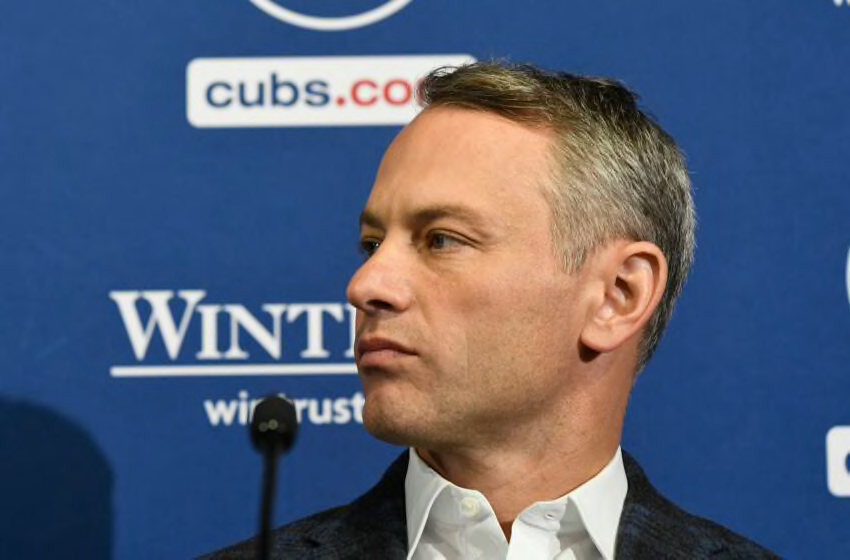
CHICAGO, ILLINOIS – OCTOBER 28: Jed Hoyer, general manager of the Chicago Cubs at a press conference introducing David Ross as the new manager of the Chicago Cubs at Wrigley Field on October 28, 2019 in Chicago, Illinois. (Photo by David Banks/Getty Images)
The Kap and J-Hood Show is the program where he appeared. David Kaplan and Jonathan Hood asked him everything that Cubs fans want to know about the last week of Chicago Cubs transactions and what it means for the future.
Of course, the Cubs traded Anthony Rizzo, Javier Baez, and Kris Bryant to the New York Yankees, New York Mets, and San Fransisco Giants respectfully. The most important things that Jed Hoyer said on the show revolved around the contract negotiations involving those three players. He wanted to shut down the narrative that they wanted to be there.
He claims that there were plenty of offers but not many counteroffers or a serious interest to sign on the part of the players. Without directly saying it, he implied that those three players didn’t actually want to stay in Chicago.
It appears that the Chicago Cubs were not close to getting deals done with their stars.
It was crazy when he brought up Lance Lynn and his situation with the Chicago White Sox. Hoyer made it a point to talk about how the White Sox and Lynn came to an agreement on a contract with ease after realizing both sides wanted a deal done. It sounds like he wishes his guys would have had the same level of want to be with this team. It never happened and now it is time to move on.
How does Jed Hoyer “move on” from this? Well, it doesn’t sound like he subscribes to the term “rebuild”. However, this is clearly a rebuild. Nick Madrigal and Nico Hoerner are good players but they likely aren’t going to be superstars. The only player worth building around is Willson Contreras who only has one year on his deal as well. That is the definition of a rebuild.
If there is anything that Jed can do this offseason that would come off as smart, it would be to make sure that he is transparent with what they are doing. This ship has sunk fast and based on his conversation with Kap and J-Hood, it isn’t getting fixed anytime soon. All Cubs fans should be checking out the interview for the full experience.



:no_upscale()/cdn.vox-cdn.com/uploads/chorus_asset/file/22758950/Screenshot_2021_08_03_132610.jpg)
:no_upscale()/cdn.vox-cdn.com/uploads/chorus_asset/file/22755341/LOLLASUN_080221_57.JPG)