Videos

Top 5 Swizzle DrinksLynette Smithon August 5, 2021 at 1:15 pm

1 Swizzle of Broken Dreams

Three Dots and a Dash

Kevin Beary’s swizzle delivers a complex, fruity punch, thanks to Guyanese rum (finished in Pineau des Charentes casks to add sweetness and red fruit flavors), peach liqueur, lime, and a layer of port floating on top. Spices from the port and muddled mint give it earthy depth. $15. 435 N. Clark St., Near North Side

2 Queen’s Park Swizzle

Good Measure

Kristina Magro has perfected this classic version (which features mint, lime, and an angostura float) by using a blend of rums, including Plantation’s OFTD, a caramelly overproof rum. $13. 226 W. Chicago Ave., Near North Side

3 Swizzle 33

Scofflaw

In its nine years, Scofflaw has always had a swizzle on the menu. This one, its 33rd, packs in Zhumir, a funky Ecuadorian spirit, Jamaican rum, and apricot and gentian liqueurs. Coconut and lime round it out. $10. 3201 W. Armitage Ave., Logan Square

4 Jungle Kitty

Arbella

Eric Trousdale swizzles rum and a grapefruit, eucalyptus, and chamomile kombucha with lime, pineapple, Campari, and hibiscus syrup for a zippy cocktail with a gently bitter edge. $15. 112 W. Grand Ave., River North

5 Sadie’s Pockets

Proxi

Jess Sandberg eschews rum entirely in this tropical number, opting instead for blended Scotch, which she mixes with toasted cashew orgeat, banana, and lemon, then tops with an angostura float. $14. 565 W. Randolph St., West Loop

Read More

Top 5 Swizzle DrinksLynette Smithon August 5, 2021 at 1:15 pm Read More »

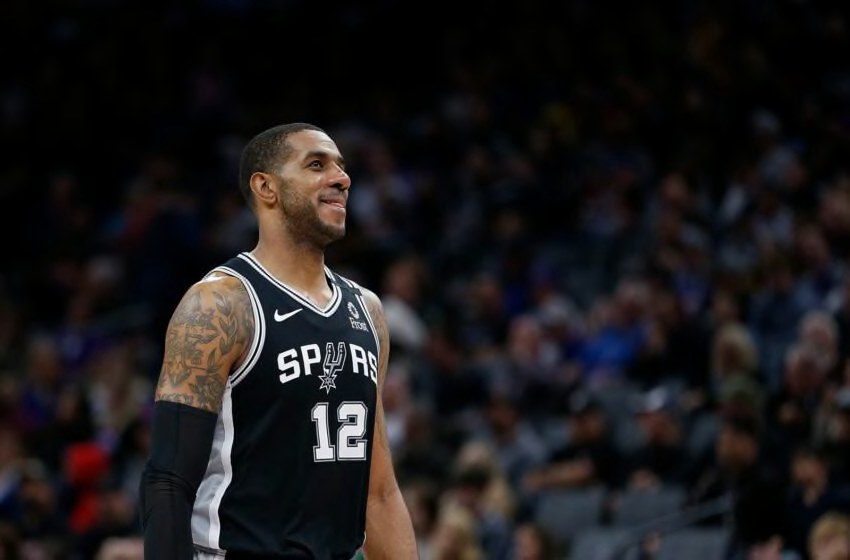
Rumor: Chicago Bulls may be in play for a Lamarcus Aldridge comebackRyan Heckmanon August 5, 2021 at 1:00 pm

Read More

Rumor: Chicago Bulls may be in play for a Lamarcus Aldridge comebackRyan Heckmanon August 5, 2021 at 1:00 pm Read More »

You are a bad-tempered, surly, argumentative, self-centered, cranky and cantankerous old geezer and that’s just for starterson August 5, 2021 at 1:00 pm

Cheating Death

You are a bad-tempered, surly, argumentative, self-centered, cranky and cantankerous old geezer and that’s just for starters

Read More

You are a bad-tempered, surly, argumentative, self-centered, cranky and cantankerous old geezer and that’s just for starterson August 5, 2021 at 1:00 pm Read More »

1 killed, 17 wounded in shootings in Chicago WednesdaySun-Times Wireon August 5, 2021 at 9:33 am

Eighteen people were shot, one fatally, in Chicago Wednesday.

The fatal attack occurred inside a West Pullman home on the Far South Side. Two gunmen entered the home in the first block of East 118th Place and opened fire about 4 p.m., Chicago police said. Maurice Morris, 34, was struck in the head and pronounced dead at the scene.

Other shootings:

  • Two men were shot in Gresham on the South Side. About 11:30 p.m., they were standing on the street in the 8100 block of South Elizabeth Street when someone inside a passing black sedan fired at them, police said. A 19-year-old man was struck in the left leg and taken to the University of Chicago Medical Center in good condition. A 46-year-old man was struck in the right arm and taken to the same hospital in good condition.
  • Minutes earlier, two men were shot in South Chicago on the South Side. About 11:05 p.m., they were in the 8800 block of South Burley Avenue when someone fired at them, police said. A 38-year-old man was struck in the buttocks and a 42-year-old man was struck in the left arm. The 38-year-old was brought to the University of Chicago Medical Center in good condition, while the older man was taken to Trinity Hospital in good condition.
  • A 29-year-old man was shot during an attempted robbery in Lawndale on the West Side. About 10:40 p.m., he was in the 3000 block of West Flournoy Avenue when he was shot in the back by three people who were attempting to rob him, police said. He was taken to Mount Sinai Hospital in serious condition.
  • A 13-year-old boy and another teen were shot in East Garfield Park on the West Side. The two were sitting in the back of a car around 7 p.m. in the first block of North Hamlin Avenue when someone opened fire, police said. The 19-year-old victim was shot in his left land and the 13-year-old was shot in his neck. Both were dropped off by a friend at Rush University Medical Center, where the 19-year-old’s condition was stabilized. The 13-year-old was transferred to Stroger Hospital in critical condition.
  • About 30 minutes earlier, a woman was shot in South Shore on the Far South Side. The woman, 42, was in an apartment when she was shot in the chest just before 6:35 p.m. in the 7800 block of South Constance Avenue, police said. She was taken to the University of Chicago Medical Center in critical condition.
  • A man was wounded while riding in a car in West Town on the Near West Side. The man, 28, was riding in a car just before 6 p.m. in the 300 block of North Loomis Street, when someone opened fire, police said. The man was shot in the left leg and groin. He was taken to Stroger Hospital in critical condition.

Eight others were wounded in shootings citywide.

Two people were killed, and 11 others were wounded, in shootings Tuesday in Chicago.

Read More

1 killed, 17 wounded in shootings in Chicago WednesdaySun-Times Wireon August 5, 2021 at 9:33 am Read More »

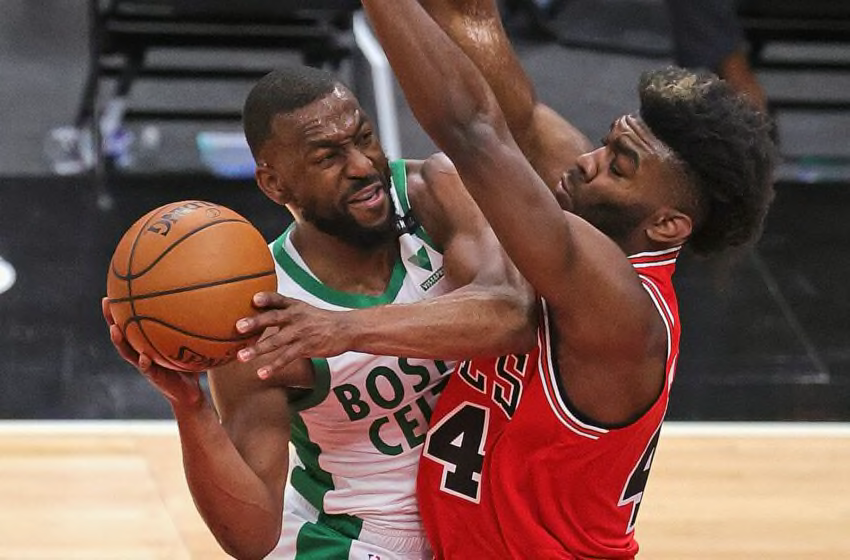
Chicago Bulls: How Kemba Walker signing impacts the BullsAnish Puligillaon August 5, 2021 at 12:00 pm

Read More

Chicago Bulls: How Kemba Walker signing impacts the BullsAnish Puligillaon August 5, 2021 at 12:00 pm Read More »

Sasha Daltonn, jazz singer and founder of the Chicago Gospel Music FestivalJamie Ludwigon August 5, 2021 at 11:00 am

COURTESY SASHA DALTONN

Sasha Daltonn (alternately spelled Dalton) is a Chicago-based singer, writer, and producer, and in 1985 she founded what is now known as the Chicago Gospel Music Festival. This summer, she’ll publish her latest book, Unplugged: The Untold Story of Chicago’s Gospel Music Festival–just in time for the city to honor her at the Chicago in Tune gospel showcase in Millennium Park on September 3.


I’m a product of Hyde Park. Hyde Park High School counts me as an alumni, but I actually graduated from Central YMCA because they didn’t have any gym classes and I was afraid to swim. My mother’s sister was a singer named Mary Brooks. She and her husband had an act in the early 50s, and I’d sometimes travel with them during summer vacation. They’d teach me a song or dance and make me part of their show. I always wanted to be in show business.

In 1979, the Bilandic administration introduced the Artists in Residence Program (AIR) to provide full-time employment for artists. I was hired as a singer, and I later developed several artistic programs. We performed and provided art programming for the schools, the Chicago Park District, seniors, and more. When I left, I started my own theater company called Chicago Enrichment Theater, which provided similar services.

I’ve always believed that education is possible through the arts, specifically theater, and my passion for sharing Black history led me to write Runnin’ With the Eight Ball, a show about three boys who are thinking about dropping out of school. Over a lively game of pool with Bronzeville seniors, they get a great lesson on the Black history of Chicago, from Jean Baptiste DuSable to Harold Washington. I included a flashback of the Club DeLisa, which had been at 55th and State. It’s always compared to New York’s Cotton Club, and well-known celebrity entertainers performed there.

I wrote the show to appeal to students, but adults started coming, and they loved the segment on the DeLisa. This led to my idea for a show about the club. I found the son of owner Mike DeLisa and asked for his permission. I began researching the club and the artists who performed there, including Dinah Washington–but I couldn’t find as much about her as the others. My interest in her story piqued, I started writing a show called Dinah and Her Music. She was from Chicago. I met her mother and sisters and interviewed everyone here who knew her. I was becoming obsessed.

There hadn’t been a show on Dinah Washington, although she was the most-recorded Black female from 1943 until her death in 1963. I finally found a young lady I thought would be perfect to portray her. As I gave her all this information, she said, “All I want to know is how much you’re going to pay me.” I was so upset I snatched the script and said, “I’ll do it myself.” I changed the name of the show to Sasha Sings Dinah. I had no plans to sing. My one-woman show Madame Hortense had been nominated for the Joseph Jefferson Citation (for best actress), but I was never as passionate about singing as I was about developing shows and producing. Now I’ve opened my big mouth, and I’ve got to do this show.

My mother supported everything I did, but she wasn’t that interested in me being an entertainer. She thought I should complete college, get a job teaching school, and maybe do this on the side. But she came to opening night on June 8, 1980, and said, “Oh, honey, I can see that this is going to be great for you.” That night there was a fire in her home, and she was overcome by smoke. Those were the last words I ever heard her speak. She died that November from the effects of smoke inhalation–I’m only now able to talk about what happened.

The show was a big success. It ran for 18 months, and when it closed I was tired. I’d never properly mourned my mother’s death. A New York producer, Woodie King, introduced himself to me on closing night and said, “You need to be in New York.” I just wanted to go home and rest, but I could hear my mother’s voice in my head saying “this is going to be great for you,” so I agreed.

While King raised financing for the show, the Harold Washington mayoral campaign was gaining support. The groundswell for a Black mayor began with Jane Byrne’s broken promises to the Black community, who she had promised to support during her campaign. When Reverend Jesse Jackson mentioned this to her, she told him that she didn’t owe them anything. He reported this on the radio, and a caller suggested boycotting ChicagoFest, a 12-day music festival at Navy Pier that also raised money for the city. They booked all the top artists, including Stevie Wonder and Frank Sinatra. When Reverend Jackson called for a boycott, Stevie Wonder was the first artist to join. A lot of artists boycotted that year. Some performed under protest. Some would say the boycott wasn’t a success, but it was; the city lost millions of dollars. It was one of the things that fuelled Washington’s journey to becoming mayor in 1983.

During the campaign, I volunteered with a group called Artists for Washington. After the election, I went to New York to do my show Dinah! Queen of the Blues, but I came back to Chicago to accompany my aunt at a fundraising event.

During that trip I attended a private party for Mayor Washington. I knew that in 1973, he’d introduced a bill in the state legislature to make Illinois the first state to celebrate Dr. King’s birthday as a provisional holiday. At this party, I said, “Next year Dr. King’s birthday will be a national holiday. Why don’t you get a jump on the nation again and do a big Dr. King event? You can have an all-day celebration and a meeting with the gangs under the banner of nonviolence and end with a concert.”

He said, “That’s a good idea. We can start with an interfaith breakfast. You’ve got to do this.” I said, “Oh no, I’m going back to New York next week.” But I stayed. The Dr. King celebration began with the first Dr. King Interfaith Breakfast, followed by an all-day event at Medinah Temple. We brought Chicago gang leaders and some of their troops together for a discussion on nonviolence with Oprah Winfrey and Stevie Wonder, moderated by John Davis of CBS Channel 2. Stevie Wonder performed that evening in concert.

After the event, I was preparing the final report and about to return to New York when a gentleman from the Illinois Arts Council came to my office. He was trying to get the Governor’s Award for the Arts for Professor Thomas Dorsey, and the committee wanted more recommendations. I didn’t know that Professor Dorsey was still alive, but I said OK and I wrote two letters, one for me and one for the mayor, on his behalf.

After the governor approved the award in March 1985, I suggested that the mayor do something bigger. He asked, “What do you think?” I said, “Do a gospel festival and call it the Dorsey Gospel Festival.” He said, “That’s a brilliant idea, Sasha! When do you want to do it?” I said, “I don’t want to do it at all, but it should be done over Father’s Day weekend, since he’s the father of gospel music.” He said, “Can you do it that fast?” I said, “No, I’m going back to New York.” But he said it was my idea and I had to do it. I returned to the Special Events office, only to be informed that the city could only provide $5,000 and city services. The Dorsey festival would be part of the mayor’s new Neighborhood Festival Program, which replaced Jane Byrne’s ChicagoFest and supported neighborhoods in producing their own events. We decided to present it at the South Shore Country Club (now South Shore Cultural Center).

When I was the point person for the Dr. King breakfast, people from the religious community were upset because I wasn’t really connected to the religious community. I was known as a jazz singer, and now the city was doing a gospel festival and they put a jazz singer over it. Some demanded my removal, but the mayor said no.

Now that I had to do this gospel festival, I was nervous. It would be impossible for anyone to produce a gospel festival without support from the religious community–let alone with only $5,000. I thought, “I need to form a committee, exactly like Washington’s campaign committee, to help build this festival.”

First, I went to Reverend Clay Evans, the most respected Black minister in the city and known as “Chicago’s pastor.” He agreed to support this effort. Then I went to Jim Fletcher, the president of Shore Bank, and he found us a sponsor. Then I went to Albertina Walker, the most prominent, most well-known gospel artist in the city, and I asked her to join my committee.

I went to other people who had been involved with the Washington campaign who were movers and shakers with a commitment to doing something right and understood the importance of the event. We weren’t only honoring Professor Dorsey–this was a major event introduced by the first Black mayor of the city, and it needed to be outstanding.

The crowd at the fifth Chicago Gospel Festival, held in Grant Park in 1989 - COURTESY SASHA DALTONN

The first year we had 35,000 people at the South Shore Country Club. I had pulled off in two months what usually takes nine or ten months to a year. The second year there were so many people they couldn’t all get in. We couldn’t contain the crowds anymore. So the third year, 1987, we moved it to Grant Park and renamed it the Chicago Gospel Festival.

At that point we had to deliver an audience of at least 60,000 people a day to be considered successful, because now we were considered a major Chicago event and we’d be compared to the Blues and the Jazz Festivals. We had to expand our thinking to reach an audience of that size. We had two stages with 16 hours of programming, and we had to be all-inclusive. That year I brought in Clifton Davis, who starred on the TV show Amen, Billy Preston, who everybody–Black, white, Hispanic–knew and loved, and singer Linda Hopkins. I brought in white artists. Mayor Washington said he was mayor for all Chicago, so all Chicago communities and ethnic groups were represented. The fifth year, 1989, was my last year, and it was the biggest festival in the history of Chicago. We featured an excerpt of the Pulitzer Prize-nominated production The Gospel at Colonus, and our attendance was over 100,000 people.

Gospel music brings people together. I objected to the idea of combining the Gospel and Blues Festivals because they had different audiences. But blues people like gospel, jazz people like gospel, and gospel people like blues and jazz music. One reason I think we were successful is that we brought all kinds of people together under one umbrella. We never had a problem.

It became something revolutionary. We weren’t the only gospel event, but to my knowledge we were the only city that presented a gospel festival and had the attendance we had–and it was free.

I’m still involved with the gospel community today and attend the Apostolic Church of God. I’m on the board of directors of the Gospel According to Chicago (GMAC) and occasionally sing with the Dr. Lou Della Evans-Reid Gospel Choir. While I’m no longer affiliated with the Gospel Festival, commissioner Mark Kelly felt I should be honored as the festival’s founder. I’m very grateful for that, and I appreciate the city sincerely. Founding the Chicago Gospel Music Festival is a blessing and one of the highlights of my life. So is the Dr. King Interfaith Breakfast, which I produced for five years.

It’s been a spiritual journey for me. You never know where you’ll end up when you start down a path. I eventually went back to school to finish my degree, and I started working on a master’s in ministry. And I started my own company, Royal Productions; we’ve designed, produced, and booked major events, served as talent coordinators, and booked major talent.

The industry has changed so much, but I still say trust your gut. There’s nothing like a good idea. If you have an idea, explore it, give it all you have, and put people together who can help you. No man is an island. Surround yourself with like-minded people and keep the faith. Eventually your dream will be realized–dreams are the seedlings of reality. v

Read More

Sasha Daltonn, jazz singer and founder of the Chicago Gospel Music FestivalJamie Ludwigon August 5, 2021 at 11:00 am Read More »

Fact-check: Downstate Republican’s claim on Nancy Pelosi’s Jan. 6 security role forgets someone — Mitch McConnellKiannah Sepeda-Miller | Better Government Associationon August 5, 2021 at 11:00 am

As the Democrat-led investigation into the Jan. 6 attack on the Capitol devolves even further into an exercise of political finger pointing, U.S. Rep. Rodney Davis of downstate Illinois has joined a chorus of Republicans trying to shift blame for security failures to House Speaker Nancy Pelosi, D-Calif.

Davis — originally picked to serve on the House panel before House Minority Leader Kevin McCarthy pulled all five of his appointees in protest — appeared with a group of House Republicans at a news conference just hours before the July 27 hearings began.

Davis, a Taylorville Republican who has been named a potential contender for governor in Illinois, called out what he alleged were structural problems preventing Capitol police from making critical decisions during the crisis.

“The chief of police cannot make a final security decision without going to political appointees that make up the Capitol Police Board — his or her bosses,” Davis said. Specifically, he pointed to the fact that then-House Sergeant-at-Arms Paul Irving requested Pelosi’s permission to seek support from the National Guard that afternoon:

“If Sergeant-at-Arms Irving felt he needed the speaker’s approval then, what were the instructions and conversations he had with the speaker’s office prior to Jan. 6?” Davis said.

“Former Capitol Police Chief Steve Sund has testified that Irving was concerned as many have said about the ‘optics,’ and we know that the speaker’s office was calling the shots on all of their actions on Jan. 6.”

U.S. Rep. Rodney Davis, R-Ill., speaks during a news conference in front of the U.S. Capitol on July 27.
U.S. Rep. Rodney Davis, R-Ill., speaks as. left to right, House Minority Leader Rep. Kevin McCarthy, R-Calif.; House Republican Conference Chair Rep. Elise Stefanik, R-N.Y.; Rep. Jim Banks, R-Ind., Rep. Jim Jordan, R-Ohio; House Minority Whip Rep. Steve Scalise, R-Louisana; Rep. Kelly Armstrong, R-N.D., and Rep. Troy Nehls, R-Texas, listen during a news conference in front of the U.S. Capitol on July 27.
Alex Wong/Getty Images

PolitiFact and other fact checkers have debunked numerous claims contending Pelosi alone was responsible for Capitol security. Davis’ claim pointed to the speaker’s role in directing Capitol security leaders, rather than all of Capitol security. But it’s still highly misleading.

Pelosi no more responsible for Capitol security decisions than McConnell

The House and Senate sergeants-at-arms, who are nominated by each chamber’s leader and elected by chamber members, serve as the Capitol’s chief law enforcement officers for their respective chambers. Each makes decisions for the Capitol Police Board, which oversees the Capitol’s police force in concert with several House and Senate committees, including one on which Davis sits.

The House sergeant-at-arms reports to the House speaker just as the Senate sergeant-at-arms reports to the Senate majority leader, but there is no indication Pelosi controls day-to-day security operations. So we reached out to Davis’ office to ask what he was talking about.

Citing a Feb. 1 letter from Sund to Pelosi, Davis spokesman Aaron DeGroot responded in an email that the former police chief “alone could not request National Guard support because he ‘had no authority to do so without an Emergency Declaration by the Capitol Police Board.’ Requesting National Guard support is a major security decision, and it’s one that even the Speaker’s office admits they were involved in.”

That description is accurate. According to a bipartisan Senate report on the Jan. 6 attack, the Capitol police chief “has no unilateral authority to request assistance from the National Guard” and “must submit a request for assistance to the Capitol Police Board for approval.” Likewise, as DeGroot noted, Pelosi’s office has said Irving did request the speaker’s permission to call on the National Guard.

However, those facts do not prove Pelosi made all the calls on how Sund, Irving, and the other members of the Capitol Police Board responded to the crisis — most notably because then-Senate Sergeant-at-Arms Michael Stenger, who reported to then-Senate Majority Leader Mitch McConnell at the time, also played an active role.

Speaker of the House Nancy Pelosi and Senate Majority Leader Mitch McConnell attend a Congressional Gold Medal ceremony at the U.S. Capitol on Jan. 15.
Drew Angerer/Getty Images

As Sund noted in his letter to Pelosi, the police chief “notified the two Sergeant at Arms” around 1 p.m. on Jan. 6 that he “urgently needed support.” Despite confusion over the statutory process for requesting National Guard assistance, both Irving and Stenger eventually approved Sund’s request to call for backup at 2:10 p.m., according to the Senate report.

Prior to that approval being granted, the New York Times reported, aides to both congressional leaders “were perplexed to learn that the two sergeants-at-arms had not yet approved the request for troops, according to spokesmen for Mr. McConnell and Ms. Pelosi.”

Supporters of Donald Trump scale the west wall of the U.S. Capitol on Jan. 6.
Associated Press

“The speaker expects security professionals to make security decisions and to be informed of those decisions,” Pelosi spokesman Drew Hammill told the Times.

Our ruling

Davis said “we know that the speaker’s office was calling the shots on all of” the actions taken by the officials in charge of Capitol security on Jan. 6.

As evidence, his office highlighted the fact that then-House Sergeant-at-Arms Irving requested approval from Pelosi before greenlighting the Capitol police chief’s request to call in the National Guard.

But Davis and his spokesman ignored a critical detail: the decision to approve that request and call for backup was not Irving’s call alone. It was made in conjunction with the Senate sergeant-at-arms, who reports to the Senate majority leader. At the time, that was McConnell.

We rate Davis’ claim Mostly False.

MOSTLY FALSE – The statement contains an element of truth but ignores critical facts that would give a different impression.

Click here for more on the six PolitiFact ratings and how we select facts to check.

The Better Government Association runs PolitiFact Illinois, the local arm of the nationally renowned, Pulitzer Prize-winning fact-checking enterprise that rates the truthfulness of statements made by governmental leaders and politicians. BGA’s fact-checking service has teamed up weekly with the Sun-Times, in print and online. You can find all of the PolitiFact Illinois stories we’ve reported together here.

Sources

House Republican press conference, C-SPAN, July 27, 2021

“No, Capitol security is not only Pelosi’s responsibility, but she bears some,” PolitiFact, Feb. 25, 2021

“Posts falsely cite Pelosi as responsible for security during Capitol insurrection,” The Associated Press, Jan. 20, 2021

“Fact checking Rep. Jordan’s claim that Speaker Pelosi was responsible for US Capitol security on January 6,” CNN, July 21, 2021

“Fact check: Nancy Pelosi wasn’t ‘in charge’ of Capitol Police on Jan. 6,” USA Today, July 27, 2021

Capitol Police Board overview, United States Capitol Police, accessed Aug. 4, 2021

Capitol Police oversight, United States Capitol Police, accessed Aug. 4, 2021

About page, Committee on House Administration, accessed Aug. 4, 2021

Letter from Sund to Congressional leaders, Feb. 1, 2021

Email: Aaron DeGroot, Davis spokesperson, July 28, 2021

“Examining the U.S. Capitol Attack: A Review of the Security, Planning, and Response Failures on January 6,” U.S. Senate committees

“The Lost Hours: How Confusion and Inaction at the Capitol Delayed a Troop Deployment,” New York Times, Feb. 21, 2021

Read More

Fact-check: Downstate Republican’s claim on Nancy Pelosi’s Jan. 6 security role forgets someone — Mitch McConnellKiannah Sepeda-Miller | Better Government Associationon August 5, 2021 at 11:00 am Read More »

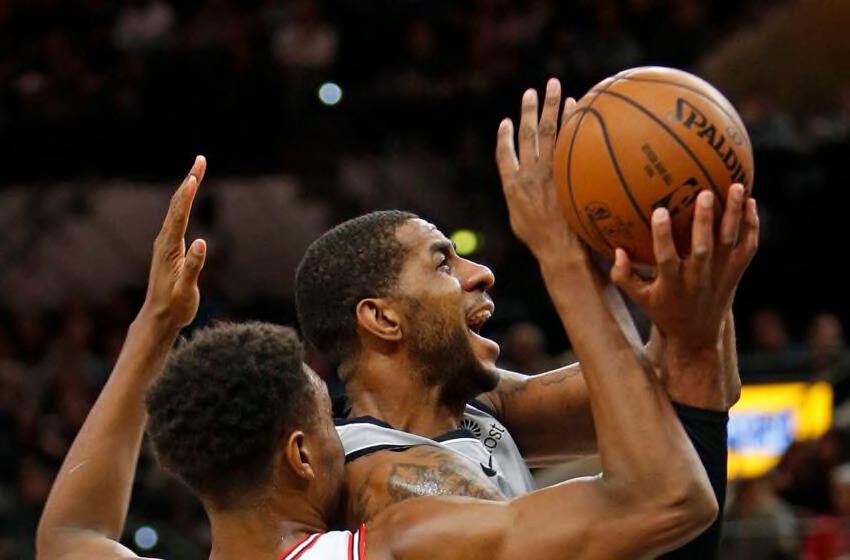
Chicago Bulls: LaMarcus Aldrige rumor forecasted aggressive offseasonAnish Puligillaon August 5, 2021 at 11:17 am

Read More

Chicago Bulls: LaMarcus Aldrige rumor forecasted aggressive offseasonAnish Puligillaon August 5, 2021 at 11:17 am Read More »

‘Vivo’: Fun musical’s hero looks like a lemur and sounds like Lin-Manuel MirandaRichard Roeperon August 5, 2021 at 10:30 am

Whether it’s “Hamilton” or “In the Heights” or even the “I Do Not Like This Man” number from “Fatwa! The Musical” in “Curb Your Enthusiasm,” there is something instantly catchy and memorable and unique about the musical stylings of the one and only Lin-Manuel Miranda. Five seconds into anything featuring the music and/or voice of Miranda, and we know that’s him and we love it and we’re immediately tapping our toes and nodding our heads in time with the tune.

Even when Miranda is a computer-animated kinkajou, he’s an infectiously catchy computer-animated kinkajou, as evidenced in the Sony Pictures Animation musical “Vivo,” released by a little streaming company you might have heard of, goes by the name of Netflix. Miranda contributed 11 original songs and is the voice of the title character, an energetic and sweet if sometimes bumbling little rainforest creature who is out of his element in more ways than one throughout this journey, but always perseveres, thanks to his strong spirit and warm heart.

Directed by Kirk DeMicco with beautiful cinematography from Yong Duk Jhun (and a visual consulting credit to the legendary Roger Deakins), “Vivo” is a gorgeous, candy-colored visual feast that begins in Havana, where the elderly and beloved town square singer Andres (Juan de Marcos Gonzalez) performs every day with his faithful kinkajou partner Vivo. When Andres receives a letter from his long-ago musical collaborator Marta Sandoval (Gloria Estefan), who has become a superstar and is about to perform a farewell concert in Miami, he decides he must go to her and tell her he’s been in love with her all this time. This will be Andres’ last chance to share the song he wrote for Marta so many years ago.

Tweenage Gabi (voiced by Ynairaly Simo) helps Vivo on his mission to Miami.
Sony Pictures Animation

Alas, and spoiler alert, Andres dies on the eve of his journey. (Cue a memorial service that will have you tearing up unless you’re dead.) A heartbroken Vivo makes it his mission to somehow find a way to Miami and deliver that song to Marta, and he hitches a ride with Andres’ niece Rosa (Zoe Saldana) and Rosa’s tweenage daughter Gabi (Ynairaly Simon), and because this is one of those animated movies where we can hear the animals talking but the humans IN the movie can’t, Vivo is facing quite the uphill challenge. Also, Rosa and Gabi live in Key West (which comes to fantastic animated life) and the concert is some 31/2 hours away in Miami, so there’s that.

“Vivo” strays this way and that, and younger viewers might get restless in the middle sections where Gabi and Vivo must cross the Everglades and they have to deal with a trio of Gabi’s peers who are out to get her but eventually become her friends, not to mention a monstrous python voiced by Michael Rooker and a couple of daffy spoonbills played by Brian Tyree Henry and Nicole Byer. But through it all, the Latino-influenced ballads, dance numbers and hip-hop numbers infuse the story with great life, and how can anybody possibly resist Lin-Manuel Miranda as a kinkajou with a tiny hat?

Read More

‘Vivo’: Fun musical’s hero looks like a lemur and sounds like Lin-Manuel MirandaRichard Roeperon August 5, 2021 at 10:30 am Read More »

1 killed, 17 wounded, in shootings Wednesday in ChicagoSun-Times Wireon August 5, 2021 at 9:33 am

Seventeen people were shot, one fatally, Wednesday in Chicago, including a man who was shot to death inside a West Pullman home on the Far South Side.

The man, 34, was inside a home about 4 p.m. when two gunmen entered and opened fire in the first block of East 118th Place, Chicago police said. He was struck in the head and was pronounced dead at the scene. He was identified as Maurice Morris by the Cook County medical examiner’s office.

In non-fatal shootings, two men were shot in Gresham on the South Side. About 11:30 p.m., they were standing on the street in the 8100 block of South Elizabeth Street, when someone inside a passing black sedan fired shots at them, police said. A 19-year-old man was struck in the left leg and taken to the University of Chicago Medical Center in good condition. A 46-year-old man was struck in the right arm and taken to the same hospital in good condition.

Minutes prior, two men were shot in South Chicago on the South Side. About 11:05 p.m., they were in the 8800 block of South Burley Avenue, when someone fired shots at them, police said. A 38-year-old man was struck in the buttocks and a 42-year-old man was struck in the left arm. The 38-year-old was brought to the University of Chicago Medical Center in good condition, while the older man was taken to Trinity Hospital in good condition.

A 29-year-old man was shot during and attempted robbery Wednesday in Lawndale on the West Side. About 10:40 p.m., he was in the 3000 block of West Flournoy Avenue, when he was shot in the back by three males who were attempting to rob him, police said. He was rushed to Mt. Sinai Hospital in serious condition.

Two males — including a 13-year-old boy — were shot in East Garfield Park on the West Side. The two were sitting in the rear of a vehicle around 7 p.m. in the first block of North Hamlin Avenue when someone opened fire, police said. The 19-year-old victim was shot in his left land. The 13-year-old was shot in his neck. Both were dropped off by a friend at Rush University Medical Center, where the 19-year-old’s condition was stabilized. The 13-year-old was transferred to Stroger Hospital and is listed in critical condition.

About thirty minutes prior, a woman was shot in South Shore on the Far South Side. The woman, 42, was in an apartment when she was shot in the chest just before 6:35 p.m. in the 7800 block of South Constance Avenue, police said. She was taken to the University of Chicago Medical Center and is listed in critical condition.

A man was wounded while riding in a vehicle in West Town on the Near West Side. The passenger, 28, was riding in a vehicle just before 6 p.m. northbound in the 300 block of North Loomis Street, when someone opened fire, police said. The man was shot multiple times in his left leg and groin. He was taken to Stroger Hospital and is listed in critical condition.

Eight others were wounded in shootings citywide.

Two people were killed, and eleven others were wounded, in shootings Tuesday in Chicago.

Read More

1 killed, 17 wounded, in shootings Wednesday in ChicagoSun-Times Wireon August 5, 2021 at 9:33 am Read More »