What’s New

Fishing is good in the NorthwoodsDon Dziedzinaon June 10, 2020 at 6:59 pm

Back in the Outdoors

Fishing is good in the Northwoods

Read More

Fishing is good in the NorthwoodsDon Dziedzinaon June 10, 2020 at 6:59 pm Read More »

Cubs draft shortstop Ed Howard No. 16ChicagoNow Staffon June 11, 2020 at 2:52 am

ChicagoNow Staff Blog

Cubs draft shortstop Ed Howard No. 16

Read More

Cubs draft shortstop Ed Howard No. 16ChicagoNow Staffon June 11, 2020 at 2:52 am Read More »

Chicago Private Psychic Readings, House Parties, Phone and New Paranormal Podcast with Edward Shanahan, Chicago Psychic Medium.Edward Shanahanon June 11, 2020 at 1:53 am

Chicago Paranormal and Spiritual

Chicago Private Psychic Readings, House Parties, Phone and New Paranormal Podcast with Edward Shanahan, Chicago Psychic Medium.

Read More

Chicago Private Psychic Readings, House Parties, Phone and New Paranormal Podcast with Edward Shanahan, Chicago Psychic Medium.Edward Shanahanon June 11, 2020 at 1:53 am Read More »

The Small Hours Festival creates community through monodramasAriel Parrella-Aurelion June 10, 2020 at 2:40 pm

When Aniello Fontano finished his MFA studies in dramatic writing from the University of New Mexico, COVID-19 was just getting started. The Chicago actor, director, and playwright had been away from the local theater community for three years but with the pandemic’s swift hit, now was not the time to go back.

Isolated in his Albuquerque apartment, he felt compelled to contribute to the artistic community from afar and give voice to the discomfort brought on by the current times. He started by writing monologues for actors now doing self-tape auditions from home. “I was constantly looking for ways to feel like I was being productive and like I was helping people,” Fontano says.

Through the large network of actors he knows, those creative efforts grew into the Small Hours Festival, a new monthly virtual festival produced by Fontano and Prop artistic director Olivia Lilley as a way to connect actors with each other, let them speak their minds about the pandemic, and give creatively to the world, instead of financially.

For gig workers, sometimes donating money isn’t an option. As in other artistic endeavors, many theatermakers don’t have the luxury of getting paid to work solely in the arts, which means they have multiple jobs and must look for other ways to get involved and help communities in times of crisis. And when your industry is suffering, how do you cope? You create, Fontano says.

“[We are] boots on the ground workers, we cannot donate money, it’s not a thing we can do, and further, our main source of income is gone,” he says. “The thing we love, the thing we are passionate about is changing drastically. For those people like myself, who really want to give something but can only give their heart and art and mind right now, [the festival] gives them an outlet to do so.”

The festival, which debuted May 21 on Instagram’s IGTV, pairs Chicago playwrights, screenwriters, and TV writers with local actors to create collaborative monodramas that highlight individual style and skills. It’s also a way to disrupt a local theater scene that can be cliquish and isolated, Lilley says. And as coproducers of Rhino Fest, Chicago’s longest-running alternative theater festival, Small Hours fits into Prop’s mission of showcasing new voices and work. “We wanted to disrupt [the theater scene] by introducing people who didn’t know each other who were awesome to each other,” Lilley says.

The producers say the festival is meant to not only highlight new artists and amplify their voices but also create lasting relationships in the theater community that continue outside of Small Hours. That starts with the foundational pairings of talent and perspective to find people who can complement each other. “With submissions, it’s finding people that care about the same things, that are passionate about the same things and matching them together,” Fontano says.

The first festival featured monologue dramas about people coping with isolation, death and the cycle of life, the Black Lives Matter movement, and other emotional stories about our past and present. Fontano, who is also on the board of Prop, wants artists to have full creative freedom and write about whatever they choose and not be limited by any curatorial perimeters.

Fontano and Lilley, who both have backgrounds participating in Chicago’s DIY scene, want the festival energy to be reminiscent of that familiar community that, at its best, transmits positivity, creation, and inclusion, rather than competition and status. “We are not competing with one another in Small Hours, we are creating,” Fontano says. “You are amplifying one another’s voices for the sake of the art and our collective enjoyment and sanity.”

The producers say the fest was created to fit the current time but hope it can transition to an in-person showcase once the pandemic is behind us. Lilley says the project was also built to partner with other theater companies in the future. “It has a brand unto itself and we want it to be flexible and malleable and go wherever it needs to go,” she says.

The experimental festival, cosponsored by Cape Horn Illustration, is back June 18 with a new lineup of actors and writers, featuring Chelsea Turner, Jessica Kearney, Kenya Ann Hall, Patrick Agada, Bernadette Carter, Derek Lee McPhatter, Aidaa Peerzada, Ada Alozie, Terry Guest, and more. While May’s festival featured 48 artists and 24 pairings that were invite only, the producers say the next round will have 24 people and 12 pairings, half of which will be invite only. Those who want to participate in the June 18 fest, which will begin uploading to the Instagram account at 8 PM that evening, can e-mail a cover letter and resume to [email protected]. v


Read More

The Small Hours Festival creates community through monodramasAriel Parrella-Aurelion June 10, 2020 at 2:40 pm Read More »

Olivia Junell, codirector of Experimental Sound StudioPhilip Montoroon June 10, 2020 at 2:45 am

PHOTO BY MEG NOE

Olivia Junell, 33, has been codirector of Experimental Sound Studio since 2015 and managing director of the Hyde Park Jazz Festival since 2014. In 2015 she joined the board of Afro-feminist troupe Honey Pot Performance, whose research and outreach efforts include the Chicago Black Social Culture Map. On March 21 she helped launch the Quarantine Concerts livestream series with ESS codirectors Adam Vida and Alex Inglizian, drummer Ben Billington (who books the Resonance series), and guitarist Daniel Wyche (who curates the Elastro series at Elastic Arts).


I moved to Chicago in 2013 from Houston, where I’d been working at the Contemporary Arts Museum. I came for my master’s at the School of the Art Institute–I did a dual master’s in arts administration and public policy and in art history. Kate Dumbleton, who’s an instructor at SAIC, was on the board of Experimental Sound Studio at that time, and so ESS ended up being one of the first places I went to in Chicago.

A couple years later a job opened up as director of community interaction–partially a development role but also partially an outreach and partnership role. I had been at ESS for a year when Lou Mallozzi, one of the cofounders and the longtime executive director, decided to retire after 30 years. At that time, Adam and Alex and Dan Mohr (who was still at ESS) all decided to pitch to the board a collaborative leadership model. That’s when I became one of the codirectors.

ESS is dedicated to artists exploring the sonic arts–supporting the development of new work, presenting work to the public, recording and documenting work, and ultimately archiving it in our Creative Audio Archive. There are six of us, and there are no full-time people. Every day at a small organization is a different hat.

When the pandemic hit, you saw canceled gigs, and then you saw artists being super quick to respond and set up livestream shows. Right before the shelter-in-place got announced, we started thinking: OK, how can we help?

Our immediate thought was that we needed to provide a hub, a central place where all of these artists could go to perform, so they could tap into a much larger network than maybe they would be able to tap into on their own. We reached out to Ben and Daniel and Carrie Cooper, who’s at Dark Matter Coffee. We talked to Nick Wylie at Lumpen. We wanted to make it a platform, not something that ESS was a gatekeeper for. Every evening is curated by a different organizer.

We’ve had Corbett vs. Dempsey, curators from Elastic–some of those include Sam Lewis, Billie Howard, Erica Miller. Eduardo Francisco Rosario has curated two really wonderful nights. We’ve had Social Norms, which is a New York-based group. We’ve had Soundpocket, which is based in Hong Kong and has been a longtime partner of ESS. I’m working with a curator from Miami that I’d never even heard of before this all started, Eddy Alvarez. He and his brother run Vidium.

Rebuild Foundation did one in April. Feed Your Head Collective, which is people from all over but I believe is based in Philadelphia. Tomeka Reid did her Chicago Jazz String Summit, which is an international lineup. Lumpen has done nights, and they have a Twitch channel also–we coproduced a streaming guide for artists. In normal circumstances, you couldn’t get all these people on a bill together. With ESS’s budget, it’d be a very long-term project to even think about bringing a curator in from Baltimore.

Since April 1, we’ve done a show every day, until last weekend. We’re now booking August. One of the central goals of the Quarantine Concerts was to provide a stream of revenue to artists–100 percent of the donations every night. So that means that $47,000 has gone out to artists that has come directly from audience members.

We can get so many different types of lineups together, audiences from all over the world–ESS can’t fit even 40 people in our space. We most nights have twice that. We’ve gotten up to over 1,000, which for experimental music ain’t bad. We’re at 157,895 views so far.

In terms of accessibility, it slices both ways. It’s as accessible as the Internet. People who maybe did not have the mobility to make it to concerts in person–it’s free on your phone, comin’ to you live. On the flip side, not everyone has the Internet.

Some projects it makes more sense to think about in a different way than just a nightly presentation, raise money for the artists, et cetera. Rebuild Foundation’s Juneteenth celebration coming up is a really good example–they’re gonna have artists playing from different outdoor locations, and donations are going to the Tamir Rice Foundation. We’ll be looking to do more partnerships like that, while also making sure the artists still get money. We’re looking for sponsorship, and the fundraising wheels are at work.

Last week a lot of the curators decided to postpone their shows, because the world needs space to focus on other things. A lot of the artists need that space also. Saturday was still the Ende Tymes Festival–they’re donating all their revenue to the Gianna Floyd fundraiser, to Reclaim the Block, and also to the Navajo Nation COVID-19 Relief Fund.

Art is incredibly important to seeing us through challenging times–not just seeing us through but also highlighting important emotions and realities of different people’s lived experiences. Historically experimental music is a white, male, academic space. And that’s such a narrow and inaccurate picture of what is happening. It’s our duty to be intentional in collaborating with Black musicians and Black organizers and POC musicians and organizers and artists. We’ve had lineups curated by Luke Stewart, Sam Lewis, Damon Locks. JayVe Montgomery curated “Shelter in Space.” We know that we need to come at this with a lot of intentionality, because it’s been fucked for so long.

There’s definitely still space for this type of platform after live music returns. Maybe it’s for commissioning artists–how can you get really experimental with the act of streaming? We have our gala coming up July 17, 18, and 19–Laetitia Sonami is working with two artists, Sue-C and Paul DeMarinis, to engage with that task.

We’ve been able to create such an amazing network of artists and curators–maybe livestreaming stops, and we do something in the in-person world or the recording world with those partnerships. Everyone feels very open to following the path wherever it may lead. v

Read More

Olivia Junell, codirector of Experimental Sound StudioPhilip Montoroon June 10, 2020 at 2:45 am Read More »

A tribute to Big Floyd on the (fantasy) gig poster of the weekSalem Collo-Julinon June 10, 2020 at 11:00 am

click to enlarge
big_floyd_tesh_silver.jpg

Last week I skipped an installment of this column to sit with others and process, to mourn and celebrate the lives of George Floyd, Trayvon Martin, Tamir Rice, Michael Brown, Eric Garner, Philando Castile, Breonna Taylor, Sandra Bland, and the hundreds of others injured or killed in incidents involving law enforcement officers. I worried about social distancing while supporting demonstrators and marchers. I listened to a lot of music.

Sometimes being involved in creating art or images seems like the least helpful thing when I’m faced with the enormities of the state. But I wanted to claim this column for something powerful this week. I wanted to make a connection. To ask you to think about a man who made music in his early adulthood in Houston, who recorded with his friends and became a member of a “click.” Who lived a big life full of hip-hop, family, and service to others. Who lived.

This week, I reached out to local artist and designer Teshika Silver (who also contributed to the Reader Coloring Book) to help me make a tribute to a concert that should have been. George Floyd was called “Big Floyd” by some of his friends, and beginning in the mid-90s he rapped under that name with Houston’s DJ Screw and the influential Screwed Up Click. I wanted to commission a concert poster for an imaginary show with Big Floyd headlining at the historic New Regal Theater, a favorite of mine on Chicago’s south side.

I asked Silver to make this concert poster happen, but I left the details up to her. I also asked her to help pick out some nonprofit organizations to highlight. She chose the date of the fantasy concert, and told me, “I imagined that George had survived, and had he survived, his rap career had a resurgence and he got his old rap crew together again. Next year, in 2021, they would tour, and end up in Chicago on Monday, January 18: MLK Day.”

Thank you, Teshika, for this work and for helping me pay tribute to Big Floyd. Readers interested in contributing to Mr. Floyd’s estate and helping to make a better life for his daughter and the rest of his family can give to the GoFundMe set up by his sister.


ARTIST: Teshika Silver
FANTASY GIG: Big Floyd, DJ Screw, and the Screwed Up Click at the New Regal Theater on Monday, January 18, 2021
ARTIST INFO: astratesh.com
NPO TO KNOW: Silver chose two local organizations to highlight: the Chicago Freedom School, which supports youth activism and liberatory education, and the Chicago Torture Justice Center, an organization and community center dedicated to addressing the traumas of police violence and institutionalized racism.

Read More

A tribute to Big Floyd on the (fantasy) gig poster of the weekSalem Collo-Julinon June 10, 2020 at 11:00 am Read More »

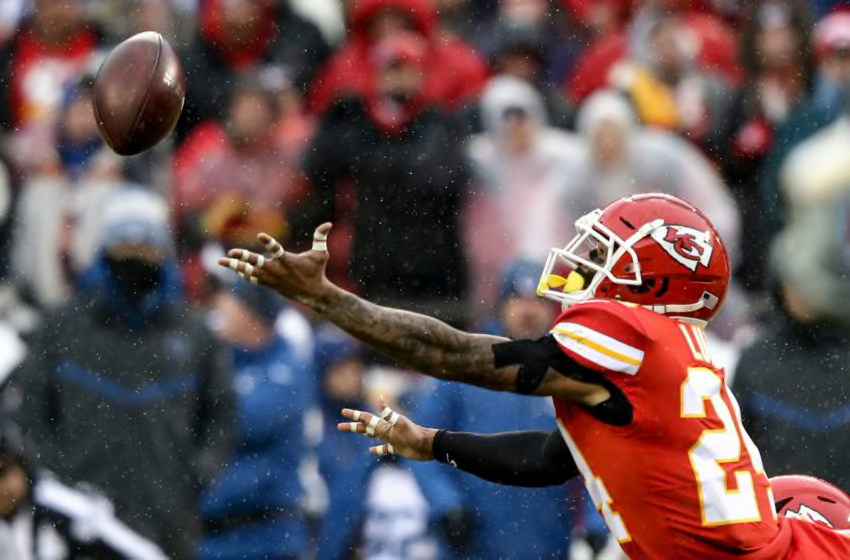
Chicago Bears: Jordan Lucas puts team in difficult situationRyan Sikeson June 10, 2020 at 2:00 pm

Read More

Chicago Bears: Jordan Lucas puts team in difficult situationRyan Sikeson June 10, 2020 at 2:00 pm Read More »