Morgan Park’s Marcus Watson, Jr., (22) shoots against Tinley Park. | Allen Cunningham/For the Sun-Times
Illinois Department of Public Health director Dr. Ngozi Ezike said on Friday that all regions in Illinois that reach Phase 4 of COVID mitigations can play high school basketball.
Illinois Department of Public Health director Dr. Ngozi Ezike said on Friday that all regions in Illinois that reach Phase 4 of COVID mitigations can play high school basketball.
The full guidelines from IDPH have not been revealed yet, but it appears that conference and intra-region basketball games will be allowed soon.
The Illinois High School Association met with representatives from Gov. J.B. Pritzker’s office on Friday morning. IHSA spokesperson Matt Troha said the IHSA will release a statement as soon as possible. It’s unknown if the IHSA will start the basketball season immediately, which is what the current schedule says, or if basketball will be pushed back to spring. Football is currently scheduled to start on Feb. 15.
Currently, Region 3 (Southwest Illinois), Region 5 (Southern Illinois) and Region 6 (East Central Illinois) are all in Phase 4. Chicago and Cook County will move to Tier 1 on Saturday, that is one step away from Phase 4.
In order for regions to rollback to Phase 4 three things are required:
-Test positivity rate below 6.5% for 3 consecutive days (7-day average).
-Staffed hospital and ICU beds availability greater than 20% for 3 consecutive days (3-day average).
-No sustained increase in COVID patients in hospital (7-day average over 7 of 10 days).
In late October Pritzker said that winter high school sports, including basketball, would be “moved into spring.” That statement came just two days after Pritzker announced they were “on hold.”
The IHSA revised its sports calendar for this school year after football and other fall sports were delayed by Pritzker in late July. The new calendar moved several fall sports to the spring season and added a new summer season. The IHSA is expected to amend or totally redo that schedule at a meeting next week.
Illinois had awarded a state championship in boys high school basketball every year since 1908. That streak came to an end last March because of coronavirus. The IHSA canceled the entire boys state tournament on March 12 and no games have been held since then.
Lower and medium-risk high school sports are being allowed at various levels of play across the state. Badminton, swimming, competitive cheerleading and competitive dance teams are allowed to practice and compete. The IHSA’s possible schedule change may soon allow soccer and volleyball teams to begin practicing or competing as well.
This file photo from exclusive video provided by San Francisco TV station KGO-TV, made late Sunday, Dec. 4, 2016, shows Derick Ion Almena, right, and Micah Allison, the couple who operated the Ghost Ship warehouse where dozens died in a fire, at an Oakland, Calif., courthouse. | AP
Derick Almena, 50, pleaded guilty to 36 counts of involuntary manslaughter in exchange for a 12-year sentence.
OAKLAND, Calif. — The master tenant of a San Francisco Bay Area warehouse where 36 people perished when a fire ignited during a dance party in 2016 pleaded guilty Friday to the deaths, avoiding a second trial after the first ended in a hung jury.
Derick Almena, 50, pleaded guilty to 36 counts of involuntary manslaughter in exchange for a 12-year sentence. Already free on bail, Almena likely won’t return to jail because of the nearly three years he already spent behind bars and credit for good behavior.
His sentencing was scheduled for March 8 and will determine whether he will continue to be monitored electronically at his home in rural Northern California and be subject to supervised probation.
Prosecutors say Almena was criminally negligent when he illegally converted the industrial Oakland warehouse into a residence and event space for artists dubbed the “Ghost Ship,” stuffing the two-story building with flammable materials and extension cords. It had no smoke detectors or sprinklers.
The Dec. 2, 2016, fire broke out at the warehouse during an electronic music and dance party, moving so quickly that victims were trapped on the illegally constructed second floor. Prosecutors said the victims received no warning and had little chance to escape down a narrow, ramshackle staircase.
The case has been emotionally wrenching for family and friends of the victims, many who packed a courtroom for months in 2019, only to see a jury split on whether to convict Almena, who leased the building. The jury also found co-defendant Max Harris, who was the Ghost Ship’s “creative director” and would collect rent, not guilty at the same trial.
Colleen Dolan, mother of victim Chelsea Faith Dolan, told the East Bay Times that families were not informed of the plea deal possibility before last Wednesday.
“My heart dropped, especially when I heard it was going to be a slap on the wrist. I want my daughter back; we want to be with our family members who died. He gets to be with his family,” she said.
Almena had been jailed since 2017 until he was released in May because of coronavirus concerns and after posting a $150,000 bail bond. He is on house arrest with an ankle monitor in the city of Upper Lake, where he lives with his wife and children.
Tony Serra, Almena’s attorney, said Thursday that he could not comment because lawyers are under a gag order imposed by Superior Court Judge Trina Thompson.
The Alameda County district attorney’s office did not respond to a request for comment.
CHICAGO, ILLINOIS – DECEMBER 13: Deshaun Watson #4 of the Houston Texans participates in warmups prior to a game against the Chicago Bears at Soldier Field on December 13, 2020 in Chicago, Illinois. The Bears defeated the Texans 36-7. (Photo by Stacy Revere/Getty Images)
All eyes are on Houston Texans quarterback Deshaun Watson as recent reports have suggested that he has played his final game with the Texans and has requested a trade. The Chicago Bears are in need of a quarterback and Watson would solve the organization’s primary problem.
The issue for the Bears in regards to Watson is why would the quarterback approve a trade from the Texans to the Bears. The reason why Watson may be hesitant to approve a trade to the Bears is because that is the team that was negligent when evaluating the Clemson product during the 2017 NFL Draft Process. Bears’ general manager Ryan Pace never had a conversation with Watson as it has become overwhelmingly clear that Pace was set on Mitchell Trubisky.
If that was the case, why would Watson want to play for Pace as his general manager?
The reason why may have nothing to do with Pace. In fact, it is Bears’ head coach Matt Nagy that could convince Watson to approve a trade to the team.
While speaking with Mike Greenberg, NFL insider and close friend to Matt Nagy, Louis Riddick claimed that Nagy is trying to find a way to get Watson to Chicago.
“I can tell you this, Matt Nagy loves Deshaun Watson,” Riddick said. “I know he loves Watson. You think right now he isn’t trying to figure out a way to get in the mix for that discussion. I guarantee you he is. I guarantee. Guarantee.”
Before we dive into what Riddick had to say, lets first review the source. Riddick’s claim is not the same thing as an insider listing the Bears as a potential sleeper for Watson. That is speculation. When an insider like Riddick drops information like he did in regards to Nagy and Watson, it generally is because they heard something.
The key element to remember here is that Nagy was not a part of the Bears’ organization. Nagy was still under Andy Reid with the Kansas City Chiefs and that is where it is believed that the Bears’ head coach developed a relationship with Watson. The Chiefs, of course, selected Patrick Mahomes in 2017 but could Nagy look at Watson as his solution for the Bears at the quarterback position?
For Nagy, Watson would be one of the few quarterbacks that the Bears could acquire that could save his job. Not only would Watson’s arrival restore faith into Nagy’s offensive system, but it would also make the Bears an instant and legitimate playoff contender.
Watson would be the clear answer for the Bears but the problem that the team will run into is that they will not be able to match an offer to the Texans that a team like the New York Jets or Miami Dolphins could provide. The Texans will undoubtedly either want a quarterback or, at least, a top 2021 first round draft selection in any trade for Watson. The Bears have neither. Nick Foles is not an enticing quarterback for the Texans nor is the 20th overall selection that the Bears have in the first round of the 2021 NFL Draft.
If Matt Nagy was the difference in a potential acquisition for DeShaun Watson, would that change you opinion of the Chicago Bears’ head coach? Sound off in the comments section with your thoughts.
When high school basketball fans think back to the 1980s, programs like Quincy, Providence St. Mel, East St. Louis Lincoln and the arrival of city powers King and Simeon are easy to think back on.
The 1990s brought us memorable basketball giants in Peoria Manual and Thornton, a few steamrolling Proviso East teams and the continued dominance of King.
The first 10 years of the 2000s included Glenbrook North, Peoria High and the beginning of a Simeon juggernaut.
Earlier this year we broke down the decade’s best teams and best players. Now, with every season of the past decade complete, it’s time to look at the Chicago area programs who won the most.
This list is comprised of the 50 winningest programs over the past 10 years, starting with the 2010-11 season and concluding with the 2019-20 season. Every team in every class throughout the Chicago area will be broken down in a variety of ways. But total wins, with winning percentage used as tie-breaker, determined the rankings.
We present No. 12 Niles North today and will add one program a day going forward.
12. NILES NORTH: 222-88
Decade’s biggest storyline: How about simply the arrival of Niles North as a legitimate basketball program? It’s a huge storyline in high school basketball.
Consider this: Niles North went 74-192 the previous decade. Then the 2010s came with coach Glenn Olson in charge and arguably the biggest turnaround of any program in the Chicago area.
Prior to Olson taking over the program in 2009-10, Niles North won a total of 34 games the previous six seasons combined. Now the Vikings have averaged 22 wins a year over the past 10. There were nine 20-win seasons in the decade with a fair amount of postseason success, including five regional championships and the only sectional title in school history in 2011.
When you realize Niles North had one regional title and two 20-win seasons in the program’s first 46 years, it’s arguably the biggest turnaround of any program in the Chicago area when comparing the past two decades.
Underrated highlight: While the rise of the program was front and center over the course of the decade, three straight trips to sectional championship games in 2011, 2012 and 2013, including its first-ever super-sectional appearance, needs to be highlighted.
Niles North, led by future NBA player Abdel Nader, pulled out a 53-52 sectional championship win over Schaumburg before losing to Warren in the super.
Player of the Decade: Abdel Nader (2011)
All-Decade Team: Abdel Nader (2011), Malachi Nix (2013), Crishawn Cook (2016), Damaria Franklin (2018) and Aquan Smart (2020)
Malachi Nix of Niles North tries to direct traffic during game against Highland Park.Sun-Times file photo
Other decade highlights:
-The 2012-13 team set a school record for wins with 27, and last year’s team matched it. The 2012-13 team lost to New Trier in the sectional final while the Vikings lost to Loyola in the sectional semifinals last March.
-The top three scorers in school history — and five of the top 10 — all came over the past 10 years. Malachi Nix broke the school scoring record with 1,582 points, while Damaria Franklin (1,548) and Aquan Smart (1,472) finished their careers No. 2 and No. 3, respectively, on the all-time list.
Crishawn Cook and Abdel Nader are two other 1,000-plus point scorers who are among the top 10, while current senior Jalen Butler was well on his way to scoring over 1,000 points in his career if not for the current missed season.
-The program produced five Division I players in the decade: Nader (NIU/Iowa State), Nix (Farleigh Dickinson), Damarrion Bariffe-Smith (Jackson State), Franklin (Tennessee Tech) and Smart (Maryland).
-After losing in the title game twice earlier in the decade, Niles North won its first-ever Wheeling Hardwood Classic title in 2017, one of the top holiday tournaments in the state. The Vikings ran their record to a perfect 13-0 with a 72-65 win over Libertyville.
Last week, the Tribune’s architecture critic, Blair Kamin, stepped down after 28 years in the role, preceded by a stint as a news reporter for the paper, two books, and a Pulitzer Prize.
Kamin’s beat is one that evolves slowly, because building things takes a long time, and the ramifications of our built environment take even more time to become apparent. So Chicago has been lucky to have Kamin in his job for this long (as well as his predecessor, Pulitzer-winner Paul Gapp, the newspaper’s first architecture critic, who was there for 18 years). For nearly three decades, Kamin has been able to absorb and influence the changes to our buildings, parks, transportation, and policy. That’s important in every city — but especially in Chicago.
I spoke with Kamin about his time covering our built environment.
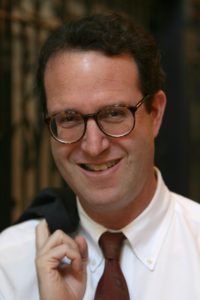
Kamin in 2008 Photograph: Charles Osgood
How did you go from architecture school to reporting to architecture criticism? Well, it’s really the reverse. I went from reporting to architecture school, and then the criticism. I grew up in a newspaper family in New Jersey. My father edited a small suburban newspaper on the Jersey Shore. And so I was serving coffee on election nights when I was a teenager. Then I had an internship at my father’s paper.
The architecture part of the story started when I was in college, at Amherst, and I took a class in Gothic architecture, and that really awakened my interest in the field. After that, I went to graduate school for architecture at Yale, and then worked at the Des Moines Register mostly as a reporter, but occasionally as an architecture critic, before coming to Chicago.
Did you think at any point you might want to be an architect? Yeah, actually. After college, I had this internal debate as to whether I should try to write about architectural practices. So after college, I went out to San Francisco and worked for two design firms. My first job in architecture was as an office clerk for an interior design and architectural firm. One of my jobs was to run the blueprint machine, which emitted these noxious fumes that made my nose wrinkle. I also worked for another architectural firm doing PR, and ultimately, I decided that I would be better off writing about architecture than practicing it.
And the wisdom of that choice was confirmed. Early on at Yale, I was taking part in an urban design class and our assignment was to go out and draw a public space in New Haven. I pinned up my drawing and one of the architecture students looked at it and said, Oh, that looks like naive art. That insult really did confirm the wisdom of my decision to be a critic rather than a practitioner.
One of your first big series was about public housing in Chicago — the legacy of the high rise buildings and the need to diversify public housing going forward so it works in different contexts. Do you do you think that’s happened? I’m curious about your reflections on public housing in Chicago since then. So you’re referring to a 1995 series, called Shelter by Design. It explored best practices in low-income housing. [It was] an attempt to raise expectations for that type of housing and provide alternatives to was then the current [Chicago Housing Authority] high rise situation, which obviously was not good.
In retrospect, I’m glad that many of the concepts that were discussed in that series form the CHA’s Plan for Transformation. For example, New Urbanism, or defensible space, or the need for mixed income housing that tried to break down the concentrations of poverty that the high-rises had become.
Also since then, I’ve been glad to see new concepts emerge like the co-located projects, which combine public housing and public libraries, that Rahm Emanuel championed, and architects like John Rona executed so, so beautifully.
Overall, though, I would say that the Plan for Transformation has been a disappointment. It took far too long. It built too little housing. The overall aim of integrating very poor people into their communities and the city at large has not been fully achieved. The continued segregation of Chicago by race and class continues. I guess you could say that the series helped set the agenda or some of the reforms that occurred, but I’m surely not satisfied with the outcome.
For low-income housing to succeed, it doesn’t need to be an architectural showplace. It just needs to do the basics, right. It needs to provide shelter, it needs to provide community, it needs to provide integration into the broader society, so [that] people can climb the ladder, economically and socially, if they want to. It doesn’t need to win a design award, although good design certainly can be a part of its success.
I do think it’s really important to say that design is not deterministic. In other words words, better buildings will not make better people. Design is part of the equation of integrating the very poor into the city. But it can’t do it all by itself. It’s naive to think that. It needs to be combined with social service programs, and other things — schools, families that are supportive — in order for it to succeed. Design can open the door to success, but it cannot achieve that on its own.
And the corollary is true, too. You can’t blame bad design for the failures completely. You can’t completely blame bad design for the failures of high-rise public housing. The failure has had to do as much with federal policy that was well intentioned, but foolish. Concentrating lots of very poor people and a vast high rise development, like the Robert Taylor Homes or Stateway Gardens, was an invitation to disaster. In a way, it didn’t matter how the buildings were designed. The design simply accentuated the social problem of these high concentrations of poverty.
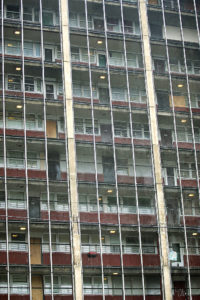
A Cabrini-Green facade in 2005 Photograph: Tim Boyle/Getty Images
Can you explain how the design exacerbated that? It did in so many ways. You didn’t have streets. You had sort of versions of streets in the sky, the modernist planning principles that Corbusier and other modernist visionaries had attempted. You didn’t have a network of streets where you have eyes on the street, like Jane Jacobs famously wrote about in The Death and Life of Great American Cities. You had what were called galleries. These were breezeways that were in front of long rows of apartments. Those were the streets. And they were fenced in like cages, so that people felt dehumanized.
You had big families in buildings that had minimal elevator service, and invariably you had kids busting the elevators, so people had to trudge up 15 stories where they might get mugged by their fellow residents. You had U-shaped clusters of public housing high rises, and those would serve as shooting galleries. The list goes on and on: all these things that were meant originally as liberating and humanizing elements were flipped on their head because of the concentration of poverty that occurred.
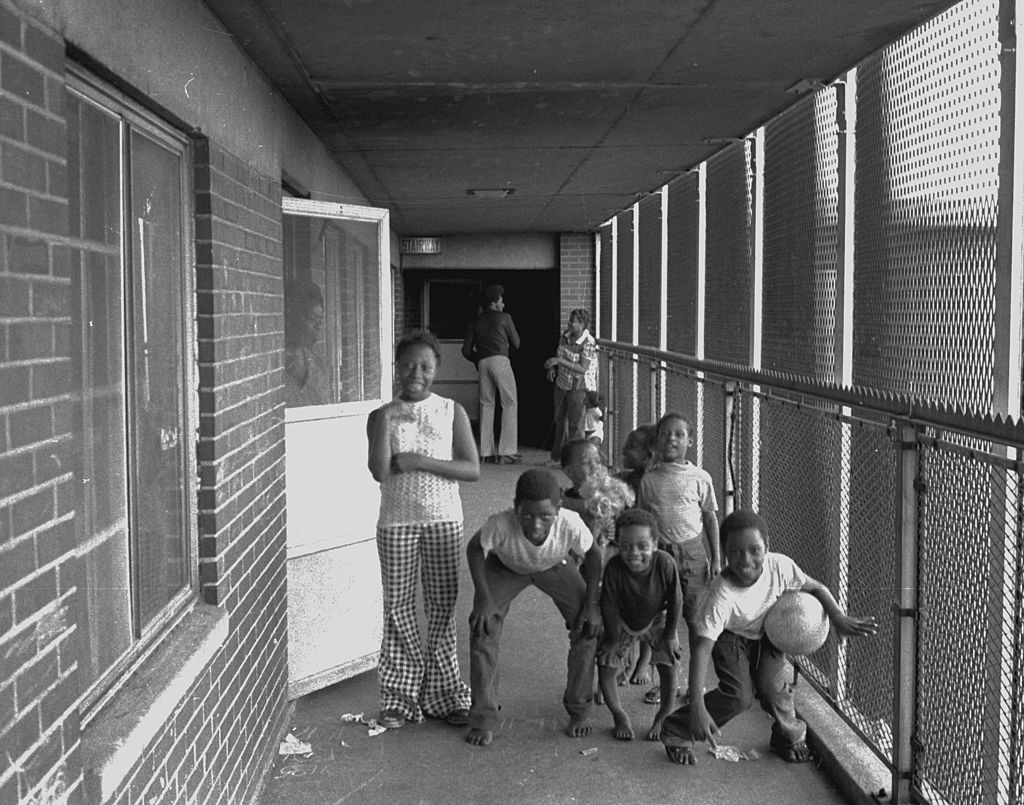
Children play in a fenced-in breezeway at the Robert Taylor Homes in 1971. Photograph: Robert Abbott Sengstacke/Getty Images
Your Pulitzer was based in part on a series about the lakefront and how it could be improved. What’s your impression of how things have changed since? I’m really gratified at the changes that have occurred since the series appeared in 1998. The most important changes have to do with Burnham Park, which is south of Roosevelt Road and encompasses the Museum Campus and McCormick Place and the parkland to the south of it. In 1998 that area was separate and unequal. Compared to Lincoln Park in the north, it had less parkland, it had less amenities, it had worse access. Everything about it was worse than the comparable stretch of Lincoln Park to the north. And that was clearly a matter of race. The Chicago Park District followed a policy of so-called benign neglect, because the neighborhoods to the west of Burnham Park were largely poor and Black. And it was an outrageous situation.
Since then, it’s really been corrected. Hundreds of millions of dollars have been spent to expand the parkland and add new features: fishing piers, a marina, beaches. There are new pedestrian bridges over Lake Shore Drive, replacing the rickety outdated bridges that had been there. Another one is going to start construction this year, I believe at 43rd Street. That’s a really dramatic change. It’s taken 22 years to achieve and the project is still ongoing.
But that’s not the only change that’s occurred as a result of the series. It also looked at Grant Park and its split personality: how it was jammed and vibrant during the summer festivals and pretty much dead otherwise. And since, with the idea of improving daily use as our mantra, there’s been an enormous change within Grant Park. That’s been fueled in large part by Millennium Park and now Maggie Daley Park, but other parts of Grant Park have come alive as well. In those years [since 1998], you think of Lollapalooza — I mean, I’m not taking credit for Lollapalooza, but Grant Park is a much more vibrant place than it was 20 years ago. And that was a key part of the series.
In Lincoln Park, and on other parts of the lakefront, I was really glad to see Ken Griffin spend [what] I believe was $50 million for separating the bike paths and walking paths. That’s a change that I’ve experienced personally, since I ride on the lakefront all the time. The biggest disappointment has been southward. There have been wonderful plans sketched for South Works, but nothing has come of them. And it remains this huge site of huge potential but unrealized visions. I very much hope that in the next 20 years, that will change and that part of the south lakefront will really see the same kind of transformation that Burnham Park has witnessed.
I don’t want to overlook the suburbs. What sort of projects or trends have stuck out to you over the years? In terms of favorite projects, I’ll give you a list:
The Serta headquarters in Hoffman Estates by Andrew Metter, formerly of A. Epstein. That building seems to float beautifully above the landscape in a big corporate office park, and it’s really a little gem that very few people know about, but it’s really worth a look.
Another favorite is the Writers Theater in Glencoe, by Jeanne Gang. That building really picked up on some of the Tudor revival architecture, exposed wood construction that you see on the North Shore, but Jeanne’s given it her own spin and created a very vibrant center of community where people can gather before and after performances, in a pavilion that’s the visual focal point of the theater. And there’s even a kind of walkway up on the second floor, that as she puts it, exists in between the tree tops, in between the ground and the sky. So that’s a really handsome building.
Ragdale, Howard van Doren Shaw’s home in Lake Forest, and an arts and crafts gem.
And then the Cook County Forest Preserves, a legacy of Dwight Perkins. That also was included in Daniel Burnham’s plan of Chicago.
Those are real contributors to the quality of life of people throughout the region. One of the throughlines, besides good design, is a sense of community admidst the less dense environment of Chicago suburbs.
I’m glad you mentioned the forest preserves. That has been an absolute lifeline during the pandemic for my family. [Author’s note: Check out Cook County’s only canyon.] Yeah, that’s great. Because of the pandemic the forest preserves have taken on fresh relevance. They’re the lungs of the region. We’re truly blessed that we had visionaries like Dwight Perkins and Daniel Burnham.
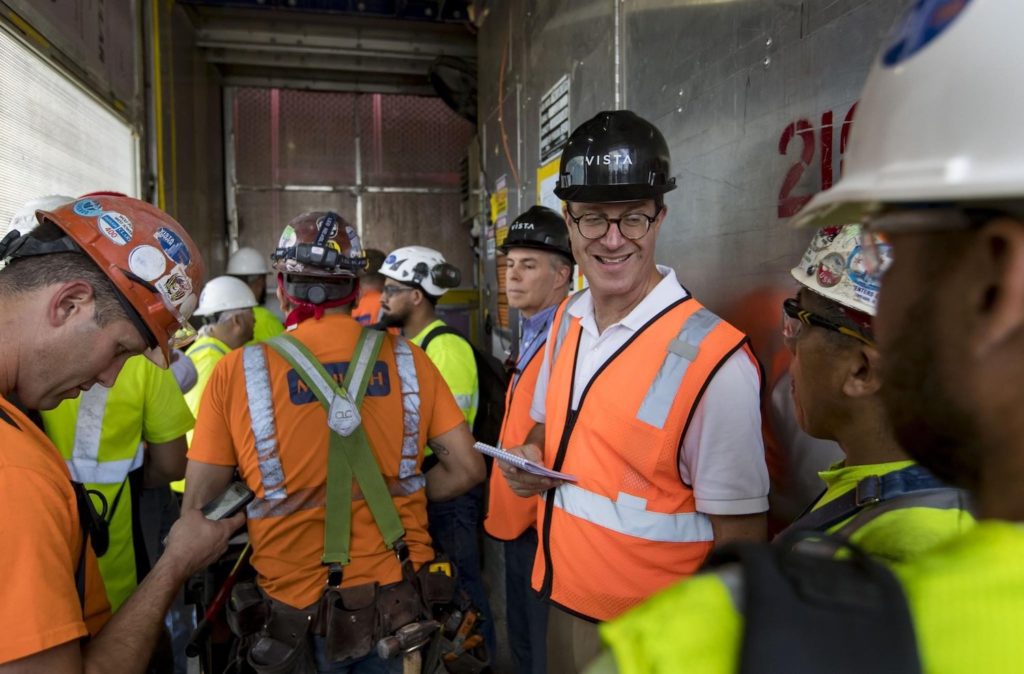
Kamin talks to workers at Jeanne Gang’s St. Regis Chicago under construction in 2019. Photograph: Brian Cassella/Chicago Tribune
There have been remarkable leaps forward in how big public parks and spaces, under Daley and Emanuel, fit into cities today. What does it say about them? In the 20 years that I was the architecture critic for the Tribune, the explosion of new open spaces has been extraordinary. In that period, we saw Millennium Park, we saw Northerly Island, we saw the downtown riverwalk, the 606, and many new parks throughout the neighborhoods. It’s still an ongoing project. There’s still a relative shortage of parkland in the neighborhoods.
But the most important trend has been taking outmoded sites from the industrial age and transforming them into public space. The airport at Meigs Field was no longer necessary, so it’s gone. We decked over commuter railroad tracks in the northwest corner of Grant Park to get Millennium Park. We took a freight line that no longer was in use to create the 606. We moved the highway west of the Field Museum and Soldier Field to create the Museum Campus. All those things represented a realization that many of the planning policies and practices of the 20th century were no longer relevant, and could be reversed by new thinking and new designs.
Millennium Park is a shining example of that. It not only has been an incredible artistic and popular success, but it’s spurred hundreds of millions of dollars of investment and transformed that area of the city. In the past, tourists did not usually go south of the Michigan Avenue Bridge. They stayed on the Mag Mile. The pedestrian flow has really changed. And that’s an indication of the transformative impact of projects like this.
It’s complicated, though, and it’s not an entirely happy story: With the 606, there was the consequence of gentrification. It was great that the shortage of neighborhood public space was addressed with this creative new linear park, and yet, not enough thought was given to the consequences that would provoke, in terms of landlords jacking up rents and displacing the very people that the 606 was supposed to benefit. Doing big infrastructure moves in the neighborhoods is not checkers, it’s chess. You have to think in terms of not just the amenity, but the impact it’s going to have over time. As future 606s are built in places like Pilsen, or on the South Side, their impact is going to have to be taken into account beforehand.
We need to go beyond Burnham’s call for providing humane open spaces as ways to relieve the harshness of the industrial city. In the postindustrial age, we need to think about social and economic realities like gentrification if a truly equitable city is to be built. And that involves going beyond purely physical improvements.
What do you want to see happen next in the city or the region? Equity is clearly the most important issue that the region faces. During my time as the Tribune’s architecture critic, the middle class in Chicago shrank dramatically as new luxury high rises were built downtown. I’m heartened by the fact that Mayor Lightfoot has started the Invest Southwest program and selected an exemplary planner in Maurice Cox. That program is really trying to turn the aircraft carrier in the right direction.
But it takes a long time to change the direction of an aircraft carrier, and to overcome decades and centuries of discrimination, redlining, all those awful things that have made Chicago such a segregated city. That is really a multigenerational project. I mean, it’s taken a generation to make the lakefront, the most attractive of public spaces, more equitable. Just imagine how long it’s going to take to make the rest of the city, with its deep seated poverty and structural racism, more equitable. It’s going to take a long time, and no one should expect instantaneous fixes. But change can occur. If resources and public resources are losing market investment, dramatic change can occur.
Another [thing I’d like to see] has to do with the environment — not only the built environment, but the air we breathe, ensuring that neighborhoods like those on the southwest side are not viewed as dumping grounds for things like moving the General Iron project out of Lincoln Park. When I speak to the environment, I’m talking about making the region less car dependent, more oriented towards transit. A lot of steps are being taken in that direction by both the City of Chicago and regional planners. I’m hopeful that things are moving in the right direction overall.
What are your personal favorite spaces to be in? Not necessarily the “best,” just what resonates with you the most? Well, I grew up on the Jersey Shore, and I spent some of the happiest moments of my life body surfing in the Atlantic Ocean off a spit of land called Sandy Hook. It’s a very narrow peninsula that juts into New York Bay and overlooks Lower Manhattan. When I was growing up, you could see the Twin Towers from the edge of this peninsula.
So with that as a backdrop, the space I really enjoy most is the lakefront. It’s this incredibly dramatic meeting of water, parkland, and built topography — the mountains, the cliffs, the canyons of tall buildings that make Lake Shore Drive such a distinctive road and make the lakefront itself such a distinctive place.
There’s very few places like that in the world that have such drama to them, and yet provide such serenity and opportunities to unwind, and unwind with people unlike you, and to see the common humanity. That’s really what I think these public spaces are about: common humanity. So many of us live in silos of zip codes, clustered together with people of similar races or similar economic brackets. Being in these public spaces is a very democratic experience that can, if only temporarily, break down barriers and achieve the kind of democratic aims that people like Frederick Law Olmstead had for public spaces in the in the 19th century.
For me, being on the lakefront is a personal experience that links to my vision of what architecture criticism is about. My role was not simply aesthetic — to be a judge of beauty. It was to look at buildings and public spaces within a framework of how people use them, and whether they give joy or not, whether they uplift us, whether they invite us to form community. I wrote in my final column that I tried to look at buildings not as aesthetic objects or technological marvels, but as vessels of human possibility.
Evanston’s Sam Rhodes works on her stroke during practice on August 19, 2020. | Kirsten Stickney/For the Sun-Times
According to multiple sources Chicago Public Schools athletic directors received emails this week stating that boys swimming and badminton practice would resume on Jan. 25, with contests to begin the following week.
According to multiple sources, Chicago Public Schools athletic directors received emails this week stating that boys swimming and badminton practice would resume on Jan. 25, with contests to begin the following week.
The plan appears tentative. The ongoing dispute between CPS and the Chicago Teachers Union over in-person learning complicates things. The final CTU strike vote won’t be tallied until Saturday night and that could throw a wrench in the possible practices and games.
CPS athletic directors have not received any info on the restart of boys and girls bowling, competitive cheer or competitive dance. Those sports are also allowed to compete according to the latest update from the Illinois Department of Public Health.
According to the sources it seems unlikely that CPS will allow contact days for other sports, something the IDPH and the IHSA is allowing.
CPS has not responded to a request to confirm the news on swimming and badminton and has not responded to several inquires this week about the status of winter sports.



:no_upscale()/cdn.vox-cdn.com/uploads/chorus_asset/file/22252869/BBKhpark_HPN_121511_p6.jpg)