An armed man was fatally shot by police Wednesday night in west suburban Forest Park.
About 7:50 p.m., officers received calls of a man who dropped a pistol on the floor of a Jimmy Johns at 350 Circle Ave., according to a statement from police. Witnesses told police the man was waving the gun around saying, “Please don’t make me do this now.”
The man walked outside the restaurant and stood with the pistol in his hand and, when officers arrived at the scene, a patrol officer and a sergeant fired shots, Forest Park Deputy Chief Ken Gross said. Investigators do not believe the man shot himself, Gross said.
Police were still trying to determine if the man fired his gun at officers, Forest Park police said in an updated statement Thursday.
The man was placed into custody and rushed to Loyola University Medical Center in Maywood, where he was pronounced dead, police said. His name hasn’t been released.
The pistol was recovered, police said. The officers involved were taken to the hospital with injuries that weren’t life-threatening.
Illinois State Police were investigating the shooting.
The Bulls kept their trade deadline dealings going Thursday by sending forward Chandler Hutchison and big man Daniel Gafford to the Wizards in exchange for guard Troy Brown and center Mo Wagner, ESPN reports.
Hutchison, the 22nd overall pick in the 2018 NBA Draft, missed time this season while dealing with a lower leg injury. He’s also repeatedly not played as a coach’s decision, failing to earn a spot in Billy Donovan’s rotation. In 79 games with the Bulls over three seasons, Hutchison averaged 5.8 points and four rebounds per game.
Gafford, a 2019 second-round pick, has averaged 4.7 points and 3.3 rebounds per game in his second NBA season.
The Bulls will hope to get more from Brown, the 15th overall pick in 2018, who averaged 10.4 points per game for the Wizards last season. He’s struggled this year, however, averaging just 4.3 points per game on 37% shooting.
The one and only Manny’s Deli is at it again. This time, they’re offering 1,000 free sandwiches if customers simply — wait for it — wear a mask. That’s right. On March 30th if you head to Manny’s Deli at 1141 S Jefferson St. and you’re one of the first 1,000 people there, you can get one of their world famous sandwiches for the price of wearing your freakin’ mask.
Manny’s Deli stays throwing 100 miles an hour. The cafeteria-style Jewish deli and coffee shop has been steady controlling the Chicago food social media scene for years and took their social presence to the next level in order to weather the storm of the COVID-19 pandemic. Their presence and importance in Chicago saw them receive national attention when Barstool Sports featured them and aided the restaurant with a donation from the Barstool Fund.
The “Free Sandwich Challenge” began when Manny’s charged Chicagoans by saying they’d give away a bunch of their famous corned beef sammies if they could “go 30 days without having to remind anyone to wear their mask.” Chicago obviously failed, but, thanks to very generous donations, Manny’s giveaway is going to proceed anyways.
Advertisement
It’s not hard. Wear your mask. Be one of the first 1,000 people at Manny’s Deli on March 30th, 2021. Get a free sandwich.
Ok folks, you asked and here’s our answer: Free Sandwich Day will be on Tuesday March 30th. It’ll be first come-first serve and we have a limit of 1000 sandwiches, one per customer. See you then. #mannysmaskchallenge
Sometimes this is exactly what needs to happen in order to get people to do what they’re supposed to do. You know the old saying “that you don’t get credit for things you’re should do.” This totally applies here. Manny’s deserves all the credit, but they’re gonna reward you the customer with one of their award-winning, stand-in-line-for-hours, tell-everyone-you-know, sandwiches if you simply do what you’re already supposed to do.
Seems like an easy decision, Chicago. So head to Manny’s Deli on March 30th for a deal just as good as the Chicago Bulls acquiring Nikola Vucevic.
Thursday marked the NBA Trade Deadline and the Chicago Bulls were among the most active teams in the league — and it’s not even over yet.
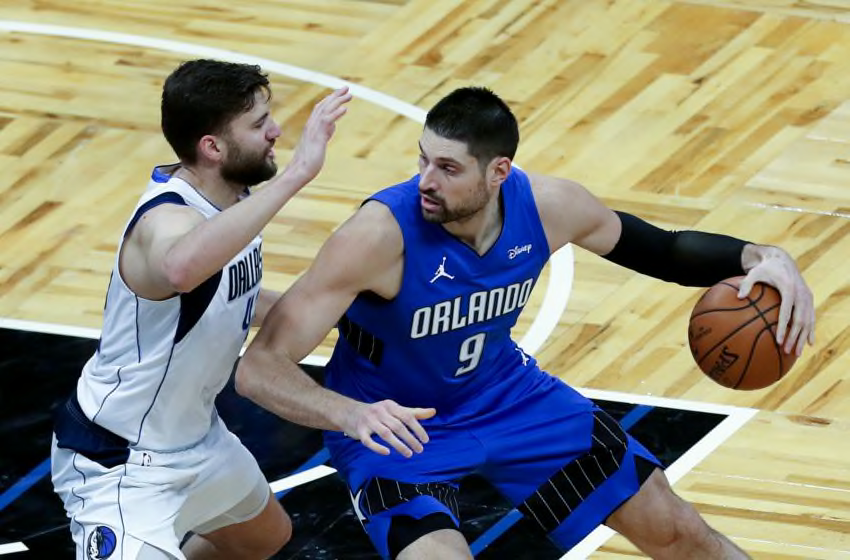
The biggest move of the day for the Bulls came on Thursday morning when they acquired all-star center Nikola Vucevic from the Orlando Magic for two first round draft picks, Wendell Carter, and Otto Porter. The Bulls also acquired Al Farouq Aminu from the Magic in this trade.
The Bulls were not done after that blockbuster trade either.
Shortly after the acquition of Vucevic was reported, the Bulls made another roster-altering move as they sent Daniel Gafford and Chandler Hutchinson to the Washington Wizards for Troy Brown and Mo Wagner.
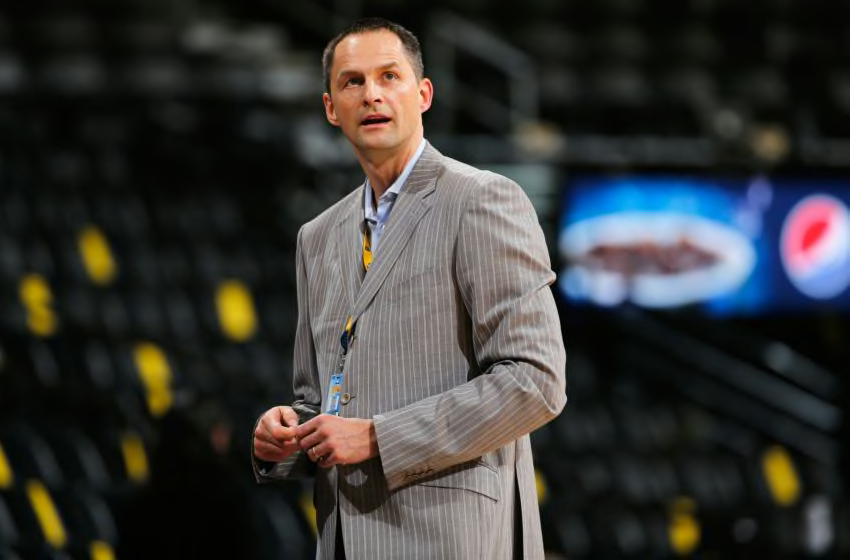
Ladies and gentlemen, Bulls’ executive vice president of basketball operations Arturas Karnisovas has firmly established his vision for the future direction of the Bulls’ organization.
When Karnsiovas first took control of the Bulls’ basketball operations, the one thing he made clear is that he wanted to take time to observe the current structure of the Bulls’ roster. Karnisovas identified his head coach in Billy Donovan but he wanted to take the first half of the season to identify the players that he wanted to build around.
The season began with speculation surrounding the future of both Zach LaVine and Thaddeus Young with the Bulls. Both Lavine and Young were rumored to be potential trade candidates as the belief was that Karnisovas wanted to tear the structure down before rebuilding it.
However, with the moves that Karnsiovas’ made on Thursday, it is clear what his direction is for the team. The Bulls are back. The move for Vucevic gives the Bulls’ a legitimate superstar to pair with Lavine while also changing the reputation that the Bulls have across NBA circles.
It was only a year ago that the Bulls were the laughing stock of the NBA. The Bulls had an incompetent head coach in Jim Boylen. Boylen drew the ire of both Lavine and Young. And, given the popularity of Lavine and Young across the league, the Bulls were never considered to be a premier location for potential free agent super stars. That is why the work that Karnisovas has done over the course of the past six months is so important.
Karnisovas has shredded the scarring that was leftover from the previous. Karnisovas, and general manager Marc Eversly, have led to the Bulls into the modern times of the NBA. The Bulls are no longer a laughing stock. Instead, the Chicago Bulls are now the attractive destination that they should be given their history.
Thursday was an important day for the future of the Chicago Bulls. The Bulls already had a top tier head coach in Donovan and budding superstar in Lavine, and with one blockbuster move, they have now found a legitimate superstar center in Vucevic. The future is bright.
The U.S. must seriously consider the idea of tinkering with the atmosphere to cool a warming Earth and accelerate research into how and whether humanity should hack the planet, the National Academy of Sciences said Thursday.
The report by the academy, set up by Abraham Lincoln to provide the government with expert advice, doesn’t recommend carrying out solar geoengineering to bounce heat back to space. At least not yet.
But an emergency plan needs to be explored, the report says, because climate change-driven extreme weather has worsened since the last time the academy looked at the highly-charged issue in 2015. That requires coordinated research into whether air-tinkering technology would work, its potentially dangerous side effects, its ethics and the potential for political fall-out.
The report looks at three possible ways to cool the air: Putting heat-reflecting particles in the stratosphere, changing the brightness of ocean clouds and thinning high clouds.
“Climate engineering is a really dumb idea, but it might not be as dumb as doing nothing at this point or continuing to do what we’ve been doing,” Scripps Institution of Oceanography atmospheric chemist Lynn Russell, a report co-author, told The Associated Press. “It has a lot of risks and those are important to learn as much as we can about.”
The panel recommended ramping up research spending by several fold to $40 million a year, along with “exit ramps” to end study if an unacceptable risk is found.
“I honestly don’t know whether or not it’s going to make sense,” said committee chairman Chris Field of Stanford University.
Critics, such as Oxford University’s Raymond Pierrehumbert, worry that there’s a “moral hazard” providing a tempting option to use questionable technology instead of the necessary cutting back on carbon pollution. He said the term geoengineering wrongly makes it sound like humans have control over heat like a thermostat.
Texas A&M University’s Andrew Dessler sees geoengineering as a safety feature for the planet, like car airbags you hope to never need.
A Harvard team is working on a small-scale experiment where eventually a balloon would put a few pounds of aerosols 12 miles (20 kilometers) into the air to reflect the sun. That group hopes to run a system test, with no chemical injection, later this year over Sweden.
This report is more forceful than the 2015 version, detailing government oversight and how research should be done, said academy president Marcia McNutt, who chaired the earlier study.
Is geoengineering too risky to even consider?
“It is not so much playing with fire as it is researching fire, so that we understand it well enough to deploy, if necessary,? said Waleed Abdalati, a former NASA chief scientist who was on the 2015 panel. “Sometimes you have to examine very risky options when the stakes are as high as they are with climate change.”
The Associated Press Health and Science Department receives support from the Howard Hughes Medical Institute’s Department of Science Education. The AP is solely responsible for all content.
A man who fled policeduring last May’s unrest and looting in Chicago pleaded guilty in federal court Thursday to illegal possession of a firearm.
Brandon Pegues, 29, admitted during a virtual hearing before U.S. District Judge Virginia Kendall to allegations made by police in the days that followed the unrest. He is likely to face a sentence of between 10 and 16 months during his sentencing hearing, set for July 21.
Chicago police said they spotted Pegues a little after 12:30 a.m. May 31 in the 800 block of South Financial Place, where they arrived “in response to mass crowds and multiple reported ongoing crimes, including criminal damage to property,” records show.
Officers said they saw four men running south on South Financial, and some were carrying hammers. When they saw Pegues, they said he looked at them, adjusted his waistband, and fled. Police said they ran after him, and Pegues eventually stumbled and fell.
Police said they saw a gun fall to the ground, and they said they saw Pegues push what turned out to be a loaded 9mm semi-automatic pistol under a nearby vehicle. Assistant U.S. Attorney Albert Berry also said Thursday that police found a hammer on Pegues.
Pegues had been convicted of residential burglary, a felony, in January 2010, court records show.
On Wednesday, a federal judge sentenced D Angelo D. Chester, 32, to more than three years in prison after he was caught with a gun after the 9 p.m. curfew Mayor Lori Lightfoot set as a result of the rioting. Chester’s criminal history prompted the judge to find that the risk of Chester committing another crime is significant.
The twist Deli favorites with Middle Eastern and Texan influences The skinny Billy Caruso has dipped into Jerusalem’s culinary melting pot, using, for example, labneh as a bagel spread (try the thyme and sea salt bagel slathered with charred strawberry and honey labneh) and making brik, a Tunisian pastry filled with potato and egg. His Austin, Texas, roots are on display, too, most notably with the pastrami, which he makes like the barbecue joints by giving a whole brisket (not just the flat) an extra-long smoke over oak and applewood. Try it in the Reuben with sauerkraut and Gruyère ($16). Must order The matzo ball soup ($13), made with blue corn matzo balls, loaded with shredded chicken and veggies, and topped with a radish and herb salad
Jeff & Judes
1024 N. Western Ave., Humboldt Park
The twist Southern takes on deli classics, plus a standout bakery program The skinny Ursula Siker grew up in Los Angeles, a city with a rich deli culture. She named this spot after her parents and took inspiration from their backgrounds (her dad comes from a Jewish family in Pittsburgh and her stepmom is from North Carolina). That means bites like a sweet potato and pimiento cheese knish ($8) alongside a thick corned beef Reuben on housemade marble rye ($18). Don’t miss the clever baked goods: Siker transforms her cinnamon challah into bread pudding ($8) and fills rye hamantaschen with cream cheese, red onion, and dill and crusts them with everything bagel spice ($7). Must order The fried chicken sandwich ($10), an übercrisp thigh brined in buttermilk and pickling spices and dredged in matzo. It’s finished with mayo and bread-and-butter pickles and served on a potato bun.
Sam & Gertie’s
1309 W. Wilson Ave., Uptown
The twist Vegan versions (you heard right!) of deli staples The skinny Andy Kalish may have named his restaurant after his grandparents, but the place is not exactly old-school. He re-creates traditional deli offerings like whitefish, corned beef, and chopped liver using beans, veggies, and other plant-based ingredients. Take his “pastrami,” which you can get with mustard on rye ($12.75) or as a Reuben (the Levin, $14.75); he combines wheat gluten with three types of beans (white, red, and garbanzo) to add texture and color, plus a secret seasoning blend that imparts a smoky, peppery bite. Must order The Fishman ($13.75), a tangy smoked “whitefish” salad (made with hearts of palm, vegan mayo and cream cheese, green onions, and dill) on an onion bun with lettuce, tomato, onions, and capers
I’m Jerry Partacz, happily married to my wife Julie for over 40 years. I have four children and eleven grandchildren. I’m enjoying retirement after 38 years of teaching. I now have an opportunity to share my thoughts on many things. I’m an incurable optimist. I also love to solve crossword puzzles and to write light verse. I love to read, to garden, to play the piano, to collect stamps and coins, and to watch “Curb Your Enthusiasm”.
The two first-round picks the Bulls are going to trade to the Magic include their first-round selection for the upcoming 2021 draft (top-4 protected), and their first-round pick for the 2023 draft. Remember, per the Stepien rule, teams cannot trade back-to-back first-round selections, so they had to skip a year in drafts.
The Orlando Magic said going into the trade deadline period they would need an “overwhelming offer” to give up Vucevic to any team. NBA teams already knew that Aaron Gordon and Evan Fournier were on the table, but the Magic were resistant to giving up their star center.
Arturas Karnisovas, the Bulls’ Vice President of Operations, and Marc Eversley, general manager, shocked the world on Thursday morning with a trade to add a second Eastern Conference all-star to their lineup.
Here’s the deal: The Bulls land Nikola Vucevic and Al Farouq Aminu for Otto Porter, Wendell Carter Jr., and two first-round picks. Huge addition for Chicago, who remains in pursuit of Lonzo Ball. The Magic are moving toward a rebuild now with Aaron Gordon deal on deck.
The Bulls finally got the cornerstone piece they need to fulfill the frontcourt. Vucevic is a two-time all-star for a reason. This season he is averaging 24.5 points, 11.8 rebounds, and 3.8 assists per game. He is shooting 48 percent from the field, 40.6 percent from behind the arc, and 82.7 percent from the charity stripe.
He is not only a great scorer and rebounder, but he is also an excellent interior defender, which is something the Bulls have needed in their lineup. The Bulls give up 50.4 points in the paint per game to their opponents, which ranks near the bottom of the NBA. Vucevic has an unbelievable career defensive rating of 105 and averages a career positive defensive box plus/minus.
Another important aspect of Vucevic’s game is the fact that he can help the Bulls further improve their pick-and-roll offense. He is versatile from his range to be the roller in pick-and-roll situations and dominate the paint, but to pick-and-pop out to shoot from distance.
Nikola Vucevic leads the NBA in pick and pop scoring by a wide margin. He has shot an eFG% of 55% in catch and shoot situations, 61% finishing around around the rim, and 49% going one-on-one in the post this season.
The Bulls are giving up Wendell Carter Jr., who has been struggling this season causing him to get benched along with Coby White. Carter is averaging 10.9 points, 7.8 rebounds, and 2.2 assists per game. Carter is inefficient in defending the paint is in constant foul trouble.
Otto Porter Jr. is taking up around $28 million in cap space and is in the final year of his deal. He has missed nearly 20 games this season and missed nearly the whole season last year due to injury. His age is taking a toll on his body and he’s hardly efficient off the bench, only as a catch-and-shoot three-point shooter.
The concern with this trade is the fact that the Bulls have given away two first-round picks to acquire Vucevic, who is now a 30-year old NBA veteran. However, the Bulls have continuously gotten high picks in the draft, from the fourth last draft, and seventh in the two before.
It’s time for the Bulls to bring in savvy veterans that can bring leadership and experience to this extremely young team. Remember, going into this season, the Bulls had a younger average age in their starting five than the University of Wisconsin’s men’s basketball team.
It’s a new era for the Bulls under Karnisovas and Eversley, and the Bulls are still trying to acquire Lonzo Ball from the Pelicans to round out their starting lineup with a true point guard. Stay tuned, Chicago.
There are many fine restaurants in Springfield. Saputo’s, the Italian bistro where former House Speaker Michael Madigan dined every evening at precisely 7 p.m., always sitting at the same table and drinking the same wine. Loukinens’ on 4th, where you can always be sure to spot legislators and lobbyists cutting deals over pan-seared Chilean Sea Bass. The last time I visited our state capital, though, I only wanted to eat at the Cozy Dog Drive In, the home of Illinois’s most important culinary innovation, the corn dog.
Illinois has a state snack food (popcorn), a state vegetable (sweet corn), and a state grain (corn). If the state had a hand-held meal, it would be the corn dog. The corn dog is Illinois on a stick: a hot dog, representing Chicago’s meatpacking heritage, wrapped in a cornmeal shell, representing the crop that carpeted over the prairie. Illinois grows 1.8 billion bushels of corn a year, second only to Iowa.
Surprisingly little of that corn goes into making corn dogs, though. Corn dogs are ubiquitous at the State Fair, sold at every other food stand on the midway, along with Lemon Shake-Ups. Every summer, the American stomach emits an enzyme enabling it to digest foods that would be inedible the rest of the year. The corn dog has, mostly, been relegated to the “fair food” category, along with funnel cakes, elephant ears, blooming onions, and chocolate-covered bacon. It’s not easy to find a corn dog in a restaurant, even in hot-dog crazy Chicago.
In 2018, the Tribune’s Nick Kindeslperger lamented that “if you want a corn dog, that battered and fried dish you eat on a stick, you’ll have to put in some real effort, and what you get might not be worth it…. As recently as six years ago, my current Tribune colleague, Louisa Chu, enthused on WBEZ about a “corn dog renaissance” in Chicago. But most of the restaurants either closed (Franks ‘n’ Dawgs, Wiener and Still Champion) or removed the corn dogs from their menus (Bangers and Lace, Old Town Social), leaving a handheld-fried-food hole in our scene.”
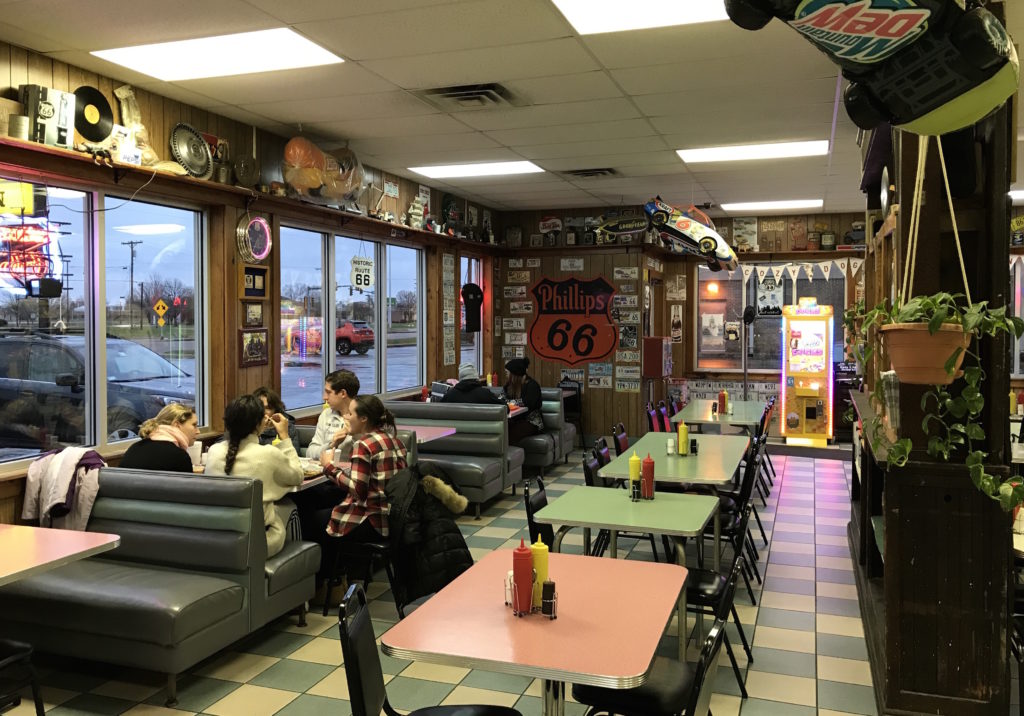
After much searching, I located a corn dog at Wolfy’s, 2734 W. Peterson Ave., in West Rogers Park. However, it was a minor offering on a hot-dog heavy menu—undersized, and not especially crunchy. If I wanted a real Illinois corn dog, I was going to have to go to the source. That’s how I ended up at Cozy Dog. A kitschy diner founded in 1946, Cozy Dog advertises itself with an illuminated sign depicting two hot dogs in connubial bliss. Appropriately enough for a purveyor of an all-American meal, it’s located in a strip mall on Route 66, and sells highway memorabilia along with hot dogs.
Cozy Dog bills itself as the “Birthplace of the Corn Dog,” with a poster depicting a nurse feeding mustard to a baby corn dog. According to a handwritten history on the restaurant’s wall, though, Cozy Dog founder Ed Waldmire actually discovered the concept “at a roadside cafe in Muskogee, Oklahoma,” while driving from his hometown of Springfield to the army air base where he was stationed in Amarillo, Texas. Ed ordered “a row of 3 wieners laid down in a hot iron, covered with a batter, & closed up to cook.”
Cozy Dog in Springfield, Illinois, along Route 66.
Photograph: Chicago Tribune
That was certainly around when the delicacy took off. Proto-corn-dog molds emerged in the patent records in 1910, but for baking, not frying. (There’s your problem.) The act of consuming fried corn dogs really entered the historical record in the 1940s, in Florida, Oregon, Texas, Minnesota. A May 1940 ad for the Silver Dollar Restaurant, north of Ada, Oklahoma, described its corn dog as the “Sandwich Sensation Now—Different” and “Worth Driving Miles For.” (Ada’s just a couple hours from Muskogee.) Minnesota’s famous Pronto Pup was trademarked in 1942 — a Tribune writer described it in 1946 as the “postwar version of the hot dog.” Corn dogs were in the air.
Ed loved the corn-coated wieners, but thought the cooking time was too long for a short-order restaurant. When he returned home to Springfield after his discharge, he began tinkering with “a rack that would clamp a flat stick. The impaled weiner could then be dipped & coated in batter, then the rack (ultimately designed to clamp 3 “dogs”) set into a fryer — with the dogs submerged just up to the base of the stick.”
Thanks to that technological innovation, Ed could sell corn dogs as fast as he could fry ’em. After years of wartime rationing, they were a huge hit with a public “dying to try something new,” Ed told the State Journal-Register. “You could have sold anything then. And Cozy Dogs— at first we called them Crusty Curs—were the biggest thing to hit the State Fair then. We couldn’t make them fast enough.”
The name change helped secure the corn dog’s position in Illinoisana. Crusty Cur sounds like a seedy waterfront tavern, Cozy Dog a homey restaurant. Even after 70 years of success, Cozy Dog is almost pretentiously unpretentious. The menu is spelled out with plastic letters affixed to a grooved board, as at all real hot dog stands. A Cozy Dog is $2.25, a bargain even Downstate. I ordered one and took it to a booth by the window, with packets of mustard. In Illinois, we don’t even put ketchup on corn dogs.
The thrill of a corn dog is the gustatory contrast between the shell and the reward at the center. I bit into the crispy cornmeal batter, tasting a cereal sweetness, and then my teeth found the soft hot dog. I can’t say “juicy.” It wasn’t the plumpest, most succulent hot dog, but it didn’t need to be, since it was only doing half the work. As the meat and the meal mingled in my mouth, I struggled to come up with a word that described the combination of two so very different foods, impaled together on the same stick. I could only think of one.



Leave a comment