The Bulls have jumped on their second trade of the trade deadline frenzy, adding two bench players to the mix.
Brown and Wagner certainly add aggression off the bench as a commonality to each other’s arsenal. Both of these players work well without the ball, which benefits Donovan’s cutting offense greatly because it needs off-ball players looking to find the ball downhill.
Losing Hutchison is nothing really to cry about, considering he’s only played in seven games for the Bulls this season. Gafford is a tougher loss because his size and power in the paint have benefitted the Bulls a healthy amount this season.
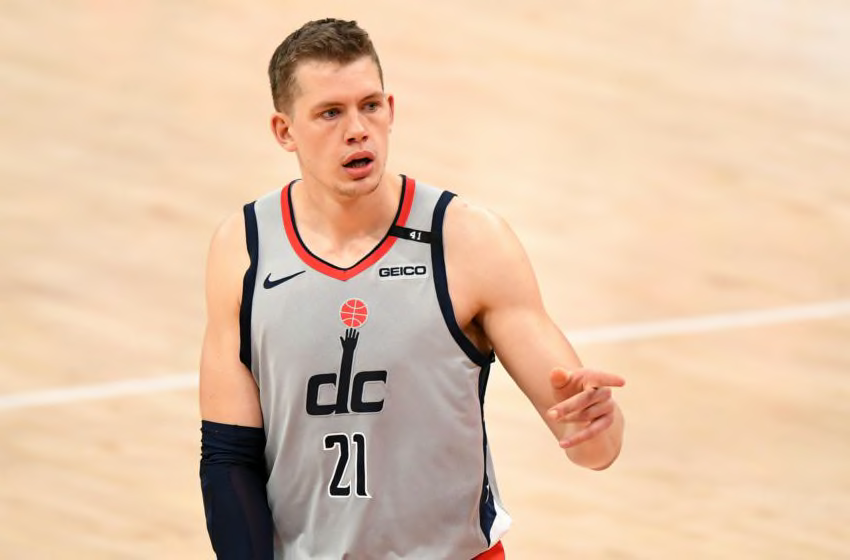
Washington is trading Troy Brown and Mo Wagner to Chicago for Daniel Gafford and Chandler Hutchinson, sources tell ESPN.
Wagner, 23, is 6-foot-11 and 245 pounds and can move quickly and aggressively with or without the ball. He specializes in setting hard screens and rolling quickly to the basket, where he can post up and get to the basket with force. Wagner can also shoot the three, which is something Gafford couldn’t do.
Wagner averages 7.1 points, 2.9 rebounds, and 1.3 assists per game this season with an average of 15 minutes per game. He has started in 13 of the 25 games he has played this season. In those, he shoots 50.8 percent from the field, 31 percent from three, and 78.8 percent from the line.
Brown, the 21-year old out of Oregon, is a 6-foot-6 small forward weighing 215 pounds. Brown is excellent at running in transition and can handle the ball quite well for a forward. His aggression, like Wagner’s, will help spark the offense for the Bulls.
Last season, Brown had an excellent sophomore year in the league, averaging 10.4 points, 5.6 rebounds, and 2.6 assists per game on 43.9 percent shooting from the field, 34.1 percent shooting from distance, and 78.4 percent from the charity stripe.
This season, he’s fallen off a bit, averaging just 4.3 points, 2.9 rebounds, and 0.9 assists per game on 13.7 minutes and 37.1 percent shooting from the field. However, his youth brings optimism to his ceiling as a 21-year old in the NBA. The Bulls bought the small forward at a low price.
To Washington
Chandler Hutchison- $2.4M and $4M (extension eligible)
Daniel Gafford- $1.5M, $1.8M (non-guaranteed) and $1.9M (team) $2.1M TE created
As I mentioned before, Hutchison was hardly a loss, but Gafford stings a little bit. He struggled while replacing Wendell Carter Jr. as the starting center while he was hurt earlier this season, but he is a solid bench player.
Gafford played in 31 games and started in 11 of them. His numbers per 36 minutes better show his value, averaging 13.8 points and 9.7 rebounds in that sample size and shooting 69 percent from the field. His size in the paint is valuable and his defensive skills are applicable too.
Arturas Karnisovas and Marc Eversley hit the nail on the head again. By the looks of this trade, it seems they have made an upgrade to the bench with two versatile young players. They need development, but they could become solid role players off the bench for the future. Mark this as another successful trade for the Bulls in the final hours of the NBA trade deadline.
Join Draft Dr. Phil and Shayne “The Smartest Man” for Keepin’ It 100! The guys are joined by Former Bears WR Rashied Davis to look back on his career and get his thoughts on the Bears today, and Kenneth Davis from the Under Center podcast to talk off-season moves and more!
The ChicagoBulls have made a big splash at the NBA trade deadline acquiring All-Star center Nikola Vucevic from the Orlando Magic in a blockbuster deal according to ESPN’s Adrian Wojnarowski.
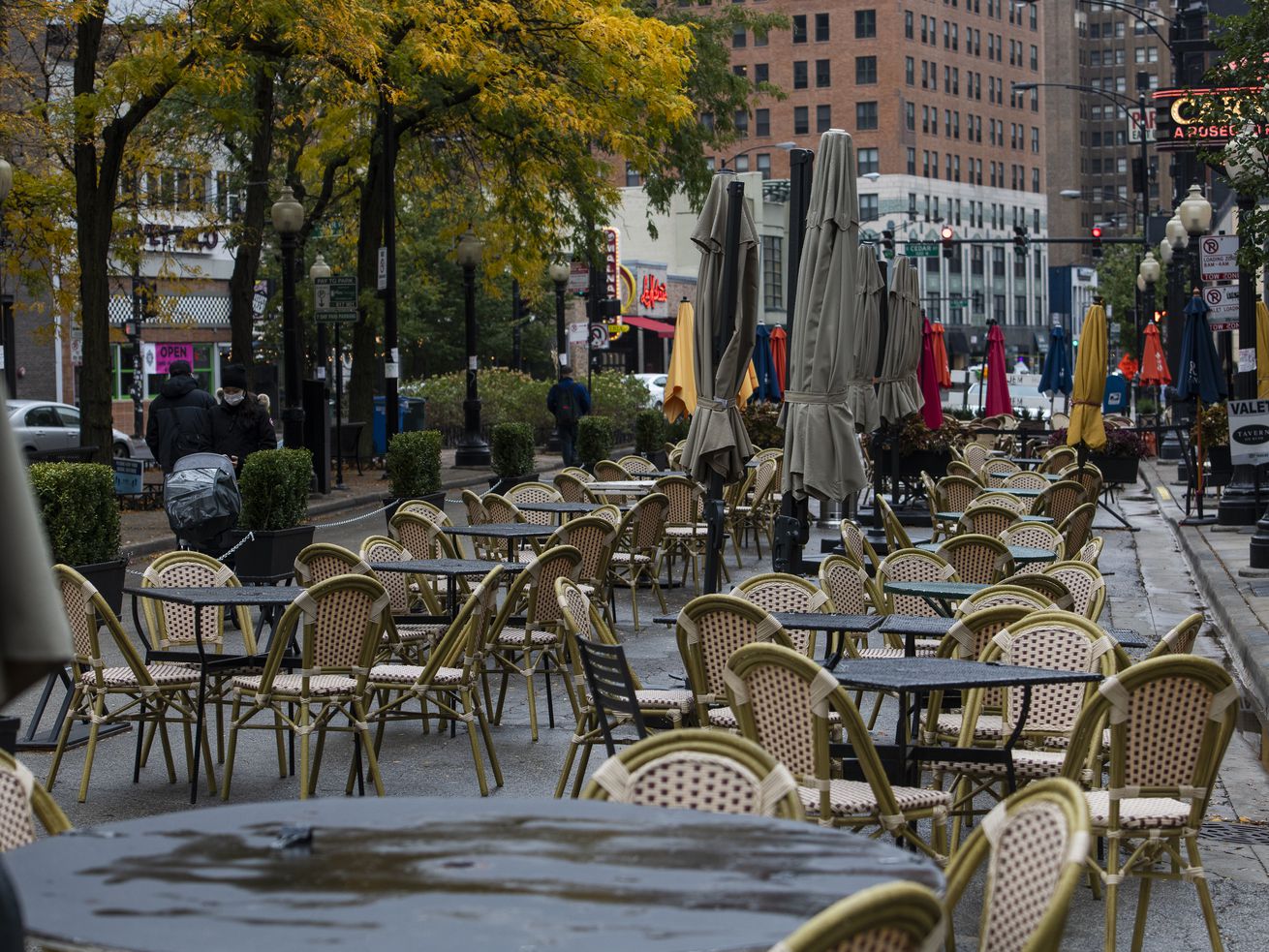
Outdoor dining tables sit empty outside Tavern On Rush and Carmine in October. | Tyler LaRiviere/Sun-Times
The state also announced 118,000 more COVID-19 vaccinations had been given in Illinois as coronavirus cases in Chicago jumped more than 20% in the past week.
Mayor Lori Lightfoot on Thursday authorized bars, restaurants and outdoor performance venues to increase outdoor capacity even as she sounded the alarm about a troubling surge in coronavirus cases among young people.
The news arrived as Chicago’s coronavirus testing positivity rate took another troubling step up.
What Lightfoot calls an “alarming trend and uptick” reminiscent of the surge Chicago saw in October is concentrated among 18-to-39-year-olds living in North Side neighborhoods including Lincoln Park, Old Town, Old Irving, Dunning and Portage Park.
“This is a cohort that we’ve had varied challenges throughout the pandemic reaching. Young people. We were all young once. We all think we’re invincible. We never think something bad is going to happen to us. And the reality is that young people have gotten sick. Very sick. And young people have died from COVID,” Lightfoot said.
“We can’t do bar crawls. We can’t do mass events. And I’m concerned with spring break happening — both for colleges and schools — that this is a concerning trend,” the mayor said.
Tough as it is to break through, the city needs to “reach them where they are”—through “a tremendous amount of messaging through texting and social media.”
“We’re gonna continue to push to reach this group and say, `COVID is real. It has not gone away from our city. It’s still very much part of our present….The vaccines are obviously giving us a ray of light at the end of a very dark tunnel,” but it’s not time to let down your guard.
Even as she sounded the alarm about the surge in coronavirus cases among young people chomping at the bit to return to freedom, the city is loosening the reins on outdoor events in several ways:
• Bars and restaurants can now serve up to 10 people at outdoor tables spaced six feet apart.
• Outdoor weddings and other social gatherings can now serve 100 people or 50% capacity, whichever is less.
• Outdoor theaters, performance venues and other “seated spectator events” with capacity “greater than or equal to 200” can operate at 25% capacity.
• Outdoor recreation can serve multiple groups, each with a 50 maximum while health and fitness centers can increase the size of outdoor classes to 100 people.
• Churches, synagogues and other religious organization can hold outdoor services and events with no capacity limit, provided six feet of social distance is maintained.
Lightfoot denied that she was sending mixed messages by warning young people while relaxing restrictions on outdoor events.
“The issue that we face really isn’t around outdoor events and we’re still being prudent there. The issue that we’re seeing is people not following the public health guidance around masking, social distancing, particularly indoor activities. That’s where we’re seeing the largest growth in new cases and outbreaks,” she said.
“A year ago, we didn’t know a lot about this virus. All we really knew was that it was spreading quickly and that it was deadly. We now have a year’s worth of data…to really understand how this virus spreads and who are the people that are most at risk. So, we can be a lot more targeted in our interventions. And that’s what we plan to do.”
Throughout the pandemic, Lightfoot has not hesitated to play the heavy.
She shut down the lakefront because Chicagoans couldn’t be trusted to maintain their social distance. She drove around the city breaking up large groups of young people.
On Thursday, the mayor said she’s not eager to play the tough-guy role again, but she will if the city’s targeted messaging falls on deaf ears.
“We’ll see if those numbers turn in another direction…If they don’t, we know what we need to do,” she said, pointing to a 23% surge in daily cases and an 18% rise in Chicago’s test positivity rate, all in the last week.
“The last thing in the world that we want to do is shut everything back down like we’re seeing for example in Europe, but we’re concerned.”
Ashlee Rezin Garcia/Sun-TimesPeople approach to receive doses of a COVID-19 vaccine at the United Center’s drive-thru vaccination site on Tuesday afternoon. More than 5 million shots have been given across Illinois.
Also on Thursday, state officials reported 2,190 new COVID-19 cases, diagnosed among 90,101 tests. That lowered the average statewide positivity rate a tenth of a percent, down to 2.7%, according to the state Department of Public Health.
But Chicago’s regional infection rate rose for an eighth straight day up to 3.4%, according to Chicago Public Health Commissioner Dr. Allison Arwady.
That figure, which indicates how rapidly the virus is spreading, was at 2.7% less than two weeks ago, marking a net increase of 26% — all while the number of tests performed has stayed flat, Arwady said during an online Q&A.
New COVID-19 cases by day
Graphic by Jesse Howe and Caroline Hurley | Sun-Times
Part of that rise is “probably” due to St. Patrick’s Day parties, Arwady said, while a more relaxed attitude among younger people drives the city’s latest COVID-19 spike.
“We’ve seen some outbreaks and some major clusters in younger people in some university socializing settings, and some of those are bars,” Arwady said. “We’re talking 20-something people in some cases where we’re seeing clustering. It’s just one person with COVID initially, but then there are people getting together, not wearing a mask and not keeping their guard up.”
Gov. J.B. Pritzker on Wednesday raised concerns about increases in the statewide infection rate, saying that while the state is still “on course” to loosen more business restrictions next month, that plan could be put on hold if metrics deteriorate.
The state reported 118,544 more people received COVID-19 vaccine doses, with a total of more than 5.1 million shots doled out since December and 1.9 million residents fully immunized — just over 15% of the population. Illinois is now averaging 101,175 doses administered per day.
COVID-19 vaccine doses administered by day
Graphic by Jesse Howe and Caroline Hurley | Sun-Times
Coronavirus hospital admissions have increased slightly over the past week but are still close to all-time low levels, with 1,251 beds occupied Wednesday night.
But the virus claimed 35 more lives, including those of 10 Cook County residents. The state’s average daily death rate has fallen by almost half compared to late February.
Since last March, more than 1.2 million residents have tested positive for the virus, and 21,171 of them have died.
The Bulls acquired center Nikola Vucevic from Orlando before Thursday’s trade deadline. | Phelan M. Ebenhack/AP
It took a lot, but the Bulls eventually found common ground with Orlando Thursday morning, also sending Otto Porter Jr. and multiple first-round picks out.
There’s impressing your future bosses, and then there’s what Nikola Vucevic did to the Bulls back on Feb. 5, still a member of the Orlando Magic.
The 30-year-old All-Star center overwhelmed anyone and everything Bulls coach Billy Donovan threw at him that night, finishing with 43 points, 19 rebounds, and oh by the way, hitting four three-pointers.
It obviously left an impression.
Hours before the Thursday trade deadline, the Bulls and Magic finally found common ground, as Vucevic was sent to the Bulls in a package that included former first-round pick Wendell Carter Jr., Otto Porter Jr., and two first-round picks in 2021and 2023 with both being top-four protected.
As well as bringing Vucevic over, the Bulls also acquired veteran forward Al-Farouq Aminu in the package.
Aminu was making $9.7 million this season, as well as having the player option next year at $10.1 million. Not bad, but obviously Vucevic came at a price, and one the Bulls were very comfortable with.
Not only do they add a true big to a lineup that was often engulfed by opposing centers, but an offensive piece that works perfectly with first-time All-Star Zach LaVine.
Vucevic works well in pick-and-roll, pick-and-pop, can stretch the floor, and in doing so opens up the paint for players like LaVine and rookie Patrick Williams to attack the rim.
But there was an even bigger picture to come out of this deal.
Yes, the center has a favorable contract that actually goes down in price. He made $26 million this season, he’ll make $24 million next season, and then $22 million in the final year. What it also continues to show, however, is the culture change the Bulls are trying to establish.
Whether the Vucevic-LaVine combo can contend as big dogs in the Eastern Conference is debatable, but what’s not is the Bulls are doing what it takes to become a destination place for possible free agents, not only the next few years in this current window, but in years to come.
That’s what aggressiveness and ridding themselves of players who would get into their own heads far too often does. Players talk, and they haven’t been talking about the Bulls for years.
Nikola Vucevic, 30 – 6-11 Center — Contract: $26 million 2020-21, $24 million 2021-22, $22 million 2022-23. Key Stats: Averaging a career-best 24.5 points per game this season, and shooting a career-best 40.6% from three-point range.
Al-Farouq Aminu, 30 – 6-8 Forward — Contract: $9.7 million 2020-21, $10.1 million (player option) 2021-22. Key Stats: He’s been limited in Orlando the past two seasons (35 games), but in Portland was a nine and seven guy on most nights.
Troy Brown Jr., 21 – 6-6 Guard/Forward — Contract: On his rookie deal that paid him $3.3 million 2020-21, $5.1 million 2021-22, $7.2 million (qualifying offer) 2022-23. Key Stats: Averaged 10.4 points and 1.2 steals per game last season.
Moritz Wagner, 23 – 6-11 Stretch-Five — Contract: $2.1 million 2020-21. Key Stats: Scored a season-high 21 points against the Clippers on Feb. 23, and was averaging 7.1 points, as well as shooting 31% from three-point range.
Bertrand Tavernier accepts a lifetime achievement award at the 2015 Venice Film Festival. | AP File
He leaves behind a legacy of 30 films that included performances by stars of French cinema such as Romy Schneider, Isabelle Huppert and Dirk Bogarde.
PARIS — French filmmaker Bertrand Tavernier, who directed acclaimed movies such “A Sunday in the Country,” “Captain Conan” and “Round Midnight,” has died, according to his family. He was 79.
Tavernier’s wife and children said Thursday that he died in Sainte-Maxime, located in France’s southerly Var region. The Lyon-born director left behind a legacy of 30 films that included performances by stars of French cinema such as Romy Schneider, Isabelle Huppert and Dirk Bogarde.
Tributes for Tavernier and his work came from far and wide. Former French Interior Minister Gerard Collomb said Tavernier’s films “will remain masterpieces of French cinema.”
Born April 25, 1941, Tavernier wore various caps during his career in cinema. He worked as an assistant director, press officer and critic before he began his turn at directing. It proved to be the decision of his life.
He first found success with 1974’s “The Watchmaker of St. Paul,” and 1976’s “The Judge and the Assassin” won two César Awards, France’s equivalent of the Oscars. The 1990 movie “Daddy Nostalgia” was famous for being Bogarde’s final screen role.
Although Tavernier was less well-known in the English-speaking world, his 1987 feature film about a fictional musician, “Round Midnight,” won Herbie Hancock an Oscar for best original score. Sun-Times movie critic Roger Ebert wrote of the film, “You do not need to know a lot about jazz to appreciate what is going on because, in a certain sense, this movie teaches you everything about jazz that you really need to know.”
Tavernier was married to the late French-Irish screenwriter Claudine O’Hagan, better known as Colo Tavernier, from 1965 to 1980. They had two children together: writer Tiffany Tavernier and director and actor Nils Tavernier.
Colo Tavernier wrote the screenplay for several of her husband’s films and won the César for best adaptation for “A Sunday in the Country” in 1985.
Workers count votes in Israel’s national elections wearing and divided in groups by sheets of plastic masks to help curb the spread of the coronavirus, at the Knesset in Jerusalem, Thursday, March 25, 2021. | AP
Israel’s election commission says that with 100% of votes counted, Netanyahu’s right-wing Likud party and his natural allies have won 52 seats in the 120-seat Knesset, Israel’s parliament. An ideologically diverse array of parties committed to ousting him won 57 seats.
JERUSALEM — Final election results show Israel in political deadlock once again, with Prime Minister Benjamin Netanyahu and his opponents falling short of a governing majority.
Israel’s election commission says that with 100% of votes counted, Netanyahu’s right-wing Likud party and his natural allies have won 52 seats in the 120-seat Knesset, Israel’s parliament. An ideologically diverse array of parties committed to ousting him won 57 seats.
A right-wing party won seven seats and an Arab Islamist party won four. Both are uncommitted, but given the many rivalries in parliament, it is not clear whether either one of them could deliver a required majority.
Party leaders have already begun negotiations that are expected to drag on for weeks. If no one is able to assemble a majority of at least 61 seats, then Israel will go to elections for an unprecedented fifth time in a little over two years.
Tuesday’s vote, Israel’s fourth parliamentary elections in two years, was widely seen as a referendum on Netanyahu’s fitness to rule while under indictment.
Deep divisions between the various parties will make it difficult for either side to gain a majority.
Arab parties have never joined a governing coalition, and for nationalist parties, such an alliance is anathema. Bezalel Smotrich, a Netanyahu ally and head of the far-right Religious Zionist party, said Thursday that “a right-wing government will not be established with support from Abbas. Period. Not on my watch.”
He was referring to Mansour Abbas, the head of the United Arab List, which won four seats.
Gideon Saar, a defector from Netanyahu’s Likud who now heads a six-seat party committed to ousting him, said “it is clear that Netanyahu does not have a majority to form a government under his leadership. Action must now be taken to realize the possibility of forming a government for change.”
The Likud, which won the most seats of any party, fired back, saying such a bloc would be “anti-democratic.” It compared Netanyahu’s opponents to the clerical leadership in Israel’s arch-enemy Iran, which vets candidates for high office.
Yohanan Plesner, president of the Israel Democracy Institute, said that the stalemate is Israel’s “worst political crisis in decades.”
“It’s apparent that our political system finds it very difficult to produce a decisive outcome,” Plesner said. He added that inherent weaknesses in Israel’s electoral system are compounded by “the Netanyahu factor”: a popular prime minister struggling to stay in power while under indictment. “Israelis are split right down the middle on this question.”
Several of Netanyahu’s opponents have started discussing advancement of a bill to disqualify a politician under indictment from being tasked with forming a government, a measure aimed at barring the long-serving prime minister from office. A similar bill was floated after the March 2020 elections, but was never passed.
Netanyahu is on trial for fraud, breach of trust and accepting bribes in three cases. He has denied any wrongdoing and has dismissed the charges as a witch-hunt by a biased law enforcement and media.
Despite the charges against him, Netanyahu’s Likud party received around a quarter of the votes, making it the largest party in parliament. A total of 13 parties received enough votes to enter the Knesset — the most since the 2003 election — and represent a variety of ultra-Orthodox, Arab, secular, nationalist, and liberal factions.
There’s impressing your future bosses, and then there’s what Nikola Vucevic did to the Bulls back on Feb. 5, still a member of the Orlando Magic.
The 30-year-old All-Star center overwhelmed anyone and everything Bulls coach Billy Donovan threw at him that night, finishing with 43 points, 19 rebounds, and oh by the way, hitting four three-pointers.
It obviously left an impression.
Hours before the Thursday trade deadline, the Bulls and Magic finally found common ground, as Vucevic was sent to the Bulls in a package that included former first-round pick Wendell Carter Jr., Otto Porter Jr., and two first-round picks in 2021and 2023 with both being top-four protected.
As well as bringing Vucevic over, the Bulls also acquired veteran forward Al-Farouq Aminu in the package.
Aminu was making $9.7 million this season, as well as having the player option next year at $10.1 million. Not bad, but obviously Vucevic came at a price, and one the Bulls were very comfortable with.
Not only do they add a true big to a lineup that was often engulfed by opposing centers, but an offensive piece that works perfectly with first-time All-Star Zach LaVine.
Vucevic works well in pick-and-roll, pick-and-pop, can stretch the floor, and in doing so opens up the paint for players like LaVine and rookie Patrick Williams to attack the rim.
But there was an even bigger picture to come out of this deal.
Yes, the center has a favorable contract that actually goes down in price. He made $26 million this season, he’ll make $24 million next season, and then $22 million in the final year. What it also continues to show, however, is the culture change the Bulls are trying to establish.
Whether the Vucevic-LaVine combo can contend as big dogs in the Eastern Conference is debatable, but what’s not is the Bulls are doing what it takes to become a destination place for possible free agents, not only the next few years in this current window, but in years to come.
That’s what aggressiveness and ridding themselves of players who would get into their own heads far too often does. Players talk, and they haven’t been talking about the Bulls for years.

/cdn.vox-cdn.com/uploads/chorus_asset/file/22397049/CV_UPDATE_032421_08.jpg)


