What’s New

COVID’s US toll projected to drop sharply by the end of JulyAssociated Presson May 5, 2021 at 4:16 pm

In this April 26, 2021, file photo, CREC Academy of Aerospace and Engineering sophomore Brian Acevedo, 16, receives a COVID-19 vaccine from nurse Myra Glass, of East Hartford, during a mass vaccination site at Pratt & Whitney Runway in East Hartford, Conn.
In this April 26, 2021, file photo, CREC Academy of Aerospace and Engineering sophomore Brian Acevedo, 16, receives a COVID-19 vaccine from nurse Myra Glass, of East Hartford, during a mass vaccination site at Pratt & Whitney Runway in East Hartford, Conn. | AP

But experts also warn that a “substantial increase” in hospitalizations and deaths is possible if unvaccinated people do not follow basic precautions such as wearing a mask and keeping their distance from others.

NEW YORK — Teams of experts are projecting COVID-19’s toll on the U.S. will fall sharply by the end of July, according to research released by the government Wednesday.

But they also warn that a “substantial increase” in hospitalizations and deaths is possible if unvaccinated people do not follow basic precautions such as wearing a mask and keeping their distance from others.

The Centers for Disease Control and Prevention paper included projections from six research groups. Their assignment was to predict the course of the U.S. epidemic between now and September under different scenarios, depending on how the vaccination drive proceeds and how people behave.

Mainly, it’s good news. Even under scenarios involving disappointing vaccination rates, COVID-19 cases, hospitalizations and deaths are expected to drop dramatically by the end of July and continue to fall afterward.

The CDC is now reporting an average of about 350,000 new cases each week, 35,000 hospitalizations and over 4,000 deaths.

Under the most optimistic scenarios considered, by the end of July new weekly national cases could drop below 50,000, hospitalizations to fewer than 1,000, and deaths to between 200 and 300.

“We are not out of the woods yet, but we could be very close,” CDC Director Dr. Rochelle Walensky said, while noting that variants of the coronavirus are a “wild card” that could set back progress.

The projections are probably in line with what many Americans were already expecting for this summer.

With COVID-19 deaths, hospitalizations and cases plummeting since January, many states and cities are already moving to ease or lift restrictions on restaurants, bars, theaters and other businesses and talking about getting back to something close to normal this summer.

New York’s subways will start running all night again this month, Las Vegas is bustling again after casino capacity limits were raised, and Florida Gov. Ron DeSantis this week suspended all restrictions put in place by local governments, though businesses may continue requiring people to wear masks and keep their distance, and many are still doing so.

Many people in Florida have resumed parties, graduations and recitals. Walt Disney World lets guests remove their masks for photographs.

“It does feel like life is returning to normal,” said 67-year-old Vicki Restivo of Miami, who after getting vaccinated resumed outings with her friends at restaurants and traveled to Egypt — and felt “very comfortable” about it.

President Joe Biden on Tuesday set a goal of delivering shots to 70% of U.S. adults by July Fourth. Such a goal, if met, would fit in with the best-case scenarios, said one of the study’s co-authors, CDC biologist Michael Johansson.

Under more pessimistic scenarios, with subpar vaccinations and declining use of masks and social distancing, weekly cases probably would still drop but could number in the hundreds of thousands, with tens of thousands of hospitalizations and thousands of deaths.

“Something I am asked often is when will the pandemic be over and when can we go back to normal. The reality is: It all depends on the actions we take now,” Walensky said.

All the projections trend down, illustrating the powerful effect of the vaccination campaign. But there’s a devastating difference between the more gently sloping declines in some scenarios and the more dramatic drops in others, said Jennifer Kates, director of global health and HIV policy at the Kaiser Family Foundation.

“Each of these differences are people’s lives,” said Kates, who is part of a Kaiser research team that has focused on COVID-19 and was not involved in the CDC study.

The U.S. death toll stands at more than 578,000. The CDC paper gives no overall estimate of how high the number of dead might go. But a closely watched projection from the University of Washington shows the curve largely flattening out in the coming months, with the toll reaching about 599,000 by Aug. 1.

More than 56% of the nation’s adults, or close to 146 million people, have received at one dose of vaccine, and almost 41% are fully vaccinated, according to the CDC.

Johansson said the paper is intended not so much as a prediction of exactly what’s going to happen but as a way to understand how things might unfold if vaccination drives or other efforts stumble.

By September, assuming high vaccination rates and continuing use of prevention measures, the models indicate new cases could fall to just a few hundred per week and just tens of hospitalizations and deaths.

The paper also sketched out a worst-case scenario, in which cases could rise to 900,000 per week, hospitalizations to 50,000, and deaths to 10,000. That most likely would happen sometime this month, the projections said.

However, the paper’s projections are based on data available through late March, when the national picture was somewhat darker.

The CDC paper “is already looking a little outdated, because we’ve seen cases continue to go down, and hospitalizations go down, and deaths go down,” Kates said.

Nevertheless, Johansson warned: “We’re still in a tenuous position.”

There is variation from state to state in how well vaccination campaigns are going and how fast restrictions are being abandoned, and that will probably mean some states will suffer a higher toll from COVID-19 than others in the coming months, Kates said.

“If you take the foot off the gas,” she said, “you can really have some bad outcomes.”

The paper doesn’t look past September, and scientists cannot say for sure what the epidemic will look like next fall and winter because it’s not known how enduring vaccine protection will be or whether variants of the virus will prove to be a greater problem.

Like the flu, COVID-19 could increase as people move indoors in the cold weather.

“My hope is with enough people vaccinated we will be able to get to something that will resemble maybe a bad flu season,” said William Hanage, a Harvard University expert on disease dynamics who was not involved in the research. But “it’s not going to go away. It’s not going to be eradicated.”

___

Associated Press writer Adriana Gomez Licon in Miami contributed to this report.

Read More

COVID’s US toll projected to drop sharply by the end of JulyAssociated Presson May 5, 2021 at 4:16 pm Read More »

Nature at its craziest: Trillions of cicadas about to emergeAssociated Presson May 5, 2021 at 4:37 pm

A cicada nymph moves in the grass, Sunday, May 2, 2021, in Frederick, Md.
A cicada nymph moves in the grass, Sunday, May 2, 2021, in Frederick, Md. Within days, a couple weeks at most, the cicadas of Brood X (the X is the Roman numeral for 10) will emerge after 17 years underground. There are many broods of periodic cicadas that appear on rigid schedules in different years, but this is one of the largest and most noticeable. | AP

Within days, a couple weeks at most, the cicadas of Brood X will emerge after 17 years underground. They’ll be in 15 states from Indiana to Georgia to New York; they’re coming out now in mass numbers in Tennessee and North Carolina.

COLUMBIA, Md. — Sifting through a shovel load of dirt in a suburban backyard, Michael Raupp and Paula Shrewsbury find their quarry: a cicada nymph.

And then another. And another. And four more.

In maybe a third of a square foot of dirt, the University of Maryland entomologists find at least seven cicadas — a rate just shy of a million per acre. A nearby yard yielded a rate closer to 1.5 million.

And there’s much more afoot. Trillions of the red-eyed black bugs are coming, scientists say.

Within days, a couple weeks at most, the cicadas of Brood X (the X is the Roman numeral for 10) will emerge after 17 years underground. There are many broods of periodic cicadas that appear on rigid schedules in different years, but this is one of the largest and most noticeable. They’ll be in 15 states from Indiana to Georgia to New York; they’re coming out now in mass numbers in Tennessee and North Carolina.

When the entire brood emerges, backyards can look like undulating waves, and the bug chorus is lawnmower loud.

The cicadas will mostly come out at dusk to try to avoid everything that wants to eat them, squiggling out of holes in the ground. They’ll try to climb up trees or anything vertical, including Raupp and Shrewsbury. Once off the ground, they shed their skins and try to survive that vulnerable stage before they become dinner to a host of critters including ants, birds, dogs, cats and Raupp.

It’s one of nature’s weirdest events, featuring sex, a race against death, evolution and what can sound like a bad science fiction movie soundtrack.

Some people may be repulsed. Psychiatrists are calling entomologists worrying about their patients, Shrewsbury said. But scientists say the arrival of Brood X is a sign that despite pollution, climate change and dramatic biodiversity loss, something is still right with nature. And it’s quite a show.

Raupp presents the narrative of cicada’s lifespan with all the verve of a Hollywood blockbuster:

“You’ve got a creature that spends 17 years in a COVID-like existence, isolated underground sucking on plant sap, right? In the 17th year these teenagers are going to come out of the earth by the billions if not trillions. They’re going to try to best everything on the planet that wants to eat them during this critical period of the nighttime when they’re just trying to grow up, they’re just trying to be adults, shed that skin, get their wings, go up into the treetops, escape their predators,” he says.

“Once in the treetops, hey, it’s all going to be about romance. It’s only the males that sing. It’s going to be a big boy band up there as the males try to woo those females, try to convince that special someone that she should be the mother of his nymphs. He’s going to perform, sing songs. If she likes it, she’s going to click her wings. They’re going to have some wild sex in the treetop.

“Then she’s going to move out to the small branches, lay their eggs. Then it’s all going to be over in a matter of weeks. They’re going to tumble down. They’re going to basically fertilize the very plants from which they were spawned. Six weeks later the tiny nymphs are going to tumble 80 feet from the treetops, bounce twice, burrow down into the soil, go back underground for another 17 years.”

“This,” Raupp says, “is one of the craziest life cycles of any creature on the planet.”

America is the only place in the world that has periodic cicadas that stay underground for either 13 or 17 years, says entomologist John Cooley of the University of Connecticut.

The bugs only emerge in large numbers when the ground temperature reaches 64 degrees. That’s happening earlier in the calendar in recent years because of climate change, says entomologist Gene Kritsky. Before 1950 they used to emerge at the end of May; now they’re coming out weeks earlier.

Though there have been some early bugs In Maryland and Ohio, soil temperatures have been in the low 60s. So Raupp and other scientists believe the big emergence is days away — a week or two, max.

Cicadas who come out early don’t survive. They’re quickly eaten by predators. Cicadas evolved a key survival technique: overwhelming numbers. There’s just too many of them to all get eaten when they all emerge at once, so some will survive and reproduce, Raupp says.

This is not an invasion. The cicadas have been here the entire time, quietly feeding off tree roots underground, not asleep, just moving slowly waiting for their body clocks tell them it is time to come out and breed. They’ve been in America for millions of years, far longer than people.

When they emerge, it gets noisy — 105 decibels noisy, like “a singles bar gone horribly, horribly wrong,” Cooley says. There are three distinct cicada species and each has its own mating song.

They aren’t locusts and the only plants they damage are young trees, which can be netted. The year after a big batch of cicadas, trees actually do better because dead bugs serve as fertilizer, Kritsky says.

People tend to be scared of the wrong insects, says University of Illinois entomologist May Berenbaum. The mosquito kills more people than any other animals because of malaria and other diseases. Yet some people really dread the cicada emergence, she said.

“I think it’s the fact that they’re an inconvenience. Also, when they die in mass numbers they smell bad,” Berenbaum says. “They really disrupt our sense of order.”

But others are fond of cicadas — and even munch on them, using recipes like those in a University of Maryland cookbook. And for scientists like Cooley, there is a real beauty in their life cycle.

“This is a feel-good story, folks. It really is and it’s in a year we need more,” he says. “When they come out, it’s a great sign that forests are in good shape. All is as it is supposed to be.”

___

Follow Seth Borenstein on Twitter: @borenbears

___

The Associated Press Health and Science Department receives support from the Howard Hughes Medical Institute’s Department of Science Education. The AP is solely responsible for all content.

Read More

Nature at its craziest: Trillions of cicadas about to emergeAssociated Presson May 5, 2021 at 4:37 pm Read More »

‘She was just doing her job and they started shooting.’ Security guard, mother of 5, shot at Park Manor apartment buildingon May 5, 2021 at 3:11 pm

A security guard was wounded in a drive-by shooting as the mother of five helped a senior citizen in the lobby of a Park Manor apartment building Tuesday evening.

Someone opened fire from a passing dark-colored car toward the lobby of the Lafayette Plaza Housing Cooperative at 50 W. 71st St. shortly before 6 p.m., according to Chicago police.

One of the bullets struck Keiona James, 37, according to her sister Kira Allen. “She was just doing her job and they started shooting,” Allen said. “She really didn’t see anything.”

Paramedics took James to the University of Chicago Medical Center in critical condition, police said. James didn’t require surgery and was expected to be released from the hospital soon, Allen said.

In a phone call, James said she was “all right” but declined to say more.

Allen said she doesn’t believe her sister was the target of the shooting. James lives far from where she works and doesn’t know anyone in the neighborhood.

Police said an 18-year-old man was also injured in the shooting, but was not shot. He showed up at St. Bernard Hospital with abrasions, police said. In an earlier statement, officers said he had suffered a gunshot wound.

No one was in custody, police said.

Read more on crime, and track the city’s homicides.

Read More

‘She was just doing her job and they started shooting.’ Security guard, mother of 5, shot at Park Manor apartment buildingon May 5, 2021 at 3:11 pm Read More »

Find the Midcentury Modern Decor of Your Dreams at Heritage Trail Mercantileon May 5, 2021 at 2:55 pm

Little did Lisa Carlson Chrisopoulos know when she bought the building at 190 Northfield Road in Northfield in early 2020 that its crowning feature would be the ventilation system. (The previous owner used the space as a garage for his exhaust-spewing Ferrari collection.) Seeing its white floor and walls and corrugated metal ceiling, she knew she could transform the place into an expansive new home for Heritage Trail Mall, the antique bazaar she ran with her parents and sister in Wilmette for nearly 28 years. With a name tweak, Heritage Trail Mercantile opened in the new location in October with 42 vendors, many of them carryovers from the original spot. Chrisopoulos now runs the market solo, but pandemic-friendly HVAC system aside, much about it will be familiar to her regulars: booths packed with smartly curated antique, vintage, and handmade wares, ranging from substantial 19th-century worktables to spindly midcentury modern lamps to trendy-again ’90s costume jewelry. If you don’t see what you’re looking for, just ask: Chrisopoulos has a crazy good memory and will keep an eye out during her regular picking trips. “It just sticks in my brain,” she says. “On my day off, it’s still the thrill of the hunt.”

Read More

Find the Midcentury Modern Decor of Your Dreams at Heritage Trail Mercantileon May 5, 2021 at 2:55 pm Read More »

Chicago Bears: Ryan Pace is being smart with the wide receiver roomon May 5, 2021 at 3:00 pm

Read More

Chicago Bears: Ryan Pace is being smart with the wide receiver roomon May 5, 2021 at 3:00 pm Read More »

Adam Toledo shooting: first assistant state’s attorney resigns after probe into statements underling made in courton May 5, 2021 at 2:12 pm

First Assistant State’s Attorney Jennifer Coleman is resigning following the office’s investigation of an in-court statement a fellow prosecutor made about the deadly Chicago police shooting of 13-year-old Adam Toledo.

In a statement Wednesday announcing the conclusion of its review, the state’s attorney office said the investigation “revealed a breakdown of communication in how information was shared, which ultimately did not get elevated to State’s Attorney [Kim] Foxx before, nor in a timely manner following, the bond court hearing.”

The statement made no mention of Coleman’s resignation, which Foxx announced separately in an internal email to staff.

The investigation stemmed from a proffer prosecutor James Murphy read in court during an April 10 bond hearing for Ruben Roman, who was arrested at the scene of Adam’s shooting, during which Murphy described the events leading up to the officer firing his weapon.

Jennifer Coleman
Jennifer Coleman
Cook County state’s attorney’s office

“The officer tells [Adam] to drop it as [Adam] turns towards the officer. [Adam] has a gun in his right hand,” Murphy told Cook County Judge Susana Ortiz about the March 29th incident.

“The officer fires one shot at [Adam], striking him in the chest. The gun that [Adam] was holding landed against the fence a few feet away.”

Five days later — and hours before a police oversight agency released footage of the shooting — State’s Attorney Kim Foxx spokeswoman Sarah Sinovic announced Murphy “failed to fully inform himself before speaking in court.”

The statement was viewed by some at the courthouse as an attempt to get ahead of video that showed Adam with his hands up without a weapon the moment he was shot by police. Adam threw a gun he had been less than a second before.

The state’s attorney’s office statement led to calls on social media for Murphy to be fired and accusations that he had lied in court. Days later, Murphy was placed on paid leave while the office launched an internal investigation.

On Wednesday, the office said Murphy “did not intend to give the impression that Adam Toledo was holding a gun when shot” and “The investigation revealed that the language the attorney used in court was inartful, leaving an unintended impression.”

Attorneys in the office will have to undergo new training about presenting facts in court, and new, unspecified policies and procedures will be implemented to ensure checks and balances work as intended, the state’s attorney’s office said.

Murphy will return to his previous assignment as a result.

In an interview on the Fran Spielman Show, Foxx said she had not read Murphy’s statement before it was read in court and hinted that the office’s actions against Murphy, and the possibility others in the office could face reprimand, hurt morale among rank-and-file prosecutors.

“This isn’t about political cover. This is about the expectation of law enforcement to be forthright and transparent,” Foxx told the Chicago Sun-Times. “There is no sacrificial lamb here. This is about making sure that we get it right, and when we don’t get it right, owning it doing what we need to do to make sure that it doesn’t happen again.”

Coleman was appointed first assistant in December, days after Foxx was sworn in for her second term, in an announcement that heralded her 25 years with the office, which included stints in the domestic violence, felony review and narcotics divisions.

“Jenny has been a valuable member of this office and I wish her the best in her next endeavors,” Foxx wrote in an email to staffers.

Read More

Adam Toledo shooting: first assistant state’s attorney resigns after probe into statements underling made in courton May 5, 2021 at 2:12 pm Read More »

‘She was just doing her job and they started shooting.’ Security guard, mother of 5, shot at Park Manor apartment buildingon May 5, 2021 at 12:30 pm

A security guard was wounded in a drive-by shooting as the mother of five helped a senior citizen in the lobby of a Park Manor apartment building Tuesday evening.

Someone opened fire from a passing dark-colored car toward the lobby of the Lafayette Plaza Housing Cooperative at 50 W. 71st St. shortly before 6 p.m., according to Chicago police.

One of the bullets struck Keiona James, 37, according to her sister Kira Allen. “She was just doing her job and they started shooting,” Allen said. “She really didn’t see anything.”

Paramedics took James to the University of Chicago Medical Center in critical condition, police said. James didn’t require surgery and was expected to be released from the hospital soon, Allen said.

In a phone call, James said she was “all right” but declined to say more.

Allen said she doesn’t believe her sister was the target of the shooting. James lives far from where she works and doesn’t know anyone in the neighborhood.

Police said an 18-year-old man was also injured in the shooting, but was not shot. He showed up at St. Bernard Hospital with abrasions, police said. In an earlier statement, officers said he had suffered a gunshot wound.

No one was in custody, police said.

Read more on crime, and track the city’s homicides.

Read More

‘She was just doing her job and they started shooting.’ Security guard, mother of 5, shot at Park Manor apartment buildingon May 5, 2021 at 12:30 pm Read More »

NFL Draft Recap: Grading The Bears Draft Pickson May 5, 2021 at 1:37 pm

Last week kicked off the annual NFL Draft for the league’s upcoming season. And we think we speak for a lot of Chicago Bears fans when we say the Bears did not disappoint. In this year’s draft, Chicago came in with eight picks across the board. One in each of the first three rounds, another in the fifth, and four in the sixth round. But some of the Bears’ draft picks didn’t even make it past day one.

Pace and Nagy were certainly busy this year as they once again jumped ahead in round one to grab their guy at quarterback. If you’ve been hiding under a rock since last Thursday, don’t worry, we’ll fill you in on all the action from the Chicago Bears draft room. The front office sure made us look like fools with our own mock draft. But we don’t mind it at all given how everything played out. So with that, let’s dive into our recap of how Chicago did this year and grade the Bears’ draft picks.

Advertisement

First Round Pick: Justin Fields, QB, Ohio State

The clock for the Chicago Bears first round draft pick started counting down a lot earlier than many of us expected it to. After a trade with the New York Giants, the Bears acquired quarterback Justin Fields from Ohio State University with the 11th pick in this year’s draft. In the trade, Chicago gave up their 20th pick in the first round of 2021, 164th pick in the fifth round of 2021, a first rounder in 2022, and a fourth rounder in 2022.

Advertisement

Is that too much to give up for your potential franchise play caller? Absolutely not. Fields was ranked by many as the third best quarterback in the draft. But despite all of his potential, he surprisingly fell down the board as the draft went on, and the Bears couldn’t pass up their chance. He ended up being the 4th quarterback selected overall, out of five taken in the first round. Justin Fields is as big of a dual threat as they come. He’s comfortable dishing passes out of the pocket and can extend plays and drives using his 4.44 40-yard dash speed. If the Bears keep him protected and healthy, we can only imagine what his ceiling will be. And when it comes to quarterback protection, that was definitely a focus with Chicago’s next pick in the draft…

Second Round Pick: Tevin Jenkins, OL, Oklahoma St.

After going all in on Justin Fields, the Chicago Bears didn’t let their foot off the gas on day 2. In the second round, the Bears were set to have the 52nd pick, which is essentially #20 in that round. But yet again, Pace pulled the trigger and went after a big guy to protect his new quarterback by selecting Tevin Jenkins out of Oklahoma State with the 39th overall pick in the draft. Jenkins was practically a steal for us at 39. He’s big, tough as they get, and has what it takes to be a star in this league. Plus, Jenkins can immediately fill in for Chicago in an area they desperately need him in. 

The Rest of the Bears’ Draft Picks

For day three, the Bears’ draft picks were mostly in the sixth round after all the deals they made, with one in the fifth and another in the seventh.  Right away, Pace used  his first pick of day 3 in round 5 at #151 overall to select offensive tackle Larry Borom from Mizzou. Borom isn’t set to make quite of an immediate of an impact like Jenkins can. However, in time, he could develop into a key piece on our o-line.

In the sixth round, the Bears had three selections at #217, 221, and 228. They used these picks on Khalil Herbert, a running back from Virginia Tech, Dazz Newsom, a receiver from UNC, and Thomas Graham Jr., a corner out of Oregon. With Herbert, the Bears have the opportunity to mold him as a returner for special teams while Newsom will add some speed to the receiver core. Graham has a chance to earn a starting spot right away on our roster as we have an open starting corner spot with the release of Kyle Fuller. And with the selection from the Chicago Bears draft picks, the team went with defensive tackle Khyiris Tonga out of BYU. He’ll have to fight for his spot, and the Bears are going to be willing to give him that opportunity. 

Not a lot of us fans had these high of expectations entering the 2021 NFL Draft. After taking the leap for Fields and making even more moves to build up the offensive line, Pace and Nagy should pat themselves on the back for this draft. If we had to grade them, we’d give them a solid A. They addressed some of the biggest needs for our team and didn’t overreach for a guy that didn’t make sense. And if everything plays out in our teams favor, the future of the Chicago Bears looks very bright.

Read More

NFL Draft Recap: Grading The Bears Draft Pickson May 5, 2021 at 1:37 pm Read More »

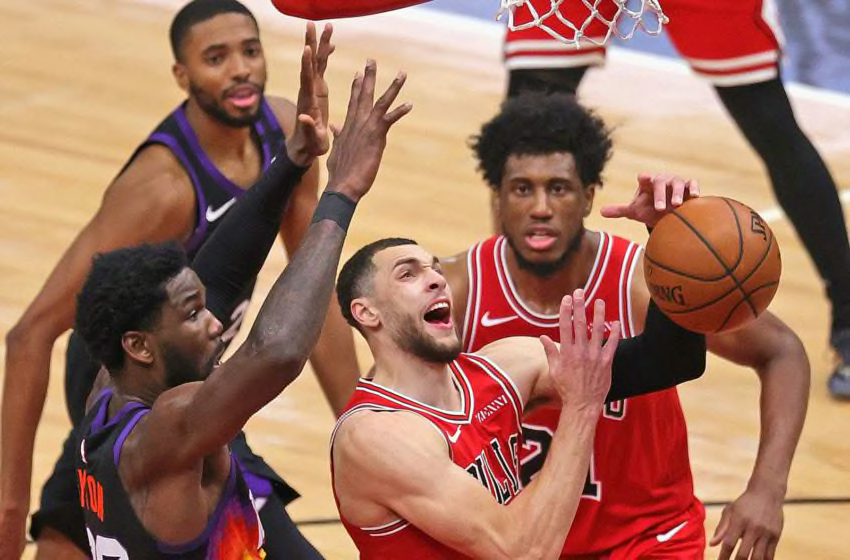
Chicago Bulls: What’s next for the future of the team?on May 5, 2021 at 2:00 pm

Read More

Chicago Bulls: What’s next for the future of the team?on May 5, 2021 at 2:00 pm Read More »