Everyone kind of wants to live in a penthouse—otherwise “deluxe apartment in the sky” or the infamous magazine wouldn’t resonate quite like they do.
As a result, they tend to be pretty expensive. But they don’t have to be. Just one of these five goes for over a million dollars, despite being unique spaces in great locations. You might not get something out of Architectural Digest, but you can pick from a range of styles, with great views, in different parts of town (or the suburbs).
What’s more: you can get a penthouse. Like a house where a penthouse should be. I’ll explain.
This handsome Roaring ’20s building was built as wealth moved north along the lake, and it’s situated right on one of Lake View’s most handsome corners, right across LSD from Belmont Harbor. It’s as nice inside as you would expect, but what really makes it special is how the interior has been updated—simultaneously extremely contemporary and a throwback to its era, without being corny about it. The use of wallpaper is just delightful, like the green floral pattern on the ceiling of the sitting room, set off with Lily Pulitzer-hued paint. It’s a pretty bold choice given the view. Or there’s the laundry room, a converted galley kitchen, which could be a throwaway, but has a rich rose pattern on… the ceiling? The library and bar, alternately, eschews wallpaper for a rich dark blue. It’s a lush and vivid look throughout, perfect for its spot.
Can’t decide between an apartment or a house? Have I got the place for you: a three-bed, three-bath house on top of an old apartment building in the South Loop. It’s actually a house, on top of the building. A nice one, kind of postmodern, a bit Stanley Tigerman-ish, with lots of windows, two big porches, and a big glass-block centerpiece bath in the middle of its open-plan first floor. It’s not exactly a luxury house, though it is nice; it doesn’t match the building at all; it’s just a house, dropped on top of an apartment building. Downside: you have to pay HOA dues on a house. Upside: you live in a house, on top of a building.
For the same feel but a bit less weird, this three-bed, two-bath river condo offers similar size at a similar price in an ideal location (and a boat dock). It has lofted bedrooms, accessible by a glass-and-metal spiral staircase, leading to a haute-industrial mesh floor, which overlooks the living space, which is cooled by a fan with transparent blades. It’s pretty cool. It also comes with roof rights, with which very little has been done, but the view of the bend in the river is gorgeous.
This corner unit has two beds and one bath and spectacular skyline views for under $400k, with reasonable HOA dues of $576 a month. What’s the catch? It’s not quite a proper penthouse, just penthouse-floor, and the finishing is pretty basic. But you can let the skyline do all the work for you, and for more color there’s a rooftop lounge, off which there is a rooftop pool, which—being on the 29th floor—you’re right next to. It’s also a great location, on the other side of LSD from Burnham Harbor and Northerly Island, and due east of Chinatown and Ping Tom Park.
Finally, here’s an inexpensive suburban option. It’s pretty simple, as you’d expect from the price, and it’s a bit dated—but kind of nicely so, as with the gold accents in the large bathroom, or the wall of mirrors that adds some light and a nice reflection to the large open-plan kitchen. Why have a penthouse out in the suburbs? For the pleasant views of the green space surrounding the building. It’s right off a big park with a pond, with Deer Grove a bit farther in the distance, which is connected by a bike trail. It’s got an outdoor pool, is practically next door to a library, and there’s a Mariano’s and a gym about a quarter-mile away, so you can spend a lot of time outdoors instead of in a car.
Got a craving for Italian pasta with a funky name? Then you’ve come to the right place! We have created a list of the best restaurants near you in Chicago to get killer gnocchi. And for the record, here’s how you pronounce it. So sound like a pro next time you order Nee-Oh-Key. *chefs kiss*
This laidback Italian restaurant serves up ALL the goodness including pizza, wines by the quartino, and of course, gnocchi. Their Gnocchi Pesto features a potato based pasta, pesto genovese, garlic confit, and overnight tomato. And Gnocchi alla Romana offers semolina dumplings, amatriciana, and pecorino.
Are you looking for a cozy Italian eatery that offers gnocchi near you in Chicago? You’ll absolutely want to try the Jalapeno Gnocchi which consists of jalapeno stuffed dumplings with roasted red pepper puree. Stop by this cute location for lots of pastas, sandwiches, salads, and daily specials.
Head to this small neighborhood joint and plan on stuffing your face. Sapori’s Gnocchi al Brivido features tender potato gnocchi sautéed in a basil pine nut pesto, tossed with tender chicken breast, sun-dried tomatoes, parmesan, and pine nuts. Just. Wow.
This Roscoe Village staple offers ~ambience~ with candlelit brick and wood rooms, a cocktail lounge, and sidewalk seats. If you’re looking for the top restaurants that offer fresh gnocchi near you in the city, the folks at Piazza Bella serve up a traditional Potato Gnocchi with fresh, handmade pasta served with a rich four cheese sauce.
Three words describe Pasta Al Gusto: fresh, fresh, and FRESH. Get down on their no-frills potato-based Gnocchi, served with your choice of sauce and topped with (dangerously addicting) parmesan cheese.
Grab a friend and get to this bustling space for dope cocktails and generous carafes of vino. Quartino’s Gnocchi is served in an organic tomato sauce with fresh basil and ricotta. Yum.
Since their reopening, A Tavola offers a 4 course menu featuring their best sellers for $64, created by Chef Dan. Of course, you’ll want to indulge in their mouth watering Gnocchi with browned sage butter & parmesan.
The folks at Antico focus on authentic Italian cuisine with an emphasis on using the freshest ingredients possible. Their execution? Simple. Just straight up Gnocchi, made fresh daily. Choose how you want it prepared. Easy, right?
To say that the Chicago Bears need a bounce back season in 2021 would be an understatement.
There is not a single fan, in their right mind, who thinks that last year was a success simply because of a playoff berth in 2020. This past season was just as much of a failure as it would have been had the Bears missed the playoffs completely.
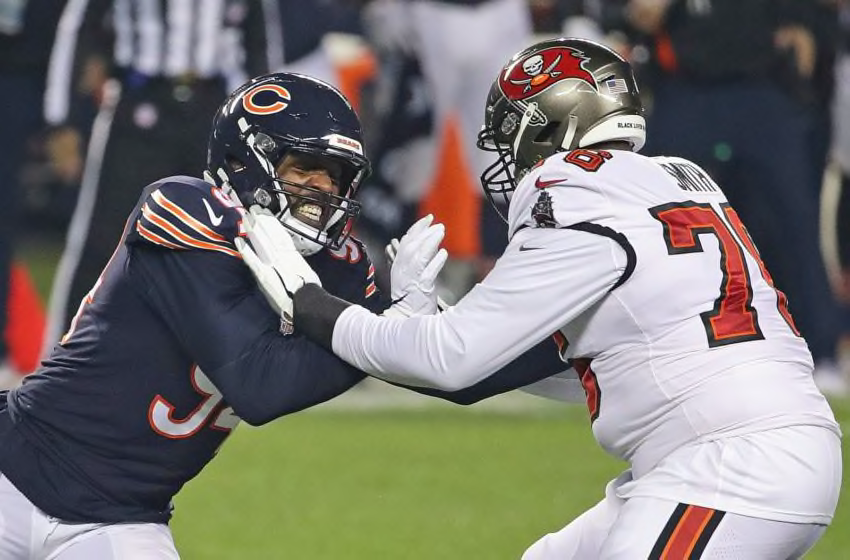
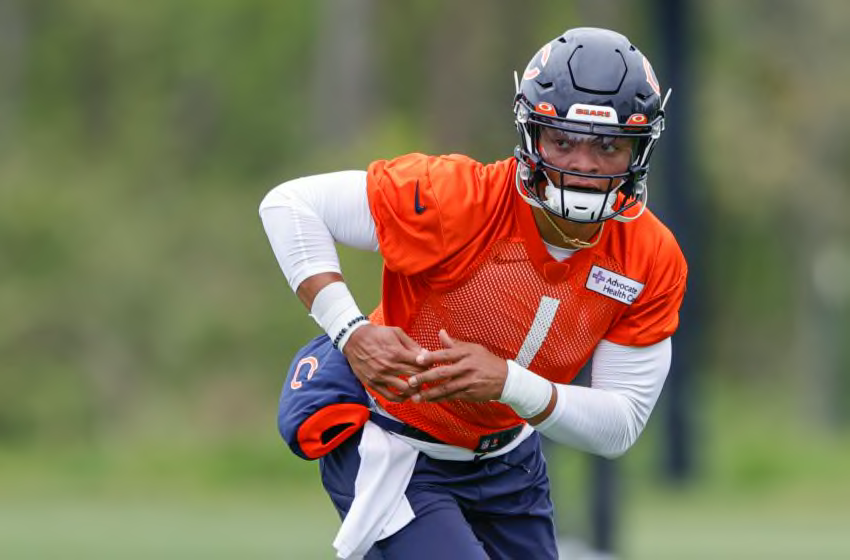
The quarterback play was as erratic as ever behind Mitchell Trubisky and Nick Foles. Hopefully, we don’t have to worry about that in 2021 with the emergence of Justin Fields. The offensive line play was subpar for most of the season, thus the Bears addressing it in a big way during this year’s draft.
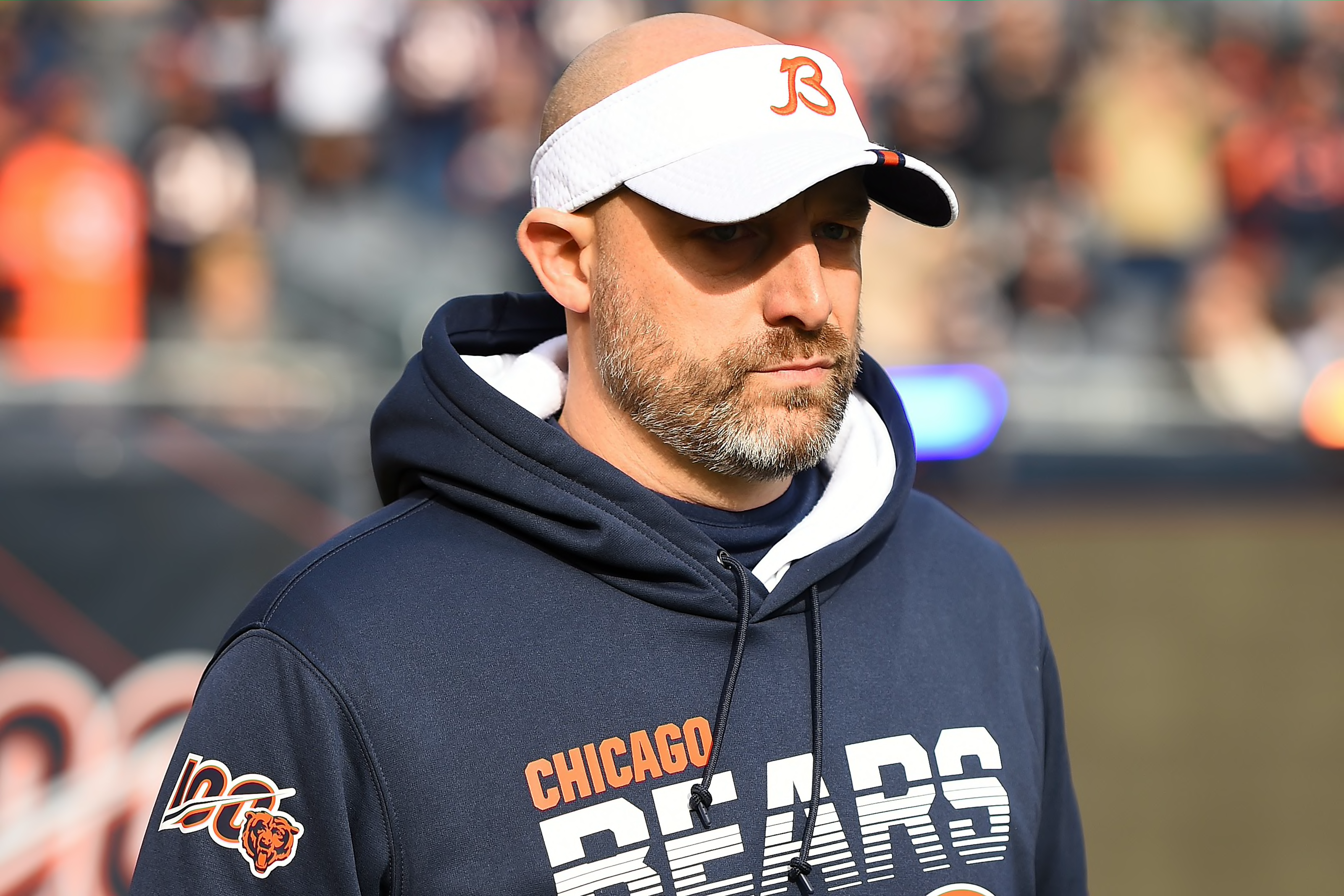
Last year is in the rear view, and there is much reason to be excited about the coming season. Of course, Fields is at the forefront of all the excitement. However, head coach Matt Nagy might have his best offensive group as a whole since coming to Chicago.
The Chicago Bears will bounce back on the heels of a few particular players in 2021.
We know the Bears are going to get great seasons from players like Allen Robinson and Roquan Smith. Both of these guys are in the thick of their prime and mean the world to their respective side of the ball.
There’s also not going to be a single person surprised if David Montgomery continues where he left off in 2020, when he finished as the league’s fourth-leading rusher. He’s one of those players most fans count on to be great again in 2021.
The Bears have some certainties going into the upcoming season, but there are some players who need to have big years ahead and for different reasons. If the Bears are to be a legitimate threat a few months down the road, the following five players have to bounce back from a disappointing season last year.
I didn’t get a chance to check this game out, but I wish I had. Not only did the offense explode but Kohl Stewart turned in another fine pitching line. I’ve missed all of the former 4th overall pick’s starts this season. A sinker baller who has struggled to miss bats and walked a few too many guys at times throughout his career, has seemingly been dialed in through three starts. He’s walked just four in 16 innings while keeping the ball on the ground for the strong Iowa infield defense.
As for the offense, Patrick Wisdom hadn’t recorded a hit in his first four games since joining the Iowa active roster this week, but the veteran power hitter made up for it last night. He blasted two home runs, walked twice and was hit by a pitch, reaching safely in all five plate appearances.
He was joined in the homer barrage by Taylor Gushue, Jose Lobaton and Rafael Ortega, but this was really a top-to-bottom effort by the I-Cubs lineup. Sergio Alcantara and Abiatal Avelino continued their hot starts (I still really like both of these offseason acquisitions, they look good at the plate and in the field). Even Andrew Romine chipped in with three hits.
The Tennessee offense got off to a strong start in their first handful of games, but has cooled off over the past ten. With Jared Young injured and Brennen Davis still in Mesa, the team is struggling to hit for power, and thus is reliant on stringing hits together. On top of that the pitching staff hasn’t been quite as sharp as expected early on. It’s an experienced staff, with plenty of AA/AAA veterans, but they haven’t found their groove.
The recent return from injury by Nelson Velazquez has been a welcomed one. South Bend has been struggling mightily on offense, mostly due to their inability to hit home runs (the team has just 2 in total). Velazquez already recorded one of the team’s two homers in his first 5 games, while recording four consecutive multi-hit games. There just isn’t much power in the South Bend lineup outside Velazquez and Chase Strumpf, who has also missed time. Everyone else in the lineup tops out as gap power hitters.
Delvin Zinn is now 11-for-11 on stolen base attempts so far this season (14 games). The athletic utility man was 30-for-38 in 2019.
A very young (6 regulars are 20-years-old-or-younger) Myrtle Beach (7-8) lineup continued it’s struggles. Two days ago their lineup did not feature a single batter above the Mendoza Line. After yesterday’s game they now have two (Jonathan Sierra and Yohendrick Pinango) but their inexperience shows, especially when they face older pitchers. As a group they are overly aggressive and often get themselves out on pitcher’s pitches.
It will get better. There is talent with this group, but it is clearly going to take some time, as they wait for the young hitters to make some adjustments. In the meantime, the club will need some of the older players to carry some of the burden: Edmond Americaan (24), Matt Mervis (23), Sierra (22). Unfortunately, Sierra is the only guy with significant full-season experience (101 G with South Bend in 2019). Americaan spent most of 2019 in Eugene, and Mervis is just 9 games into his professional career.
Top Performers
D.J. Herz: 4 IP, 2 H, R, 0 BB, 8 K (1.08)
Injuries, Updates, and Trends
As bad as the Pelicans offense (.168/.243/.257, 52 runs in 15 G) has been, its actually only the third worst offense among the twelve team Low-A East league. There are four teams with batting averages below .200 and OPS below .600. Kannaplois (36 R) and Fredericksburg (39 R) have had even greater struggles pushing runs across than the Pelicans. A sign of the Pelicans inexperienced approach is they trail all teams in walks (38) by a huge margin (second worst is 55), while also striking out at the third highest amount (176).
The Pelicans pitching is middle of the pack overall, but they have the third lowest batting average against (.204). Defense and a few too many walks and hit batters are keeping them from moving higher.
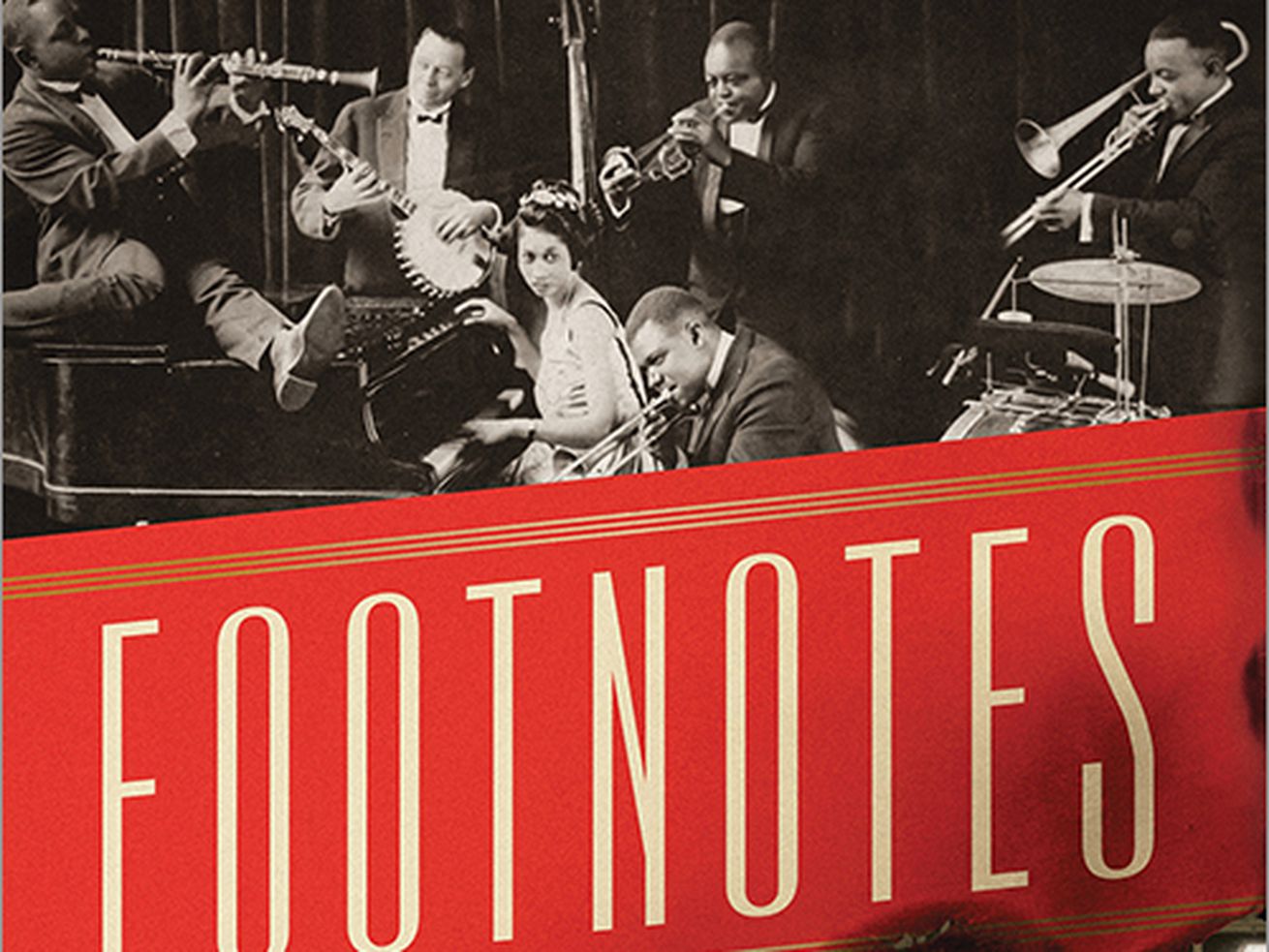
“Footnotes: The Black Artists Who Rewrote the Rules of the Great White Way,” is a deep dive into the 1921 musical “Shuffle Along” and its creators. | Sourcebooks
‘Shuffle Along’ defied the racism of the day, becoming Broadway’s first all-jazz musical. It changed musical theater and showed white audiences would pay Broadway prices to see Black performers.
Caseen Gaines didn’t know anything about the forgotten 1921 production of “Shuffle Along,” the groundbreaking hit musical that brought Black entertainers to Broadway, until he saw George C. Wolfe’s 2016 reimagining of the show.
“Shuffle Along, or The Making of the Musical Sensation of 1921 and All That Followed” celebrated and dissected that earlier show. But it abruptly closed when one of its key performers, Audra McDonald, became pregnant and left the show.
Sourcebooks“Footnotes: The Black Artists Who Rewrote the Rules of the Great White Way,” is a deep dive into the 1921 musical “Shuffle Along” and its creators.
Gaines attended the penultimate performance. Seeing a show that celebrated this landmark musical meet a premature end felt “like justice being denied once again.”
“I went home and started Googling around like most people do when they find something interesting and want to know more about it,” Gaines says. “Then, I fell down the rabbit hole.”
More than four years later, Gaines is the author of “Footnotes: The Black Artists Who Rewrote the Rules of the Great White Way” (Sourcebooks, $26.99), a deep dive into the musical and its multitalented and determined creators — playwright-comedians Flournoy Miller and Aubrey Lyles, singer and lyricist Noble Sissle and composer and ragtime pianist Eubie Blake.
Maryland Center for History and CultureFlournoy Miller (from the top), Noble Sissle, Eubie Blake and Aubrey Lyles in a publicity photo from the 1921 production of “Shuffle Along,” the groundbreaking hit musical that brought Black entertainers to Broadway.
“It was a perfect storm, and at the center of it were two comedians who were incredibly smart, witty and clever and two equally smart musicians,” Gaines says.
“Shuffle Along” defied the systemic racism of the day. Broadway’s first all-jazz musical, it changed the sound of musical theater and showed that white audiences would pay Broadway prices to see Black performers.
It helped popularize the Harlem Renaissance, ran for 484 performances before touring the country and launched or boosted the careers of Josephine Baker, Paul Robeson, Florence Mills, Lottie Gee, Fredi Washington and Adelaide Hall.
“There was a great story to tell not only about this moment in 1921 but also about how something that was so prevalent and significant became something that 100 years later is a footnote,” Gaines says. “The creators are just a few of the many Black Americans who forever changed this country and have been denied their due.”
Gaines sets his book against the backdrop of a recession, the aftermath of the global flu pandemic and the worst period of anti-Black violence since the Civil War. The play opened a week before the Tulsa Race Massacre, in which mobs attacked Black residents and businesses of the Oklahoma city’s Greenwood District, and two years after “a prolonged period of radicalized antagonism and violence known as the Red Summer.”
Maryland Center for History and CultureNoble Sissle with the show’s chorines in a publicity photo for the 1921 production of “Shuffle Along.”
The musical’s plot was based on Mills and Lyles’ play “The Mayor of Dixie,” about two conniving men, Sam Peck and Steve Jenkins, who run for mayor of Jimtown. Whoever wins agrees to appoint the other as police chief. Differences arise, and their opponent in the race, Harry Walton, vows to end their corrupt reign. Amidst this, a love story unfolds.
It was the first Broadway musical to feature syncopated jazz and a chorus of professional female dancers. Its popular songs included “I’m Just Wild About Harry” (later a campaign song for 1948 presidential candidate Harry S Truman), “Love Will Find a Way” (Broadway’s first African American romantic musical duet) and “In Honeysuckle Time.”
Gaines’ research led to libraries including the New York Public Library’s Schomburg Center for Research in Black Culture, the Maryland Center for History and Culture and the Emory University archives. The show’s creators were celebrities, and their lives were well documented in the Black press.
Gaines says he relished discovering Sissle and Blake’s unpublished memoirs. He uses excerpts throughout the book.
“These were really helpful because there was such a richness in their voices,” he says.
Johanna CalleAuthor Caseen Gaines.
“Shuffle Along” was a chaotic mix of vaudeville, operetta and burlesque. It heralded a new form of musical. The jazz score was revolutionary and exciting, yet the show also relied on “the Southern comfort of antebellum humor and blackface,” holdovers from vaudeville minstrel shows.
“You can see how tenuous the construction of the show had to be for it to resonate with white audiences,” says Gaines, 35. “It’s a really interesting look at the delicate dance that people of color have to do in order to find mainstream success.”
After Broadway, “Shuffle Along” toured through 1924, in Chicago and other cities.
Gaines, who teaches English and journalism at Hackensack High School in New Jersey, says the story of Miller, Lyles, Sissle and Blake and their determination to succeed is as important today as it was in 1921.
“Sometimes, when you look at the footnotes of history, you find a more interesting story to tell about America,” Gaines says.
He says the story he unearthed is one of “racial representation, a story about living in ones authentic self as a means of gaining representation.
“It feels so relevant to me right now because I think there’s something very important in being reminded that this took place 100 years ago. If we are to ever break the cycle of systemic racism, we need to remember how long this fight has been and use that to act with increased urgency.”
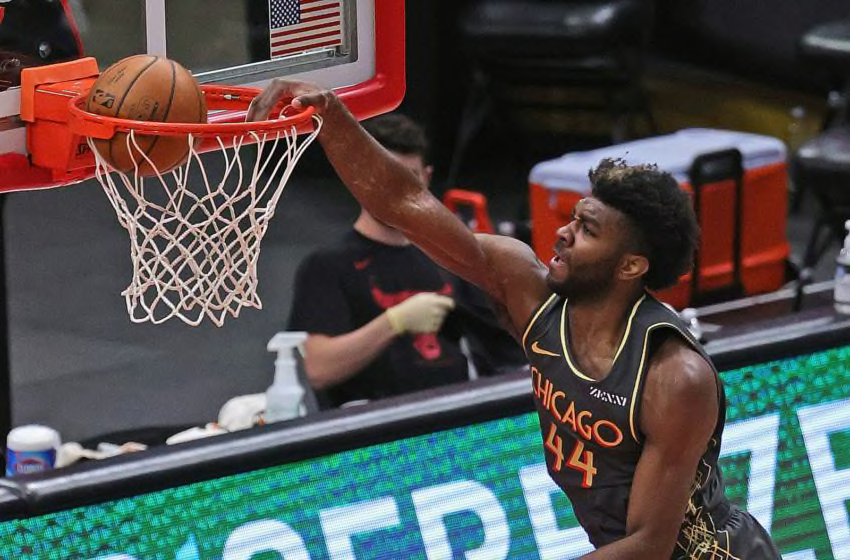
Now that the Chicago Bulls season is done, it’s important to look back on the development over the first year of their new starting small forward, Patrick Williams.
Williams, also known as PWill or PDubs, was drafted out of Florida State in the 2020 NBA draft by the Bulls. He was not a highly-touted prospect for the NBA after never starting a game for the Seminoles.
Williams played in 29 games in college and averaged 9.2 points, four rebounds, and one assist per game. He shot just under 46 percent from the field, 35 percent from distance, and 83 percent from the free-throw line. Pretty reputable numbers for a freshman in the ACC.
Williams was clearly athletic and a great defender in college, racking up a steal and a block per game.
[embedded content]
Scouts thought he might have gone too early in the draft, knowing that Deni Avidja could be a better option for the #3 position because he has been playing professionally since he was 16-years old.
However, Williams had a standout year as a rookie.
“For me, it’s more mental than anything,” said Williams. “I have to learn how to control my mentality and to really dial in 100 percent mentally. I think that will make me the player that I want to be and that I need to be. I want to be known as one of the greats in this league.”
Let’s check out his improvement from both sides of the court.
If you watched Williams play in the preseason games against the Houston Rockets, you saw a frightened 19-year old kid out there.
Williams had no confidence in his ability to shoot the ball and his conservative play became utterly useless for the Bulls early on.
Clearly, his effort and hustle on defense were always there, trying to help the team in any way he could. But, he failed to participate in the game when the team needed him.
That fear did not last long.
Williams scored 16 points in his first game against the Atlanta Hawks, shooting 5/11 from the field and 5/6 from the charity stripe.
By the end of the season, he had more confidence in his shot and his ability to drive the basket. He averaged 9.2 points, 4.6 rebounds, and 1.4 assists in his first season, nearly identical to his college stats.
Williams was also extremely efficient, something head coach Billy Donovan tipped his cap to Williams for.
He shot 48.3 percent from the floor, 39.1 percent from downtown, and 72.8 percent from the free-throw line. The 50/40/90 club is definitely in Williams’s future.
His efficiency while on the floor is not great, recording a 105 average offensive rating and a -2.7 offensive box plus/minus, but that will improve.
Either way, Williams was a great pick for the Bulls and has superstar potential in the league.
Defense
There isn’t much negative to say about Williams’s defense. He stepped into the role of taking on the toughest matchups for the Bulls this season and is one of the best defenders.
His huge build, 6-foot-8 and 225 pounds, really helped him facing tougher opponents. His on-ball defense and shot contests are excellent, a real treat to Bulls’ fans this season.
He recorded a zero in the defensive box plus/minus category this season, an outstanding mark for a rookie with the matchups he gets every game.
He also led the team in defensive win shares this season with 2.2, tied with Thaddeus Young.
Williams’s defense does not need much explanation. The Bulls seriously needed a true defensive player to take on teams’ better players, and now he’s the one to do it.
The Chicago Bears have been disastrous at the quarterback position for a very long time. It has been well documented as they have tried and failed to make it right more than once. The latest edition of trying to make it right will come in the form of Justin Fields. This one feels just a bit different because of his style and the talents he brings to the table. He was a dynamic player at Ohio State so the Bears are hoping that he can bring some of that to their organization.
The Chicago Bears have a lot of faith in the future of Justin Fields going forward.
The Bears signed Andy Dalton not long before the draft and the fanbase didn’t take it well. It makes sense because it just felt like another short-term band-aid that wasn’t going to work. Now, the quarterback room has Fields, Dalton, and Nick Foles (who was acquired from the Jacksonville Jaguars during the 2020 offseason).
The question for the Bears now is whether or not the Bears will use Justin Fields early in the season. There are people on both sides of the argument but there seems to be one great week to start him based on a few different things.
The Chicago Bears should start Andy Dalton in week one against the Los Angeles Rams on the road. That is probably the best defense that Chicago will face all season long so it is smarter to let a veteran like Dalton handle them. Chances are that things aren’t going to go great for the Bears there on Sunday night football, so there might be a change not long after that.
Week two will see Chicago come home to play the Cincinnati Bengals. Joe Burrow’s squad is going to be looking to improve in 2021 but they certainly don’t jump off the page as contenders just yet. Burrow is very good and he could get them there eventually but it may take another year or two. That is the perfect game to start Fields for the first time in his NFL career.
Fields making a start against one of the weaker teams on the schedule is the perfect way to get his feet wet in the league. It will be nice for him to not have someone like Aaron Donald chasing him around all night. It will also give Bears fans a chance to see this guy play for the first time at home where Soldier Field is sure to be rocking for the first time since the end of 2019. Regardless of when that Fields debut actually comes, it is going to be exciting to watch.
When Lisa Osborne Ross was named chief executive officer of public relations giant Edelman U.S. in early May, it was the culmination of 25 years in public relations, politics and public affairs, rising through the ranks in corporate America.
It’s the first time an African American has held the top position in the 69-year history of the global firm — founded in Chicago in 1952, now with more than 2,300 employees in 13 states — and a first for an African American leading a PR/advertising firm of its size.
“It almost brings me to tears when you say it like that,” Ross said from her Washington, D.C., offices.
“The magnitude of what it has meant — certainly to women that look like us and to men that look like us — but also what it has meant to so many, has moved me. And, if I allow it, it could dismantle me, honestly.
“I’ve been overwhelmed by the global village that I feel is behind me,” said Ross, who came to Edelman in 2017 as president and was promoted to chief operating officer in February 2020.
That was just before the coronavirus pandemic shut down the American economy, followed by the killing of George Floyd, a Black man, at the hands of a white Minneapolis cop, which sent many in a locked-down nation to the streets in protest.
Lisa Osborne Ross became the first African American CEO of Edelman U.S. in early May. The company is among Chicago area corporations or regional headquarters that have undertaken momentous moves to propel racial equity in the year of racial reckoning following George Floyd’s death. Provided
Ross led her firm’s COVID task force and its racial justice task force.
“I’m aware of the history of the moment, and it’s an amazing, amazing feeling,” she said of her promotion at Edelman, one of several Chicago area corporations that have undertaken momentous moves to propel racial equity in the year of racial reckoning following Floyd’s death.
“But with that comes the responsibility, right? And the expectation. And, if I allowed it, the worry of: ‘Can I do this?’ “
But she said, “I feel confident, secure, committed. I have a very clear vision.”
The killing while in uniform triggered a collective soul-searching over structural racism inherent in every aspect of American life, including racial disparities in COVID infections and deaths and the racial income and wealth gap.
That also poured out into the corporate sector, sports, entertainment and media.
Protests that began peacefully grew violent as they spread from Alaska to West Virginia, Americans of every race and creed joining voices to declare: Enough.
“For me personally, it was just like air came out of your body,” Alice Rodriguez, managing director and head of JPMC Community Impact at JPMorgan Chase, said of watching the video of the killing. “You couldn’t breathe. It was hard to believe this was even happening in our country.”
Alice Rodriguez, managing director and head of JPMC Community Impact at JPMorgan Chase, leads the banking giant’s $30 billion Path Forward commitment to advance racial equity through investments in affordable housing, home ownership, small businesses and family financial health in Black and Latinx communities, and diversity within its workforce.Provided
Rodriguez is one of the nation’s highest-ranking Latinos in banking and chairwoman of the U.S. Hispanic Chamber of Commerce, which advocates for America’s 4.7 million Hispanic-owned businesses and the Hispanic workforce. The daughter of an immigrant, she climbed the ranks over the course of 34 years with the nation’s largest bank.
She talks about how her mother, with a seventh grade education, worked to provide opportunities for her four children — one of them now overseeing JPMorgan Chase’s $30 billion commitment to advance racial equity. Called Path Forward, it is a response to the reckoning by a bank with $3.7 trillion in assets.
The seminal tragedy of Floyd and the demands for change prompted corporate America to speak out against racism and injustice.
That put a spotlight on racism in hiring and promotion, segregation in C-suites, lending for homes/businesses, denigrating treatment of and portrayals of Black and Brown narratives.
Many questioned whether the statements from a corporate community facing pressure to weigh in from customers, employees and other stakeholders were just talk.
“The pandemic had revealed all of these inequities, and BIPOC” — Black, Indigenous and people of color — “communities had gotten hit so hard by the pandemic, so people were raw,” Edleman’s Ross said of the reckoning that prompted mea culpas from many corporate entities.
Demands for change sent many of those big corporations running to firms like Edelman. Ross ended up overseeing the PR giant’s counseling of more than 400 clients regarding diversity, equity and inclusion efforts and multicultural outreach efforts.
“There are four things companies have to do,” Ross said. “You have to use your influence — not just say something but do something. You have to educate yourself on systemic racism in your industry, then advocate for change. Then, you have to get your own house in order. When you are posting this and communicating that, remember that people will be, like, ‘Well, let me look at your board and your executive committee and your C-suite.’
“And recognize that there will be consequences if you don’t. This is a movement, not a moment. The demand for equity is not going away. If anything, it’s going to accelerate.”
Ross’ appointment follows the history and headlines made earlier this year by two other African American women ascending to the top post at Fortune 100 companies.
A month before, Roz Brewer, formerly chief operating officer of Starbucks Corp., was named CEO of Walgreens Boots Alliance, the 120-year-old, Deerfield-based pharmacy giant.
Only one other African American woman — Ursula Burns, former head of Xerox — has held that top post in the 66-year history of the list representing America’s largest companies. Mary A. Winston was interim CEO of Bed Bath & Beyond for seven months in 2019.
Only a handful of African American men or women hold the top post.
Rosalind Brewer (left), CEO of Walgreens Boots Alliance, and Thasunda Duckett, CEO of the Teachers Insurance and Annuity Association of America. The May appointment of Lisa Osborne Ross to CEO of Edelman U.S. follows the history-making ascension by these two African American women to the top post at Fortune 100 companies.Provided
Carlos Cubia, senior vice president and global chief diversity officer for Walgreens, has long worked on diversity, equity and inclusion. He came to Walgreens in 2017 after driving diversity agendas at Covidien, Blue Cross Blue Shield and Safeco Insurance.
“The racial equity movement accelerated some initiatives that we already had in the works. Now, we’re implementing them,” Cubia said. “We are weaving DE&I throughout every aspect of our business, from the C-suite to our board of directors to our global beauty brands to our recruiting, hiring and retention to our marketing efforts.”
A “Leadership Accountability Model” now ties bonus incentives to Walgreens’ goals of increasing the numbers of women and people of color in leadership positions year after year — women by 3 percentage points, people of color by 2 percentage points.
And a new recruitment tool analyzes language in Walgreens job descriptions with the aim of helping to ensure inclusivity.
A “Marketing for Change” team was established to review product marketing in Walgreens stores, responding to insights from African American consumers.
Regarding health disparities, the company’s “Vaccine Equity Initiative” focused distribution in POC communities disproportionately affected by COVID, and a partnership with Uber is offering free transportation to vaccines in Chicago, Atlanta, Houston and El Paso, Texas.
Brewer wasn’t the only African American woman to break barriers at Walgreens. The company also appointed Valerie Jarrett, former White House senior adviser under President Barack Obama, to its board — the first African American woman in that role at the company.
Carlos Cubia, senior vice president, global chief diversity officer for Walgreens Boots Alliance.Provided
“While we are proud of the work we’ve done, we know we still have a long way to go, which is why this is both a critical and exciting time to be in this space,” Cubia said.
According to a Federal Reserve survey, America’s racial wealth disparities remained unchanged over the past decade. The typical white family had eight times the wealth of a typical Black family and five times the wealth of the typical Hispanic family.
A report by the Center for American Progress think tank blames racism for the Black-white wealth gap, pointing at a discriminatory economic system in which the labor, housing and financial markets stymie African American households from acquiring generational wealth.
“If you look at median net worth for white households, it’s $188,000,” JPMorgan Chase’s Rodriguez said. “If you look at it for a Latino household, it’s $36,000. For a Black household, it was $24,000.
“If you start to peel back then the two drivers of wealth creation in this country, homeownership is one of the big ones, then entrepreneurship. Long-term savings is another. There’s a lot of different drivers, but these three come to the top. Path Forward is our approach to the wealth divide in this country.”
Launched in October, the initiative is helping 40,000 Black and Latinx families nationwide to become homeowners in the next five years, with $5,000 grants for down payments.
According to Rodriguez, the company is aiming to help 3,000 families on the South Side and the West Side.
Phillip Sinclair celebrates closing on his new home in Woodlawn earlier this month. An artist known as “P. Scott” and the owner of Pilsen’s NYCH Gallery, Sinclair was able to buy his first home through JPMorgan Chase’s “Path Forward” initiative. That effort aims to eliminate barriers to homeownership and financial health for 3,000 Black and Latinx families on Chicago’s South Side and West Side.Provided
“I always figured by the age of 30 I’d stop paying rent and build my own assets, instead of helping others with theirs,” said Phillip Sinclair, a 45-year-old Chicago artist known as “P. Scott,” who closed on his first home on May 11. “Owning my own home has always been a goal.”
After years of trying, the father of two and owner of Pilsen’s NYCH Gallery was able to purchase a two-flat in Woodlawn through the JPMorgan Chase program.
“I’ve been an entrepreneur since age 22, and income is not always guaranteed,” said Sinclair, who’s also a fashion designer and full-time hairstylist for NBC’s “Chicago P.D.” show, which is filmed in Chicago. “A lot of times, banks get nervous with entrepreneurs. I’ve attempted this a few times. Chase made me believe I could make this happen. They took the time to really walk me through the steps. The downpayment grant was essential in this whole process.
“It still feels surreal. To come from where I came from, to close on my first house is just a dream come true.”
Path Forward grew out of a nationwide listening tour with community leaders by top bank executives. The $30 billion commitment for the program includes home refinancing for 20,000 Black and Latinx families, with $2,500 grants, financing of 100,000 affordable rental units, 15,000 small business loans and $750 million to be spent with Black and Latinx suppliers.
Another element: a mentoring program to help Black and Latinx-owned small businesses grow in 13 communities nationwide. That targets 1,500 businesses in Chicago.
Patrice Darby Neely is founder of GoLogic Solutions, a data aggregation and economic development start-up. Through a JPMorgan Chase program offering mentoring to 1,500 Black and Latinx-owned small businesses in Chicago, Neely got help on diversifying revenue while she builds her base of clients.Provided
South Shore resident Patrice Darby Neely, a second-generation entrepreneur, has taken advantage of the program for her year-old data-aggregation and economic development startup, GoLogic Solutions. Among a rare breed of Black women in tech, Neely started GoLogic after COVID hit her first one, GoNanny, hard. It shut down after four years of growth.
The one-on-one mentoring she’s gotten since joining the program in September has been critical to the growth of her newest endeavor, Neely said.
“My mentor helped us create a strategic partnership strategy to be able to work with Fortune 500 companies and corporate philanthropic organizations,” she said. “Having a reliable partner who you can trust to inform your business decisions is one of the most important things you can do as an entrepreneur.”
Path Forward also includes 1 million low-cost checking/savings accounts for those new to or previously locked out of banking and a new community center branch model offering skills training and atypical bank programs in communities like South Shore.
The bank also has committed to investing $50 million with Black- and Latinx-led banks.
Like Walgreens, JPMorgan Chase — which, with 14,000 workers in Chicago, is one of the city’s biggest employers — now plans to hold executives accountable, in their performance evaluations and their pay, for meeting workforce diversity goals.
Northbrook-based Allstate Corp., one of America’s largest home and car insurers, is doing the same.
William Jaramillo, in the new role of community manager, listens to Mayor Lori Lightfoot at the Feb. 4 grand opening of the Chase Stony Island Community Center Branch, one of three Chase branches revamped under a community center model. Its $2.6 million in renovations was awarded to minority-owned contractors.Provided
“We knew we needed to take a bigger stand than what we had done in the past,” said Christy Harris, Allstate senior vice president of talent management, employee experience, culture, employee value proposition and inclusive diversity. “Our CEO sent a letter to all of our employees, basically saying, ‘It’s just us. We have the opportunity to model different behavior within this organization that will bleed out externally.’ And, with that, we decided to declare Juneteenth a company holiday.”
Commemorating Juneteenth — the emancipation on June 19, 1865, of the last enslaved people in the holdout state of Texas — was a step considered by several municipalities and corporations in the weeks after the Floyd killing. Allstate blazed a trail.
The company also launched a three-year DE&I strategic plan covering not only hiring and promotion but also its supply chain and charitable giving. Allstate’s charitable foundation added a racial and economic equity pillar to its mission.
In November, Allstate made history on Wall Street. To fund its $4 billion acquisition of National General Holdings Corp., the company awarded its $1.2 billion corporate bond offering exclusively to banks owned by people of color, women and veterans. Such business typically is snagged by large banks like JPMorgan Chase, Bank of America and Citigroup.
It was the largest-ever corporate deal managed solely by diverse firms, breaking barriers in a financial management arena long plagued by inequity. For its $92 billion investment portfolio, Allstate has committed to doubling trading volume with diverse firms this year.
“Normally, you’d go to the big players, but, when you’re really intentional, you can carve out this kind of opportunity,” said Harris, who has led DE&I efforts at the insurance giant for five years.
Christy Harris, an Allstate Corp. senior vice president who oversees areas of the insurer’s business including inclusive diversity efforts.Provided
“This is where businesses can make a big difference, when your values align with your business practice,” she said. “For some of these banks, this is the first time they’ve been able to engage in something this size. Sometimes, you just need a chance. And once given that chance, the window has now opened for you to create even bigger opportunities.”
Allstate is among nearly four dozen large companies — from Accenture, American Express and Aon to Wells Fargo, Whirlpool and Yum! — that, in December, launched OneTen, a new organization with a mission to upskill, hire and promote 1 million African Americans to family-sustaining, upwardly mobile jobs in the next 10 years.
That pledge comes as preliminary U.S. Census Bureau data show an acceleration in the browning of America. Similarly, a Brookings Institution analysis found America’s white population declining for the first time since the first census was taken in 1790, a decline largely due to aging.
All population growth occurred among other race and ethnic groups, with rising racial and ethnic diversity among millennials, Gen Z and younger groups now comprising over half the nation’s population.
Statistics project a majority Black and Brown America by 2045, when whites are expected to comprise 49.7% of the population, Hispanics 24.6%, African Americans 13.1%, Asians 7.9% and people who are multiracial 3.8%.
Harris said she sees diversity, equity and inclusion efforts spurred by the Floyd tragedy as critical to a future workforce.
And like so many parents of Black sons, the racism that too often seeps into America’s policing — laid bare in that horrific video — fuels her worry for her sons, who are 16 and 17.
“I’m from Minneapolis,” said Harris, whose husband is African American. “I grew up there and lived there many years. And, being a white female, maybe didn’t realize what was happening there. I now think about this all the time.”
READI Chicago got a $2 million grant from JPMorgan Chase on May 5 to support its response to reduce gun violence through behavioral therapy, jobs, training and other support services. Seen here (from left) are program participants Rashawn Carson and Tevin Pope, senior director Eddie Bocanegra and participant Terrell Matthews.Provided
“Last year, my 17-year-old and I were walking down the street,” Harris said. “He was telling me how girls at his school like boys who are 6 feet tall, light-skinned, curly hair, etc. I said, ‘Oh, kind of like you.’
“And he said, ‘You know, Mom, isn’t it interesting how everyone wants to look like me but nobody wants to be me?’ I said, ‘Why do you say that?’ And it happened that a police officer was driving by right then. He points and says, ‘Because of that right there.’ “
As corporate America continues efforts to make good on Floyd-era pledges, leaders of community organizations in disadvantaged Black and Latinx communities hope the benefits of this pivotal time in American history will be long term.
One of those, the 4-year-old READI Chicago, got a major boost from a $2 million grant from JPMorgan Chase on May 5 to help provide jobs, behavioral therapy and other supports to men at high risk of ending up involved in violence. Of those READI serves, 96% have been arrested and 64% previously incarcerated. READI works to help these neighborhood residents return to the workforce.
“I’m so glad this country is finally coming to a level of recognition and reckoning with race and equity,” said Eddie Bocanegra, READI’s senior director.
“Too often, the population we focus on is overlooked and dismissed because of mistakes of the past,” Bocanegra said. “When we talk equity, we’re talking about employment, the importance of creating career pathways and opportunities for everyone. Everyone deserves a second chance.”
Eddie Bocanega, senior director of READI Chicago, a community organization that got a $2 million grant from JPMorgan Chase: “Too often, the population we focus on is overlooked and dismissed because of mistakes of the past.”Provided
The Chicago Police Board has cleared a veteran police officer accused of lying to investigators after video surfaced appearing to show the officer punching a handcuffed man at a South Side Hospital nearly seven years ago.
In a 5-3 vote during its monthly meeting Thursday, the board passed a motion finding Officer Clauzell Gause not guilty of making a false statement about his use of force and restoring him to his position.
The Civilian Office of Police Accountability had recommended last year that Gause be fired for allegedly lying to investigators. He had also been hit with felony misconduct charges, but those were dropped by the Cook County state’ attorney’s office in 2019.
The confrontation happened June 3, 2014, when then-24-year-old Rayshon Gartley was taken to Jackson Park Hospital for a mental health evaluation. Prosecutors said Gause was seen on surveillance footage punching and shoving Gartley, who was restrained and handcuffed at the hospital.
Gause omitted from a report that Gartley was handcuffed when he punched him, according to a document outlining the charges. Gause also told COPA investigators in an interview that he didn’t make contact with Gartley’s face or head, the document states.
But hospital surveillance video allegedly captured Gause, who was in uniform, holding Gartley’s arms behind his back and shoving him against a wall, causing him to bounce back toward the officer, prosecutors said. Gause then appeared to punch Gartley in the face with a closed fist.
It was not the first time Gause had been accused of misconduct while wearing a CPD uniform. At least 14 complaints have been filed against him, according to the Citizens Police Data Project.
Gause was also one of 11 Chicago police officers named in a federal lawsuit filed by Jerome James, who accused the officers of using excessive force after he was arrested outside a White Castle restaurant in December 2013.
According to the suit, James was throwing something in a trashcan outside the restaurant in Rosemoor when officers who were waiting for food took him into custody “without any probable cause that a crime had been committed.”
While James was being held at the Calumet District station, he asked the officers why he was being held, causing the officers to assault him, the lawsuit states.
The officers allegedly used “brass knuckles” to punch him in the face, hurled racial epithets at him and ripped the clothes off his body, leaving him naked for “several hours,” the suit states.
James was taken to Roseland Community Hospital, but only after another detainee alerted a supervising officer that James needed medical attention, the suit alleges.
The city settled the lawsuit for $60,000 in December 2015, records show.
Eleven people were shot May 20, 2021 in Chicago. | Sun-Times file photo
A 16-year-old boy was seriously wounded in a shooting Thursday evening on the Far South Side.
Eleven people were shot Thursday in Chicago, including a 16-year-old boy seriously wounded on the Far South Side.
About 5:15 p.m., the teen was in the 13200 block of South Langley Avenue when someone opened fire, striking him in the abdomen and groin area, Chicago police said.
He was taken to Christ Medical Center in Oak Lawn in serious condition, police said. No arrests have been reported.
A 36-year-old woman was shot late Thursday in Woodlawn on the South Side.
The woman was riding as a passenger in a vehicle about 11:45 p.m. in the 400 block of East Marquette Road when a male fired shots from the sidewalk, police said. She was struck in the right shoulder and driven to the University of Chicago Medical Center in good condition, police said.
A man was shot Thursday night in The Island neighborhood on the West Side.
The 30-year-old was walking on the sidewalk about 11:20 p.m. in the 1100 block of South Mason Avenue when someone fired shots, striking him in the right calf, according to police. He was driven to West Suburban Medical Center, where he was listed in fair condition, police said.
About five minutes earlier, a 17-year-old boy was shot in Austin on the West Side.
He was outside about 11:15 p.m. in the 900 block of North Lockwood Avenue when he heard several shots and felt pain, police said. The teen suffered a gunshot wound to the leg and was taken to Mount Sinai Hospital where his condition was stabilized, police said.
Two men were wounded in a shooting in Austin on the West Side.
About 11:05 p.m., the men were outside in the 700 block of North Lorel Avenue when someone fired multiple shots, police said.
One man, 33, suffered a gunshot wound to the abdomen and went to West Suburban Medical Center in Oak Park where he was listed in serious condition, police said. The other man, 21, was struck in the left calf and taken to the same hospital where his condition was stabilized, police said.
An 18-year-old woman was shot in Humboldt Park on the West Side.
About 10:40 p.m. she was a passenger in a vehicle traveling in the 1300 block of North Monticello Avenue when a male on the sidewalk began shouting gang slogans before shooting at the vehicle, police said. The woman suffered two gunshot wounds to the upper left arm and was taken to St. Marys Medical Center in good condition, police said.
A man was shot and critically wounded on the South Side.
He was outside about 7:20 p.m. in the 9500 block of South Constance Avenue when someone opened fire, striking him in the abdomen and leg, police said. The 32-year-old was taken to the University of Chicago Medical Center in critical condition, police said.
Another person was shot Thursday evening in West Englewood on the South Side.
The shooting happened about 5:45 p.m. in the 6500 block of South Claremont Avenue, police said. A male suffered gunshot wounds to his lower back and abdomen in the incident, police said. He was taken to a hospital in serious condition.
A 40-year-old man was shot Thursday afternoon on the Southwest Side.
He was in a vehicle about 3 p.m. at a parking lot in the 7600 block of South Cicero Avenue when someone opened fire, striking him in the neck, police said. He was taken to Christ Medical Center in Oak Lawn in fair condition, police said.
In the day’s first reported shooting, a man was wounded in Grand Crossing on the South Side.
He was sitting in his vehicle about 1:55 a.m. in the 7400 block of South Stony Island Avenue when someone inside a white-colored vehicle began firing shots, police said. The 30-year-old was struck in the face and was taken in good condition to the University of Chicago Medical Center, police said.








/cdn.vox-cdn.com/uploads/chorus_asset/file/22528483/9781492688815.jpeg)
/cdn.vox-cdn.com/uploads/chorus_asset/file/22523513/Sissle_Blake_Miller_Lyles.jpeg)
/cdn.vox-cdn.com/uploads/chorus_asset/file/22523521/Sissle_Chorines.jpeg)
/cdn.vox-cdn.com/uploads/chorus_asset/file/22523526/Caseen_Gaines.jpeg)
:no_upscale()/cdn.vox-cdn.com/uploads/chorus_asset/file/21750357/maudlogo2_e1529693044957.0.jpg)
:no_upscale()/cdn.vox-cdn.com/uploads/chorus_asset/file/22528340/merlin_97610842.jpg)
:no_upscale()/cdn.vox-cdn.com/uploads/chorus_asset/file/22513442/merlin_97610858.jpg)
:no_upscale()/cdn.vox-cdn.com/uploads/chorus_asset/file/22521534/merlin_97699350.jpg)
:no_upscale()/cdn.vox-cdn.com/uploads/chorus_asset/file/22514020/merlin_97624216.jpg)
:no_upscale()/cdn.vox-cdn.com/uploads/chorus_asset/file/22517470/Phillip_Scott_Sinclair_closed_on_his_first_home_on_May_11__2021__with_the_help_of_a_new_JPMorgan_Chase_program_offering__5_000_grants_in_communities_of_color.jpg)
:no_upscale()/cdn.vox-cdn.com/uploads/chorus_asset/file/22513577/Patrice_Darby_Neely__Founder__CEO__GoLogic_Solutions.jpg)
:no_upscale()/cdn.vox-cdn.com/uploads/chorus_asset/file/22513943/merlin_97610860.jpg)
:no_upscale()/cdn.vox-cdn.com/uploads/chorus_asset/file/22514022/merlin_97610862.jpg)
:no_upscale()/cdn.vox-cdn.com/uploads/chorus_asset/file/22517797/Eddie_Bocanegra__Senior_Director__READI_Chicago__with_program_participants__2019.jpg)
:no_upscale()/cdn.vox-cdn.com/uploads/chorus_asset/file/22528315/Eddie_Bocanegra__Senior_Director_2__READI_Chicago.jpg)

Leave a comment