Turner Sports has reached a multi-year agreement with Wayne Gretzky to be a studio analyst when its coverage of the National Hockey League begins in October. | Greg Allen/Invision/AP
Gretzky will appear during key moments in the regular season — including opening week and the Winter Classic — and then throughout the Stanley Cup Playoffs.
“The Great One” is headed from the front office to a cable television studio.
Turner Sports has reached a multi-year agreement with Wayne Gretzky to be a studio analyst when its coverage of the National Hockey League begins in October. He will appear during key moments in the regular season — including opening week and the Winter Classic — and then throughout the Stanley Cup Playoffs.
Gretzky said during a telephone interview with The Associated Press that the opportunity to join Turner, as well as some other changes, led to this being the perfect time to move into an analyst role. Gretzky and his wife, Janet, moved to Missouri earlier this year to be closer to his mother-in-law, who turns 100 in August.
The move from California also allows them to be closer to their two grandchildren, who are in South Florida.
“We just felt like, after the passing of my dad and my youngest going to college this year, maybe this is a good time to move. We’ve kind of become empty nesters,” he said. “Atlanta is an hour from Florida and an hour from St. Louis. So I guess the stars were aligned. We get to spend a lot of time with our family, and I get to do what I love to do, which is talk about hockey.”
“The exciting additions of Wayne, Kenny and Eddie will jumpstart our NHL coverage with some of the best and biggest talents in the sport,” said Tara August, senior vice president of Talent Relations and Special Projects at Turner Sports. “Their incomparable experiences within the game and unparalleled depth of knowledge will bring a distinct dimension to our game and studio coverage. We’re thrilled to welcome them to the Turner Sports family.”
Gretzky has resigned as vice chairman of the Edmonton Oilers as part of the move to Turner. He returned to the franchise he helped lead to four Stanley Cups in 2016, where his duties included working on the business side, as well as supporting development initiatives in the Rogers Place arena district.
Gretzky said Turner reached out to him a couple months ago about a potential role. He also received a recruiting pitch from former neighbor and TNT “Inside the NBA” analyst Charles Barkley.
Even though they are good friends, Gretzky said no one should expect him to have the same style or delivery as Barkley, who is a big hockey fan.
“I’ll be honest and forthright, but I’m not, by any means, controversial,” Gretzky said. “And just so we’re very clear, I’m going to be way more positive than I am negative. That’s just my nature. You can still be critical without going over the edge.”
While Gretzky is admittedly more shy than Barkley, what he does bring is the ability to analyze the game from all angles. Besides a transcendent 20-year career as the NHL’s all-time leading scorer, he coached the Coyotes for four seasons and has been a part of front offices in Phoenix and Edmonton.
Much like he did in bringing the game to new fans when he was traded to the Los Angeles Kings in 1988, Gretzky is hoping to continue to expand the game’s reach.
“I think the game is in a better position than it’s ever been before. The young players who are in the game today are outstanding athletes and they represent the game the way it should be,” he said. “And I’m 60 years old. I don’t need the stress of running a hockey team day to day. But this gives me an opportunity to talk about the game and try to take it to another level.
“I think everyone has a responsibility who was a player in the National Hockey League to try to grow the game, and if I can be part of making Turner a positive venue for people to watch, I’m all for it. In all seriousness, I wish I could still play but unfortunately, that’s not going to happen.”
Gretzky will spend the next couple of months watching the playoffs before settling into the analyst chair. He sees home ice becoming a bigger factor as arenas continue to expand capacity. There also remains the uncertainty if Canada will open the border for the Northern Division champion to travel during the semifinals and finals, or if they will have to relocate to the United States.
“It’s hard to predict right now because you sort of got to take it one game at a time,” he said. “It’s never been more true because of COVID, but I think that’s where we’re at right now.”
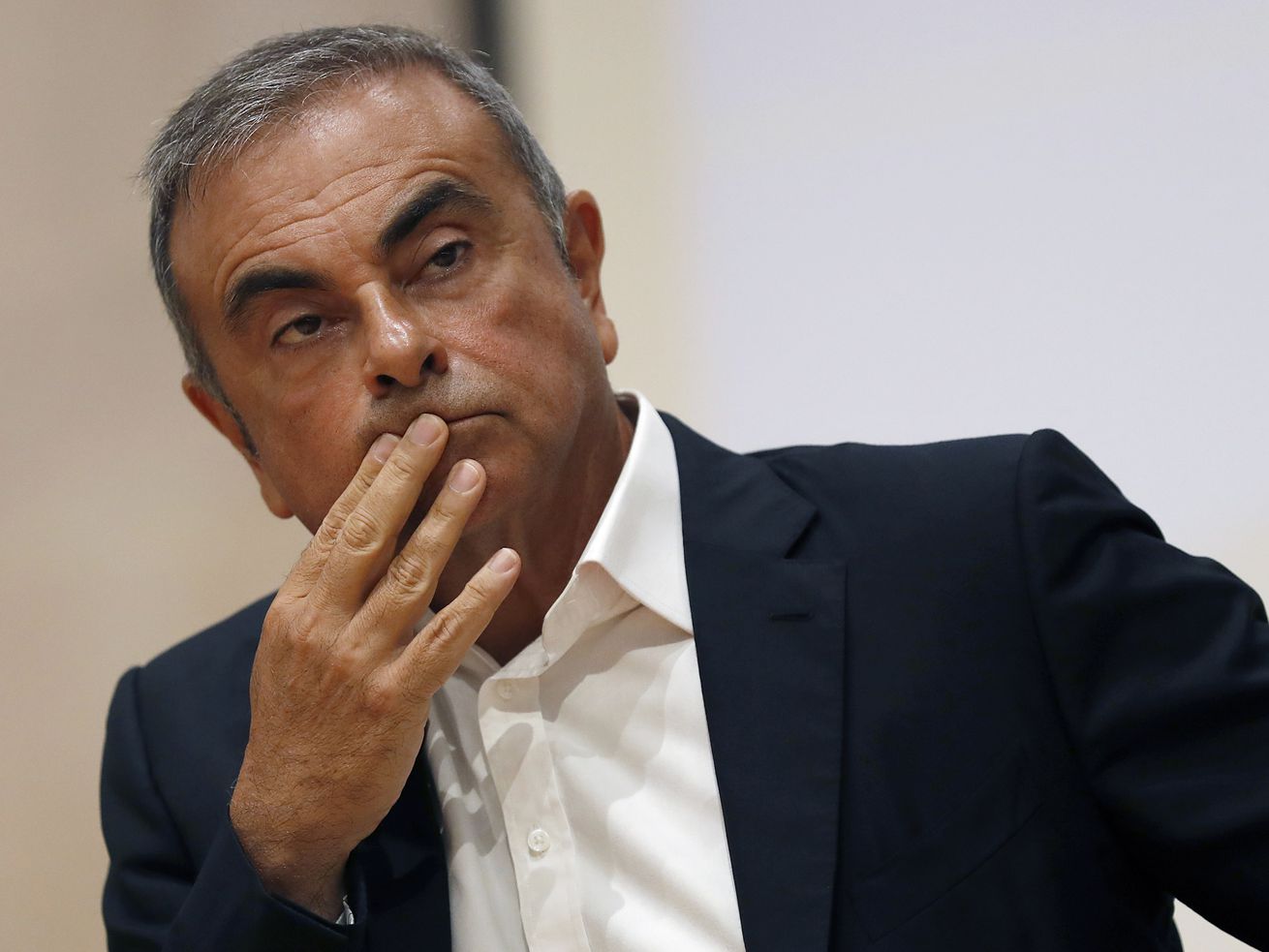
In this Sept. 29, 2020, file photo, former Nissan Motor Co. Chairman Carlos Ghosn holds a press conference at the Maronite Christian Holy Spirit University of Kaslik, as he launches an initiative to help Lebanon that is undergoing a severe economic and financial crisis, in Kaslik, north of Beirut, Lebanon. | AP
In an interview with the AP, the embattled former chairman of the Renault-Nissan-Mitsubishi alliance dissected his legal troubles in Japan, France and the Netherlands, detailed how he plotted his brazen escape from Osaka, and reflected on his new reality in crisis-hit Lebanon, where he is stuck for the foreseeable future.
BEIRUT — Auto magnate-turned-fugitive Carlos Ghosn is campaigning to clear his name, and hopes a visit by French investigators to his home in exile in Lebanon will be his first real opportunity to defend himself since the bombshell arrest that transformed him from a visionary to a prisoner overnight.
In an interview with The Associated Press, the embattled former chairman of the Renault-Nissan-Mitsubishi alliance dissected his legal troubles in Japan, France and the Netherlands, detailed how he plotted his brazen escape from Osaka, and reflected on his new reality in crisis-hit Lebanon, where he is stuck for the foreseeable future.
Mending his reputation will be an arduous task. Ghosn was arrested in Japan in November 2018 on accusations of financial misconduct and fled to Lebanon a year later. He now faces multiple legal challenges in France after the Japanese accusations triggered scrutiny of his activities there. Meanwhile, several associates are in jail or on trial in Japan and Turkey, in cases related to his financial activities or escape.
“There has been a lot of collateral damage . . . but I don’t think I’m responsible for that. The people responsible for that are the people who organized the plot” to bring him down, Ghosn said Tuesday.
Ghosn has denied accusations of underreporting his compensation and misusing company funds, contending he was the victim of a corporate coup linked to a decline in Nissan Motor Co.’s financial performance as the Japanese automaker resisted losing autonomy to French partner Renault.
He said he voluntarily agreed to undergo days of questioning in Beirut next week by French magistrates investigating allegations of financial misconduct in France that led to the seizure of millions of euros of his assets. The outcome could result in preliminary charges being handed to him or in the cases being dropped.
The French investigators are looking into the financing of lavish parties Ghosn threw at the Versailles chateau — complete with period costumes and copious Champagne — as well as 11 million euros in spending on private planes and events arranged by a Dutch holding company, and subsidies to a car dealership in Oman. Ghosn denies any wrongdoing.
“In Japan, you had a Japanese person interrogating me, writing in Japanese and wanting me to sign things in Japanese that I don’t understand,” he said. “Now I will be speaking in French, and I’ll have my lawyers present. Of course, I have much more confidence in the French legal system than in the Japanese system.”
Ghosn was kept in solitary confinement in Japan for months without being allowed to speak with his wife. He has said he fled the country after it became clear he would have “zero” chances of a fair trial. His arrest drew international scrutiny and criticism of Japan’s legal system and its 99% conviction rate.
In late 2019, Ghosn fled Japan after jumping $14 million bail in a Hollywood-style caper. The improbable escape — hidden in a box stashed in the hold of a Turkey-bound private jet, according to Japanese officials — embarrassed Japanese authorities and has allowed him to evade trial there.
Now an international fugitive on Interpol’s most-wanted list, the 67-year-old Ghosn lives in self-imposed exile in his native Lebanon, where he teaches a weekly university business course and is fighting other legal fires.
He told the AP he was “shocked” after a Dutch court last week rejected his wrongful dismissal claim against an Amsterdam-based alliance between Nissan and Mitsubishi, and ordered him to repay the nearly $6 million salary he received in 2018. The ruling came in a case in which Ghosn sought to have his 2018 sacking from Nissan-Mitsubishi B.V. overturned and demanded $16.5 million in compensation.
Ghosn has vowed to appeal.
Ghosn, who has French, Brazilian and Lebanese citizenship, contended he was the victim of a character assassination campaign led by Nissan with the complicity of the Japanese government, aided by accomplices in France.
In the AP interview, he mounted a robust defense of a former Nissan executive, American Greg Kelly, who was arrested the same day as Ghosn and is standing trial in a Tokyo District court on charges of under-reporting Ghosn’s compensation. He would not talk about two other Americans who allegedly helped him escape, Michael Taylor and his son, Peter. They are in a Japanese jail awaiting trial after their extradition from the U.S.
Asked whether their legal troubles weighed on his conscience, Ghosn said: “I feel empathy and compassion for them, because I was in the same situation.”
Testimony and documents presented at Kelly’s trial have shown that he sought ways to beef up compensation for Ghosn after he agreed to a pay cut at Nissan in 2010, because Japan began requiring disclosures of high executive pay. Ghosn insisted Tuesday that no additional compensation agreements were approved by the board.
“Obviously he (Kelly) is innocent,” Ghosn said.
Recalling details of his escape, Ghosn told the AP how the plan was hatched, including choosing to execute it in December when he would be less likely to be recognized under a hat and heavy clothes.
“It was very bold, but because it was bold, I thought it may be successful,” he said. Ghosn refused to confirm reports he escaped in a musical instrument box, saying he didn’t want to say anything that could be used against people being prosecuted for assisting him.
Arriving in a black Nissan SUV accompanied by a bodyguard, the former high-flying executive seemed to have lost none of his swagger despite his colossal fall. He said he spends his days in Beirut preparing his legal defense, teaching, helping startups and working on his books and documentaries.
As a fugitive living in the Mediterranean country where he grew up, he said he was enjoying a slower pace devoid of jet lag, enjoying having coffee with his wife and extensive talks with his children.
That includes living in a deeply unstable country in the grips of a historic financial and economic unraveling. Ghosn said he spent six months repairing his home after it was damaged in the massive explosion at a Beirut port last summer. And like other Lebanese, he said he has a substantial amount of money stuck in the banks after authorities clamped down on dollar currency withdrawals and transfers in October 2019.
Reflecting on his downfall, he said, “It’s like you have, you know, I don’t know, a heart attack somewhere, or you’ve been hit by a bus. You change your life.”
“All of a sudden, you are in a completely different reality and you have to adapt to this reality.”
In this April 1, 2021 photo provided by Dawei Watch news outlet, Hnin Twel Tar Aung, girlfriend of 17-year old Kyaw Min Latt, cries while holding his photo before his cremation in Dawei, Myanmar. Despite the fact that the security forces are aware that their actions are being filmed, posted online, and seen around the world, they have continued their attacks on civilians. | AP
The findings by the The Associated Press and the Human Rights Center Investigations Lab are based on more than 2,000 tweets and online images, in addition to interviews with family members, witness accounts, and local media reports.
Two black pickups speed down an empty city street in Myanmar before coming to a sudden stop. Security forces standing in the back of the trucks begin firing at an oncoming motorbike carrying three young men.
The bike swerves, crashing into a gate. More shots are fired as two of the passengers run away, while the third, Kyaw Min Latt, remains on the ground. Moans are heard as officers grab the wounded 17-year-old from the pavement, throwing his limp body into a truck bed before driving off.
The incident lasted just over a minute and was captured on a CCTV camera. It is part of a growing trove of photos and videos shared on social media that’s helping expose a brutal crackdown carried out by the junta since the military’s Feb. 1 takeover of the Southeast Asian nation.
An analysis by The Associated Press and the Human Rights Center Investigations Lab at the University of California, Berkeley, looked at cases where bodies of those targeted indiscriminately by police and the military are being used as tools of terror. The findings are based on more than 2,000 tweets and online images, in addition to interviews with family members, witness accounts, and local media reports.
The AP and HRC Lab identified more than 130 instances where security forces appeared to be using corpses and the bodies of the wounded to create anxiety, uncertainty, and strike fear in the civilian population. Over two-thirds of those cases analyzed were confirmed or categorized as having moderate or high credibility, and often involved tracking down the original source of the content or interviewing observers.
Since the military takeover, more than 825 people have been killed — well over two times the government tally — according to the Assistance Association for Political Prisoners, a watchdog organization that monitors arrests and deaths. The junta did not respond to written questions submitted by AP.
The HRC Lab examined hours of footage posted online over a two-month period showing dead bodies being snatched off the streets and dragged like sacks of rice before being thrown into vehicles and driven to unknown destinations. Some people have been disappeared or arrested one day and returned dead the next, their corpses mutilated with signs of torture, witnesses confirmed to AP.
Autopsies have been carried out without the permission of families. And some death certificates blame heart attacks or falls after violent attacks, contradicting witness accounts and images captured by protesters, journalists, or residents, including some who have been stealthily recording incidents with mobile phones through windows or from rooftops.
Cremations and exhumations of the deceased have been secretly conducted in the middle of the night by authorities. Other times, grieving families have been forced to pay military hospitals to release their loved ones’ remains, relatives and eyewitnesses told the AP.
Though the incidents may seem random and unprovoked — including kids being shot while playing outside their homes — they are actually deliberate and systematic with the goal of demobilizing people and wearing them down, said Nick Cheesman, a researcher at Australian National University, who specializes in the politics of law and policing in Myanmar.
“That,” he said, “is exactly the characteristic of state terror.”
___
Taking a page from the army’s historical playbook, experts say the violence also appears aimed at keeping the death toll artificially low and concealing evidence. But unlike past violence, the attacks are being captured on smartphones and surveillance cameras in real-time and could one day be used against the regime before international criminal courts, as has happened elsewhere in the world.
“It has always been the military’s strategy to hide the mass crackdown there, the mass killing of the protesters,” said Van Tran, a Cornell University researcher who studied the bloody 1988 and 2007 uprisings in Myanmar. “There are always large-scale operations in order to either cremate the bodies of people that were shot down or … bulldoze and bury those bodies. So a lot of the time, families do not know where their children went.”
Almost a quarter of the recent cases with known locations analyzed by the HRC Lab involved injured people or dead bodies snatched by security forces in the country’s biggest city, Yangon, followed by Mandalay and Bago.
The largest number of those incidents, documented through posts on social media, was reported on March 27. Celebrated annually as Armed Forces Day, it commemorates the start of the military’s resistance to Japanese occupation during World War II after more than a century of British colonial rule.
This year protesters dubbed it “Anti-Fascist-Resistance Day,” and came out in large numbers in a stand against the military takeover.
It was on that day that motorbike rider Kyaw Min Latt was shot, though his family told AP the young carpenter had not been to a demonstration but was instead heading home from the job site to grab an early lunch with two friends.
Using satellite visuals, reverse image searches, and a sun-shadow calculator, the HRC Lab was able to verify that the shooting took place at 10:38 a.m. in front of a high school on Azarni Road in the southern town of Dawei. In the footage, two shots are heard and Kyaw Min Latt, who was sitting between the driver and a fellow passenger, is seen grabbing his head and falling sideways. Officers chased after the two other riders with guns raised. Another bang is then heard.
Sixteen minutes later, a passerby posted a picture on Facebook of blood-soaked concrete and flip flops near the white motorbike that security forces had carefully propped back up before taking Kyaw Min Latt’s body.
Within two hours, the CCTV footage was also being shared widely across social media platforms.
That’s how the teen’s father received the news. He told AP he later learned his son had been taken to a military hospital. He rushed there to see him that afternoon and said the teen was still alive, but unconscious.
“He was badly wounded,” Soe Soe Latt said. “He opened his eyes when we were at the hospital, but could not say any words.”
The boy died soon after, and his father said army doctors wanted to perform an autopsy. The family fought against it, but said the hospital would only release the body if they signed a paper saying their son died of head injuries from falling off the motorbike.
A photo published online before Kyaw Min Latt’s funeral by Dawei Watch, a local news outlet, told a different story: There was a gaping wound in the teen’s neck.
_____
Myanmar has a long, tumultuous history of coups, military control, and ethnic conflicts.
A junta seized power in 1962, ending 14 years of civilian rule. That began five decades of censorship, mass arrests, disappearances, and dark isolation, resulting in harsh international sanctions that placed it roughly on par with North Korea.
Then in 2011, the country became the darling of the Obama administration and other Western governments when it started moving toward quasi-civilian rule and implementing political reforms as part of its long-promised “roadmap to democracy.”
But, despite the newfound freedoms and political reforms in the past decade — from the first ATMs and KFC restaurants to high-speed Internet and smartphones — the military never really relinquished control.
A quarter of the seats in parliament were reserved for those in uniform, and the armed forces held onto key ministries. Senior Gen. Min Aung Hlaing, now chairman of the junta’s State Administrative Council, also had the power to impose a state of emergency if he felt national security was at risk.
But after the party headed by Nobel Peace Prize laureate Aung San Suu Kyi won a landslide election last November, the military, known as the Tatmadaw, cried voter fraud. That triggered the February takeover and an emergency declaration, transferring all power to the top commander, on the morning the new parliament was set to begin.
Suu Kyi — who earlier supported security forces during their violent crackdown on ethnic Rohingya Muslims — and other leaders of her National League for Democracy party were put under house arrest. Hundreds of thousands of people from all walks of life poured into the streets nationwide in protest.
Soon after, other NLD members were hauled in for questioning. Some of them would never return alive. Party officials said that family members were prohibited from collecting the body of one man who died at an interrogation center. Two other NLD members were returned as corpses to relatives the next day, drawing a sharp rebuke from the U.S. State Department.
Photos and videos posted on social media from several locations, and analyzed by the HRC Lab, show they appear to have been tortured, with the skin partially peeled from one man’s face. Another had dried blood on his head and bruises covering his body.
“Just tell people he had a heart attack and died,” a man who attended the cleaning of one victim’s body told AP, recalling what doctors told family members.
Despite the attacks on NLD members, the anti-military demonstrations continued. Ordinary citizens soon found themselves targets of soldiers and police.
This month, relatives of one man in Bago Region’s Pyay Township said security forces arrived at their home with guns drawn.
After beating 33-year-old Aung Khaing Myit, his sister told AP they took him away for questioning about his suspected involvement in a bomb blast. She said the officers swore nothing would happen to him, but he was heard screaming in a nearby room before falling silent.
The next day, the family was taken to a military hospital. They were told Aung Khaing Myit died while trying to jump out of a transport vehicle and that he was already placed inside a coffin. His sister said they were allowed to look at his bruised face, but not his entire body, and then authorities took him away for cremation over their objections.
“We knew they beat him to death,” she said. “But they tried to lie to us.”
And even if bodies are returned to families, it doesn’t mean they will be buried and left to rest in peace.
Nineteen-year-old Kyal Sin, better known as Angel, became a high-profile case after being shot in the head March 3 during a protest in Mandalay, galvanizing supporters to wear T-shirts and banners bearing her image. Thousands, outraged by her death, gathered for her funeral the next day.
But later that night, the flowers were removed from her grave and MRTV state television said her body had been exhumed by authorities so an official autopsy could be carried out, exonerating the police. All that remained at the site afterward was a bloody latex glove and other strewn debris.
Authorities later released a death certificate saying the bullet that killed her didn’t match the caliber used by police, and that it came from the wrong direction for security forces to be responsible.
Shootings by soldiers and police were the reason Ye Yint Naing’s mother had forbidden him to join a protest in northern Shan State. But that didn’t stop the 15-year-old — he simply skipped breakfast that morning and snuck out while she was busy washing clothes in the back of the house.
He quickly met up with friends and headed to the rally, but an hour later tensions began to explode. After activists set a car on fire, Myanmar security forces responded by shooting into the crowd.
Ye Yint Naing was hit and fell to the ground. As he lay bleeding and calling for help, his friends watched paralyzed for two hours, unable to reach him because they feared they would be shot by a sniper standing watch, his brother told AP.
When the gunfire finally stopped, Ye Yint Naing’s motionless body was loaded into an ambulance and driven away. Social media posts provided the first clues for family members about what happened to him.
A picture posted on Facebook by a sympathetic worker at a local cemetery showed them where the body was ultimately taken. Once there, Ye Yint Naing was cremated — which goes against Muslim burial customs — following an order by police.
“They actually wanted to hide the dead body,” his brother said, adding he was able to get a bag with ashes and bits of bone to bury. “I have to say, ‘Thank you,’ to the person who cremated the body and took the photo. If not, it would have been hard for our family to find my younger brother because we would not know where he was taken.”
Other secret cremations were confirmed in a mountainous trading town in the same state. Military trucks carrying soldiers and police rumbled into Aungban to stamp out a protest early on March 19th, firing off tear gas and bullets that left at least eight people dead, a witness told the AP.
Images from the scene posted on social media, showed one bloodied body lying next to a curb, and video captured men dressed in black uniforms kicking debris and randomly shooting their guns.
Security forces brought most of the corpses to the local cemetery that night and days later. They broke locks on the crematorium and used car tires to burn several bodies, witnesses said, until “all that remained was ash.”
Terrified that their loved ones will not receive proper burials, some family members have started hiding bodies, racing to get them buried before security forces can claim them.
That was the case with 13-year-old Htoo Myat Win. He was hit in the chest by a stray bullet while sitting inside his home in the central town of Shwebo, Sagaing Region.
Video posted online showed security forces shooting while walking through the street, and a neighbor who witnessed the boy’s death confirmed to AP that they were “spraying bullets” at houses.
Authorities came to ask the family for the boy’s body, but they refused to hand it over and instead hid it at a local temple, the neighbor said, declining to give his name fearing retribution. “They cremated him the next day.”
___
Junta spokesman Zaw Min Tun said there is a clear legal procedure in place when people die. Families are informed and autopsies are carried out.
“We never hide this number,” he said at a press conference earlier this month.
However, the military has put the total killed nationwide at about 300, stressing that nearly 50 police have also died in the violence. Earlier, state-run TV called the more widely used figures from AAPP “fake” news, even though the highly regarded Thailand-based monitoring group often includes the victims’ names, ages and photographs. It also details how and where they died as part of its tally, helping bolster the credibility of those numbers.
Ko Bo Kyi, the group’s co-founder, noted the junta also claimed hundreds — instead of thousands — died during some of the country’s biggest pro-democracy protests in 1988. He added that, just as in the past, their goal now is to maintain a climate of fear and uncertainty that immobilizes people and breaks their will.
“They believe if they kill, torture, and arrest the protesters, they can stop the demonstrations,” he said.
But access to technology and social media since the recent military takeover could eventually be used to help build an international criminal case against the junta, while also making it difficult for foreign donors and developed nations to turn a blind eye to what could one day be classified as crimes against humanity.
“It’s a whole new ballgame in terms of evidence in a way that will make prosecution possible many years from now if need be,” said Richard Dicker, International Justice director at the nonprofit Human Rights Watch, noting that video footage from smartphones has also been used in other uprisings and conflicts, including crimes committed in Syria. “That wouldn’t have been viable (in the past) because the evidence would have disappeared.”
Still, despite the fact that security forces are aware their actions are being filmed, posted online, and seen around the world, they have continued their attacks on civilians unabated. Dicker said authoritarian governments have long silenced their opponents.
Normally, he added, these kinds of atrocities occur at night in the shadows. “What’s new is that it is taking place on the streets and in public view.”
___
Associated Press journalist Kiko Rosario contributed to this report from Bangkok.
___
Contact AP’s global investigative team at [email protected] or https://www.ap.org/tips/
Workers prepare for the 73rd annual Tony Awards ceremony in New York in 2019. | Charles Sykes/Invision/AP
Producers of the telecast announced Wednesday that the Tonys will be held Sept. 26 and will air on CBS as well as Paramount+. The usual three-hour event has added a fourth hour.
NEW YORK — The long-delayed Tony Awards have been given a fall air date and a four-hour streaming canvas to celebrate the pandemic-shortened Broadway season that upended the theater world.
Producers of the telecast announced Wednesday that the Tonys will be held Sept. 26 and will air on CBS as well as Paramount+. As if making up for lost time, the usual three-hour event has added a fourth hour.
This year, the award show will start at 7 p.m. ET/4 p.m. PT on Paramount+ exclusively, then two hours later continue on CBS with a live concert event “featuring superstar Broadway entertainers and Tony Award winners re-uniting on stage to perform beloved classics and celebrate the joy and magic of live theater.” Capping the evening will be the awarding of the three top awards: best play, best play revival and best musical.
“There is nothing that compares to the magic of live theater — and we are thrilled to be able to share its celebratory return and the incredible talent and artistry of the abbreviated 2019-2020 season with theater fans everywhere,” said a statement from said Charlotte St. Martin, president of The Broadway League, and Heather Hitchens, president and CEO of the American Theatre Wing.
There was no word on whether there would be a host.
The news was met with excitement from theater fans but with grumbles that the bulk of the awards — the acting, directing and technical ones — would only be accessible to Paramount+ customers. The plan is similar to that employed by the Grammys — the bulk of those awards are streamed in a pre-show event — although that is accessible for free.
Broadway theaters abruptly closed on March 12, 2020, knocking out all shows — including 16 that were still scheduled to open in the spring. Broadway shows have been given the green-light to restart and the first will be “Hadestown” on Sept. 2.
Organizers are looking for a Broadway theater to be the base for the in-person event. But presumably, the Sept. 26 date for the Tonys means that the nominated shows can be ready to perform on the telecast from their respective home theaters to cut down on overcrowding.
This season’s nominations were pulled from just 18 eligible plays and musicals, a fraction of the 34 shows the season before. During most years, there are 26 competitive categories; this year there are 25 with several depleted ones.
The sobering musical “Jagged Little Pill,” which plumbs Alanis Morissette’s 1995 breakthrough album to tell a story of an American family spiraling out of control, has the most nominations with 15.
There are three best musical nominees: “Jagged Little Pill,” “Moulin Rouge: The Musical” and “Tina — The Tina Turner Musical.” And there are five best play nominees: “Grand Horizons,” “The Inheritance,” “Sea Wall/A Life,” “Slave Play” and “The Sound Inside.”
Nipping on the heels of “Jagged Little Pill” for overall numbers of nominations is “Moulin Rouge!,” a jukebox adaptation of Baz Luhrmann’s hyperactive 2001 movie about the goings-on in a turn-of-the-century Parisian nightclub, that got 14 nods.
Two very different offerings are tied with 12: “Tina — The Tina Turner Musical,” which tells the rock icon’s life with songs that include “Let’s Stay Together” and “Proud Mary,” and “Slave Play,” Jeremy O. Harris’ ground-breaking, bracing work that mixes race, sex, taboo desires and class. The dozen nods make “Slave Play” the most nominated play in Tony history.
This photo provided by KGO-TV/ABC7, emergency personnel respond to the scene of a shooting on Wednesday, May 26, 2021 in San Jose, Calif. Santa Clara County sheriff’s spokesman said there are multiple fatalities and injuries in a shooting at a rail yard and that the suspect is dead. | AP
Santa Clara County sheriff’s spokesman Deputy Russell Davis said that he could not specify the number of dead and wounded or describe how the suspect died.
SAN JOSE, Calif. — Gunfire erupted Wednesday at a railyard in San Jose, and a sheriff’s spokesman said multiple people were killed and wounded and that the suspect was dead.
Santa Clara County sheriff’s spokesman Deputy Russell Davis said that he could not specify the number of dead and wounded or describe how the suspect died.
The shooting took place at a light rail facility that is next door to the sheriff’s department and across a freeway from the airport. The facility is a transit control center that stores trains and has a maintenance yard.
The victims include Valley Transportation Authority employees, Davis said.
The VTA provides bus, light rail and other transit services throughout Santa Clara County, the largest in the Bay Area and home to Silicon Valley.
A spokesperson for the agency did not immediately respond to multiple requests for comment.
“Our hearts are pained for the families of those we have lost in this horrific shooting,” San Jose Mayor Sam Liccardo said on Twitter.
Gov. Gavin Newsom said in a tweet that his office was “in close contact with local law enforcement and monitoring this situation closely.”
Special agents from the FBI and the federal Bureau of Alcohol, Tobacco, Firearms and Explosives were responding to the crime scene, officials said.
Secretary of State Antony Blinken steps off his plane upon arrival at Cairo International Airport, Wednesday, May 26, 2021, in Cairo, Egypt. | AP
U.S. Secretary of State Antony Blinken landed in Cairo a day after holding intensive talks with Israeli and Palestinian leaders.
CAIRO — U.S. Secretary of State Antony Blinken jetted to Egypt on Wednesday as he pressed ahead with a diplomatic mission aimed at shoring up a cease-fire that ended an 11-day war between Israel and the Gaza Strip’s ruling Hamas militant group.
Blinken landed in Cairo a day after holding intensive talks with Israeli and Palestinian leaders. In Egypt, he met with President Abdel Fattah el-Sissi and other top officials. Later he traveled to Jordan to meet with King Abdullah II.
Blinken has vowed to “rally international support” to rebuild the destruction in hard-hit Gaza while promising to make sure that none of the aid reaches Hamas. He is instead trying to bolster Hamas’ rival, the internationally recognized Palestinian Authority.
Blinken has set modest goals for the trip, his first official visit to the Middle East as secretary of state. His main goals have been to help rebuild Gaza and lower the tensions in contested Jerusalem that helped fuel the war.
But he has made it made clear the U.S. has no immediate plans to pursue peace talks between the sides and done little to address the underlying causes of the decades-long conflict, though he expressed hope for creating a “better environment” that might lead to negotiations.
In Cairo, Blinken on Wednesday met with el-Sissi for nearly two hours. Meeting with American diplomatic staff afterwards, he described Egypt as a “real and effective partner” that helped end the Gaza war and is helping “build something positive.” El-Sissi spoke to President Joe Biden last week before and after the ceasefire was announced.
“I think we both believe strongly that Palestinians and Israelis deserve equally to, to live in safety and security to enjoy equal measures of freedom, opportunity and dignity. And we’re working on that together,” Blinken said before departing to Jordan.
Both Egypt and Jordan are key U.S. allies that have peace agreements with Israel and frequently serve as mediators between Israel and the Palestinians. Egypt maintains ties with Hamas, but also enforces a tight blockade on Gaza, along with Israel, with a shared goal of preventing the Islamic group from arming.
The stop in Cairo, along with Biden’s phone talks with el-Sissi, signal a closer relationship between the countries after a cooler beginning, when the U.S. expressed concern over el-Sissi’s human rights record.
The Gaza reconstruction effort will be an important test. The 11-day war killed more than 250 people, mostly Palestinians, and caused heavy destruction in the impoverished coastal territory. Preliminary estimates have put the damage in the hundreds of millions of dollars.
Ahmed Aboul Gheit, secretary-general of the Arab League, said U.S. commitment is critical for the region. Before the Gaza war, the Biden administration had kept its distance, preferring to focus on higher foreign policy priorities like China and Iran.
“In the absence of an effective role for the U.S., we should expect nothing but more cycles of violence and bloodshed of innocent people,” he wrote in the Saudi daily Asharq Al-Awsat.
One of the U.S. goals is to ensure that any assistance be kept out of the hands of Hamas, which opposes Israel’s right to exist and which Israel and the U.S. consider a terrorist group.
In Gaza, Hamas leader Yehiyeh Sinwar told journalists Wednesday that the group welcomed international reconstruction aid, as long as it did not come from Israel, and had no objections to international oversight.
“I emphasize our commitment in Hamas that we will not take a single penny earmarked for rebuilding or humanitarian issues,” he said.
Sinwar, who has close ties with the group’s armed wing, said Hamas receives ample military assistance from outside sources — led by Israel’s archenemy, Iran. “When I said we do not take money destined for aid, this is because we have comfortable sources of funds covering our activities,” he said.
He also lashed out at Blinken for trying to strengthen the Palestinian Authority at Hamas’ expense. “They are trying to add more fuel to the fire of Palestinian division,” Sinwar said.
British Foreign Secretary Dominic Raab was in Israel on Wednesday to build on the momentum of Blinken’s visit.
Echoing Blinken’s message, Raab said the U.K. supported Israel’s right to defend itself against Hamas rocket fire and would seek to prevent aid money from reaching Hamas. But he also expressed hope that cease-fire efforts would lead to a broader regional peace effort.
“We want to support Israel but we also want the Palestinians to find a track towards an enduring peace,” he said.
Blinken said Tuesday the U.S. is trying to bolster the rival government of President Mahmoud Abbas, whose forces were ousted from Gaza by Hamas in 2007. Abbas’ Palestinian Authority now administers autonomous areas in the Israeli-occupied West Bank. Abbas has been largely sidelined by recent events, is deeply unpopular at home and has little influence in Gaza.
Abbas hopes to establish an independent state in all of the West Bank, Gaza and east Jerusalem — areas captured by Israel in the 1967 Mideast war.
In a gesture to the Palestinians, Blinken on Tuesday announced plans to reopen a diplomatic office in Jerusalem that oversees outreach to the Palestinians. He also pledged nearly $40 million in additional aid to the Palestinians.
In all, the Biden administration has pledged some $360 million to the Palestinians, restoring badly needed aid that the Trump administration had cut off.
The truce that ended the Gaza war on Friday has so far held, but it did not address any of the deeper issues plaguing the Israeli-Palestinian conflict. Those challenges include a hawkish Israeli leadership that seems unwilling to make major concessions, Palestinian divisions, years of mistrust and deeply rooted tensions surrounding Jerusalem and its holy sites.
The war was triggered by weeks of clashes in Jerusalem between Israeli police and Palestinian protesters in and around the Al-Aqsa Mosque, built on a hilltop compound revered by Jews and Muslims that has seen several outbreaks of Israeli-Palestinian violence over the years. The protests were directed at Israel’s policing of the area during the Muslim holy month of Ramadan and the threatened eviction of dozens of Palestinian families by Jewish settlers.
The truce remains tenuous since tensions are still high in Jerusalem and the fate of the Palestinian families is not yet resolved.
On Wednesday, an Israeli court heard arguments from a Palestinian family trying to block their eviction in Silwan, another east Jerusalem neighborhood targeted by settler groups.
“The settlers want to take my house, to steal my house with their fake papers,” said Kaet Abdel Fath El Rajabi, who said his family has lived in the building for 60 years. Several dozen protesters stood outside the courthouse in support of the family.
In his remarks after his meeting with Blinken on Tuesday, Netanyahu hardly mentioned the Palestinians, warning of a “very powerful” response if Hamas breaks the cease-fire while expressing support for economic development in the West Bank.
Blinken repeatedly affirmed what he said was Israel’s right to defend itself. But he also called on leaders of all sides to chart a “better course” in hopes of laying the groundwork for peace talks aimed at establishing an independent Palestinian state alongside Israel.
Lake Shore Drive, seen from the northbound on-ramp entrance at East 18th Drive. | Brian Ernst/Sun-Times
Any two aldermen can move to “defer and publish,” which delays action for one meeting without explanation. The move is likely to start with downtown Ald. Brian Hopkins.
An eleventh-hour parliamentary maneuver on Wednesday appears likely to temporarily derailed a controversial plan to rename Outer Lake Shore Drive in honor of Jean Baptiste Point DuSable.
Any two aldermen can move to “defer and publish,” which delays consideration of any matter for one meeting without explanation.
The parliamentary maneuver is likely to start with downtown Ald. Brian Hopkins (2nd), though it was unclear which alderman might second the motion.
In a text message to the Sun-Times, Hopkins said, “I’m willing to D&P. But, I’m not asking around for a second. Mayor’s staff is. I’m just waiting to hear if/who will second.”
Asked to explain why, Hopkins wrote, “Still unclear if downtown buildings are affected. Specifically 500, 505 and 474 N. Lake Shore Drive. Carving out inner drive doesn’t help.”
The potential delay angered Ald. David Moore (17th), the City Council champion for renaming the roadway to honor DuSable, a Black man who was Chicago’s first permanent non-indigenous settler.
Moore has said previously that by renaming only the outer drive, the number of addresses affected would be severely limited.
On Wednesday, Moore vowed to join Ald. Sophia King (4th), his co-sponsor, in calling a special City Council meeting to accomplish the name change — and retaliate by playing his own brand of hardball from here on in.
“If they want to play politics, I take that personal and everything that comes before that Council, I’ll d-and-p,” he said, referring to “defer and publish.”
“Everything that comes before that Council, I’ll ask for a roll call on. If they want to do this, then that’s what I’ll do,” Moore said.
“It takes a little bit more than this to make me angry. But, what I will tell you is that they’re going to be angry because I’m going to hold up every City Council meeting going forward regardless,” he added.
“They can’t stop this. It’s just a delay.”
Mayor Lori Lightfoot has made it clear she has “concerns” about the name change. She fears changing the name of Chicago’s most iconic and picturesque boulevard — made famous in song and movies — could hurt marketing of the city and be costly and cumbersome for homeowners and businesses.
“If she’s saying that, that’s a negative undertone to me towards Black people. I don’t know where she gets that from. That tells me that a Black person’s name is not marketable,” Moore said.
Moore on Tuesday said Mayor Lori Lightfoot’s administration previously had tried to block the ordinance with an alternative he views as having “racial overtones” — renaming the Dan Ryan Expressway for DuSable instead.
Lightfoot has also offered to complete DuSable Park, create an exhibit honoring DuSable at the “most traveled part” of the downtown Riverwalk and rename the entire Riverwalk in honor of DuSable.
Those options, he said, amounted to “keep it on the South Side. South of like 35th Street. Let’s be honest: Keep it in the Black community,” Moore told the Sun-Times Tuesday.
Moore refused to name the person who made the offer to rename the Dan Ryan. “I’ll just say the [Lightfoot] administration and leave it at that.”
Even so, Moore said he blames individual aldermen — not the mayor — for Wednesday’s delay.
“Councilmen have their own voice. We’ve always talked about having a strong Council, weak mayor. That’s why I ran for office. So I could have a strong voice. Council men [and women] get to vote. The mayor don’t get a vote. If Councilmen kowtow to that, that’s because they’re weak. Not because the mayor is so strong,” he said.
Moore said he is certain he still has the 26 votes needed to pass the name change. He’s determined to get it done — sooner, not later.
“They can’t stop this. It’s just a delay. … People care about this. People know that this is the right thing to do,” he told the Sun-Times.
“It’s about the children. When I introduced it, the number of kids from [local elementary schools] became aware of Jean Point Baptiste DuSable. All of those kids — when they called me — it was important to them. Even more young people began to learn about him. Even more people up north began to learn about him. That’s what this is all about.”
Brian Ernst/Sun-TimesSouth Lake Shore Drive at East 31st Street, looking north.
Some expressing concern about the change say it will inconvenience some residents.
Zoning Committee Chairman Tom Tunney (44th) has said he’s gotten an earful about the name change from “people who actually live on Lake Shore Drive.” They fear it would be “somewhat of a nightmare in terms of mailing addresses and everything else they would have to re-arrange,” Tunney has said.
Downtown Ald. Brendan Reilly (42nd) has similarly warned the name change will require a “time-consuming and costly fix” for “tens of thousands” of Chicago voters and have “costly implications” for businesses, police and fire.
Also, earlier this week, Moore disclosed the combined cost to the city, state and CTA to change signs, maps and schedules pales by comparison to the cost of Lightfoot’s alternative proposals to honor DuSable — less than $2.5 million “to make the street change, signs and everything.”
In 1993, then-aldermen Toni Preckwinkle and Madeline Haithcock proposed renaming Lake Shore Drive to honor DuSable. Mayor Richard M. Daley put the kibosh on the idea.
Then, 18 years later, then-Ald. Ed Smith proposed a different honor — naming City Hall after DuSable. It met the same fate.
Since then, the political landscape has changed dramatically.
The Council is now majority-minority, with 20 Black aldermen and 13 Hispanic members.
Japan’s Asahi Shimbun newspaper on Wednesday called for the Tokyo Olympics to be canceled with the games set to open in less than two months. | Eugene Hoshiko/AP
Coming out against the Olympics could be significant since the newspaper, like many in Japan, is a sponsor of the postponed Tokyo Games that are scheduled to open on July 23.
TOKYO — Japan’s Asahi Shimbun newspaper on Wednesday called for the Tokyo Olympics to be canceled with the games set to open in less than two months.
It is the first of Japan’s major newspapers to make the move and joins some regional newspapers that have recently added to the growing opposition to holding the Olympics.
Coming out against the Olympics could be significant since the newspaper, like many in Japan, is a sponsor of the postponed Tokyo Games that are scheduled to open on July 23. Asahi is typically liberal-leaning and often opposes the ruling party led by Prime Minister Yoshihide Suga.
“We cannot think it’s rational to host the Olympics in the city this summer,” the newspaper said in its editorial under a headline that read: “We Demand PM Suga Decide Cancellation.”
“Distrust and backlash against the reckless national government, Tokyo government and stakeholders in the Olympics are nothing but escalating,” the editorial added. “We demand Prime Minister Suga to calmly evaluate the circumstances and decide the cancellation of the summer event.”
Asahi has a morning circulation reported at 5.16 million, and 1.55 million for its evening edition. It is second in circulation behind Yomiuri Shimbun, and subsequently is the second largest circulating newspaper in the world behind Yomiuri.
Despite the editorial, there is no indication the International Olympic Committee or local organizers have any plans to pull the plug on the games. But opposition is mounting with only a tiny percentage of Japanese people now vaccinated.
Tokyo organizing committee CEO Toshiro Muto said Wednesday he was aware of the editorial, but offered little response.
Asahi is one of about 70 local Olympic sponsors that have chipped in almost $3.5 billion to the organizing committee budget. It is also one of a half dozen newspapers that are sponsors.
“Of course, different press organizations have different views. And that’s very natural,” Muto said, adding local partners, or sponsors, continued to offer “support.”
Senior IOC member Richard Pound said in an interview with Japan’s JiJi Press last week that the final deadline to call off the Olympics was still a month away.
“Before the end of June, you really need to know, yes or no,” JiJi quoted Pound as saying.
The British Medical Journal called last month for a hard look at going forward with the Olympics. Local medical officials have also been skeptical, and billionaire businessman Masayoshi Son suggested over the weekend that the IOC was forcing the Olympics on Japan.
“Right now, more than 80% of the nation’s people want the Olympics postponed or canceled,” said Son, the founder and CEO of SoftBank Group Corp. who also owns the SoftBank Hawks baseball team.
“Who is forcing this to go ahead, and under what rights?” Son added.
Asahi also criticized the IOC, calling it “self-righteous” and also lambasted IOC vice president John Coates. Last week, Coates was asked if the Olympics would be held if a state of emergency were in force.
“Absolutely, yes,” he replied.
The newspaper said there was a “huge gap” between Coates’ words and the sentiments “of the people.”
“Despite its overgrown size and excessive commercialism and many other problems, the Olympics have been supported because of empathy for its ideals. … But what is the reality now?” Asahi asked.
On Tuesday, the Japanese government said a warning by the United States to avoid travel to Japan would have no impact on holding the Olympics.
Japan has officially spent $15.4 billion to organize the Olympics, and government audits suggest it might be much larger. The IOC gets billions from selling broadcast rights, which amounts to about 75% of its income.
Public opinion polls in Japan show between 60%-80% want the Olympics canceled because of the COVID-19 pandemic, and an online petition asking the games be canceled has gained 400,000 signatures in a few weeks.
Tokyo, Osaka and other regions of the country are under a state of emergency that is likely to be extended past its May 31 expiration.
Organizers and the IOC, often citing the authority of the World Health Organization, say the games can be held safely with 15,000 Olympic and Paralympic athletes entering Japan, joined by tens of thousands of judges, officials, sponsors, broadcasters and media.
Fans from abroad have already been banned, and organizers are to announce next month if any fans at all will be allowed into Olympic venues.
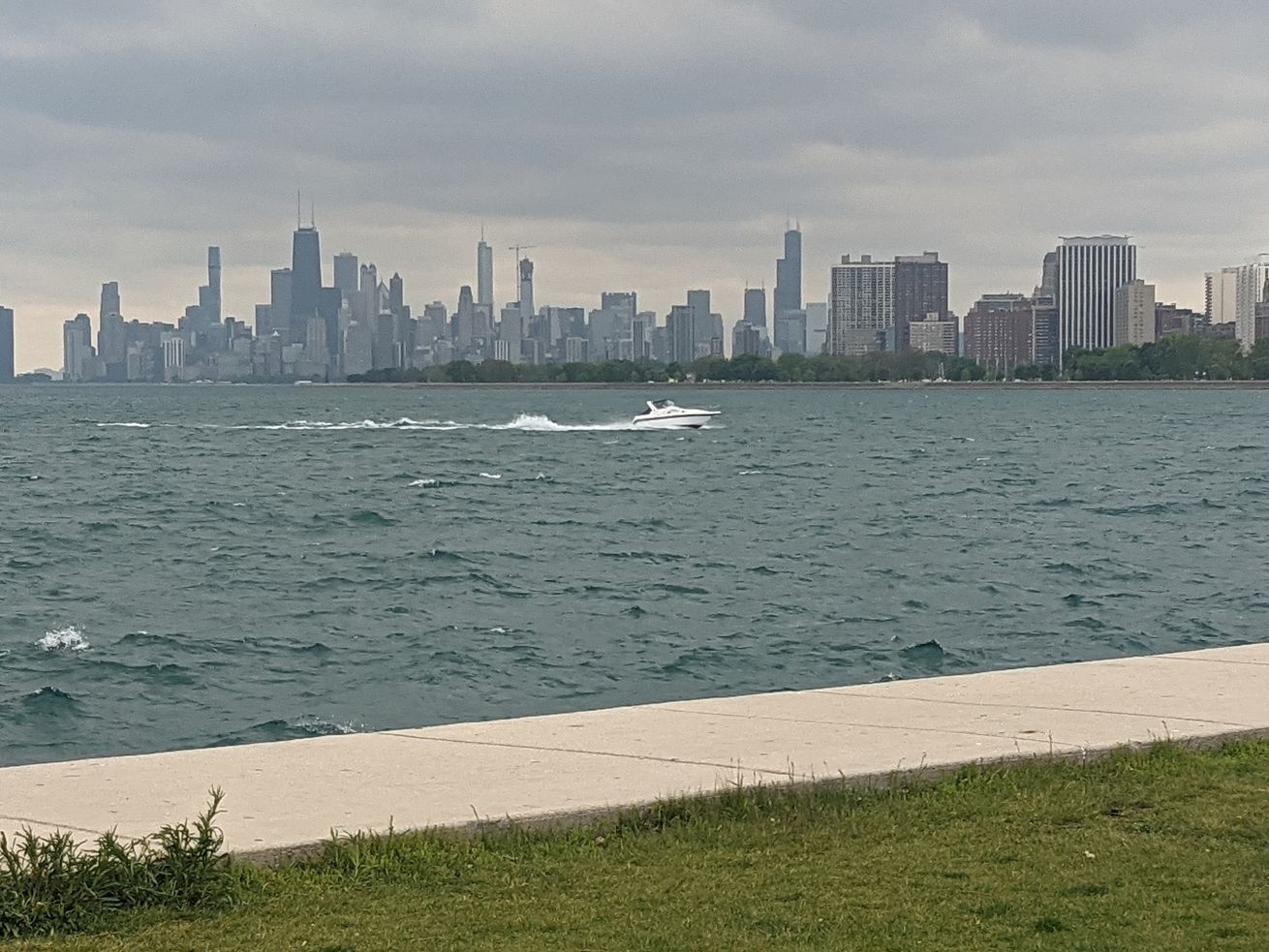
A boat speeds back toward Montrose Harbor in the middle of the best view of downtown Chicago from the south side of Montrose, the day before parking meters turned on at Montrose Harbor Drive. | Dale Bowman
Parking meters going in at Montrose Harbor pull up memories; plus notes on the IHSA bass finals possibly moving, a balloon spooks nesting Monty and Rose and, as always, the Stray Cast.
I napped last Wednesday at my favorite view on the Chicago lakefront from the south side of Montrose Harbor.
I figured I had better get it in before pay-meter parking began Thursday.
The sun broke through briefly, enough to heat the car.
For years, besides fishing with my favorite view of downtown, I stopped at Montrose to eat lunch or nap. In younger days, more nefarious things ensued late at night.
I love the spot. Not to get too biblical, but it restores my soul.
As I savored the downtown skyline, Maria Rizzo circled the new meter, trying to figure out whether she needed to pay. I told her it did not start until the next day, then asked if it would affect her.
‘‘Probably not,’’ she said.
The city is counting — correctly, I think — on the draw of fishing, scenery, picnicking, bike paths, soccer fields, birding and dreaming on the hill to keep people coming and paying for parking.
For now the meters are only on Montrose Harbor Drive, from Park Bait around to the circle. A couple of free quick-stop spots remain in front of Park Bait.
IHSA bass fishing move?
Dale BowmanBoats lining up Saturday on Carlyle Lake before takeoff on Day 2 of the Illinois High School Association’s state finals for bass fishing.
Friday and Saturday might have been the last time the Illinois High School Association’s state finals for bass fishing were held at Carlyle Lake.
At the IHSA board meeting June 14, a decision is expected about whether Carlyle or Springfield will host the next three state finals, associate executive director Kurt Gibson said. Carlyle hosted the first 12.
Illinois hunting
Hunters harvested 13,383 turkeys during Illinois’ spring season, a drop from 15,831 in 2020. Click here for a more detailed breakdown.
Wild things
A balloon hitting the protective wire spooked mating piping plovers Monty and Rose off their nest May 17 at Montrose beach, according to chicagopipingplovers.org. Celebratory balloons outside are like housecats outside: Nothing good comes of it.
Stray cast
Tony La Russa does to the joy of Sox what summer sun does to fluddles.




/cdn.vox-cdn.com/uploads/chorus_asset/file/22538921/LSDRENAME_31st_skyline.jpg)

/cdn.vox-cdn.com/uploads/chorus_asset/file/22540817/IHSAbass05_22_21liningup.jpg)