What’s New

Shooter said he hated work years before killing 9: OfficialsAssociated Presson May 27, 2021 at 9:10 pm

HERO Tent President Kiana Simmons places a candle at a vigil organized by her group following the mass shooting at the Valley Transportation Authority (VTA) light-rail yard, outside City Hall on May 26, 2021 in San Jose, California.
HERO Tent President Kiana Simmons places a candle at a vigil organized by her group following the mass shooting at the Valley Transportation Authority (VTA) light-rail yard, outside City Hall on May 26, 2021 in San Jose, California. | Getty

Samuel James Cassidy had a memo book that had notes on how he hated the Santa Clara Valley Transportation Authority. The memo also said he had books on terrorism but when he was asked whether he had issues with people at work he said no.

SAN JOSE, Calif. — A gunman who killed nine people at a California rail yard appeared to target some of the victims, a sheriff told The Associated Press on Thursday, while a Biden administration official said he spoke of hating his workplace when customs officers detained him after a 2016 trip to the Philippines.

The shooter arrived at the light rail facility for the Valley Transportation Authority in San Jose around 6 a.m. Wednesday with a duffel bag filled with semi-automatic handguns and high-capacity magazines, Santa Clara County Sheriff Laurie Smith said in an interview.

“It appears to us at this point that he said to one of the people there: ‘I’m not going to shoot you,’” Smith said. “And then he shot other people. So I imagine there was some kind of thought on who he wanted to shoot.”

While there are no cameras inside the rail yard’s two buildings, Smith said footage captured him moving from one location to the next. It took deputies six minutes from the first 911 calls to find the gunman on the third floor of one of the buildings, Smith said.

He killed himself as deputies closed in on the facility serving the county of more than 1 million people in the heart of Silicon Valley. More than 100 people were there at the time, and authorities found five victims in one building and two in another, Smith said.

Authorities do not yet know whether the gunman had worked regularly with any of the victims. Investigators were serving search warrants for his home and cellphone, seeking to determine what prompted the bloodshed, the sheriff said.

“I’m not sure we’ll ever actually find the real motive, but we’ll piece it together as much as we can from witnesses,” she said.

The attacker was identified as 57-year-old Samuel Cassidy, according to two law enforcement officials who were not authorized to discuss the investigation publicly and spoke to the AP on condition of anonymity.

Cassidy had a memo book with notes on how he hated the Valley Transportation Authority, according to a Biden administration official who described a Department of Homeland Security memo that laid out Cassidy’s statements. The official saw the memo and detailed its contents to The Associated Press but was not authorized to speak publicly about an ongoing investigation.

The memo said he had books about “terrorism and fear and manifestos” but when he was asked whether he had issues with people at work he said no.

The memo doesn’t say why he was stopped after his 2016 trip. It notes that Cassidy had a “minor criminal history” and cites a 1983 incident where he was arrested in San Jose and charged with “misdemeanor obstruction/resisting a peace officer.”

Cassidy’s ex-wife said he had talked about killing people at work more than a decade ago.

“I never believed him, and it never happened. Until now,” a tearful Cecilia Nelms told the AP on Wednesday.

She said he used to come home from work resentful and angry over what he perceived as unfair assignments.

“He could dwell on things,” she said. The two were married for about 10 years until a 2005 divorce filing, and she had not been in touch with Cassidy for about 13 years, Nelms said.

The three handguns he had appear to be legal, sheriff’s officials said. Authorities do not yet know how he obtained them.

He also had 11 high-capacity magazines, each with 12 rounds. In California, it is illegal to buy magazines that hold more than 10 rounds. However, if Cassidy had obtained them before Jan. 1, 2000, he would be allowed to have them unless he was otherwise prohibited from possessing firearms.

The sheriff said authorities found explosives at the gunman’s home, where investigators believe he had set a timer or slow-burn device so that a fire would occur at the same time as the shooting. Flames were reported minutes after the first 911 calls came in from the rail facility.

The attack was the 15th mass killing in the U.S. this year, all shootings that claimed at least four lives each for a total of 87 deaths, according to a database compiled by The Associated Press, USA Today and Northeastern University.

President Joe Biden urged Congress to act on legislation to curb gun violence, saying, “Every life that is taken by a bullet pierces the soul of our nation. We can, and we must, do more.”

The shooting killed employees who had been bus and light rail operators, mechanics, linemen and an assistant superintendent over the course of their careers.

They were Alex Ward Fritch, 49; Paul Delacruz Megia, 42; Taptejdeep Singh, 36; Adrian Balleza, 29; Jose Dejesus Hernandez, 35; Timothy Michael Romo, 49; Michael Joseph Rudometkin, 40; Abdolvahab Alaghmandan, 63, and Lars Kepler Lane, 63.

Family and friends remembered Singh as a hero. He called another transit employee to warn him about Cassidy, saying he needed to get out or hide.

“He told me he was with Paul, another victim, at the time,” co-worker Sukhvir Singh, who is not related to Taptejdeep Singh, said in a statement. “From what I’ve heard, he spent the last moments of his life making sure that others — in the building and elsewhere — would be able to stay safe.”

Singh had worked as a light rail train driver for eight or nine years and had a wife and two small children, said his cousin, Bagga Singh.

“We heard that he chose the people to shoot, but I don’t know why they chose him because he has nothing to do with him,” Bagga Singh said.

A solemn and tearful moment of silence was held Thursday by transit authority officials, who read the names of the nine victims aloud and stood beside a giant poster board with their photos.

The reality of the loss was hard to accept, said Raul Peralez, a San Jose councilman and transit authority board member who was a lifelong friend of Rudometkin, one of the victims.

“I, unfortunately, get to know personally how these nine families have felt this past night, this morning with just a sense of disbelief, with a hope that your loved one is still going to come home and knowing that that’s just never going to happen again,” he said.

A vigil for the victims was planned Thursday evening in San Jose.

Meanwhile, there was nothing in public records to indicate Cassidy ever got in trouble with the law. He received a traffic ticket in 2019, and sheriff’s officials said they were still investigating his background.

But in court documents filed in 2009, an ex-girlfriend described him as volatile and violent, with major mood swings because of bipolar disorder that became worse when he drank heavily.

Several times while he was drunk, Cassidy forced himself on her sexually despite her refusals, pinning her arms with his body weight, the woman said in a sworn statement filed after Cassidy sought a restraining order against her. The documents were obtained by the San Francisco Chronicle.

The AP generally does not name people who say they have been sexually assaulted.

Cassidy had worked for Valley Transportation Authority since at least 2012, according to the public payroll and pension database Transparent California, first as a mechanic from 2012 to 2014, then maintaining substations.

___

Associated Press journalists Jocelyn Gecker in San Francisco, Martha Mendoza in Santa Cruz, John Antczak in Los Angeles, and Michael Balsamo and Colleen Long in Washington contributed to this report.

Read More

Shooter said he hated work years before killing 9: OfficialsAssociated Presson May 27, 2021 at 9:10 pm Read More »

Couple hospitalized in serious condition after house fire in Norwood Park: officialsSun-Times Wireon May 27, 2021 at 9:38 pm

Two people were injured in a house fire May 27, 2020, in Norwood Park.
Two people were injured in a house fire May 27, 2021, in Norwood Park. | Sun-Times file photo

Crews battled a blaze in the 5800 block of North Oriole Avenue, according to Chicago fire officials.

A couple in their 60s were hospitalized after a fire broke out Thursday afternoon in a Norwood Park home on the Northwest Side.

The blaze started after 3 p.m. in the 5800 block of North Oriole Avenue, according to Chicago fire officials.

Two adults suffered injuries brought on by smoke inhalation and were transported to area hospitals in serious-to-critical condition, fire officials said.

Read More

Couple hospitalized in serious condition after house fire in Norwood Park: officialsSun-Times Wireon May 27, 2021 at 9:38 pm Read More »

7-year-old grazed, man wounded in Calumet Heights shootingon May 27, 2021 at 8:41 pm

A 7-year-old boy was grazed by a bullet and a man was shot Thursday in Calumet Heights on the South Side.

They were inside of a vehicle about 2:55 p.m. in the 1700 block of East 95th Street when another vehicle approached and someone inside opened fire, Chicago police said.

The boy was grazed in the ear, and the man was shot in the chin area, police said. They were both at Trinity Hospital in good condition.

Area Two detectives are investigating.

Read More

7-year-old grazed, man wounded in Calumet Heights shootingon May 27, 2021 at 8:41 pm Read More »

‘Nothing looks good’ preparing for summer wildfire seasonon May 27, 2021 at 8:14 pm

SALEM, Ore. — Wearing soot-smudged, fire-resistant clothing and helmets, several wildland firefighters armed with hoes moved through a stand of ponderosa pines as flames tore through the underbrush.

The firefighters weren’t there to extinguish the fire. They had started it.

The prescribed burn, ignited this month near the scenic mountain town of Bend, is part of a massive effort in wildlands across the U.S. West to prepare for a fire season that’s expected to be even worse than last year?s record-shattering one.

The U.S. Forest Service and the Bureau of Land Management have thinned by hand, machines and prescribed burns about 1.8 million acres of forest and brushland since last season, officials from the agencies told The Associated Press. They typically treat some 3 million acres every year.

All that activity, though, has barely scratched the surface. The federal government owns roughly 640 million acres in the U.S. All but 4% of it lies in the West, including Alaska, with some of it unsuitable for prescribed burning.

“All these steps are in the right direction, but the challenge is big and complex,” said John Bailey, professor of silviculture and fire management at Oregon State University. “And more needs to be done to even turn the corner.”

The efforts face a convergence of bleak forces.

Severe drought has turned forests and grasslands into dry fuels, ready to ignite from a careless camper or a lightning strike. More people are building in areas bordering wildlands, expanding the so-called wildland-urban interface, an area where wildfires impact people the most. Invasive, highly flammable vegetation is spreading uncontrolled across the West.

“I’m seeing probably the worst combination of conditions in my lifetime,” said Derrick DeGroot, a county commissioner in southern Oregon’s Klamath County. “We have an enormous fuel load in the forests, and we are looking at a drought unlike we’ve seen probably in the last 115 years.”

Asked how worried he is about the 2021 fire season, DeGroot said: “On a scale of 1 to 10, I’m a 12. Nothing looks good.”

In other prevention measures in the West, utility companies are removing vegetation around power lines and are ready to impose blackouts when those lines threaten to spark a fire.

Armies of firefighters are being beefed up. And communities are offering incentives for residents to make their own properties fire-resistant.

Still, much work remains to change the region’s trajectory with fire, particularly in two key areas, said Scott Stephens, professor of wildland fire science at the University of California, Berkeley.

“One is getting people better prepared for the inevitability of fire in areas like the wildland-urban interface. That includes new construction,” he said. “And the second is getting our ecosystems better prepared for climate change and fire impacts.”

On the local level, individuals and communities need to create defensible spaces and evacuation plans, he said. On the government level, more resources need to go toward managing forests.

“I think we’ve got one to two decades,” Stephens said. “If we don’t do this in earnest, we’re frankly just going to be watching the forest change right in front of our eyes from fire, climate change, drought, insects, things of that nature.”

Part of the issue is that increasing wildfire resilience often requires trade-offs, said Erica Fleishman, professor at Oregon State University’s College of Earth, Ocean, and Atmospheric Sciences.

Cities or states could require defensible spaces around homes. Building codes could call for fire-resistant materials. That would drive up construction costs but also mean homes would be less likely to burn and need rebuilding, she said.

“The insurance industry and the building industry and communities and lawmakers are all going to need to have the will to create these changes,” she said.

Fleishman also believes more prescribed fires could be conducted in the wildland-urban interface, but said “society is risk averse.”

“Right now, there’s not, in many cases, a whole lot of will to do it,” she said.

Prescribed burns target vegetation that carries flames into forest canopies, where they can explode into massive wildfires.

Planning and preparing for them can take two to five years. And carrying them out is a never-ending task, said Jessica Gardetto, spokeswoman for the National Interagency Fire Center, in Boise, Idaho.

While targeting one forest, other forests continue to grow, creating “this vast buildup across the landscape,” she said.

Besides overgrown forests, the West faces a newer threat: cheatgrass, which grows prolifically after a wildfire and becomes incredibly flammable.

Gardetto said trying to get rid of the invasive grass is like the endless toil of Sisyphus, the Greek mythological figure who was forced to roll a boulder up a hill, only for it to roll down as it neared the top, over and over again.

After a fire is put out, the first thing to come back is cheatgrass.

“It starts this horrible cycle that is really difficult to combat,” she said.

California Gov. Gavin Newsom and U.S. Forest Service Chief Vicki Christiansen signed an agreement last August committing the state and the federal agency to scale up treatment of forest and wildlands to 1 million acres annually by 2025.

They have a long way to reach that goal. Cal Fire, a state agency responsible for protecting over 31 million acres of California’s privately owned wildlands, treated some 20,000 acres with prescribed fire and thinning from last summer through March.

Meanwhile, California increased the number of seasonal firefighters by almost 50%, according to Lynne Tolmachoff, spokeswoman for Cal Fire.

With the fire season getting longer each year, Colorado lawmakers last spring allocated about $3 million to increase staffing at the Colorado Division of Fire Prevention and Control, said Mike Morgan, its director.

“Historically, wildland firefighters were college students. They’d get out of school on Memorial Day, they’d go fight fire, and they’d go back to school on Labor Day,” Morgan said. “Well, now we’re having fires every month of the year, and so we need firefighters year-round.”

The Bureau of Land Management is transforming its seasonal firefighting force to fulltime with a $13 million budget increase, Gardetto said.

Despite all these efforts, warnings are going out telling people to be ready for the worst.

The Oregon Office of Emergency Management advised residents on Monday to have a bag packed and have an evacuation plan.

“Abnormally dry conditions and pre-season fires on the landscape are causing concern for the 2021 wildfire season,” the agency said. “Now is the time for Oregonians to prepare themselves, their families and their homes for wildfire.”

___

Associated Press writers Don Thompson in Sacramento, California; Thomas Peipert in Denver; and Daisy Nguyen in San Francisco contributed to this report.

___

Follow Selsky on Twitter at https://twitter.com/andrewselsky

Read More

‘Nothing looks good’ preparing for summer wildfire seasonon May 27, 2021 at 8:14 pm Read More »

VIDEO: Javier Baez makes heads up play that leads to run for Chicago CubsCCS Staffon May 27, 2021 at 7:03 pm

Chicago Cubs shortstop Javier Baez made an awesome heads up play in Thursday’s game against the Pittsburgh Pirates that led to a run.

The post VIDEO: Javier Baez makes heads up play that leads to run for Chicago Cubs first appeared on CHI CITY SPORTS l Chicago Sports Blog – News – Forum – Fans – Rumors.Read More

VIDEO: Javier Baez makes heads up play that leads to run for Chicago CubsCCS Staffon May 27, 2021 at 7:03 pm Read More »

Baseball TV broadcasts eminently more watchable with fans — DUH!Jeff Agreston May 27, 2021 at 7:00 pm

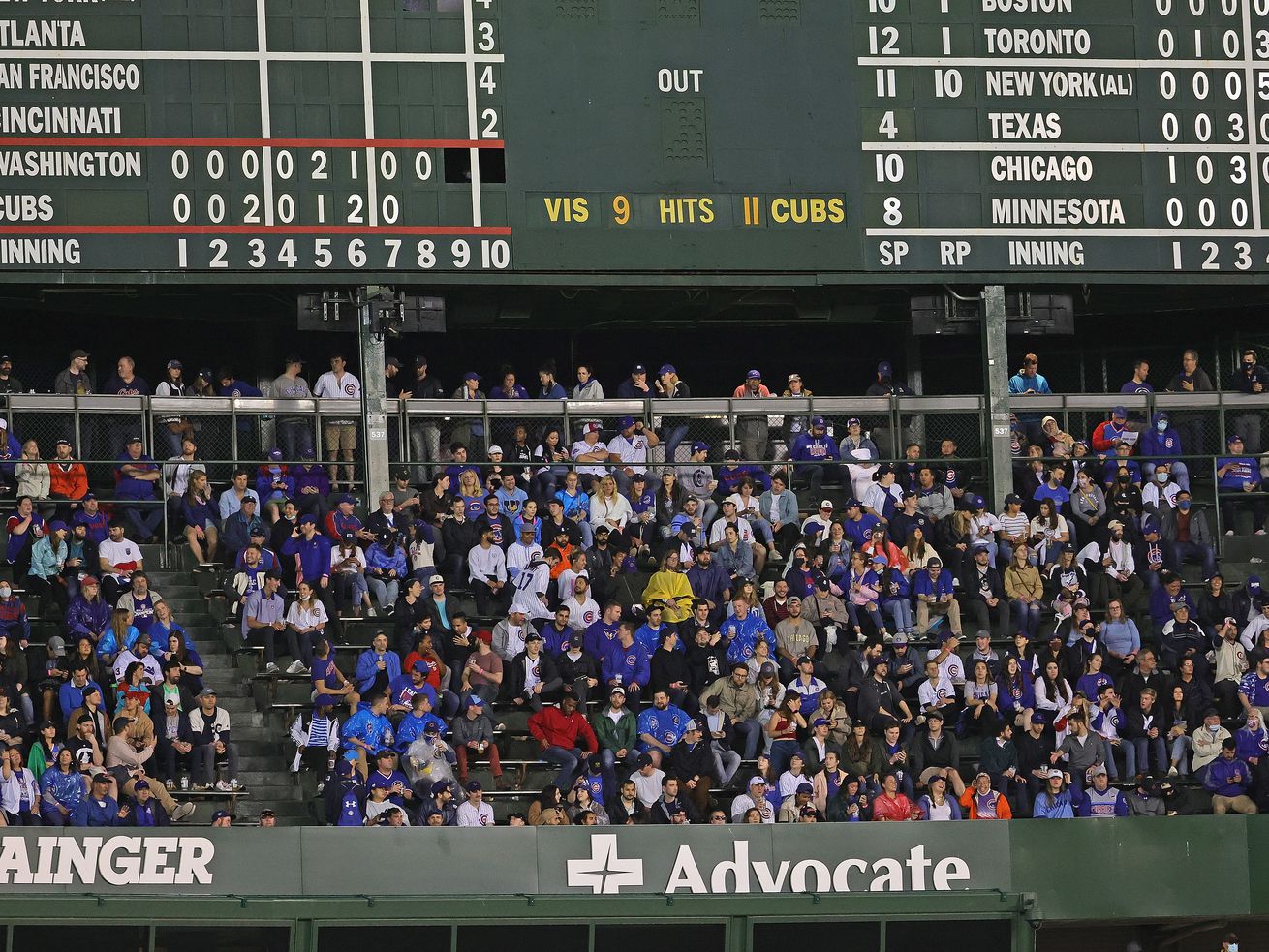
Washington Nationals v Chicago Cubs
The center-field bleachers at Wrigley Field are filled with vaccinated fans for the Nationals-Cubs game May 18. It was a sight for sore eyes — and ears. | Jonathan Daniel/Getty Images

After thinking I’d grow accustomed to the incongruity of a competitive ballgame missing the surrounding, telltale signs of a competitive ballgame, I realize now I never did.

Last year, I said something stupid.

OK, yesterday, I said something stupid. But for the purpose of this column, I’m referring to what I wrote when baseball returned last July with cardboard cutouts and fake crowd noise to help TV broadcasts replicate fans in ballparks emptied by the pandemic.

“So this is what pandemic baseball looks like on TV,” I wrote. “I’ll take it.”

Idiot.

In my defense, it beat the alternative of no baseball, and I wrote as much. But after thinking I’d grow accustomed to the incongruity of a competitive ballgame missing the surrounding, telltale signs of a competitive ballgame, I realize now I never did.

There’s a lot to be thankful for as pandemic restrictions begin to ease. Near the top of my list is having more fans back in the stands. Guaranteed Rate Field increased capacity from 25% to 60% on Monday, and the difference on the broadcast was palpable. Wrigley Field will follow suit Friday.

Last season, almost every camera shot was a reminder of the ballpark’s emptiness. There was no way to hide it, and it grew tiresome. The networks knew it, too.

“You don’t realize how much you miss the fan engagement,” said Kevin Cross, NBC Sports Chicago senior vice president and general manager. “The fans bring natural sound, which is important, but it’s not the most important. Most important, they bring engagement.

“The fans in the stands are a different voice on the broadcast that you can’t replicate artificially. When something is happening at the ballpark, the reaction is authentic, and you get a sense of what’s going on at the game. Real-time engagement is great for the viewer.”

That missing piece of the broadcast surely had an effect on viewership, which reached record lows for major events last year. Granted, the compressed sports schedule and out-of-season events played a part. But the quality of the broadcast did, too, and it suffered without fans.

Sometimes those fans become the talk of the game. Remember the Cubs fan who balanced his hat on his head in the bleachers in 2019? Hat tip to Yogi, who was interviewed during the game.

We’re seeing fans catch foul balls again and throw home-run balls back, such as the little boy whose father carried him down to the front row of the Wrigley bleachers to toss back a Dodgers homer this month.

It wasn’t easy for broadcasters to keep up their energy last year without a crowd to rouse them. They did the best they could trying to make broadcasts sound normal. But they could only do so much to build up a key moment without fans to raise the decibel meter.

“I think the [crowd’s] energy translates through our announcing teams,” said Mike McCarthy, Marquee Sports Network general manager. “Some of those games last year, it was so heartbreaking at times to hear the sound of the ball clanging off the empty seats. I hope we never hear it again.”

McCarthy, in particular, is thrilled to have fans back at Wrigley. From the network’s launch last year, its plan was to make the ballpark a co-star of broadcasts, treating it like Augusta National during the Masters. With a live audience on hand, the network is excited to expand its cast.

Marquee brass includes disciples of late Sports Broadcasting Hall of Famer Bill Webb, who directed baseball games for Fox and SNY, the Mets’ network. McCarthy and senior vice president of programming and production Mike Santini worked with Webb for years, and director Mike Fox was a mentee of his.

“He turned [directing] into an art form, to lock in on a couple of fans that are just anxiety-laced and seeing the games through their eyes,” McCarthy said. “We certainly try to bring that, but then we have this added benefit of the experience at Wrigley, which is unlike any other. We have conversations all the time about trying to bring that into the broadcast.”

The next step is to put announcers back in ballparks for road games. As happy as they are to hear a crowd through their headset while calling a game remotely, they need to be on site to call the best game possible. Sometimes it’s evident when broadcasters’ view of the game is limited to what the cameras are showing them, and they only feel the full effect of fans when they’re sitting among them.

“We can’t wait to get normalized again,” McCarthy said. “Our guys are doing a fantastic job in a limited set of circumstances, but it’ll be great to get them out on the road. Until then, we have this challenge in front of us, but it only makes us salivate more for the home games.”

Remote patrol

  • NBC will carry its third – and perhaps final – Indianapolis 500 at 10 a.m. Sunday. The network’s deal with IndyCar is in its final season, and Roger Penske reportedly will take his racing series to a higher bidder. NBC’s top IndyCar team of announcer Leigh Diffey and analysts Townsend Bell and Paul Tracy will call the race. Mike Tirico will host the studio show with Danica Patrick, and IndyCar rookie and seven-time NASCAR champion Jimmie Johnson will serve as an analyst.
  • The Cubs will return to ESPN’s “Sunday Night Baseball” on June 13 against the Cardinals at Wrigley Field. The teams’ meeting Sunday in St. Louis drew an average audience of 1,529,000 viewers, according to Nielsen. “SNB” is averaging 1,599,000 viewers this season, up 29% from the 2020 full-season average – even with Alex Rodriguez on the call.

Read More

Baseball TV broadcasts eminently more watchable with fans — DUH!Jeff Agreston May 27, 2021 at 7:00 pm Read More »

Stage musical featuring songs of Britney Spears bypassing Chicago for its world premiereMiriam Di Nunzioon May 27, 2021 at 7:00 pm

Keone and Mari Madrid will direct and choreograph the Broadway-bound musical “Once Upon a One More Time.”
Keone and Mari Madrid will direct and choreograph the Broadway-bound musical “Once Upon a One More Time.” | Nicole Lewis

“Once Upon a One More Time” arrives Nov. 29. But it won’t be in Chicago as previously announced.

The long-anticipated world premiere of the Britney Spears song-infused stage musical “Once Upon a One More Time” arrives Nov. 29. But it won’t be in Chicago as previously announced.

The Boadway-bound musical directed and choreographed by Drama Desk-nominated artists Keone and Mari Madrid, was set to debut at Chicago’s James M. Nederlander Theatre last April when the production plans were derailed due to the coronavirus pandemic shutdown of all theaters and entertainment venues. The show will now premiere in a production by the Shakespeare Theatre Company in Washington, D.C.

It’s not clear if the previously announced cast of Briga Heelan ( “Great News”) as Cinderella, Justin Guarini (“American Idol”) as Prince Charming, Emily Skinner (“The Cher Show”) and Simon Callow (“Four Weddings and a Funeral”) are confirmed for the D.C. production.

The show’s story centers on a book club gathering featuring Cinderella, Snow White, Little Mermaid and other classic storybook characters whose worlds are upended when a “rogue fairy godmother” gives them a copy of “The Feminine Mystique” to discuss.

“I’m so excited to have a musical with my songs — especially one that takes place in such a magical world filled with characters that I grew up on, who I love and adore,” said Spears in a 2019 statement when the show was announced.

Ironically, the Spears musical was originally slated to replace a Michael Jackson stage musical that had been set for its 2019 world premiere in Chicago. Plans for that production, which had been tentatively titled “Don’t Stop ‘Til You Get Enough,” never fully materialized. “MJ” the musical is now set to debut in December 2022 on Broadway at the Neil Simon Theatre.

Read More

Stage musical featuring songs of Britney Spears bypassing Chicago for its world premiereMiriam Di Nunzioon May 27, 2021 at 7:00 pm Read More »

Megan Thee Stallion, DaBaby each score 7 BET Award nominations, topping the listLindsey Bahr | Associated Presson May 27, 2021 at 6:11 pm

Chart-topping rappers DaBaby and Megan Thee Stallion each scored seven BET Award nominations.
Chart-topping rappers DaBaby and Megan Thee Stallion top this year’s list of BET Award nominations. | AP

Drake and Cardi B are the second-most nominated acts, scoring five bids each, while four nominations went to Chris Brown, Chloe x Halle, Bruno Mars and Anderson .Paak.

NEW YORK — Megan Thee Stallion and DaBaby are the prom queen and king of the 2021 BET Awards.

The chart-topping rappers each scored seven nominations at the show airing live on June 27 from the Microsoft Theater in Los Angeles.

Megan Thee Stallion, who won three Grammys this year, is up for best female hip-hop artist, album of the year for “Good News” and video of the year for “WAP,” her No. 1 hit with Cardi B. The “Savage” rapper is also a double nominee for both the viewer’s choice award and best collaboration.

DaBaby has four songs competing for best collaboration: “Rockstar” with Roddy Ricch; “For the Night” with Pop Smoke and Lil Baby; “Cry Baby” with Megan Thee Stallion; and “What’s Poppin” with Lil Wayne, Tory Lanez and Jack Harlow.

He’s also nominated for best male hip-hop artist, the viewer’s choice award and album of the year for “Blame It on Baby.”

Drake and Cardi B are the second-most nominated acts, scoring five bids each, while four nominations went to Chris Brown, Chloe x Halle, Bruno Mars and Anderson .Paak. All of those acts are nominated for video of the year.

Megan Thee Stallion and DaBaby were two of the big stars at last year’s BET Awards — the first awards show to air during the pandemic. It was a critical success and featured highly produced and well-crafted pre-taped performances, with some centered around the Black experience highlighted by the Black Lives Matter movement, civil rights and the lives of those lost because of police officers, including George Floyd.

This year’s show will allow those who are vaccinated to register to be part of the live audience. The network said it is working closely with Los Angeles County to adhere to COVID-19 protocols.

While press at the awards show will be limited, BET does plan to have a red carpet ahead of the live event.

“We are back and excited to bring culture’s biggest night … safely back to Los Angeles to celebrate this year’s incredible roster of nominees,” Connie Orlando, BET’s executive vice president of specials, music programming and music strategy, said in a statement Thursday. “We broke ground as one of the first official award shows to move forward during the global pandemic and we are ready to take our pioneer status to the next level with the return of an audience to celebrate the best and brightest creative minds in the entertainment industry.”

Other nominees at the show include The Weeknd, up for album of the year and best male pop/R&B artist, and late rapper Pop Smoke, who won five Billboard Music Awards this week and picked up two nominations at the BET Awards, including best male hip-hop artist. His competition includes J. Cole, Drake, Lil Baby, DaBaby and Jack Harlow.

Nicki Minaj was surprisingly shut out of best female hip-hop artist despite launching two No. 1 hits last year with her appearances on 6ix9ine’s “Trollz” and Doja Cat’s “Say So” remix. From 2010 to 2016, Minaj had won the honor for seven consecutive years, and had been a nominee for 11 consecutive years.

Female performers competing with Megan Thee Stallion, last year’s best female hip-hop artist winner, include Cardi B, Doja Cat, Saweetie, Latto and Coi Leray.

The late actor Chadwick Boseman followed his many posthumous awards nominations with one at the BET Awards — he’s nominated for best actor along with recent Oscar winner Daniel Kaluuya, Eddie Murphy, LaKeith Stanfield, Aldis Hodge and Damson Idris. Actor-singers Andra Day and Zendaya are up for best actress, along with Viola Davis, Angela Bassett, Issa Rae and Jurnee Smollett.

Best movie nominees are “Coming 2 America,” “Ma Rainey’s Black Bottom,” “The United States vs. Billie Holiday,” “Judas and the Black Messiah,” “Soul” and “One Night in Miami.”

Read More

Megan Thee Stallion, DaBaby each score 7 BET Award nominations, topping the listLindsey Bahr | Associated Presson May 27, 2021 at 6:11 pm Read More »

We must fight a rising tide of antisemitism — and all forms of hate — togetherLonnie Nasatiron May 27, 2021 at 6:04 pm

Pro-Israel demonstrators attend a rally denouncing antisemitism and antisemitic attacks in New York on May 23, 2021. | Getty

With the easing of pandemic restrictions and the latest battle between Hamas terrorists and Israel, there has been a horrific resurgence of antisemitism in the United States.

The COVID-19 pandemic put many wonderful aspects of everyday life on an extended pause, from weddings and family visits to cultural and sporting events.

In a significant turn of events, some hateful activities also were put on pause, including what had been a steady rise in antisemitism.

Now, suddenly, with the near simultaneous easing of pandemic restrictions and the latest battle between Hamas terrorists and Israel, there has been a horrific resurgence of antisemitism on America’s streets and social media.

Even during the 14 years I was running the Chicago office of the ADL, I never saw such a torrent of antisemitism in such a short period of time.

Last week in New York, over a span of just three days, six men shouting “free Palestine” punched two Jewish teenagers; a group brandishing a Palestinian flag as a weapon harassed and spat on diners suspected of “dining while Jewish;” a band of youths, keffiyehs covering their faces, lunged at men in kippahs, accusing them of supporting child murder; another mob cornered two Jews, sparking a street brawl, and yet another cruised an iconic Jewish business district, harassing pedestrians and lobbing fireworks, burning a 55-year-old woman. A 20-year-old professional soccer player was accosted by men wielding knives who asked if he was Jewish — and threatened to kill him if his answer was yes.

In Los Angeles, pro-Palestinian attackers barged into a sushi restaurant, asked who was Jewish and threw punches and bottles at diners. In Florida, a man hurled antisemitic abuse at a rabbi and later emptied a bag of feces outside the rabbi’s synagogue. In Tucson, unidentified individuals hurled a large object through a synagogue’s glass doors.

Here in metropolitan Chicago, a Skokie synagogue’s windows were broken, with a “free Palestinian” sticker left behind as a calling card. And in Naperville, pro-Palestinian counter-protestors surrounded, shook and assaulted a parked vehicle of Israel supporters, shouting, in Arabic and English, “death to Jews.”

Sadly, in a victory for the haters, some American Jews are taking kippahs off their heads, Stars of David from their necks, and mezuzahs (small prayer parchment) from their doorposts. Still others are no longer walking to synagogue amid this wave of antisemitic brutality.

Increasingly, social media provides zero respite from the antisemitism of the streets.

A local Facebook group for moms sharing parenting resources was hijacked by an anti-Israel administrator who proceeded to expel any of the 41,000 followers who expressed support for Israel, challenged her anti-Israel views or in some cases just had Jewish-sounding last names.

Posting hateful, intimidating antisemitic messages and images on previously civil Twitter, Facebook and Instagram accounts is now frighteningly common. Merely identifying oneself as a Jew has become a veritable invitation to be abused by hundreds online — or to be “canceled.”

Antisemitism is inextricably linked to other forms of hate, which tragically also have risen significantly across our country. We must continue to fight hatred together and build upon the victories, such as Congress’s recent enactment of the NO HATE Act, which was realized by joining forces across diverse communities and standing in solidarity with each other.

We are grateful for those political, religious and civic leaders who have — without equivocation or prodding — condemned this rise of antisemitism.

Still, the silence of too many others is disquieting.

We all know the potential consequences when haters are abetted by those who turn the other cheek to age-old antisemitic tropes and inflammatory rhetoric. When people are targeted for no reason other than being Jewish, it is antisemitism, plain and simple. Nothing justifies it, and no one should rationalize or minimize it.

COVID-19 spread quickly, wreaking havoc, and leaving death and heartache in its wake. Hopefully, the deadliest days of this virulent disease are behind us.

Just as people worldwide rallied to defeat COVID, so too do we hope for a unified response to antisemitism, a global and deadly disease in its own right. Until then, we will remain vigilant and anxious to work with allies.

Lonnie Nasatir is president of the Jewish United Fund of Chicago.

Send letters to [email protected].

Read More

We must fight a rising tide of antisemitism — and all forms of hate — togetherLonnie Nasatiron May 27, 2021 at 6:04 pm Read More »