Life events, simple pleasures, hard times, and moments of joy still persist during the Coronavirus Pandemic. This week, our family grieves the passing of a loved one, my husband’s cousin, who died of a brain hemorrhage. We mourn with her children, parents and grandmother. Sentiments from our recent family movie, Goodbye Christopher Robin, ring true.Christopher Robin’s childhood coming of age tale urges, “Keep me in your heart I’ll stay there forever.”
Hold in our heart forever
We acknowledge the sadness in our hearts, hope for brighter tomorrow and continue with loved ones. “[When] there is tomorrow when we’re not together…there is something you must always remember. You are braver than you believe, stronger than you seem, and smarter than you think but the most important thing is, even if we’re apart… I’ll always be with you.”
Days may run together during almost 24/7 quarantine, times of uncertainty and grief. As the wise Christopher Robin and Winnie-the-Pooh friends asked, “What day is it? It’s today.” Hard news facts and family loss may jolt us from summer of 2020 monotony during Covid-19.
Christopher Robin, and his Winnie-the-Pooh friends expound, “doing nothing often leads to the very kind of something.” We experience peace in neighborhood walks. We still work toward progress. We follow public health guidelines as we journey outside our comfort zone to learn and grow.
Neighbor garden stroll
“People say nothing is impossible, but I do nothing everyday.” We pause and recharge. We anchor weekend days with three activities help, e.g. workbook pages, hiking and/or soccer, usual reading. We adapt and stay safe with facial masks, social distance and lots of cleaning. Acceptance helps conserve our energy as we do our best to control our reaction.
As the Zen Winnie-the-Pooh friends acquiesced, “I suppose it’s right where it needs to be.” We strive to practice patience and compassion with ourselves and loved ones. Christopher Robin understood, “I always get to where I’m going by walking from where I’ve been.”
We wonder at the sound of rain, roar of thunder, and beauty of clouds. This week in Chicago, we felt grateful to take shelter from tornado winds that pummeled our block. As Christopher Robin said, “Your life is happening right in front of you.”
We extend our condolences to friends and family who shoulder loss. We keep friends and family in our hearts and prayers during this time unique pressure. XO
Helloooo Pittsburgh! My hometown and also the city of bridges, in case you were wondering.
This post was edited while our power was out thanks to the early August derecho, and after half a pizza and a glass of wine. For more information about pizza and wine, follow @natcmatthews on Instagram.
Let me preface this post by saying we are those parents who really didn’t do much pre-pandemic. When our daughter was a newborn, we took her out to dinner and she would sleep in her bassinet, but once we implemented her bedtime routine, those normal-people-timed dinners effectively ended and we developed this paralyzing fear of messing with her routine – as if keeping her up late one night or throwing off her nap would mean she would never sleep again, and she’d call me as an adult in the middle of the night, asking why I did this to her.
So, over the last couple years, we’ve watched our friends take their babies everywhere: Nice restaurants and parties and on faraway beach vacations and even to the mountains. Meanwhile, we stayed home and just hoped that the diligence with which we executed her schedule would pay off in the form of our little girl sleeping through the night and being in a good mood the whole next day, every day. Is that too much to ask?
Don’t get me wrong – we’ve taken her out to eat (mostly lunch/brunch), out on walks, to a couple of street festivals, and right before covid hit we started going to dance class (I miss that so much!). But after these outings we sometimes felt exhausted or frustrated, and wondered if the going out was worth the trouble.
All that to say, when we were trying to find childcare earlier this summer, the idea came up to drive eight-ish hours from Chicago to my hometown of Pittsburgh to have my parents watch her and, well, the traveling sounded kind of hellish. What would she do for eight hours? What if she just cries the whole time? You mean I have to get out of the car and go into a rest stop filled with germy travelers when all I’ve been doing for four months is avoiding going inside of ANYwhere? I have to change a diaper in a car? WTF does that look like?
But, without childcare set up for the summer, we needed help. And so, our decision was made – we would drive to Pittsburgh and stay for a month, until we could hire a nanny or otherwise figure out childcare in Chicago.
Before we left, we got tested and quarantined (at the time, Chicago testing was widely available with quick results). We packed up a month’s worth of things, three days’ worth of food (you never know what’s going to happen when you’re driving through Ohio), and made the long drive to Pennsylvania.
The trip there was incredibly fast (a record-breaking 7 hours) and our daughter was an ANGEL. (Not so much on the way back, but that post is for another day).
We ended up staying with my parents for five weeks, slightly longer than expected, and it was the greatest decision we could have made. I had been warned by some friends that moving back in with your old “roommates” might be fun at first, but eventually we’d all get sick of each other. I can totally understand how that might happen, but we really didn’t experience that (Hi, Mom!).
Not only were we spoiled with the comforts of homemade meals nearly every night (plus my mom’s excellent choice of local takeout – looking at you, Gaucho Parilla Argentina – and my dad’s random donut purchases that would appear in the fridge, thanks Dad!), but our daughter got to know her grandparents, and vice versa. In a year where being away from loved ones has been the norm, that’s worth any 7-8 hour drive. Plus, now we know that while taking a long road trip will throw off our daughter’s entire schedule for the day, that isn’t the end of the world. Not only was it worth the trouble, it’s been a highlight of our quarantine experience.
So thank you, Pittsburgh, for being our summer quarantine home. While we didn’t get to see much of the city, it gave us a place to stay safe, a place to see family, and trusted and loving childcare (that also allowed mama to go back to work full-time). The city gave us daily walks in quiet parks and along the river, the best Italian hoagies I’ve had in a long time, and a long drive with a toddler that was way less miserable than I expected.
If you’re looking for some guidance in helping you make decisions like this one, I found this article (that went viral earlier this year) very helpful.
More notes on moving back in with my parents:
For the first couple of weeks, my nightly glass of wine would be confiscated if I left it unattended. I learned that my Dad has a habit of clearing the entire table after dinner and dumping out whatever’s in the glasses…I now hide my wine if I have to leave to change a diaper.
The first time we ordered pizza for Friday pizza night, trying to decide what toppings we were going to order was like trying to beat back coronavirus in the U.S., aka never-ending…then we realized we’d have five more Fridays to pick whatever toppings we wanted.
I have never seen a cheese drawer so full.
One day I left my daughter’s shorts on a chair because she refused to put them on. My dad picked them up and thought they were my underwear…awkwaaard.
One time my parents’ landline phone rang and they both turned to me, like, “is it for you”? I had to remind them that I haven’t given out a landline number since I was 16.
A long-term resident of Chicago’s Ravenswood area, Hartmann worked in reference publishing for 20 years. He was a researcher for “Who’s Who in America,” and was a longtime editor of a newsletter covering developments in the U.S. Congress. He’s currently working in directory publishing. He can be reached via e-mail at [email protected].
EDMONTON, ALBERTA – AUGUST 15: Marc-Andre Fleury #29 of the Vegas Golden Knights makes the second period save on Alex DeBrincat #12 of the Chicago Blackhawks in Game Three of the Western Conference First Round during the 2020 NHL Stanley Cup Playoffs at Rogers Place on August 15, 2020 in Edmonton, Alberta, Canada. (Photo by Jeff Vinnick/Getty Images)
The ChicagoBlackhawks are in a tough spot being down 3-0 in their playoff series.
The Chicago Blackhawks didn’t capitalize on their opportunity to make Chicago feel better after a pretty horrible sports day. The Chicago White Sox lost both games of a doubleheader to the St. Louis Cardinals who haven’t played in two weeks and the Chicago Cubs blew a lead to the Milwaukee Brewers and lost in extra innings. It was a tough day made complete when the Hawks lost to the Vegas Golden Knights by a final score of 2-1.
The Hawks kept up with Vegas on the shot board as they actually outshot them 27-26. Both Corey Crawford and Marc-Andre Fleury made some nice saves in this one to keep the score tight. It was a tough scene when William Karlson scored a short-handed goal just 4:12 into the first period. Vegas is very hard to keep up with in general but it is really hard to come back when you go down early.
It eventually became 2-0 when Patrick Brown scored later in the second period. The Hawks got it to within one when Olli Maatta scored shortly after the third period started. This loss stings because it is very hard to see any team beat Vegas four times in a row at any point in time. The Hawks need to make some history in order to advance otherwise they will be history.
In the history of the National Hockey League, over 190 teams have ever held a 3-0 series lead and only four of them have come all the way back to move on. The most recent was the first-round series between the San Jose Sharks and Los Angeles Kings in 2014. The Sharks had the all-powerful 3-0 series lead and Los Angeles pretty much dominated every game since and took the series in seven games. Los Angeles went on to defeat the Hawks in the Western Conference Finals and eventually won the Stanley Cup that year.
Before that, the 2010 Philadelphia Flyers came back from being down 3-0 in their series to the Boston Bruins. They were even down in game seven by a score of 3-0 and they stormed all the way back to complete multiple comebacks. Philadelphia would go all the way to the Stanley Cup Final before they were defeated by the Chicago Blackhawks.
It does feel weird that the two most recent teams to come back from a deficit like that ended up playing the Hawks at some point. Before this comeback, it had been 35 years since anyone did that. This is an extremely tall task but it will certainly be fun to see how the core guys on the Hawks handle this type of adversity. They have been here before so maybe some adjustments can be made.
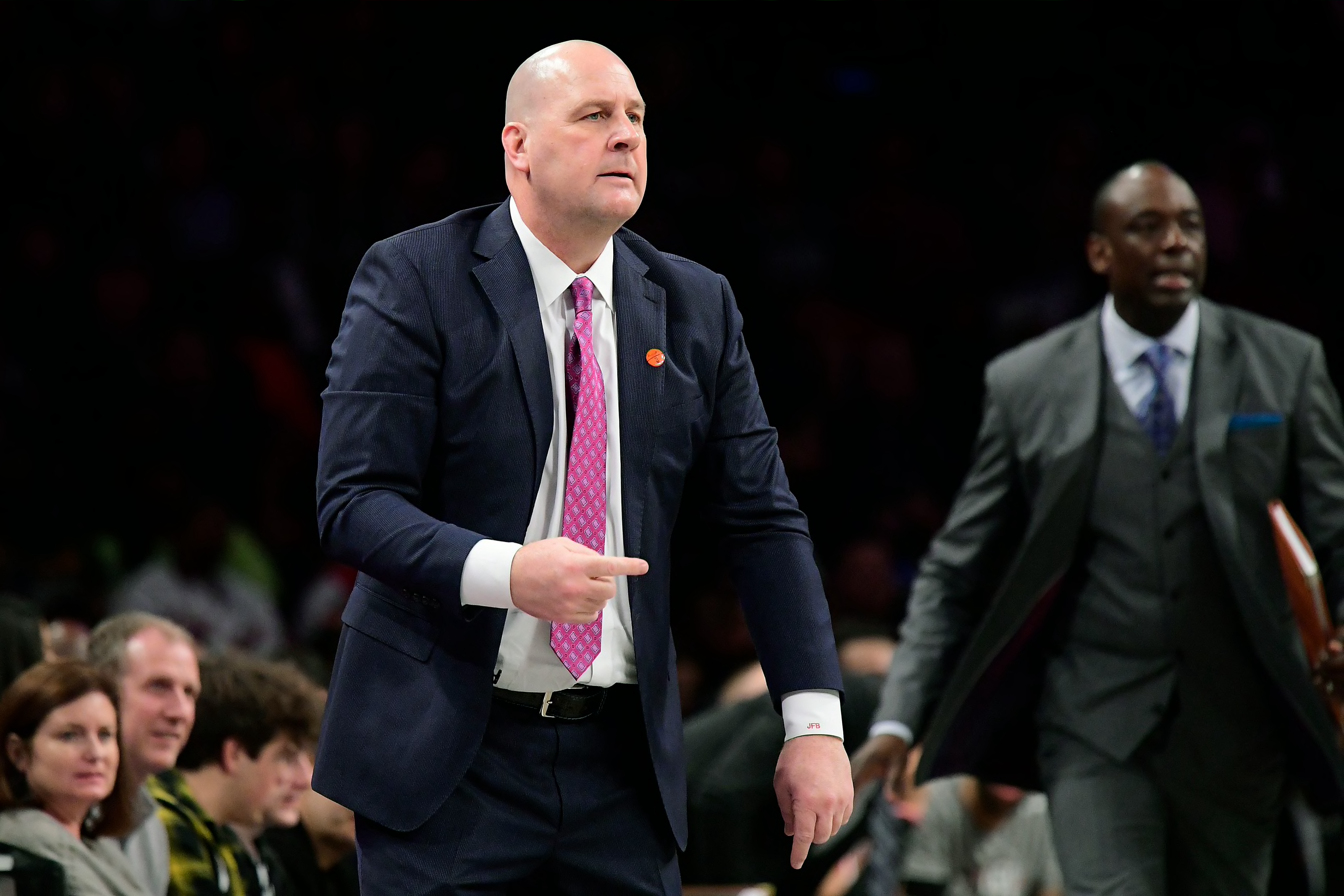
Jim Boylen is officially gone. Now, the Chicago Bulls begin their head coaching search.
After the Chicago Bulls fired Fred Hoiberg, they didn’t conduct a true head coaching search when they simply handed the job to then-assistant Jim Boylen. It was never an ideal scenario. The fans and players knew it.
Now, it’s time to start fresh. With the Bulls officially firing Boylen on Friday, there seems to be a weight lifted off the shoulders of the organization. To be frank, I am certain that Bulls fans feel the same exact way.
All one has to do is go check out Bulls Twitter to see how elated the fan base has become over the move by Arturas Karnisovas.
Speaking of Karnisovas, this is now his second big decision as Vice President of Basketball Operations. The first was to bring in Marc Eversley as his general manager. But, now, his second decision feels a little more weighted. This is a big one.
There are reports of the Bulls not being in any hurry to find their next coach, as they do not want to rush this decision. That makes sense, however, they will have competition for some of the candidates available.
RELATED PRODUCT
Tailgate Men’s Chicago Bulls Graphic T-Shirt Washed Red XXL
The Bulls are one of only two active teams without a head coach. The other is New Orleans, who just dismissed Alvin Gentry of his duties as well.
But, the Brooklyn Nets have yet to make a decision on interim head coach Jacque Vaughn. The Houston Rockets did not reach an extension with Mike D’Antoni, which means he could be out as well.
As for the Bulls, specifically, there are several names linked to them and their head coaching search. ESPN’s Adrian Wojnarowski tweeted the majority of key names to watch after the firing of Boylen, but there is one more obvious name to add to that list. Let’s examine all of the latest rumored canddiates to replace Boylen.
With a little less news to report since this weekend, here’s a quick recap of what this column is about.
I’m reporting beer tappings, dinners, and related events in brewery tap rooms, brewpubs and beer bars in the Chicago area. For now I’m also throwing in all the beer trucks and trivia events I find, just to encourage people to get out and support their local beer scene.
You’ll often find breaking news on my Facebook page. I usually re-post notices of establishments that have closed temporarily if one of their employees tests out for COVID exposure. Especially in these times, if you to go somewhere, call your destination beforehand. And DO follow the current rules on distancing and masking.
If I have been missing any events you know about, click the email link on this page and let me know!
Fresh Beer Events, occasional bacon, but always spam free, opt out any time.
Meet The Blogger
Mark McDermott
Writer, trivia maven, fan of many things. I thought to learn all there is to know about beer as a way to stay interested in learning. It is my pleasure to bring Chicago’s craft beer scene to you.
Yesterday, I came across a reworked version of Neil Young’s “Looking For A Leader.” He changed some of the words to make them relevant for 2020. I started thinking about if there are other songs about Donald Trump. Hmmm….man, there sure are.
Instead of using older, worn-out classic rock tunes, Joe Biden should use some of these at his rallies? WOW….wouldn’t that burn Don’s ass?!
My so called friends think it’s time to edit this section. After four years, they may be right, but don’t tell them that. I’ll deny it until they die!
I can’t believe I’ve been writing this blog for four years.
It started as a health/wellness thing and over the years has morphed to include so many things that I don’t know how to describe it anymore.
I really thought this was going to be the final year of the blog but then Donald Trump came along. It looks like we’re good for four more years..God help us all!
Oh yeah…the biographical stuff. I’m not 60 anymore. The rest you can read about in the blog.
Neighborhoods near Chicago’s city limits on the South, Southeast, Southwest, and West sides have a well knownlongstandingtransportation access problem, creating disparity in commute times to available jobs. Transit inequality severs a part of the city’s talent pool and slows regional job growth, and although the loss of economic opportunity is hard to measure with any accuracy its magnitude compounds over time.
Enter The Jitney
Chicago’s transit inequality is not an intractable problem. If we will only look, countries throughout the world demonstrate a tried and true solution for transporting dispersed urban populations to job centers. Residents in Africa, Eastern Europe, Latin America, and Asia hire private share taxi minibuses for transportation throughout areas of dispersed density. They’re known as jeepneys in the Philippines, tap taps in Haiti, moniyot sherut in Irael, public light buses in Hong Kong, louage in Tunisia, danfo in Nigeria, fula fula in Kinshasa, angkutan kota in Indonesia, taxis in Iran, Songthaews in Thailand, shuttle vans in New Zealand, dolmuş in Turkey, taxis collectifs in Quebec, Colectivos in Argentina, peseros in Mexico, ruleteros in Guatemala, or Jitneys in Chicago. In former Soviet countries they are called “marshrutkas,” and even as so many other public services have fallen apart they continue to work remarkably well.
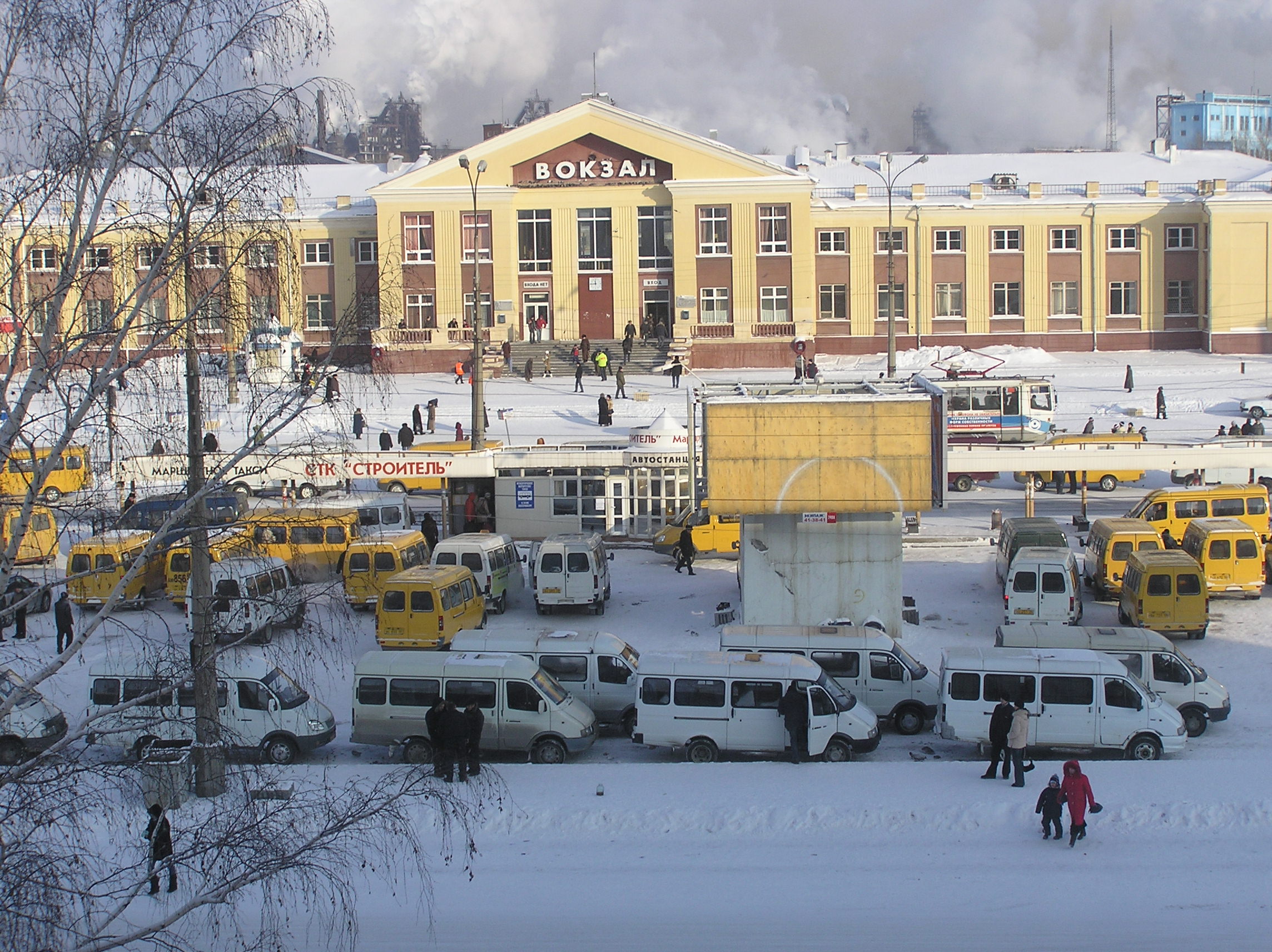
Marshrutkas at a Russian train station, waiting to take passengers in any number of directions.
Where they are allowed, “Jitneys” or “Dollar Vans” are successful in the US, too. But in the early 20th Century streetcar companies successfully lobbied for bans in most cities. For a brief primer, here’s a quick overview. Here’s how they successfully operate in Queens. A share taxi solution could be implemented in Chicago for little cost, and over a timeline barely longer than it takes to write an ordinance.
The right tool for the job
Chicago’s challenge is that the South and West sides are much larger, much less dense, and much less wealthy than the North side, creating transit demand that isn’t concentrated along logical corridors but rather blanketed throughout vast areas. This is exactly the same problem that share taxis address in so many of the world’s communities. They are self-directed rather than precisely scheduled, meaning they dynamically respond to changing demand patterns through the days, months, and years. They are smaller than full size buses and can more easily run full, meaning they seldom operate at a loss, even in areas without density. Their numerous number and smaller size allows them to more precisely match demand – like a screen with a higher resolution and smaller pixels – avoiding resource waste. Finally, they would represent a low barrier to entry entrepreneurial opportunity for Chicagoans all over the city.
Jitneys are not new to Chicago, but they’ve never been fully unleashed. The Tribune ran a story about the 1950s “Jitney war” in Bronzeville, in which Jitneys were providing critical transportation services that racist bus drivers refused to provide. In 1994 Crain’s reported that the city was considering allowing more Jitneys to serve South side neighborhoods, but this effort was shut down by CTA and taxicab lobbies the same way previous ones had been.
Dollar Vans lined up in Brooklyn.
The current problem is that Chicago bars jitneys (Chp 9-114-350(a)) and ride share vehicles (Chp 9-115-100(b)(1)) in excess of 9 seats from operating in the city. It bars jitneys from particular profitable areas such as downtown and the airports, and leaves enormous amounts of discretion in the hands of the Business Affairs and Consumer Protection commissioner to ban additional routes, fix prices as low as desired, and administratively add further regulations, creating significant legal uncertainty. Furthermore, the city’s ridesharing ordinance – molded extensively by the taxicab lobby – does not inspire confidence that further regulations will maintain a low barrier to entry for nascent transportation entrepreneurs.
Low Barriers To Entry Alleviate Inequality
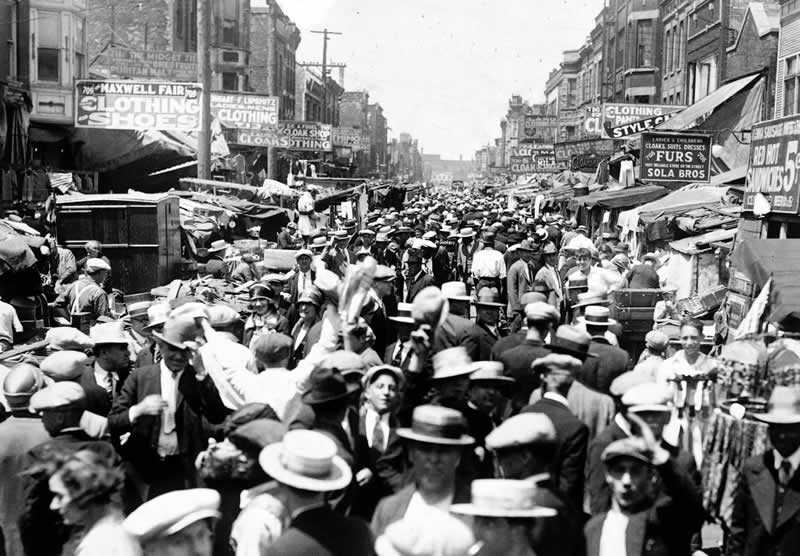
Once located in a dense neighborhood, Maxwell Street Market lowered barriers to entry for entrepreneurs and customers. Chicago Blues resulted from the constant collisions of creativity.
Every entrepreneur faces a number of barriers to entry when considering a business, including financial requirements, needed knowledge, legal and regulatory restrictions, supply and operational logistics challenges, accounting and records keeping set up costs, the need to secure space from which to operate, and so on. Lowering these barriers to entry is the key to increasing economic mobility. A resident with an import and retail idea can try and sell at temporary, low-rent Maxwell Street Market and see how people respond. A budding restaurateur can start in a relatively inexpensive, mobile food truck.
Prioritizing lower barriers to entry as a key part of equitable economic development efforts would have significant policy implications. Maxwell Street should probably be moved to Woodlawn, where it would do more good. Better yet, there should be additional outdoor street markets throughout Chicago’s neighborhoods, and in many neighborhoods they shouldn’t be taxed. The city should start pushing south side developers to build European-style flea market halls with permanent micro-retail booths. Manufacturing makerspaces and incubators should be a critical city-sponsored infrastructure component in all Chicago neighborhoods.
Additionally, it’s critical that the city carefully writes ordinances in consideration of small time entrepreneurs risking their life savings to climb the first rungs of the economic ladder. This means ignoring restaurant lobbies that want food truck locations highly restricted, and taxicab lobbies that want rideshares heavily regulated.
Consider the barriers to entry for a Chicagoan who loses their job just after buying a car, and decides to use their vehicle as a rideshare. This Chicagoan shouldn’t have to be fingerprinted, or get two different kinds of licenses, or take online classes, or face fines because they can’t afford full ADA upgrades to their automobile, or be barred from operating because last year they moved from Hegewisch to Whiting, Indiana. The origins of these rules are plain; the ridesharing ordinance actually says this newly self-employed rideshare driver can’t pick up people giving hailing gestures, and has to submit to regular city inspections verifying there’s no visible rust on their vehicle.
This Tennessee flea market includes permanent booths, lowering barriers to entry and dropping the cost of starting a business to thousands of dollars rather than tens or hundreds of thousands.
Systemically Unequal
When the 14th Amendment was first passed, the right to earn a decent living was considered a key part of the “privileges or immunities” of citizenship. A free person owns his/her own body, and can engage in commerce. The City of Chicago should debate proposed regulations in these terms: “Will this bar the gates to poor Chicagoans, and prevent them from earning a living? Does this raise the barriers to entry above the level many can reach?“
Chicago’s neighborhoods desperately need a city council that prioritizes lowering the barriers to entry and the costs of a job. The ability to get to work is a linchpin piece of this, and in pursuing real solutions the underperforming system may need to be shaken up.
Just like people, systems reveal their priorities through their actions. Subordinating the clear significant need of the populace to political lobbies is in my view clear evidence of the same systemic racism and classism that also infects the criminal justice system. The system does not produce incentives that get results for those without clout, and nobody seems interested in changing the incentives to attain better results. Avoiding reform also demonstrates a lack of trust in the people. An alderman should believe – should know in his/her heart – that if he/she stands up to special interests in defense of constituents’ rights, they will have his/her back.
Much like share taxis, food truck courts drop barriers to entry both for neighborhood services and for entrepreneurs. Pictured is San Francisco’s SOMA StrEAT Food Park – Source: insidescoopsf.sfgate.com
Reform would of course require navigating the certain opposition of the transportation unions and taxicab lobby, which would fear the competition. A politician may well consider jitneys to be a path of excessive political resistance.
Consider the relevant question, however:
Is the city or state likely to be able and willing to fund a fully public system of a jitney-equivalent service level?
Since with the right policy there would be an explosion of affordable transportation options throughout all areas of the city, equivalent service means the addition of thousands or perhaps tens of thousands of buses throughout Chicago. In the face of the many other demands upon limited public funds, we should be honest with ourselves about the public’s ability to provide an equivalent service level. In urban Ukraine marshrutkas are in many areas more numerous than cars, and they run with passenger loads 2 or 3 times higher than the Chicago’s arbitrary 9-person cap. There’s no public solution that can match this level of service.
Reform is Needed
In enacting real reform, the council could make certain that all areas of the city are covered. In applying for a license (which should be unlimited in number), the driver would have to share their location when driving. In exchange for driving on a profitable well served route, a driver would need to also drive an underserved route. The city would make a trade: Belmont in exchange for Marquette, or Damen in rush hour in exchange for Damen in the wee hours. The share taxi data correlated with population statistics should create a robust data set and result in a calculation of each route’s and time’s relative public value. Note that route trading isn’t a new idea, and has been successfully implemented in Eastern Europe.
Effective reform is urgent; when a city consistently fails to help its residents attain a better life, it fails at the chief economic purpose of a city. And people leave. Chicago has gained and then lost a million people since 1920, and its remaining population is both more concentrated in or near downtown and further dispersed throughout the urban periphery. The economic geography of the city is much different than when the transit system was built. Even with the red line’s Southern extension, many wards will remain underserved by city buses.
Faced with the reality of scarce public resources, outside-the-box approaches like share taxis are the most realistic, practical way of providing equitable transit throughout all of Chicago’s communities. A system of share taxi route trading would make Chicago a national model in public transportation, much like Minneapolis has become in some circles for their zoning reform measures. The city is geographically vast, but “Jitneys” throughout the world have a track record of effectively addressing widely dispersed transportation demand. They would work here, too.
It will take courage and foresight, but I encourage Aldermen in underserved wards to consider jitneys for the good of Chicagoans throughout their districts. These include Ward 17, Ward 34, Ward 13, Ward 10, Ward 6, Ward 7, Ward 9, Ward 41, Ward 50, Ward 18, and Ward 38.
In observing an effective solution deployed around the world, transit inequality should be unacceptable in 2020 Chicago; every Chicagoan could and should have reasonable access to any available good job in Chicago, irrespective of its particular location. Jitneys are a proven solution, within easy reach if we have the will to do what is right and insist on equal opportunities for all.
IIT produced engineer with the ambition to develop property in Chicago and help return some of the Chicago sense of place to areas of the city that are losing it. Investors and engineers solve problems for a living, so I offer my strong opinions on what these are and how they might be solved.
Not saved by the bell! The 2020 school season is right around the corner, but since we’re in the middle of a pandemic, heading back to the hallways is not the reality for many students. Remote learning is currently the landscape for the majority this year. Since we’re all navigating our “new” normal, I decided to take the guess-work out of items that a parent may or may not need to add to their “Back To School” shopping list.
I got the chance to display these unique products on CBS 2 Chicago. There was an array of products! I included products covering different price points and age ranges– there’s something in this list for everyone. Below is a detailed breakdown including the video of what was featured and links to purchase some of those products.
Whether returning to the classroom or continuing their education at home, the “back-to-school” season can be a tough adjustment for kids after the long summer. Touchpoints are non-invasive, easy to use wearables that can help ease “back to school” stress, boost mental performance and focus of students, and improve sleep.
TouchPoints use gentle, haptic, micro-vibrations to alter the brain’s stress patterns and bring you back to logical, rational thinking which allows you to think more clearly and focus on the task at hand. Along with reducing stress in over 70% of users in just 30 seconds, TouchPoints have been shown to help improve focus by 50% in a double-blind placebo-controlled study.
SnapCalc is an app that can help with at-home learning. Not only can the app help you solve math problems in a matter of seconds – it teaches how to get that answer by showing you the step by step solution.
Created by a mom of five and an avid traveler, LLH is a monthly subscription kit that helps educate through cultural exploration and life skills. The kit has everything needed to provide children with days of entertainment and learning disguised in play. From 3D puzzles, recipes, stickers, flags, and more, Little Learning Hands is a great resource to give parents some relief without the guilt of screen time as well as supplement learning in a fun and engaging way.
Eliminate distractions, with these premium quality noise-canceling headphones. Shure enShured (pun intended) that they made headphones to cater to an audio master! That’s not to say a novice wouldn’t get listening pleasure out of these headphones but they come loaded with wireless studio-quality sound, long-wearing comfort and durability, 20 hours of battery life, and the ability to adjust the noise-canceling headphone. This will take any zoom meeting or learning to the next level.
Get Updates on Celebrity Interviews, trendy Beauty & Fashion Tips, and coverage of Live Events
Meet The Blogger
Nekia Nichelle
Nekia Nichelle is a digital and broadcast journalist covering entertainment, lifestyle, beauty and pinch of fashion.
She has interviewed celebrities such as John Legend, Halle Berry, Jenny McCarthy, Brandy, Queen Latifah, Katie Couric and more.
When she’s not blogging, she can be heard on 107.5 WGCI, V103 and WLIT 93.9FM, as well as other stations, keeping you informed on all the traffic snafus during your morning commute.
Stay social with her on:
Instagram, Twitter, Facebook and Snapchat: @NekiaNichelle
Facebook Fan Page: @IamNekiaNichelle





 Chicago’s Favorite Food Critics and Bloggers





Leave a comment