Still futzing along with my spare computer while I wait to find out if the data from my fried MacBook can be retrieved. My spare Intel box has been working, except I’m using the same Bluetooth keyboard for this and my iPad, and the keyboard favors the wrong device when I need it.
After cancelling the springtime Dark Lord Days, Three Floyds Brewing Co. has finally announced a plan to distribute this year’s allotment. People visiting 3floyds.com on October 19, starting at 3 pm Central, can place an order. Each $170 package includes:
Four custom-printed bottles of 2020 Dark Lord Russian-Style Imperial Stout
One bottle of a rare 2020 Dark Lord variant
Tote bag (That’s right!)
Limit 2 packages per customer. Each package will contain a random 2020 variant. People who buy two bags will get different variants.
Fresh Beer Events, occasional bacon, but always spam free, opt out any time.
Meet The Blogger
Mark McDermott
Writer, trivia maven, fan of many things. I thought to learn all there is to know about beer as a way to stay interested in learning. It is my pleasure to bring Chicago’s craft beer scene to you.
“Leading” senior citizen groups are upset because opponents of Gov. J.B. Pritzker’s graduated income tax shakedown are suggesting that it could lead to an Illinois tax on retirement income.
Older people will get confused, the groups say. But this is one older person who sees clearly that, indeed, the graduated income tax, while not making a tax on retirement income inevitable, sure makes it easier.
Once a graduated income tax is in place, calling for a tax on “rich” seniors will be a lot easier than imposing the existing flat tax on all seniors, including seniors who are living off meager pensions or social security.
And why not?
Illinois is one of only three states that doesn’t tax retirement income. It’s especially gratifying for unionized Illinois government workers, whose retirement income eclipses more modest private sector workers.
Democratic politicians here see additional “revenues” (i.e. taxes) as a major solution to Illinois catastrophic budget crisis. That they won’t touch one of the most obvious sources of additional revenue reveals a truth about them: Cowards.
To subscribe to the Barbershop, type your email address in the box and click the “create subscription” button. My list is completely spam free, and you can opt out at any time.
New York hip-hop pioneers Public Enemy put together a music video for “Fight the Power: Remix 2020” to kick off June’s BET Awards, which was broadcast in the shadow of continuing street protests against police brutality triggered by the killing of George Floyd. They’d made the original version of “Fight the Power” for the soundtrack of Spike Lee’s Do the Right Thing, and though that 1989 film–with its focus on racial divides, police brutality, and gentrification–could be seen as forecasting 2020, it was describing struggles that date back at least to 1619. As Chuck D raps in the track, there’s “nothing but rednecks for 400 years if you check.” The updated “Fight the Power” includes new guest verses from Nas, Black Thought, Rapsody, Jahi, and YG that echo the original’s rallying call for Black, Brown, and other marginalized people to rise up, updated for our times; as Rapsody deftly reminds the listener, “You love Black Panther but not Fred Hampton.” When it comes to sociopolitical commentary, Public Enemy haven’t been at a loss for words even once since Chuck D and Flavor Flav cofounded the group in 1985, and their dedication to politically educating their listeners comes through loud and clear on their new album, What You Gonna Do When the Grid Goes Down? (Def Jam). In addition to the refreshed “Fight the Power,” the record features new mixes of six tracks that originally appeared on the 2017 album Nothing Is Quick in the Desert (offered for free download exclusively on Bandcamp for about a week surrounding Independence Day). While not every song carried over from Nothing Is Quick is a winner (we could’ve done without hearing Daddy-O deadnaming Caitlyn Jenner again on “Yesterday Man”), the smooth-groove protest track “Beat Them All” deserves a second hearing–and not just because it encourages political action against shoddy leadership. One of the new songs on What You Gonna Do, “State of the Union (STFU),” is a fun collaboration with the great DJ Premier (formerly of Gang Starr). It doesn’t take a rocket scientist to figure out the message–an impassioned demand that the current leaders of the country “shut the fuck up”–and it’s absolutely delightful to hear Chuck D join Flavor Flav in the song’s chorus. Public Enemy were inducted into the Rock & Roll Hall of Fame in 2013, and the Smithsonian has Chuck D’s boombox, but the group aren’t resting on their laurels anytime soon–not while there’s still a revolution that needs a soundtrack. v
Illinois’ three-month COVID-19 shutdown left the state $200 million in the hole in terms of gambling tax revenue, as casino profits were slashed by nearly a third compared to last year.
And while the bright lights have been flipped back on at the state’s 10 casinos and 36,000-plus video gaming terminals, it’s no sure bet those revenues will jump back to normal anytime soon, according to a report released this week by the state’s bipartisan Commission on Government Forecasting and Accountability.
“Even with the resumption of wagering, it is expected that the ramifications of the pandemic on public confidence will persist for some time,” state analyst Eric Noggle said in the report.
Gaming was put on hold along with thousands of other businesses statewide for the duration of Gov. J.B. Pritzker’s pandemic stay-at-home order from March 16 through the end of June, which also marked the end of the state’s fiscal year.
Casinos raked in $943 million, plummeting 30% from the previous fiscal year’s haul of $1.4 billion — with the coronavirus shutdown putting a brutal exclamation mark on an eighth consecutive year of casino losses.
The state’s most lucrative gambling house, Rivers Casino in Des Plaines, suffered a 27% revenue loss of about $119 million.
“No one could predict COVID-19 and the impact it would have on the gaming industry and the entire economy,” Rivers general manager Corey Wise said, adding that “COVID protocols have been well received and successful” since reopening in July.
A security guard stationed at the front door gives a face mask to a guest before he can enter Rivers Casino in Des Plaines on the first day of reopening following July 1. Ashlee Rezin Garcia/Sun-Times
Video gambling terminals not in casinos took a 23% hit, sucking down $1.2 billion of gamblers’ money compared to $1.6 billion the year prior.
On top of that, Illinois Lottery sales fell $173 million to $2.8 billion. That’s the lottery’s worst one-year decline since the 1970s, a 5.8% falloff that Noggle attributed to the pandemic because “customers were more likely to stay at home and some retailers may not have been open.”
Overall, gambling tax revenue for the state fell by 13.4% to $1.2 billion. That’s just another headache for Pritzker as he scrambles to make ends meet after the pandemic fired a $2.7 billion hole into his spending plan. The Democratic governor has ordered his cabinet directors to plan for a “nightmare scenario” of budget cuts of at least 5% this fiscal year and 10% in the next one.
But a new gaming revenue stream is showing promising early returns. Gamblers plunked down nearly $140 million in sports bets in August, Illinois’ second full month of legal sports betting.
Among the state’s seven sportsbooks, the house held about $7.2 million of that handle, pumping about $1.1 million into state coffers.
The state had hoped to see some of that money sooner, as the industry launched just days ahead of the COVID-19 shutdown. Just $12,224 was collected in sports betting tax revenue by the end of June.
But the proliferation of mobile sports betting options — and the return of most major American sports — have sent those numbers skyrocketing since July. Illinois bettors put down $52.5 million during that first full month of sports wagering.
Numbers are expected to keep ballooning with five online sportsbooks live statewide. Nearly 90% of the Illinois’ August sports betting handle was placed online.
State analysts are still hedging their bets though, with Noggle writing that “while these revenue amounts are sure to increase in FY 2021, the extent that this will occur remains uncertain due to the lingering impact of COVID-19 on sports events.”
The state is also counting on six new casinos authorized under last year’s gambling expansion law to eventually start generating cash.
“However, questions remain on the extent that gaming revenues will increase given the plethora of gaming opportunities that already exist and the potential ramifications of the virus on the economy and discretionary spending,” Noggle said.
The Illinois Gaming Board has until the end of the month to issue license decisions on casino applicants — but that appears on track to be delayed. The board isn’t scheduled to meet again until Nov. 5.
The annual event polled over 700,000 readers of the travel publication between April and June and it seems that 700,000-plus readers know what they’re talking about. Chicago is the best big city in America to visit and from someone who’s most definitely not biased by any means, let me tell you why.
Everywhere you turn there’s something new for you to discover. As an individual who has lived here their entire life, I’m still finding out new things about my environment. And I know what you’re going to say about the murder rates and violence Chicago is so mercilessly ravaged for in the national media and how can this city possibly be voted for anything positive knowing that. But in all honesty, the Chicago portrayed in the media vs the Chicago people genuinely experience is like comparing Mitchell Trubisky between the 20’s and Mitchell Trubisky in the red zone.
Advertisement
Also, we have deep dish pizza. I hate that greasy sauce puddle that people call food but tourists love it and I can guarantee you that Chicago ranks high for places to visit because of joints like Gino’s East, Lou Malnati’s, and Giordano’s. If you’re ever in Chicago on a trip and want to eat some real authentic Chicago food, call me. Or drop a line in the comment section. I’ll take you on a food tour that would make Anthony Bourdain rise from his grave. Rest in Peace, king.
The city is not without its flaws. No city is. However, this award is a testament to the great things the city offers despite being in the national spotlight for those flaws. Chicago is a metropolis of immense diversity. I call it the city of neighborhoods with each of those neighborhoods being a representation of a different culture, ethnicity, or characteristic of people. It’s something you cannot find anywhere else in the world and that’s what makes it such an attraction for people to visit.
There’s something for everyone to experience here, and no, that doesn’t just mean Navy Pier or going to the bean. It doesn’t just mean the Michael Jordan statue, Wrigley Field, or Lake Michigan—though for some it does. And that’s the point. If you want to experience sports Chicago, there’s a ton of that. Food Chicago? Even more of it. Architectural and historical Chicago, ohhhhh sheesh is there enough to fill 15 schedules for you.
It provides you the depth of New York City without the smell and you can do it without maxing out you PTO calendar. It’s the City by the Lake, the Windy City, or the City of Neighborhoods.
Advertisement
It’s Chicago, and it’s my kind of town. So come visit because we are, in fact, Number 1.
At UrbanMatter, U Matter. And we think this matters.
Advertisement
Tell us what you think matters in your neighborhood and what we should write about next in the comments below!
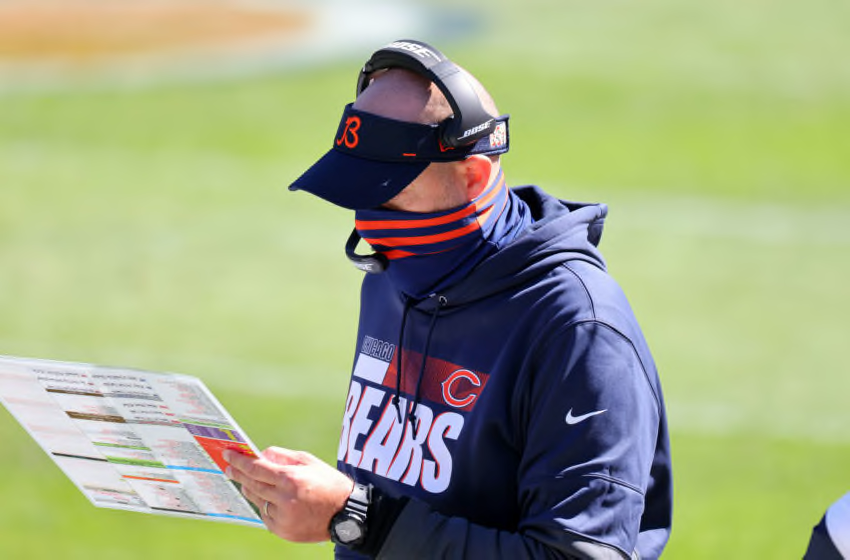
Chicago Bears head coach Matt Nagy continues to be plagued by the same errors he made all of 2019.
There may not be a worse 3-1 team in the NFL in recent memory. The Chicago Bears are overly fortunate to have won three of their first four and boast this record a quarter of the way through the season.
Already, the Bears have amped up the quarterback controversy with Matt Nagy choosing to roll with Nick Foles over Mitchell Trubisky. While Foles provided a lift against the Atlanta Falcons in Week 3, this past week was a different story.
Not to get the debate going again, but Foles’ presence on Sunday didn’t help the cause much. The problem wasn’t necessarily all Foles, though.
Nagy looked like he learned absolutely nothing from his mistakes a year ago when the Bears were a mediocre 8-8. He no longer looks like the offensive genius he was advertised to be when coming over from the Kansas City Chiefs in 2018. His first year was a honeymoon. Since then, Nagy has been average at best in every aspect of coaching.
Whether it be how he handles injuries and how they relate to answering media questions, whom he chooses to give second, third and fourth chances (looking at you, Anthony Miller) or the head-scratching play calls, Nagy has plenty to improve upon.
If he doesn’t, both he and general manager Ryan Pace will be out after this year if the brass is smart. It’s difficult to still believe in Nagy when he continues to make the same mistakes, but we’ve seen him be capable of much more.
This Thursday night, he and the Bears have a quick turnaround against Tom Brady and the high-flying Bucs offense. The defense can only do so much with so little help on offense, and Nagy is going to need to make some adjustments.
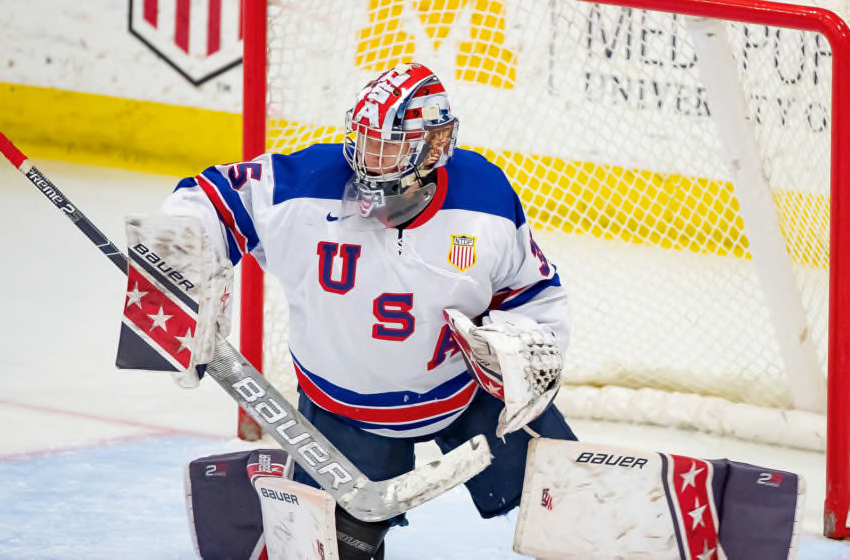
PLYMOUTH, MI – DECEMBER 11: Drew Commesso #35 of the U.S. Nationals makes a save against the Slovakia Nationals during game two of day one of the 2018 Under-17 Four Nations Tournament game at USA Hockey Arena on December 11, 2018 in Plymouth, Michigan. USA defeated Slovakia 7-2. (Photo by Dave Reginek/Getty Images)
The ChicagoBlackhawks selected a goaltender with their second-round pick.
The Chicago Blackhawks made a big pick with their second-round selection. They have a clouded future in the net so they decided to make an organizational addition there. They took Drew Commesso with the 46th overall pick who is now the second goalie to be taken in this year’s draft. The first goalie, Yaroslav Askarov, was rumored to be on Chicago’s radar before the Nashville Predators scooped him up early in the first round. This could go on to be a great pick for Chicago down the road if he becomes their long-term goalie.
This pick (originally belonged to the Pittsburgh Penguins) was given to Chicago by the Vegas Golden Knights in the Robin Lehner trade. It seems fitting that they used that pick to select a goalie. This is a selection that has absolutely nothing to do with Corey Crawford as they will still try to bring him back for another year or two. Commesso has a little ways to go before he makes it to the NHL.
He is now an alumnus of the United States National Development Program. This upcoming season will see him attend Boston University where he will try to further his development. There aren’t many NCAA programs better at developing their players than BU so that is a good sign.
His numbers really started to rise over the past year playing with the USNDP. He went 18-7-1 with the U18 team and had a 2.05 goals-against average and a .920 save percentage. There were three shutouts in those 18 wins. He was the United States goalie in the 2019 Five Nations Tournament and he led all netminders in wins, goals-against average, and save percentage.
It is safe to say that he is very good at stopping pucks with those numbers. His strength is his athleticism. The scouts believe that his athleticism is of pro-quality and that will help him in his quest to become a full-time NHL goalie. Being the second goalie selected in the draft is an honor because it is always different in terms of where they go.
If they weren’t going to use a first-round pick on Askarov, using a second-round pick on Commesso is the next best option. He is a great young netminder that should be able to make an impact with the Hawks one day. This team has been okay at developing goalies over the years but they need to make sure they hit once Corey Crawford is truly out the door. He might be gone already but this pick won’t affect that at all.
AUGSBURG, GERMANY – OCTOBER 04: Lukas Reichel of Eisbaeren Berlin controls the ball during the DEL match between Augsburger Panther and Eisbaeren Berlin at Curt-Frenzel-Stadion on October 4, 2019 in Augsburg, Germany.(Photo by TF-Images/Getty Images)
The ChicagoBlackhawks took Lukas Reichel with the 17th overall pick in the 2020 Draft.
The Chicago Blackhawks started the 2019-20 season by playing a preseason game in Berlin, Germany. It ended with them slotted to make the 17th overall pick of the 2020 NHL Draft. Well, last night they made that pick and they chose Lukas Reichel who played on the team (Eisbaren Berlin) that they played in that aforementioned preseason game. It is strange how it worked out but they got to have an early look at the kid they would go on to draft in the first round.
As an 18-year-old playing for Eisbaren, he scored 12 goals and had 12 assists for 24 points in 42 games. Those numbers might not jump off the page at you but they are good numbers for a teenager in that league. The Hawks might have reached for him just slightly but there is no doubt that he is a promising young prospect. He has a great skating ability and should be able to use his tremendous vision to create for himself and teammates in the NHL.
The DEL is a very good league so his play there is notable. He was also very good at the U20 World Junior Classic. He played for Germany and had a fantastic tournament. That country is really coming up in hockey as he wasn’t even the first German taken off the board. Tim Stutzle of Germany was selected with the third overall pick in the draft by the Ottawa Senators. There had only been five first-round Germans ahead of this year so adding two more is huge.
As a left-wing, Reichel could be a big part of the Hawks going forward. He will join the young core of Alex DeBrincat, Kirby Dach, Adam Boqvist, and Ian Mitchell one day as they try to build beyond the core that has won multiple championships. He has the skills that should be able to help them on the power play and at five on five.
The plan is probably for him to one day play alongside Kirby Dach but it would be really cool to see him get at least one chance to play with Patrick Kane or Jonathan Toews. Even if it is just on the power play rather than even strength, it would be a lot of fun and probably be good for his development.
It is crazy that they drafted a kid who played on the team they went up against in the Global Series preseason game but that is the way things work out sometimes. Stan Bowman may or may not be allowed to retool this team further but allowing him to make this pick makes it seem like he will be around for at least a little bit longer. A lot of his job stability might rest on how some of these young picks develop. Lukas Reichel is now, hopefully, the next one on the list of young talent for this organization to develop.
Western Illinois sophomore DeShon Gavin has been active in an on-campus voting registration drive. (photo courtesy goleathernecks.com)
“Protest in college football is nearly as old as the sport itself, but change has come slowly. Are the power dynamics finally shifting?” –Alex Kirshner of TheRinger.com
The quote above served as the headnote in a piece this summer titled “The Impact and Evolution of College Football Player Protest”. The story outlined the experiences of groups like the Syracuse 8 and relationships to the realities for player activists today.
For the record, the Syracuse 8 — actually nine as the media miscounted — was a group of Black players who boycotted spring practice in 1970 after head coach Ben Schwartzwalder refused to address their concerns and instead barred them from team activities. Players also said Schwartzwalder bad-mouthed them to NFL types. None of the nine played in the league.
Kirshner wrote, “That December, chancellor John Corbally said racism in the athletic department was ‘real, chronic, largely unintentional, and sustained and complicated unwittingly by many modes of behavior common in American athletics and long-standing at Syracuse University.’ However, Corbally said he saw no reason to make ‘personnel changes.’ Schwartzwalder stayed on the job until retiring in 1973. Syracuse didn’t apologize to the boycotting players until welcoming them back to campus for an on-field ceremony in 2006, 36 years later.”
Flash forward to today
The recent social justice movements that have swept across the nation and globe certainly harken back to those events of 50 years ago.
Kirshner wrote, “At Iowa, former and current players gave testimonials that led to the resignation of the country’s highest-paid strength-and-conditioning coach. At Clemson, players pressured the administration to remove John C. Calhoun’s name from the honors college. At Mississippi State, a player helped spur legislators into voting to get rid of a state flag that incorporates the Confederate battle emblem. Players have also taken stands at Oklahoma State, Florida State, UCLA, Texas, and Texas A&M, among other schools.
“Protest in college football is nearly as old as the sport itself, but players and academics alike believe that today’s athletes have more power than their predecessors from any other era. That may be a reflection not only of how demands for systemic change are resonating throughout America, but of how this sport has evolved in particular.”
College football coaches and administrators are certainly well aware of this. Our Monday Prairie State Pigskin story chronicled events that have led to the dismissal of Illinois State’s offensive coordinator and the retirement announcement of the school’s longtime athletic director.
Being the head coach of a college football program requires a balancing act between running your program as you see see fit while opening your ears and mind to player concerns. And of course, there are the demands and expectations that you must win to keep your job.
Prairie State Pigskin asked the Illinois FCS head coaches to share their thoughts on the growth of player power.
“First of all, it goes back to who you recruit in your program,” Western Illinois’ Jared Elliott said. “As college coaches we’re fortunate to make our programs look like how we’d want them to look by who we bring in here. I think we’ve done a good job of that. I love our locker room. I love our players. I love the character of our players. We try to recruit those things as much as we do football skills. So when you do that, you’ve got kids that you trust and know what they’re about. I love having the ability for our players to have a platform and a voice. I know that our kids put a lot of thought behind what they say and what they mean. We’ve got a very unified team. We’ve got a team that really does stand together and cares about one another.
Jared Elliott
“There is a shift right now that we’re seeing, no question, more of a player voice than we’ve ever heard. My approach and my stance is that at the end of the day it’s my job as head coach here to be a decision maker, and we’ll make decisions. We’ll all be behind them whatever that is, but I am in full support of especially the leaders on our team, the guys that have been elevated to the leadership positions. They’ve put a lot into this team to earn that respect and to have a voice. My staff and I are in full support of those guys having a voice.”
Sophomore running back DeShon Gavin is one such player in Elliott’s program using his voice. The Joliet native who played at Providence Catholic High School has been active in an on-campus voting registration drive.
“I want to encourage a movement, using my platform as a student-athlete to promote real change,” Gavin was quoted on the WIU athletics website.
Reasonable expectations
“You have to be reasonable as a coach and the players have to be reasonable,” Illinois State’s Brock Spack said. “You can have demands, but demands really don’t go very far. It’s expectations that you need to communicate. What are my expectations and how do I get to that? Young people growing up have to learn that if you’re going to have that kind of power they have to learn how to communicate their expectations in a way that’s respectful and reasonable. That’s key. Being disrespectful and unreasonable is not going to get you very far. They need to understand that. Coaches are listening, more than we ever have been. At least we are here. We’re trying to be. We get it.
Brock Spack
“So that’s where I come from. We have to have middle ground. There has to be understanding there is a chain of command, and you have to understand that. We all have to abide by the protocol of our program, the protocol of the organization because when you go out in the working world and you go outside of the protocol, the rules and the expectations of the organization you’re working and you’re going to find yourself in the unemployment line. I think we have to understand that as players and coaches as well. Your organization runs better when you listen.
“And on the flip side of that, the players should have an opinion and you should listen, but is your opinion reasonable? That’s something we should look at. We can have open dialogue. It’s good to have it, but we’re the adults, we’re the ones that have the experience and that’s what we get paid to do — to make those kinds of decisions. You have to communicate that and make sure the players understand . . . but you as a coach, you as a leader should listen. That doesn’t mean you’ll always agree, but you can explain yourself and why you may not agree.”
Open and honest communication
Like many head coaches today, Adam Cushing of Eastern Illinois has a players’ council that he and his staff meet with regularly.
Adam Cushing
“It’s a positive for college football, for the whole society, that people are using the voice and are empowered to do so. In the end, that’s what’s critical,” Cushing said. “Listen to what’s being said and get to the why it’s being said. Have open and honest conversation. That’s how we’re respecting everything that is said.
“And then, here’s what our side of that is. I know that’s what you want; here’s why we want to do it this way. Take any example. Here’s why we ran after practice today. We had our eight periods of helmets and non-air work this morning and then we ran. We didn’t run last week because we’re trying to progress them up. But explaining, ‘hey we ran you and we ran you really hard because you have to get better than you were last week.’ That’s a microcosm, but it’s explaining on both sides. I think truly gone are the days of, ‘Do it this way!’
“There’s more information at their fingertips than anyone of our generations ever had. They absolutely deserve the why. As long as we are continuing to communicate that on both sides, that’s the balance, I don’t know if that’s the right word, but open and honest communication.”
Social media is a game-changer
Southern Illinois head coach Nick Hill finished his record-setting career as Salukis’ quarterback in 2007, so he’s not that far removed from his playing days.
Nick Hill
“It’s a good thing that the players’ voices are definitely being heard,” Hill said during his media address Tuesday. “I would say in the last 10 years since I was here (things have evolved). The social media platform has obviously changed in the last decade. When I was a junior Facebook first came up, and you didn’t have it on your phone. At any point, now everybody has a platform. How you use that is important. That’s probably the biggest thing that has changed.
“Players in sport have always had a platform. It’s using it in the right way. It’s using it in pursuing that. And recognizing that the window of opportunity that you have as a student-athlete to use your voice and use your platform, connections, those type of things to create change, create a positive conversation. I think that that’s always been there, I think more so now with the social media. Those type of things make it easier for their voices to be heard.”
Blog co-authors Barry Bottino and Dan Verdun bring years of experience covering collegiate athletics. Barry has covered college athletes for more than two decades in his “On Campus” column, which is published weekly by Shaw Media. Dan has written four books about the state’s football programs–“NIU Huskies Football” (released in 2013), “EIU Panthers Football (2014), “ISU Redbirds” (2016) and “SIU Salukis Football” (2017).
You ever have that moment when you wake up, open the laptop, click on Zoom and think to yourself, “Yep. I’m ready to work on a farm.”
Now, don’t get me wrong, this forced work-from-home arrangement started out great. No commute. Optional pants. But I feel like I signed a deal with the devil. He sold me on sweatpants but didn’t mention this would go on for a year, maybe longer. He didn’t tell me that by October the phrases, “Wanna hop on a Zoom call?” “Let’s hop on a Zoom,” “You get my Zoom link?” would make me want to throw my laptop into a lake.
But it seems like a lot of people enjoy this new setup. Or at least that’s what the headlines say. At most, you’ll see something like, “Employees mention ‘Zoom fatigue,’ but by and large are thriving with work from home.’ Out in Silicon Valley, companies compete for who can extend work-from-home longest.
“Our employees will be working from home til the end of 2020.”
“Oh yeah? Well, ours will be working from home til 2022!”
“Yeah? Well, ours will no longer be working at all. We’re paying them to do yoga, from home, til 2025.”
“Wait, really?”
“Eh, that might’ve been too far.”
For introverts, this is the golden era of office work. Years of trying to focus at their desks surrounded by, “Hey, how bout that Bears game? You see that Bears game?” has been replaced with a working nirvana. They’re getting so much done. Introverts are on fire. Extroverts are talking to their plants.
As an extrovert, what ultimately led me to work a farm shift was simple: If I can’t be around co-workers, then at least give me some cows and chickens. Doesn’t matter if it’s on a Saturday, doesn’t matter if it’s 6 am, I’m ready to do some work that’s not held over Zoom.
Welcome to the Farm
I show up at 6 am to All Grass Farms. The sun is rising off in the distance and there’s fog over the prairie. I take it in for a second, ready to let out that work-from-home sigh, the one where you think, “Man, I wish I could be outside today,” before it registered,”Wait, this is my office.” The sunrise, the fog, the field. It’s all part of it. I look around and the space seems huge. It’s a whole different outlook than scrolling through Outlook.
I meet with one of the farmers and our first task is to fill up buckets of feed to take out to the egg-laying chickens. We fill up the buckets, throw them in the back of a John Deere Gator. Drive over and when I see the two chicken areas, there’s gotta be a thousand chickens. Maybe more. All of them are going crazy. Cluck-cluck-cluck. When you carry a bucket of food around a flock of chickens, you are their god. They all surround you and there’s no sense of order, no middle manager chicken who says, “Alright guys, now let’s line-up single file.” It’s total chaos.
They have a big dog named Baraboo who hangs out with the chickens and fights off any intruding foxes, raccoons, or other predators that try to sneak in. He occasionally takes out a chicken himself, but that’s only when they get too close to his food. All the animals on the farm take their food very seriously.
After the chickens, it’s time to feed the pigs. When you’re with a group of pigs, you look down and wonder, “Where did the Porky the Pig cartoon ever come from?” Pigs aren’t pink, they’re not cute, and they don’t have a stuttering problem. But they definitely pig out. And they’re a total mess. Where the chickens look up to their feeder as a god, I don’t think the pigs even see someone holding the bucket. I probably looked like food to them too.
Actually, it’s kind of like how I look down at the pigs. All I see is bacon.
The Guernsey Girls
The next stage of the shift is the main event. All Grass Farms is, first and foremost, a dairy farm. They’ve got 25-30 Guernsey cows that need to be milked every morning for the 9 am opening of the farm store. We head over and herd the Guernsey cows into the barn. I look and each one has a nametag. There are a few one-month, two-month-old calves hanging out with their moms. One of the farmers talks about the different personalities of the cows and it’s true, some are easy-going, they’re good with walking right into the barn. Others fight back a little. A few are just lying down like teenagers on a school day. “Come on, just give me like 15 more minutes. I got the snooze button.”
We take the cows into the milking area and I look up at the clock. “It’s not even 8 am!?” They bring in four cows at a time, bring each one to a stall. My job is to setup four big bowls of food in front of them. Cows aren’t nearly as crazy as the pigs, but they don’t look up to me like the chickens. They have more of an entitled look in their eyes like, “Alright, skinny boy, keep my food coming.”
After eight, maybe 12 cows, they give me my first shot at milking. There’s a milking machine, but the process is first you wipe off the udder, clean off any dirt from each teat (and there’s nothing wrong with giggling each time I use the word ‘teat’ in this post). After that, here’s the tough part. Time to manually get a couple of squirts. The squirts go into these four petri dish type things with a purple dye. You’re testing the milk for mastitis, which you determine based on the color and consistency in each dish.
My instinct when milking is to pull down like you’re ringing the “Thank You!” bell at an Arby’s. Doesn’t work. Try again. Nope. Turns out milking a cow is a lot like the surfing scene in Forgetting Sarah Marshall; the general rule is “To do less.” I’d try and describe the right way to do it, but I don’t think I 100% figured it out. Had to be bailed out a few times.
It reminded me of the introvert vs. extrovert dilemma in the work-from-home era. In the office, the extrovert could always point to the “morale” boost they provided to the team. Being a good “locker room guy.” And so a manager might say, “Well, they don’t know how to milk the cow, but their Arby’s tug makes people laugh and it’s good for the culture.” Meanwhile the introvert is flying through their tasks but the manager says, “Ehhhh, but they don’t really talk to anyone. And they didn’t join the work league softball team.” The extrovert ends up winning because of those “intangibles.” But the work-from-home era has wiped out all the extra stuff. Now it’s only about who can milk the cows the fastest.
After the mastitis test, you put this yellow foamy stuff on each teat, let that sit for 30 seconds. This is further cleaning and disinfecting. Wipe it off. Wipe the teats with another disinfecting wipe. And then clamp on four suction tubes which begin the actual milking process. The milk goes through the tubes, through the pipes, through another filtration system and into the store. Doesn’t get more “milk on tap” than that.
For anyone who has concerns with the safety of raw milk, those fears are gone after a shift at All Grass Farms. When you start with cows that have nametags and personalities, that are allowed to roam freely on the grass, eat nothing but what they’re designed to eat, and each teat is checked, cleaned, tested, and then filtered again, that’s about as pure as it gets. It’s why I swear by their milk – not only being the best I’ve tasted but I feel great after it. Their milk is a super food.
Grab a Shovel, Kid
So what do 30 cows do as they wait to go into their stalls? It’s simple. Nothing but pee and poop. Each cow is kind of like a 1,600 lb newborn baby. After they’ve been filed out back to the farm, now it’s time to grab a shovel.
For at least an hour, maybe longer, I’m shoveling crap the same way I’d shovel a driveway in January. One row at a time. Reach the end. Throw the pile into a wheel barrel. Start the next row.
This was a new perspective on work. Literally doing the “crappy” part of the job. And it made me think, you know, no matter if the work is something you love to do or not, there’s always the shovel the crap part. Even something fun like writing this blog post, Monday’s the fun part, but Tuesday and Wednesday I come back in and look for mistakes. Edit. Shovel the crap. At work, there’s the parts you love, but then there are the long meetings. And catching up on email. And, of course, the dreaded Zoom. I think next time I have to do one of these parts, I’m gonna look at a shovel on the wall. “Oh yeah, this is the crappy part.”
After the cows, we head over to the baby turkeys and chickens area. Our mission is to pick up 20 turkeys that look bigger than the rest and move them over to what I’ll call a turkey pavilion.
Those 20 turkeys, it’s totally random who gets picked. I’m just trying to spot which ones look a little bit bigger than their counterparts. But I imagine the turkeys talking to each other afterwards. They come up with reasons for why they didn’t get picked.
Whew. I didn’t get picked because I’ve been a pretty good turkey this week.
Or:
Yeah, Dale totally deserved to get fired. He’s been a total turkey jerk this week.
Seems absurd, of course, but I think about this in life – when good things or bad things happen – I’m always trying to pinpoint something I did right or wrong to deserve or earn it. Or you look at those age-old philosophical questions, “Why do bad things happen to good people or good things happen to bad people,” whatever the case, we try to assign meaning. I wonder if God feels a lot like the guy looking down, sorting through the turkeys. Just smiles and says, “Oh man, you guys have no idea what’s going on.”
That’s another thing on the farm, you’re surrounded by life and death. I saw two chickens and one turkey that didn’t make it. Another one who was injured, probably wouldn’t make it to the next day. In the office, there’s no life and death. The closest thing to death is a broken printer.
I thought about all of these turkeys and some are earlier in the process, but all of them it’s onto the pavilion, eat, get bigger, walk around, then eventually show up on our Thanksgiving tables. The whole cycle feels very Lion King “Circle of Life.” They go from farm animal to food to nap to a fond memory. So there’s really no end to a turkey’s life, it’s just different stages that all connect together.
Or, to use a quote from Eckhart Tolle, “Death is not the opposite of life. Life has no opposite. The opposite of death is birth. Life is eternal.”
Farmer vs. Turkey
Now it’s time for the best part of the day. They attach this pavilion type structure to the back of a Ford F-150. The goal is to move it forward so the turkeys have fresh grass. I’m given a stick that’s kind of like a kayak paddle or the offering stick they use at a Catholic church.
I head to the back of the pavilion, get in my defensive stance. As the truck pulls forward, the turkeys rush to the back, trying to escape. I patrol the space like a hockey goalie. “Get outta here!” You smack the stick against the boards, the sound scares the turkeys enough to run forward. But you gotta be quick, another five turkeys are trying to make a run for it. Sometimes you gotta push the turkeys forward with the paddle. And it’s for their own good, if they get caught under the pavilion, it’s game over.
We repeat this three more times, this time with the chickens. They’re a little bit easier. As we’re leaving, my co-worker (co-farmer?) points to a pile of cow crap. He talks about how the crap naturally brings in a bunch of flies. The flies lay eggs. Then the larvae/maggots become some of the best food, best source of protein for the chickens. Talk about a Circle of Life.
And as I went home for the day, feeling exhausted and sore all over, I wondered if my time there was helpful at all. I wasn’t the fastest shoveler. Wasn’t the greatest milker. But I thought, you know, if a farm can utilize a pile of cow crap, well, there must be at least some value in a volunteer shift from a city writer.
Over the last several months, I’ve been using the Medium Rare blog in a different format, featuring local restaurants and businesses around the Chicago area. These can also drift into a little bit of philosophy and stories from my own life + a historical deep dive like this one a couple weeks ago on the history of milk. You can read more about All Grass Farms’ story right here.
To catch up with the city pieces, most about restaurants and small businesses in Lakeview East, check out this book-in-progress over on Long Overdue Books.
To subscribe to Medium Rare via email, just enter your email address in the box below. See you next Tuesday!
I was born and raised in Midland, Michigan and moved here to Chicago a couple years ago after graduating from Hope College. I live in the city with my beautiful wife Ashley.
A little bit about me – I go to bed early, I enjoy greasy food and would wear sweatpants everyday if I were allowed to. I just signed up for a year-long Divvy membership, but could very well be the slowest bicyclist in Chicago.
I write the Medium Rare blog and will have a new post up every Monday.


 Chicago’s Favorite Food Critics and Bloggers


:no_upscale()/cdn.vox-cdn.com/uploads/chorus_asset/file/21944102/CV_CASINO_070220_04.jpg)





Leave a comment