If Illinois restaurant owner Jeff Buckler wanted to keep Lil Buford’s Bar & Grill open during the COVIDI-19 pandemic, he would be more than welcome to open it here in Jacksonville, Florida.
Instead, Illinois’ strict lockdown dictates demand that he close in-door dining, an option that that would destroy his Champaign County, Illinois restaurant and throw his employees out of work. So, in defiance, he has vowed to keep the restaurant open until he receives a court order to shut it down.
So, c’mon down, Jeff. Here inner dining–with proper protections–is humming. Not only are restaurants are open in Jacksonville. Schools are too. Disney World is. The NFL Jacksonville Jaguars play before fans. The Jacksonville Symphony Orchestra is live in front of an audience. Uncounted small businesses have gone bankrupt.
Yet, Florida and Republican Gov. Ron DeSantis continue to be maligned from out-of-state know-it-alls for supposedly putting us poor Floridians in mortal danger. I’ve heard DiSantis called “criminal” and worse.
Therefore, I return to comparing the deaths rate in Florida and Illinois. And the results are the same when I began digging up the facts last spring in response to the tsk-tsking of Florida by Chicago Mayor Lori Lightfoot and other scolds. That fact was that us-uns in Florida are better off than you-uns in Illinois.*
I’ll start with the COVID-19 death rate–the most reliable and relevant of the flood of statistics that are drowning us.
The COVID-19 cumulative death rate in Florida is 99 per 100,000 population. In Illinois, it is 137 per 100,000 population. That’s about a third more deaths in Illinois per 100,00 than in Florida. In the past week or so, the average death rate per 100,000 in Florida was 0.4 percent. In Illinois, it is 1.1 percent. In absolute numbers, Florida has more deaths (21,308) than Illinois (17,470), but that’s because Florida’s population (21.7 million) is almost double Illinois’ (12.7 and shrinking).
Hospitalizations and more serious infections of course are grave matters, yet–unfortunately–comparable figures are unavailable for the two states. The least important statistic, but the one that gets the most attention, is the number of cases. The number from state to state is so squishy as to be useless. Yet, they continue to be the almost singular focus of the media.
While the comparisons between Florida and Illinois are interesting in themselves, they take on more importance in the continuing debate over the most effective method of preventing the spread of the novel coronavirus.
To open or close the economy? Strict sheltering at home or more of the blessings of liberty. Governors and mayors who demand rigid restrictions on occupations, schools and travel should have another think coming if they would examine how shut states such as Illinois compare with more open ones like Florida’s.
Florida does better than the given wisdom; it was supposed to do worse than restrictive states like Illinois–much worse if you listen to the most vocal critics. Obviously staying open is not in itself an explanation for the better health of Florida; it only addresses the claim that staying open is a death warrant.
But one thing for sure: Florida is the more liberal state, one in which children are getting better education by attending schools, small business are on a more solid footing and, dare I say it, people are living healthier and happier lives.
A footnote: Florida becomes first state to vaccinate people 65 and older
You’ve heard the saying about aging athletes – he’s lost a step but he more than makes up for it with experience. It’s true in life as well. At about the time the first Social Security check arrives most of us have recognized the transition from the person we used to be to the person we have become.
I’m not talking about the wrinkles. Senior citizen is not a synonym for old person! Being old is a function of age; being senior is a subtext of attitude. It depends on how you look at the term; seniors in high school or college for example, are student leaders, the respected upperclassmen called upon to pass on their experience to the younger undergraduates.
It behooves us to ignore society’s perception of “old people” as obsolete and irrelevant. You do not lose the beauty of who you are no matter what your age. As the poet Martin Buxbaum wrote, “You merely move it from your face into your heart.”
When you embrace the person you are and become comfortable in your own skin, the possibilities are endless. How rewarding it is after years of working nine-to-five to finally put less emphasis on “doing” and more on the pleasures of “being.” That doesn’t mean to shut down the plant and put your abilities in mothballs. It means take a good honest look at paths to fulfillment that are not relentlessly tied to dubious achievement, driving yourself to outdo the other guy and feeling elated or depressed dependent on the applause from others.
Too many retirees move from the corner office to a corner of the den and feel diminished by the loss of the props that shored up their self-esteem, the big time job, a top spot in the pecking order, the external “stuff” you accumulate as perks of the endless grind. For these men and women retirement is more of a punishment than reward for years of hard work.
The secret is to have something to retire to, rather than be left adrift when your timecard is called from the rack. I’m not talking about a “bucket list” of stuff to do before you die. It’s reviving the dreams that necessity and circumstance and timidity and naivety forced you to store away in the “What If” file, sealed shut so many years ago you can barely remember where the key is.
Your eyesight may dim as you grow older, but you can see things infinitely more clearly as you acquire the capacity to look inside yourself. My inquiry meant an honest appraisal of my career in advertising, an evaluation of what I enjoyed most and what I liked least, not only about the job and the work it entailed, but a consideration of redemptive values and how I felt about myself in relation to my moral principles. Growing doubt about the field’s unrestrained goal of creating consumption – often from faux desires more concerned with vanity and ego than genuine need – made it clear that phase of my life was over.
Still, I had thoroughly enjoyed the creative side of the work. I decided that writing commercials for literally hundreds of advertised brands was foundation for transferring my creative chops to a more rewarding endeavor. Plus I wanted to dispute the societal assumption that older people are like sofa cushions with the fluff flattened.
What came out of that lengthy introspection was this blog, innumerable workshops and four books later, a rewarding way to feel useful and productive.
It would be presumptuous to pose as the voice of the country’s senior citizens. But as we make the transition to elderhood, it would be a rarity not to benefit from some help to re-assess and re-focus, and there aren’t many authors my age writing candidly about what waits in the path ahead as we age.
2020, of course, presented a challenge in itself. After ten months of sheltering in place and social distancing I feel marooned, the lead character in the script for a B-movie, lost on a desert island with a dead battery in the short wave radio. “Can anybody hear me? Come in, world.”
Now my task, our task, is not to mistake short term circumstance with our long term intention. The pandemic is a once in a lifetime event that will fade in significance; it should not define our lives.
The lessons of a lifetime have given us the inner wisdom and power to separate from circumstance. The pandemic is a bump in the road, not a detour; we are going forward, using this past year to add clarity and reinforce our intention for the long view.
In the course of a long business career I held many titles familiar to the corporate world. But as I quickly learned the lofty nameplates no longer apply when your career comes to a close and you move from the corner office to a corner of the den. The challenge was to stay vital and active rather than idling on the sidelines. I had to create a new foundation upon which to build life’s purpose and joy.
I stopped adding up my stock portfolio as a measure of my net worth and developed a healthy self esteem independent of applause from others.
I am the co-author of The In-Sourcing Handbook: Where and How to Find the Happiness You Deserve, a practical guide and instruction manual offering hands-on exercises to help guide readers to experience the transformative shift from simply tolerating life to celebrating life. I also am the author of 73, a popular collection of short stories about America’s growing senior population running the gamut of emotions as they struggle to resist becoming irrelevant in a youth-oriented society.
Retired Chicago Cubs second baseman and outfielder Ben Zobrist — whose heroics in Game 7 of the 2016 World Series helped the team win its first title in 108 years — and his wife, singer Julianna Zobrist, will list their six-bedroom, 3,500-square-foot Victorian-style house in North Center for just under $2.1 million. Read the entire article on the Chicago Tribune. (Julianna Zobrist)
Georgia and Dobby are extremely sweet, gentle, snugly and friendly, nine-week-old, two-pound, calico kittens looking for a loving guardian.
Born October 17th, they have been raised in a fabulous foster home with multiple cats. They love people and other cats, but have never met a dog.
They are excellent with their litter box using cat attract litter and love their canned food.
Georgia and Dobby are extremely healthy, de-wormed, spayed, up to date on age appropriate vaccinations, microchipped and virus-tested negative.
To meet and possibly adopt Georgia and Dobby as a pair, please fill out the adoption application at https://friendsofpetraits.com/dog-cat-adoption-application/ and follow up to make an appointment to meet them by e-mailing [email protected].
Their adoption fee of $375 as a pair benefits the rescued pets of Friends of Petraits Rescue.
They are being fostered in Chicago’s Rogers Park neighborhood.
Could the ChicagoBlackhawks trade Dylan Strome if they can’t come to a deal ahead of 2021?
If the Chicago Blackhawks want to sign Dylan Strome to a contract in time to have him on the ice for the 2020-21 season, they better do it quick. It is approaching quickly and Training Camp is set to begin in a couple of days. The Blackhawks need as much help as they can get with all of the injuries they have sustained recently so making sure Strome is there should be at the top of their list. It does seem like he is very important so a decision of some sort should be made soon.
Strome was very good when he came to the Chicago Blackhawks. He was struggling to be consistent as a member of the Arizona Coyotes before the trade so he had to be thrilled to come to the Blackhawks. He was able to reunite with his junior linemate in Alex DeBrincat and they were awesome together.
The issue for the Hawks is that he is hard to evaluate a salary for. He has the potential to be a very good centerman that can put up a lot of points. His ability to create offense and make those around him better is very good when he is on top of his game. He can also score the puck pretty well which is valuable in his own right.
If this problem of him not being signed becomes a lingering issue, the Hawks might just trade him. They have the salary flexibility to sign him but they might just also might want to move on. He is only 23 so he fits the mold of a kid you keep during a rebuild but if they can’t find a deal, they should just trade him for more assets. These are three trade packages that might work:
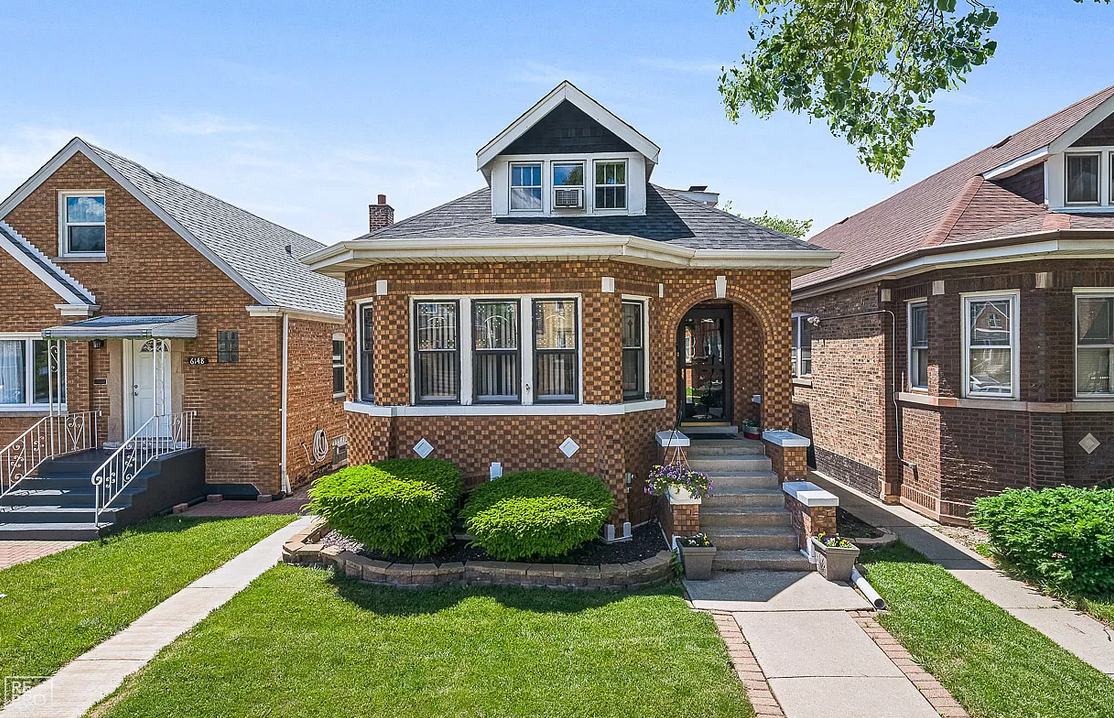
If you own a classic Chicago bungalow, there are a lot of resources for taking care of it in an aesthetically appropriate manner — from the exterior bricks and steps to the floors, walls, and trim. Every year, the Driehaus bungalow awards are a nice introduction to people who are doing it right.
But what about furnishings? One option is hitting Chicagoland and Michiana antique stores to see what turns up; another is following online consignment sites to see if something pops up among the MCM knickknacks. But the most direct approach is to make some furniture yourself (or pay someone to do it for you).
Start with the early 20th century architect and journalist William Radford, one of the busiest, if not necessarily the best, builders of his era. A Riverside resident trained in construction, Radford built a small empire out of the Radford Architectural Company, which sold home plans and books. All told, the company offered more than a thousand different home, commercial, and agricultural building plans. Many are bungalows — here are 208 of them — and if Radford was more industrious than artistic, they’ve aged nicely, like this Montomery Ward house of Radford’s design.
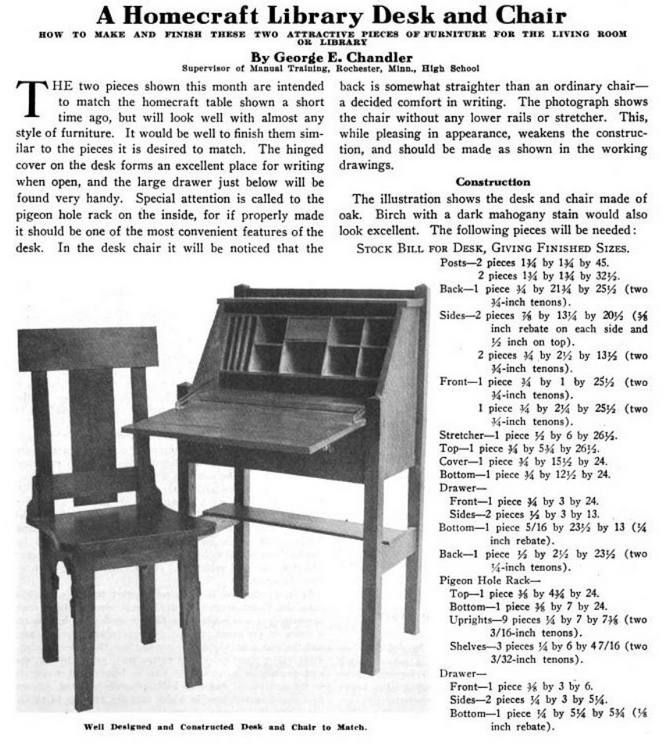
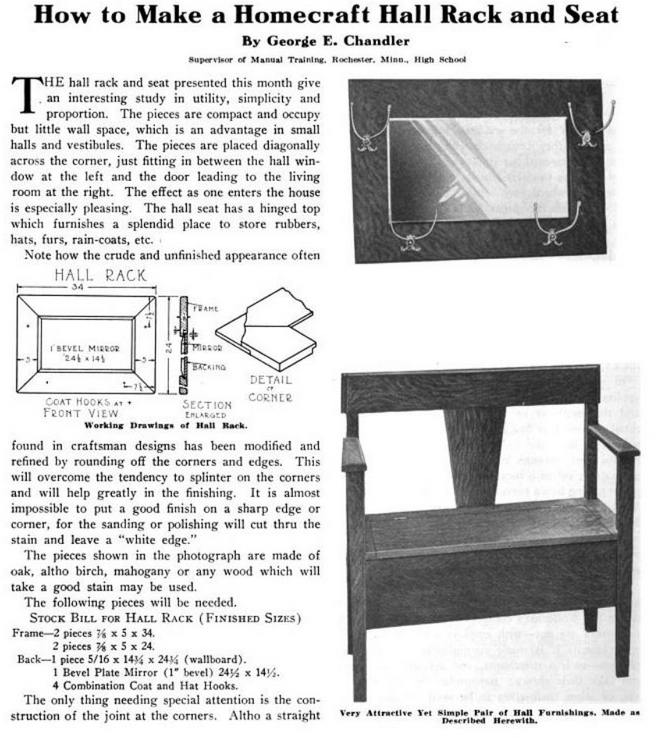
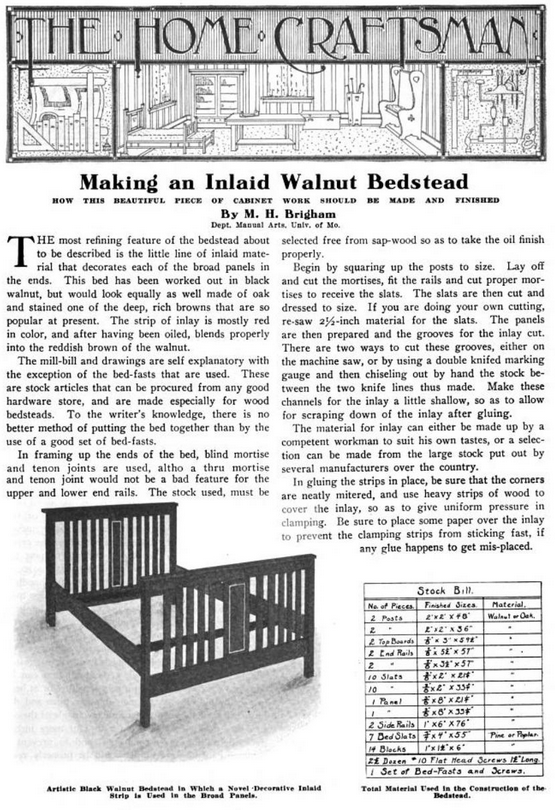
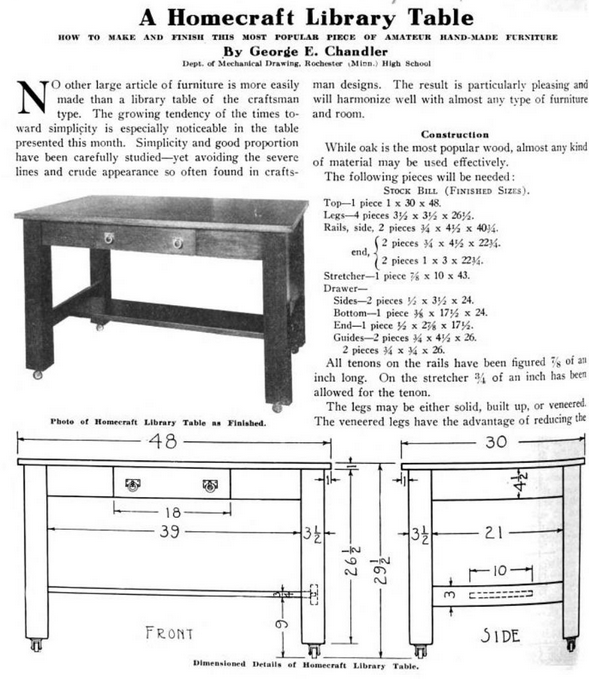
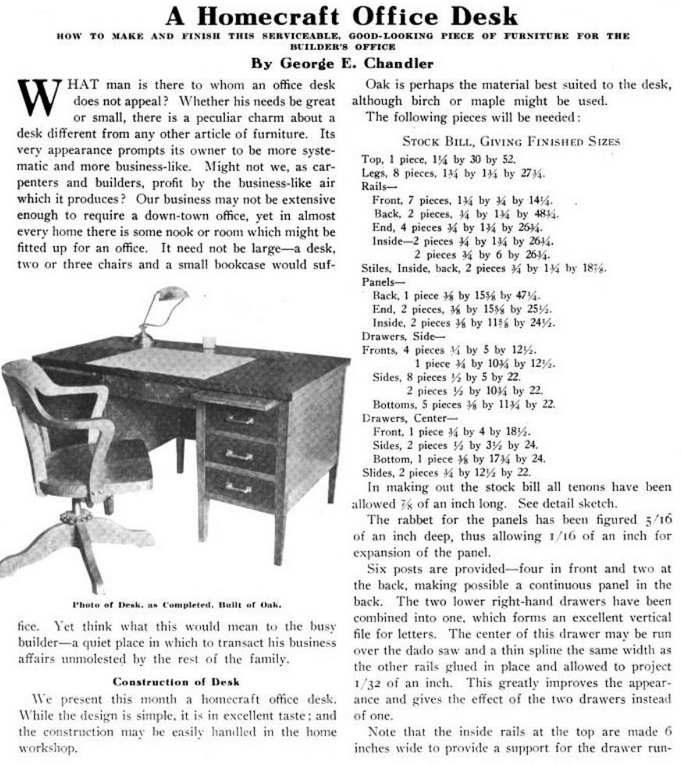
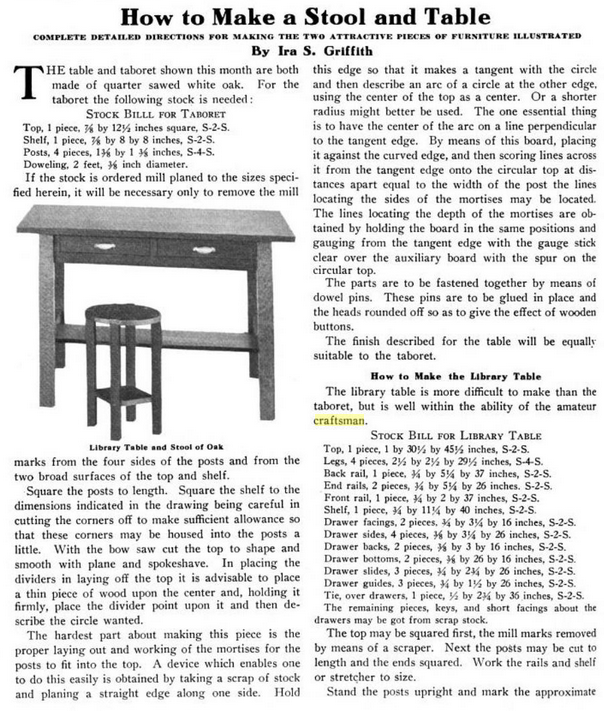
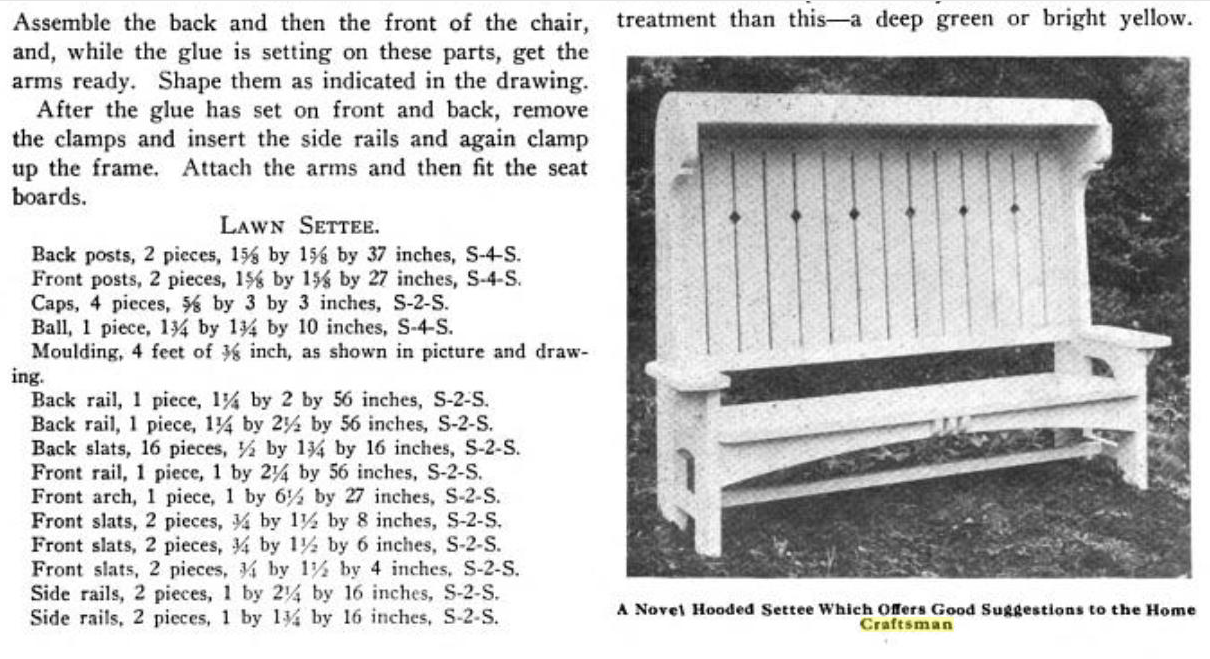
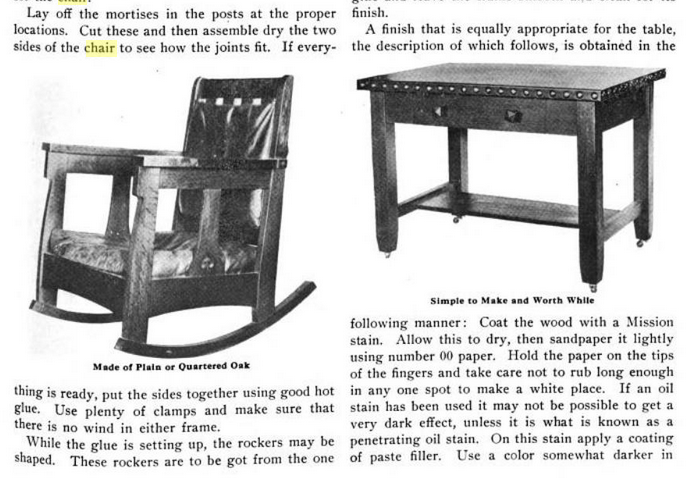
Among Radford’s many publications was American Carpenter and Builder, a collection of building plans, carpentry tips, and industry advice. Most of it is for professionals, but the “Home Craftsman” section contained plans for (comparatively) simple furniture that fit the single-family home plans that Radford sold. Think of it a bit like Enzo Mari’s Autoprgettazione? for Chicago bungalows. Some of it should be left to pro carpenters, like the office desk, but skilled amateurs could adapt the more basic designs for some nice touches.
Hamilton says in her role as wellness coordinator at Chicago Freedom School — a nonprofit that trains and supports youth in community organizing — she helps people “live their politics.” Activists can easily lose themselves as they fight for social justice. So she helps ground them by offering a whole toolkit of ways to stay resilient, even joyful, such as breathing exercises and nutritious eating plans. Here’s how the 39-year-old Austin native, who’s also a massage therapist, manages self-care while tending to others.
Recovery mode
“I have always been very active — I could hop on a bike and ride 30 miles. I ran a lot. I’d rock climb once or twice a week. But last year I developed a severe spinal injury that led to me being unable to walk or stand for a couple of months; I didn’t work for half the year. Doctors recommended back surgery, but as a massage therapist, I’ve worked on people who had similar procedures, and there were always complications. Instead, I’ve been slowly rehabilitating. I can stand and walk again, and my physical therapist recently cleared me to bike; I have a beautiful and challenging yoga practice that I do at home. I still have a ways to go, but every step I take feels like a miracle.”
Dietary philosophy
“I’m a vegetarian. If I eat breakfast, I love to zhuzh up a coconut yogurt with some nuts. Lunch and dinner depend on the season — when it’s cold, it’s soup time, so I might have a tomato bisque or a mixed lentil soup. Soup helps me feel nurtured and comforted, and it also is dynamic enough to contain diverse nutrients. I do a lot of grazing throughout the day, eating veggies, nuts like pecans or almonds, and seasonal fruits. In the summer, it’s peaches and nectarines; in the fall, Pink Lady or Fuji apples.”
Vocal power
“Singing has been a lifelong love. It doesn’t even have to be words — sometimes it is a small, gentle hum that ends up transitioning into sounds that resemble scatting, or a song at the top of my voice. Physiologically, it’s oxygenating and a stress reliever. As I tell our young people, the power of a protest is in gathering and speaking for what is right. By vocalizing loudly, you transform energy from something hopeless into something inspiring.”
Full circle
“My brother passed away several years ago. I was in deep, intense grief. I’m not sure where I got the idea, but I bought a weighted Hula-Hoop. At first, I would hoop and cry. But to keep the hoop up, I had to focus, and through that practice, it became joyful. Now I hoop all over the place, and I invite other people to join me.”
Reclaiming well-being
“One of the things I’ve been struggling with is that Breonna Taylor was just trying to sleep. What does healing justice look like when you cannot rest, when systems are invested in stealing away your sense of calm and peace? We need to challenge ideas about what wellness means. Wellness practices aren’t luxuries, like going to a spa; they are also resilience practices to get us through while we’re in a pandemic and an uprising.”
If you own a classic Chicago bungalow, there are a lot of resources for taking care of it in an aesthetically appropriate manner — from the exterior bricks and steps to the floors, walls, and trim. Every year, the Driehaus bungalow awards are a nice introduction to people who are doing it right.
But what about furnishings? One option is hitting Chicagoland and Michiana antique stores to see what turns up; another is following online consignment sites to see if something pops up among the MCM knickknacks. But the most direct approach is to make some furniture yourself (or pay someone to do it for you).
Start with the early 20th century architect and journalist William Radford, one of the busiest, if not necessarily the best, builders of his era. A Riverside resident trained in construction, Radford built a small empire out of the Radford Architectural Company, which sold home plans and books. All told, the company offered more than a thousand different home, commercial, and agricultural building plans. Many are bungalows — here are 208 of them — and if Radford was more industrious than artistic, they’ve aged nicely, like this Montomery Ward house of Radford’s design.
Among Radford’s many publications was American Carpenter and Builder, a collection of building plans, carpentry tips, and industry advice. Most of it is for professionals, but the “Home Craftsman” section contained plans for (comparatively) simple furniture that fit the single-family home plans that Radford sold. Think of it a bit like Enzo Mari’s Autoprgettazione? for Chicago bungalows. Some of it should be left to pro carpenters, like the office desk, but skilled amateurs could adapt the more basic designs for some nice touches.
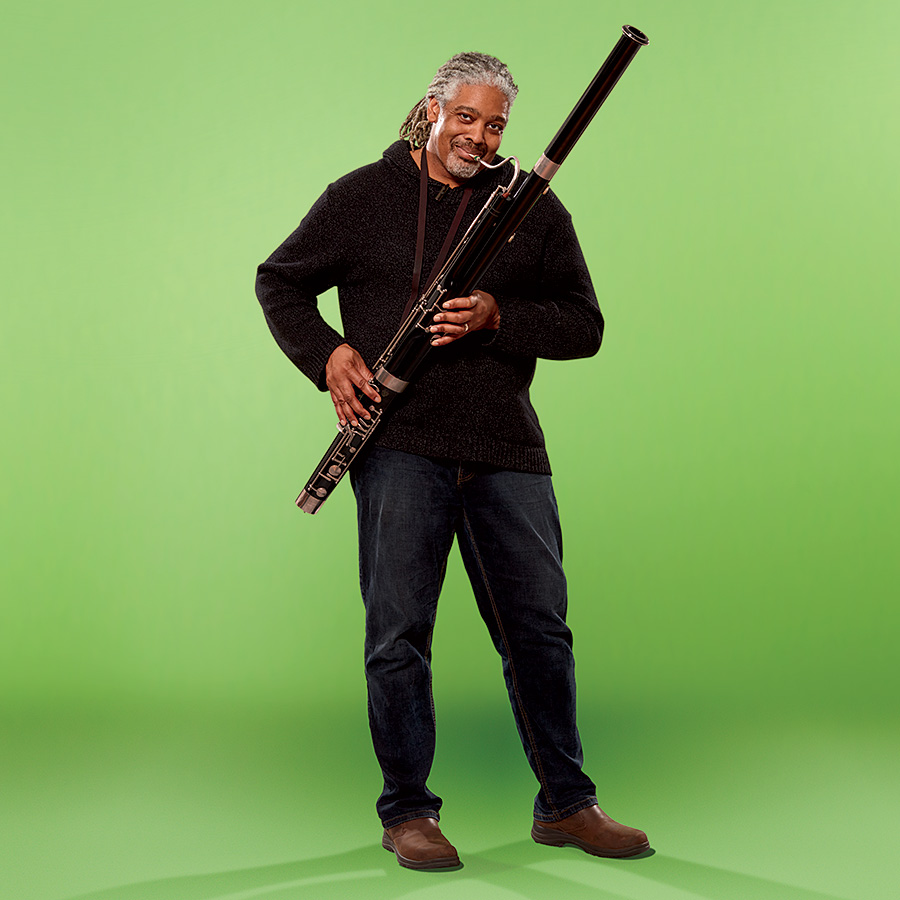
Photos: Lisa PredkoH. Steven Sims Cyclist, musician, natural medicine lover Otolaryngologist and director of the Chicago Institute for Voice Care at the University of Illinois Hospital & Health Sciences System
Training routine
Three times a week or so, I bike two and a half miles to work, and then on my ride home to the South Loop, I’ll take the scenic route — up to Lincoln Park or farther out west. I also have a mini stepper, which I use twice a week for about 30 minutes. Exercise helps with stress, so it helps with the job. The interesting thing is, doing very delicate surgery has increased my physical coordination. I chuckle to myself because my reflexes now are so quick that when I drop my keys they never hit the floor.
Part of how I decompress from the day is to go upstairs to where my keyboard, trombone, and sometimes bassoon are and sit and play for 10 or 15 minutes. Music is a mode of expression and catharsis for me. It helps with alertness and overall energy, and it releases endorphins. I sing all the time walking around my office, much to the chagrin of everyone around me. My music background also helps me listen carefully to a patient’s voice and notice changes in pitch or cadence of speech.
DIY immunotherapy
I make something called thieves’ oil. It’s a blend of cinnamon, clove, eucalyptus, lemon, and rosemary essential oils. I’ve found it helpful for soothing a sore throat and cutting down on mucus, and the clove oil is a bit of an anesthetic. You can add some water and make a spray for the back of the throat.
Cold-crushing formula
There’s a mushroom called chaga that stimulates parts of our immune system. I put it in a jar, pour in some Everclear — you need a pure alcohol so it will extract the properties but not add contaminants — and put in one or two sticks of cinnamon to make it taste better. I let that sit for a couple of weeks, then transfer it into a dropper bottle. I take a dropperful under the tongue five or six days a week, and I typically don’t get colds.
Lots of liquids
I’m telling patients all the time they should have eight eight-ounce glasses of water per day, so I try to do at least that. I drink nettle leaf tea because I have allergies. If you notice you’re very phlegmy after you have dairy milk, that means it’s not for you. So I drink almond and coconut milk. Coffee is dehydrating if you have a lot of it, and that will lead to thicker mucus too, so I’ll have just two sips and set it down.
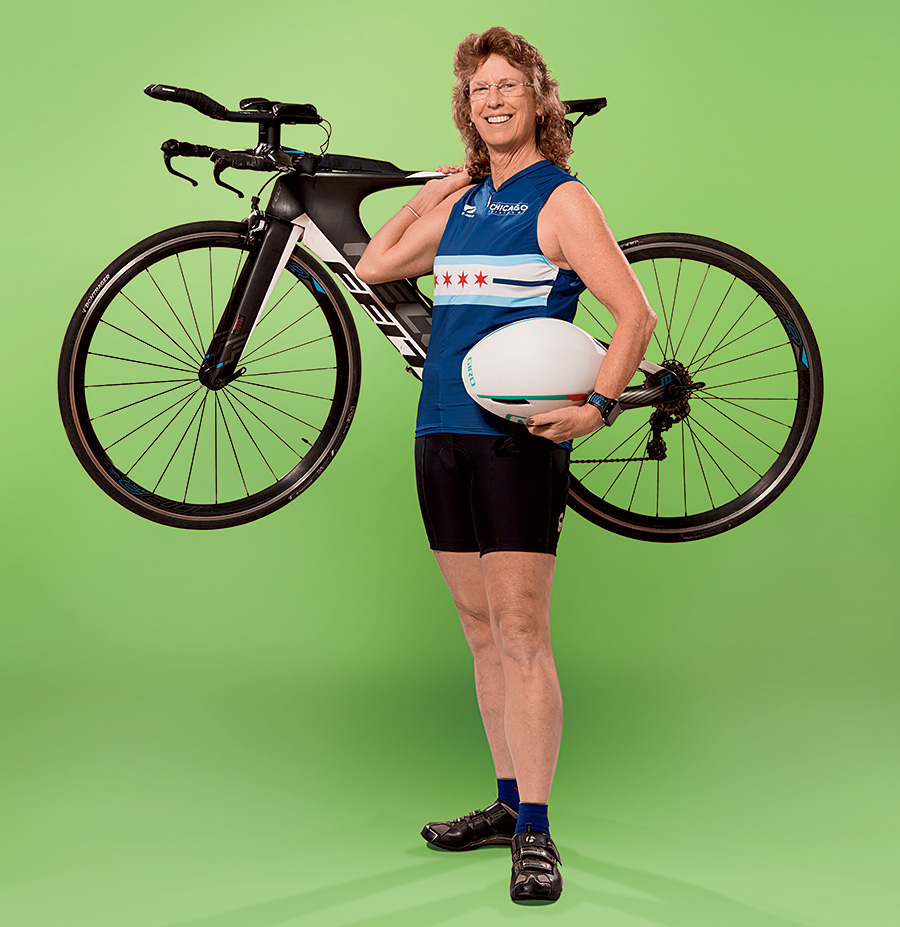
Deborah Burnet Triathlete, salt avoider, woman of faith Professor of medicine and chief of general internal medicine at UChicago Medicine
Triathlon training
I’m 62. About five years ago, my gym had an indoor triathlon, and I won. Not just for my age group — I won for all the women. I thought, This seems good. I’ve got to keep doing this. And then I won the Chicago Triathlon for my age group the last couple years. Since COVID, pools are mostly shut down, so I’ve been biking more. I bike with the Joliet Bicycle Group on Saturdays; we often go about 50, 60 miles. During the week, I do 20 miles or so on the local paths, or I run three miles. It clears my brain. My husband and I also bought indoor bike trainers, the Tacx Flux 2. You put your bicycle on it, and you can see other cyclists doing their workouts, but it looks like you’re together in London or Central Park or wherever.
Boning up
I was recently diagnosed with osteopenia, which is borderline bone thinning, so I take 1,000 units of vitamin D a day, plus about 1,000 milligrams of calcium. Interestingly, there’s some evidence that people with low vitamin D are more susceptible to COVID and to more severe COVID.
Say no to sodium
I’m on a low-salt diet for Ménière’s disease, which is an inner ear condition, and to keep my blood pressure down. A low-salt diet is no more than 1,500 milligrams of sodium a day. Bread from the store is actually very salty — a hard roll has about 450 milligrams in it — so I bake my own sourdough bread two or three times a week. A lot of recipes use a tablespoon of salt, but I use an eighth to a quarter teaspoon and, for the rest, NoSalt potassium chloride. I make homemade pizza, and for that I use Swiss cheese, which is much lower in salt. The one time I’m more liberal about my salt is if I’m going to do a half-marathon, because that expends a lot of sweat. I’ll drink half-strength Gatorade.
Serenity now
I don’t do meditation per se, but I often pray or read scripture in the morning. Before I go into an exam room and see a patient, as I clean my hands, I try to empty my mind of the last patient and the other stuff I’m thinking about and say a little prayer: “My hands, God’s work.”
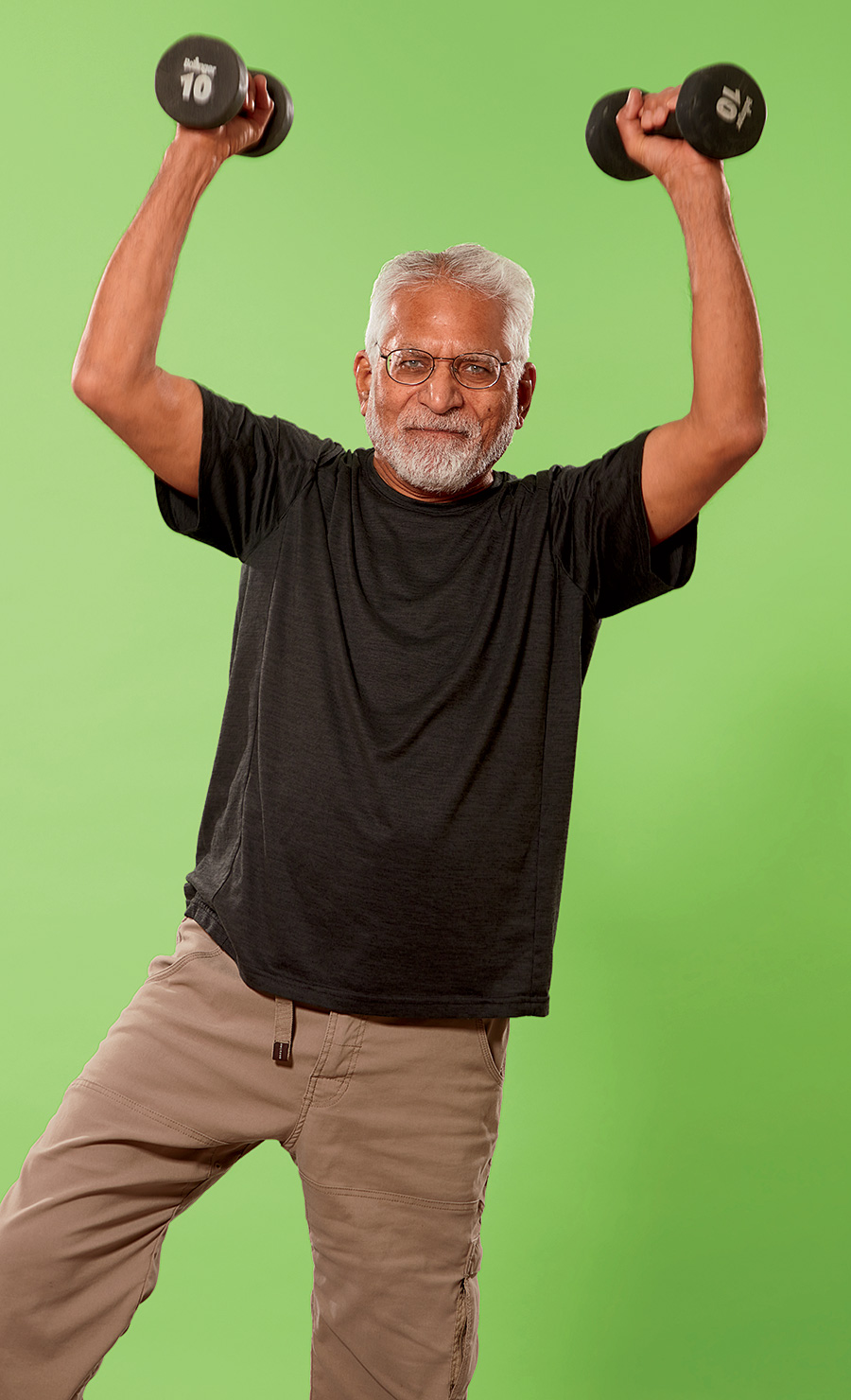
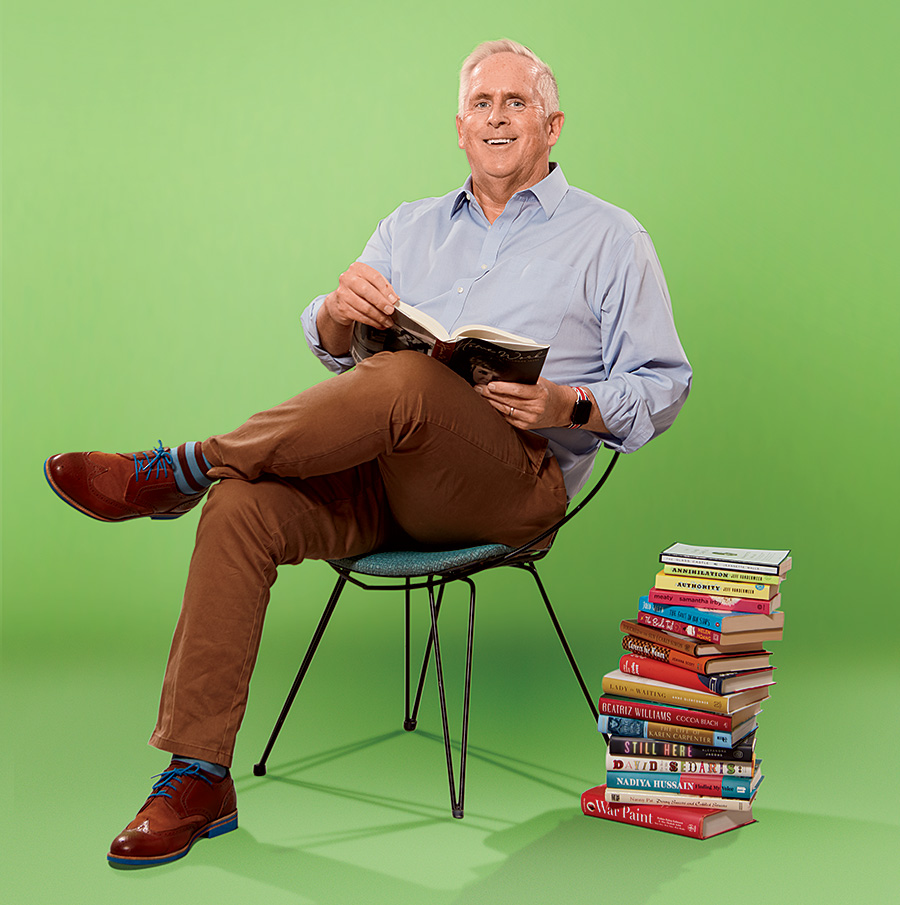
Surendra Gulati Planker, soaked almond eater, casual wordsmith Neurologist at Amita Health St. Joseph Medical Center, Joliet
Training routine
I ask all my patients, “Do you exercise?” “Yeah,” they say, “I take the garbage out,” or “I go to the mailbox.” That’s very disheartening. As we age, we need to keep the body in the best possible condition. There’s evidence that having a good cardio program helps with memory function. I’m 70, and I work out five days a week in my home gym. I do the elliptical, then I do pushups and plank. My planking record is five minutes and 15 seconds. In my office, oftentimes between patients I’ll do 10-pound weights with my arms, standing on one leg, then the other. Doing that makes me more energetic than going for a cup of coffee.
Stretching it out
There was a time in my practice that I was a lot busier than I am right now, when I was working 14 hours a day, and I realized that I had become deconditioned. I’d often get a backache when I stood for a while. So I got into a habit of stretching my hips and hamstrings years ago. That can result in significant improvement in lower back pain.
Staying sharp
I ask my patients with speech difficulties to read aloud every day — it’s a good form of speech therapy. I read every day too, though not aloud. I also subscribe to things like Word of the Day. Today’s word was simple: “propensity.” Many of the words I might know already, but it’s a reminder to use them.
A nutty diet
I need to watch my cholesterol. I’ve taken coenzyme Q10 every day for the last few months; it’s a derivative of fish oil for cholesterol management. And every night my wife soaks some almonds, which helps too. I’ll have six or seven. The soaking is a tradition that goes back to India. I also think soaked almonds taste better, and they’re digested better by the body.
Balancing the booze
I like to drink Scotch, but I limit it to a couple of times a week. Alcohol can affect balance and walking, which is important for older people. If they’re sitting home watching television and drinking — which happens a lot to patients I see — that becomes a recipe for problems like deconditioning, gait disturbance, and fall risk.
Thomas Klarquist Peloton rider, bedtime reader, high-tech water drinker Internal medicine specialist at Advocate Illinois Masonic Medical Center
Revving up
I go for walks as much as I can. If I’m going to an exam room, I’ll even circle around different hallways, just to get a few extra steps. I also have a Peloton bike that I use in the evenings and on weekends for 30 minutes. It’s a good way to relax, because I like listening to the music — ’80s and ’90s dance mixes. You’d think that exerting yourself would make you more tired, but it actually makes me more awake.
Sheet pan supper
During COVID, I’ve learned how to do sheet pan dinners, where you roast vegetables and use skinless, boneless chicken breasts with seasoning, so you’re increasing the flavor without increasing the sodium. It’s low calorie, healthy, and you have only one pan to wash. When I order in Asian food, I limit how much rice I have, because I’m a type 2 diabetic, and rice really increases my blood sugar.
Hydrate!
If you have excess blood sugar, you have to urinate it out, and staying hydrated helps. I use the HidrateSpark, a bottle that you fill with water, and then it lights up when you’re supposed to drink. At work, other people have their water bottles, and whenever mine signals, I announce: “It’s time to drink.” So everybody has to drink up. Alcohol is pretty much a bowl of sugar, so for me it’s a strawberry margarita probably once every three months.
The one-minute rule
When you’re about to eat something, think about it for a minute. And in that minute, you can decide to have a smaller portion, an alternative, or just forgo it. Even if you end up eating that same cookie two hours later, you’re getting used to saying no to food at that time. The other thing I’ll do is postpone my dessert for a half hour or so after dinner. That keeps me from snacking later on.
Much-needed R&R
I try to have at least an hour of time before I go to sleep where everything winds down. That means washing my face, brushing my teeth, moisturizing, and then getting into bed and reading. Reading is my retreat for my mental health. I do it up to 30 minutes each night — sometimes it’s comic books, sometimes it’s Charles Dickens. I use my Apple Watch to see my sleep pattern, and when I read, I don’t wake up as much during the night.
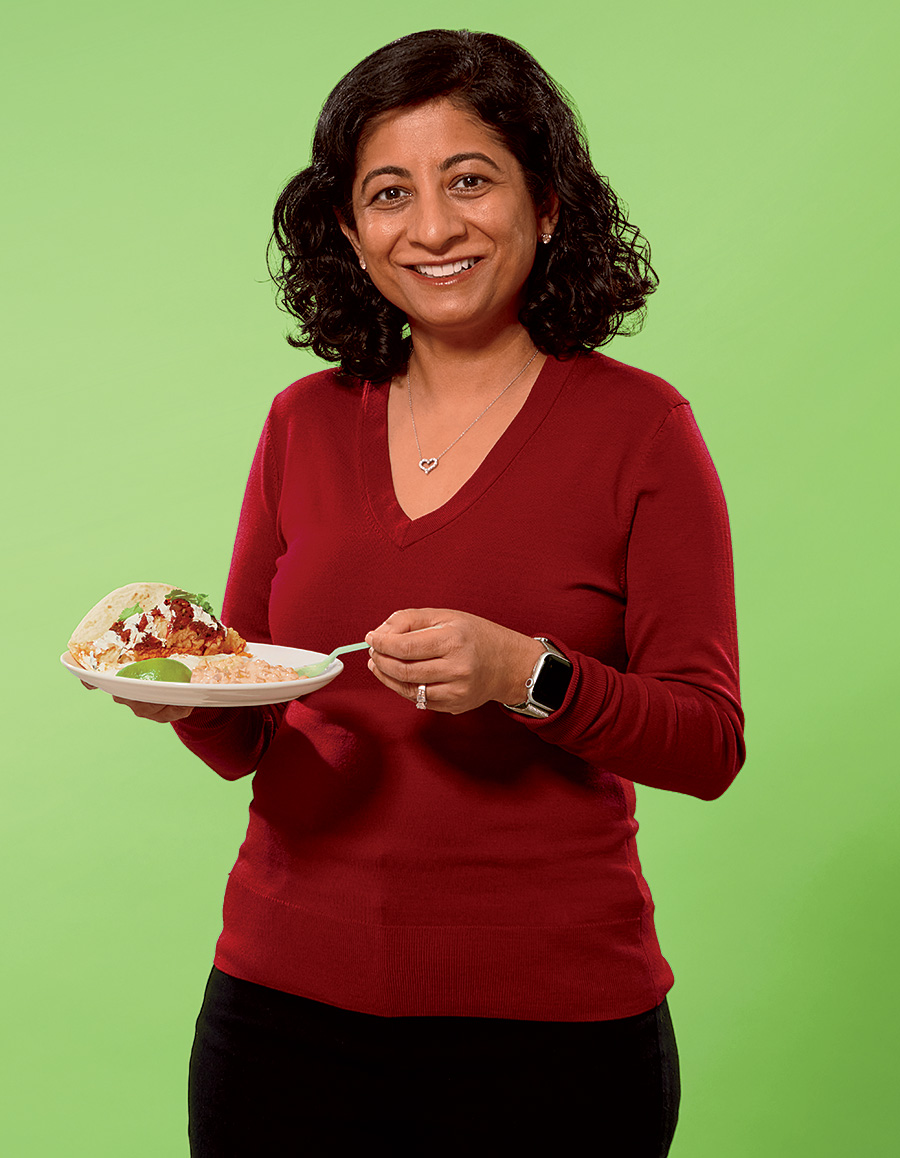
Anju Tripathi Peters Power walker, M&M popper, mask evangelist Allergist and immunologist at Northwestern Memorial Hospital
The power of walking
Prior to COVID, at least four times a week I would go to my gym and do classes, like cardio kickboxing. What the lockdown did was force my family to start walking again. We’re in Lincoln Park, and we walk to my parents, who live two miles away in Wrigleyville. I’m like, “Let’s do power walking,” and I move my arms, and my teenagers make so much fun of me. I hope I’m not as crazy as they say I look. I told my kids, “If walking is good enough for Fauci, it’s good enough for us.” On weekends, I get anywhere from 12,000 to 14,000 steps a day or more. Between my clinics, if I have 20, 25 minutes, some of my colleagues and I will go walk on the track in the park next to the hospital. We used to meet for lunch or a cup of coffee. Now we walk.
A mostly healthy diet
We don’t know if any particular food or drink helps the immune system, but the most important thing is to eat healthy in general. There are some studies suggesting vitamin D is key. I take a multivitamin, and getting some sun is important. Still, we eat foods that are not good for us because they give us tremendous happiness. Literally every day — I didn’t do this before COVID — I have between five and 10 peanut butter M&M’s. I’ll have a margarita now and then, but I’m not a big drinker, because alcohol compromises your immune system. Also, when people drink, they let their guard down, masks come down.
Takeout respite
After a long day’s work, when I’m tired and don’t want to cook, my family walks to a restaurant and we get food to bring home. This has been good for my well-being. For a family of five, dishes are a huge issue. They opened a Velvet Taco in my neighborhood last year, and I like it because they have many options, so there is something for everyone in my family. The tacos come in flour shells, but you can get them in lettuce, which is healthier.
Masks’ many benefits
Stress messes up the immune system bigtime, and you won’t be able to fight off harmful things as easily. One way I keep it under control is by doing things that make me feel like I won’t get the virus. I wear a mask as soon as I step outside. When you’re an allergist, you worry about things irritating people’s lungs. I focus on sinus disease and severe asthma, and I’m very aware that if there are allergens outside, people who are allergic potentially will have more symptoms. But one thing that’s been very helpful this year is the mask. By wearing masks, people have prevented a lot of infections, not just coronavirus.
If Ald. Matt O’Shea is able to follow through with his plan to annex Mount Hope Cemetery, it would be the first time Chicago’s borders have expanded since the mid-20th Century. That’s when we absorbed O’Hare Airport, as well as a forest preserve and a stretch of Foster Avenue to connect it to the rest of the city.
Meanwhile, the cities of the Sun Belt have continued to expand into the 21st Century, so much so that Houston is now threatening to bump Chicago from Third City to Fourth City by population. Like most Northern industrial hubs, Chicago’s growth ground to a halt decades ago. Why did we stop growing, and can we ever grow again?
In the late 19th and early 20th centuries, Chicago grew into a great metropolis by gobbling up suburbs we now know as city neighborhoods. In the 1880s, the city limits were bounded roughly by Fullerton, Pershing, and Pulaski.
Then, Chicago landed the Columbian Exposition, which was envisioned as our coming-out party as a world-class city. At the time, Chicago only had 500,000 people, making it the fourth-largest city in the U.S. That wasn’t enough for our ambitions. We wanted to challenge New York.
In order to become the Gotham of the Great Lakes, the city’s leaders approached the residents of four bordering townships: Lake View to the north, Jefferson to the northwest, Hyde Park to the south, and Lake to the southwest. Join us, went the offer, and you’ll get better police and fire protection, better water and sewers, better roads, and the prestige of a Chicago address.
In 1889, all four townships voted themselves into the city, doubling its population and making it the nation’s second city, behind New York. (In Hyde Park Township, workers at the Pullman Palace Car Company were eager to dissolve the “company town” established by their bosses.)
“The city had better supplies of water, city services, and these suburbs couldn’t compete,” said Dominic A. Pacyga, author of Chicago: A Biography.
(New York, which at the time consisted only of the island of Manhattan, responded by amalgamating with four surrounding counties, building a five-borough city whose population was beyond the reach of Chicago.)
In the years following that mass annexation, Chicago added bits and pieces along its borders: Rogers Park and Norwood Park in 1893, Edison Park in 1910. (The latter was won by Chicago’s new Schurz High School, which was easier to get to than neighboring Maine Township’s.) Mount Greenwood was the last major residential neighborhood to join the city, in 1927.
Annexation ended for two reasons: the city was growing too large and unwieldy to manage, and it hit a wall of suburban resistance. We courted Oak Park and Evanston, but, with well-established identities as railroad suburbs, they turned us down. The Metropolitan Water Reclamation District allowed suburbs to buy water from Chicago, and neighboring towns developed their own city services, often better than Chicago’s. Then, in the white flight era following World War II, suburban addresses became a class symbol.
“Once the smaller suburban communities figured out how to provide water and sewer and high schools, they went on their merry way,” said Ann Durkin Keating, professor of history at North Central College.
Cleveland stopped growing in 1923, and Detroit in 1926. But that hasn’t been true of all Northern cities. Indianapolis merged with its suburbs in 1970. Columbus has grown into the largest city in Ohio by requiring annexation in order to join its water system. Even here in Illinois, Decatur has been grabbing unincorporated land to make up for population losses resulting from its flailing industrial base.
Down South, Houston has expanded to 662 square miles — nearly three times Chicago’s size — by ruthlessly grabbing every piece of land in the path of its growth. Thankfully, even Houston is slowing down, due to a new Texas law requiring cities to get permission from the communities they annex.
That’s the law in Illinois, too. Even annexing Mount Hope Cemetery, which is in an unincorporated area and contains no voters (we’ll spare you the joke about dead people voting in Chicago), would require an act of the legislature. Those barriers mean Chicago’s borders will likely remain fixed.
“There was talk a few years ago: ‘Why doesn’t Evergreen Park become part of Chicago? Why don’t the inner-ring suburbs become part of Chicago?’” Pacyga said. “It’s more expensive to live in the suburbs, but you get this feeling, ‘I live in the suburbs.’ It’s a social class thing.”
Chicago doesn’t have the motivation to grow, either, according to Pacyga. The city makes more money selling its water to suburbs than to its own residents. Struggling suburbs such as Riverdale and Dolton might benefit from joining Chicago, because their property tax rates are so much higher than ours, but absorbing another municipality could be a strain on the city’s budget.
Lastly, there’s the issue of cultural identity. As we learned in the great “bruh” debate of 2017, Chicagoans have a nose for suburbanites claiming the city as home. (You can even take a quiz about it.)
In the Cash Box Kings’ song “Joe, You Ain’t From Chicago,” a narrator in the song’s opening skit calls Johnnie’s Italian Beef “the best beef place in Chicago.”
“Joe, that ain’t Chicago,” he’s told. “That’s Elmwood Park.”


 In reply to Aquinas wired:Please provide citations.
 In reply to jnorto:And they’re dealing with the facts.




Leave a comment