Parts of the Wrigley Field campus could be used to administer the coronavirus vaccine. | Getty
But will fans be able to watch baseball in person at Wrigley — or Guaranteed Rate Field — this season? Mayor Lori Lightfoot on Tuesday said it’s going to happen, but she didn’t say how soon.
The Chicago Cubs are “in discussions with the city” about opening a mass-vaccination site “somewhere on the Wrigley Field campus,” team spokesman Julian Green said Tuesday.
Those shots won’t be administered on the field itself, Green said, but vaccinations could take place along the stadium’s inside concourses, in the outdoor plaza along the third-base line, in a players’ parking lot or in the Wrigley conference center.
“We want to be helpful,” Green said. “If we can assist by allowing the assets we have to be used as a site for a life-saving vaccine, we’d be honored to serve.”
Advocate Aurora Health is in line to operate the site, providing “clinical staffing and technical infrastructure,” if the city authorizes it and there are adequate vaccine supplies.
The health care provider would be “proud to partner on a possible Wrigley Field mass vaccination site,” said Advocate spokeswoman Brigid Sweeney.
Sweeney said Wrigley is being considered because it’s easy CTA access makes it “a convenient option for people who do not own cars.”
Meanwhile, in other news involving Wrigley — and Guaranteed Rate Field, home of the White Sox — Lightfoot said fans of both teams will be able to attend games this season. She just didn’t say how many, or when.
“There will be a point some time this season where you’ll see fans in the stands” at both ballparks, said the mayor, a Sox season ticket holder.
And while Lightfoot didn’t reveal details, she did say both the Sox and Cubs have “come up with very good plans” to make that possible.
The Cubs presented a plan to the city and MLB to bring fans back in July, midway through the pandemic-shortened season, but it never panned out, the Sun-Times reported.
Crane Kenney, president of business operations for the Cubs, had hoped to allow 6,000 to 7,000 fans in the field at a time, spaced out in groups of two, four and six. The original plan also called for designated gates and staggered entry and exit times.
Despite Lightfoot’s comment on seeing fans in the stands, the White Sox and Cubs will still have to make sure their plans to welcome fans back are in accordance with city and MLB safety protocols.
The MLB said plans to have fans in attendance during the regular season haven’t been made official yet, but there is an “optimism about fans being able to enjoy games in person in 2021,” according to its website.
Opening day is scheduled for April 1, with the White Sox playing the Angels at Angel Stadium in Anaheim, Calif., and the Pirates playing Cubs at Wrigley Field.
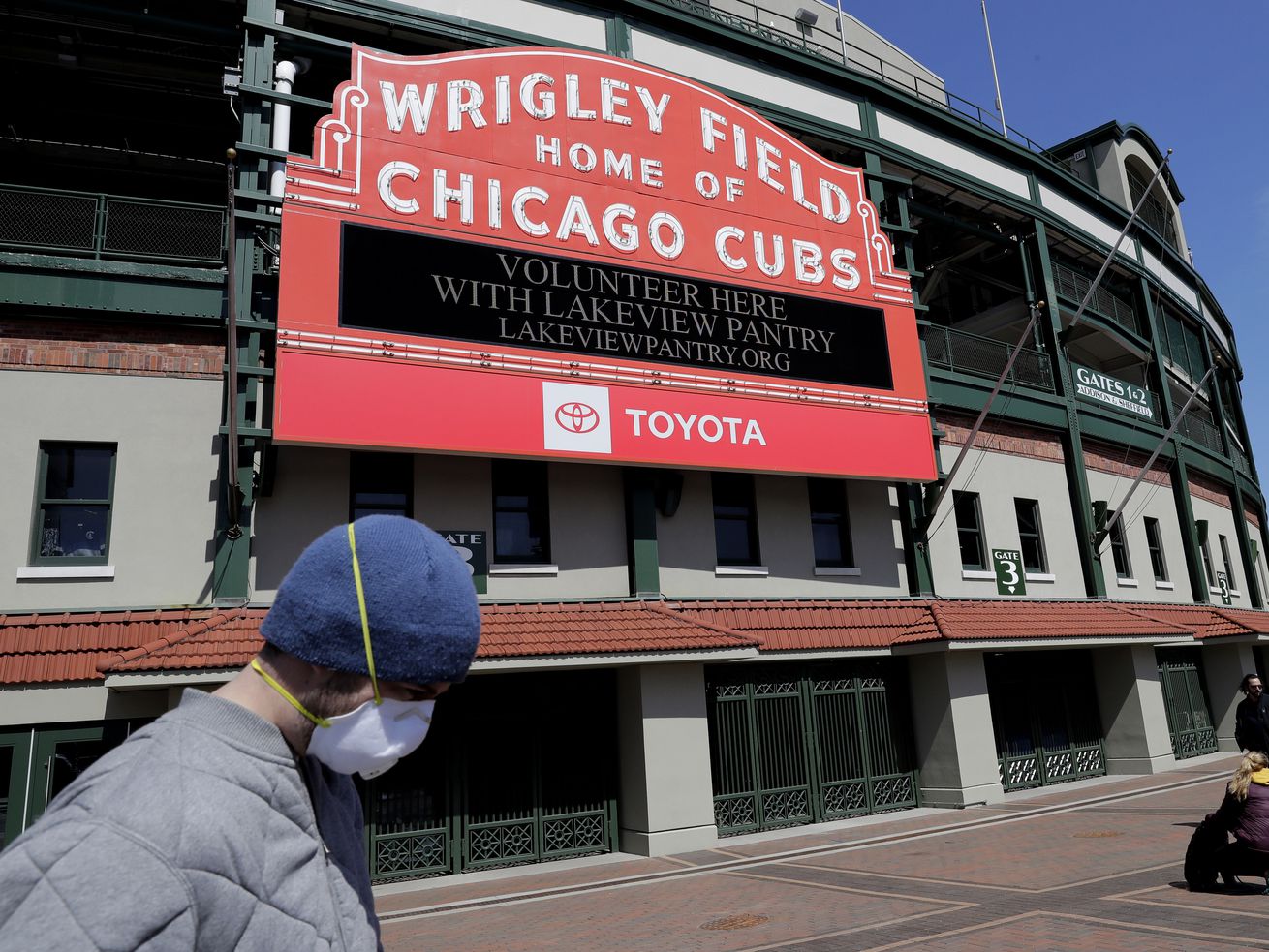
Nam Y. Huh/AP PhotosWrigley Field’s marquee displays Lakeview Pantry volunteer information in Chicago, Thursday, April 16, 2020.
Another Chicago sports mecca could soon join the United Center as a site for coronavirus vaccinations.
The Chicago Cubs are “in discussions with the city” about opening a mass-vaccination site “somewhere on the Wrigley Field campus,” team spokesman Julian Green said Tuesday.
Those shots won’t be administered on the field itself, Green said, but vaccinations could take place along the stadium’s inside concourses, in the outdoor plaza along the third-base line, in a players’ parking lot or in the Wrigley conference center.
“We want to be helpful,” Green said. “If we can assist by allowing the assets we have to be used as a site for a life-saving vaccine, we’d be honored to serve.”
Advocate Aurora Health is in line to operate the site, providing “clinical staffing and technical infrastructure,” if the city authorizes it and there are adequate vaccine supplies.
The health care provider would be “proud to partner on a possible Wrigley Field mass vaccination site,” said Advocate spokeswoman Brigid Sweeney.
7:05 p.m. Illinois smokers now prioritized for the coronavirus vaccine
Illinois smokers are now among the priority groups eligible for the COVID-19 vaccine.
As a part of the state’s vaccination schedule, residents with certain high-risk medical conditions — including smoking — are now able to get shots, along with seniors and medical and essential workers.
The move to Phase 1B+ went into effect Feb. 25. The expansion was done in order to “advance the state’s goal of equitable distribution” to communities of color, according to the Illinois Department of Health website.
According to the Centers for Disease Control, being a “current or former cigarette smoker” puts you at greater risk for severe COVID-19 illness.
CDC statistics show that 21% of Native Americans smoke, the highest level among demographic groups. Whites are next at 15.5%, followed by Blacks (14.9%), Hispanics (9%) and Asians (7%).
5 p.m. How soon can senior citizens sign up for vaccine appointments at United Center?
Provided PhotoThe United Center will open as a mass COVID-19 vaccination site on March 4.
Senior citizens can start signing up Thursday for COVID-19 vaccine appointments at a new mass vaccination site poised to launch next week outside the United Center.
People 65 or older will be able to try to snag appointments online or by phone at 8:30 a.m. March 4, Gov. J.B. Pritzker announced Tuesday.
Appointments will open at 4 p.m. March 7 to other people eligible for shots under the state’s expanded Phase 1B pool of recipients, which includes residents 16 and older with chronic health conditions such as heart disease or diabetes.
More than 100,000 slots will be available to those seniors who are first in line when registration opens, according to Pritzker’s office.
Residents will be able to sign up at zocdoc.com/vaccine, or call (312) 746-4835.
“From the beginning, we have prioritized ensuring our seniors and vulnerable populations can receive the COVID-19 vaccine as quickly and equitably as possible, and I’m thrilled the United Center vaccine site will help deliver on those core goals,” Gov. J.B. Pritzker said in a statement. “This site adds 6,000 doses per day to our growing statewide capacity and joins 15 state-supported mass vaccine sites now operating across Illinois.”
4:39 p.m. Biden vows enough vaccine for all US adults by end of May
WASHINGTON — President Joe Biden said Tuesday that the U.S. expects to take delivery of enough coronavirus vaccines for all adult Americans by the end of May, two months earlier than anticipated, as his administration announced that drugmaker Merck & Co. will help produce rival Johnson & Johnson’s newly approved shot.
With the bolstered supply, Biden also announced he would be using the powers of the federal government to direct all states to prioritize vaccinating teachers, and said the federal government would provide the doses directly through its pharmacy program. He challenged states to administer at least one dose of the vaccine to all teachers by the end of March as part of his administration’s efforts to reopen more schools across the nation.
“We’re now on track to have enough vaccine supply for every adult in America by the end of May,” said Biden, who likened the partnership between the two drug companies to the spirit of national cooperation during World War II.
The announcement comes as the White House looks to speed the production of the single-dose J&J vaccine and accelerate the nation’s plans to reach “herd immunity” in the U.S. and begin restoring normalcy after the pandemic. Biden noted that vaccine supply was only one bottleneck toward that goal, and that the new challenge will be injecting doses into arms as swiftly as possible.
To that end, the Biden administration told governors Tuesday to prepare for their supplies of vaccine to continue to climb over the coming weeks. Additional doses are also heading toward a federally backed program to administer doses in more accessible retail pharmacies.
Those pharmacies will be key in getting the vaccines into the arms of teachers, which will help reopen schools to better educate students who have been at risk at falling behind during the pandemic.
“Let’s treat in-person learning as the essential service that it is,” Biden said.
4:05 p.m. New program helps Chicagoans manage debt, find aid — and it’s free
Bread lines across the city grew as the pandemic triggered an economic downturn, but a new financial program hopes to ease the burden Chicagoans face.
Led locally by Heartland Alliance in partnership with the city, the program connects residents with financial advisors to help manage expenses and find available federal or local aid.
The Financial Navigator program, launched in mid-February, is designed around a free 30-minute phone call that advises people on which bills to target and shows them how to maximize their income.
“We are helping people try and avoid eviction, avoid bankruptcy and get this city back on its feet,” said Barbara Martinez, manager of Heartland Alliance’s asset building program. “We are speaking with people who are behind on bills, utilities and rent, so our goal is to help them prioritize their expenses and which bills they should target.”
The nationwide initiative was launched by the Cities for Financial Empowerment Fund — a philanthropic group based in New York. The fund has partnered with 31 cities and counties to create a database of local and national resources.
Martinez said there is no magic wand to make bills evaporate but steps can be taken to “knock out things little by little.”
2:19 p.m. Texas becomes biggest US state to lift COVID-19 mask mandate
AUSTIN, Texas — Texas is lifting its mask mandate, Gov. Greg Abbott said Tuesday, making it the largest state to end an order intended to prevent the spread of the coronavirus that has killed more than 42,000 Texans.
The Republican governor has faced sharp criticism from his party over the mandate, which was imposed eight months ago, and other COVID-19 restrictions. It was only ever lightly enforced, even during the worst outbreaks of the pandemic.
Texas will also do away with limits on the number of diners that businesses can serve indoors, said Abbott, who made the announcement at a restaurant in Lubbock.
The decision comes as governors across the U.S. have been easing coronavirus restrictions, despite warnings from health experts that the pandemic is far from over. Like the rest of the country, Texas has seen the number of cases and deaths plunge. Hospitalizations are at the lowest levels since October, and the seven-day rolling average of positive tests has dropped to about 7,600 cases, down from more than 10,000 in mid-February.
Only California and New York have reported more COVID-19 deaths than Texas.
“The fact that things are headed in the right direction doesn’t mean we have succeeded in eradicating the risk,” said Dr. Lauren Ancel Meyers, a professor of integrative biology and director of the University of Texas COVID-19 Modeling Consortium.
1:54 p.m. Every CPS student to get $450 for food through federal program that will benefit 1 million Illinois children
Ashlee Rezin Garcia/Sun-Times
The family of every Chicago Public Schools student, regardless of income or citizenship status, is set to receive more than $450 in the mail this month — plus hundreds more next month — to support food expenses.
The benefits, which can be twice that amount or more for families with two or more kids in school, are funded through a federal pandemic relief program. In total, one million students throughout the state will qualify for similar benefits.
The program — Pandemic Electronic Benefits Transfer, an offshoot of the EBT system — is intended to help students who usually receive free or reduced-price breakfast and lunch but who haven’t had access to in-school meals during the pandemic. Since CPS participates in a federal program that provides free lunch for all students in the district, every CPS student is eligible and will automatically receive the benefits in the mail.
P-EBT is specifically meant to replace the loss of in-school meals, so the fact that CPS and other districts have distributed meals to go at hundreds of schools during the pandemic has no impact on any district’s eligibility.
The first funds will be distributed in the first half of March with $6.82 loaded onto the cards for each school day through December that students were in remote learning — adding up to a little over $450 for CPS students. Another set of cards will be mailed in April with benefits for January through March, and families will receive a monthly benefit starting in May for the rest of the school year.
11:42 a.m. Victims of anti-Asian attacks reflect a year into pandemic
Nearly a year after they were almost stabbed to death inside a Midland, Texas, Sam’s Club, Bawi Cung and his two sons all have visible scars.
It’s the unseen ones though that are harder to get over. Cung can’t walk through any store without constantly looking in all directions. His 6-year-old son, who now can’t move one eyebrow, is afraid to sleep alone.
On a Saturday evening in March, when COVID-19 panic shopping gripped the nation, Cung was in search of rice at a cheaper price. The family was in the Sam’s Club meat section when Cung suddenly felt a punch to the back of his head. A man he didn’t know then slashed his face with a knife. The assailant left but soon returned to stab the boys. He wounded the 3-year-old in the back and slashed the 6-year-old from his right eye to a couple of inches past his right ear.
The grisly encounter brought home the dangerous climate Asian Americans have faced since the coronavirus entered the U.S., with racially motivated harassment and assaults occurring from coast to coast.
10:27 a.m. Lightfoot to loosen grip on restaurants and bars — again — to allow 50% capacity, trade group says
With vaccinations ramping up, Mayor Lori Lightfoot is once again loosening her grip on restaurants and bars, but not enough to satisfy the hard-hit industry.
According to Illinois Restaurant Association President Sam Toia, the revised regulations will allow Chicago restaurants and bars to increase indoor capacity to 50% or 50 people, whichever is less. The current limit is 40%.
Bars and restaurants now forced to stop serving patrons at 11 p.m. can stay open until 1 a.m. It’s a vital lifeline to businesses that have been fighting for survival after twice being forced to close their dining rooms during the pandemic.
Toia said he understands the mayor’s decision to approach Chicago’s cautious reopening as if she’s “turning the dimmer switch” instead of flipping on the light switch.
He simply wants the mayor to turn that switch even faster — by increasing the capacity for each restaurant room or designated area separated by a plexiglass divider from 50 people to 100 or 150.
“You cannot do catering parties with more than 50 people. We’re moving into the spring time here. You’ve got a lot of communions, graduations, Bar Mitzvah’s, weddings,” Toia said.
“We would really like to see it get bumped up to 150 per room. But we understand we move in steps here. So, getting up to 100 would be better than 50.”
9:40 a.m. U of I rapid COVID test gains emergency use authorization
A rapid COVID-19 saliva test developed by researchers at the University of Illinois has gained emergency-use authorization from the U.S. Food and Drug Administration, university officials announced Monday.
The test was developed not for individual use and will not be for sale on drugstore shelves, but was designed for large-scale use by universities, municipalities and companies to allow for constant testing, low positivity rates and the avoidance of shutdowns.
The University of Illinois rolled out the testing platform — known as covidSHIELD — on its Urbana-Champaign campus last year and kept positivity rates under 0.5%, allowing school officials to maintain in-person learning.
The University of Illinois set up testing stations around the campus and conducted more than a million tests. After a test subject “dribbled” saliva into a tube (no spitting to avoid aerosolizing the saliva), samples were shuttled to a lab via golf carts, according to Martin Burke, a chemistry professor who heads up the university’s SHIELD team.
Results were accessed via smartphone app within 24 hours and were necessary to gain access to campus buildings.
Gov. J.B. Pritzker has allocated $20 million in federal COVID relief funding to make sure the testing platform is available to all 12 of the state’s universities and 48 community colleges.
University officials created two units to share the testing protocol: SHIELD Illinois, which focuses on expansion within the state, and Shield T3, a university-related organization deploying the saliva test outside of Illinois.
“Interest in Shield T3 and requests for our help have been pouring in from around the globe,” said Bill Jackson, interim executive director of the Discovery Partners Institute, who works closely with the separate Shield T3 unit. “This important step simplifies the process of setting up labs and gives our partners added assurance.”
By the time he took office, President Joe Biden had abandoned his campaign promise to require that all Americans cover their faces in public, admitting that such an order was beyond his authority. But that concession did not stop the Biden administration from imposing a nationwide eviction moratorium with an equally dubious legal basis.
Last week a federal judge in Texas ruled that the Constitution does not give the federal government the power to decree that landlords across the country must house tenants who do not pay their rent. That case, along with a challenge to Arizona Gov. Doug Ducey’s pandemic powers that the state Supreme Court will hear next Tuesday, is part of an overdue re-examination of the assumption that politicians can do whatever they deem necessary to fight COVID-19.
The eviction moratorium, which the Centers for Disease Control and Prevention originally issued in September, was renewed by Congress in December, and then extended again by the Biden administration. It is based on a breathtakingly broad reading of the CDC director’s authority to “take such measures” he “deems reasonably necessary” to stop the interstate spread of communicable diseases.
The CDC reasoned that evicted tenants might “become homeless” or “move into close quarters in shared housing,” thereby increasing the risk of virus transmission. That rationale suggests the CDC’s authority is vast, encompassing any policy that is plausibly related to disease control, including business closures and a national stay-at-home order as well as the face mask requirement that Biden ultimately decided could not be imposed by executive fiat.
9:46 a.m. How to end the confusion of COVID-19 vaccine appointment scheduling
If you’ve tried to get a COVID-19 vaccine appointment, you know how frustrating the process can be. People are spending hours obsessively refreshing websites, hoping an appointment will open up somewhere. They scan Facebook groups for tips and insider information. One writer compared it to Soviet-style queues for cabbage.
The competition for slots will only worsen when the COVID-19 vaccination priority list opens to the broader public.
As an expert in health care operations and vaccine supply chains, I have closely followed the difficulties in connecting COVID-19 vaccine doses with people. I believe the best solution to vaccine appointment scheduling lies in building a trustworthy one-stop preregistration system.
Illinois guard Andre Curbelo (5) jumps into the arms of head coach Brad Underwood in the second half of an NCAA college basketball game against Michigan in Ann Arbor, Mich., Tuesday, March 2, 2021. Illinois won 76-53. (AP Photo/Paul Sancya) | Paul Sancya/AP
Trent Frazier led Illinois with 22 points and Andre Curbelo added 17; Dosunmu still out
ANN ARBOR, Mich. — Andre Curbelo scored 11 of his 17 points in the first half, and No. 4 Illinois dismantled No. 2 Michigan with a smothering defensive performance, routing the Wolverines 76-53 on Tuesday night.
Playing again without injured star Ayo Dosunmu, the Illini (19-6, 15-4) kept Michigan from clinching the Big Ten title and boosted their own chances at a No. 1 seed in the NCAA Tournament. Trent Frazier led Illinois with 22 points, and Kofi Cockburn added 12.
Eli Brooks scored 11 points and was the only player in double figures for Michigan. The Wolverines (18-2, 13-2) looked physically overwhelmed for much of the night, unable to create good shots against the Illinois defense and unable to keep the Illini off the boards. It was an eye-opening blowout — especially since Michigan has rolled to similar margins of victory against other good teams this season.
Both teams had a hard time scoring in the first half, but Curbelo’s ability to drive to the basket helped Illinois to a 33-22 lead at the break. Then the Illini kept pouring it on.
Illinois outscored Michigan 22-5 in second-chance points and held the Wolverines to 35% shooting from the field.
The Big Ten confirmed before the game that it will use winning percentage to determine the league champion. Michigan can still wrap that up with a win in either of its last two games — or if Illinois loses its last game this weekend.
BIG PICTURE
Illinois: The Illini still have an uphill climb to win the Big Ten, but if they finish a game or two behind Michigan in the loss column, their fans will likely be heard from on the topic. The Wolverines are scheduled to play three fewer games than Illinois, and the size of this blowout — without Dosunmu — will resonate. Dosunmu has missed the past three games with a broken nose, but the Illini have won them all.
Michigan: It’s only one game, and the Wolverines had been remarkably consistent in their dominance of the Big Ten this season — but Michigan looked so lacking in energy and offensive poise Tuesday that it will be interesting to see the team’s response later this week.
POLL IMPLICATIONS
This is a tricky one to evaluate. Michigan may drop behind No. 3 Baylor. Illinois could certainly pass Michigan as well after this game, but the Illini still have four more losses than the Wolverines. Plus, both Michigan and Illinois have more tests to come before the next poll.
UP NEXT
Illinois: The Illini play at No. 7 Ohio State on Saturday.
Michigan: The Wolverines finish the regular season with a home-and-home series against rival Michigan State, starting Thursday night in Ann Arbor.
Tonight’s Chicago Metro N & NW suburban edition of Public Affairs features a GOP Gov Candidate many think could beat Gov Pritzker, if the election were held tomorrow: K & E Partner Richard Porter
Possible Gov candidate Porter said the massive IL population loss during the last decade is due to residents voting w/their feet against an unholy alliance of Dem…
Watch Tonight’s “Public Affairs,” with show host Jeff Berkowitz interviewing likely Gov Candidate Richard Porter (R-Northfield) in Part 1 about how to fix IL’s massive $400 billion pension liability problem and inordinately high property taxes, both of which are major factors in Illinois’ very significant losses of people, jobs and companies over the last decade to both adjacent and far away states.
Porter’s three decades of legal practice at the Chicago office of the world’s largest (by revenue) law firm (Kirkland & Ellis) arguably prepared him with unique insights as to how best to fix IL’s $400 billion pension liability problem as Governor.
In short, most think Porter could debate Gov Pritzker on TV tonight and walk away the easy winner. What do you think? Watch tonight’s show in the suburbs or watch it on the web (24/7) and let us know what you think?
********
Tonight’s show airs at 8:30 pm on Comcast Cable Ch. 19 or Cable Ch. 35 (See, below) in 25 North and Northwest Chicago metro suburbs:
—Comcast Cable Ch. 19 inBuffalo Grove, Elk Grove Village, Hoffman Estates, parts of Inverness, Lincolnwood, Morton Grove, Niles, Northfield, Palatine, Rolling Meadows and Wilmette and on
—Comcast Cable Ch. 35 in Arlington Heights, Bartlett, Glenview, Golf, Des Plaines, Hanover Park, Mt. Prospect, Northbrook, Park Ridge, Prospect Heights, Schaumburg, Skokie, Streamwood and Wheeling.
Richard Porter is interviewed by Jeff Berkowitz of Public Affairs, as Porter articulates his vision for a new day in IL.
***********************************
Porter’s three decades of legal practice at the Chicago office of the world’s largest (by revenue) law firm (Kirkland & Ellis) and his involvement in politics over the years (including as an RNC National Committeeman from IL and with the New Trier Republican Organization) arguably prepared him with unique insights as to how best to fix IL’s $400 billion pension liability problem as Governor.
Porter said the massive IL population loss during the last decade is due to residents voting w/their feet against an unholy alliance of Dem politicians w/unions that produced both extraordinary Dem political power and a very large percentage of what many view as outrageously, excessive public sector pensions that is a major fiscal drag on the IL Economy and it’s people’s well being.
Porter contends the solution to the current IL fiscal disaster is to pass federal legislation that returns power to the people, giving the authority to their elected representatives (In accord with Article IV of the U. S. Constitution, the Supremacy Clause and the Commerce Clause) to cut and restructure government pension benefits.
Porter explains how the restructuring will allow local governments to live within a state passed property tax cap (as a per cent of property market value) while also maintaining high quality education where that already exists. Additionally, Porter advocates school choice and other reforms that will improve education, especially in inner city areas across the state that contain many schools that are failing to deliver a quality education to their students, who are often minorities.
Porter also explains how the Republicans could reach agreement with the Dems to pass the above referenced federal legislation.
Potential Gov Candidate Richard Porter says now might be the time to repeal IL teachers’ right to strike.
A fire broke out in a home Feb. 28, 2021 in the 8600 block of South Hermitage Avenue in Gresham. | Chicago Fire Department
They were found in a burning house by firefighters about 4 a.m. Sunday in the 8600 block of South Hermitage Avenue, Chicago fire officials said.
The deaths of a mother and her daughter who were killed in a fire Sunday in Gresham have been ruled homicides.
Ieashia Ford, 34, and her daughter Porche Stinson Ford, 15, both died of injuries from inhaling combustible products “due to house fire due to arson,” according to autopsy results released Tuesday by the Cook County medical examiner’s office.
Their deaths were each classified as homicides, the medical examiner’s office said.
There was enough evidence at the scene of the fire for bomb and arson detectives, as well as homicide detectives, to investigate the cause of the fire, officials said. Police didn’t provide an update on the investigation into the cause of the fire Tuesday.
The pair were taken in critical condition to Little Company of Mary Hospital, where they were pronounced dead, officials said.
Four other people were taken to Christ Medical Center in Oak Lawn for treatment due to injuries from the blaze, officials said.
Allen Robinson has 3,151 yards and 17 touchdown catches in three seasons with the Bears. | Phelan M. Ebenhack/AP
There are almost never concrete answers in a Pace press conference, but his comments on Robinson seemed to signal there’s no way they’ll let him leave.
Ryan Pace has two goals as Bears general manager: win a Super Bowl and reveal as little as possible in the rare moments when the NFL calendar forces him to take questions from the media.
So virtually everything Pace ever says is veiled and couched, whether he’s hedging on quarterbacks or trying to avoid a topic altogether. Reading between the lines, though, his comments Tuesday on free agent wide receiver Allen Robinson appeared to signal the Bears will do whatever is necessary to keep him.
While Robinson is amenable to that in the form of a contract extension, Pace seems willing to put the franchise tag on him — Robinson is on the record as hating that possibility — and live with the fallout of angering arguably his best player.
“We’ve got to look at it — obviously, we have a ton of respect for Allen, and then we have to do what’s best for the Bears, too,” Pace said. We consider everything. The league gives us the franchise tag as an option. That tool’s there for a reason. We haven’t made a firm decision on any of that yet, but we know we have that at our disposal.
“We love Allen Robinson. He’s a great player for us … and not just the player, but the teammate, the professional that he is. The franchise tag is an option for us. It doesn’t mean we’re necessarily going to use that, but we want to keep our good players and Allen is a good player for us.”
That’s as close as we’re going to get to Pace tipping his hand. And the good news for the Bears, regardless of Robinson’s inevitable frustration if they tag him, is that he has the sense to know there’s no way he can let Robinson walk out the door. It would instantly vaporize whatever credibility Pace has left and would strip a fledgling offense of its only reliable player — a player, by the way, who has been saying for a year and a half that he wants to be a Bear for the long haul.
Robinson put up 200 catches, 2,397 yards and 13 touchdowns while playing with Mitch Trubisky, Nick Foles and Chase Daniel the last two seasons. His other big year was a 1,400-yard, 14-touchdown eruption while being paired with Blake Bortles on the 2015 Jaguars.
“A-Rob knows how much we love him,” coach Matt Nagy said.
That’s the problem, though. He knows precisely, to the dollar, how much they love him. And he thinks they should love him more.
Robinson is exactly what the Bears need: a player who produces no matter what’s going on around him. And he’s only 27.
That’s why Spotrac projects his market value contract at four years, $80.2 million, which is in line with the average salary he was seeking when he and the Bears hit an impasse in extension talks, a source said. The numbers haven’t been finalized yet, but Robinson’s franchise tag would likely cost the team $18 million.
That’s not nearly the long-term payday Robinson has earned with his play.
“I plead the 5th,” his agent, Brandon Parker, tweeted after Pace’s press conference.
Despite Robinson mounting a public campaign against the franchise tag over the past two months, Pace probably thinks he’ll get over it if the Bears go that route. He likely has little concern about Robinson making a public mess of this or holding out of training camp.
That’s the price Robinson pays for being the ultimate professional. Rather than being rewarded with a contract extension a year ago, the Bears took for granted, and were correct in assuming, that he would show up and do his job regardless. And now they have no hesitation betting on that again.
Nam Y. Huh/AP PhotosWrigley Field’s marquee displays Lakeview Pantry volunteer information in Chicago, Thursday, April 16, 2020.
Another Chicago sports mecca could soon join the United Center as a site for coronavirus vaccinations.
The Chicago Cubs are “in discussions with the city” about opening a mass-vaccination site “somewhere on the Wrigley Field campus,” team spokesman Julian Green said Tuesday.
Those shots won’t be administered on the field itself, Green said, but vaccinations could take place along the stadium’s inside concourses, in the outdoor plaza along the third-base line, in a players’ parking lot or in the Wrigley conference center.
“We want to be helpful,” Green said. “If we can assist by allowing the assets we have to be used as a site for a life-saving vaccine, we’d be honored to serve.”
Advocate Aurora Health is in line to operate the site, providing “clinical staffing and technical infrastructure,” if the city authorizes it and there are adequate vaccine supplies.
The health care provider would be “proud to partner on a possible Wrigley Field mass vaccination site,” said Advocate spokeswoman Brigid Sweeney.
5 p.m. How soon can senior citizens sign up for vaccine appointments at United Center?
Provided PhotoThe United Center will open as a mass COVID-19 vaccination site on March 4.
Senior citizens can start signing up Thursday for COVID-19 vaccine appointments at a new mass vaccination site poised to launch next week outside the United Center.
People 65 or older will be able to try to snag appointments online or by phone at 8:30 a.m. March 4, Gov. J.B. Pritzker announced Tuesday.
Appointments will open at 4 p.m. March 7 to other people eligible for shots under the state’s expanded Phase 1B pool of recipients, which includes residents 16 and older with chronic health conditions such as heart disease or diabetes.
More than 100,000 slots will be available to those seniors who are first in line when registration opens, according to Pritzker’s office.
Residents will be able to sign up at zocdoc.com/vaccine, or call (312) 746-4835.
“From the beginning, we have prioritized ensuring our seniors and vulnerable populations can receive the COVID-19 vaccine as quickly and equitably as possible, and I’m thrilled the United Center vaccine site will help deliver on those core goals,” Gov. J.B. Pritzker said in a statement. “This site adds 6,000 doses per day to our growing statewide capacity and joins 15 state-supported mass vaccine sites now operating across Illinois.”
4:39 p.m. Biden vows enough vaccine for all US adults by end of May
WASHINGTON — President Joe Biden said Tuesday that the U.S. expects to take delivery of enough coronavirus vaccines for all adult Americans by the end of May, two months earlier than anticipated, as his administration announced that drugmaker Merck & Co. will help produce rival Johnson & Johnson’s newly approved shot.
With the bolstered supply, Biden also announced he would be using the powers of the federal government to direct all states to prioritize vaccinating teachers, and said the federal government would provide the doses directly through its pharmacy program. He challenged states to administer at least one dose of the vaccine to all teachers by the end of March as part of his administration’s efforts to reopen more schools across the nation.
“We’re now on track to have enough vaccine supply for every adult in America by the end of May,” said Biden, who likened the partnership between the two drug companies to the spirit of national cooperation during World War II.
The announcement comes as the White House looks to speed the production of the single-dose J&J vaccine and accelerate the nation’s plans to reach “herd immunity” in the U.S. and begin restoring normalcy after the pandemic. Biden noted that vaccine supply was only one bottleneck toward that goal, and that the new challenge will be injecting doses into arms as swiftly as possible.
To that end, the Biden administration told governors Tuesday to prepare for their supplies of vaccine to continue to climb over the coming weeks. Additional doses are also heading toward a federally backed program to administer doses in more accessible retail pharmacies.
Those pharmacies will be key in getting the vaccines into the arms of teachers, which will help reopen schools to better educate students who have been at risk at falling behind during the pandemic.
“Let’s treat in-person learning as the essential service that it is,” Biden said.
4:05 p.m. New program helps Chicagoans manage debt, find aid — and it’s free
Bread lines across the city grew as the pandemic triggered an economic downturn, but a new financial program hopes to ease the burden Chicagoans face.
Led locally by Heartland Alliance in partnership with the city, the program connects residents with financial advisors to help manage expenses and find available federal or local aid.
The Financial Navigator program, launched in mid-February, is designed around a free 30-minute phone call that advises people on which bills to target and shows them how to maximize their income.
“We are helping people try and avoid eviction, avoid bankruptcy and get this city back on its feet,” said Barbara Martinez, manager of Heartland Alliance’s asset building program. “We are speaking with people who are behind on bills, utilities and rent, so our goal is to help them prioritize their expenses and which bills they should target.”
The nationwide initiative was launched by the Cities for Financial Empowerment Fund — a philanthropic group based in New York. The fund has partnered with 31 cities and counties to create a database of local and national resources.
Martinez said there is no magic wand to make bills evaporate but steps can be taken to “knock out things little by little.”
2:19 p.m. Texas becomes biggest US state to lift COVID-19 mask mandate
AUSTIN, Texas — Texas is lifting its mask mandate, Gov. Greg Abbott said Tuesday, making it the largest state to end an order intended to prevent the spread of the coronavirus that has killed more than 42,000 Texans.
The Republican governor has faced sharp criticism from his party over the mandate, which was imposed eight months ago, and other COVID-19 restrictions. It was only ever lightly enforced, even during the worst outbreaks of the pandemic.
Texas will also do away with limits on the number of diners that businesses can serve indoors, said Abbott, who made the announcement at a restaurant in Lubbock.
The decision comes as governors across the U.S. have been easing coronavirus restrictions, despite warnings from health experts that the pandemic is far from over. Like the rest of the country, Texas has seen the number of cases and deaths plunge. Hospitalizations are at the lowest levels since October, and the seven-day rolling average of positive tests has dropped to about 7,600 cases, down from more than 10,000 in mid-February.
Only California and New York have reported more COVID-19 deaths than Texas.
“The fact that things are headed in the right direction doesn’t mean we have succeeded in eradicating the risk,” said Dr. Lauren Ancel Meyers, a professor of integrative biology and director of the University of Texas COVID-19 Modeling Consortium.
1:54 p.m. Every CPS student to get $450 for food through federal program that will benefit 1 million Illinois children
Ashlee Rezin Garcia/Sun-Times
The family of every Chicago Public Schools student, regardless of income or citizenship status, is set to receive more than $450 in the mail this month — plus hundreds more next month — to support food expenses.
The benefits, which can be twice that amount or more for families with two or more kids in school, are funded through a federal pandemic relief program. In total, one million students throughout the state will qualify for similar benefits.
The program — Pandemic Electronic Benefits Transfer, an offshoot of the EBT system — is intended to help students who usually receive free or reduced-price breakfast and lunch but who haven’t had access to in-school meals during the pandemic. Since CPS participates in a federal program that provides free lunch for all students in the district, every CPS student is eligible and will automatically receive the benefits in the mail.
P-EBT is specifically meant to replace the loss of in-school meals, so the fact that CPS and other districts have distributed meals to go at hundreds of schools during the pandemic has no impact on any district’s eligibility.
The first funds will be distributed in the first half of March with $6.82 loaded onto the cards for each school day through December that students were in remote learning — adding up to a little over $450 for CPS students. Another set of cards will be mailed in April with benefits for January through March, and families will receive a monthly benefit starting in May for the rest of the school year.
11:42 a.m. Victims of anti-Asian attacks reflect a year into pandemic
Nearly a year after they were almost stabbed to death inside a Midland, Texas, Sam’s Club, Bawi Cung and his two sons all have visible scars.
It’s the unseen ones though that are harder to get over. Cung can’t walk through any store without constantly looking in all directions. His 6-year-old son, who now can’t move one eyebrow, is afraid to sleep alone.
On a Saturday evening in March, when COVID-19 panic shopping gripped the nation, Cung was in search of rice at a cheaper price. The family was in the Sam’s Club meat section when Cung suddenly felt a punch to the back of his head. A man he didn’t know then slashed his face with a knife. The assailant left but soon returned to stab the boys. He wounded the 3-year-old in the back and slashed the 6-year-old from his right eye to a couple of inches past his right ear.
The grisly encounter brought home the dangerous climate Asian Americans have faced since the coronavirus entered the U.S., with racially motivated harassment and assaults occurring from coast to coast.
10:27 a.m. Lightfoot to loosen grip on restaurants and bars — again — to allow 50% capacity, trade group says
With vaccinations ramping up, Mayor Lori Lightfoot is once again loosening her grip on restaurants and bars, but not enough to satisfy the hard-hit industry.
According to Illinois Restaurant Association President Sam Toia, the revised regulations will allow Chicago restaurants and bars to increase indoor capacity to 50% or 50 people, whichever is less. The current limit is 40%.
Bars and restaurants now forced to stop serving patrons at 11 p.m. can stay open until 1 a.m. It’s a vital lifeline to businesses that have been fighting for survival after twice being forced to close their dining rooms during the pandemic.
Toia said he understands the mayor’s decision to approach Chicago’s cautious reopening as if she’s “turning the dimmer switch” instead of flipping on the light switch.
He simply wants the mayor to turn that switch even faster — by increasing the capacity for each restaurant room or designated area separated by a plexiglass divider from 50 people to 100 or 150.
“You cannot do catering parties with more than 50 people. We’re moving into the spring time here. You’ve got a lot of communions, graduations, Bar Mitzvah’s, weddings,” Toia said.
“We would really like to see it get bumped up to 150 per room. But we understand we move in steps here. So, getting up to 100 would be better than 50.”
9:40 a.m. U of I rapid COVID test gains emergency use authorization
A rapid COVID-19 saliva test developed by researchers at the University of Illinois has gained emergency-use authorization from the U.S. Food and Drug Administration, university officials announced Monday.
The test was developed not for individual use and will not be for sale on drugstore shelves, but was designed for large-scale use by universities, municipalities and companies to allow for constant testing, low positivity rates and the avoidance of shutdowns.
The University of Illinois rolled out the testing platform — known as covidSHIELD — on its Urbana-Champaign campus last year and kept positivity rates under 0.5%, allowing school officials to maintain in-person learning.
The University of Illinois set up testing stations around the campus and conducted more than a million tests. After a test subject “dribbled” saliva into a tube (no spitting to avoid aerosolizing the saliva), samples were shuttled to a lab via golf carts, according to Martin Burke, a chemistry professor who heads up the university’s SHIELD team.
Results were accessed via smartphone app within 24 hours and were necessary to gain access to campus buildings.
Gov. J.B. Pritzker has allocated $20 million in federal COVID relief funding to make sure the testing platform is available to all 12 of the state’s universities and 48 community colleges.
University officials created two units to share the testing protocol: SHIELD Illinois, which focuses on expansion within the state, and Shield T3, a university-related organization deploying the saliva test outside of Illinois.
“Interest in Shield T3 and requests for our help have been pouring in from around the globe,” said Bill Jackson, interim executive director of the Discovery Partners Institute, who works closely with the separate Shield T3 unit. “This important step simplifies the process of setting up labs and gives our partners added assurance.”
By the time he took office, President Joe Biden had abandoned his campaign promise to require that all Americans cover their faces in public, admitting that such an order was beyond his authority. But that concession did not stop the Biden administration from imposing a nationwide eviction moratorium with an equally dubious legal basis.
Last week a federal judge in Texas ruled that the Constitution does not give the federal government the power to decree that landlords across the country must house tenants who do not pay their rent. That case, along with a challenge to Arizona Gov. Doug Ducey’s pandemic powers that the state Supreme Court will hear next Tuesday, is part of an overdue re-examination of the assumption that politicians can do whatever they deem necessary to fight COVID-19.
The eviction moratorium, which the Centers for Disease Control and Prevention originally issued in September, was renewed by Congress in December, and then extended again by the Biden administration. It is based on a breathtakingly broad reading of the CDC director’s authority to “take such measures” he “deems reasonably necessary” to stop the interstate spread of communicable diseases.
The CDC reasoned that evicted tenants might “become homeless” or “move into close quarters in shared housing,” thereby increasing the risk of virus transmission. That rationale suggests the CDC’s authority is vast, encompassing any policy that is plausibly related to disease control, including business closures and a national stay-at-home order as well as the face mask requirement that Biden ultimately decided could not be imposed by executive fiat.
9:46 a.m. How to end the confusion of COVID-19 vaccine appointment scheduling
If you’ve tried to get a COVID-19 vaccine appointment, you know how frustrating the process can be. People are spending hours obsessively refreshing websites, hoping an appointment will open up somewhere. They scan Facebook groups for tips and insider information. One writer compared it to Soviet-style queues for cabbage.
The competition for slots will only worsen when the COVID-19 vaccination priority list opens to the broader public.
As an expert in health care operations and vaccine supply chains, I have closely followed the difficulties in connecting COVID-19 vaccine doses with people. I believe the best solution to vaccine appointment scheduling lies in building a trustworthy one-stop preregistration system.
Parts of the Wrigley Field campus could be used to administer the coronavirus vaccine. | Getty
But will fans be able to watch baseball in person at Wrigley — or Guaranteed Rate Field — this season? Mayor Lori Lightfoot on Tuesday said it’s going to happen, but she didn’t say how soon.
The Chicago Cubs are “in discussions with the city” about opening a mass-vaccination site “somewhere on the Wrigley Field campus,” team spokesman Julian Green said Tuesday.
Those shots won’t be administered on the field itself, Green said, but vaccinations could take place along the stadium’s inside concourses, in the outdoor plaza along the third-base line, in a players’ parking lot or in the Wrigley conference center.
“We want to be helpful,” Green said. “If we can assist by allowing the assets we have to be used as a site for a life-saving vaccine, we’d be honored to serve.”
Advocate Aurora Health is in line to operate the site, providing “clinical staffing and technical infrastructure,” if the city authorizes it and there are adequate vaccine supplies.
The health care provider would be “proud to partner on a possible Wrigley Field mass vaccination site,” said Advocate spokeswoman Brigid Sweeney.
Sweeney said Wrigley is being considered because it’s easy CTA access makes it “a convenient option for people who do not own cars.”
Meanwhile, in other news involving Wrigley — and Guaranteed Rate Field, home of the White Sox — Lightfoot said fans of both teams will be able to attend games this season. She just didn’t say how many, or when.
“There will be a point some time this season where you’ll see fans in the stands” at both ballparks, said the mayor, a Sox season ticket holder.
And while Lightfoot didn’t reveal details, she did say both the Sox and Cubs have “come up with very good plans” to make that possible.
In this Feb. 10, 2021, file photo, a man receives a COVID-19 vaccine in North Las Vegas. Catholic leaders in New Orleans and St. Louis are advising Catholics that the COVID-19 vaccine from Johnson & Johnson is “morally compromised” because it’s produced using cell lines developed from aborted fetuses. Archdiocese statements in each city say Catholics should choose coronavirus vaccines made by Moderna or Pfizer — if they are available. Johnson & Johnson stresses in a statement Tuesday, March 2, that no fetal tissue is used in the vaccine. | AP
Roman Catholic leaders in St. Louis and New Orleans are advising Catholics that the COVID-19 vaccine from Johnson & Johnson, newly approved for use in the U.S., is “morally compromised” because it is produced using a cell line derived from an aborted fetus.
NEW ORLEANS — Roman Catholic leaders in St. Louis and New Orleans are advising Catholics that the COVID-19 vaccine from Johnson & Johnson, newly approved for use in the U.S., is “morally compromised” because it is produced using a cell line derived from an aborted fetus.
The New Orleans archdiocese says the decision to receive a vaccine is one of individual conscience. In its statement late last week, it stopped short of advising Catholics not to take the Johnson & Johnson vaccine, but adds that Catholics should choose coronavirus vaccines made by Moderna or Pfizer — if they are available.
The Archdiocese of St. Louis on Tuesday encouraged Catholics to seek out the Pfizer or Moderna vaccines and avoid the Johnson & Johnson version if possible. Like the New Orleans archdiocese statement, the St. Louis statement called the Johnson & Johnson vaccine “morally compromised.” However, the St. Louis statement stressed that Catholics can get that vaccine “in good conscience if no other alternative is available.”
Later Tuesday, a statement issued by chairmen of the United States Conference of Catholic Bishops’ committees on doctrine and abortion issues issued a statement reiterating the moral concerns. It said the Pfizer or Moderna vaccines are preferable “if one has the ability to choose a vaccine.”
While not disputing the church officials’ contention that an abortion-derived cell line is used in the production, Johnson & Johnson issued a statement Tuesday stressing that there is no fetal tissue in its vaccine.
Johnson & Johnson’s COVID-19 vaccine is made using a harmless cold virus, called an adenovirus, the same technology it used to produce a successful Ebola vaccine. The adenovirus is grown using what’s called an immortalized cell line, and the virus then is pulled out and purified.
Several types of cell lines created decades ago using fetal tissue exist and are widely used in medical manufacturing but the cells in them today are clones of the early cells, not the original tissue.
The United States Conference of Catholic Bishops said in a January statement that “abortion-derived” cell lines were used to test the Moderna and Pfizer vaccines but not in their development or production.
The Archdiocese statements renewed religious discussions about the vaccine and the use of abortion-derived cells. In December, the Vatican said that “it is morally acceptable to receive COVID-19 vaccines that have used cell lines from aborted fetuses” in the research and production process when “ethically irreproachable” vaccines aren’t available to the public.
Pope Francis has frequently spoken about the need to ensure that vaccines are widely available, especially to the poor and marginalized. And, last month, a decree signed by the governor of the Vatican city-state said that Vatican employees who opt out of vaccination without a proven medical reason could be subject to sanctions, including being fired.
The Archdiocese of New Orleans posted its statement Friday, the day before the Food and Drug Administration cleared the Johnson & Johnson vaccine for use in the U.S.
Asked Tuesday about the New Orleans Archdiocese statement, Louisiana Gov. John Bel Edwards — a rare anti-abortion Democrat — stressed the need for people to use any of the approved vaccines available in order to stop the spread of the virus.
Edwards said he spoke Sunday with Archbishop Gregory Aymond about the statement. “I don’t read his statement as completely telling people who are Catholic or otherwise not to avail themselves of the Johnson & Johnson vaccine,” said Edwards.
“I’m encouraging everyone out there to take the first vaccine that is available to them.”
He noted a statement issue Monday by Bishop Michael Duca of Baton Rouge.
Duca acknowledged “moral concerns” about the newly approved vaccine. But, he added “if for any reasonable circumstance you are only able to receive the vaccine from Johnson & Johnson, you should feel free to do so for your safety and for the common good.”
That is similar to guidance the U.S. bishops’ conference issued in January. “Given that the COVID-19 virus can involve serious health risks, it can be morally acceptable to receive a vaccine that uses abortion-derived cell lines if no other available vaccines comparable in safety and efficacy with no connection to abortion,” the January guidance said.
___
Associated Press reporters Luis Henao in New York, Jim Salter in St. Louis, Lauran Neergaard in Alexandria, Virginia, and Melinda Deslatte in Baton Rouge, Louisiana, contributed to this story.


/cdn.vox-cdn.com/uploads/chorus_asset/file/22341230/Virus_Outbreak_Illinois_Chicago_Cubs.jpg)
/cdn.vox-cdn.com/uploads/chorus_asset/file/19703294/United_Center_3.jpg)
/cdn.vox-cdn.com/uploads/chorus_asset/file/22339794/Virus_Outbreak_Chicago_Schools__6_.jpg)


Leave a comment