Pat and Nick talk Vaughn, Rodon, Collins, Burger, Kopech and more with James Fox from FutureSox & Southside Sox. They also talk Spring Trainings of the past, Gio and Lynn, fans on opening day, and BAN THE SHIFT!
According to the Chicago Tribune’s Brad Biggs, Chicago has started kicking the tires on 32-year old Trent Williams to anchor the left side of the line.
A year after the death of pioneering Afrobeat drummer Tony Allen, a posthumous album highlights his work with younger generations.
As the anniversaries of pandemic lockdowns arrive, many of us have been reflecting on the people we’ve lost in the past year, whether from COVID or any other cause.…Read More
Englewood rapper Dre Izaya has recently emerged as part of a loose collective of pop, R&B, soul, and hip-hop artists associated with Loop Theory, a local indie artist-development and management company founded by producer Disrupt and rapper Navarro. (The agency also releases music by the artists on its roster.)…Read More
Protesters rallied outside City Hall last month to oppose the relocation of the General Iron metal shredding operation to the Southeast Side. | Tyler LaRiviere/Sun-Times, Tyler LaRiviere/Sun-Times
The city said its “review process has identified concerns and questions related to the relationship between” multiple businesses operated by the metal shredder’s new owner along the Calumet River.
Mayor Lori Lightfoot’s Administration is seeking more information about the cumulative air pollution around a proposed scrap-metal shredding operation on the Southeast Side, an inquiry that delays the city’s permitting for the controversial business.
The city has been reviewing an operating permit application from Reserve Management Group, which acquired Lincoln Park-based General Iron in 2019. The company has been building a new facility at East 116th Street along the Calumet River to relocate General Iron, as the rebranded Southside Recycling, next to RMG’s existing businesses.
In a letter Monday, a city environmental official told RMG that it requires more information “to properly assess the relationship between and the potential cumulative impact of all Reserve Management Group operations” in the area. Air pollution throughout the Southeast Side is among the worst in the city.
The “review process has identified concerns and questions related to the relationship between Southside Recycling and other adjacent, co-owned and functionally integrated business entities,” city Environmental Engineer Renante Marante wrote. “The interaction of these existing operations together with the new capabilities proposed by Southside Recycling warrant further consideration in order to adequately assess the cumulative impact of the proposed recycling operations.”
“Southside Recycling is building a modern new facility that will operate alongside four other RMG companies,” the company said in a statement also citing its own air emissions modeling in its defense.
The permit has been at the center of a highly emotional protest from residents, including a month-long hunger strike. Lightfoot also is feeling heat from federal officials who have launched a civil rights investigation into the city’s zoning and land-use practices. On Friday, a federal official reiterated to the city that Lightfoot should not issue the permit until the civil rights investigation is complete.
Under a September 2019 agreement with the Lightfoot Administration, General Iron agreed to move from mostly white, wealthy Lincoln Park to Latino and Black-majority Southeast Side. That agreement is at the center of a fair housing civil rights complaint to the Department of Housing and Urban Development.
The city has asked to meet with RMG officials this week to discuss what information is needed for review of the operating permit. In the letter, Marante said the city’s review has included input from air-modeling experts and public comments.
The other businesses in the area cited by the city as potentially contributing to air pollution include Reserve Marine Terminals, South Shore Recycling, Napuck Salvage of Waupaca and Regency Technologies.
The city has been reviewing the permit application and was expected to soon either issue a draft version or deny the application. Some groups have been stepping up pressure on the mayor.
The “operations would endanger the health and safety of Southeast Side residents, including increasing the disparate burdens this community already bears,” a coalition of community members and hunger strikers said in a statement. “We are relieved that the City is not charging forward to issue a draft permit.”
In recent weeks, doctors and other health professionals have urged Lightfoot to reject the permit application, saying approving it would be contradicting her own statements about environmental racism and future planning. Last summer, the city put out an air quality report and map showing areas of the city overburdened with pollution, including the Southeast Side.
Meanwhile, a HUD official repeated last week that the agency is asking the city to not issue RMG a permit until it has completed its investigation. The letter from Kimberly Nevels, a HUD official in Chicago, took issue with a city lawyer’s comments to a federal judge in a separate but related civil rights court hearing last week that “suggested that there was no pending request for the City to delay the permit’s issuance.”
“Nothing,” Nevels said, “has led to any change in HUD’s ongoing request that the City refrain from issuing any further permits in this matter.”
Brett Chase’s reporting on the environment and public health is made possible by a grant from The Chicago Community Trust.
Illinois players are wearing basketball shorts of the appropriate length. The big, floppy shorts seem to have gone out of style. | Michael Conroy/AP
After a long couple of decades, men’s basketball shorts finally back to fitting the way they should.
Let’s start with fashion, which is always a must at NCAA Tournament time.
Men’s basketball uniforms seemingly have returned to sanity. And I am a happy camper.
You might recall that for the last couple of decades, big and floppy was considered better than small and tight when it came to men’s hoops unis.
I’m not sure of the exact reason for this. I think it’s complex and might be related to Michael Jordan, MC Hammer, Billie Eilish and a surplus of nylon, Lycra and dazzle in the fabric warehouses of this planet.
I complained bitterly from the git-go, as I saw the billowing sails of polyester and satin replacing the snugness of yore. I’m not sure we’re ready for the near-thong-and-undershirt look of the early John Stockton and Oscar Robertson years, but at least a modern guard won’t lose a dribbled ball up the leg of his trunks, as I once saw a bloomer-clad high school player do some years ago.
Fashion that makes your job harder is a weird duck. Bless you, children. Faith restored.
• Two details from the Illinois team. Deep reserve forward Dave Griffith is from Fisher (Illinois) High School. Thus, he was a Bunny on the Bunnies team.
Deep reserve guard Tyler Underwood will turn 25 this summer. He has been in college for six years and is working on his third degree. He’s coach Brad Underwood’s son.
• It wouldn’t be Pac-12 basketball without ESPN announcer Bill Walton bringing his unique brand of smoke-enlightened insanity to broadcasts with play-by-play straight man Dave Pasch.
You’ll recall Walton as the Grateful Dead-loving Hall of Fame center who said last season during a game between Oregon and Colorado: ‘‘Great offensive rebounding here by the Buffaloes! Looks like they had some good grass at halftime.’’
He once ate a cupcake on air — with a lit candle on it. He recently told Pasch: ‘‘I have found that mushrooms can only help you.’’ Then he added: ‘‘Remember, fungus is singular; fungi is plural.’’
Some people can’t stand the guy. I find him oddly informed and delightfully unhinged, the way Charles Barkley is enjoyably off-the-wall, if semi-nuts, at times.
Walton was explaining the genesis and outflow of the Colorado River to Pasch on Saturday — during the Oregon State-Colorado game — and drifted into a conspiracy-tinted soliloquy about the NCAA Tournament selection committee. The group was as secretive and fear-inducing as a cluster of renegade generals and mad scientists controlling a doomsday machine, he implied.
‘‘The faceless, the nameless, the autonomous!’’ Walton said with horror.
‘‘Actually, we know who they are,’’ Pasch replied calmly.
Amusing stuff. Must be taken one puff at a time.
• Illinois vs. Loyola. It could happen in the second round if both teams advance.
But there’s no guarantee No. 8 seed Loyola can get past No. 9 seed Georgia Tech, which won the Atlantic Coast Conference Tournament. In that title game, Tech looked peskier than a horde of yellow jackets, beating Florida State 80-75 and forcing a stunning 25 turnovers.
Loyola has 6-9, 255-pound big man Cameron Krutwig, a dominant force in the Missouri Valley Conference. Against Illinois, however, he’d be dwarfed by center Kofi Cockburn, who goes 7 feet, 285.
Not sure that’s a force Loyola wants to prod.
• And where would we be if we forgot coaches and their 2021 salaries? (Remember, the players are still — and forever have been — unpaid.)
We’ve got Texas coach Shaka Smart at $3.1 million (after a $501,000 pandemic reduction), TCU coach Jamie Dixon at $3.7 million, Texas A&M coach Buzz Williams at $3.9 million and Texas Tech coach Chris Beard at $4.7 million (even after a $569,000 pandemic discount).
Yippee, Lone Star State!
Wait. Hold on. Texas Southern won the Southwest Athletic Conference, and coach Johnny Jones makes only $250,000? My goodness. Get some of that Texas oil money, son. Or git along to greener pastures.
Feeling sorry for failed Bulls coach Fred Hoiberg, now at Nebraska? Don’t. Hoiberg gets $3.9 million this season. And if he’s bad enough to be let go, he’s got a $22 million buyout clause.
We won’t mention Kentucky coach John Calipari’s $8 million salary or $55 million buyout. Nope.
Finally, endlessly disgraced Rick Pitino (no salary disclosed) is back to the Big Dance with his record-tying fifth team, Iona. My, how the NCAA must love that.
The Moderna vaccine is one of the vaccines being given in Chicago. | Getty
Check out answers to frequently asked questions, including: Am I eligible for a coronavirus shot? Where can I get one? Can I go to a pharmacy? How long do I have to wait?
As Chicago expands its COVID-19 vaccination program, here are some answers to questions on who can get the shots and where to get them.
Who’s eligible for the vaccine?
• Seniors and essential workers: In late January, Chicagoans age 65 and older and more than 300,000 essential workers became eligible for the vaccine. The group includes police and firefighters, correctional workers, grocery store employees, educators and transit employees. Go to www.chicago.gov/covidvax for a full list.
• Residents with high-risk medical conditions: On February 25, Illinois expanded the eligible group to include residents 16 and older with high-risk medical conditions. Examples of conditions given by the state include obesity, diabetes, pulmonary diseases, smoking, heart conditions, chronic kidney diseases, cancer, solid organ transplant, sickle cell disease, pregnancy and persons with disabilities.
Gov. J.B. Pritzker said each local health department will determine the process for those vaccinations but the city of Chicago, Cook County and the collar counties have said that they will not begin offering shots to those with health conditions until there is more supply. Chicago officials estimate that to phase to start March 29.
• Health care and nursing home workers: Health care workers as well as employees and residents of nursing homes and congregate facilities have been eligible since December and those individuals can still be vaccinated.
When will others become eligible for a shot?
Other essential workers:The next phase of the state’s plan, Phase 1C, does not have a set start date yet, and the state has not said who will be included other than “essential workers.”
However, Chicago has said that group will likely include workers in: transportation and logistics; water and wastewater; food service; construction; finance, including bank tellers; information technology and communications; energy; legal; media; public safety like engineers; higher education; and public health.
General public aged 16 and older: The state has not said when the general public will become eligible for vaccines, but the governor has said he wants to make all adults 16 and older eligible before May 1, which is the target date set by Gov. Joe Biden.
The city’s website estimates the general public will be eligible on May 31.
Where do I go to get vaccinated?
Vaccinations are handled through appointments either through a doctor or other health care provider, a pharmacy or an employer. There are also designated sites for mass vaccinations run by cities and counties that are also open, although eligibility varies by location.
The United Center: Since March 10, the Federal Emergency Management Agency has been operating a mass vaccination site at the United Center. Officials have limited who is eligible for an appointment there to all residents 16 and older from certain ZIP codes in vulnerable areas of the city as well as seniors who live in Chicago.
As of March 14, the ZIP codes include 60624, 60644, 60651, 60653, 60608, 60619, 60620, 60649 and 60652.
Pharmacies: The city lists several where members of eligible groups under the state’s guidelines can sign up to get the vaccine. Some have started vaccinating those with underlying conditions, while others plan to wait until their counties expand eligibility:
What if I don’t have a doctor or health care provider?
Mayor Lori Lightfoot announced an outreach plan to engage residents in 15 South Side and West Side communities, largely areas of the city that include many uninsured residents with poor access to health care. The city is working with hospitals, health clinics and other local organizations to inform neighbors on vaccination details. For theses communities, the city has widened the eligibility rules. Go to the city’s Protect Chicago page for more details.
Will it cost me money to get the vaccine?
The vaccine is free to everyone.
Do I need multiple shots?
To be fully effective, the Moderna and Pfizer vaccines approved for COVID-19 each require a second dose, which will either be three or four weeks apart from the first dose. Typically your second appointment is scheduled at the time you receive your first dose.
The Johnson and Johnson vaccine, which is becoming more available, only requires one shot. Experts say all the vaccines are very effective against stopping infections and extremely effective against preventing severe infections. Individuals will not be able to choose which vaccine they get.
Do I still need to wear a mask after getting the vaccine?
Two weeks after getting the second shot of the Moderna or Pfizer vaccines, your chance of contracting the virus will be dramatically reduced. No vaccine is completely protective but both of the COVID therapies are more than 90% effective. Johnson and Johnson, which was tested more recently in more countries and against more variants of the virus, is more than 70 percent effective, which officials say is still excellent.
But because there has not been research yet on whether you can still spread the virus to others, officials recommend continuing to take precautions like mask wearing even after you get vaccinated. The CDC said that those who have been fully vaccinated can follow looser restrictions when interacting with others who also have been inoculated.
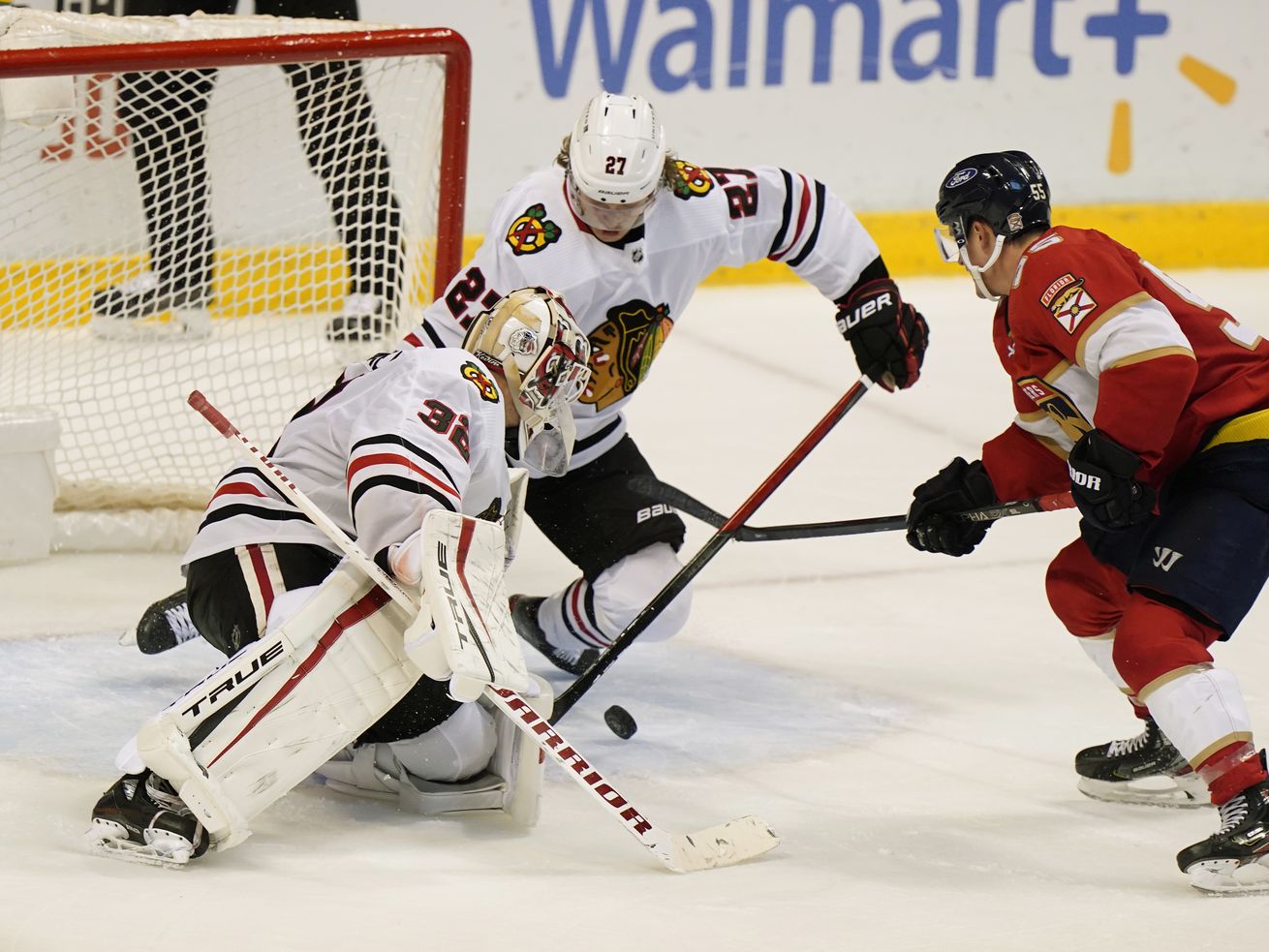
The Panthers scored five unanswered goals to beat the Blackhawks 6-3 on Monday. | AP Photo/Wilfredo Lee
The Hawks’ penalty kill conceded two goals before the power play gave up a backbreaking short-handed goal in the 6-3 defeat.
When the Blackhawks’ even-strength play has struggled, their special teams often have kept them afloat.
That wasn’t the case Monday.
An abysmal night by the power-play and penalty-kill units doomed the Hawks to a 6-3 loss to the Panthers, their fourth defeat in their last five games.
‘‘To boil it down, we just didn’t have the desperation when the game was on the line at the key moments that they did,’’ coach Jeremy Colliton said. ‘‘You have to bring your best all the time. Most of the time is not going to cut it.’’
The Hawks’ penalty kill, which had been better in the last few games but generally has been poor in the last few weeks, surrendered two goals on three Panthers power plays.
The first came after an arguably cheap tripping penalty on defenseman Duncan Keith that Colliton later called ‘‘stupid.’’ The second jump-started the Panthers’ comeback after goals by Philipp Kurashev and Brandon Hagel briefly gave the Hawks a 3-1 lead in the second period.
Colliton recently has implored the penalty kill to be more aggressive, but that strategy seemed to space them out too much Monday, giving the Panthers’ passes plenty of space to slice through.
‘‘We couldn’t find clears sometimes,’’ Hagel said. ‘‘Maybe [we need to] win more battles.’’
The power play was even worse. On their first three power plays, the Hawks were outshot 1-0 by the Panthers’ penalty-killers. On their fourth, they conceded a go-ahead short-handed goal to Aleksander Barkov with 6:34 left.
‘‘What happened at the end with the power play was inexcusable,’’ Colliton said. ‘‘Tough to explain how that happens.
‘‘At the very least, [we need to have] just the desperation to not get scored on. They scored the goal, but on the power play before, they got a chance, as well. Our power play has been really good for us this year, won us some hockey games. Tonight was tough.’’
The Hawks’ ongoing faceoff woes are a ‘‘big part . . . no question’’ of their troubles on special teams, Colliton admitted. They won only 24 of 64 draws Saturday, then just 25 of 65 draws Monday.
But the power play also faltered in board battles, lacked creativity on zone entries and hesitated in possession in the offensive zone. Even wing Patrick Kane, who at one moment in the first period had lots of room to shoot or make a dangerous pass, waffled indecisively until the Panthers closed down and knocked the puck away.
‘‘To me, when we’ve been at our best on the power play, we win a 50-50 [battle and] we attack,’’ Colliton said. ‘‘You hope you’re going to win pucks back and win those battles, and then they’re exposed. Because typically they’re going to commit numbers to try to win [the puck] back. So if you can win those pucks, then there are plays to make. But we didn’t win enough of them.’’
Thanks to two late empty-netters, the Panthers finished the game scoring five consecutive goals. It was the third time in the last five games in which the Hawks allowed four or more consecutive goals. They also have blown seven of their nine multigoal leads since the start of February.
And with two games against the Lightning — then two more against the Panthers — coming up, these are trying times.
‘‘From where I sit, there are two choices [we] can make,’’ goalie Kevin Lankinen said. ‘‘You can bury your head and feel bad for yourself or just learn and keep moving forward.’’