What’s New

Stigmas on race, gender and sex overlap in Atlanta slayingsAssociated Presson March 18, 2021 at 8:11 pm

A woman places flowers near a makeshift memorial outside of the Gold Spa in Atlanta, Wednesday, March 17, 2021.
A woman places flowers near a makeshift memorial outside of the Gold Spa in Atlanta, Wednesday, March 17, 2021. Police in the Atlanta suburb of Gwinnett County say they’ve begun extra patrols in and around Asian businesses there following the shooting at three massage parlors in the area that killed eight, most of them women of Asian descent. | AP

While the U.S. has seen mass killings in recent years where police said gunmen had racist or misogynist motivations, advocates and scholars say the shootings this week at three Atlanta-area massage parlors targeted a group of people marginalized in more ways than one, in a crime that stitches together stigmas about race, gender, migrant work and sex work.

Seven of the eight people killed were women; six were of Asian descent. The suspect, according to police, appeared to blame his actions on a “sex addiction.”

While the U.S. has seen mass killings in recent years where police said gunmen had racist or misogynist motivations, advocates and scholars say the shootings this week at three Atlanta-area massage parlors targeted a group of people marginalized in more ways than one, in a crime that stitches together stigmas about race, gender, migrant work and sex work.

“In some ways this is another manifestation of the targeting of marginalized people in the U.S.,” said Angela Jones, an associate professor of sociology at Farmingdale State College, State University of New York, whose research has focused on race, gender, sexuality and sex work.

The killings in Atlanta follow a wave of recent attacks against Asian Americans since the coronavirus first entered the United States, with the majority of reports coming from women. The 21-year-old suspect denied his attack was racially motivated and claimed to have a “sex addiction,” with authorities saying he apparently saw massage parlors as sources of temptation.

It’s not yet clear if the businesses offered sexual services or if the shooter had gone there before, but the Atlanta mayor said police hadn’t previously been there beyond a minor potential theft. Still, the suspect equated the parlors to sex, and that drove him to kill, police said.

“There’s this assumption that all these massage parlor workers are sex workers. That may or may not be the case,” said Esther Kao, an organizer with New York-based Red Canary Song, a group of Asian and Asian American sex workers and allies that does outreach to massage parlors. “The majority of massage parlors are licensed businesses that also provide professional, non-sexual massages.”

“There’s this assumption of sexuality and fetishization of Asian women’s bodies that is unique to this kind of crime,” she said.

At least one of the victims was a patron, not an employee. Thirty-three-year-old Delaina Ashley Yaun and her husband had gone to the spa on a date, her mother, Margaret Rushing, told WAGA-TV. Yaun leaves behind a 13-year-old son and 8-month-old daughter.

The shootings follow high-profile instances of race and gender-based killings in recent years by white men. In 2014, a 22-year-old who had railed against women online killed six people and wounded 14 near the University of California, Santa Barbara. The following year, eight Black church members and their pastor were shot and killed in a racist attack in South Carolina. In 2018, a Florida gunman with what police called a “hatred towards women” killed two and injured five at a yoga studio. The year after that a shooter targeting Latinos opened fire at an El Paso, Texas, Walmart, killing 22 people.

“This is a thread that is woven through the histories of these gunmen. Toxic masculinity is truly a problem in this country,” said Shannon Watts, founder of the gun-control group Moms Demand Action.

The fact the Georgia shooter targeted the businesses because he linked them to commercial sex is a nightmare scenario for those who work in erotic industries and are increasingly subjected to online harassment and attempts to report massage parlors to the IRS, said Kate D’Adamo, an organizer and advocate for sex worker rights. “At its core it’s about going out and targeting sex workers as fallen women, blaming them for social ills,” she said.

Prostitution laws mean women also fear reporting harassment or violence to police, afraid of being arrested themselves or their pleas ignored, she said. Those fears are even more pronounced for women of color, those who are immigrants or those with few language skills.

They feel they can’t report crimes to police, said Barbara Brents, a University of Nevada, Las Vegas, sociology professor who studies the sex industry. “When they do, sex workers are not taken seriously and they’re also subject to arrest themselves.”

Researchers who spoke to more than 100 Chinese and Korean workers at illicit massage parlors for a 2019 study found that while some women did say they felt deceived or coerced into jobs that involved sex work, many more chose the profession after having bad experiences in the few other types of generally low-paying jobs available to them, like restaurants and nail salons.

While there were some reports of exploitation or mistreatment by managers, an “alarming” 40% of women told researchers that a client had forced them to have sex in the last year, the study said.

In the Atlanta shooting, the suspect’s claims of sex addiction, meanwhile, ring hollow for some. It is not a condition recognized by the American Psychiatric Association, said David Ley, a clinical psychologist and author of “The Myth of Sex Addiction.” And while it was cited by celebrities for a time, the Harvey Weinstein case became an emblem of how it can be used as an attempt to avoid taking responsibility for abuse and assault, he said.

There’s also a disturbing thread of racism in some online discussions of sex addiction, he said.

“They hold other people — the porn industry, sex workers, even women in general — responsible for triggering these sexual desires in them they are afraid of,” he said.

Moral views can shape beliefs about sexuality, and friends described the Atlanta shooting suspect as being deeply Christian. He also told police he had planned to go to Florida to target the porn industry.

The sex-addiction claim is a way to redirect blame, Kao said. “He’s absolutely taking no responsibility and putting all of that on the workers themselves and it also distracts from the race issue,” she said.

Meanwhile, the suspect, Robert Aaron Long has been arrested on charges of murder and assault. It wasn’t clear yet if he had a lawyer who would represent him.

Police said Long confessed to the crime and told officials about a “temptation for him that he wanted to eliminate.”

___

Whitehurst reported from Salt Lake City and Price from Las Vegas.

—-

Follow Lindsay Whitehurst at twitter.com/lwhitehurst and Michelle Price at twitter.com/michellelprice

Read More

Stigmas on race, gender and sex overlap in Atlanta slayingsAssociated Presson March 18, 2021 at 8:11 pm Read More »

Blackhawks notebook: Stan Bowman ‘actively having conversations’ about trade possibilitiesBen Popeon March 18, 2021 at 8:18 pm

Calvin de Haan is a veteran the Hawks might consider trading ahead of the deadline. | AP Photos

Plus, the Hawks signed prospect Josiah Slavin this week and are “hoping” Dylan Strome returns to action soon.

The Blackhawks have numerous routes available to them as trade chatter grows around the NHL.

General manager Stan Bowman said during a live taping of the team’s podcast Wednesday that he’s “actively having conversations” with other GMs, even though the April 12 trade deadline remains more than three weeks away.

“I don’t know if you would call us a seller or a buyer,” Bowman said. “We’re willing to do a little bit of both, but we’re not going to sell off players we think have a future for us.

“We’re trying to add players that we think can be part of our future. I don’t think we’re going to be looking for rental players who will be here a couple of months and having to give up some top, young assets to do it.”

The Hawks could viably pursue three different approaches to the trade market.

With abundant salary cap space this season and next, the Hawks could accumulate some valuable prospects or draft picks by taking on another space-strapped team’s bad contract. Bowman confirmed Wednesday he’s open to doing so, and it would make a lot of sense.

The Hawks own several veterans they could sell off for more picks and prospects. Mattias Janmark and Carl Soderberg are both pending unrestricted free agents with some value.

Lucas Wallmark’s contract is also expiring (although he’ll be a restricted free agent); his lack of a steady role makes him expendable if there’s interest. Calvin de Haan appears on track to be exposed in the expansion draft, so the Hawks could look to trade him before then.

And, as Bowman mentioned, the Hawks could also consider acquiring a young player with contract term that could help both this season — the team is still in a playoff spot for now, despite their recent downturn — and in the future.

The Hawks must be mindful of the fact they’re currently two contracts away from the 50-contract limit. They also won’t completely gut their roster, so probably only one or two of Janmark, Soderberg, Wallmark and de Haan will exit.

Slavin signs

The Hawks signed wing Josiah Slavin, their 2018 seventh-round pick, to his entry-level contract on Tuesday.

Slavin’s two-year deal officially kicks in next season — a move likely done to avoid inching closer to that 50-contract limit right now — but he’ll spend the rest of this season in Rockford on an AHL “tryout” contract.

The younger brother of Hurricanes defenseman Jaccob Slavin, Josiah Slavin played for the Chicago Steel in 2018-19 and then Colorado College in 2019-20 and 2020-21. His college season ended last week; he scored 13 points in 22 games.

The Hawks will need to make decisions by this summer on whether to sign or relinquish the rights to their last four picks from the 2017 draft — Roope Laavainen, Parker Foo, Jakub Galvas and Josh Ess — as well as 2019 seventh-rounder Cole Moberg.

Strome close to return

The Hawks are “hoping” Dylan Strome will play in one of the two games (Thursday or Saturday) in this series against the Lightning, coach Jeremy Colliton said Thursday.

Strome hasn’t appeared since Feb. 19 due to a concussion but has been practicing with the team since March 8.

“Any time you can inject some new energy, [it’s good],” Colliton said. “He’s shown he can produce at our level. And [it’d create] a little more competition as well in the forward group, which we would welcome.”

Read More

Blackhawks notebook: Stan Bowman ‘actively having conversations’ about trade possibilitiesBen Popeon March 18, 2021 at 8:18 pm Read More »

Illinois vs. Loyola? Only if Ramblers can overcome Georgia Tech perimeter trioSteve Greenbergon March 18, 2021 at 8:13 pm

ACC Men’s Basketball Tournament - Georgia Tech v Florida State
Jose Alvarado is the most dangerous guard on — with Moses Wright unable to play — a guard-oriented Georgia Tech squad. | Photo by Jared C. Tilton/Getty Images

Even with ACC player of the year Moses Wright out, the Yellow Jackets have dangerous defenders and shot creators in Jose Alvarado, Michael Devoe and Jordan Usher.

How does Illinois coach Brad Underwood size up 16th-seeded Drexel, the top-seeded Illini’s opening NCAA Tournament opponent?

“They know exactly what they’re trying to get every possession down the court on the offensive side,” Underwood said. “They execute extremely well. I’ve been very impressed by how hard they play. Even though they start a freshman and a sophomore, they have a vast amount of knowledge; their go-to guys are upperclassmen. They rebound the ball great. And they’ve got all the makings of a team that deserves to be there.”

Translation: Somebody bring me those Loyola and Georgia Tech scouting reports.

If the Illini (23-6) lose to the champs of the Colonial Athletic tournament, it’ll be merely the second-biggest upset in the history of the Big Dance. Nothing the Dragons (12-7) pull off Friday could top UMBC’s takedown of Virginia in 2018 — the lone victory in 140 tries for 16s against 1s. There’s only one first time.

Far bigger drama comes with eighth-seeded Loyola (24-4) against ninth-seeded Georgia Tech (17-8). It doesn’t take a fan with a maroon-and-gold scarf to question why the selection committee didn’t bump up the Ramblers a seed line or two given how highly they were ranked by those with poll votes or fancy advanced metrics attached to their names.

It’s one thing to try to survive the Yellow Jackets, winners of eight in a row and champs of the ACC tournament. But to have Illinois lined up next in the Midwest region? Pretty rough.

On the other hand, some of us are old enough to remember when winning even one NCAA Tournament game would’ve been a really big deal up in Rogers Park. And the Ramblers’ chances at an opening “W” got a lot better when the Yellow Jackets’ best player, Moses Wright — the ACC player of the year — tested positive for COVID-19 during intake screening in Indianapolis.

Wright, the team’s top scorer and rebounder and the only true big man in its regular rotation, is in isolation and, according to coach Josh Pastner, asymptomatic.

“A gut punch,” Pastner said of losing his best player, who won’t be available against the Illini if the team gets past Loyola. “It stinks.”

Without much depth at his disposal under the best of circumstances, Pastner likely will have to give 6-10 Rodney Howard — who has played double-digit minutes only five times all season — extended duty against Ramblers star center Cameron Krutwig.

Krutwig, a deft, crafty, dancing-bear lefty against Wright, a monster dunker who can knock down the three, would’ve been a riveting watch for basketball lovers. Nationally, Wright against Illinois center Kofi Cockburn would’ve been among the biggest storylines of Round 2.

Then again, Cockburn, a second-team All-American, vs. Krutwig, a third-teamer, would be mighty special. It’s fun to look ahead like that, isn’t it? To take things two games at a time, if you will.

Needless to say, the Ramblers can’t operate in such a manner. Not at tournament time. Not against a foe from the big, bad ACC. Not against anyone.

As good as Wright is, the best thing about the Yellow Jackets during their hot streak is how their perimeter play came alive. Long slashers Michael Devoe and Jordan Usher and slick point guard Jose Alvarado aren’t big three-point shooters, but each can create off the dribble and turn a game with disruptive defense. Krutwig will make a huge imprint on this game, but it’ll be Braden Norris, Lucas Williamson and the rest of the Ramblers guards who need to keep up.

Loyola, though, enters the game as a strong favorite. Even after the Final Four run of 2018, this fact alone is pretty wild when you step back and think about it.

Read More

Illinois vs. Loyola? Only if Ramblers can overcome Georgia Tech perimeter trioSteve Greenbergon March 18, 2021 at 8:13 pm Read More »

Gov. J.B. Pritzker’s introduced a ‘bridge’ phase that includes increasing capacity limits, business operations (LIVE UPDATES)Sun-Times staffon March 18, 2021 at 9:26 pm

Pat Nabong/Sun-Times

Here’s the latest news on how COVID-19 is impacting Chicago and Illinois.

Latest

Pritzker unveils reopening plan, vaccinations available for all over 16

Nearly a year after he issued his first stay-at-home order, Gov. J.B. Pritzker announced his plan to reopen the state, a “bridge” phase that includes increasing capacity limits at places like museums and zoos but also sets thresholds for vaccinations and new COVID-19 caseloads as the state inches toward normalcy “with a dial-like approach.”

The governor also announced the expansion of coronavirus vaccine eligibility to all Illinois residents over 16 — except Chicagoans — starting April 12 along with the new “bridge” phase as part of his plan to reopen the state, sources told the Chicago Sun-Times Wednesday.

“Although we still are in the midst of a global pandemic, the end seems truly to be in sight,” Pritzker said.

The bridge phase will allow for higher capacity limits at museums, zoos and spectator events as well as increased business operations, according to a news release announcing the plan.

To achieve that stage, the entire state must reach a 70% first-dose vaccination rate for residents 65 and over, maintain a 20% or lower ICU bed availability rate and hold steady on COVID-19 and COVID-like illness hospital admissions, mortality rate, and case rate over a 28-day monitoring period.

To reach the reopening phase, the state must reach a 50% vaccination rate for residents age 16 and over and meet the same metrics and rates required to enter the transition phase, over an additional 28-day period, the news release said.

The governor said Thursday Illinois will resume normal business operations “when at least 50% of our 16 and over population has received at least one dose.”

Read the full story from Rachel Hinton here.


News

4:25 p.m. Illinois’ coronavirus death toll surpasses 21,000 as pandemic wanes

Illinois’ COVID-19 death toll eclipsed 21,000 on Thursday, a sobering reminder that the virus is still ravaging families across Illinois even as vaccine supply improves and the state gradually prepares to reopen for business.

The latest 34 coronavirus deaths reported by the Illinois Department of Public Health included nine Cook County residents and raised the statewide pandemic total to 21,022. Another 2,265 deaths are considered to have been “probable,” untested cases.

Since a South Side woman became the state’s first known victim of COVID-19 a year ago, the virus has claimed an average of 58 Illinois lives every day.

But the daily death rate was almost triple that figure during the worst days of the crisis. Nearly 1,100 residents lost their battles with COVID-19 during the first week of December, amounting to roughly 156 deaths each day. That included the worst day of all with 238 coronavirus fatalities logged Dec. 2.

That was also the week before Illinois’ first coronavirus vaccine doses were administered. The death rate has shrunk by about 85% since then, with an average of 23 COVID-19 deaths per day over the past week.

Read the full story from Mitchell Armentrout here.

12:01 p.m. Pritzker to extend vaccine eligibility to all adult non-Chicagoans in state on April 12, sources say


Pat Nabong/Sun-Times
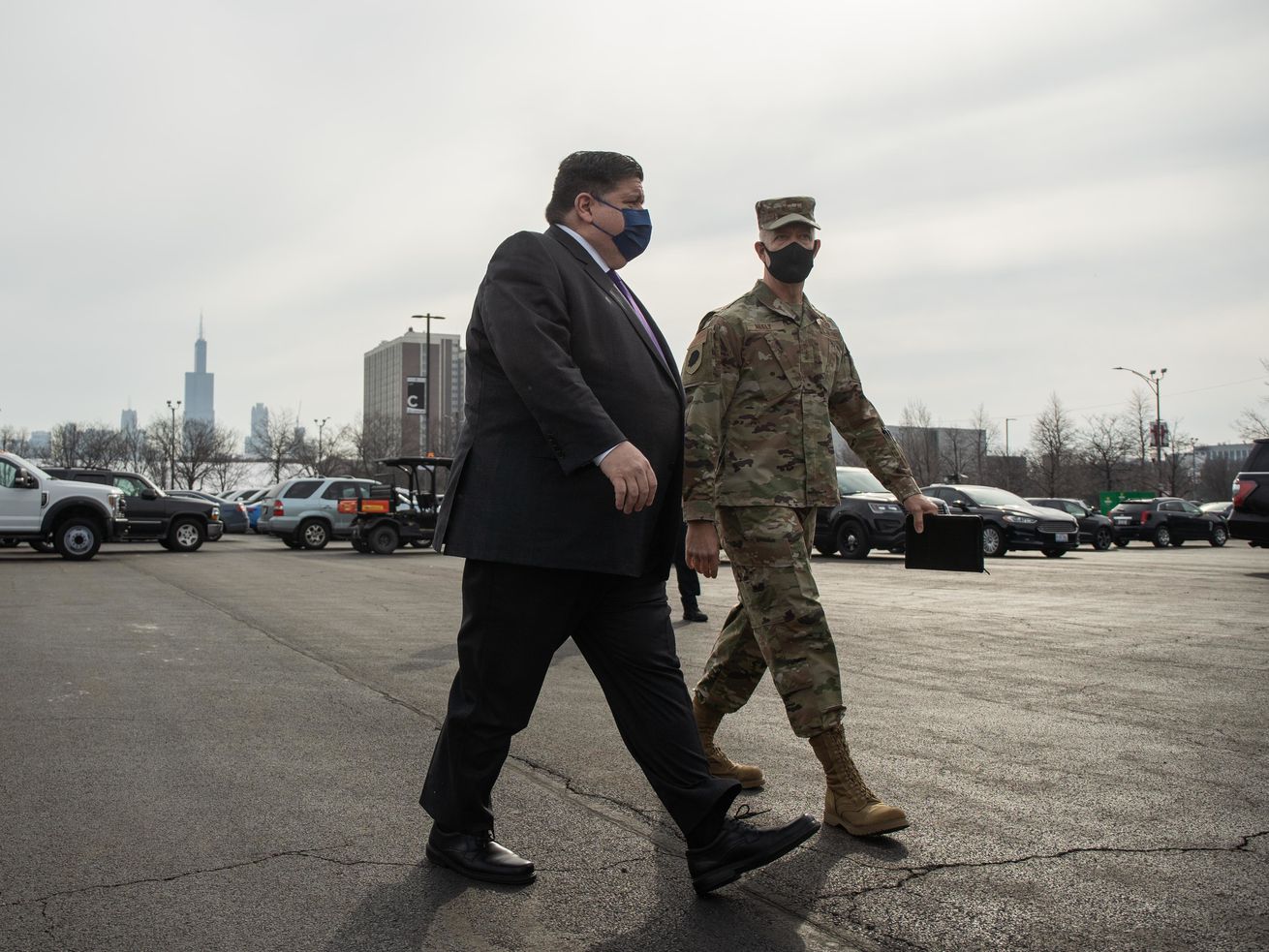
Gov. J.B. Pritzker and Major General Richard Neely walk to a press conference about the opening of the new COVID-19 mass vaccination site on the parking lot of the United Center in the Near West Side neighborhood, Tuesday morning, March 9, 2021.

Gov. J.B. Pritzker plans to expand coronavirus vaccine eligibility to all Illinois residents over 16 — except Chicagoans — starting April 12, and initiate a new “bridge” phase as part of his plan to reopen the state, sources told the Chicago Sun-Times.

The governor is expected to make the announcement at 11:30 a.m. Thursday at the Thompson Center.

Chicago receives its own federal vaccine allotment and sets its own eligibility rules. City Public Health Commissioner Dr. Allison Arwady said Wednesday that “most Chicagoans” could get in line for the vaccine by March 29, with an expansion to those over 16 with underlying conditions and targeted groups of essential workers.

Pritzker had already made a comparable expansion for the rest of the state last month. On April 12, the only requirement for the state’s non-Chicagoans will be that they be over the age of 16.

President Joe Biden last week urged states to make all adults eligible for vaccines by May 1, a deadline Pritzker predicted the state would beat.

The bridged reopening Pritzker is planning to announce on Thursday will allow for “a gradual increase in capacity limitations” as the state vaccinates more people and continues to monitor case numbers, one source said.

All of the state’s regions will move into the intermediate phase — there will be additional metrics to meet, involving new case numbers and the state’s positivity rate, to get to Phase 5, which is a full reopening, the source said. The state has been in Phase 4 since last summer.

Pritzker said Wednesday, saying he expects to unveil a plan this week that is “not only healthy for everybody, but also good for the economy.”

Part of the challenge to lifting restrictions will be handling threats posed by newer, faster spreading coronavirus variants — but the governor suggested that was not an insurmountable hurdle to reopening.

“Let me be clear to everybody,” the governor said at a news conference in downstate Decatur. “I am more optimistic today than I have ever been throughout this pandemic, about where we are going and getting to the end of the pandemic.”

Read the full story here.

11:37 a.m. Who deserves credit? Biden leans into pandemic politics

WASHINGTON — In President Joe Biden’s war against the coronavirus, former President Donald Trump hardly exists.

The Democratic president ignored Trump in his first prime-time address to the nation, aside from a brief indirect jab. It was the same when Biden kicked off a national tour in Pennsylvania on Tuesday to promote the $1.9 trillion American Rescue Plan. Now, as his administration is on the cusp of delivering on his promise of administering 100 million doses of vaccine in his first 100 days, Biden is in no rush to share the credit.

The truth is that both Biden and Trump deserve some credit, though Biden stands to benefit from being in power during the nation’s emergence from the pandemic. In the president’s telling, the United States’ surging vaccination rate, economic recovery and the hope slowly spreading across the nation belong to him and his party alone.

On Thursday afternoon, Biden is set to provide an update on the state of the vaccination campaign, with what is expected to be an early victory lap on reaching the milestone more than a month before he promised. While the official figures won’t be reported for days, the 100 millionth dose is likely to be administered on Thursday — his 58th day in office.

The president’s approach represents a determination to shape how voters — and history — will remember the story of America’s comeback from the worst health and economic crises in generations. In the short term, the debate will help decide whether Democrats will continue to control Congress after next year’s midterm elections. And in the longer term, each president’s legacy is at stake.

For now, the fight is framed by conflicting realities.

Read the full story here.

9:47 a.m. Trump Tower vaccine fiasco ‘absolutely can never be repeated,’ Lightfoot says

A “disappointed” Mayor Lori Lightfoot on Wednesday chastised executives at The Loretto Hospital who approved a round of COVID-19 vaccinations for employees of the tony Trump International Hotel & Tower last week even though they weren’t eligible to get the coveted shots.

The CEO of the Austin neighborhood hospital — which the mayor chose as the site of the city’s first-ever vaccine dose as a show of commitment to equitable vaccine distribution in low-income communities of color — has said “we were mistaken” in letting the 72 hotel workers jump to the front of the line.

Lightfoot called it a blunder that “can never be repeated.”

“Of course I was disappointed to hear about it. … Loretto has been a tremendous partner with the city,” Lightfoot said during a news conference announcing the city’s plan to expand eligibility — including to hospitality workers — on March 29.

Read the full story from Mitchell Armentrout and Brett Chase here.


New Cases & Vaccination Numbers


Analysis & Commentary

3:00 p.m. Most of American Rescue Plan Act is only tenuously related to pandemic

The “recovery rebates” that Americans began receiving this week supposedly have something to do with the economic damage caused by COVID-19 and the control measures it inspired. But like most of the so-called American Rescue Plan Act, these payments, which account for more than a fifth of the bill’s $1.9 trillion price tag, are only tenuously related to the pandemic.

The Democrats who championed the law hope those bribes will buy them votes in the midterm elections. But you really should be thanking your children and grandchildren, because they will ultimately pick up the tab for this package and the rest of the $5 trillion spending binge that Congress claimed was justified by a public health emergency.

Individuals with adjusted gross incomes of up to $75,000 will get $1,400, while married couples earning up to $150,000 will get $2,800, plus $1,400 for each dependent. That amounts to $5,600 for a four-person family, on top of the $5,800 that such households received under the coronavirus relief packages that Congress approved in March and December.

Congress distributed that money without regard to whether the recipients had suffered pandemic-related economic distress. A Pew Research Center survey conducted last August suggests that most of them have not: 42% of respondents said they or someone in their households had lost jobs or income due to COVID-19, less than half the 85 % of Americans who are expected to receive the latest round of payments.

Read the full column here.

Read More

Gov. J.B. Pritzker’s introduced a ‘bridge’ phase that includes increasing capacity limits, business operations (LIVE UPDATES)Sun-Times staffon March 18, 2021 at 9:26 pm Read More »

White Sox clubhouse vibes ‘are great’ with new manager Tony La RussaDaryl Van Schouwenon March 18, 2021 at 9:38 pm

White Sox manager Tony La Russa talks with pitcher Lance Lynn during spring training drills. (John Antonoff/For the Sun-Times)

“He wants to prove it was the right decision,” White Sox GM says

GLENDALE, Ariz. – Everyone braced for the worst when Tony La Russa, age 76 and a Hall of Famer but one who hadn’t managed since 2011, was named White Sox manager.

But here we are, four weeks through spring training and two weeks from Opening Day, and Sox players have expressed nothing but acceptance and support. Setting a well-received tone at the beginning of camp by saying he had to earn his players’ respect, and admitting being nervous about undertaking his new job, La Russa was in good standing at the outset and has done nothing to lose it.

Star shortstop Tim Anderson, guarded and cautious when first asked about La Russa during the winter, wants it made known that he’s behind him and that everything is good in the Sox clubhouse.

“I want everyone to know Tony is great, me and Tony is fine, I love Tony,” shortstop Tim Anderson told the Sun-Times Thursday. “Tony is going to allow us to do whatever we want to do.”

La Russa’s surprise hire in October was initially met with outrage, primarily because of his age and his close friendship with chairman Jerry Reinsdorf.

There were concerns about how the young, lively and fun loving Sox would mesh with an old-school manager who doesn’t seem to be fond of bat flipping.

Anderson said he’s going to keep doing his thing.

“One more big announcement: Tony and the White Sox are totally fine,” Anderson said. “The vibes are great, we’re all definitely getting along. So let’s not forget what the ultimate goal is and what we’re trying to accomplish here.”

First impressions have been good. Early in camp, Adam Engel said La Russa does “everything for a reason” and communicated clearly.

“A really cool thing about Tony is there’s no question marks behind what he’s doing,” Engel said. “He’s going to tell you why he’s doing it. If it seems different, he’s going to tell you why. He’s incredibly smart, incredibly wise, a ton of experience. You can just tell that nothing surprises him. He sees stuff and it’s like he saw it coming.”

Sox Opening Day starter Lucas described his first phone conversation with La Russa as “amazing.”

A guest on Jomboy Media’s “The Chris Rose Rotation” podcast Thursday, Giolito said, “You know, when we hired him, media was going crazy, ‘he’s not going to connect with the younger guys,’ this and that. I was reading it and I was like, ‘where is this coming from? I get it to a certain degree but he hadn’t even talked to a player yet. Does he get a chance or not?”

Respecting La Russa’s resume, Giolito reserved judgment.

“The first conversation was amazing,” Giolito said. “Once we got into baseball stuff, the first place he went was, “at least to my knowledge from what everyone’s told me you guys have a strong clubhouse. I’m going to have to earn your guys’ respect.”

That is how La Russa has approached it from the start, general manager Rick Hahn said.

“He wants to prove it was the right decision, that people put aside the resume, he’s the right guy for this team and he can play his role in getting us to the promised land,” Hahn told the Sun-Times. “ He knows there was doubt and naysayers and he’s doing everything in his power to prove them wrong. It starts in the clubhouse and then the organization.

“The trust and faith seems uniform throughout the organization right now. It’s going to take a little longer.

“In the end we all realize we’re going to be judged on whether it yields a championship or two. In the meantime, he’s doing everything in his power day by day to get us closer to that.”

Read More

White Sox clubhouse vibes ‘are great’ with new manager Tony La RussaDaryl Van Schouwenon March 18, 2021 at 9:38 pm Read More »

7 Hottest Chefs in Chicago Right NowAudrey Snyderon March 18, 2021 at 7:44 pm

One of the best things about Chicago (claimed by residents and visitors alike) is its food. Not only is the quality of so many items offered by local restaurants great, but the breadth and variety of Chicago’s food landscape is unparalleled by most other cities. Who are the heroes responsible for these tongue-tickling creations? Who are the wizards whipping up these masterpieces? These are seven of the hottest chefs in Chicago right now and the restaurants they bless their talents with. 

Margaret Pak, Thattu

Though Thattu’s Food Hall location is currently closed, Pak’s intriguing and delicious “Indian street food concept,” inspired by the Kerala region of India, continues through pop-up events. Subscribe to Thattu’s newsletter for a chance to taste Kerala Fried Chicken, Kadala Curry, and more.

Erick Williams, Virtue

Williams’ restaurant Virtue, which “melds his background in fine dining and his love of southern cuisine,” serves delectable dinner menu items including BBQ pork steak, lemon chicken, and catfish. Every Friday, Virtue’s Black Expression Series invites patrons to enjoy dinner and wine during a Zoom discussion hosted by Black community leaders and innovators.

Sarah Grueneberg, Monteverde

A chef and partner at the West Loop Italian restaurant, Grueneberg has been the driving culinary force behind the pastificio as it has received a growing list of awards and accolades since its opening in 2015. Try fresh, housemade Spaghetti, or some Tortelloni di Zucca.

Darnell Reed, Luella’s Southern Kitchen

Reed has traveled the world to expand his culinary horizons, but his “first love is food of the south.” Inspired by the recipes and methods of his great-grandmother Luella (who moved from Mississippi to Chicago in the 1940s), Reed created an amazing menu that is true to its southern roots, and includes items such as Chicken Gumbo, Shrimp and Grits, and Chicken and Waffles.

Carlos Gaytán, Tzuco

With a name inspired by Gaytán’s Mexican hometown Huitzuco, the French-technique-infused Mexican restaurant serves items like the Tzuco Burger— beef, Gruyère, Serrano peppers, and black truffle aioli are key ingredients in this culinary concoction of epic proportions. The inventive and hard-working Gaytán became the first Mexican chef to receive a Michelin star in 2013.

Gene Kato, Momotaro

The chef of seasonal Japanese restaurant Momotaro grew up in a Japanese household in North Carolina, and in his practice remains “devoted to elevating Japanese cuisine while remaining authentically respectful of tradition.” Visit the Fulton Market District, where Momotaro’s menu includes Beef “Tsukune” Sliders, Mapo Tofu, and a vast selection of sushi and sashimi.

Thai Dang, HaiSous

Born in Vietnam and raised just outside Washington, D.C., Dang brings a combination of true Vietnamese flavors and well-practiced, modern culinary techniques to his restaurant HaiSous. Those hungry for these lauded creations can visit HaiSous in Pilsen, where they can order such items as Chả Giò (an egg roll lettuce wrap), Cá Nướng Xả (roasted bass with lemongrass), and Vietnamese Rice Pudding.

Hottest Chefs Chicago Featured Image Credit: Luella’s Chef on Instagram

The post 7 Hottest Chefs in Chicago Right Now appeared first on UrbanMatter.

Read More

7 Hottest Chefs in Chicago Right NowAudrey Snyderon March 18, 2021 at 7:44 pm Read More »

Chicago Bears Rumors: Kenny Golladay meets with teamJordan Campbellon March 18, 2021 at 8:59 pm

The Chicago Bears officially introduced their new starting quarterback on Thursday in the form of Andy Dalton and it appears that they are determined to add some offensive weapons in order to assist Dalton in his efforts with the team. The most talented offensive player on the Bears’ roster is wide receiver, Allen Robinson. The issue […]

Chicago Bears Rumors: Kenny Golladay meets with teamDa Windy CityDa Windy City – A Chicago Sports Site – Bears, Bulls, Cubs, White Sox, Blackhawks, Fighting Illini & More

Read More

Chicago Bears Rumors: Kenny Golladay meets with teamJordan Campbellon March 18, 2021 at 8:59 pm Read More »

Mitch Trubisky signs 1-year deal with Buffalo BillsJason Lieseron March 18, 2021 at 6:59 pm

Trubisky, the No. 2 overall pick in 2017, has an 87.2 career passer rating. | AP Photos

Any thought Trubisky could return to the Bears was shot down when they agreed to sign quarterback Andy Dalton on Tuesday.

When the Bears traded four draft picks to move up one spot and draft Mitch Trubisky, they were confident they’d solved their quarterback problems for the next decade or so.

Less than four years after the trade, Trubisky’s time with the Bears is over.

He agreed to sign a one-year deal with the Buffalo Bills on Thursday, ending his Bears career with two playoff appearances, one injury replacement Pro Bowl berth and 29 wins over 50 starts. He will back up starter Josh Allen.

“I don’t know what went on in Chicago, but he started 50 games,” Bills general manager Brandon Beane told reporters. “The label has been put on Mitchell from afar that maybe he doesn’t deserve it. This is a reset for him. We don’t expect him to be here long term.”

Any thought Trubisky, 26, would return to the Bears was shot down when they agreed to sign quarterback Andy Dalton on Tuesday.

Trubisky did indicate a willingness to return to the Bears immediately after their playoff loss to the New Orleans Saints, insisting he had “unfinished business” in Chicago.

Trubisky will be best remembered for not living up to the expectations set when general manager Ryan Pace traded for him minutes into the 2017 draft in Philadelphia.

And, of course, the other quarterbacks Pace could have selected.

Trubisky was picked second. The Chiefs drafted Patrick Mahomes No. 10 and the Texans took Deshaun Watson No. 12. The Bears attended the Clemson pro day of the most decorated college quarterbacks of all time, but Watson has maintained for four years that the Bears talk to him before the draft.

Why?

“I have no idea,” Watson said in December.

Arguably the two most dynamic young quarterbacks in the sport, both Mahomes and Watson signed big-money contract extensions last offseason. The Bears, meanwhile, declined to give Trubisky his fifth-year option for 2021.

A parting between Trubisky and the Bears might be best for both sides. Pace and coach Matt Nagy are facing a must-win season, and Trubisky would benefit from being freed of the expectations heaped on him by a city that hasn’t cheered for an elite quarterback in 71 years.

Trubisky was drafted in 2017 just seven weeks after the Bears signed Mike Glennon in free agency. Glennon’s tenure lasted one season — and his starting job four games. Trubisky was inserted into the Bears’ lineup in Week 5. He won four of 12 starts. Coach John Fox was fired at the end of the season.

The Bears hired coach Matt Nagy — the Chiefs’ offensive coordinator that spent one season preparing Mahomes to start — to develop Trubisky. In Nagy’s first year, the pairing looked promising: Trubisky and the Bears went 12-4, won the NFC North and were a Cody Parkey double-doink away from winning their first playoff game.

Trubisky cratered enough in his third season, though, showing questionable decision-making and not running as often as he had earlier in his career, that the Bears decided not to pick up his option in May.

His final season with the team was a rollercoaster. He lost his starting job in the third quarter of the third game and returned only after a struggling Nick Foles hurt his hip in a Week 10 loss to the Vikings in Week 10. The Bears put Trubisky under center and assembled tempo-driven, run-based offensive attack, with good results. Trubisky lost to the Packers and Lions before winning three-straight games to give the Bears a win-and-they’re-in finale against Green Bay.

The Bears lost — but so did the Cardinals, allowing the Bears to back into the playoffs as the NFC’s first-ever No. 7 seed. They lost to the Saints in a blowout the next week.

Read More

Mitch Trubisky signs 1-year deal with Buffalo BillsJason Lieseron March 18, 2021 at 6:59 pm Read More »

Pritzker to expand vaccine eligibility, employ ‘dial-like approach’ to reopening state: ‘The end seems truly to be in sight’Rachel Hintonon March 18, 2021 at 7:48 pm

Gov. J.B. Pritzker on Thursday, March 18, 2021, announcing the state’s plan to open up vaccines to all Illinoisans over 16 — except Chicagoans — by April 12 and the “bridge” phase to reopening the state. To his left is Ngozi Ezike, head of the Illinois Department of Public Health.
Gov. J.B. Pritzker on Thursday, announcing the state’s plan to open up vaccines to all Illinoisans over 16 — except Chicagoans — by April 12 and the “bridge” phase to reopening the state. To his left is Ngozi Ezike, head of the Illinois Department of Public Health. | Pat Nabong/Sun-Times

The governor announced the expansion of coronavirus vaccine eligibility to all Illinois residents over 16 — except at Chicago sites — starting April 12, and set thresholds for vaccinations and new COVID-19 caseloads for the state to return to normal.

Nearly a year after he issued his first stay-at-home order, Gov. J.B. Pritzker on Thursday announced his plan to reopen the state, employing a “bridge” phase that will include increasing capacity limits at museums, zoos and other places.

The governor also announced the expansion of coronavirus vaccine eligibility to all Illinois residents over 16 — except at Chicago sites — starting April 12, and set thresholds for vaccinations and new COVID-19 caseloads for the state to return to normal.

“Although we still are in the midst of a global pandemic, the end seems truly to be in sight,” Pritzker said.

The state can enter that 28-day “bridge” phase to a full reopening when 70% of those 65 and over have received their first dose of the COVID-19 vaccine.

Pritzker expressed optimism about the state being able to return to more normal operations and pointed to the 58% first-dose vaccination rate for seniors, as of Thursday morning.

The state must also maintain a 20% or lower intensive-care-unit bed availability rate and hold steady on COVID-19 and COVID-like illness hospital admissions, mortality rate, and case rate over a 28-day monitoring period.

In the intermediate stage between Phases 4 and 5, museums will see their capacity limitations increase from 25% to 60%. The same limitations will apply to zoos.

Amusement parks will be able to increase capacity from the 25% restriction in Phase 4 to 60% in the intermediate stage. Festivals and general admission outdoor, spectator events can seat 30 people per 1,000 square feet in the bridge phase.

Meetings, conferences and conventions will see their capacity limit increase to either 1,000 people or 60%, whichever is less. The limitations around meetings also apply to theaters and performing arts venues.

The governor said Thursday Illinois will resume normal business operations “when at least 50% of our 16 and over population has received at least one dose.” The state’s mask requirement will be lifted when the U.S. Centers for Disease Control recommends it.

Pritzker wouldn’t put a date on when the state might get to the bridge phase, but with about 1% of the state’s population receiving the vaccine per day, it could happen “expeditiously.”

“While we’re racing against a tough clock — the new, more dangerous variants that is — it is fully in our power to turn the page on this dark and devastating chapter,” Pritzker said. “These vaccines are our fastest ticket back to hugging our grandkids, eating inside restaurants without worrying about the risks, school dances, community celebrations, all the things that we miss about normal life.”

Gov. J.B. Pritzker speaks during a news conference at the James R. Thompson Center in the Loop, Thursday afternoon.
Pat Nabong/Sun-Times
Gov. J.B. Pritzker speaks during a news conference at the James R. Thompson Center in the Loop, Thursday afternoon.

Throughout the pandemic, the governor has given local governments leeway to impose tighter COVID-19 restrictions, but not looser ones, and the city often has done just that, keeping a tighter lid on indoor capacity limits at bars and restaurants.

Citing scarce supply, Chicago has stayed a step behind the state’s vaccination plan for the past month, though any Chicago residents 16 and over will be able to go to any state-supported site to receive a vaccine starting April 12, a Pritzker spokeswoman said.

The city will open appointments to people 16 and older with chronic health conditions as it enters Phase 1C March 29 — more than a month after Pritzker allowed that to happen in other regions.

Chicago Public Health Commissioner Dr. Allison Arwady said the city, which receives its vaccine shipments separately from the rest of the state, won’t open appointments as allowed in Pritzker’s plan.

“I would like to spend the first month of this 1C period still doing some prioritization so that people [in high-contact jobs] and people with underlying conditions are prioritized above healthy 23-year-old college students,” Arwady said during a separate online Q&A. “Assuming that the vaccine supply is there, we will for sure expand to everybody May 1. Maybe we’ll do it before that if it’s there. … Some of it is just about how much do you have vaccine supply and when.”

Dr. Allison Arwady, commissioner of the Chicago Department of Public Health.
Ashlee Rezin Garcia/Sun-Times file
Dr. Allison Arwady, commissioner of the Chicago Department of Public Health, in January.

Pritzker said he hopes Chicago “will move expeditiously toward opening up [vaccine appointments] even more.

“I think that it will be hard for the city if people who can get vaccinated, who live just beyond the city borders, are able to get an appointment to go get vaccinated, but people who are within the city may not be able to because they haven’t opened that up,” the governor said. “But again, I think that’s up to them.”

As for business operations, city officials didn’t immediately respond to a request for comment on whether Mayor Lori Lightfoot will follow Pritzker’s bridge plan.

Dr. Rachel Rubin, a co-leader of the Cook County Department of Health, said the county had not yet made the decision about whether or not to follow the state in opening up its vaccine eligibility or the bridged reopening.

“We don’t know if we will go as quickly into that bridge or if we might break that bridge up into sort of different sections, the beginning, medium, and end part of that bridge, we will have to see,” Rubin said. “My inclination at this point is for us to be extremely cautious about opening up, our numbers of new cases have leveled out, they are not continuing to decrease at this moment, they have really leveled out.”

The governor’s new plan appears to allow for fans to attend Bulls and Blackhawks games at the United Center, and also opens the door to conventions — potentially offering a boon to a hospitality industry that has been decimated by the pandemic.

But that’ll be up to Lightfoot’s office.

“McCormick Place’s commitment throughout this pandemic has been to act in the best interest of public health and we will continue to do so as we await further information regarding re-opening guidelines for the city of Chicago,” a spokeswoman for the lakeside hall said in a statement. “We stand ready to re-open as soon as public health conditions allow.”

Illinois Restaurant Association President Sam Toia, who previously butted heads with the administration in expanding indoor service, called it “an important step towards recovery.”

“We have urged Gov. Pritzker to set a path to allow for expanded events with extensive safety measures in place, and this pragmatic approach to loosening restrictions will greatly enhance business opportunities for restaurants, event companies, conventions, and culinary tourism — all of which are critical to Illinois’ economic engine,” Toia said in a statement.

Illinois Retail Merchants Association president Rob Karr said it presents “a clear path forward to a full re-opening” — one that businesses hope “will be a short one,” he said in a statement.

Chicago Federation of Labor president Bob Reiter, a member of the Sun-Times board of directors, said “having a pathway toward reopening helps both workers and their employer plan a more defined path forward. To continue on this pathway to reopening, the health and safety of workers remains an absolute priority.”

Read Gov. Pritzker’s full “bridge phase” reopening plan:

Read More

Pritzker to expand vaccine eligibility, employ ‘dial-like approach’ to reopening state: ‘The end seems truly to be in sight’Rachel Hintonon March 18, 2021 at 7:48 pm Read More »

Civilian police oversight compromise includes binding referendumFran Spielmanon March 18, 2021 at 7:47 pm

Chicago Public Safety Headquarters.
A binding referendum could be used to establish the powers a civilian panel would have to oversee the Chicago Police Department. | Getty Images

If Chicago voters OK the binding referendum on the 2022 primary ballot, Mayor Lori Lightfoot would lose the power to hire and fire the police superintendent even though her political future could rise and fall on that choice.

Chicago voters would be asked to approve a binding referendum empowering a civilian police oversight commission to hire and fire the police superintendent, negotiate police contracts and set the Chicago Police Department’s budget, under a compromise ordinance circulated Thursday.

Two groups that have long pushed dramatically different versions of civilian police oversight followed through on their promise to join forces on a revised ordinance certain to encounter stiff resistance. That’s because it would strip both Lightfoot and the City Council of coveted authority over police issues.

If Chicago voters approve the binding referendum on the 2022 primary ballot, Lightfoot would lose the power to hire and fire the police superintendent even though her political future could rise and fall on that choice.

Her Law Department would lose the power to negotiate police contracts — ratified by the City Council.

And Lightfoot and aldermen would be stripped of the power they now hold to establish police spending. That power also would be ceded to an 11-member civilian oversight commission composed of nine elected commissioners and two appointed by the mayor.

Ald. Chris Taliaferro (29th), the former Chicago Police officer now chairing the Committee on Public Safety, described the compromise ordinance as overreach.

“It should be within the authority of the mayor to hire and fire the superintendent, the Police Board and the COPA administrator. If she’s gonna wear the hat for any good or bad that happens within the police department, she needs to be able to hire and fire the chief executive of those offices,” Taliaferro said.

“I can’t imagine being the mayor of a municipality and you have no say-so in the direction of the police department.”

Taliaferro said he’s all for civilian police oversight, but the powers of that commission should be confined to “observing the policies and procedures” of CPD, the Police Board and the Civilian Office of Police Accountability.

Even if voters do not approve the binding referendum, the 11-member commission would have the final say in disputes over police policy unless two-thirds of the City Council decides otherwise. The commission would also be empowered in any event to take a vote of no-confidence in the superintendent and hire and fire the chief administrator of the Civilian Office of Police Accountability.

“Once you start reaching too far into city government, why would you need a City Council? Why not take over City Council? … You can’t have one organization doing it all,” Taliaferro said.

Ald. Carlos Ramirez-Rosa (35th) championed the more extreme version of civilian oversight proposed by the Civilian Police Accountability Council before helping forge the compromise with the Grassroots Alliance for Police Accountability.

Ramirez-Rosa called the binding referendum the “constitutional and politically-sound pathway” for Chicago.

“Under mayoral control, we got Laquan McDonald. Under mayoral control, we saw the abuse of Anjanette Young. Under mayoral control, we ended up with this consent decree. Mayoral control isn’t working. It’s cost Chicagoans their lives. It’s cost the city of Chicago hundreds of millions of dollars in police misconduct settlements,” Ramirez-Rosa said.

If, as expected, Lightfoot opposes the compromise, “What she’s saying is, she doesn’t want to give the people of Chicago a choice.”

And what are the chances that a binding referendum would pass?

“CPAC leaders wouldn’t have agreed to this compromise had it not been for their belief that they can get out the vote for a directly-elected civilian commission with expanded powers,” Ramirez-Rosa said.

The mayor’s office had no immediate comment on the compromise ordinance.

A source close to the negotiations argued the overreaching referendum plays into the mayor’s hands.

“If she were a deft politician, she would try to sound reasonable and say, ‘I support community oversight. But I don’t support a community takeover of the Police Department,” said a source close to the negotiations who asked to remain anonymous.

“She would say, ‘You elected me to fix the Chicago Police Department. Putting it in the hands of this body isn’t the way to fix things and it isn’t the way Chicago runs.’”

Last month, Lightfoot pressured Taliaferro to postpone a showdown vote on civilian police review to give her time to introduce a substitute ordinance that, among other things, would empower the mayor to break disputes whenever she and the commission disagree on proposed changes to police policy.

Lightfoot has also objected to empowering the civilian board to take an advisory vote of no-confidence in the police superintendent that would trigger the superintendent’s firing if it’s followed by a two-thirds vote by the City Council.

The following day, GAPA and CPAC joined forces, putting even more pressure on the mayor.

Read More

Civilian police oversight compromise includes binding referendumFran Spielmanon March 18, 2021 at 7:47 pm Read More »