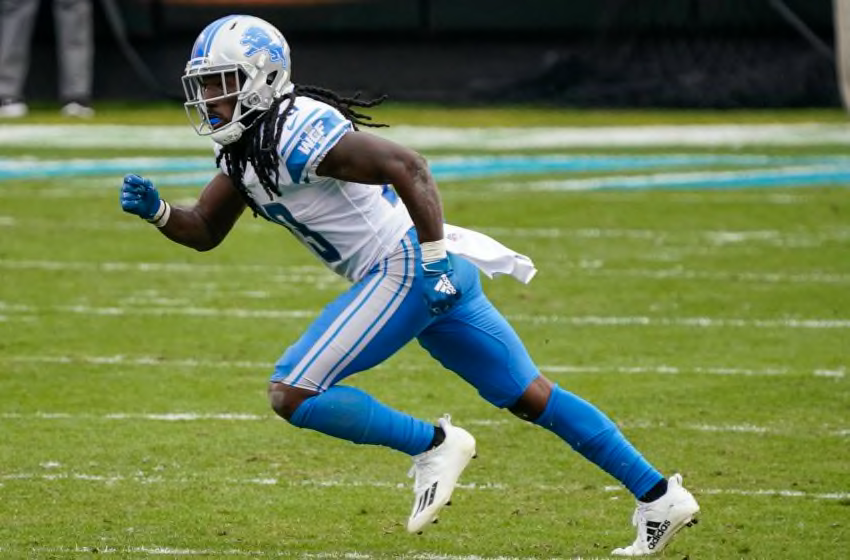
Nov 22, 2020; Charlotte, North Carolina, USA; Detroit Lions cornerback Desmond Trufant (23) reacts during the second half against the Carolina Panthers at Bank of America Stadium. Mandatory Credit: Jim Dedmon-USA TODAY Sports
The Chicago Bears prepared themselves on Friday for life without all-pro cornerback Kyle Fuller as the team agreed to a one-year deal with veteran cornerback Desmond Trufant.
It was reported on Thursday night that the Bears were preparing to release Fuller as a result of his $21 million cap hit for the 2021 season. The Bears had originally approached Fuller with a contract extension that would have seen his base salary cut in half and it is understandable why the two-time pro bowl cornerback turned that deal down.
While the Bears have not officially released Fuller yet, word is that the team is attempting a last-minute trade of the cornerback to prevent him from signing with division rival, the Green Bay Packers. One thing is clear, Fuller is not returning to the Bears in 2021.
With Fuller not in the picture for the Bears’ secondary in 2021, it was clear that the team had a significant hole at the cornerback position. While Jaylon Johnson showed flashes of being a shutdown cornerback during his rookie campaign, it is important to remember that he has been dealing with consistent shoulder injuries since his college days. Beyond Johnson, the Bears cornerback depth was bleak at best considering the release of Buster Skrine.
The Bears’ signing of Trufant provides the Bears with much needed depth at the cornerback position. Not only that but Trufant now will become the cornerback to replace Fuller in the Bears’ defense.
While Trufant has proven to be a dependable cornerback during his time with the Atlanta Falcons, since joining the Detroit Lions, the issue of health has surrounded him the past two seasons. Between the past two seasons, Trufant has only played 15 games with a majority of those games being in the 2019 season. It is worth noting that Trufant compiled 4 interceptions with the Lions during the 2019 season while opposing quarterbacks had a 65.8 completion percentage when throwing his way.
Trufant is no Kyle Fuller. That much is clear. But what Trufant does provide the Bears with is much needed depth. Without the signing of Trufant, it would have been pretty evident that the Bears would target the cornerback position in the early rounds of the 2021 NFL Draft. With Trufant now in the fold, the Bears can afford to address more pressing needs in the early rounds of the draft such as at the quarterback position or right tackle position.
Trufant may not be Fuller, but considering the position that Bears’ general manager Ryan Pace has put the team in, the former Lions’ cornerback was a much needed signing.
The president and CEO of Loretto Hospital, who authorized vaccinations for workers at Trump Tower, where a fellow executive owns a unit, is now under fire for providing vaccinations to more than 200 members of his southwest suburban church.
The vaccinations were provided in February to congregants of Valley Kingdom Ministries International in southwest suburban Oak Forest, according to hospital spokeswoman Bonni Pear.
Pear said hospital President and CEO George Miller reached out directly to the Chicago Department of Public Health to ask about the church vaccinations before they took place.
“CDPH informed Mr. Miller that as long as the recipients lived, worked or received medical care in the city and were 1B-eligible they could be vaccinated. At the time the church vaccinations occurred, the mandate from CDPH was to vaccinate as many 1A and 1B-eligible Chicagoans as possible,” Pear said.
The hospital’s primary mission has been to vaccinate people who live in and around the predominantly black community in the Austin neighborhood where its located.
3:15 p.m. 73% of students who opted in now showing up for in-person classes, CPS says — but vast majority remain home
Chicago Public Schools on Friday released the most comprehensive figures to date on school attendance since in-person learning resumed in February, with the administration saying they are “encouraged” by the numbers although the vast majority of students remain remote.
For the week of March 8 through 12 — the first week when all elementary grade levels were allowed back in classrooms — about three quarters, or 73 percent, of those students who were expected to show up actually did, according to CPS.
The district also said in-person attendance increased the longer schools have been open, pointing to the 55 percent of pre-K and students enrolled in cluster programs who attended in person on Feb. 11, increasing to 69 percent on March 12.
That group was the first to return to in-person learning following the district-wide closure due to the coronavirus pandemic, with K-5 students returning March 1 and grades 6-8 coming back March 8.
2:30 p.m. AstraZeneca vaccinations resume in Europe after clot scare
WARSAW, Poland — Countries across Europe resumed vaccinations with the AstraZeneca shot on Friday, as leaders sought to reassure their populations it is safe following brief suspensions that cast doubt on a vaccine that is critical to ending the coronavirus pandemic.
France’s prime minister rolled up his sleeve to get the vaccine and Britain’s planned to, as did a handful of other senior politicians across the continent where inoculation drives have repeatedly stumbled and several countries are now reimposing lockdowns as infections rise in many places.
Britain is a notable exception: The outbreak there is receding, and the country has been widely praised for its vaccination campaign, though this week it announced that it, too, would be hit by supply shortages. European Union countries, by contrast, have struggled to quickly roll out vaccines, and the pause of the AstraZeneca shot by many this week only added to those troubles.
1:20 p.m. What in-person school could look like for CPS high schoolers who opt in
CPS high school students have until Friday to decide whether to return for in-person classes this year — even though they have little idea what things will look like if they go back.
Chicago Public Schools officials have released few details about reopening plans, although they said earlier this week that April 19, the beginning of the fourth quarter, is the target date to restart. The district said it is eyeing a hybrid learning plan that would put students in classrooms two days each week, meaning students would have 18 days or so of in-person learning before school gets out in late June.
The district also said it hopes to keep students with the same teachers they currently have for remote learning.
It’s not just the district’s 74,000 high school students who have been given few details while CPS negotiates with the Chicago Teachers Union. High school principals are also waiting for more information.
12:30 p.m. Happiness Report: World shows resilience in face of COVID19
STOCKHOLM — The coronavirus brought a year of fear and anxiety, loneliness and lockdown, and illness and death, but an annual report on happiness around the world released Friday suggests the pandemic has not crushed people’s spirits.
The editors of the 2021 World Happiness Report found that while emotions changed as the pandemic set in, longer-term satisfaction with life was less affected.
“What we have found is that when people take the long view, they’ve shown a lot of resilience in this past year,” Columbia University economist Jeffrey Sachs, one of the report’s co-author, said from New York.
11:15 a.m. CDC changes school guidance, allowing desks to be closer
NEW YORK — Students can safely sit just 3 feet apart in the classroom as long as they wear masks but should be kept the usual 6 feet away from one another at sporting events, assemblies, lunch or chorus practice, the Centers for Disease Control and Prevention said Friday in relaxing its COVID-19 guidelines.
The revised recommendations represent a turn away from the 6-foot standard that has sharply limited how many students some schools can accommodate. Some places have had to remove desks, stagger scheduling and take other steps to keep children apart.
Three feet “gives school districts greater flexibility to have more students in for a prolonged period of time,” said Kevin Quinn, director of maintenance and facilities at Mundelein High School in suburban Chicago.
In recent months, schools in some states have been disregarding the CDC guidelines, using 3 feet as their standard. Studies of what happened in some of them helped sway the agency, said Greta Massetti, who leads the CDC’s community interventions task force.
9:30 a.m. Uber offering drivers access to streamlined vaccination booking process through Walgreens
Illinois Uber drivers will now have access to a simpler process to schedule COVID-19 vaccination appointments through Walgreens.
The initiative stems from Uber and Walgreens’ partnership formed in early February to help COVID-19 vaccines become more accessible to underserved communities.
According to the Cook County Department of Public Health, ride-hailing service drivers are considered public transit workers and are eligible to be vaccinated in Phase 1B — which began Jan. 25 — along with first responders, educators, corrections workers, inmates and grocery store workers, among others.
Officials reported 1,655 new cases of the disease were diagnosed among 77,798 tests, decreasing Illinois’ average positivity rate slightly to 2.2%.
Analysis & Commentary
10:45 a.m. COVID-19, the Affordable Care Act and why America must tackle its health care disparities
One community at a time, the deadly coronavirus spread into every corner of the Chicago area last year, killing nearly 10,000 and sending thousands more to intensive care units at overwhelmed hospitals.
The harrowing story of COVID-19’s spread throughout Cook County, as told in a Sun-Times investigation by Kyra Senese and Eric Fan, drives home once again a powerful lesson about health care access:
America, much to its shame as the world’s richest nation, is a country beset by health care disparities that lead to enormous differences, based on race and income, in who lives, who dies and who can see a doctor when they get sick.
Those disparities, of course, were already clear to anyone who cared to look. They just became more glaring during a pandemic that swiftly killed the poor and vulnerable even as wealthier folks had the means to hunker down and avoid the virus.
7 a.m. Yup, got myself vaccinated, but won’t say how — oh, OK, I will
Yes, I got my first COVID vaccination on Monday. And no, I’m not going to tell you how it happened. In a manner embarrassing enough that I decided to never share the specifics. I didn’t lie. I didn’t body-check anybody out of line. Let’s leave it at that.
The moment I made this uncharacteristic decision — discreet silence not being my forte — my immediate qualm was, “So what do I say if people ask?”
And the fully formed thought instantly flashing into mind was:
“I’ll just say I got vaccinated at the synagogue with everybody else, in late 2019, just before the virus was released.”
That’s a joke. I make jokes. It’s a twitch, a reflex, to cover unease at getting the life-saving shot that 88% of Illinoisans haven’t gotten yet. Is it a good joke? Well, it plays on the psycho conspiracy theories that millions of Americans lap up like kittens around a dish of cream. Certainly not as wild as Secret Jewish Space Lasers.
The president and CEO of Loretto Hospital, who authorized vaccinations for workers at Trump Tower, where a fellow executive owns a unit, is now under fire for providing vaccinations to more than 200 members of his southwest suburban church.
The vaccinations were provided in February to congregants of Valley Kingdom Ministries International in southwest suburban Oak Forest, according to hospital spokeswoman Bonni Pear.
Pear said hospital President and CEO George Miller reached out directly to the Chicago Department of Public Health to ask about the church vaccinations before they took place.
“CDPH informed Mr. Miller that as long as the recipients lived, worked or received medical care in the city and were 1B-eligible they could be vaccinated. At the time the church vaccinations occurred, the mandate from CDPH was to vaccinate as many 1A and 1B-eligible Chicagoans as possible,” Pear said.
The hospital’s primary mission has been to vaccinate people who live in and around the predominantly black community in the Austin neighborhood where its located.
2:30 p.m. AstraZeneca vaccinations resume in Europe after clot scare
WARSAW, Poland — Countries across Europe resumed vaccinations with the AstraZeneca shot on Friday, as leaders sought to reassure their populations it is safe following brief suspensions that cast doubt on a vaccine that is critical to ending the coronavirus pandemic.
France’s prime minister rolled up his sleeve to get the vaccine and Britain’s planned to, as did a handful of other senior politicians across the continent where inoculation drives have repeatedly stumbled and several countries are now reimposing lockdowns as infections rise in many places.
Britain is a notable exception: The outbreak there is receding, and the country has been widely praised for its vaccination campaign, though this week it announced that it, too, would be hit by supply shortages. European Union countries, by contrast, have struggled to quickly roll out vaccines, and the pause of the AstraZeneca shot by many this week only added to those troubles.
1:20 p.m. What in-person school could look like for CPS high schoolers who opt in
CPS high school students have until Friday to decide whether to return for in-person classes this year — even though they have little idea what things will look like if they go back.
Chicago Public Schools officials have released few details about reopening plans, although they said earlier this week that April 19, the beginning of the fourth quarter, is the target date to restart. The district said it is eyeing a hybrid learning plan that would put students in classrooms two days each week, meaning students would have 18 days or so of in-person learning before school gets out in late June.
The district also said it hopes to keep students with the same teachers they currently have for remote learning.
It’s not just the district’s 74,000 high school students who have been given few details while CPS negotiates with the Chicago Teachers Union. High school principals are also waiting for more information.
12:30 p.m. Happiness Report: World shows resilience in face of COVID19
STOCKHOLM — The coronavirus brought a year of fear and anxiety, loneliness and lockdown, and illness and death, but an annual report on happiness around the world released Friday suggests the pandemic has not crushed people’s spirits.
The editors of the 2021 World Happiness Report found that while emotions changed as the pandemic set in, longer-term satisfaction with life was less affected.
“What we have found is that when people take the long view, they’ve shown a lot of resilience in this past year,” Columbia University economist Jeffrey Sachs, one of the report’s co-author, said from New York.
11:15 a.m. CDC changes school guidance, allowing desks to be closer
NEW YORK — Students can safely sit just 3 feet apart in the classroom as long as they wear masks but should be kept the usual 6 feet away from one another at sporting events, assemblies, lunch or chorus practice, the Centers for Disease Control and Prevention said Friday in relaxing its COVID-19 guidelines.
The revised recommendations represent a turn away from the 6-foot standard that has sharply limited how many students some schools can accommodate. Some places have had to remove desks, stagger scheduling and take other steps to keep children apart.
Three feet “gives school districts greater flexibility to have more students in for a prolonged period of time,” said Kevin Quinn, director of maintenance and facilities at Mundelein High School in suburban Chicago.
In recent months, schools in some states have been disregarding the CDC guidelines, using 3 feet as their standard. Studies of what happened in some of them helped sway the agency, said Greta Massetti, who leads the CDC’s community interventions task force.
9:30 a.m. Uber offering drivers access to streamlined vaccination booking process through Walgreens
Illinois Uber drivers will now have access to a simpler process to schedule COVID-19 vaccination appointments through Walgreens.
The initiative stems from Uber and Walgreens’ partnership formed in early February to help COVID-19 vaccines become more accessible to underserved communities.
According to the Cook County Department of Public Health, ride-hailing service drivers are considered public transit workers and are eligible to be vaccinated in Phase 1B — which began Jan. 25 — along with first responders, educators, corrections workers, inmates and grocery store workers, among others.
Officials reported 1,655 new cases of the disease were diagnosed among 77,798 tests, decreasing Illinois’ average positivity rate slightly to 2.2%.
Analysis & Commentary
10:45 a.m. COVID-19, the Affordable Care Act and why America must tackle its health care disparities
One community at a time, the deadly coronavirus spread into every corner of the Chicago area last year, killing nearly 10,000 and sending thousands more to intensive care units at overwhelmed hospitals.
The harrowing story of COVID-19’s spread throughout Cook County, as told in a Sun-Times investigation by Kyra Senese and Eric Fan, drives home once again a powerful lesson about health care access:
America, much to its shame as the world’s richest nation, is a country beset by health care disparities that lead to enormous differences, based on race and income, in who lives, who dies and who can see a doctor when they get sick.
Those disparities, of course, were already clear to anyone who cared to look. They just became more glaring during a pandemic that swiftly killed the poor and vulnerable even as wealthier folks had the means to hunker down and avoid the virus.
7 a.m. Yup, got myself vaccinated, but won’t say how — oh, OK, I will
Yes, I got my first COVID vaccination on Monday. And no, I’m not going to tell you how it happened. In a manner embarrassing enough that I decided to never share the specifics. I didn’t lie. I didn’t body-check anybody out of line. Let’s leave it at that.
The moment I made this uncharacteristic decision — discreet silence not being my forte — my immediate qualm was, “So what do I say if people ask?”
And the fully formed thought instantly flashing into mind was:
“I’ll just say I got vaccinated at the synagogue with everybody else, in late 2019, just before the virus was released.”
That’s a joke. I make jokes. It’s a twitch, a reflex, to cover unease at getting the life-saving shot that 88% of Illinoisans haven’t gotten yet. Is it a good joke? Well, it plays on the psycho conspiracy theories that millions of Americans lap up like kittens around a dish of cream. Certainly not as wild as Secret Jewish Space Lasers.
Chicago Restaurant Week is back in Chicago! But, with all that is happening in the world, there are a few changes. The event now runs March 19th through April 4th. The number of participating restaurants has also changed. In 2020, there were more than 430 venues and this year there are only 250. But, have no fear, you’ll still be able to find some awesome deals. In the past, Chicago Restaurant Week has been all about increasing on-site customers, but with the restrictions on capacity, they have expanded to delivery and takeout. Now to me that’s good news! If you’re not comfortable going out but still want to participate in the deals, you still can!
Located in the West Loop and part of Lettuce Entertain You, Aba boasts a comprehensive menu of Mediterranean and Middle Eastern dishes. Unlike some of the restaurants participating in Restaurant Week, Aba didn’t skimp on their menu. They are offering both brunch and dinner deals! Brunch will be $25, including two courses plus a cocktail, wine or beer, and dinner is $55 that includes two courses, dessert and cocktail, wine, or beer.
Remember how I said that some restaurants are offering delivery and takeout for Restaurant Week? Well, although Galit is participating in the deals, they are only open for delivery and takeout. But, don’t be concerned, they are still offering their $55 dinner deal that includes four courses and dessert! Enjoy four courses of Middle Eastern cuisine.
Girl & the Goat is one of Chicago’s best known restaurants thanks to the Top Chef champion, Stephanie Izard and is located on the Randolph Restaurant Row. This is the first year that they are participating in Chicago Restaurant Week and they certainly won’t disappoint. You can enjoy a four course meal PLUS dessert for $55. Though the items are picked from their regular menu, this is the perfect time to explore the newest addition to Restaurant Week.
This Alpine-inspired restaurant has been quite a reliable spot for Chicago Restaurant Week. It’s dinner menu ($39 for three courses) offers plenty of value. Plus, if you head over to their Instagram, you can see they are offering a limited number of (half) Amish chickens each night during Restaurant Week. And although centered around meats, vegetarians are welcome! Table, Donkey & Stick offers a one of a kind entree of confit radish tagliatelle. The menu is available for dine-in, takeout, and delivery.
ROOH has introduced a new era of modern Indian fine dining in Chicago. They are offering dinner for $55 with three courses and desert. And if you are a vegetarian you will have a lot to choose from. From cauliflower to paneer, ROOH has a wide variety of dishes whether you’re vegetarian or not.
Bringing you American Southern Cuisine, Virtue is a must for Restaurant Week. Like most of the restaurants participating, their menu is specialized for the occasion and is $55 per person. The menu includes three courses (including desert) and your pick of wine or spirits.
As part of Restaurant Week, HaiSous is offering two options for their dinners. You can choose from the $39 or $55 picks. But, they are a family style restaurant so be sure to grab your mom, your friend, or your partner because you’ll definitely need help finishing it all! You will experience two courses with a palette cleanser dessert at the end. And if you are gluten intolerant, have no fear, their whole menu is GLUTEN FREE!
Chicago Restaurant Week is a good excuse to grab a table and dig into a $39 dinner menu made up of three courses—plus dessert! Fans of Cajun cuisine will love the crawfish beignets or shrimp and grits before a main course of salmon en papillote or pan seared rainbow trout. And finally you will end with a delicious buttermilk pie!
After a one-year hiatus from the sporting world the NCAA Tournament returns to our lives this March with the 68-team tournament tipping off officially Thursday, March 18th and the first round of games on March 19th. As the most popular sporting event in the world gears up for its triumphant return, Chicago’s bars will open their doors even wider to fans and alumni of each of the represented teams.
Loyola-Chicago will be largely represented with watering holes in Rogers Park, and all of nine Big Ten schools in the tournament have their colors flying in numerous locations around Chicagoland. We deliver to you the best Big Ten bars in Chicago to watch your favorite Big Ten team on the opening weekend of the 2021 NCAA Tournament.
There are a plethora of Wisconsin Badgers bars in Chicago, especially on the North Side but none more iconic than Will’s Northwoods Inn. So grab a pint and some cheese curds and head north on Racine to watch the Badgers square off against the North Carolina Tar Heels on Friday night.
Fireplace Inn is much more than a watering hole for Purdue fans, it’s a bar you can comfortably watch the entire tournament at. However, for the Boilermakers’ opening round game against North Texas, this Old Town place will be ground zero for an intense 4-13 matchup Friday night.
In terms of things Chicago “Best Of’s…” you take to your grave, Bird’s Nest having the best wings in Chicago is one of them. It’s also an Illinois bar that prides itself on repping the home state vibrantly. Illinois begins their journey to the Final Four on Friday afternoon against Drexel.
The Michigan Wolverines have a legitimate shot at a National Title with Juwan Howard on the sideline. They’ll begin their tournament against Texas Southern on Saturday afternoon with the hopes of cutting down the nets for the first time since Howard was there as a player.
Maryland enters the tournament as a 10-seed after being bounced by Michigan in the Big Ten tournament. Those looking to enjoy Terps basketball in Chicago can head to George Street Pub and get as rowdy as Mark Turgeon when he’s losing while watching Maryland vs the UConn Huskies.
Clover is great because if you want a few beers before a nice dinner at La Scarola, or The Dawson, or Piccolo Sogno; then Clover is for you. A great atmosphere with darts and multiple bar areas to watch your Iowa Hawkeyes right in the heart of River West.
When it comes to Big Ten schools Rutgers is still the stepchild people don’t fully accept into the fraternity. However, Derno’s on Diversey is the go-to spot for any Scarlet Knights fan to watch outside of Piscataway.
Ohio State has a massive alumni presence in Chicago but the Lincoln Park tavern that houses the Buckeyes faithful stands above the rest. McGee’s on Websters down the street from DePaul is an Irish spot with deep Ohio State roots and a ton of TVs to watch the games.
Whether you’re planning for a holiday, a special event, or an office celebration — or even if you want to create a new tradition in your office, hosting an office potluck can be a great way to get the party started. Sharing food with those around you is a great way to connect and build social interactions between co-workers, no matter the purpose.
But if you’ve never hosted a potluck before — especially an office potluck — you might be feeling a bit overwhelmed with the responsibility of coordinating and hosting everything.
But there’s no need to worry. Everyone hosts parties differently, and potlucks at the office are no exception. You can put your own spin on things, all while following a few specific guidelines to ensure everything is organized and seamless.
Once you learn the ropes, everything will become a little easier, and you’ll be serving up the party like never before. If you’re ready to get into planning the perfect office pot luck, stick around for these handy tips that can help you out in a pinch.
1. Coordinate Early
While pot lucks are often meant to feel spontaneous — with everyone contributing their own dishes and coming together to share them — potlucks are also about planning.
Make sure you know what you need before you start planning by making lists, but still leave some wiggle room for creative ideas. Ideally, getting started on the planning a few weeks ahead of time can save you a lot of stress.
2. Make a Sign-Up Sheet
Speaking of planning, the sign-up sheet might just be your key to a well-organized bash. Laying out categories such as mains, snacks, fruits, drinks, and desserts can allow everyone to sign up for specific things, all while you keep an eye on the areas that are lacking.
While you should leave room for creativity, you can also get specific if you need certain items — such as soda or juice.
3. Bring Enough for Everyone
If you’re stumped on how much food you’ll actually need, it can be helpful to have at least an idea of what the food breakdown per-person will likely be.
Remember — if you don’t make enough, you might run out. But if you make more than enough, you can leave leftovers in the office fridge for the week ahead. So it’s better to be safe than sorry.
In general, foods like burgers or hotdogs for a cookout go two per person, one bag of chips can be split between four or five people, and small dessert items can go around two per person. However, every party is different.
4. Remember Physical Goods
Sure, most people will remember the basics of plates, forks, and cups when planning for a potluck or party. But there are a lot of other physical goods that can fall by the wayside.
From sturdier serving utensils for heavier dishes like lasagna or casseroles to paper towels, condiments, and tablecloths, physical goods are some of the most important things to bring to a potluck.
Make sure the need for those items is detailed clearly on any sign-up sheet you put out. That way, people can contribute those, too.
5. Ask for Feedback
If you plan to make your office potluck a reccurring event, it can be helpful to ask people for feedback when all is said and done. Some people might request more vegan or gluten-free options, some people might even have food allergies, or you may find requests for logistical changes like the time of the event or the seating arrangements.
You never know until you ask. And when you ask, you can improve your event each time.
Hosting an Office Potluck
Potlucks can be the perfect merging of planning and spontaneity. By planning one in your office, you can give your employees the opportunity to connect over food and participate themselves, while not placing too much responsibility on any one person.
While there might seem to be a lot of moving parts, it gets easier the more organized you are. What’s your favorite dish to bring to a potluck party?
Illinois State defensive end Romeo McKnight pressures Western Illinois quarterback Connor Sampson in the 2019 game. (photo by Barry Bottino, Prairie State Pigskin)
Perhaps an unusual spring calls for an even more unusual football season.
When Illinois State hosts Western Illinois Saturday, each rival is still seeking its first victory of this pandemic-driven, Missouri Valley Football Conference-only schedule.
Each team enters the game with an 0-3 record. After losing their opener to then-unranked South Dakota, the Redbirds have suffered narrow defeats to then No. 3-ranked Northern Iowa and No. 5 North Dakota State.
WIU, meanwhile, dropped a hard-to-stomach opening Saturday loss to Missouri State (30-24) at home and then were pummeled by then-No. 8 South Dakota State and No. 3 North Dakota.
Historical perspective
The last time Illinois State started this far into a season without a win was 2001 when Denver Johnson’s Redbirds began the fall 0-7. ISU ended 2-9.
In 2019, Western lost its first eight games. The Leathernecks finished 1-11 with its lone victory coming 38-34 over South Dakota at WIU’s Hanson Field.
The last time Illinois State and Western Illinois met winless? 1906, sort of. That year, Western did have a previous win but it was over Macomb High. It was common practice at the time for colleges to play local high school or club teams. ISU entered the Nov. 10 matchup with two losses and a tie. Illinois State prevailed 18-0.
An added footnote to put things into further perspective—that’s the same fall the White Sox defeated the Cubs in the World Series.
Kickoff moved up an hour
Speaking of baseball, Saturday’s kickoff has been moved from noon to 11 a.m.
The game time has been modified to allow for Marquee Sports Network to broadcast the game prior to Chicago Cubs spring training baseball later that day.
The series
The Redbirds and the Leathernecks will meet for the 103rd time with WIU leading the all-time series 51-48-3 dating back to 1904. The Redbirds have won nine out of the last 10 meetings, including a 28-14 win in Macomb in 2019.
Leatherneck news & notes
Third down has been an issue for the WIU offense. The Leathernecks are 11-for-40 (37.5 percent) on the season . . . Senior Dennis Houston led the team with 108 receiving yards on eight receptions last weekend; it marked his third career game with 100-plus yards. He leads the MVFC and ranks third in the nation with 8.7 catches per game . . . Quarterback Connor Sampson completed 33 passes, the third most in Western’s single-game history, against North Dakota. He holds the top three marks after posting 34 in the season-opener against Missouri State and 34 at Illinois State a year ago. He finished Saturday’s game 33-for-47 with 336 yards . . . Senior Adam Fellner booted a 71-yard punt in the first quarter, the seventh-longest in WIU history.
Redbird news & notes
Redshirt freshman Nigel White ran for a career-high 87 yards against North Dakota State, with a long run of 32 yards . . . Tight end Tanner Taula led ISU with four catches for 50 yards and scored his second career touchdown . . . Linebacker Brandon Simon, who began his collegiate career at Iowa, was the top Redbird tackler with nine, while Charles Woods added eight stops to go along with two interceptions . . . True freshman Jackson Waring took his first snaps at quarterback in a brief relief of starter Bryce Jefferson . . . ISU head coach Brock Spack is just two wins away from tying Howard Hancock for the program’s all-time wins record (86). Spack is 10-2 against WIU.
Where to find this game
Illinois State (0-3) hosts Western Illinois (0-3) at 11 a.m. Saturday. The game is available on Marquee Sports Network and both schools’ radio networks.
Blog co-authors Barry Bottino and Dan Verdun bring years of experience covering collegiate athletics. Barry has covered college athletes for more than two decades in his “On Campus” column, which is published weekly by Shaw Media. Dan has written four books about the state’s football programs–“NIU Huskies Football” (released in 2013), “EIU Panthers Football (2014), “ISU Redbirds” (2016) and “SIU Salukis Football” (2017).
Microscopic appearance of prostate cancer (left) with special stain (right.)
When I talk to folks, or blog to you all about making diagnosis, what I usually chat about is the time spent looking down the twin ocular barrels of my Olympus BX43 binocular microscope. After all, that is when my eyes and brain are most engaged in looking at the prostate tissue and forming a diagnostic impression. But in fact, that microscope time is probably less than half the time I spend on the hundreds of pieces of prostate tissue I see every day.
In the morning, while our crack anatomic pathology team is busy grossing, processing, embedding, cutting, staining, and cover-slipping prostate tissue to prepare beautiful slides for me, I am getting my paperwork rolling. I download a spreadsheet of all my cases for the day, using it to create individualized worksheets for each case. That lets me know the age of each patient, the name of the urologist doing the biopsy, and how many parts I can expect with each case. Basic stuff.
I then take my worksheets and progress to our online medical record (I love those online records!) Here I can get information on the patient’s past prostate history. Has he been biopsied before? What did we find? I can look at the most recent PSA blood test, and also look at a timeline of all the past PSAs to see how the values have changed over time. In addition, many patients have a “targeted biopsy,” aimed at “regions of interest” in an MRI of the prostate. I can read the radiologist’s report and learn just how suspicious those ROIs are.
All this information is running through my head when I look at the slides. Although it is a pathology maxim that “the truth is in the glass” the other data can guide me as I am making decisions on what I see. Oh, and while I am looking at that glass I am recording my findings on my worksheet, leafing through textbooks or websites for help on difficult cases, ordering the special stains I need, and filling out billing sheets. Sometimes it feels like my head is bouncing back and forth like a ping-pong ball, with a glance through the ‘scope as I am turning left and right.
Once I have handled the last slide of the afternoon I drop the worksheets with our administrative team. It is their job to transfer all my codes into our Lab Information System to create a nicely formatted report.
Next morning, I review the reports and add any information I have garnered from the special stains I ordered the day before. It is almost time to electronically sign the reports, and whisk them via the magic of interfaces to the performing urologist. But before that can happen, especially in malignant cases, there is one essential review step.
Nobody wants to call a benign biopsy malignant. So before a cancer case is signed out, we have it reviewed by at least one additional member of our pathology staff. In the oldest days that would be done at a multi-headed microscope. In the more recent old days (i.e. pre-Covid) we would review cases on a video screen in my office. Since the pandemic, we have avoided congregating and now place our slides on a tray and pass them to another pathologist for review in their own offices. A log sheet ensures all cases are seen and diagnoses are concurred with. Only then are the cases signed and distributed.
Am I done at that point? Almost! Since UroPartners has a very vibrant Cancer Registry, my final step is to mark the parameters of each cancer (grade, number of positive cores, length of involvement, other findings) on a sheet for our Tumor Registrar. This data allows our group to have an ongoing understanding of the patients that pass through our doors and to follow large cohorts of patient data. This has fueled numerous scientific papers and advancements in prostate cancer treatment.
My microscope may be my best friend, but it has lots of help in making sure our patients have the correct diagnosis in a timely manner. And that is always my goal.
———————————
The above is the opinion of the author and does not necessarily reflect the opinion of UroPartners LLC.
Like what you read here? Add your name to our subscription list below. No spam, I promise!
___
Hi! I am Les, a practicing pathologist living in the North Suburbs and commuting every day to the Western ones. I have lived my entire life in the Chicago area, and have a pretty good feel for the place, its attractions, culture, restaurants and teams. My wife and I are empty-nesters with two adult children and a grandchild. We recently decided to downsize, but just a bit! I will be telling the story of the construction of our new home, but also writing about whatever gets me going on a particular day. Be sure to check out the “About” page to learn more about where we plan to go with this blog!
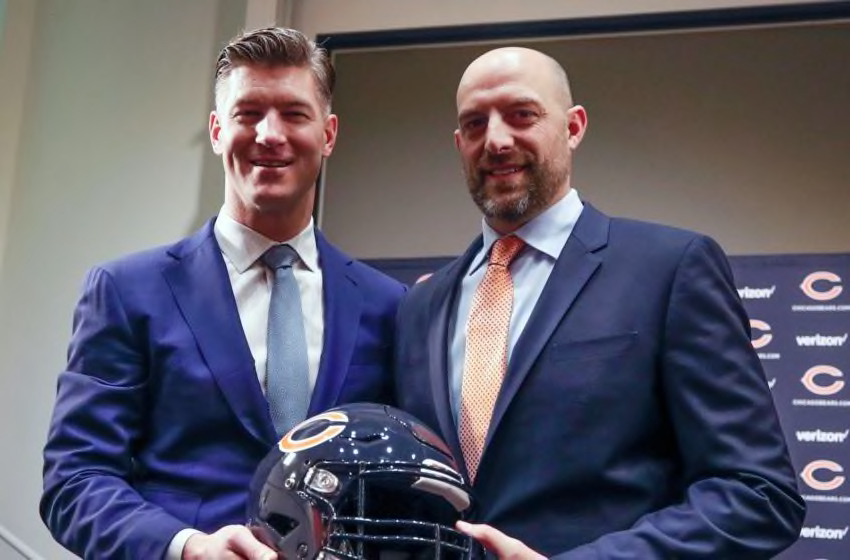
Jan 9, 2018; Lake Forest, IL, USA; Chicago Bears general manager Ryan Pace (L) and head coach Matt Nagy (R) pose for a picture during the press conference at Halas Hall. Mandatory Credit: Kamil Krzaczynski-USA TODAY Sports
Entering the offseason, the idea was that Chicago Bears general manager Ryan Pace and head coach Matt Nagy were in a “win-or-else” mode in regards to keeping their current positions with the team.
Initially, it appeared that Pace and Nagy were operating with that ultimatum. The Bears were leaving no stone unturned in their search to resolve the quarterback position. They swung big for a trade of Seattle Seahawks quarterback Russell Wilson. An acquisition of Wilson likely would have cooled the seats of both Pace and Nagy.
However, in the aftermath of their missed attempt for Wilson, it appears that Pace and Nagy may be safer than originally speculated.
The first piece of evidence that Pace and Nagy may be safe beyond the 2021 season is what occurred in January. While speaking during the end of season press conference, neither Bears’ chairman George McCaskey nor team president Ted Phillips commented on the current length of contracts for Pace and Nagy.
The lack of comment from McCaskey or Phillips fueled speculation that Pace secretly received a one-year contact extension that extends his contract through the 2022 season and links him directly to Nagy. If that is the case, then it is entirely plausible the Pace and Nagy convinced McCaskey and Phillips on a two-year rebuilding plan.
Looking at the Bears’ moves this past week through the microscope that Pace and Nagy are safe beyond the 2021 season, then it starts to make sense. Why else would the Bears immediately sign Andy Dalton after missing out on Wilson when they already have Nick Foles in place. Why else would the Bears cut Kyle Fuller instead of Jimmy Graham or Charles Leno; or, restructuring the contracts of Robert Quinn or Danny Trevathan. Why else would the team be willing to allow Akiem Hicks to seek a trade?
These are not the moves that are made by a general manager and head coach that know their jobs are line. The fear is that there is no check and balance system above Pace. Pace is admittedly the Bears’ “football guy”. And with Pace having a family like relationship with the McCaskey family, it is not entirely crazy to believe that he convinced them of a two-year plan.
If that is the case, the Bears are doomed. The reason the Bears are on the edge of rebuilding are because of Pace’s grotesque mistakes. Mistakes that have obliterated the Bears’ salary cap flexibility. Pace covers his previous mistakes with another mistake. That is why he should not be allowed to lead the Bears through another rebuild because that would inevitably lead to another rebuild to correct the previous rebuild. Folks, the Chicago Bears are doomed.
These long-time Catholic League rivals, now in different divisions, are both expecting to have their most talented teams in years. No. 1 Loyola has six D-I recruits: running back Vaughn Pemberton (Ball State), offensive tackle Conor Clyde (Dayton), defensive end Brandon Svets (Harvard), linebackers Liam Conaghan (Eastern Illinois) and Braden Mullen (Dartmouth), and kicker Nate Van Zelst (Wisconsin). A seventh, Illinois-bound lineman Josh Kreutz, won’t play this season because of injury. No. 9 St, Rita has the state’s best junior in Kaleb Brown, who can line up at running back or receiver. Receiver Henry Wilson (Western Michigan), back after missing the end of the Mustangs’ run to the 5A state final in 2019 with a broken leg, is another playmaker.
No. 3 Lincoln-Way East has won two of the past three Class 8A titles, but that’s not in play during this abbreviated pandemic season. Instead the Griffins will look to extend their conference and regular-season winning streaks of 20 and 28 games, respectively. Three MAC recruits lead the way: running back Jamal Johnson (Bowling Green), receiver Mason Pierre-Antoine (Northern Illinois) and safety Matt Kordas (Bowling Green). No. 12 Bolingbrook’s defense was loaded with playmakers coming out of last season, but safety Justin Walters (Notre Dame) and cornerback Malik Rainey (Cincinnati) are early enrollees in college. Linebacker Tyler McLaurin (MIchigan) is still around, though.
No. 5 Brother Rice at Providence, 7:30 p.m. Friday
This old-school Catholic League matchup features a pair of explosive running backs: Rice’s Willie Shaw, a Toledo recruit who had 20 touchdowns last season, and Providence’s Aaron Vaughn. No. 5 Rice is experienced across the field with veterans like linebacker Myles Jones (Georgetown), defensive end Ryan Whelan (Dayton), quarterback Jack Lausch and offensive linemen Luke Murphy, Max Mallon and Conor McAlilly. Providence returns Minnesota-bound tight end Jameson Geers and adds Kevin Spelman, a transfer from Ohio who will start on both lines.
Waubonsie Valley at No. 10 Naperville Central, 2 p.m. Saturday
Antonio Torres, an all-conference defensive back/running back as a sophomore at Waubonsie last season, is now at No. 10 Central. The Redhawks also picked up senior quarterback Jaden McGill from Oak Park. He’ll be throwing to receiver Reggie Fleurima, who this week became Northwestern’s first commit in the Class of 2022. Kicker Aiden Ellison is one of the nation’s best. Dual-threat quarterback Nathan Pappas is a player to watch for Waubonsie, which has a new coach in Tom Baumgartner.
Hersey at Rolling Meadows, 1 p.m. Saturday
The last time one of these teams didn’t win at least a share of the Mid-Suburban East title was 2011. Rolling Meadows has a new coach in Sam Baker (formerly at Grayslake North) and an almost entirely new defense. But receiver Daniel Sobkowicz, who had 50 catches in 2019, is back. Hersey must replace two-way star Jordan Hansen, now playing safety at Northern Illinois after accounting for 59 touchdowns as a starting quarterback for the Huskies.

:no_upscale()/cdn.vox-cdn.com/uploads/chorus_asset/file/22382958/Screen_Shot_2021_03_19_at_11.57.15_AM.png) Sun-Times file
Sun-Times file


Leave a comment