MINNEAPOLIS — A man who was among the onlookers shouting at a Minneapolis police officer to get off George Floyd last May testified Tuesday that he called 911 after paramedics took Floyd away, “because I believed I witnessed a murder.”
Donald Williams, a former wrestler who said he was trained in mixed martial arts, including chokeholds, returned to the witness stand a day after describing seeing Floyd struggle for air and his eyes roll back into his head. He said he watched Floyd “slowly fade away … like a fish in a bag.”
Prosecutor Matthew Frank played back Williams’ 911 call, on which he is heard identifying officer Derek Chauvin by his badge number and telling the dispatcher that Chauvin had been keeping his knee on Floyd’s neck despite warnings that Floyd’s life was in danger. She offers to switch him to a sergeant.
As he is being switched, Williams can he heard yelling at the officers, “Y’all is murderers, bro!”
On Monday, Williams said he thought Chauvin used a shimmying motion several times to increase the pressure on Floyd. He said he yelled to the officer that he was cutting off Floyd’s blood supply. Williams recalled that Floyd’s voice grew thicker as his breathing became more labored, and he eventually stopped moving.
Williams was among the first prosecution witnesses as Chauvin, 45, went on trial on charges of murder and manslaughter in Floyd’s death. The death of the Black man after he was held down by the white officer touched off sometimes-violent protests around the world and a reckoning over racism and police brutality.
Prosecutors led off their case by playing part of the harrowing bystander video of Floyd’s arrest. Chauvin and three other officers were fired soon after the footage became public.
Prosecutor Jerry Blackwell showed the jurors the video after telling them that the number to remember was 9 minutes, 29 seconds — the amount of time Chauvin had Floyd pinned to the pavement “until the very life was squeezed out of him.”
Chauvin attorney Eric Nelson countered by arguing: “Derek Chauvin did exactly what he had been trained to do over his 19-year career.”
Floyd was fighting efforts to put him in a squad car as the crowd of onlookers around Chauvin and his fellow officers grew and became increasingly hostile, Nelson said.
The defense attorney also disputed that Chauvin was to blame for Floyd’s death.
Floyd, 46, had none of the telltale signs of asphyxiation and had fentanyl and methamphetamine in his system, Nelson said. He said Floyd’s drug use, combined with his heart disease, high blood pressure and the adrenaline flowing through his body, caused a heart rhythm disturbance that killed him.
“The evidence is far greater than 9 minutes and 29 seconds,” Nelson said.
Blackwell, however, rejected the argument that Floyd’s drug use or any underlying health conditions were to blame, saying it was the officer’s knee that killed him.
WASHINGTON — A Supreme Court case being argued this week amid March Madness could erode the difference between elite college athletes and professional sports stars.
If the former college athletes who brought the case win, colleges could end up competing for talented student-athletes by offering over-the-top education benefits worth tens of thousands of dollars. And that could change the nature of college sports.
At least that’s the fear of the NCAA. But the former athletes who sued say most college athletes will never play professional sports and that the NCAA’s rules capping education benefits deprive them of the ability to be rewarded for their athletic talents and hard work. They say the NCAA’s rules are not just unfair but illegal, and they want schools to be able to offer any education benefits they see fit.
“This is letting the schools provide encouragement to be better students and better educated … in return for what amounts to full-time jobs for the school. What could possibly be wrong with that?” said lawyer Jeffrey L. Kessler in an interview ahead of arguments in the case, which are scheduled for Wednesday.
The former players have so far won every round of the case. Lower courts agreed that NCAA rules capping the education-related benefits schools can offer Division I men’s and women’s basketball players and football players violate a federal antitrust law. The narrow ruling still keeps schools from directly paying athletes, but the NCAA says it is a step in that direction.
In an interview, the NCAA’s chief legal officer Donald Remy defended the association’s rules. He said the Supreme Court has previously found preserving the amateur nature of college sports to be an “appropriate, pro-competitive justification for the restrictions that exist in the system of college athletics.”
The NCAA wasn’t happy with the outcome the last time its rules were before the Supreme Court. In 1984, the high court rejected NCAA rules restricting the broadcast of college football. The justices’ ruling transformed college sports, helping it become the multi-billion dollar business it is today.
This time, the justices will hear arguments by phone as they have been doing for almost a year because of the coronavirus pandemic. And the public can listen live. The justices will almost certainly issue a decision in the case before they leave for their summer break at the end of June.
A ruling for the former players doesn’t necessarily mean an immediate infusion of cash to current college athletes. Currently, athletic scholarships can cover the cost of college athletes’ attendance at college. That includes tuition, housing and books, plus a stipend determined by each school meant to cover things like travel expenses and other incidentals. What a ruling for the students means is that the NCAA can’t bar schools from sweetening their offers to Division I basketball and football athletes with additional education-related benefits.
Individual athletic conferences could still set limits. But Kessler said he believes that if his clients win, “very many schools” will ultimately offer additional benefits.
That would mean that to compete for the best players, colleges might offer things like postgraduate scholarships, tutoring, study abroad opportunities, vocational school payments, computer equipment and internships, among other things. And there’s a fear some schools might try to disguise other, improper benefits as permissible education spending.
The former college athletes have some big-time supporters. The players associations of the NFL, NBA and WNBA along with a group of former NCAA executives are all urging the justices to side with the former athletes, as is the Biden administration.
Whatever happens at the high court, how college athletes are compensated is already likely changing. The NCAA is in the process of trying to amend its longstanding rules to allow athletes to profit from their names, images and likenesses. That would allow them to earn money for things like sponsorship deals, online endorsement and personal appearances.
Those efforts have stalled, however. For their part, players at this month’s March Madness tournament have been pushing for reform with the hashtag #NotNCAAProperty on social media. Even if the NCAA changes its rules, however, any money college athletes might make from endorsement deals would be over and above the educational benefits schools might offer as incentives.
As for the justices, they’re not necessarily just watching from the sidelines. The majority are also avid sports fans. Justices Samuel Alito, Sonia Sotomayor and Elena Kagan love baseball. Justice Neil Gorsuch is a Denver Broncos fan, while Clarence Thomas is devoted to the University of Nebraska. Amy Coney Barrett, who was a professor at Notre Dame, has said her football Saturdays were spent tailgating. Justice Brett Kavanaugh wrote simply to lawmakers considering his 2018 nomination: “I am a huge sports fan.”
SILVER SPRING, Md. — Canadian blockchain technology company Dapper Labs has secured $305 million in private funding — some of it from current and former NBA players, including Michael Jordan — to scale up its virtual NBA trading card site, the company said Tuesday.
Vancouver, British Columbia-based Dapper says NBA Top Shot has rung up $500 million in sales and registered more than 800,000 accounts since its public beta testing phase began in October.
The virtual cards come in the form of a floating digital cube that includes a video highlight of an NBA player and come with a non-fungible token, backed by blockchain technology, certifying its authenticity and scarcity. A LeBron James dunk highlight sold for $210,000 recently but more common cards can often be had for less than $10.
Besides the NBA, Dapper partners include Warner Music Group, Ubisoft, and UFC. The company says the new round of funding will help it expand its NFT and blockchain products to a wide range of businesses.
“We want to bring the same magic to other sports leagues as well as help other entertainment studios and independent creators find their own approaches in exploring open platforms,” said Dapper Labs CEO Roham Gharegozlou.
The most recent round of funding was led by New York-based private equity firm Coatue Management and brings Dapper’s total capital raised to $357 million.
Current players listed as investors in Dapper include Kevin Durant, Kyle Lowry, Spencer Dinwiddie and Klay Thompson. The company also says some current and former NFL and MLB players have put money in, as well as the rapper 2 Chainz.
There are talks that the Chicago Loop Alliance wants to close down State Street in the Loop to traffic for 12 Sundays this summer. The move would be in an effort to draw Chicagoans to the heart of downtown, more specifically, to draw foot traffic to the once-popular retail corridor that was heavily impacted by COVID-19.
If you did not know the Chicago Loop Alliance was a thing, don’t fret. Here’s your quick lesson: it was founded in 2005 after a merger between the Central Michigan Avenue Association (yes, a thing) and the Greater State Street Council (yes, also a thing). Both of these were founded in the ’20s and the two consisted of local merchants wishing to promote economic prosperity during the Great Depression. Now, according to their website, their mission is, “Chicago Loop Alliance creates, manages, and promotes positive and inclusive programs that attract people to the Loop and accelerate economic recovery.”
Advertisement
The plan, titled ‘Sundays on State’, outlines the Alliance’s wish to shut down the neck of State Street from Lake to Madison on Sundays. Specifics are still being ironed out, however, the primary goals are to “highlight local art and culture…and also to encourage our retailers to start bringing merchandise onto the street or offer tours of theaters that might not yet be open…” per Chicago Loop Alliance CEO Michael Edwards.
Many neighborhoods throughout Chicago have shut down blocks in order to accommodate bars and restaurants moving onto the street to comply with COVID dining regulations. Division St., Lincoln Ave, and Randolph in West Loop are among the most popular and successful. It sounds as though the CLA’s outlines for ‘Sundays on State’ are more comprehensive and interactive, designed for Chicagoans of all ages to enjoy from June to September.
Advertisement
During the group’s yearly meeting, much of the discussion was on making the Loop a more inclusive place. For much of 2020, State Street and surrounding city blocks became the epicenter of major demonstrations for racial and social justice; the group’s plan is centered around taking these grounds and bringing back shoppers, visitors, and workers to highlight everything from art, to business, to cuisine, and more.
Per WTTW Chicago, “CLA is also launching a self-guided mural walk that will take people past 22 pieces of public art in the Loop, including well-known works and some lesser-known offerings. The group is also planning some art pop-ups in vacant spaces, similar to a successful program after the Great Recession.”
Advertisement
As the city continues to distribute vaccines, there is an anticipation that more Loop-based businesses will return to in-person office hours this summer as well. The CLA’s plans to piggy back off that organic foot traffic feels like a potential home run, especially because it is foot traffic that is the true driver of retail and restaurant spending. This news also comes as the city announced that the Taste of Chicago and Lollapalooza could both return in some fashion this summer depending on how the city progresses into the spring months with COVID positivity rates and number of citizen that are fully vaccinated.
Come back to UrbanMatter Chicago for more information on the city’s summer plans as more news releases in the coming weeks!
Graduate transfer super back Jay Vallie prefers making a big block to catching touchdowns. (Photo by Sandy King, EIU Athletics)
Growing up, Jay Vallie played backyard football and pretended to be Detroit Lions wide receiver Calvin Johnson.
During high school, he was pretty sure his future was as a college basketball player.
Now, as a graduate transfer at Eastern Illinois, his football days are spent playing the unique super back position, a hybrid tight end who lines up all over the field.
Vallie, who spent four years at fellow FCS program Dayton, played there with current New Orleans Saints tight end Adam Trautman and soon discovered a connection between EIU and the Saints when he arrived in Charleston.
In the fall, Vallie will experience some “bittersweet” emotions when the Panthers play a non-conference game at Dayton.
In our weekly Moving the Chains Q&A feature, he discusses the addition of a beard this fall, which is a no-no at Dayton, along with Cincinnati’s unique style of chili, the most beautiful places in his home state of Michigan and another NFL team he is connected to by his birthday.
Learn more about Vallie:
When you talk to friends and family, how do you explain the super back position?
I try to relate it to a tight end, because that’s the closest position that it’s like. Sometimes, we’ll be in line. Sometimes we’ll be in the wing, or we call it the ‘sniffer.’ We can be flexed out like a receiver. I know in past years, they’ve been lined up in the fullback or the tailback positions. It’s very versatile what they can do with us. They can put us anywhere and align us to perform based on what the job is.
Who is the most famous person from your hometown of Grand Blanc, Mich.?
I went to school in the town next to Grand Blanc, which is Goodrich. Football wise, Kyler Elsworth was a pretty good family friend of ours. He walked on at Michigan State University (as a linebacker). In the (2014) Rose Bowl when they played against Stanford, there was a fourth-down stop that won the game (for MSU). He was the one that jumped over the line and got that stop. That was pretty cool.
Current New Orleans Saints tight end Adam Trautman was a teammate of yours at Dayton. Among NFL tight ends, who is your favorite?
Well, after Adam Trautman (laughs), I really love George Kittle (of San Francisco). He embodies what the tight end should be with his mindset, the way he attacks the run and pass games. He’s just always the enforcer. He’s dominant in whatever aspect he’s in.
Next fall, EIU plays a game at Dayton, your former school. Do you plan to be in the stands or in uniform for the Panthers?
Jay Vallie
I will be in uniform for that game. It will be exciting, and a little bittersweet. It will be fun running around with the guys I’ve been running around with for the past five years. When I talked to my coach (at Dayton about leaving as a grad transfer), he just didn’t want me to go anywhere in the old conference. I said, ‘Don’t worry. I don’t want to go anywhere that we play.’ Of course, after I got here, I found out we actually will be playing. Those guys are still my family. I talk to a good portion of them almost every day still. On the other hand, I’m excited to play them. It’s almost like the family Thanksgiving game. Just going out and having fun with your family.
Dayton’s neighbor, Cincinnati, is famous for its own unique type of chili dish, which is served over spaghetti. Would you give Cincinnati chili a thumbs up or thumbs down?
I’m going to have to give it a thumbs down. It was good, but it’s not as good as it’s always hyped up to be. I was satisfied, but not thrilled.
Growing up in Michigan, who was your favorite pro athlete and pro sports teams?
With the Lions, I loved Megatron – (wide receiver) Calvin Johnson. When we’d play football in the backyard, he’d be the guy we would try to emulate. As far as teams, I was born on the day of Super Bowl XXXII in 1998, when the Broncos won (31-24 against Green Bay). I have a little commemorative football for them with the score and everything. So I’ve always been kind of a Broncos fan. I like to see them do well.
Fans are now being allowed into pro sports stadiums again. The next time you go to a sporting event as a fan, what’s the one food you have to eat?
I love popcorn. Whether I’m going to a movie or going to a game, the one thing I’m always getting is a big bowl of popcorn. The smell of stadium popcorn always draws me in.
Being a native of Michigan, have you ever held up your hand like a mitten to show people where your hometown is?
Every time. (Laughs) That’s the only way for me to explain to people who aren’t familiar with the area where I’m located. It’s the easiest way.
Michigan has plenty of resort towns. What are three can’t-miss places in your home state?
Definitely Grand Haven, which is out west. Up north in Mackinac Island. And then, I spent some time last summer in Marquette, which is way up in the (Upper Peninsula) near Lake Superior. Those three areas are beautiful. The U.P. itself is like a totally different world. The nature is amazing.
Is catching a touchdown or making a big block a better feeling?
I would say a big block definitely feels better. It feels way more awesome putting a guy into the ground than catching a touchdown. There are so many guys on the team that can catch a touchdown, but if you block a guy and that leads to a touchdown, that feels just as good as scoring if not better.
Tell us about your family.
My mother, Lonnie Rae, is a retired educator. My dad, David, is a financial advisor for Merrill Lynch. I have one brother (Mitchel), who works with my father at Merrill Lynch. He’s six years old than me. My sister-in-law, Stephanie, is currently halfway done with nursing school. She’s going to be a nurse anesthetist. My brother and sister-in-law have a black lab named Ace that they’ve trained to be a bird dog, a hunting dog. He’s very obedient. Whenever I come home, I get to wrestle with him a little bit.
You earned a mechanical engineering degree at Dayton, and you’re in the MBA program at EIU. What’s your dream job?
Once I hang up the cleats, I have been drawn to technical sales or consulting, or some type of technical management, which is why I’m going for the MBA. I have the technical thinking that engineers have, and with my dad being a financial advisor, I thought that technical management is a good in between to apply both those areas that I’ve had in my life.
One thing you’ve added at EIU that you never had at Dayton is a beard. Why?
At Dayton, there’s a no facial hair rule. During the football season, they like the clean-cut look. I always had to shave it for football season. This year, I asked my coach, ‘Hey, do I need to shave?’ He said, ‘No, why would you need to?’ I said, ‘Oh, just wondering.’ So I get to let it go.
Who’s a famous person from EIU that you weren’t aware of until you got to campus?
I actually didn’t know that (New Orleans Saints head coach) Sean Payton was here. I thought that was really cool. As soon as I found out, I actually Snapchatted a picture of his jersey that’s in Lantz Arena to my buddy Adam Trautman. I said, ‘Hey, look who it is.’ He thought it was really cool.
If you’re hungry after practice, do you head to a drive-thru or straight home to cook for yourself?
I have a pretty strict diet. Before practice, I usually have a bowl of oatmeal with some peanut butter and protein powder. After practice, I come home and cook myself an omelet, a bagel and have a bowl of cereal.
The Summer Olympics begin in a few months. Which Olympic sport would you like to compete in?
Basketball would definitely be my sport. Growing up, basketball was one of my biggest sports. For a while, until the end of high school, I thought I was going to be playing college basketball. Luckily, things worked out the way they are and I’m here now. I wouldn’t change anything.
If you could travel anywhere in the U.S. and anywhere overseas, where would you go?
Colorado is definitely one place I really want to go. I really want to see what it’s like. My parents have gone multiple times on vacation. They’d send me pictures, and it’s amazing. I’d definitely like to try snowboarding and skiing. I’d also like to go over to Italy. There are cities like Rome and Venice … with lots of history and monuments that are there to explain the stories of the world. Italy would be a really cool place to spend some time.
Who is a person in your life that inspires you?
I’d say my older brother. Growing up, he’d be out playing basketball or football with his friends. I’d run out and play with them. They would just kick my butt. They would run me into the ground every time. I took that as motivation. No matter how many times I’d play my brother (in basketball), he’d beat me 21-2. If he beat me 21-7, I’d say, ‘OK, I’m going to get him next time.’ I’d try again, and I kept doing that a lot. When I started getting older, I’d talk to him a lot about college sports and everything in life. He’s been very helpful and has given me a lot of insight.
There are three players from Michigan on the EIU roster. When you all get together, are you more likely to talk about the Lions, Tigers or Pistons?
Right now, the Lions. I’m thrilled with their new (head coach) hire, Dan Campbell. I think there’s a lot of good moves going on in Detroit right now.
Blog co-authors Barry Bottino and Dan Verdun bring years of experience covering collegiate athletics. Barry has covered college athletes for more than two decades in his “On Campus” column, which is published weekly by Shaw Media. Dan has written four books about the state’s football programs–“NIU Huskies Football” (released in 2013), “EIU Panthers Football (2014), “ISU Redbirds” (2016) and “SIU Salukis Football” (2017).
New vaccination site will be dedicated to essential union workers
Pat Nabong/Sun-Times
Mayor Lori Lightfoot on Monday announced a new vaccination site in partnership with the Chicago Federation of Labor that will help get doses of COVID-19 vaccine into the arms of essential union workers.
Lightfoot said the site will be able to handle about 1,200 vaccinations weekly at first and can grow to 6,000 weekly as vaccine supply increases.
The announcement comes as the city expands eligibility requirements to what’s called Phase 1C. That expansion includes residents ages 16 to 64 with underlying medical conditions, such as chronic kidney disease or cancer.
It also will allow vaccination for those working in construction, retail, restaurants and all other essential workers who had not previously been eligible.
“You all know this, but it bears repeating. Chicago is 100% a union town,” the mayor said in making the announcement at the vaccination site, the International Union of Operating Engineers Local 399, 2260 S. Grove St.
“It’s our union workers who make up the backbone of this city.”
Those wishing to be vaccinated at Local 399 must live or work in Chicago, hold a current union card or be a union retiree, and qualify under the city’s current eligibility criteria.
9:32 a.m. Mayor’s plan for $1.8 billion in federal relief won’t go to City Council until May or June
Last month, a divided City Council authorized another round of federal coronavirus relief despite the political furor triggered by Mayor Lori Lightfoot’s decision to use $281.5 million from earlier funds to cover police payroll costs.
It looks like aldermen must wait a while for Round 2 of what is certain to be a battle royal over the $1.8 billion avalanche of federal money on its way to Chicago.
“I would expect that we probably won’t be taking a package to City Council [until] at the earliest, May, and it may not be ’til June,” the mayor said Monday.
Lightfoot’s timetable did not sit well with downtown Ald. Brian Hopkins (2nd).
“We need to have more involvement in the preparation of that package. Nobody wants a done deal dropped in our laps at the last minute and then say, ‘Take it or leave it. Vote it up or down,'” Hopkins said.
“All the aldermen I’ve talked to about this have expressed an interest in being involved in the prioritization of it. … There’s gonna be a healthy disagreement among the various caucuses within the City Council about what a top priority should be. But we should be a part of that debate.”
The Chicago Department of Public Health reported 438 new confirmed cases, 3 deaths and a test positivity rate of 4%.
Another 110,211 shots went into arms on Saturday.
Over 6.2 million vaccine doses have been sent to providers in Illinois and more than 2 million residents have now been fully vaccinated, officials said.
After putting together a curse-breaking, World Series-winning Chicago Cubs roster, Theo Epstein departed the team this offseason. Depending on how the 2021 season goes on the North Side, what remains of Epstein’s core may not be far behind him on its way out of town.
Anthony Rizzo, Javier Baez, and Kris Bryant – the three most important players in the lineup – are all slated to be free agents after this season. Barring any agreed-upon extensions, if the team finds itself struggling out of the gate and not in position for a playoff push come the All-Star break, it wouldn’t be surprising to see all three of those players moved at the deadline.
Clearly, how the 2021 season goes will have a huge impact on the direction of the Cubs franchise for years to come.
With that in mind, here are three bold predictions for the Cubs this season. If even one or two of these predictions come true, it could change the course of the Cubs’ season and have repercussions in Wrigleyville for years.
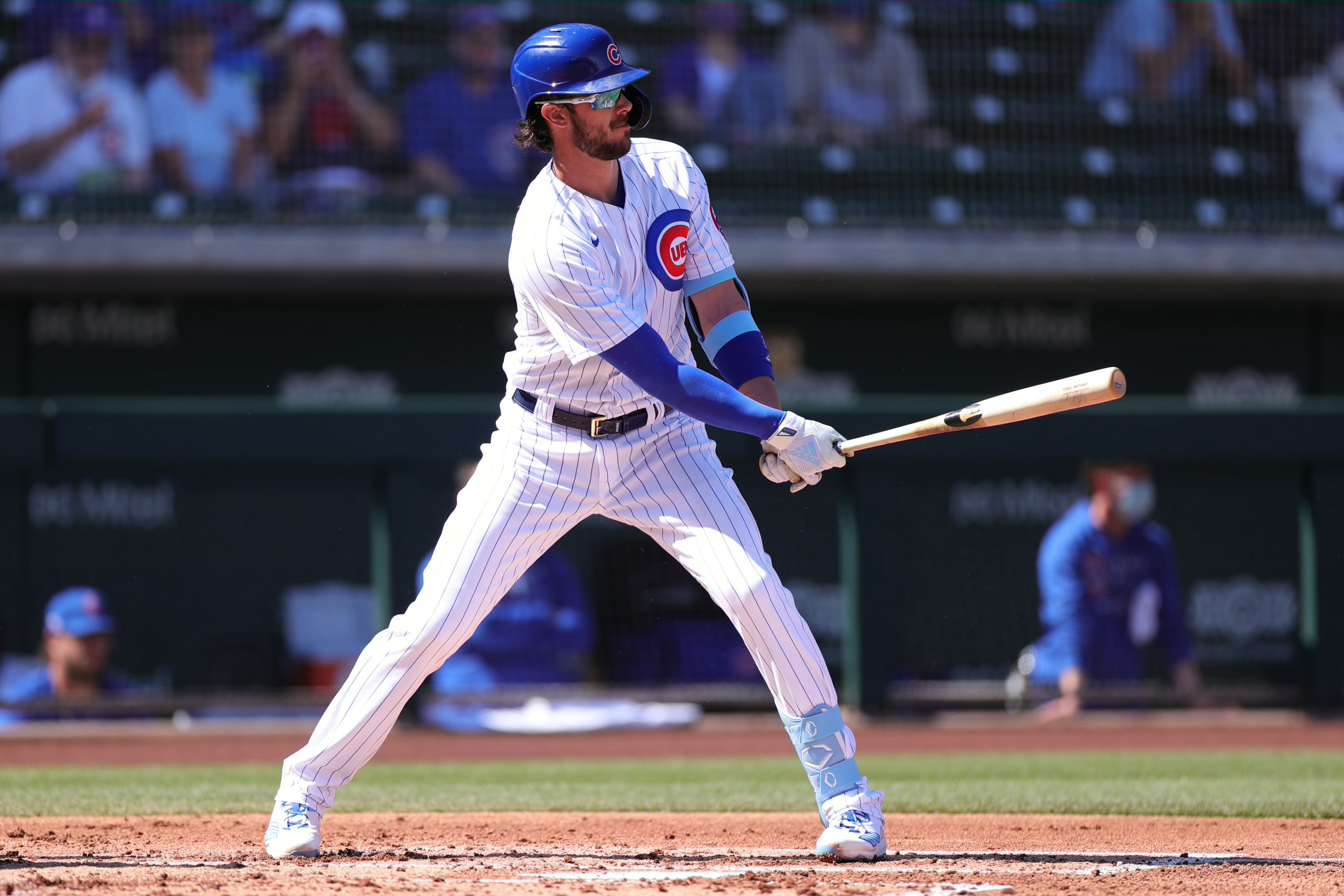
1. Kris Bryant will set a new career-high in home runs
I’ve been an unashamed believer in Bryant since his major league debut in 2015. Yes, it’s been a bumpy ride at times, but the underlying talent that netted him a Most Valuable Player award and three trips to the All-Star game is still there.
Bryant is coming off by far his worst season – he hit a measly .206/.293/.351 while appearing in just 34 games. He battled through nagging injuries for most of the shortened season, and some serious news about those ailments just came to light.
In a recent interview with NBC Sports Chicago, Bryant revealed that his wrist “injury” he played through last year was actually an impact fracture. That can go a long way in explaining Byrant’s poor performance, especially in such a small sample size.
If Bryant is back at full health, the league should be on notice. Regardless of your opinion of the former MVP, he’s been undeniably one of the best position players in baseball since his debut. Since getting called up in early 2015, Bryant’s 28.4 fWAR is the sixth most among position players and his .378 wOBA is the 18th best.
Not only does Bryant have something to prove after such a down season in 2021, but he’s also playing for a new contract.
It seems like ever since his MLB debut, there’s been a countdown clock on when Bryant would be a free agent and sign his mega-deal, courtesy of his star agent, Scott Boras. A strong bounce-back performance from Bryant in 2021 would cement his status as one of the top free agent options during the upcoming offseason.
Bryant’s got a lot on the line this year, and a great season could make him a couple hundred million dollars richer. If that’s not an incentive to put on a clinic at the plate, I don’t know what is.
Seeing Bryant launch 40 or more home runs this year isn’t something I’d put money on, but it certainly doesn’t seem too far-fetched given the circumstances. While it’s likely Bryant’s last season as a Cub, watching him set a new career-high in home runs would be a great final memory of his time in Chicago.
Authorities were conducting an arson investigation after a fire broke out Tuesday at a home in the Grand Crossing neighborhood, according to Chicago police.
The fire erupted about 2 a.m. in the 7500 block of South Dobson Avenue, according to preliminary information from police spokeswoman Karie James.
There were no reported injuries, James said. Additional details weren’t immediately available.
A spokesman for the Chicago Fire Department did not immediately return a request for comment.
I remember the smell of that morning. The dry-baked, powdery dust of the Iraqi desert swirled down the flight line, mingling with the sweet smell of hydraulic fluid and sharp diesel scent of JP-8 fuel. Walking up to my Black Hawk at Logistical Support Area Anaconda, our base near the small town of Balad, I breathed in the hot exhaust from other aircraft that had just taken off for their missions. And as I climbed into the cockpit, I was enveloped in a funky mix of hot metal, sweat, and body armor. There’s no other smell like it in the world, and it never failed to get my blood pumping.
For the most part, our missions consisted of ferrying troops and supplies from one base to another, tasks we called “taxi service,” “grocery runs,” or “the Baghdad shuffle.” Despite the mundane nicknames, they were dangerous — particularly during the First and Second Battles of Fallujah, when fighting flared up just west of Balad. These were the periods when coalition forces went on the attack, flushing enemy combatants out of their strongholds and sending them scattering into the desert. The insurgents would then lie in wait, hoping to take their revenge on the helicopters that crisscrossed overhead. Helicopters like mine. During my eight months in Iraq, insurgents had peppered our birds with machine-gun fire a couple of times near Abu Ghraib prison. And once, as I was flying north to the Iraqi Kurdistan capital of Erbil, a rocket-propelled grenade exploded in a puff of black smoke just to the rear of our aircraft.
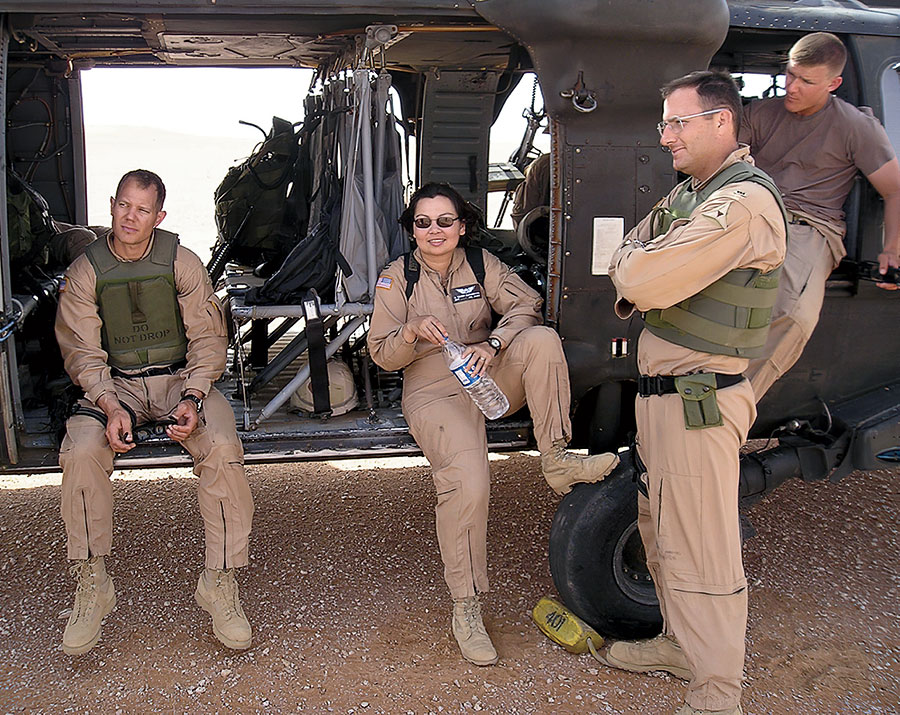
This day, November 12, 2004, I was scheduled to fly with three crew members: Chief Warrant Officer 4 Dan Milberg, Sergeant Chris Fierce, and Specialist Kurt Hannemann. Chris, with his perfect name — Sergeant Fierce! — was our crew chief. Kurt, at 23 the youngest in our crew, was a big, friendly, wise-beyond-his-years kid from Peoria. A headquarters kid whose job was to process flight plans and other paperwork, he had volunteered to be a door gunner because we didn’t have enough. He also wanted to get outside the wire — and so did I. My job as a battle captain was to plan and coordinate missions for helicopter crews, but pilots want to fly, and so at least twice a week I made sure to get out and fly missions myself.
Dan was our pilot in command. We hadn’t flown together in a few months, ever since he’d switched to night rotations — “goggle missions,” as we called them — but I loved flying with him. He was a solid tactical pilot, with years of wartime experience going back to Operation Desert Storm in the ’90s. I always learned something new when I flew with Dan. And he’s also just a good guy — easy to get along with, funny as hell, and willing to let me take the stick for most of the day.
I have a pretty twisted sense of humor, but Dan was the one guy who could match it. We were always talking shit during our missions, trying to top each other with the dirtiest, most sarcastic, most warped stories. We jokingly made a pact that if we knew we were going down, we’d use our final seconds to strip naked and switch places, just to fuck with the accident investigators. We knew we could say absolutely anything to each other, and that each of us had the other’s back.
The four of us climbed into the aircraft, readying for the day ahead. Our bird was just over 20 years old, but it was one of the better helicopters our unit was flying. The dirty little secret of Army aviation is that the best and newest equipment goes to active-duty units, while reserve units like ours get whatever’s left over. Our Black Hawk had actually been deactivated by the Army, which meant it was headed to the junkyard until Charlie Company of our battalion snatched it up, deeming it the best of a bad lot.
I settled into the right front cockpit seat, and Dan took the left. Directly behind Dan, Kurt took up his position, facing backward out the side door gunner’s window to aim his mounted M60 machine gun at any enemy combatants we might speed past. Chris sat behind me, also with his M60 at the ready. For safety reasons, our battalion’s aircraft always traveled in pairs, so we were joined that morning by a second Black Hawk, piloted by Chief Warrant Officer 3 Pat Meunks.
It had been a long, hot, dusty summer, but the heat had finally broken. A light rain was falling, and the temperature was in the 70s, which felt almost chilly after the months of brutal heat. Even so, we decided to fly with our doors off, knowing the day would warm up as the sun rose and the rain tapered off. Our missions were assessed at threat level amber that day, meaning enemy engagement was possible. Per usual, we planned to fly fast and low across the desert, to minimize the amount of time the bad guys would have to spot our aircraft and open fire.
We took off for our first leg at 7:30 a.m., heading to Camp Victory, near the Baghdad airport, to pick up a small group of U.S. contractors. For hours, we flew missions back and forth across central Iraq, ferrying personnel and cargo between military installations. After seven or eight missions, we finally set down in the Green Zone — the four-square-mile heavily guarded area in central Baghdad that housed international coalition forces — in late afternoon. We were scheduled to have about an hour on the ground, then return to Balad before sunset.
Everybody was stoked to be in the Green Zone, especially since we had enough time to grab a late lunch at the little café there that made stir-fry to order. Kurt and I ambled up to the counter and picked out our fresh ingredients — chicken, mushrooms, sprouts — and on a whim I ordered a chocolate milkshake. It was the first one I’d had in almost a year, and it tasted amazing. Afterward, we still had a little bit of time, so we hustled over to a nearby bazaar that was selling Christmas ornaments. I bought a few as gifts, delicate little pieces with scenes of Babylon on them, and then it was time to go. The tactical operations center had radioed a request for us to divert for one additional mission — a quick run to Camp Taji, a U.S. military installation just outside Baghdad, to pick up a couple of soldiers who needed a lift to Balad.
My guys were tired from the long day, but they were up for one last run. As we walked back to our Black Hawk, the sun finally began peeking through the clouds. The air was clean and crisp after the rain, and a bright rainbow arced across the sky. Years later, Kurt would tell me that his thought at that moment was, “Wow, I can’t believe they pay me extra to do this.” We were doing something we loved, in support of our country, on one of the most gorgeous days I had seen in a long time.
Given all that, we hardly minded when we arrived in Taji to find that the troops had already caught a lift with another helicopter crew. But there was a stray colonel there who needed a ride, so he climbed into our sister helicopter. We did a “hot refuel,” gassing up the birds as the engines were running and the blades turning. Then, shortly after 4 p.m., we took off for Balad. We were a daytime crew, and not supposed to be flying after sunset, so we’d have to hustle back. Flying time was expected to be about 15 to 20 minutes.
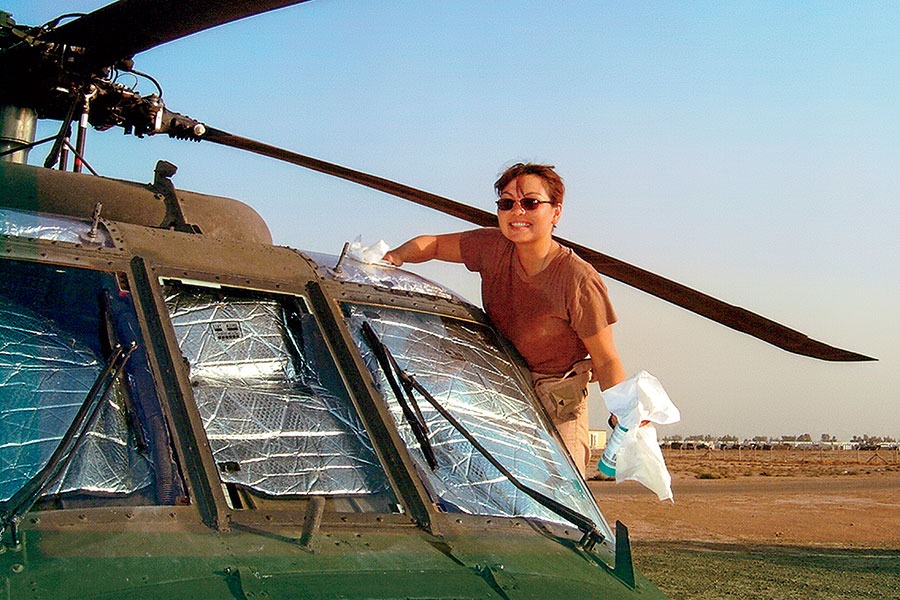
“At least twice a week I made sure to get out and fly missions myself,” writes Duckworth, whose main role, as a battle captain, was to coordinate them from base. Photograph: Courtesy of the Duckworth Family
As our Black Hawks lifted above the dusty airfield, I could see the muddy Tigris River snaking by just to the east. I maneuvered our helicopter into “chalk one,” the lead position, with the other aircraft flying just to our right as “chalk two.” Though it was possible to fly a straight line between Taji and Balad, the First Cavalry Division flight controllers dictated our departure path, designed so that the enemy couldn’t predict our movements.
We had been in the air about 10 minutes when I heard Dan’s voice through my headset. “Hey, stick pig!” he said. “How about letting me get some flying time?” I smiled. Dan knew I would pilot the bird for as long as he’d let me, and he had let me do it all day. But this was our last 15 minutes, so he wanted to take the stick. “You have the flight controls,” I told him, initiating the standard call-and-response to ensure a smooth handover. “I have the flight controls,” Dan replied. I confirmed the transfer once more verbally, and with that, Dan was now in control of the Black Hawk.
Soon after Dan took over, a grove of date palms came into view. These groves were like little oases scattered across the desert, their rows of tall palms swaying in the breeze. We were flying at about 130 mph now, skimming along about 10 feet above treetop level, when I heard an unmistakable tap-tap-tap-tap. I knew instantly what it was: small-arms fire hitting the metal fuselage outside my right door.
class>
“Fuck,” I said to Dan. “I think we’ve been hit.” My training kicked in, and although our GPS hadn’t been working that whole day — we’d been using old-fashioned printouts and paper maps — I instinctively reached forward to push “target store” on the GPS to record the exact location of enemy fire.
And then the world exploded.
A rocket-propelled grenade blew through the plexiglass “chin bubble” window at my feet and detonated in a violent fireball right in my lap. The explosion vaporized my right leg. It blew my left leg up into the bottom of the instrument panel, shearing off the shin below the knee and leaving my leg hanging by just a thin thread of flesh. And because I had leaned forward, reaching to activate the GPS, the explosion also tore through my right arm, violently shredding it into a bloody mess of muscle, sinew, and bone. In a single, shattering instant, my body was blown apart. My skin was burned and riddled with shrapnel, and blood began pumping out of my wounds.
I didn’t know any of this. At the moment of the explosion, my brain went into overdrive trying to figure out what to do next. Dan hadn’t responded when I said we’d been hit, so I thought he must be severely wounded. I called out to Chris and Kurt, but no one answered.
In shock and acting on pure instinct, I tried to fly the helicopter. Unaware that my legs were gone, and focused on finding a landing spot, I struggled to press the pedals. At the same time, I tried to pull on the cyclic stick between my legs, which controls the rotor and almost certainly had stopped functioning. The RPG had knocked out our avionics system, so we couldn’t hear or talk to each other, and the cockpit was quickly filling with black smoke. We’re gonna get a compressor stall, I thought, knowing the No. 2 engine must have sucked in debris from the explosion. We’re going to have a hydraulic failure. My mind was whirling, frantically trying to solve each new crisis.
The Black Hawk rattled and shook, not responding to anything I did with the flight controls. We had to land, but what little I could see through the cracked windshield was all palm trees. If we couldn’t find an open space in a matter of seconds, we’d have to ditch in the trees, where the rotor blades would beat us up once they hit the branches. God, we need a place to land! my brain screamed — and just then, by some miracle, a small opening of grassy land appeared.
It came under us so fast, we’d have to make an impossibly steep approach not to overshoot. I kept trying to steer us to the opening, pissed that my pedals wouldn’t work and completely unaware that Dan was controlling the bird. The helicopter went into a very steep, very fast descent. I pulled up on the collective, the stick just to my left that controls the pitch of the rotors, trying to slow our descent and cushion our landing. For a fleeting moment, I wondered why the flight instruments looked so much larger than normal. As Dan would later tell me, this was because I was slumped over in my seat, my face just inches away from the instrument panel.
Then, suddenly, we were on the ground. I saw the rotor blades jolt to a stop not even a quarter turn into their rotation, and despite the chaos and smoke, I noticed that one of the engine power control levers hadn’t been pulled fully back into the off position. I tried to reach up to pull it back, but that was the last straw for my ravaged body. As I collapsed forward, I saw grass poking up through the bottom of the cockpit. Why the fuck is there grass coming through the chin bubble? I thought.
And then everything went black.
With fellow U.S. Army “rotorheads” during her 2004 deployment. Pat Meunks, who would pilot the helicopter that evacuated Duckworth and her crew from the shootdown site, stands at right. Photograph: Courtesy of the Duckworth Family
I have no recollection of my rescue and evacuation, though I’m told that I went in and out of consciousness while it was happening. The following details are what I’ve been able to learn in the years since the shootdown. Some of them, I only discovered while talking to people for my book.
In the seconds after the RPG hit, Dan had looked over and seen me slumped forward, hanging from my seat’s shoulder harness. My face was covered with black residue from the explosion, my eyes were closed, and my mouth was hanging open. As an EMT and police officer in civilian life back in Missouri, Dan had seen dead people, and looking at me, he thought I was gone. He had been so focused on landing the aircraft that he didn’t notice that I’d been coming in and out of consciousness, little flickers of life in my eyes as I fought an internal mental battle to land the aircraft.
As soon as Dan set the helicopter down, he unstrapped his harness and jumped out of the cockpit. “Get out of the aircraft!” he yelled to the crew. “Set up a perimeter!” We had landed about 500 yards from where the RPG had hit, which meant that whoever shot us down might come charging through the trees at any moment to continue the attack. One saving grace was that there didn’t seem to be a road between where we were hit and where we landed.
Kurt stumbled out of the aircraft, grabbed his M4, and promptly fell to the ground as his legs collapsed under him. He stood up, confused, and then felt something wet on his hand. When he looked down, his hand was covered in blood, and he twisted around to see that the whole back of his uniform was soaked crimson.
At the same time, Dan rushed around to my side of the cockpit and looked inside. All he could see was my torso and a severed leg lying on the floor; as far as he could tell, there was nothing left of me from my waist down. I was obviously not going anywhere, so he turned his attention to Chris, who was sitting directly behind me. “Chris, get out of the aircraft!” he yelled.
“I can’t,” Chris told him. “My leg is broken.” In fact, the explosion had torn his leg apart just below the knee, and he, too, was bleeding profusely. Despite his injury, Chris had acted quickly and courageously as we descended, picking up pieces of burning metal with his gloved hands and throwing them out the window, possibly saving the helicopter from catching fire.
“You have to get out,” Dan insisted. “I’ll help you.” Leaving me for the moment, Dan reached through the door or window — he can’t remember which — and managed to pull Chris out and get him away from the aircraft.
Once he’d gotten Chris clear, Dan looked over and saw that Kurt was still standing next to the helicopter. “Set up the perimeter!” he shouted again. What was Kurt waiting for?
“I’ve been hit,” Kurt replied, turning to show Dan the blood-soaked back of his uniform. At that moment, Dan’s face just crumpled, like How fucking bad can this get? All three of his crew members were badly injured, one was possibly dead, and with no one physically able to set up a perimeter, we were potentially moments away from an ambush.
That’s when Kurt performed one of the bravest acts I can imagine. Confused, woozy from blood loss, and rapidly going into shock, he picked up his M4 and stumbled toward the perimeter. Instead of running to the rear to protect himself, Kurt positioned himself between us and the enemy.
Dan waved down our sister helicopter, and Pat set it down near us. Specialist Matt Backues, the door gunner for that Black Hawk, jumped out and ran to where Dan stood on my side of the cockpit. “Let’s get her out of here,” Dan said. Matt looked inside and couldn’t believe what he was seeing. My visor had cracked in the explosion, and half of it had blown off. He could see one closed eye and my blackened skin, and he looked at my lips to see if I was breathing. This all happened in an instant — and then he quickly reached in to unbuckle my harness.
Matt and Dan pulled my seemingly lifeless body out of the helicopter, stumbling backward as they got me free of it. They positioned themselves on either side of me, planning to underarm-carry me to the other helicopter, but in a matter of seconds we were all slick with blood and bits of flesh, making it hard to hold on to me. On top of that, the terrain was uneven with tall grass and big clumps of dirt, so the guys couldn’t stay upright. They’d fall on me, get back up, stumble a few steps, collapse to the ground. Everyone knew we had to get out of there quickly, before the insurgents came back. Yet these men took this extra time and risked their own lives — not even to save my life, because they thought I was dead, but to recover my body for my family. They did it for the purest of reasons, that you never leave a fallen comrade behind.
Realizing that Chris was too badly hurt to make it to the other Black Hawk, Dan broke away to help him. Left alone to carry me, Matt grabbed the shoulder straps of my flight vest and started dragging me backward through that damned field. At one point, Colonel Hamm — the officer we’d picked up 10 minutes earlier in Taji and whom none of us knew — came over to help. When Matt finally got me to the helicopter, he and the colonel started trying to load me in, but they couldn’t quite get me in the door.
In the meantime, Kurt had somehow hoisted himself in, and when he saw the other guys struggling with me, he reached down to help. He grabbed my flight vest and heaved, managing to get my upper half into the helicopter. Then he reached down to heave for a second time, to pull in my lower half. And that’s when he saw that there was nothing else to pull in. As Kurt watched in shock, Matt spontaneously grabbed my dangling left foot and chucked it into the helicopter behind me. It’s a measure of what kind of man Matt is that he saved my life that day but later all he could say was, “Tammy, I’m so sorry I threw your foot like that.”
“I’ve never seen something that traumatic, as far as human injury, in my life,” Kurt told me much later. “I thought you were dead.” Which is why, when Chris appeared in the doorway seconds later, needing help getting into the aircraft, an exhausted Kurt just pulled him right on top of me. There didn’t seem to be much point in rearranging us, because no one in that helicopter thought I was alive.
With everyone finally on board, we took off for Taji. Sitting above me, bleeding profusely from his own wounds, Kurt kept looking down at Chris and me. Blood sloshed back and forth across the deck, and he had no idea whose it was. But Chris had managed to put a tourniquet on his leg, so when he saw even more blood sloshing, he thought, Shit, Tammy’s still bleeding, her heart must still be pumping. He was the first to realize I might still be alive.
A former medevac pilot, Pat knew that with injuries this severe, every second counted. He called ahead to Taji and requested to have a medevac bird waiting for us, to get Kurt, Chris, and me as quickly as possible to the surgical hospital in Baghdad.
As we were landing, the medevac helicopter, blades already spinning, was waiting for us in the area normally used for picking up passengers — the same area where, less than a half hour earlier, we had picked up Colonel Hamm. Later, at the debrief, one of our guys asked him, “So how long have you been in Iraq?” The colonel looked at his watch. He’d arrived in country that day, only to be thrown into this surreal scene of blood and mayhem. “Welcome to Iraq, sir,” someone had said.
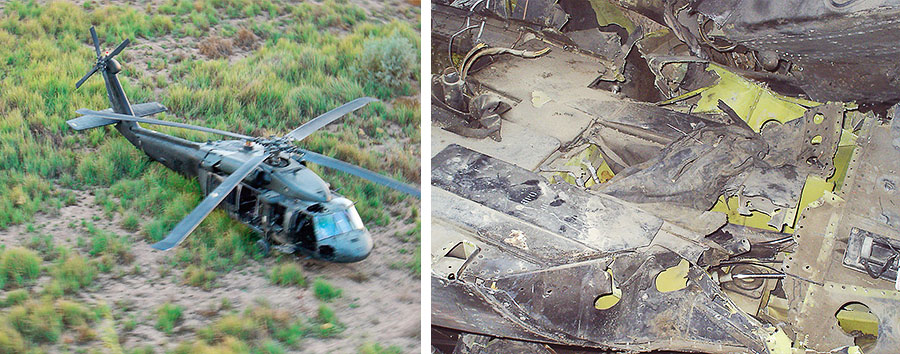
Left: Duckworth’s Black Hawk at the shootdown site; you can see the holes the RPG made when it came in through the bottom of the cockpit, exploded, and exited out the top. Right: This is Duckworth’s side of the cockpit photographed after the helicopter was scrapped; the tube with wires coming out at upper left is the remains of the cyclic stick that was between her legs. Photography: U.S. Army
When Pat set the helicopter down, a couple of guys who were waiting for a lift somewhere apparently thought we were their ride. As they stood up and started sauntering to the helicopter, the door suddenly flew open and a voice roared, “Get the fuck out of here!” It was Kurt, who for good measure turned around to show the blood-soaked back of his flight suit. The guys turned tail and ran. We laugh about it now — those poor bastards thought they were hopping an easy helicopter ride up to their base, only to be confronted by our hot mess of blood and body parts.
The team at Taji quickly loaded Chris and me onto stretchers and put us into the medevac. They had a stretcher ready for Kurt too, but he just said, “No, no, let’s go!” and limp-hopped into the back of the bird. The medic on board approached Chris, to take care of him as the most severely injured, but Chris pushed him away, saying, “Take care of Tammy! I think she’s alive.”
We took off for Baghdad, landing there at 5:24 p.m., less than an hour after the shootdown — the “golden hour,” as medical professionals call the crucial first 60 minutes after someone suffers catastrophic injury. That fast action — by my crew, the crew of our sister helicopter, and the medevac team — is why I’m alive today.
In 2004, the 31st Combat Support Hospital in Baghdad took care of an average of 15 traumas a day. On the busiest days, such as during the Second Battle of Fallujah, they took in 35 to 40. The helicopters would come thumping in, and the medical team would rush out to bring in the wounded. Trauma bed 2 was reserved for the most critically injured, and that’s where they put me.
Where my right leg had been, there was now just a gaping, ragged wound that looked like bloody hamburger meat with jagged bones sticking out. My lower left leg was mangled beyond repair, the toes of my foot curled grotesquely and the skin on top burned black. And all of these open, bleeding wounds were contaminated with dirt, shrapnel, and burned flesh. One of the surgeons who helped save my life, Adam Hamawy, described my leg injuries to me years later as “mud and blood, that’s all there was.”
In addition to the traumatic injuries to my lower extremities, the bones of my right arm were shattered, the skin and muscle pulverized. There was no pulse in my right hand, which was pale and lifeless. My face and torso had been pelted with hot shrapnel, and I had lost half of the blood in my body. The medical team gave me every unit of blood they had on hand. Then, as my treatment continued into the night and the hospital ran out, they started waking people up in their bunks, hustling around to find anyone who could give. In all, I would receive 40 units of blood, plasma, and platelets in Baghdad.
I have no recollection of any of this. I learned it later from a couple of guys who were there that day, Sergeant First Class Gregory Childs, who was the noncommissioned officer in charge of the emergency room, and Captain Jason Williams, one of the nurses who treated me. According to Sergeant Childs, I was white as a sheet from blood loss as they stretchered me in from the medevac, but I propped myself up on my one good elbow and kept demanding status reports on my crew. And in 2019, when I met Captain Williams for the first time since the shootdown, he seemed to remember every detail from my treatment that day:
When they rolled you in, you were still awake. You were asking, “Where are my guys?” And we were like, “Just relax, we’re going to take care of you. We’ve got people taking care of them.”
We had a stationary gurney, a striker gurney, like you’d find in a hospital. They rolled you in on the mobile rickshaw, and when I reached over to pull you onto the gurney, your right hip was missing. There was nothing there. And it just — all the remaining tissue just flopped over. And I’m like, wow, she is significantly injured.
I said, “You don’t realize it, but you’re super severely injured. Just let us take care of you.” And you were looking at me and kept asking, “How’s so-and-so? Where are they at? Are you taking care of my men?”
We were working on you to prepare you for surgery. I was about to give you the medication for what we call a rapid sequence intubation. It basically knocks you out and paralyzes you so we can put the tube in your throat to go to surgery.
I didn’t know your rank at the time, so I just said, “Ma’am, I’m getting ready to put you to sleep for surgery. The next time you wake up, you’re going to be in either Landstuhl, Germany, or back in the States.”
And right before I pushed the medicine, you reached up to me. You grabbed me by the scrubs and pulled me to you and looked me dead in the eyes and said, “You better take care of my guys.”
There were a lot of heroes that day. Dan Milberg landed a catastrophically damaged helicopter with extraordinary skill and nerve. Kurt Hannemann went to guard our perimeter even as he was bleeding from wounds of his own. Matt Backues used every ounce of his strength to drag my unconscious body across the Iraqi desert. Pat Meunks saved precious minutes by calling ahead for a medevac helicopter. Chris Fierce alerted the medevac team that they needed to check on me, as despite all appearances I might still be alive. Sergeant John Fischer from Pat’s crew helped carry Chris to safety. First Lieutenant Ura Asher kept his head as the copilot so Pat could focus on making the medevac calls. Colonel Hamm, in his first few hours in country, not only tried to help carry me but manned a weapon when we got airborne in case we saw any more of the enemy. The doctors and nurses who treated me in Baghdad kept me alive, and the troops there rushed to give blood when I desperately needed it.
I didn’t land the aircraft, and I didn’t carry anyone on my back. I wasn’t a hero that day. But that moment in the ER in Baghdad is still my personal proudest moment. Because in the last breath I had before the nurse put me under, which for all anyone knew might have been my last, I was still trying to take care of my guys. In the rawest, most traumatic moment of my life, my instinct was to check on my men.
And if those had been my last words, I’d have been fine with that.
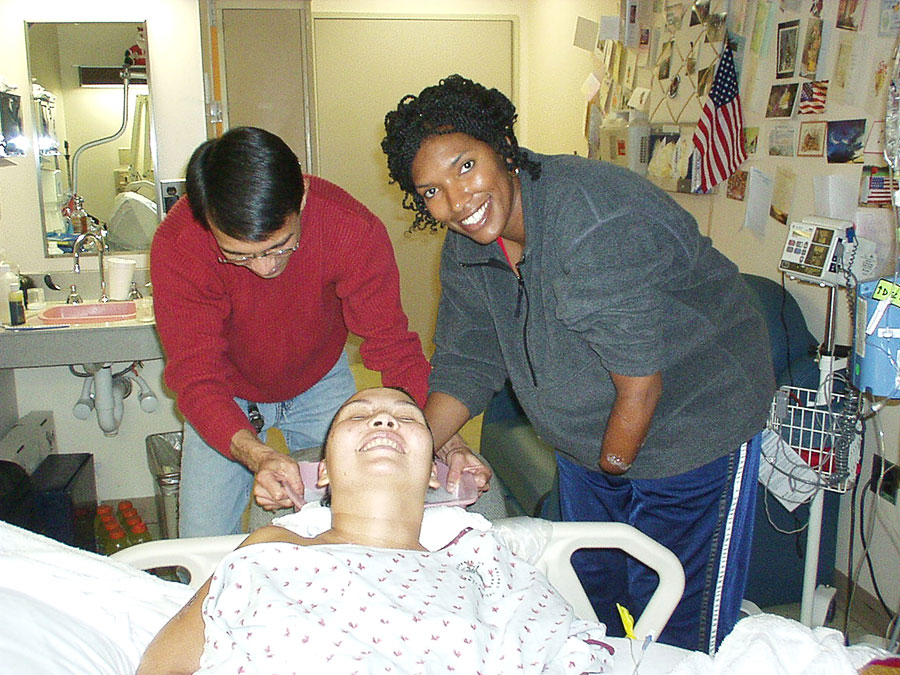
Sergeant First Class Juanita Wilson, herself an amputee, came to visit Duckworth at Walter Reed Medical Center once she was out of the ICU, and with the help of Duckworth’s brother, Tom, washed the blood and dust out of her hair. Photograph: Courtesy of the Duckworth Family
So, you want to fly again?” a nurse asked me the day after I awoke at Walter Reed Army Medical Center in Washington, D.C. It was nine days after the shootdown.
“Yeah,” I said. “I do.”
“Well, then, you’d better start moving.”
A wave of nausea rolled through my body, and for a moment I couldn’t speak. When it passed, I said, “I can’t move anything.” My right arm was pinned by a metal external fixator, which was holding my shattered bones together. I could feel the soles of my nonexistent feet burning, and phantom pain shot all the way up through the stumps of my legs, radiating into every part of my body. Everything hurt. What did this nurse expect me to do?
“Come on,” she said. “Can you do anything at all? Show me.” With effort, I managed to move my left hand at the wrist. “Great!” she said. “Give me 10 of those.” I made that small motion 10 times, and she smiled. “Now three sets of 10.” And that’s how my recovery started, moving one hand side to side while flat on my back in the intensive care unit.
In those first days at Walter Reed, I thought a lot about a phrase I’d learned from fellow soldiers in Iraq: “Own the suck.” It sucks to be deployed. It sucks to be sweating in 120-degree heat and have nowhere to pee. And it really sucks to lose your legs. But you know what? That’s your suck. Your loved ones, your friends, your doctors and nurses can never really know what you’re going through — only you do. So own your suck. Kick its ass. Otherwise, it owns you.
I decided to own — no, to dominate — my suck by taking my recovery one small step at a time. If I couldn’t move my arm, I’d move my hand. If I couldn’t sit up without feeling faint, I would raise my head inch by inch until I could. If I kept my focus and worked hard, I could make it a little better tomorrow, and the next day, and the next day, until I became strong again.
By choosing to own the suck, I was able to come to grips with my situation, and what I needed to do, pretty quickly. Unfortunately, my mom was still struggling to accept what had happened to me. As a Buddhist, she believed in the concept of karma, that your fate is tied to how you’ve lived. So that first week, Mom drove herself crazy, crying at my bedside and asking why I had to suffer like this.
“Mae khaa,” I said, calling her “Mom” in Thai, “did it ever occur to you that maybe because I lived a good life, that’s why I survived?” I could see in her face that my words were helping. And saying them out loud actually helped me too.
As my doctors weaned me off morphine, they tried to stabilize my condition and get my pain under control. Every day, they would take me into surgery to debride my wounds, a process that involved digging out shrapnel, washing out debris, and clearing away dead tissue in hopes of keeping infection at bay. They always put me under anesthesia for the debriding, but when I’d wake up, the gaping wounds on my leg stumps and arm hurt even worse.
I still hadn’t seen my right arm, because the doctors were trying to shield both my husband, Bryan, and me from how gruesome it looked. I knew it must have been bad, because even one of the nurses had to leave the room periodically so we wouldn’t see her cry. My arm was such a mangled mass of shredded, raw tissue that calling it hamburger would have been a compliment. Most of the muscle and skin had been blown apart by the RPG, and all three bones — my humerus, ulna, and radius — were broken into multiple pieces. The external fixator looked like a medieval torture tool, but it was literally the only thing holding my arm together.
The doctors still weren’t sure whether the arm could be saved, but they planned to perform a complicated surgery to try. In the meantime, in an effort to relieve the most intense pain, they put in a nerve block, a device connected to a catheter tube that bathed the nerve in a constant stream of painkillers. They then spent five days making sure I was strong enough for the surgery, which would involve not only my arm, but my torso and parts of my gluteus. The entire process, which involved multiple surgeons, was expected to take eight to 10 hours.
First, the doctors would piece back together the shattered bones of my arm, like a jigsaw puzzle. Then they would screw flat pieces of metal, custom-made to fit my arm, into the bones to hold them in place.
The next step was to rebuild the arm with living tissue. Most of my muscle and sinew had been blown apart in the explosion, so it wasn’t enough just to repair the bones; if the doctors didn’t include some new tissue, my upper arm would just be a thin stick covered with flappy skin, unprotected and virtually useless. So the plan was to create a “muscle flap,” an innovative technique that would result in a fleshy, mostly functional arm.
This was a tricky, time-consuming procedure, as my doctor, Lieutenant Colonel Gerald Farber, explained on the morning of my surgery. He would make three long incisions into my belly, creating an open rectangle, and then peel back my skin and muscle wall like a trapdoor, opening my abdomen down to my rib cage, with one long side of the rectangle still attached. He would then place my arm onto the opening and sew the flap to it, affixing my arm to my side. Finally, he would remove a patch of skin from my butt, use a special machine to punch holes in it and stretch it out, and then graft it to the wound over my rib cage to seal it up.
“Don’t worry, you’ll be asleep through all of it,” he said. And then he smiled. “I’ve been going over all the steps of this surgery all night,” he told me, probably figuring I’d find that comforting.
“Well, I hope not all night,” I said. “I mean, I hope you got some sleep.”
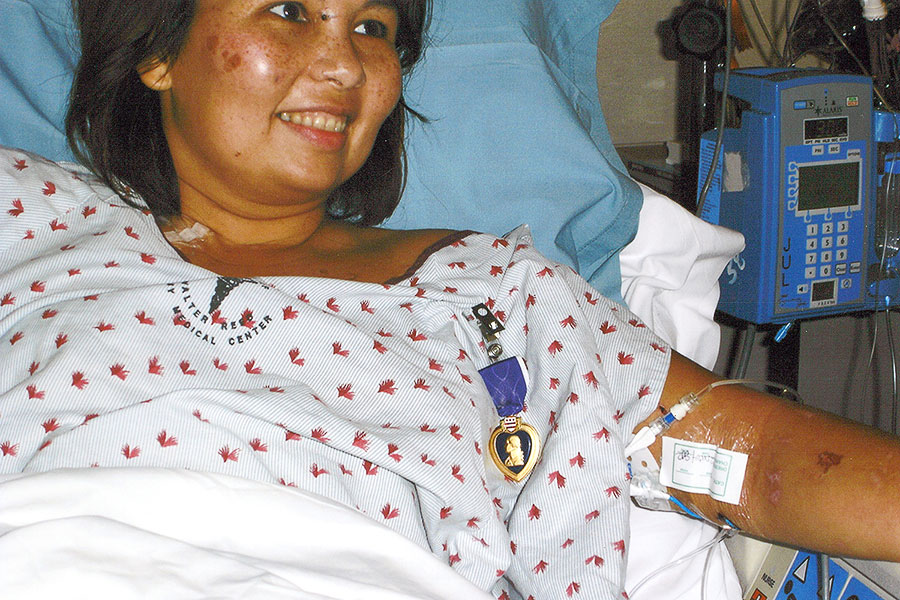
Duckworth receiving her Purple Heart three weeks after the shootdown. Photograph: Courtesy of the Duckworth Family
The surgery took 11 hours, because everything didn’t go quite as planned. After slicing a patch of skin off my right butt cheek, then stretching it with the special tool, the doctors discovered it wasn’t big enough to graft over my rib cage. So they had to take another patch from my left thigh. After I woke up, I was seriously bummed to find out that in addition to all my existing wounds, I now had two brand-new ones — giant 6-by-3-inch and 10-by-3-inch road-rash patches that stung like hell.
My butt was the only part of me that hadn’t been injured in the explosion, and now I couldn’t put any pressure on the right side of it, or on my left thigh. There was probably a joke in there somewhere about having my ass saved by my buddies only to have it literally skinned by the docs, but I wasn’t laughing, because while the nerve block helped me with the pain from my amputations and my arm, it did nothing to help with these new wounds.
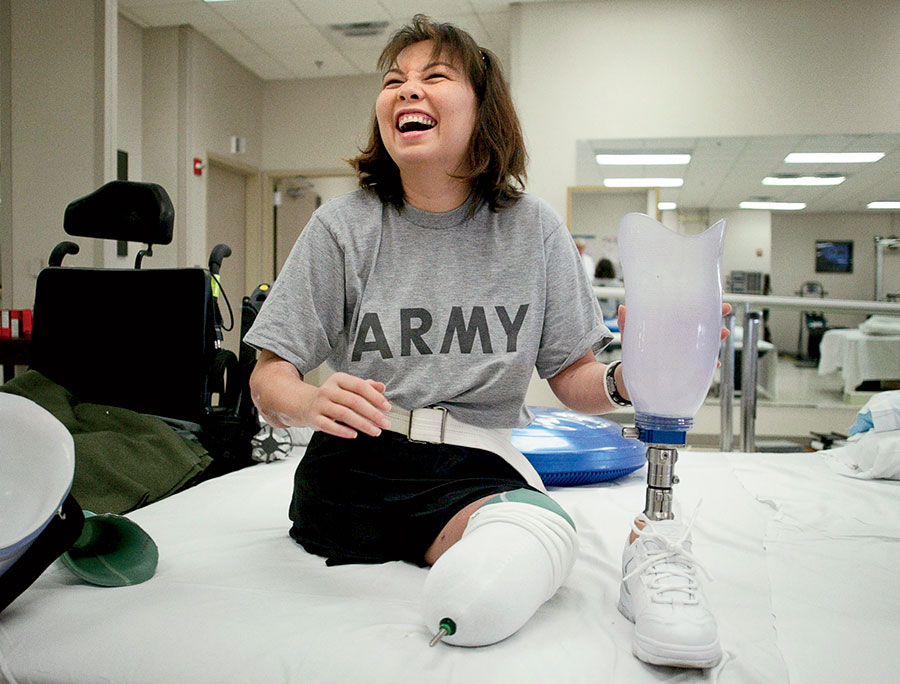
If you lose a leg as a civilian, most insurers won’t pay for a prosthetic limb until many months have passed. This is because the shape and size of your stump changes over time, so every few weeks you’d have to get your equipment resized, at a cost of thousands of dollars each time. But at Walter Reed, we got our new legs within the first six weeks. The doctors wanted us to start wearing them, standing up and getting mobile as soon as possible, because the earlier you start, the smoother the recovery process tends to be.
The medical team fitted me with a clear plexiglass socket and took measurements for my new legs. “What size feet did you have?” one of the prosthetics tech assistants asked. “Eight,” I told him. The new legs would need to have feet that were the same size as the ones I’d lost so my body would be proportional and I could wear my old shoes.
Unfortunately, when my new legs came, the feet were the size of boats. “What the hell?” I asked. “Ahhh,” the prosthetist said. “These are men’s size 8.” There were so few female leg amputees, apparently it hadn’t occurred to anyone in the military supply chain to order women’s feet sizes. In fact, just about everything at Walter Reed was created with men in mind. During my first week, the Wounded Warrior Project charity brought a prepacked “comfort kit” to me in the ICU. It had an iPod, which was nice, but the rest was stuff I had no use for: men’s briefs, a shaving kit, socks, and slippers. Bryan took one look and exclaimed, “Cool! Now I don’t need to do laundry for another week.” I just rolled my eyes.
By the time I got out of the ICU and into my own room, nearly three weeks had passed since the shootdown. During that time, I hadn’t been able to do any of the simple daily activities we all take for granted. I hadn’t eaten a meal since that stir-fry in the Green Zone. Instead, I had a feeding tube that snaked up my nose and down into my throat. I hadn’t had a shower since “Mortaritaville,” which is what we’d nicknamed the base near Balad, because insurgents fired so many rockets and mortars at it. And I hadn’t been able to wash my hair beyond the dry shampoo powder my mom occasionally sprinkled on me.
But as soon as I was in a regular room, Sergeant First Class Juanita Wilson showed up. While I was in the ICU, she knew that I couldn’t bear to be touched — that even having someone lean against my bed would make the sheets shift against my skin, causing unbearable pain. Now that I’d gotten the nerve block, I could withstand touch. Juanita understood all this because she had gone through it herself, having lost a hand when a roadside bomb exploded beneath her vehicle in Iraq. So now that I could bear it, she came to give me the greatest gift I could imagine. She came to wash my hair.
“Scoot to the edge,” she said. I gently shifted my weight, taking care to arrange the tubes still connected to my body, and held my head off the side of the bed. I hung on to the safety rail with my left hand while my brother, Tom, gingerly poured water out of a little plastic pitcher, soaking my hair. Juanita lathered my head with shampoo, massaging it into my scalp. She washed out all the dirt and dust of Iraq, the flakes of dried blood, and the black explosive residue from my hair into the little pink plastic basin my brother was holding. He’d empty it out, and then pour more water on my hair as she washed me, over and over again, until the water in the basin finally ran clear.
We must have been quite a sight — me with no legs, one arm stitched to my rib cage, hanging off the edge of my bed while Juanita gently washed the remnants of war out of my hair with her one remaining hand. Years later, Oprah Winfrey would bring us together in a surprise reunion on her talk show, and the minute I saw Juanita’s face, I burst into tears. Even now, when I think about how tenderly she cared for me, I tear up all over again.
The shootdown left Duckworth, here with one of her prosthetic legs four months later, as the first American female double amputee of the Iraq War. Photograph: David Carson/Post Dispatch/Polaris
Tammy,” Bryan had whispered the day after I woke up. “There are a couple of generals waiting outside to see you.” I’m sorry, what? Was this real or a hallucination? Why would generals — plural — be coming to see me? I was a captain at the time, third rank from the bottom in the Army officers’ seniority chart. Having generals come visit me was like a middle manager having the whole C-suite drop by.
The generals came through, one at a time, each wanting to thank me and tell me I was a good soldier. I appreciated the sentiment but was relieved when the visits were over. You normally want to be at your best when meeting with the highest-ranking officers, but I was being asked to do it while in the ICU and suffering from blinding pain, vomiting, and hallucinations.
I learned quickly that this wouldn’t be a one-time occurrence. Every day, people wanted to come to my bedside, say a word or two, get a photo taken, then continue on to the next wounded warrior. And not just military officers. We had visits from actors, politicians, comedians, cabinet members. They fell into one of two categories. In the first were people who really cared about the patients — guys like Gary Sinise and Adam Sandler, who visited repeatedly, offered support, and never made the visits about themselves. In the second were those who came for their own PR purposes, turning the wounded into props so their marketing machine could show them “supporting the troops.” They’d shuffle through, offer a hello and a halfhearted handshake, pose for the camera, then head out without bothering to learn our names. We started referring to ourselves as the Amputee Petting Zoo.
At first it was weird to have celebrities and politicians roaming the halls as we went through recovery. But so many of them showed up, it soon felt normal. Barack Obama used to come through, usually late at night, without the kind of big entourage other senators traveled with. He’d pop in, ask about my family, ask how my recovery was going. I didn’t realize it until later, but he was on the Senate Veterans’ Affairs Committee, and he was paying close attention to all of our answers.
The first time I managed to stand on a prosthetic leg, Adam Sandler was there. His movie 50 First Dates had just come out, and every so often, he’d bring his crew or other actors around to say hello. When he saw me in the therapy room fighting to get upright, he decided to hang out and watch.
Whenever someone in the therapy room accomplished a task for the first time, everybody erupted into cheers, and I was determined to get vertical that day. I hadn’t even been able to sit up for long without getting dizzy, as I’d been lying in bed for the past six weeks, so this was a real challenge. The physical therapist strapped me to a tilt table, and bit by bit, she cranked a lever that tilted the table slowly from horizontal to vertical.
“If you feel like you’re going to black out, say something,” she told me. I’d last about 10 seconds, then go back down. Then she’d ratchet me up a little farther, for 20 seconds — and then back down. I just kept pushing, and although the dizziness was hard to take, there was no way I was going to let myself black out in front of Adam Sandler. When I finally got upright — just for a few seconds — and heard him start yelling and clapping with the rest of the veterans in the room, I felt like I’d won a marathon.
The Chicago Bulls lacked major defensive effort and offensive discipline, losing to the Golden State Warriors 116-102 on the road.
There are 15 important observations to take from this game for the Bulls.
Rotations. Head coach Billy Donovan toyed with different rotations tonight. To start the evening, he sat Lauri Markkanen for Thaddeus Young. The first guards off the bench were Ryan Arcidiacono and Garrett Temple, who left the game due to injury. See below. Donovan also played around with a Daniel Theis and Nikola Vucevic pairing.
Bench Points. The Bulls outscored the Warriors 31-22 in bench points. Markkanen led the way with 13 points off of nine shots, an efficient night for him for his first game in the second rotation. The Bulls played eight players off the bench. This will change in the future.
Injuries/DNP. Coby White surprised fans with a late inactive before the game due to a neck injury. Temple left in the second quarter with a hamstring injury. Donovan made some interesting moves by not playing Al-Farouq Aminu nor Denzel Valentine off the bench. However, Devon Dotson and Cristiano Felicio saw late-game action.
Team Defense. The Warriors are an average shooting team this season, ranking 16th in field goal percentage and 14th in three-point percentage. Not against the Bulls. They shot right on 50 percent from the field and 42.1 percent from downtown as a team. The Bulls failed to control the Warriors’ offense in many areas. See below.
Pick-and-roll defense. The “drop coverage,” or the Donovan-defensive scheme that includes Bulls’ defending bigs to drop down in coverage off screens, is not working for them. The Warriors took full advantage of the space left between their ball-handler and the Bulls’ defending big by splashing mid-range and three-point shots. Check #6,7,8 for specifics.
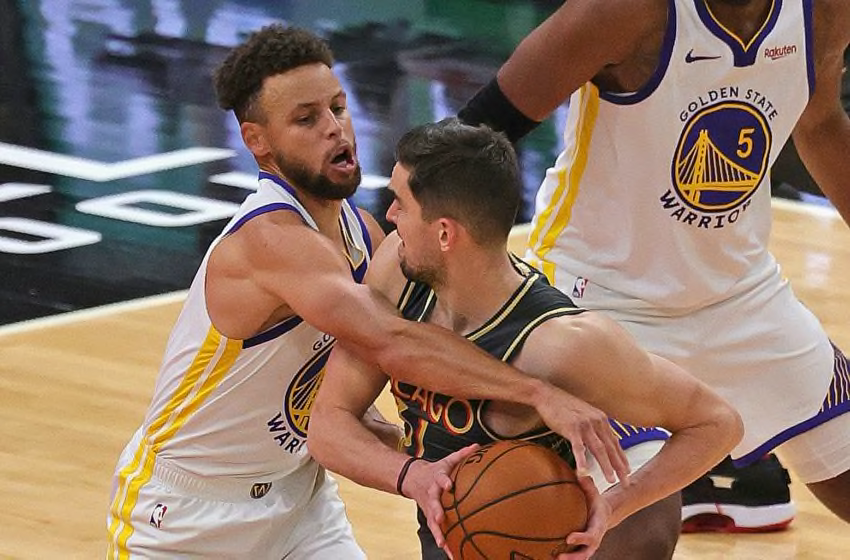
Stephen Curry. The main exploiter for the Bulls’ drop coverage on Monday night was Curry. Flying from off-ball and on-ball screens to get ideal matchups with Markkanen and Vucevic, Curry had a tremendous shooting night. He shot 11/24 from the field and 6/14 from three-point land for 32 points in his first night back from injury. He was out the previous five games before playing the Bulls.
Draymond Green. Green, while a much better defender than an offensive asset, had his fun against the Bulls on the offensive end. Green was free to shoot whenever he pleased from downtown since the Bulls decided to sag off of him to encourage him to shoot. This left Green to shoot 3/5 from downtown and 4/7 from the floor for 11 points on the night.
Kelly Oubre. Oubre was an effective body for the Warriors’ win on Monday. Disappointing enough, Oubre did plenty of work inside the paint. He grabbed 11 rebounds, four of them offensive, and capitalized for 18 points on 8/19 shooting. His aggressiveness outdid the Bulls’ attempts to contain him in the paint. Tomas Satoransky was an easy matchup for him.
Team Offense. The Bulls had an outstanding first half on offense, scoring 60 points on 22 assists in the first two quarters. For most of the first half, the Bulls were lighting up and shooting over 60 percent from the field. The catch of this success came from the scoreboard, seeing that the Warriors were up five points going into half even though the Bulls were shooting out of their minds. The defense has to improve.
Turnovers. The Bulls committed 20 turnovers, allowing the Warriors to score 15 points off of them. This caused a major gap in shot attempts too, as the Warriors got up 92 shots to the Bulls’ 84 on the night. The Bulls need the offense to stay in games at the moment.
Starters. The Bulls’ starters impressed, with all scoring in double-digits. Nikola Vucevic highlighted the Bulls’ offense in his second game with them, recording 21 points, nine rebounds, and six assists on 9/13 shooting from the field. Patrick Williams showed off his mid-range game for the Bulls with 14 points, six rebounds, and four assists. Satoransky nearly put up a double-double with 14 points and eight assists.
Zach LaVine. Is LaVine’s ankle injury becoming a cause for concern? He hardly played at all in the fourth quarter. LaVine also shot miserably from the floor, shooting 25 percent from the field and 1/7 from distance. He had just 12 points on the night and highlighted four turnovers with two offensive fouls called on him. It was encouraging to see the Bulls take lead changes on the Warriors in the first quarter without him scoring until 10:06 in the second quarter.
Free Throws. Another missing puzzle piece for the Bulls — free throws. They did get to the charity stripe more than the Warriors, taking 11 shots to the Warriors’ nine attempts. However, 11 is not going to do the job for them. Credit is due where credit is due, however, to the Bulls’ 58 points in the paint in comparison to the Warriors’ 46. That certainly came from the open space the Warriors had from distance, sinking 16/38 from the three-point line.
Transition. While not extremely evident, the Bulls did score 15 fast-break points over the Warriors’ 11 in that category. If the Bulls can step up their defense, their transition offense could become one of the better in the NBA. Troy Brown Jr. highlighted a fast break steal and dunk in garbage time. He, Aminu, Green, and LaVine could soon become high-flyers on transition if they can get their defense together.
Daniel Theis Effect. Save the best for last. Theis was not all that impressive on offense, with just six points, two rebounds, and three assists. He did impress Bulls fans with a posterizing slam dunk over James Wiseman on a lob from Williams. His defense was the major highlight. Bulls fans glorified his presence on the court and watched him record two blocks, one steal, and protect the rim with aggression. Theis’s energy is something Bulls’ big men need to replicate for upcoming games.
Just want to reiterate for emphasis that the Bulls shot 60% with 22 assists–a sublime 1st half offensive showing–and trail by 5.


:no_upscale()/cdn.vox-cdn.com/uploads/chorus_asset/file/22407940/CV_UPDATE_030621_17.jpg) Pat Nabong/Sun-Times
Pat Nabong/Sun-Times

Leave a comment