Public health officials on Friday announced Illinois’ second-most productive COVID-19 vaccination day yet with 166,885 doses going into arms statewide.
Nearly a quarter of all Illinoisans are now fully immunized against the coronavirus after Thursday’s shot effort, which came a week after the state set a record with almost 176,000 administered doses.
Illinois is now averaging about 130,000 shots per day as Chicago vaccine providers prepare to expand eligibility to all residents 16 and older starting Monday.
A federal pause on the Johnson & Johnson vaccine means there won’t be as many appointments available as officials might have thought a week ago, but the state has downplayed that obstacle. J&J doses only account for about 8% of Illinois’ vaccine supply.
Most appointments at city-run sites will go ahead as scheduled next week after shuffling around some doses, according to the Chicago Department of Public Health.
Mass vax sites at the United Center and Chicago State University will use Pfizer doses instead of J&J, as will the off-site Walgreens clinics that are scheduled to distribute doses at houses of worship this weekend, officials said Friday. The city’s program for homebound residents has switched to Pfizer, too.
Three other city efforts are at a full stop for now, including the O’Hare Airport vaccination site for transportation workers and a series of Illinois Restaurant Association events. The city’s “vaccination bus” is out of service, too.
COVID-19 infections have been on the rise for the past month even while the vaccine effort picks up momentum — but officials have expressed optimism the state might be flattening its latest curve.
The Illinois Department of Public Health reported 3,866 more cases were diagnosed among the latest 93,602 tests, keeping the state’s seven-day average positivity rate at 4.2% — twice as high as it was in mid-March, but the fourth straight day it’s fallen or held steady.
Hospitals took on an additional 15 COVID-19 patients with 2,058 beds occupied Thursday night. That’s nearly a thousand more coronavirus patients than were admitted March 12.
The state also reported 21 more deaths, including that of a Cook County man in his 40s, raising Illinois’ pandemic toll to 21,630.
Nearly 1.3 million residents have contracted the virus over the past year, compared to about 3.2 million who are now fully vaccinated.
Gov. J.B. Pritzker and Chicago Public Health Commissioner Dr. Allison Arwady have urged residents to get shots wherever they can find them. Thousands of appointments are available through the weekend and into next week at a federally run vaccination site in Gary, Indiana, which is open to Illinois residents.
For help finding a vaccine appointment in-state, visit coronavirus.illinois.gov or call (833) 621-1284.
COVID-19 vaccine doses administered by day
Graphic by Jesse Howe and Caroline Hurley | Sun-Times
A body is taken on Friday from the scene where multiple people were shot at a FedEx Ground facility in Indianapolis. A gunman killed several people and wounded others before taking his own life in a late-night attack at a FedEx facility near the Indianapolis airport, police said. | Michael Conroy/AP
Some 20% of guns retrieved at Illinois crime scenes come from Indiana. But many of our neighbors to the east don’t especially care.
After a rifle-bearing gunman killed eight people and injured others at a FedEx facility in Indianapolis late Thursday, Indiana Republican U.S. Sen. Mike Braun tweeted that the victims’ loved ones and co-workers “will be dealing with this tragedy for a long time to come.”
Notice who Braun didn’t say will be dealing with it: Congress.
Or even the Indiana state legislature.
That all too common attitude — “nothing for us to do here, folks” — helps explain why the United States has far and away the greatest number of gun deaths among all wealthy nations. We witness horror after horror — Sandy Hook, Marjory Stoneman Douglas High School, Mandalay Bay Resort and Casino, the Pulse nightclub, Virginia Tech and daily shootings on our streets — and little or nothing happens.
The FedEx calamity was at least the third mass shooting in Indianapolis just this year. It followed a recent string of mass shootings across the United States, including eight people fatally shot last month at massage businesses in the Atlanta area and 10 at a supermarket in Boulder, Colorado. The United States lurches from one tragedy of gun violence to another.
Yet too many elected officials refuse to consider smarter laws that could reduce gun violence.
Braun, who calls himself “100% pro-2nd Amendment,” should be working day and night to reduce gun violence. But like so many other elected officials, he isn’t. It’s a sign of America’s out-of-control gun culture.
That attitude doesn’t play well in Chicago, where guns easily obtained under Indiana’s lax gun laws are constantly brought to Chicago and used in crimes. Some 20% of guns retrieved at Illinois crime scenes come from Indiana. But many of our neighbors to the east don’t especially care.
“Other than representatives who come out of the northwest part of Indiana, I think they tend to take the attitude it is Chicago’s problem, not ours,” said Paul Hanson, vice president of Hoosiers Concerned About Gun Violence.
Instead of addressing gun violence, Indiana lawmakers recently pushed a bill to revoke that state’s law that requires a permit to carry a weapon, either openly or concealed. That effort appears to be dead for now, but gun safety advocates expect similar efforts in the future.
Such tolerance for gun trafficking is a problem for Illinois, Kathleen Sances, president and CEO of the Illinois Gun Violence Prevention PAC, said on Friday. “Everything they do to weaken their laws makes it worse for us because the guns come across the border.”
On Friday, FedEx said the shooter at its facility was a former employee. Police identified him as Brandon Scott Hole, 19. When he arrived at the facility, he started shooting quickly in the parking lot without any confrontation beforehand. He apparently shot himself after entering the building, police said. His mother reportedly had warned authorities of his potential for violence, and police had confiscated a gun from him last year.
We hear such stories too often after victims have died or been injured. Congress and the states should be working overtime to find ways to protect people from gun violence.
In Illinois, for example, there are no background checks on person-to person firearms sales and transfers. The seller is required to check that the buyer has a Firearms Owners Identification card, but the seller doesn’t have to ensure the FOID card is valid or run a background check. Legislators should pass the Block Illegal Ownership legislation in the state House and Senate to close that loophole and others.
On the federal level, the Senate should approve three bills tightening background checks that have passed the House. The bills would expand background checks on individuals seeking to purchase or transfer firearms and close the so-called Charleston loophole, which allows gun sales to proceed without a completed background check if three business days have passed.
And all that should just be a start.
President Joe Biden was right when he said, “Gun violence is an epidemic in America. But we should not accept it. We must act.”
Rachel Guglielmo, a volunteer with the Indiana chapter of the gun safety group Moms Demand Action, says the biggest challenge is that too many people don’t pay attention.
To enact the laws we need, “there is no way other than citizen engagement and activism,” she said.
That’s a message we all need to heed. For too long, gun groups have been the most vocal. It’s time for the rest of us to speak up.
Mayor Lori Lightfoot took office promising to stop the “epidemic of gun violence that devastates families, shatters communities, holds children hostage to fear in their own homes” and leaves their parents wondering “if Chicago is a place where they can continue to live and raise their children.” Yet she hits the midway point of her term with violence in the city far worse than when she came to City Hall. | AP
The mayor is nearing the midpoint of her four-year term with crime and violence in Chicago far worse than when she walked in.
Twice targeted by devastating rounds of looting, the city already was bracing for protests tied to a verdict in Derek Chauvin’s trial in Minnesota in the killing of George Floyd and the fallout from the police shooting in suburban Minneapolis of Daunte Wright.
The timing is no better for Mayor Lori Lightfoot, now a month away from the midpoint of her four-year term.
The shooting of a 13-year-old in a Little Village alley in the early hours of March 29 after a foot chase — the sort of chase the mayor wants to rein in — has shined an unflattering spotlight on what was supposed to be Lightfoot’s greatest strengths but instead have turned out to be her greatest shortcomings: police reform and public safety.
“We haven’t even reached the two-year mark,” said Ald. Carlos Ramirez-Rosa (35th), chairman of the Chicago City Council’s Socialist Caucus. “And already we have the tragic shooting of a child by a police officer. And we have a cover-up of police misconduct in the case of Anjanette Young.
“Voters may, in fact, feel betrayed or feel like they were let down,” Ramirez-Rosa said. “Many of them voted for Lightfoot believing she was going to right the ship at CPD.”
Ald. Byron Sigcho-Lopez (25th) said that what he saw on the video was a police officer shooting and killing a 13-year-old boy who “stopped and put his hands up when the officer told him to. … A boy whose body was fully open and vulnerable to a police officer’s weapon. What we saw is exactly what happens when police officers are taught that their lives matter more than anyone’s else’s.
“Our system protects the broken notion that Black and Brown children are disposable,” Sigcho-Lopez said. “Now is the time to tear down that racist, violent system and fix our city. The mayor doesn’t have any more chances. Our city can’t afford to lose another life.”
Lightfoot made her political bones on the issues of police reform and public safety. She’s a former Chicago Police Board president who co-chaired the Task Force on Police Accountability amid the furor that followed the police shooting of Laquan McDonald.
Former Mayor Rahm Emanuel was ordered to release the video of convicted Officer Jason Van Dyke — later convicted of murder — shooting McDonald 16 times after Emanuel was accused of concealing the video until he was safely re-elected to his second and final term.
Lightfoot personally drafted the policy that requires the city to release body-camera and dashcam video of police shootings and other incidents involving cop shootings within 60 days.
She promised during her inaugural address to stop the “epidemic of gun violence that devastates families, shatters communities, holds children hostage to fear in their own homes” and leaves their parents wondering “if Chicago is a place where they can continue to live and raise their children.”
Yet she hits the midway point with crime and violence far worse than when she walked in.
In March, shootings were up by 70% over the same period a year ago. Homicides were up 50%. The number of carjackings more than doubled.
Her handpicked police superintendent, David Brown, a retired Dallas police chief, seems overwhelmed by the Chicago job as his officers continue to be shot at in record numbers.
Lightfoot also has fallen short on the companion issues of police reform and accountability.
Her administration has been slow to comply with a federal consent decree.
She has failed to deliver the civilian oversight panel she promised in the first 100 days of her administration because of a dispute over the powers she vowed to give them: to hire and fire the police superintendent and be the final arbiter on disputes over police policy.
Lightfoot also has come under fire for changing her story about what she knew and when she knew it regarding the botched raid on the home of Anjanette Young, an innocent woman forced to stand naked, crying and pleading as an all-male team of Chicago cops raided the wrong home.
The mayor initially said she knew nothing about the raid until Channel 2 aired the shocking body-cam video in December.
But the mayor’s own emails revealed she was informed of a “very bad” raid on Young’s home in November 2019 and that she was so alarmed that she asked for a meeting with top aides to discuss it that same day.
Lightfoot admitted there is “a lot trust in me that’s been breached” by her handling of the raid on Young’s home and vowed to “win back the trust that we have lost.”
She has a long way to go.
Pat Nabong / Sun-TimesAld. Byron Sigcho-Lopez: “Our system protects the broken notion that Black and Brown children are disposable.”
“We see the case of Anjanette Young, Rekia Boyd and Laquan McDonald,” Sigcho-Lopez said. “Now, we see Adam Toledo. We are told, time after time, that we need to wait for police accountability. We have a bill right now that has the votes in the council, empowering communities for public safety. It is the bill that we need. The mayor does not have any excuses to delay this vote.”
Ald. Maria Hadden (49th) is the prime mover behind a sweeping search-warrant reform that Young has embraced. Hadden has promised to forge ahead with her own ordinance, arguing that it’s stronger in “17 different ways” than reforms outlined in an executive order unveiled by Lightfoot and Brown.
“The mayor has lost some credibility on this issue,” Hadden has said. “So why would people trust her executive order?”
Lightfoot has said she “wears the jacket” for Chicago violence, facing the blame, and that she’s not about to “outsource” control of the Chicago Police Department to a civilian oversight commission.
But those words ring hollow to many at a time violence seems out of control and, in some neighborhoods, people are so fearful of being carjacked that they’re patrolling gas stations to allow female drivers to fill up without fear.
Pat Nabong / Sun-TimesAld. Chris Taliaferro on the quick release of video from the police shooting of 13-year-old Adam Toledo: “This is an examploe the system working.”
Ald. Chris Taliaferro (29th) — the former Chicago police officer who is Lightfoot’s Committee on Public Safety chairman — said the political fallout for the mayor from the Toledo shooting video will be minimal if there even is any fallout.
According to Taliaferro, Lightfoot’s decision to pressure the city’s Civilian Office of Police Accountability to reverse its policy on withholding shooting videos involving juveniles and instead release the video in record time shows how much things have changed since the uproar over withholding the Laquan McDonald shooting video footage.
“This is an example of the system working,” he said. “Complete accountability. The investigation is occurring. Complete transparency. Videos are being shown only days after the shooting occurred after the family has had an opportunity to view it.
“Reform of our police department and reform of our ability to get these videos out sooner — it’s worked,” Taliaferro said. “I don’t think there’s any fallout because what the mayor has promised the public she actually came through on.”
What about the mayor’s promise of a safer city and swifter compliance with the consent decree?
“Some things are in her control,” Taliaferro said, “and some are not.
“Our department has implemented quite a few reforms in accordance with the consent decree. Have they kept up with the pace that’s been agreed upon by the monitor and the attorney general’s office? No. But they have made some great strides toward that.”
Hours before the video showing Adam Toledo being shot was released, an emotional Lightfoot tried to minimize any political fallout. She said the police department was prepared for the worst and would not be caught off-guard again. She acknowledged that Chicago “failed” the 13-year-old and vowed to use his death at the hands of police as a catalyst to provide constructive alternatives for teenagers like him.
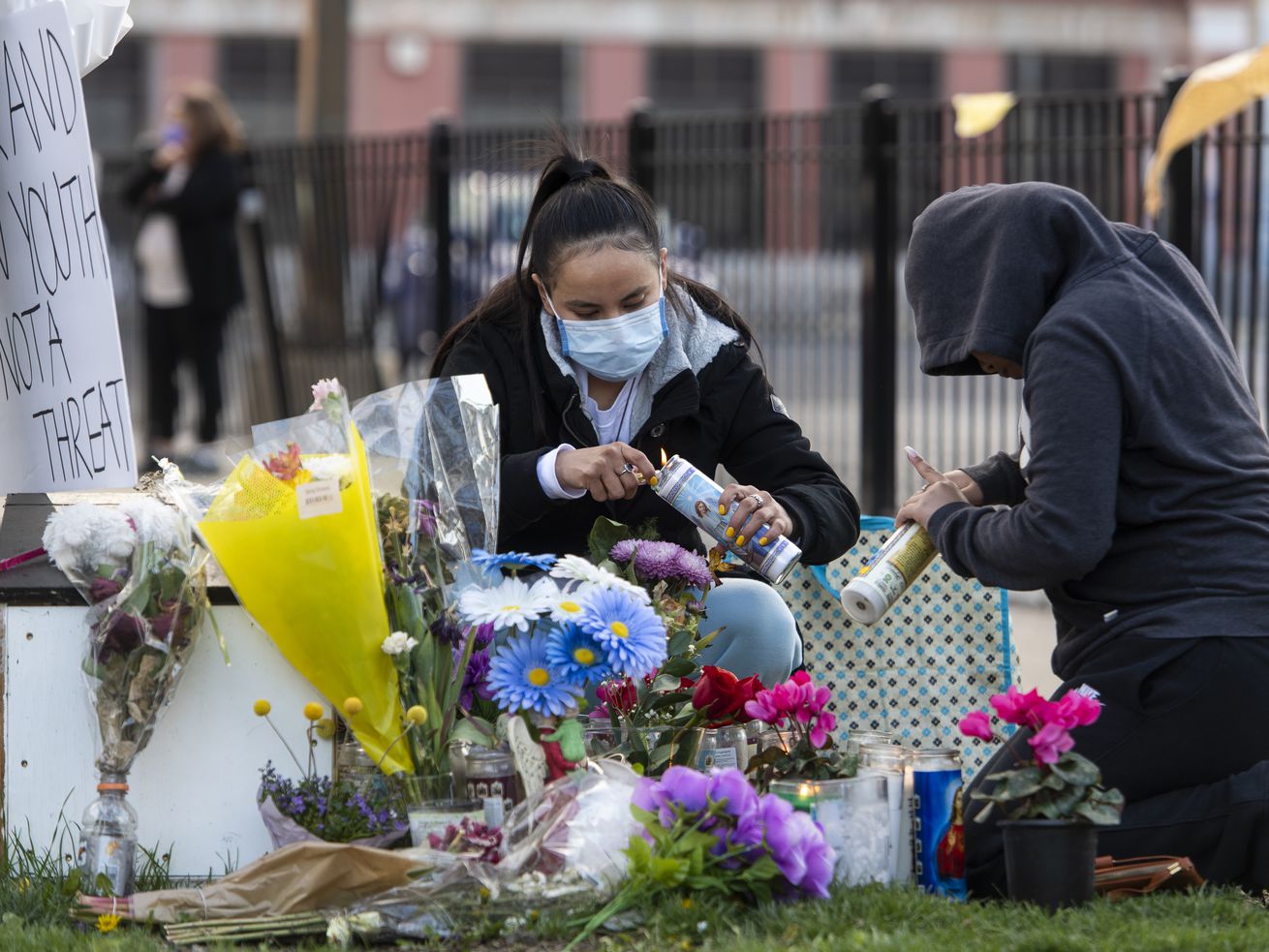
Tyler LaRiviere / Sun-TimesLittle Village residents Victoria Ramon-Fox (left) and Haley Scott light a candle at a memorial for Adam Toledo on Friday in the 2300 block of South Sawyer Avenue.
And she promised yet again to reform a police department foot-chase policy that “put everyone at risk: the officers, the person being pursued and bystanders.”
Taliaferro urged the mayor to be careful how far she goes to rein in those chases “at a time when crime is very high.
“If police can’t pursue on foot a fleeing offender, then are we sending a signal to our offenders that they won’t get caught because nobody’s gonna chase behind me?” the alderman said. “That may be sending the wrong message to anybody that’s going to commit a crime or even thinking about committing a crime. It may possibly give them the inclination to go ahead and commit that crime because I know the police won’t chase.”
Taliaferro said police reform is needed, and so are policy changes. But he said it needs to be done in a way that protects Chicago residents and the police officers who serve and protect them.
“If we implement policies that will serve to hurt our residents by police not being able to apprehend an offender because of the lack of a foot chase, then we may be in trouble,” he said. “Our crime rates may skyrocket.”
Coronavirus vaccinations will resume next week at Loretto Hospital in city-run clinic, the Chicago Department of Public Health announced Friday.
The new vaccination site will be focused on serving residents of the hospital’s Austin community, according to a health department news release.
On March 18, the health department had halted the delivery of vaccines to Loretto, 645 S. Central Ave., after reports surfaced that the hospital had vaccinated 72 ineligible workers at Trump International Hotel & Tower.
4:30 p.m. More than twice as many Illinoisans vaccinated than infected with COVID-19, as city prepares to expand eligibility
Public health officials on Friday announced Illinois’ second-most productive COVID-19 vaccination day yet with 166,885 doses going into arms statewide.
Nearly a quarter of all Illinoisans are now fully immunized against the coronavirus after Thursday’s shot effort, which came a week after the state set a record with almost 176,000 administered doses.
Illinois is now averaging about 130,000 shots per day as Chicago vaccine providers prepare to expand eligibility to all residents 16 and older starting Monday.
A federal pause on the Johnson & Johnson vaccine means there won’t be as many appointments available as officials might have thought a week ago, but the state has downplayed that obstacle. J&J doses only account for about 8% of Illinois’ vaccine supply.
Most appointments at city-run sites will go ahead as scheduled next week after shuffling around some doses, according to the Chicago Department of Public Health.
Mass vax sites at the United Center and Chicago State University will use Pfizer doses instead of J&J, as will the off-site Walgreens clinics that are scheduled to distribute doses at houses of worship this weekend, officials said Friday. The city’s program for homebound residents has switched to Pfizer, too.
3:45 p.m. Michigan’s worst-in-the-nation COVID-19 outbreak is starting to affect automotive production
DETROIT — Michigan’s worst-in-the-nation COVID-19 outbreak is beginning to slow auto production, with a major Ram pickup truck plant reducing its output because of a high number of absent workers.
About 10% of the production work force at the Stellantis (formerly Fiat Chrysler) assembly plant in Sterling Heights, north of Detroit, either tested positive or is on quarantine, a person who has been briefed on the situation said Friday. That is equivalent to about 600 workers, said the person, who asked not to be identified because neither the company nor the United Auto Workers union is releasing details.
The 5-million-square-foot plant has about 7,450 hourly workers, but not all of them are on the assembly lines. To try to stem the shortfall, the company has pulled workers from a pickup factory in nearby Warren, Michigan, that has been forced to shut down by the global shortage of semiconductors
2:50 p.m. How to politely ask whether someone has gotten the COVID-19 vaccine
Have the people you know and might be around been vaccinated? Many of us aren’t quite sure how to ask.
It’s a seemingly simple question whether you’re asking before going on a date with someone new or planning a long-awaited hangout with friends. But it can feel uncomfortable to ask.
Partly that’s because of polarizing opinions the pandemic has prompted.
“Not everyone places the same value on being vaccinated,” says Lynn F. Bufka, the American Psychological Association’s senior director of practice transformation and quality. “There are people who are quite clear that they do not want to be vaccinated.”
1:05 p.m. Bulls’ Zach LaVine expected to miss several games in coronavirus protocol
Coby White appears to be lost in his bench role.
Lauri Markkanen looks like he already signed elsewhere.
Patrick Williams seems to have gone headfirst into the rookie wall.
Factor in two embarrassing losses in less than a week to the last-place Timberwolves and the tanking Magic, and, well, there’s seemingly no way things could get worse for the Bulls.
Then Thursday hit.
A noon practice was quickly cancelled after Zach LaVine entered the NBA’s health and safety protocol with a positive coronavirus test, according to a source.
The hope is LaVine only will be out a handful of days, but with the Bulls scheduled to play five games in the next seven days and with only 18 games left in the regular season, that could be the difference between holding on to the final play-in spot or sitting in a lottery position and praying for lottery luck.
12:15 p.m. US setting up $1.7B national network to track virus variants
WASHINGTON — The U.S. is setting up a $1.7 billion national network to identify and track worrisome coronavirus mutations whose spread could trigger another pandemic wave, the Biden administration announced Friday.
White House officials unveiled a strategy that features three components: a major funding boost for the Centers for Disease Control and Prevention and state health departments to ramp up coronavirus gene-mapping; the creation of six “centers of excellence” partnerships with universities to conduct research and develop technologies for gene-based surveillance of pathogens; and building a data system to better share and analyze information on emerging disease threats, so knowledge can be turned into action.
“Even as we accelerate our efforts to get shots into arms, more dangerous variants are growing, causing increases in cases in people without immunity,” White House coronavirus adviser Andy Slavitt told reporters. That “requires us to intensify our efforts to quickly test for and find the genetic sequence of the virus as it spreads.”
10:45 a.m. After contracting COVID-19, ex-Chicago Outlaws Motorcycle Club boss Orvie Cochran gets early prison release
After Outlaws Motorcycle Club boss Orville “Orvie” Cochran survived a shooting outside the biker gang’s South Side clubhouse in 2000 — he slipped on some ice and fell, thus avoiding a hail of bullets — a former friend described him as “- – – damn lucky.”
Cochran’s luck still hasn’t run out.
Arrested in 2017 after being on the run for 16 years to avoid racketeering charges, he caught a break on his sentence. And now — after contracting the coronavirus in prison — Cochran has gotten a federal judge to free him from prison six months early.
The judge ordered a “compassionate” release for Cochran, who had asked for that even before getting infected because, he said, he was afraid he would and had health problems that could make COVID especially dangerous for him.
9 a.m. What is a COVID-19 vaccine passport, and will you need one?
What is a COVID-19 vaccine passport, and will I need one?
“Vaccine passports,” or vaccine certificates, are documents that show you were vaccinated against COVID-19 or recently tested negative for the virus. They could help you get into places such as stadiums or even countries that are looking to reopen safely.
The certificates are still being developed, and how and whether they’ll be used could vary widely around the world. Experts say they should be free and available on paper, not just on apps, since not everyone has a smartphone.
In the U.S., federal officials say there are no plans to make them broadly mandatory. In some states, Republican governors have issued orders barring businesses or state agencies from asking people to show proof of vaccination.
8:30 a.m. Pause on Johnson & Johnson COVID-19 vaccine won’t affect United Center appointments, city’s top doc says
Appointments at the United Center’s COVID-19 mass vaccination site will go on as scheduled next week with Pfizer doses being administered instead of the Johnson & Johnson vaccine that’s been shelved nationwide, officials said Thursday.
The city’s most prominent mass vax site has been doling out Pfizer since it launched a month ago in a parking lot across the street from the Near West Side arena.
That’ll still be the case Monday, which is when the federally run site had been scheduled to switch to J&J doses — until a handful of extremely rare blood clots tied to that vaccine prompted a temporary suspension this week while experts investigate.
The Federal Emergency Management Agency will provide additional Pfizer doses in its place, meaning plans won’t change for anyone with a United Center appointment, according to Chicago Public Health Commissioner Dr. Allison Arwady.
“Everybody who has an appointment from Monday on at the United Center can keep that appointment. You do not need to do a thing. You will just receive Pfizer instead of Johnson & Johnson,” Arwady said during an online Q&A.
The Illinois Department of Public Health reported 3,581 new cases of the disease were diagnosed Wednesday among 105,661 tests to keep the state’s average testing positivity rate at 4.2%.
About one quarter of Illinois residents have been fully vaccinated so far, with 138,538 doses administered Tuesday. The state also reported 3,536 new cases and 31 more deaths.
Staff member of state House Speaker Emanuel ‘Chris’ Welch tests positive for COVID-19. The staff member was tested Monday as part of the Legislature’s required protocols to return to in-person work in the Capitol.
Deputy Chief Craig McCartt of the Indianapolis Metropolitan Police Department address the media with an update near the crime scene of the FedEx Ground facility on April 16, 2021 in Indianapolis, Indiana. | Getty
Police Chief Randal Taylor noted that a “significant” number of employees at the FedEx facility are members of the Sikh community, and the Sikh Coalition later issued a statement saying it was “sad to confirm” that at least four of those killed were community members.
INDIANAPOLIS — The former employee who shot and killed eight people at a FedEx facility in Indianapolis was interviewed by FBI agents last year, after his mother called police to say that her son might commit “suicide by cop,” the bureau said Friday.
Coroners began the slow process of identifying the victims as family members spent hours agonizing over word of their loved ones. The slayings Thursday night marked the latest in a string of recent mass shootings to rock the U.S.
The shooter was identified as Brandon Scott Hole of Indianapolis, Deputy Police Chief Craig McCartt told a news conference. Investigators searched a home in Indianapolis associated with Hole and seized evidence, including desktop computers and other electronic media, McCartt said. The home is located in a neighborhood of midcentury houses near Interstate 465.
Hole began firing randomly at people in the parking lot of the FedEx facility late Thursday, killing four, before entering the building, fatally shooting four more people and then turning the gun on himself, McCartt said. He said the shooter apparently killed himself shortly before police entered the building. He said he did not know if Hole owned the gun legally.
“There was no confrontation with anyone that was there,” he said. “There was no disturbance, there was no argument. He just appeared to randomly start shooting.”
McCartt said the slayings took place in a matter of minutes, and that there were at least 100 people in the facility at the time. Many were changing shifts or were on their dinner break, he said. Several people were wounded, including five who were taken to the hospital.
A FedEx employee said he was working inside the building Thursday night when he heard several gunshots in rapid succession.
“I see a man come out with a rifle in his hand and he starts firing and he starts yelling stuff that I could not understand,” Levi Miller told WTHR-TV. “What I ended up doing was ducking down to make sure he did not see me because I thought he would see me and he would shoot me.”
Paul Keenan, special agent in charge of the FBI’s Indianapolis field office, said Friday that agents questioned Hole last year after his mother called police to say that her son might commit “suicide by cop.” He said the FBI was called after items were found in Hole’s bedroom but he did not elaborate on what they were. He said agents found no evidence of a crime and that they did not identify Hole as espousing a racially motivated ideology. A police report obtained by The Associated Press shows that officers seized a pump-action shotgun from Hole’s home after responding to the mother’s call.
McCartt said Hole was a former employee of FedEx and last worked for the company in 2020. The deputy police chief said he did not know why Hole left the job or if he had ties to the workers in the facility. He said police have not yet uncovered a motive for the shooting.
Police Chief Randal Taylor noted that a “significant” number of employees at the FedEx facility are members of the Sikh community, and the Sikh Coalition later issued a statement saying it was “sad to confirm” that at least four of those killed were community members.
The coalition, which identifies itself as the largest Sikh civil rights organization in the U.S., said in the statement that it expected authorities to “conduct a full investigation — including the possibility of bias as a factor.”
The agonizing wait by the workers’ families was exacerbated by the fact that most employees aren’t allowed to carry cellphones inside the FedEx building, making contact with them difficult.
“When you see notifications on your phone, but you’re not getting a text back from your kid and you’re not getting information and you still don’t know where they are … what are you supposed to do?” Mindy Carson said early Friday, fighting back tears.
Carson later said she had heard from her daughter Jessica, who works in the facility, and that she was OK.
FedEx said in a statement that cellphone access is limited to a small number of workers in the dock and package sorting areas to “support safety protocols and minimize potential distractions.”
FedEx Chairman and Chief Executive Officer Frederick Smith called the shooting a “senseless act of violence.”
“This is a devastating day, and words are hard to describe the emotions we all feel,” he wrote in an email to employees.
The killings marked the latest in a string of recent mass shootings across the country and the third mass shooting this year in Indianapolis. Five people, including a pregnant woman, were shot and killed in the city in January, and a man was accused of killing three adults and a child before abducting his daughter during at argument at a home in March. In other states last month, eight people were fatally shot at massage businesses in the Atlanta area, and 10 died in gunfire at a supermarket in Boulder, Colorado.
Indianapolis Mayor Joe Hogsett said the community must guard against resignation and “the assumption that this is simply how it must be and we might as well get used to it.”
President Joe Biden said he had been briefed on the shooting and called gun violence “an epidemic” in the U.S.
“Too many Americans are dying every single day from gun violence. It stains our character and pierces the very soul of our nation,” he said in a statement. Later, he tweeted, “We can, and must, do more to reduce gun violence and save lives.”
House Speaker Nancy Pelosi said she was “horrified and heartbroken” by the shooting and called for congressional action on gun control.
“As we pray for the families of all affected, we must work urgently to enact commonsense gun violence prevention laws to save lives & prevent this suffering,” the Democratic leader said in a tweet.
Gov. Eric Holcomb ordered flags to be flown at half-staff until April 20.
___
Associated Press reporters Michael Balsamo and Eric Tucker in Washington contributed to this report. Casey Smith is a corps member for the Associated Press/Report for America Statehouse News Initiative. Report for America is a nonprofit national service program that places journalists in local newsrooms to report on undercovered issues.
Deputy Chief Craig McCartt of the Indianapolis Metropolitan Police Department address the media with an update near the crime scene of the FedEx Ground facility on April 16, 2021 in Indianapolis, Indiana. | Getty
Police Chief Randal Taylor noted that a “significant” number of employees at the facility are members of the Sikh community, and the Sikh Coalition later confirmed that members of the community were among the wounded and killed.
INDIANAPOLIS — FBI agents last year interviewed the gunman who fatally shot eight people at a FedEx facility in Indianapolis, the bureau said Friday, as investigators searched the home of the 19-year-old former FedEx employee.
Coroners began the slow process of identifying the victims as family members spent hours agonizing over word of their loved ones. The slayings Thursday night marked the latest in a string of recent mass shootings to rock the U.S.
The shooter was identified as Brandon Scott Hole of Indianapolis, Deputy Police Chief Craig McCartt told a news conference. Investigators searched a home in Indianapolis associated with Hole and seized evidence, including desktop computers and other electronic media, McCartt said.
Paul Keenan, the special agent in charge of the FBI’s Indianapolis field office, said Friday that agents questioned Hole last year after his mother called police to say that her son might commit “suicide by cop.” He said the FBI was called after items were found in Hole’s bedroom but he did not elaborate on what they were. He said agents found no evidence of a crime and that they did not identify Hole as espousing a racially motivated ideology.
McCartt said Hole was a former employee of the company and last worked for FedEx in 2020. McCartt said he did not know why Hole left the job or if he had ties to the workers in the facility. He said police have not yet uncovered a motive for Thursday’s shooting but added that law enforcement officers seized a gun from him last year. McCartt also said authorities are still identifying the victims and that not all of the victims’ families have been notified.
Hole started randomly firing at people in the parking lot and then went into the building and continued shooting late Thursday night, McCartt said. He said the shooter apparently killed himself shortly before police entered the building.
“There was no confrontation with anyone that was there,” he said. “There was no disturbance, there was no argument. He just appeared to randomly start shooting.”
McCartt said four people were killed outside the building and another four inside. Several people were also wounded, including five who were taken to the hospital. McCartt said the slayings took place in a matter of minutes.
Officials with the coroner’s office began the process of identifying victims Friday afternoon, a process they said would take several hours.
Police Chief Randal Taylor noted that a “significant” number of employees at the FedEx facility are members of the Sikh community, and the Sikh Coalition later issued a statement saying it was “deeply saddened to learn” that Sikh community members were among the wounded and killed.
The coalition, which identifies itself as the largest Sikh civil rights organization in the U.S., said in the statement that it expected authorities to “conduct a full investigation — including the possibility of bias as a factor.” The coalition’s executive director, Satjeet Kaur, noted that more than 8,000 Sikh Americans live in Indiana.
The agonizing wait by the workers’ families was exacerbated by the fact that most employees aren’t allowed to carry cellphones inside the FedEx building, making contact with them difficult.
“When you see notifications on your phone, but you’re not getting a text back from your kid and you’re not getting information and you still don’t know where they are … what are you supposed to do?” Mindy Carson said early Friday, fighting back tears.
Carson later said she had heard from her daughter Jessica, who works in the facility, and that she was OK. She was going to meet her, but didn’t say where.
FedEx said in a statement that cellphone access is limited to a small number of workers in the dock and package sorting areas to “support safety protocols and minimize potential distractions.”
FedEx Chairman and Chief Executive Officer Frederick Smith called the shooting a “senseless act of violence.”
“This is a devastating day, and words are hard to describe the emotions we all feel,” he wrote in an email to employees.
The killings marked the latest in a string of recent mass shootings across the country and the third mass shooting this year in Indianapolis. Five people, including a pregnant woman, were shot and killed in the city in January, and a man was accused of killing three adults and a child before abducting his daughter during at argument at a home in March. In other states last month, eight people were fatally shot at massage businesses in the Atlanta area, and 10 died in gunfire at a supermarket in Boulder, Colorado.
Indianapolis Mayor Joe Hogsett said the community must guard against resignation and “the assumption that this is simply how it must be and we might as well get used to it.”
President Joe Biden said he had been briefed on the shooting and called gun violence “an epidemic” in the U.S.
“Too many Americans are dying every single day from gun violence. It stains our character and pierces the very soul of our nation,” he said in a statement. Later, he tweeted, “We can, and must, do more to reduce gun violence and save lives.”
House Speaker Nancy Pelosi said she was “horrified and heartbroken” by the shooting and called for congressional action on gun control.
“As we pray for the families of all affected, we must work urgently to enact commonsense gun violence prevention laws to save lives & prevent this suffering,” the Democratic leader said in a tweet.
A witness said he was working inside the building when he heard several gunshots in rapid succession.
“I see a man come out with a rifle in his hand and he starts firing and he starts yelling stuff that I could not understand,” Levi Miller told WTHR-TV. “What I ended up doing was ducking down to make sure he did not see me because I thought he would see me and he would shoot me.”
A man told WTTV that his niece was sitting in the driver’s seat of her car when the gunfire erupted, and she was wounded.
“She got shot on her left arm,” said Parminder Singh. “She’s fine, she’s in the hospital now.”
Gov. Eric Holcomb ordered flags to be flown at half-staff until April 20, and he and others decried the shooting.
Chris Bavender, a spokesperson for the FBI’s Indianapolis office, said the bureau is helping with the investigation.
___
Associated Press reporters Michael Balsamo and Eric Tucker in Washington contributed to this report. Casey Smith is a corps member for the Associated Press/Report for America Statehouse News Initiative. Report for America is a nonprofit national service program that places journalists in local newsrooms to report on undercovered issues.
Two women from Little Village tend to the memorial for Adam Toledo near 24th St. and Sawyer Avenue. Toledo, a 13-year-old, was shot and killed by a Chicago police officer. | Tyler LaRiviere | Sun-Times
Police use of force and gun violence are part of the story. Our city must have a broader discussion about these complexities.
What happened in the early morning hours of March 29, 2021, when 13-year-old Adam Toledo was killed is heartbreaking. Yet it’s also complicated.
Recent tragedies across the county have made clear that as a society we must examine our police force’s use of deadly force. At the same time, at least in Chicago, we need a city-wide intervention to address gun violence amongst the citizenry.
Adam’s death highlights how these two issues are inextricably linked. If Ruben Roman, the 21-year-old also in the area, or Adam did not shoot at that car, the officer would not have been chasing Adam through that alley.
SEND LETTERS TO:[email protected]. Please include your neighborhood or hometown and a phone number for verification purposes. Letters should be 350 words or less.
We must address police shootings but we must also confront the daily gun violence that has plagued our city for so long that it has become commonplace. Attempting to tackle these issues will be anything but easy. Our institutions, like the Chicago Sun-Times, will need to assume leadership roles if there is to be a path forward. To do this, and to do it right, we have to approach issues like this with empathy and a willingness to embrace their complexity.
The editorial board shied away from the complexity in its piece “‘Show your hands,’ the officer ordered, a split second before shooting Adam Toledo,” to disappointing and detrimental effect. The same videos the editorial board viewed show that Adam had a gun and that Adam or Ruben had used that gun, apparently to shoot at a car, just minutes before the tragedy.
These uncomfortable facts don’t make what happened to Adam in any way acceptable, but this newspaper has a duty to fully present them if it wants to be relied upon as one of the city’s institutional leaders.
This is an opportunity for a broader discussion and I hope the Sun-Times will take the lead going forward.
Matthew Ingersoll, Beverly
A teen out at 2:30 a.m. is the real tragedy
Though it is a tragedy Adam Toledo died, it is not the fault of the cop who shot him. Toledo was running from the cop in an alley at 2:30 in the morning with a gun in his hand.
Put yourself in the cop’s shoes, receiving a call of “shots fired” with an armed suspect running away. Your adrenaline is rushing and a split-second decision has to be made. Though we now view it frame by frame, that is not how life is lived in real time, let alone at 2:30 a.m. in a dark alley while chasing an armed, unknown suspect.
The real tragedy and question is why a 13-year-old was out with an armed, 21-year-old convicted criminal at 2:30 in the morning.
That is what caused this tragedy, not a cop responding to it.
Jean DuBois, Elmhurst
Keep high schools closed
As a veteran public school educator for over 20 years, it is my conviction that keeping high school students out of school buildings in regard to in-person learning is the right thing to do at this point. The argument by Ammie Kessem in her April 13 op-ed is from a selfish perspective without taking into account the entire picture.
First, not every high school teacher has been vaccinated, which poses serious risks for themselves and students. Second, high school students change classes throughout the day causing an enormous amount of traffic in hallways, especially in schools with a large student population.
Third, data show that most high school students would rather continue with remote learning that eliminates the possibility of contracting COVID 19. Fourth, if some students return to class but more choose remote learning, how can the teacher provide quality instruction for both groups?
Fifth, Ms. Kessem’s allegation that the remaining ”20 days in school would be the best 20 days ever for many Chicago high schoolers”is just her belief, without any empirical evidence.
I applaud the Chicago Teachers Union for doing what many teachers, staff, and students believe to be in their best interest. The rest of this school year should be relegated to remote learning without having to be concerned about the possible danger of in-person instruction and without having to develop a strategy to provide meaningful instruction for both the remote learners and those who are in-person.
Tepera pitched — and got into trouble — Tuesday in Milwaukee. | Photo by Stacy Revere/Getty Images
Ryan Tepera — claiming “no malicious intent” toward Brandon Woodruff — is appealing his three-game suspension and fine.
David Ross wasn’t even sure where he was going to watch Friday’s Cubs-Braves game. A few hours before first pitch, he just knew that he had to clear the heck out of the clubhouse area. It only added to his aggravation.
Turns out it’s no fun being suspended — especially when you don’t believe you ought to be.
Ross was suspended for one game and fined after Major League Baseball determined that reliever Ryan Tepera intentionally threw at Brewers pitcher Brandon Woodruff Tuesday in Milwaukee. Apparently, it mattered not that Brewers pitchers were repeatedly plunking Cubs catcher Willson Contreras or that Tepera’s pitch to Woodruff was low and didn’t even hit him.
“We threw one behind a guy’s calf and we’ve got suspensions and fines everywhere? That makes zero sense to me,” Ross said, mixing in an expletive.
Bench coach Andy Green managed in place of Ross, who added that he has had a “hard time understanding a lot of what’s come down” from the league. Tepera — claiming “no malicious intent” toward Woodruff — is appealing his three-game suspension and fine, with a hearing coming as soon as next week, and is available to pitch until then.
“It was just a message that we’d had enough,” the right-hander said.
Tepera, too, ripped the league’s punishment.
“To be blunt, today’s game of baseball has become so soft,” he said. “Back in the day, matters were settled on the field — one of many unwritten rules that have changed over time.”
Contreras has been hit 14 times in his last seven games against the Brewers. He has been hit more times than anyone — 19, including once Friday by Braves starter Kyle Wright — since the start of the 2020 season. The Cubs have led the majors in that painful category over that same period.
“We lead the league in getting hit by pitches, and it’s not even close,” Ross said. “And we’ve never intentionally retaliated, to my knowledge.”
J-Hey on Jackie
On Jackie Robinson Day at Wrigley, with players on both teams wearing No. 42 on their backs, Cubs right fielder Jason Heyward drew a link from Robinson to today’s 100-plus-member Players Alliance — a nonprofit organization formed by current and former Black baseball players to create increased opportunities for the Black community.
“It’s amazing that he was able to make the sacrifices he did and continue his character, continue his love for the game and not put himself above that,” Heyward said. “[He did it] for his teammates, of course, but also for the numerous amount of people like myself [whom] he didn’t know it was going to affect. …
“He didn’t know the extent. He didn’t know that there would be a Players Alliance here today, unified and trying to rally troops behind good messages and positivity in our communities.”
This and that
A late scratch from his last scheduled start because he wasn’t feeling well, Kyle Hendricks should be good to go on Sunday.
• The four players who were on the COVID-19-related injured list in recent days — Jason Adam, Matt Duffy, Dan WInkler and Matt Duffy — have all tested negative for the virus. They were put on the list according to safety protocols after coaches Craig Driver and Chris Young tested positive.
• Adam and Duffy appeared in Friday’s game. Ross was hopeful to have Winkler and Workman back in the bullpen on Sunday.


/cdn.vox-cdn.com/uploads/chorus_asset/file/22450123/merlin_93350490.jpg)
/cdn.vox-cdn.com/uploads/chorus_asset/file/22450108/merlin_96229420.jpg)
/cdn.vox-cdn.com/uploads/chorus_asset/file/22450128/merlin_97101610.jpg)

/cdn.vox-cdn.com/uploads/chorus_asset/file/22450106/CV_LORETTO_11.jpg)