A man was sentenced April 15, 2021, to 12 years in prison for selling guns to gang members in Chicago. | Adobe Stock Photo
David Santiago, 39, pleaded guilty last year to two counts of illegal possession of firearms, the U.S. Attorney’s office for the Northern District of Illinois said in a statement.
A man convicted of selling guns out of his bedroom to Chicago gang members was sentenced to 12 years in federal prison last week.
David Santiago, 39, pleaded guilty last year to two counts of illegal possession of firearms, the U.S. Attorney’s office for the Northern District of Illinois said in a statement. The sentence was handed down April 15.
Santiago had previously been convicted of multiple felonies and was not legally allowed to possess a firearm, the attorney’s office said.
Prosecutors said Santiago sold guns out of his home in Chicago Lawn, many of which went to people whom he knew were gang members.
He boasted to buyers that the guns were “clean” and “brand new,” prosecutors said, and were purportedly obtained in Kansas.
During one sale, the buyer discussed how he intended to give a gun to a younger member of a gang, to which Santiago replied that he was going to provide one to the “guys” as well, prosecutors said. The buyer was cooperating with law enforcement and recorded the interaction.
Investigators seized 16 guns including rifles and semi-automatic handguns, prosecutors said. More than 100 grams of heroin were also recovered as Santiago also sold drugs out of his home.
“Santiago was running an illegal gun store from his bedroom,” Assistant U.S. Attorney Timothy J. Storino argued in the government’s sentencing memorandum. “The over-proliferation of firearms in this city and the easy access of firearms in the hands of persons who should not have them has a direct correlation to the cyclical gun violence epidemic in Chicago.”
WASHINGTON — Capitol Police Officer Brian Sicknick, who was injured while confronting rioters during the Jan. 6 insurrection, suffered a stroke and died from natural causes, the Washington, D.C., medical examiner’s office ruled Monday, a finding that lessens the chances that anyone will be charged in his death.
Investigators initially believed the officer was hit in the head with a fire extinguisher, based on statements collected early in the investigation, according to two people familiar with the case. And they later thought the 42-year-old Sicknick may have ingested a chemical substance — possibly bear spray — that may have contributed to his death.
But the determination of a natural cause of death means the medical examiner found that a medical condition alone caused his death — it was not brought on by an injury. The determination is likely to significantly inhibit the ability of federal prosecutors to bring homicide charges in Sicknick’s death.
U.S. Capitol Police said that the agency accepted the medical examiner’s findings but that the ruling didn’t change the fact that Sicknick had died in the line of duty, “courageously defending Congress and the Capitol.”
“The attack on our officers, including Brian, was an attack on our democracy,” police officials said in a statement. “The United States Capitol Police will never forget Officer Sicknick’s bravery, nor the bravery of any officer on January 6, who risked their lives to defend our democracy.”
Federal prosecutors have charged two men with using bear spray on Sicknick during the Jan. 6 riot. The arrests of George Tanios, 39, of Morgantown, West Virginia, and Julian Khater, 32, of Pennsylvania, were the closest federal prosecutors have come to identifying and charging anyone associated with the five deaths that happened during and after the riot.
Lawyers for the two men had no immediate comment Monday.
Sicknick died after defending the Capitol against the mob that stormed the building as Congress was voting to certify Joe Biden’s electoral win over Donald Trump. It came after Trump urged his supporters to “fight like hell” to overturn his defeat.
Sicknick was standing guard with other officers behind metal bicycle racks as the mob descended on the Capitol.
“Give me that bear shit,” Khater said before he reached into Tanios’ backpack, according to court papers. Tanios told Khater “not yet” because it was “still early,” but Khater responded that “they just f—ing sprayed me.” Khater was then seen holding a can of chemical spray, prosecutors say.
As the rioters began pulling on one of the racks, Khater was seen with his arm in the air and the canister in his hand while standing just 5 to 8 feet from the officers, authorities said.
In February, Sicknick became only the fifth person in history to lie in honor in the Capitol Rotunda, a designation for those who are not elected officials, judges or military leaders. He was interred at Arlington National Cemetery.
___
Balsamo reported from New York. Associated Press writer Alanna Durkin Richer contributed to this report from Boston.
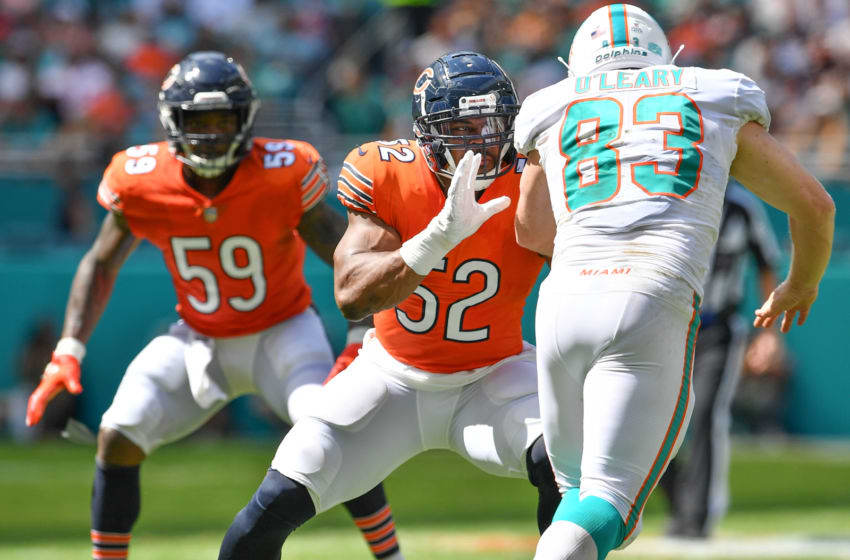
With the 2021 NFL Draft just days away, the Chicago Bears‘ plan must start coming into focus.
Right now, it feels as though the Bears’ chances at making something big happen are slim to none. For some reason, there has been a bit of a lull in the rumor mill after it was alive and well in Chicago for weeks on end.
There was no move for Russell Wilson. The Deshaun Watson interest appears to have simmered down due to the situation at hand. At the moment, it looks as though the Bears will probably be picking at no. 20 overall.
The Bears may have to wait another year to solidify their need for a franchise quarterback.
Or will they?
The Chicago Bears’ ideal trade partner for the 2021 NFL Draft may have just surfaced.
According NFL insider Ian Rapoport, the Miami Dolphins could be looking at making yet another move.
The #Dolphins have already made two moves in the NFL Draft and they may not be done yet: Sources say they’ve received calls from teams looking to trade up to No. 6 and it is something they’re considering. Lot of things in play, but Miami could be at it again.
This offseason has been an eventful one for the Dolphins. First, they made an enormous splash in the pre-draft process when they traded back with the San Francisco 49ers.
The 49ers gave up the no. 12 overall pick, a third rounder in 2022 and first-round picks in both 2022 and 2023 to move all the way up to number three. Now, the fate of the first round may truly depend on what John Lynch and San Francisco decide to do.
But, the Dolphins weren’t done there. Almost immediately after making that trade with San Francisco, they were on the move again. Miami moved up to no. 6 overall via the Philadelphia Eagles, dealing the no. 12 pick, a fourth rounder in 2022 and their first-round pick in 2022 to move up six spots. The Dolphins also acquired a fifth rounder in the deal, too.
If the Dolphins were entertaining yet another deal, it could simply be to stockpile even more picks. Originally, folks thought the Dolphins were going after either Penei Sewell or one of the top playmakers in the draft by moving up to the sixth pick — think Ja’Marr Chase or Kyle Pitts.
Now, the hype around this year’s quarterback crop is growing even stronger, which could allow Miami to move back and still end up with an excellent playmaker or two in this year’s first round — plus additional picks later on.
The fact that we could see three quarterbacks go in the first three picks helps Miami here. It puts pressure on other quarterback-needy teams to move up, thus allowing offensive playmakers to fall further back.
The Bears don’t have as good of a package to offer as, say, a team inside the top 12 picks. However, general manager Ryan Pace could be on his last leg in Chicago and should pull out all of the stops with this one.
The Bears should absolutely be in talks with Miami, here, as landing a franchise quarterback is the one piece of the puzzle this roster has been missing for a few years now.
In this image from video, former Minneapolis police Officer Derek Chauvin listens as his defense attorney Eric Nelson gives closing arguments as Hennepin County Judge Peter Cahill preside Monday, April 19, 2021, in the trial of Chauvin at the Hennepin County Courthouse in Minneapolis. Chauvin is charged in the May 25, 2020 death of George Floyd. | AP
The jury of six white members and six Black or multiracial ones was sent off to begin deliberating after nearly a full day of closing arguments in which prosecutors argued that Derek Chauvin squeezed the life out Floyd last May in a way that even a child knew was wrong.
MINNEAPOLIS — The murder case against former Officer Derek Chauvin in the death of George Floyd went to the jury Monday in a city on edge against another round of unrest like the one that erupted last year over the harrowing video of Chauvin with his knee on the Black man’s neck.
The jury of six white people and six people who are Black or multiracial began deliberating after nearly a full day of closing arguments in which prosecutors argued that Chauvin squeezed the life out of Floyd last May in a way that even a child knew was wrong.
The defense contended that the now-fired white officer acted reasonably and that the 46-year-old Floyd died of a heart condition and illegal drug use.
After closing arguments were done, Judge Peter Cahill rejected a defense request for a mistrial based in part on comments from California Rep. Maxine Waters that protesters could get more confrontational if there is no guilty verdict.
The judge told Chauvin’s attorney: “Congresswoman Waters may have given you something on appeal that may result in this whole trial being overturned.” He added: “I wish elected officials would stop talking about this case, especially in a manner that is disrespectful to the rule of law and to the judicial branch.”
Chauvin, 45, is charged with second-degree murder, third-degree murder and second-degree manslaughter, all of which require the jury to conclude that Chauvin’s actions were a “substantial causal factor” in Floyd’s death and that his use of force was unreasonable.
The most serious charge carries up to 40 years in prison.
“Use your common sense. Believe your eyes. What you saw, you saw,” prosecutor Steve Schleicher said in closing arguments, referring to the excruciating bystander video of Floyd pinned down on the pavement with Chauvin’s knee on or close to his neck for up to 9 minutes, 29 seconds, as bystanders yelled at the officer to get off.
Chauvin attorney Eric Nelson countered by arguing that Chauvin did what any reasonable police officer would have done after finding himself in a “dynamic” and “fluid” situation involving a large man struggling with three officers.
As Nelson began speaking, the now-fired Chauvin removed his COVID-19 mask in front of the jury for one of the very few times during the trial.
The dueling arguments got underway with some stores boarded up in Minneapolis, the courthouse ringed with concrete barriers and razor wire, and National Guard members on patrol. Floyd’s death last spring set off protests in the city and across the U.S. that sometimes turned violent.
The city has also been on edge in recent days over the the police killing of a 20-year-old Black man in a nearby suburb on April 11.
Prosecutor Jerry Blackwell had the final word, offering the state’s rebuttal argument. The prosecutor, who is Black, said the questions about the use of force and cause of death are “so simple that a child can understand it.”
“In fact, a child did understand it, when the 9-year-old girl said, ‘Get off of him,’” Blackwell said, referring to a young witness who objected to what she saw. “That’s how simple it was. `Get off of him.’ Common sense.”
Under the law, police have certain latitude to use force, and their actions are supposed to be judged according to what a “reasonable officer” in the same situation would have done.
Nelson noted that officers who first went to the corner store where Floyd allegedly tried to pass a counterfeit $20 bill were struggling with Floyd when Chauvin arrived as backup. The attorney also noted that the first two officers on the scene were rookies and that police had been told that Floyd might be on drugs.
“A reasonable police officer understands the intensity of the struggle,” Nelson said, saying that Chauvin’s body-worn camera and his police badge were knocked off his chest.
Nelson also showed the jury pictures of pills found in Floyd’s SUV and pill remnants discovered in the squad car. Fentanyl and methamphetamine were found in Floyd’s system.
The defense attorney said the failure of the prosecution to acknowledge that medical problems or drugs played a role “defies medical science and it defies common sense and reason.”
During the prosecution’s argument, Schleicher replayed portions of the bystander video and other footage as he dismissed certain defense theories about Floyd’s death as “nonsense.” He said Chauvin killed Floyd by constricting his breathing.
Schleicher rejected the drug overdose argument, as well as the contention that police were distracted by hostile onlookers, that Floyd had “superhuman” strength from a state of agitation known as excited delirium, and that he suffered possible carbon monoxide poisoning from auto exhaust.
The prosecutor sarcastically referred to the idea that it was heart disease that killed Floyd as an “amazing coincidence.”
“Is that common sense or is that nonsense?” Schleicher asked the jury.
Blackwell, his fellow prosecutor, likewise rejected the defense theory that Floyd died because of an enlarged heart: “The truth of the matter is that the reason George Floyd is dead is because Mr. Chauvin’s heart was too small.”
Earlier, Schleicher described how Chauvin ignored Floyd’s cries and continued to kneel on him well after he stopped breathing and had no pulse. Chauvin was “on top of him for 9 minutes and 29 seconds and he had to know,” Schleicher said. “He had to know.”
He said Chauvin heard Floyd “but he just didn’t listen.”
The prosecutor said Floyd was “not a threat to anyone” and was not trying to escape when he struggled with officers but instead was terrified of being put into the tiny backseat of the squad car.
He said a reasonable officer with Chauvin’s training and experience — he was a 19-year Minneapolis police veteran — should have sized up the situation accurately.
Chauvin, wearing a light gray suit with a blue shirt and blue tie, showed little expression as he watched himself and the other officers pinning Floyd to the ground on bodycam video played by his attorney. He cocked his head to the side and occasionally leaned forward to write on a notepad.
An unidentified woman occupied the single seat set aside in the pandemic-spaced courtroom for a Chauvin supporter.
Floyd’s brother Philonise represented the family in court, as he often has during the trial.
Schleicher also noted that Chauvin was required to use his training to provide medical care to Floyd but ignored bystanders, rebuffed help from an off-duty paramedic and rejected a suggestion from another officer to roll Floyd onto his side.
“He could have listened to the bystanders. He could have listened to fellow officers. He could have listened to his own training. He knew better. He just didn’t do better,” Schleicher said.
“Conscious indifference. Indifference. Do you want to know what indifference is and sounds like?” Schleicher asked before playing a video of Chauvin replying, “Uh-huh” several times as Floyd cried out.
___
Webber reported from Fenton, Michigan. Associated Press video journalist Angie Wang in Atlanta and writer Mohamed Ibrahim contributed.
Ruben Roman has been charged with reckless discharge of a firearm, unlawful use of a weapon, child endangerment and violating probation.
The man who allegedly fired a gun before a Chicago police officer shot and killed the 13-year-old Adam Toledo posted bond and was released from Cook County jail over the weekend.
Ruben Roman, 21, was placed on electronic monitoring after he posted $15,000 bond Saturday for charges tied to Toledo’s shooting along with a $25,000 bond for a separate weapons case, the Cook County Sheriff’s Department said Monday.
Surveillance video captured Roman shooting at a passing vehicle on the morning of March 29, while Adam stood next to him at 24th Street and Sawyer Avenue, according to prosecutors.
After firing the shots, Roman ran north with Adam on Sawyer Avenue and ducked into an alley near 23rd Street, where officers spotted them about a minute later, prosecutors said.
One officer tackled Roman and knocked loose a pair of red gloves that were later found to have gunshot residue on them, prosecutors said. Police body-camera footage showed the other officer continuing to chase Adam down the alley.
Adam, at one point, is seen standing sideways in a large gap of a wooden fence with what appears to be a gun in one of his hands. The officer is on the other side of the alley and yells, “Drop it!”
In less than a second, Adam drops the gun and raises his empty hands as the officer fires, striking the boy in the chest.
After the shooting, Roman was initially charged with resisting arrest — a misdemeanor. An arrest warrant was later issued after Roman skipped a court date.
Roman was then charged with reckless discharge of a firearm, unlawful use of a weapon, child endangerment and violating probation.
When detectives questioned Roman about Adam’s identity, Roman allegedly gave them a fake name. He denied knowing Adam or firing any shots and claimed he was in the alley “waiting for a train,” prosecutors said.
CRDT’s Wilfredo Rivera finds the past year has “magnified, amplified, and vindicated the work and the focus I’ve had for the past six seasons.”
Cerqua Rivera Dance Theatre launches a hybrid 2021 season on April 22, with an in-person and livestream performance to inaugurate a new partnership with Epiphany Center for the Arts; new works by co-founder and artistic director Wilfredo Rivera and choreographers Stephanie Martinez, Monique Haley, and Shannon Alvis; and a fall concert series three weekends in October. Despite the challenges of 2020, CRDT rapidly made changes to continue creating and presenting new works.…Read More
Shell casings litter a West Side parking lot Sunday afternoon after a 7-year-old girl was shot and killed and her father was seriously wounded as they waited in a McDonald’s drive-thru. | Anthony Vázquez/Sun-Times
After another bloody Chicago weekend that saw a 7-year-old gunned down in the drive-thru of a Homan Square McDonald’s, the mayor said CPD Supt. David Brown is doing the best he can under “impossible” circumstances.
Chicago Police Superintendent David Brown is doing the best he can in an “impossible situation,” Mayor Lori Lightfoot said Monday, demanding federal gun-control laws, a resumption of criminal trials and an end to electronic monitoring that allows “violent criminals” to “terrorize” Chicago.
Another 22 people were shot and wounded over the weekend.
At an unrelated news conference at Walter Payton College Prep, Lightfoot was asked whether she is satisfied with the job Brown is doing to stop the bloodbath on Chicago streets.
“The short version is, yes I am. But, ask me if I’m satisfied with the job that everyone who has a responsibility for guns flowing into our city is doing. And the answer is, no,” Lightfoot said.
The mayor then launched into her oft-repeated tirade about the need for Congress to ban assault weapons, order “common sense background checks” and order “inter-jurisdictional cooperation” to prevent a never-ending pipeline of illegal guns to keep flowing onto Chicago streets.
“So, yes, I’m very satisfied with what our police superintendent and the police department are doing in an impossible environment where we’ve got to have help. And it starts with background checks, not allowing people who can’t fly on planes to actually get guns and banning assault weapons for starters,” she said.
Ashlee Rezin Garcia/Sun-TimesMayor Lori Lightfoot was at Walter Payton College Preparatory High School on Monday with Chicago Public Schools CEO Janice Jackson. It was the first day in-person learning had resumed at CPS high schools. Lightfoot and Jackson also took time to address the fatal shooting of a 7-year-old girl at a Homan Square McDonald’s on Sunday.
Lightfoot saved her harshest criticism for, what she called the missing pieces in the Cook County criminal justice system.
“We’ve got to actually hold people accountable who are wreaking havoc in our streets. The fact that we have gone now 13 months and we don’t have criminal trials in Cook County” is shameful, the mayor said.
“We just charged somebody yesterday. Two brothers who murdered a person … 11 bullets into them, in front of witnesses. And at least one of them was out on another gun charge, on electronic monitoring. This isn’t working. We need to have trials and we need to put dangerous people behind bars so that the community is actually safe.”
Lightfoot said she has been “having that conversation” about the need to rein in electronic monitoring for “over a year.”
“I don’t control electronic monitoring, `cause I’ll tell you if I did, that problem would be solved,” the mayor said.
Lightfoot said it’s time to put pressure on the county courts system. That means Chief Judge Tim Evans, the presiding judge of criminal court and Cook County Sheriff Tom Dart, who, the mayor said, has been a “great partner” to the city.
“This is madness that we are allowing really violent people back out on the street with ankle bracelets or some other form of pre-trial release and they’re terrorizing our communities over and over again,” she said.
Jaslyn Adams’ father, Jontae Adams, was shot and seriously wounded in the shooting. The shooting occurred around 4:20 p.m. while Adams was driving his silver Infiniti through the McDonald’s at 3200 W. Roosevelt Rd.
Police said the shooting was believed to be gang-related. Less than three hours later, two people were shot in their car at a Popeyes in Humboldt Park; investigators believe that shooting is connected to the McDonald’s shooting.
In the Humboldt Park incident, a 33-year-old man and a 19-year-old woman were in a blue Chevrolet Malibu, having just ordered food, at the Popeyes drive-thru window at Chicago and Kedzie avenues when a gunman pulled up in a car at 7:12 p.m and opened fire.
The man was shot in the left leg; the woman in the abdomen. Both were taken to Stroger Hospital, with the man in serious condition, the woman in critical.
Chicago Public Schools CEO Janice Jackson said she feels “like a broken record talking about how my hear aches” every time another CPS student is gunned down on Chicago streets.
“The Jaslyn situation was particularly heartbreaking for me because, when I heard she was going to McDonald’s with her father, I just thought of what that felt like to me as a kid. That was like, always a big deal. You get to go to McDonald’s and I get to do it with my dad,” Jackson said.
“I can only imagine the heartbreak. I’m sick of our kids not feeling safe in this city — even doing something normal and regular.”
In this image from video, former Minneapolis police Officer Derek Chauvin listens as his defense attorney Eric Nelson gives closing arguments as Hennepin County Judge Peter Cahill preside Monday, April 19, 2021, in the trial of Chauvin at the Hennepin County Courthouse in Minneapolis. Chauvin is charged in the May 25, 2020 death of George Floyd. | AP
The jury of six white members and six Black or multiracial ones was sent off to begin deliberating after nearly a full day of closing arguments in which prosecutors argued that Derek Chauvin squeezed the life out Floyd last May in a way that even a child knew was wrong.
MINNEAPOLIS — The murder case against former Officer Derek Chauvin in the death of George Floyd went to the jury Monday in a city on edge against round of unrest like the one that erupted last year over the video of the Black man pinned to the pavement with Chauvin’s knee on his neck.
The jury of six white members and six Black or multiracial ones was sent off to begin deliberating after nearly a full day of closing arguments in which prosecutors argued that Chauvin squeezed the life out Floyd last May in a way that even a child knew was wrong.
The defense contended that the now-fired white officer acted reasonably and that the 46-year-old Black man died of an underlying heart condition and illegal drug use.
“Use your common sense. Believe your eyes. What you saw, you saw,” prosecutor Steve Schleicher said, referring to the excruciating bystander video of Floyd pinned down with Chauvin’s knee on or close to his neck for up to 9 minutes, 29 seconds, as bystanders yelled at the white officer to get off.
Chauvin attorney Eric Nelson countered by arguing that Chauvin did what any “reasonable” police officer would have done after finding himself in a “dynamic” and “fluid” situation involving a large man struggling with three officers.
As Nelson began speaking, the now-fired Chauvin removed his COVID-19 mask in front of the jury for one of the very few times during the trial.
The dueling arguments got underway with some stores boarded up with plywood in Minneapolis, the courthouse ringed with concrete barriers and razor wire, and National Guard members on patrol. Floyd’s death last spring set off protests in the city and across the U.S. that at times turned violent.
The city has also been on edge in recent days over the the police killing of a 20-year-old Black man in a nearby suburb on April 11.
Prosecutor Jerry Blackwell had the final word, offering the state’s rebuttal argument. The prosecutor, who is Black, said that the questions about the use of force and cause of death are “so simple that a child can understand it.”
“In fact, a child did understand it, when the 9-year-old girl said, ‘Get off of him,’” Blackwell said, referring to a young witness who objected to what she saw. “That’s how simple it was. `Get off of him.’ Common sense.”
Under the law, police are given certain latitude to use force, and their actions are supposed to be judged according to what a “reasonable officer” in the same situation would have done — a point the defense stressed repeatedly.
Nelson noted that officers who first went to the corner store where Floyd allegedly tried to pass a counterfeit $20 bill already were struggling with Floyd when Chauvin arrived as backup. The attorney also noted that the first two officers on the scene were rookies and that police had been told that Floyd might be on drugs.
“A reasonable police officer understands the intensity of the struggle,” Nelson said, saying that Chauvin’s body-worn camera and his police badge were knocked off his chest.
During the prosecution’s argument, Schleicher replayed portions of the bystander video and other footage as he dismissed certain defense theories about Floyd’s death as “nonsense,” saying Chauvin killed Floyd by constricting his breathing.
Schleicher rejected the drug overdose argument, as well as the contention that police were distracted by hostile onlookers, that Floyd had “superhuman” strength from a state of agitation known as excited delirium, and that he suffered possible carbon monoxide poisoning from auto exhaust.
The prosecutor sarcastically referred to the idea that it was heart disease that killed Floyd as an “amazing coincidence.”
“Is that common sense or is that nonsense?” Schleicher asked the racially diverse jury.
But Nelson said the prosecution brought in experts to testify that Floyd died because of asphyxia, or lack of oxygen, while the person who actually performed the autopsy, the county medical examiner, reached a different finding.
Hennepin County Medical Examiner Dr. Andrew Baker, who ruled Floyd’s death a homicide, said Floyd’s heart gave out because of the way police held him down. He listed Floyd’s drug use and underlying health problems as contributing factors.
Nelson also showed the jury pictures of pills found in Floyd’s SUV and pill remnants discovered in the squad car. Fentanyl and methamphetamine were found in Floyd’s system.
The defense attorney said the failure of the prosecution to acknowledge that medical problems or drugs played a role “defies medical science and it defies common sense and reason.”
But Blackwell said prosecutors only have to prove that Chauvin’s actions were a substantial causal factor in his death, not the sole cause.
He also ridiculed the idea that Floyd, who didn’t have a pulse, would come “back to life” and go on a “rampage.”
“That’s the sort of thing you see in Halloween movies., ladies and gentlemen, not in real life. Not in real life,” Blackwell said.
And he rejected the theory that Floyd died because of an enlarged heart: “The truth of the matter is that the reason George Floyd is dead is because Mr. Chauvin’s heart was too small.”
Earlier, fellow prosecutor Schleicher described how Chauvin ignored Floyd’s cries and continued to kneel on him well after he stopped breathing and had no pulse.
Chauvin was “on top of him for 9 minutes and 29 seconds and he had to know,” Schleicher said. “He had to know.”
He said Chauvin “heard him, but he just didn’t listen.”
The prosecutor further argued that Floyd was “not a threat to anyone” and wasn’t trying to escape when he struggled with officers. Instead, Schleicher said, he was terrified of being put into the tiny backseat of the squad car.
He said a reasonable officer with Chauvin’s training and experience — he was a 19-year Minneapolis police veteran — should have sized up the situation accurately.
Chauvin, wearing a light gray suit with a blue shirt and blue tie, showed little expression as he watched himself and the other officers pinning Floyd to the ground on bodycam video played by his attorney. He cocked his head to the side and occasionally leaned forward to write on a notepad.
An unidentified woman occupied the single seat set aside in the pandemic-spaced courtroom for a Chauvin supporter.
Floyd’s brother Philonise represented the family in court, as he often has during the trial.
Schleicher also noted that Chauvin was required to use his training to provide medical care to Floyd but ignored bystanders, rebuffed help from an off-duty paramedic and rejected a suggestion from another officer to roll Floyd onto his side.
“He could have listened to the bystanders. He could have listened to fellow officers. He could have listened to his own training. He knew better. He just didn’t do better,” Schleicher said.
“Conscious indifference. Indifference. Do you want to know what indifference is and sounds like?” Schleicher asked before playing a video of Chauvin replying, “Uh-huh” several times as Floyd cried out.
Nelson, in a closing argument that took about 2 hours and 45 minutes, played portions of bystander video that showed the increasingly agitated onlookers shouting at Chauvin to get off Floyd’s neck. He said officers may have determined it wasn’t safe to render medical aid to Floyd in that environment.
Nelson described what he called a “critical moment”: Floyd took his last breath, Chauvin reacted to the crowd by taking out his Mace and threatening a use of force, and the off-duty paramedic walked up behind Chauvin, startling him.
“And that changed Officer Chauvin’s perception of what was happening,” Nelson said. He added: “I cannot, in my opinion, understate the importance of this moment.”
Chauvin, 45, is charged with second-degree murder, third-degree murder and second-degree manslaughter. All three charges require the jury to conclude that Chauvin’s actions were a “substantial causal factor” in Floyd’s death and that his use of force was unreasonable.
Second-degree intentional murder carries up to 40 years in prison, third-degree murder 25 years, and second-degree manslaughter 10 years. Sentencing guidelines call for far less time, including 12 1/2 years on either murder count.
___
Webber reported from Fenton, Michigan. Associated Press video journalist Angie Wang in Atlanta and writer Mohamed Ibrahim contributed.





/cdn.vox-cdn.com/uploads/chorus_asset/file/22455548/HIGHSCHOOLS_042021_29_copy.jpg)