Bil Vermette has been making ambient and electronic soundscapes for more than 40 years, and his new album, Hunting for Planet 9, won’t disappoint fans looking for another collection of instrumental, synthesizer-heavy space waves to add to their playlist. The Berwyn musician became known for his hypnotic compositions as a member of late-70s synth collective VCSR, and after the band split in the early 80s, Vermette began self-releasing solo work on his own Rainforest Productions label, starting with 1984’s Katha Visions (reissued in 2013 by the Galactic Archive label run by Reader contributor Steve Krakow, in conjunction with Permanent Records).…Read More
Kanye West performs at the 50th Annual Grammy Awards in Los Angeles in 2008. The Nike Air Yeezy 1 Prototypes worn by West during his performance were acquired for $1.8 million by social investing platform Rares. | AP
The price is nearly triple the auction record for a sneaker set in 2020 at Christie’s for $615,000. That was a pair of ’85 Jordan 1s that the basketball superstar wore when he famously shattered the backboard during a pre-season game in Italy.
NEW YORK (AP) — A pair of prototype Nikes worn by Kanye West during his performances of “Hey Mama” and “Stronger” at the Grammy Awards in 2008 has shattered the record for a pair of sneakers ever sold.
Sotheby’s announced Monday that West’s so-called “Grammy Worn” Nike Air Yeezy 1 fetched $1.8 in a private sale. It was acquired by RARES, a sneaker investment marketplace.
The sale marks the highest publicly recorded price for a sneaker sale and the first pair of sneakers to top $1 million. Sotheby’s brokered the private sale.
APThe Nike Air Yeezy 1 Prototypes worn by West during this 2008 performance at the Grammy Awards were recently acquired by social investing platform Rares.
The size 12 shoes designed by West and Mark Smith are made of soft black leather with perforated detailing throughout the upper, and the heel overlay is branded with a tonal Swoosh. The design features the iconic Yeezy forefoot strap and signature ‘Y’ medallion lacelocks in bright pink.
The price is nearly triple the auction record for a sneaker set in 2020 at Christie’s for $615,000. That was a pair of ’85 Jordan 1s that the basketball superstar wore when he famously shattered the backboard during a pre-season game in Italy.
“We are thrilled with the result, which has nearly tripled the highest price on record,” Brahm Wachter, Sotheby’s head of streetwear and modern collectables, said in a statement. “The sale speaks volumes of Kanye’s legacy as one of the most influential clothing and sneaker designers of our time, and of the Yeezy franchise he has built which has become an industry titan.”
Kirk Rivers addresses demonstrators outside City Hall as they await members of the city council who held an emergency meeting on Friday, April 23, 2021, in Elizabeth City, N.C., in regards to the death of Andrew Brown Jr., who was shot and killed by a Pasquotank County Deputy Sheriff earlier in the week. | AP
The fatal shooting of Andrew Brown Jr. last Wednesday in Elizabeth City has prompted days of protests, calls for the public release of deputy body camera video and civil rights leaders decrying that warrants shouldn’t lead to a fatal shooting.
ELIZABETH CITY, N.C. — North Carolina deputies who fatally shot a Black man outside of his house obtained the search warrant that brought them there after investigators recorded him selling small amounts of cocaine and methamphetamine to an informant, according to court documents released Monday.
The fatal shooting of Andrew Brown Jr. last Wednesday in Elizabeth City has prompted days of protests, calls for the public release of deputy body camera video and civil rights leaders decrying that warrants shouldn’t lead to a fatal shooting. Signs including emergency scanner traffic and an eyewitness account indicate that Brown was shot in the back as he was trying to drive away. Authorities have released few details.
Brown’s family had hoped to have a private viewing of the body camera video on Monday morning, but county officials indicated that would be delayed because they were working on blurring some faces in the recording.
Civil rights attorney Benjamin Crump, who’s among lawyers representing Brown’s family, told reporters Monday morning that the delay is meant to protect law enforcement officers at the same time as they release the warrants with negative details about Brown.
“Now, you all may have noticed that they released a warrant saying all kinds of things about Andrew Brown, but they want to redact the face of the … officers that killed Andrew Brown,” he said, adding that law officials blurring deputies’ faces are “going to protect them and not show their face and not say their names … because what they want to do is assassinate the character” of Brown.
Pasquotank County Sheriff Tommy Wooten II has said that multiple deputies fired shots. Elizabeth City police were not involved in the shooting. Seven deputies are on leave pending a probe by the State Bureau of Investigation.
The warrant released Monday was obtained by the Pasquotank County sheriff’s office and signed by a local judge to allow the search of Brown’s Elizabeth City home. It said that an investigator in nearby Dare County was told by the informant that the person had been purchasing crack cocaine and other drugs for over a year from Brown. The informant described purchasing drugs at the house that was the target of the search.
The warrant said that in March, local narcotics officers used the informant to conduct controlled purchases of methamphetamine and cocaine from Brown on two separate occasions. The warrant says both drug transactions were recorded using audio and video equipment.
The search warrant said investigators believed Brown was storing drugs in the home or two vehicles. The document, which indicated the search wasn’t completed, didn’t list anything found.
The arrest warrants, which were released last week, charged him with possession with intent to sell and deliver 3 grams of each of the drugs.
Calls have been growing to release deputy body camera footage of the incident, which is not public record in North Carolina. A judge must generally sign off on any release of body camera video. Wooten has said he would ask a local judge as early as Monday to allow the release of the footage. A coalition of media has also petitioned the court for its release, and city officials also plan to.
Short of releasing it publicly, state law allows law enforcement to show body camera video privately to a victim’s family. County officials said Monday they will show the video to family after blurring out some of the faces in the video to protect an active internal investigation.
“As soon as these redactions are complete, we will allow the family to view this footage,” Pasquotank County Attorney R. Michael Cox said in a statement. “We hope this occurs today, but the actual time will be driven by the completion of the redactions.”
Also Monday, Elizabeth City officials declared a state of emergency amid concerns about how demonstrators would react to a possible video release. Protests since the shooting in the eastern North Carolina town of about 18,000 have generally been peaceful.
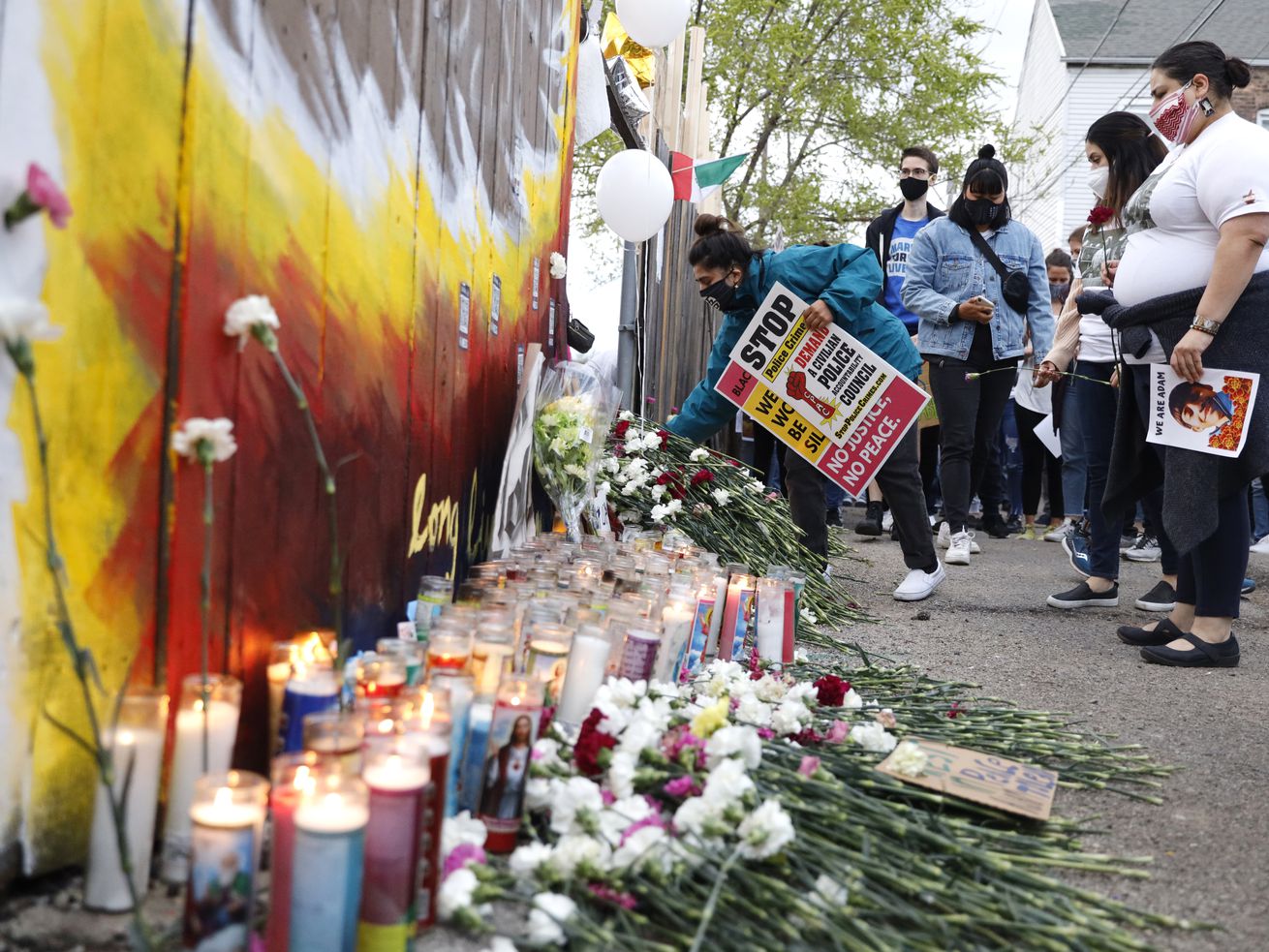
People pay tribute at the site in Little Village where 13-year-old Adam Toledo was shot by a police officer. | AP Photos
“I expect you will receive much negative reaction from activists, the general population and even by your own peer group.”
Kudo’s to you Mark Brown for your well thought out column about the Adam Toledo shooting. I expect you will receive much negative reaction from activists, the general population and even by your own peer group.
I’m sure you knew this, but followed through.
The current one-sided attitude of “my way or no way” is tearing the country apart. There are always two sides to a story but lately the press has put on blinders. Keep up your unbiased and unfettered views.
Steve Babyk, East Humboldt Park
SEND LETTERS TO:[email protected]. Please include your neighborhood or hometown and a phone number for verification purposes. Letters should be 350 words or less.
Police need better ways
Mark Brown is correct. No one should be jumping for joy that a young teen was shot and killed by a police officer, but no one should be sitting in judgment of the officer — who was called to the scene by fearful neighbors. The officer made a fatal mistake, but that’s what it was — a mistake, an error in a split-second situation. This is why the Chicago Police Department must, must, must come up with better ways of handling future similar crisis situations. Could more — many more — officers respond to these calls? Could officers be trained to aim for a suspect’s legs? There must be better ways to deal with suspects in these situations than to shoot to kill.
George Pfeifer Evanston
Home runs and Roger Maris
Great column on Saturday by Rick Telander about the New York Yankee greats Mickey Mantle, Roger Maris and Billy Martin. Unfortunately for me, my 1961 baseball fandom ended in July of that year. Some guy named “Uncle Sam” needed me. So whenever I get a chance to read about Maris’ 61 home runs in 1961, I jump at it. “Jump” might be an exaggeration at my age. I’m 80. Let’s just say I enjoy it.
But my arithmetic must differ with Telander’s. Babe Ruth hit 60 home runs in 154 games while Maris hit 61 home runs in 162 games? Looks to me like Maris had eight more games to break Ruth’s record. Congrats to Maris for his 61 homers, but as for the record, hmmm.
Bob Meder, Romeoville
Allow nurses to work across state lines
The past year has highlighted the critical importance of ensuring Illinois hospitals and clinics can quickly hire an adequate number of professional registered nurses. The pandemic also has highlighted the need for nurses to travel across state lines to provide care to those in need. Disease and disaster don’t respect state boundaries, and neither should our licensing laws.
The Nurse Licensure Compact would ensure that nurses could practice across state lines without having to obtain numerous, separate licenses. This would allow nurses to begin working in Illinois more quickly than our current system allows and ensure patients receive the quality care they need.
Nurses licensed in the compact can currently practice in 34 states under a single multi-state license. The compact has been in place for over 20 years and provides safe and effective care by ensuring all included nurses meet the same uniform licensure requirements to practice.
Nurse leaders across Illinois have been challenged with identifying enough nurses to provide care in their facilities and often that need strikes with little warning. On behalf of the Illinois Organization of Nurse Leaders, we urge the Illinois General Assembly to support adding our state to the Nurse Licensure Compact. In a crisis, time is of the essence and the Compact helps Illinois respond to the need for professional nursing services.
Elaine Kemper, Denise Wienand, Nicole Wynn, Tim Carrigan and Nicole Wynn, all members of the Illinois Organization of Nurse Leaders
A teenage boy was shot dead April 26, 2021, in Little Village.
Shootings in the 10th District, which includes Little Village, have risen 29% this year compared to the same period in 2020, according to police statistics.
A 17-year-old boy was killed in a shooting in Little Village on the Southwest Side Monday morning, police said.
The teen was walking with a female about 10:15 a.m. in the 2700 block of South Drake Avenue when someone opened fire, striking him in the head, Chicago police said.
The boy was pronounced dead at the scene, police said. His identity has not been released.
The companion saw a small white car speed off immediately after the shooting, police said. She did not get a good look at the driver.
Shootings in the 10th District, which includes Little Village, have risen 29% this year compared to the same period in 2020, according to police statistics.
On Saturday, a 16-year-old boy was wounded in a shooting a few blocks away in the 3300 block of West 28th Street.
Earlier this month, 17-year-old Lydia Jimenez was fatally shot while in a vehicle in the 4100 block of West 25th Street, police said.
“I’ve felt a pull that goes beyond familial obligations,” writes Mark Kosin about why he is moving back to Chicago. “I’m also a 30-something professional looking for a better life post-pandemic.” | Tyler LaRiviere/Sun-Times
Finally seeing light at the end of the pandemic’s long, dark tunnel, my mind can’t help but wonder: how is this great city going to remake itself yet again?
When I started to remotely interview with companies in Chicago from sunny California during this February’s barrage of snowstorms and single-digit wind chills, I was often met with questions, explicit and implied, mostly starting with the word “Why?!”
Why leave the ocean, mountains, and 70 degree days? Why trade the Golden Coast for a big lake? Why go against nearly a decade of Illinois population decline? Admittedly, there are a few bedrock reasons for my move: family roots, good friends I don’t see enough, and I’ve missed far too many 1:20 p.m. Friday starts at Wrigley.
But there’s something more — I’ve felt a pull that goes beyond just familial obligations. I’m also a 30-something professional looking for a better life post-pandemic. I’m moving back because after a nightmare of a year, Chicago is poised for a breakout decade. And I want in.
It’s no secret my current home state of California has faced its own steep challenges even before the pandemic hit. Unaffordable housing has pushed thousands onto the streets and forced 56% of lower-income residents to spend too much of their paychecks on rent. Pollution and wildfires keep the state among the worst in the world for air quality. And did you know that a major quake along the San Andreas fault could cut off 70% of Southern California’s fresh water supply?
Lake Michigan may produce some intense weather, but at least it’s not going anywhere.
Beyond the long-term environmental and housing concerns (no small things if you’re looking to start a family), I couldn’t help feeling the crowding and costs of California as professionally and personally stifling. Even my lifelong Californian neighbor would tell me with a shrug, “Hey, we’re a great place to visit.” Over the last year, I contemplated a future back east across the Mississippi and saw a wide open prairie of possibility.
Yes, Chicago was devastated by 2020. Shuttered businesses and restaurants, unrest from an overdue racial reckoning, and a crippling plague that claimed over 10,000 souls all turned the city into something almost unrecognizable to residents. Urban disaster without rival — except for Chicago, which famously burned to the ground 150 years ago.
It’s a tale we’d almost risk over-telling if it weren’t so incredible. Decimated in 1871, Chicago would aggressively charge into the future, remaking itself into a global icon that would literally host the world at a fair two decades later. Imagining myself as part of yet another rebuild — a “second” Second City? — is something too irresistible to ignore.
Finally seeing the light at the end of this long, dark tunnel, my mind can’t help but wonder: how is this great city going to remake itself yet again? What new businesses will arise out of this year of disruption? How will the arts scene respond once we can crowd into black box theaters and gallery spaces again? How will chefs and bartenders excite and inspire us out of our homes and back into their establishments?
The future is objectively bright. The city and state are set to benefit from both a major COVID-19 relief bill and a potential infrastructure cash influx to bolster Chicago as a transit hub. Chicagoland is still rated as a “Top Metro” for corporate investment (last year saw 327 business expansions and relocations according to Site Selection Magazine). Startups in the Chicago area offer a return-on-investment that far outpaces national averages per a recent report. And Chicago continues to have one of the largest and most diversified economies in the world.
This is not to paper over the heavy lift for citizens and city leaders. There’s a reason a poll showed that 73% of residents think the city’s on the wrong track. Even its greatest boosters know Chicago has deep systemic problems that threaten to derail a robust recovery. The road ahead is not for the weak-willed. Luckily, if there’s something that Chicagoans are famous for — a virtue extolled by legendary writers in prose and poetry — it is hard work.
It’s a city that turns its back on pessimism. The city I know is not going into the future with misplaced idealism, but with bullish confidence in itself and its people.
As far as I’m concerned, there’s never been a better time to be a Chicagoan.
Mark Kosin is a writer who recently accepted a job as a copywriter at a Chicago tech firm.
Tigrayan refugee Abraha Kinfe Gebremariam, 40, uses a flashlight to check on his 4-month-old twin daughters Aden and Turfu after praying at a church early in the morning in Hamdayet in eastern Sudan, near the border with Ethiopia. Even as Tigrayans ran for their lives or jostled for space on a boat to safety, the sight of the tall, silent, sorrowful man carrying the tiny twin girls made people pause. | Nariman El-Mofty / AP
The violence in northern Ethiopia’s Tigray region had come at the worst possible time for a family whose village was caught in the first known massacre of a grinding war.
Gunfire crackled near the straw-woven home of Abraha Kinfe Gebremariam.
He hoped it drowned out the cries of his wife, curled up in pain, and the newborn twin daughters wailing beside her.
The violence in northern Ethiopia’s Tigray region had come at the worst possible time for Abraha and his family. Their village of Mai Kadra was caught in the first known massacre of a grinding war that has killed thousands of ethnic Tigrayans like them.
Abraha pleaded with his wife, still writhing from post-childbirth complications, to be silent, fearing any noise could bring gunmen to the door. His two young sons watched in fear.
“I prayed and prayed,” Abraha said. “God didn’t help me.”
He was terrified his family would not survive.
Five months after it began, the armed conflict in Ethiopia has turned into what witnesses describe as a campaign to destroy the Tigrayan minority. Thousands of families have been shattered, fleeing their homes, starved, killed or still searching for each other across a region of six million people.
Amid the heartbreak, the sight of a tall, silent man carrying a grimy, pink bassinet slung around his neck with tiny twin girls would still bring out the kindness of strangers, even from the ethnicity targeting them.
The bloodshed in Mai Kadra began in November, as Abraha’s wife, Letay, was enjoying the final stretch of a seemingly normal pregnancy. She was four days late but untroubled. The number of the ambulance for the health clinic was in hand, ready to call.
But then the sounds of fighting grew closer. The shooting and screams sent Letay, her husband and their sons, 5-year-old Micheale and 11-year-old Daniel, into hiding in the tall, parched grass near their home.
They lay for hours under the hot sun. There was nothing to eat or drink. Letay rested on her side.
“Don’t worry, I’m OK,” she told her worried husband.
That night, they crept indoors to sleep.
The next day, Letay went into labor.
The gunfire continued in Mai Kadra, and most of the neighbors had fled. Frightened and feeling alone, Abraha and his wife decided not to risk going to the clinic. They would deliver their baby at home.
An elderly neighbor from the ethnic group fighting the Tigrayans, the Amhara, had not left. She agreed to help.
Abraha had never seen childbirth. Like most men across Tigray would do, he hovered outside the door, praying. The delivery was quiet and fast, just three hours long. Finally, he peeked inside.
He had longed for a daughter. Now, nestled beside his wife, he saw two. His joy was tempered by anxiety.
“Here something awful was happening in our village,” he said. “I wondered, ‘How can I do this?’ ”
But, in the hours ahead, he forgot about the babies. Something was badly wrong with his wife. Her afterbirth wasn’t coming out.
Letay’s pain grew. She tried to breastfeed the twins but couldn’t. As she lost herself in agony, the babies began to cry.
The family tried, in vain, to comfort them. They kept the exhausted Letay awake because of their belief that otherwise the afterbirth would fall back into her.
Nariman El-Mofty / APTigrayan 4-month-old twin sisters Aden (left) and Turfu Gebremariam inside their family’s shelter in Hamdayet in eastern Sudan, near the border with Ethiopia. In the fear and despair of the days following their birth, the twins were left unnamed. There simply was no time. Finally, their young brother Micheale christened them himself. One of the girls was named Aden, or “paradise.” The other, who reminds people of her mother, was named Turfu, or “left behind.”
“I don’t know what wrong I did to my God for these troubles,” Abraha said, starting to cry.
Four days after Letay delivered, her afterbirth was expelled. But she wept day and night in pain.
Abraha despaired. By now, from neighbors’ accounts, the family understood they were trapped in a massacre. Ethnicity had become deadly, with reports of both Amhara and Tigrayans being shot or slaughtered.
“If I took my wife to the clinic, they might kill me,” Abraha said. “It was very difficult to decide.”
He waited until he could bear it no longer. A week after Letay gave birth, he asked the Amhara neighbor to take her for help.
But the clinic could not, or did not, help her. Abraha doesn’t know whether ethnic tensions played a role.
On the ninth day after giving birth, Letay beckoned Abraha closer.
“Look after my babies,” she said. “I’m going to die. I don’t have hope. I’m very sorry.”
She died the next day.
Nariman El-Mofty / APA photograph of Letay, the deceased wife of 40-year-old Tigrayan Abraha Kinfe Gebremariam, inside her family’s shelter in Hamdayet iin eastern Sudan, near the border with Ethiopia. Ten days after giving birth to twin daughters in the Tigrayan region of Ethiopia, she died, unable amid an ethnic war, to have gotten medical help.
In Tigray culture, the community gathers when someone dies. Even strangers take part, throwing a little dirt on the grave.
But as Abraha emerged from his home for the first time since the war began, only a handful of people stepped forward to help carry his wife’s body to the church. Fewer than a dozen neighbors were there.
It was daylight. The burial was short. There were no speeches. The churchyard likely was full of fresh graves from the hundreds killed in Mai Kadra, but Abraha didn’t notice his surroundings.
He returned home, where the babies he had almost forgotten about were waiting. Having been caught up in his wife’s final days, he had little idea how the girls were fed or even survived.
Abraha found himself struggling. Washing the tiny, wriggling girls terrified him. Without diapers, he rinsed and reused pieces of cloth. And with two babies instead of one, everything seemed to run short.
Nariman El-Mofty / APMicheale Gebremariam, 5, a Tigrayan refugee, plays with jewelry belonging to his deceased mother Letay.
He wondered whether he was failing his family. The twins cried most of the time. Trapped in a home that spanned only a few paces in size, Abraha got little sleep.
When he broke down and cried, his sons comforted him.
“We need you, be strong,” they said.
Abraha didn’t leave the house. His son Daniel tried to visit the market one day and saw 10 bodies piled onto a vehicle, with another four in the dirt. He never went to the market again.
The Amhara neighbor went out for the family’s food and helped with the children. For another measure of safety, an acquaintance from a different ethnic group, the Wolkait, managed to get the ethnicity changed on Abraha’s identity card. On paper, he, too, became Wolkait.
That happened just in time. When Amhara militia members came to his home, Abraha showed the altered ID. He addressed them in Amharic, Ethiopia’s main language, not daring to speak a word of his native Tigrinya.
Nariman El-Mofty / APA handmade dress for 4-month-old Tigrayan twins Aden and Turfu Gebremariam, made from cloth belonging to their deceased mother Letay.
He also showed them his baby girls.
Any suspicions disappeared. The militia came to the house several times after that. They offered Abraha a little money and tried to comfort him over his loss.
“They thought I was one of them,” Abraha said.
His family was safe, for now. But he knew they couldn’t stay. The fake Wolkait identity had worked almost too well. Abraha’s brother-in-law, 19-year-old Goytom Tsegay, said Amhara special forces tried to recruit him.
Life in Mai Kadra was more dangerous by the day. Every night, Abraha heard someone else had been killed. A month after the fighting began, he decided to leave.
He didn’t even know where to go.
The family packed light, so the Amhara who now controlled Mai Kadra would not notice they were leaving for good. Abraha, his children and his brother-in-law carried just five pieces of the local injera bread, a tin of milk and two liters of water, plus a change of clothes for the twins.
A woman in the community brought the pink bassinet for the babies. Abraha hid a small book of photos of his wife and children under its mattress, along with his wife’s jewelry. He was scared the militia would find them, but he couldn’t bear to leave them behind.
The family walked to the checkpoint at the edge of town accompanied by the Amhara neighbor. She chatted with fighters there. This family is Amhara, she said.
Sympathetic, the militia unknowingly helped the fleeing Tigrayan family. They stopped a car on the road and arranged a ride, saving Abraha and his children a six-hour walk to the city of Humera near the Sudanese border.
Blinded by grief and nervousness, Abraha hardly looked out the window during the drive, one he had made many times. Other desperate families were fleeing on foot through the lowland farms, trying to stay out of sight of the militia, clutching whatever possessions they had left.
In Humera, also under growing Amhara control, Abraha’s family went to the hospital to ask for milk. Again, one glance at the babies in his arms won him friends.
“All the staff was sorry for me, even the cleaners,” he said.
TIGRAY REGION, ETHIOPIA
Associated Press
A fellow Tigrayan, one of the few remaining on staff, quietly took them to her home and suggested they go to Sudan for safety. It was a four-hour walk away.
Abraha had heard that the Amhara youth militia and soldiers from nearby Eritrea roamed the route. Both have been accused of beating or shooting people trying to flee.
“We were very afraid we would be killed,” he said.
The family members started their final walk before dawn. They stayed off the roads, crossing fields instead, asking fellow Tigrayans they met for the safest way. They stopped sometimes to hide in the grass and give milk to the crying babies.
The heat rose quickly with the rising sun. The flat expanse of Sudan came into sight, then the narrow Tekeze River.
Frantic Tigrayans jostled for places aboard the boats that would ferry them across the border. Many were waiting. It was loud and chaotic. The twins began to wail.
Nariman El-Mofty / APMicheale Gebremariam waits for his father Abraha Kinfe Gebremariam to bathe him after waking up early in their shelter in Hamdayet, eastern Sudan, near the border with Ethiopia.
The sight of Abraha, the bassinet and what it carried stilled some in the crowd. To Abraha’s astonishment, the family was waved to the front and given a reduced price for the crossing.
He and the babies were ushered to a boat of their own that was lashed together from a dozen 20-liter jerrycans. It was flat, with no guardrail.
Abraha couldn’t swim. Still, as he settled into place in the center of the boat and its bottom scraped free of his country, he felt the burden of the past month ease.
“I was 100% sure the babies would grow up, that things would change from that moment,” he says. “My stress melted away. There were no more fears for our lives.”
Even the twins had become quiet. He looked down. They had fallen asleep.
The family arrived in Sudan exhausted, the twins badly underweight. Megan Donaghy, a nurse midwife with Doctors Without Borders, wondered what had happened to their mother.
Abraha pulled out a picture and told her, “This is my wife.” The entire family smiled as they looked at it.
“And that’s when I cried, when I saw her face,” Donaghy says. “She was just this beautiful, vibrant woman, a young woman, who loved her family, and here they were in tattered clothes, rundown, tired, hungry, with these sweet little babies.”
A fellow refugee, Mulu Gebrencheal, a mother of five, came across the family and wept. She has since become an informal adviser on the babies’ care. Abraha and his sons are quick learners, she says. But she mourns for the twins.
“Even the hug of a mother is very sweet,” she says. “They’ve never had this. They never will.”
Nariman El-Mofty / APTigrayan refugee Abraha Kinfe Gebremariam, 40, holds his 4-month-old twin daughters Aden (left) and Turfu.
Months after arriving in Sudan, the twins lay on their backs under tiny mosquito nets on metal-frame beds, gnawing a fist or smiling up at the besotted men who have become experts in infant care. On their tiny wrists, the girls take turns wearing a single protective amulet given to them by a local woman.
For Abraha, a painful task remained. He had finally managed to reach his relatives inside Tigray for the first time since the war began. His sister picked up the phone, and he asked her to invite other family members to an important call the following day.
He made his way alone back to the border with Ethiopia, where refugees come with their phones for a clearer signal. He forced himself to begin with the good news.
His family, excited, clamored for details of his wife.
“Did she give birth?” they asked.
“Yes, twins,” Abraha told them.
Joyful, his family pressed for more. “Boys or girls?” “Who looks like whom?” “How was the labor?”
Finally, Abraha calmed them and continued.
“But,” he said, “I couldn’t save her life.”
His family began to cry. He joined them. He worried about what awful things might have happened to his sister and others that they were hiding from him even now.
As the tears calmed, his family tried to comfort him.
“God has his own plan.”
“Try to be strong.”
“Look after the babies and the boys.”
“You’re all they have.”
Nariman El-Mofty / APFive-year-old Tigrayan refugee Micheale Gebremariam hugs his 4-month-old sister Aden after waking up early in the morning in their shelter in Hamdayet in eastern Sudan, near the border with Ethiopia.
That evening, Abraha returned to what he and his children now call home, thanks to those who helped them get out alive. He picked up the baby girls and again searched their faces for traces of their mother. His family agrees: One of the babies does look like Letay.
In the fear and despair following their birth, the twins were left unnamed. There was no time. Finally, Abraha’s young son Micheale christened them himself.
One of the girls was named Aden — “paradise.”
The other, who reminds people of her mother, was named Turfu — “left behind.”
Nariman El-Mofty / APAbraha Kinfe Gebremariam, 40 (second from left) with his sons Micheale, 5 (left) and Daniel, 11 (center). his 19-year-old brother-in-law Goytom Tsegay (second from right) and his 4-month-old twin daughters Aden (right) and Turfu on his lap.
Morgan Urso, 15, said she was kicked out of Team Illinois Hockey Club after opening up to her coach about her depression and anxiety. | Pat Nabong/Sun-Times
Morgan Urso was told she could no longer be part of Team Illinois Hockey after she disclosed her experience with depression and suicidal thoughts.
Morgan Urso tried many sports as a young child and didn’t like any of them. Everything changed at age 10 when she went to hockey practice with her brother.
“I ended up loving the game,” Morgan said. “The feeling of the fresh air hitting my face every shift is a feeling that I’d take any day.”
Now a high school sophomore, Morgan’s zeal for the game took a hit when her club hockey team unexpectedly banned her from practice, games and team activities.
The Urso family, who lives in La Grange, recently sued Team Illinois Hockey and the Amateur Hockey Association of Illinois for disability discrimination, claiming Morgan was suspended after she told a coach about her mental illness.
During her freshman year in 2019, Morgan experienced a severe depressive episode, resulting in her going to an outpatient program and being given new medication.
Morgan said her coach, Team Illinois Hockey Director Larry Pedrie, was initially supportive. “He said if I needed to be an assistant coach on the bench with him or if I wanted to go out and skate or miss, I could do whatever I needed to,” Morgan said.
Morgan’s mother, Kelly Urso, said she received a call the next day and was informed that Pedrie had spoken with Mike Mullally, USA hockey director at the Amateur Hockey Association of Illinois, and they had decided to bar Morgan from all Team Illinois practices, games and other activities.
“I remember saying, ‘What?’ a lot, like, how did he decide this,” Urso said. “He just kept saying, ‘I have [Team Illinois’] full board support, this is what AHAI has advised us to do.’ I ended up hanging up on him because I got so emotional.”
Pat Nabong/Sun-TimesMorgan and her family filed a lawsuit against Team Illinois Hockey and the Amateur Hockey Association of Illinois, claiming the organizations discriminated on the basis of disability.
Urso said a few hours later she heard from other parents on the team that Pedrie told them and their children not to communicate with Morgan until she was able to provide a doctor’s note clearing her to participate in 100% of team activities.
Pedrie’s email to parents of players expressed a desire to keep kids from “carrying the burden of a teammate’s personal struggle.”
“We were mad, disappointed and hurt,” Urso said. “We had come from programs where hockey was your family, and to have this be the reaction, we were just confused.”
Morgan, who missed a month of ice time, was allowed to finish the season after the Ursos hired lawyer Charlie Wysong, a partner at Hughes Socol Piers Resnick & Dym Ltd. However, Morgan said she was “super uncomfortable” being around her coach and constantly felt nervous back on the team.
In spring 2020, the Urso family filed a complaint with the Illinois Department of Human Rights. The department investigated but declined to pursue a case against the team or the hockey association.
Pat Nabong/Sun-TimesDespite being able to rejoin the team, Morgan said from then on she was “super uncomfortable” being alone with her coach and other players’ parents.
On April 20, Morgan and her parents filed a lawsuit in DuPage County Circuit Court against Team Illinois Hockey and AHAI for discriminating against her on the basis of disability.
“We’re not allowed to banish people who are depressed or anxious or have suicidal thoughts,” Wysong said. “That’s not OK.”
The Amateur Hockey Association of Illinois and its lawyer declined to comment on the lawsuit. Pedrie did not respond to several requests for comment.
Urso said the family sued to prevent other families from undergoing a similar situation. She said there should be policies and procedures in place to support children experiencing mental health issues in youth sports and proper training for coaches.
“We hope that it will help youth sports recognize that this is a major issue, especially after COVID-19, that kids are dealing with a lot of mental health issues,” Wysong said.
Courtesy/Kelly UrsoMorgan Urso (right) and her siblings in their “Team Morgan,” shirts. The family formed “Team Morgan” to raise funds and awareness about mental illness.
Morgan, a center, returned to the ice for the 2020-21 season with a former hockey team. This year, Morgan plans to try out for a St. Louis AAA Blues hockey team.
She has also started working with the #SameHere Global Mental Health Movement, which aims to raise awareness about and provide resources for those dealing with mental illness.
In forming “Team Morgan,” the Urso family raised and donated more than $50,000 to #SameHere for mental health treatment.
“Anyone out there struggling is never alone,” Morgan said. “There’s always someone to talk to, whether it’s me, or a friend or a parent. And don’t be afraid to go to your coach.”
Commuters wearing face masks to curb the spread of COVID-19 walk after getting off a regional train at the Cadorna railway station in Milan, Italy, Monday, April 26, 2021. Italy is gradually reopening on Monday after six months of rotating virus lockdowns. | AP
Italy has the second-deadliest pandemic toll in Europe after Britain, with over 119,000 confirmed deaths.
MILAN — Italy’s gradual reopening on Monday after six months of rotating virus lockdowns is satisfying no one: Too cautious for some, too hasty for others.
Allowing outdoor dining comes too little, too late for Italy’s restaurant owners, whose survival is threatened by more than a year of on-again, off-again closures. The country’s continued 10 p.m. curfew puts a damper on theater reopenings, and is seen as bad public relations for Italy’s key tourism industry, which hopes the second summer of the pandemic can finally see the return of overseas visitors. The government has also been facing strong pressure to reopen from Italy’s right-wing parties.
Yet the nation’s weary virologists and medical workers worry that even the tentative reopening planned by Premier Mario Draghi’s government will invite a free-for-all that risks a new virus surge before the current one is truly tamped down.
“Unfortunately, as I have had to repeat often: The virus does not negotiate. The virus, moreover, has succeeded in adapting itself, becoming more aggressive and more widespread,’’ said Professor Massimo Galli of Milan’s Sacco Hospital.
In a preview of what many fear, Italians on Sunday — a day before the virus restrictions loosened — crowded the streets, squares and parks of cities from Rome to Turin, Milan to Naples, as warmer weather pushed aside an unusually cold spring.
Recognizing the risks, Italy’s interior ministry instructed law enforcement officers on Sunday to make sure that social distancing and mask-wearing were enforced so that the loosening of restrictions doesn’t translate into a new virus spike.
Italy has the second-deadliest pandemic toll in Europe after Britain, with over 119,000 confirmed deaths. And experts say that number is low because more Italians suspected of having COVID-19 died in spring 2020 before they could be tested.
By Monday, 15 of Italy’s 21 regions and autonomous provinces will be under the lowest levels of coronavirus restrictions, with inter-regional travel allowed for the first time since the fall. The number of people who can visit friends and family at any one time will double from two to four. Restaurants and bars will be able to seat people for open-air dining. Contact sports can resume outdoors.
However, plans to fully reopen Italian high schools for the last six weeks of the school year ran up against inadequate public transport and had to be scaled back to a minimum of 70% in-person schooling for the upper grades.
Four southern regions — Basilicata, Calabria, Puglia and Sicily — along with tiny Aosta on the French border in the north remain under stronger, second-tier virus restrictions.
The Italian island of Sardinia — the only region entirely free of restrictions this winter — was plunged into the red zone in mid-April after the all-clear signal resulted in a surge of new infections. Sardinia has become a cautionary tale cited by Italian virologists.
The reopenings come even as Italy’s intensive care wards remain above the 30% threshold for alarm. Italy’s vaccine campaign is also still well shy of its 500,000-shots-a-day goal, and is only now moving to protect people in the 70-79 age bracket. The World Health Organization says people over 65 have accounted for the vast majority of COVID-19 deaths in Europe.
“There are two words that should guide us in the next days,’’ Health Minister Roberto Speranza said Sunday. ”Trust, because the measures have worked, and prudence. We need to take one step at a time, be gradual and evaluate the evolution day by day.”


/cdn.vox-cdn.com/uploads/chorus_asset/file/22470947/AP21115704194682.jpg)



/cdn.vox-cdn.com/uploads/chorus_asset/file/22465697/merlin_97226678.jpg)
/cdn.vox-cdn.com/uploads/chorus_asset/file/22465981/merlin_97226798.jpg)
/cdn.vox-cdn.com/uploads/chorus_asset/file/22465990/merlin_97226826.jpg)
/cdn.vox-cdn.com/uploads/chorus_asset/file/22465999/merlin_97226800.jpg)
/cdn.vox-cdn.com/uploads/chorus_asset/file/22466011/Screen_Shot_2021_04_23_at_4.58.01_PM.png)
/cdn.vox-cdn.com/uploads/chorus_asset/file/22466016/merlin_97226788.jpg)
/cdn.vox-cdn.com/uploads/chorus_asset/file/22466029/merlin_97226824.jpg)
/cdn.vox-cdn.com/uploads/chorus_asset/file/22466044/merlin_97226684.jpg)
/cdn.vox-cdn.com/uploads/chorus_asset/file/22466040/merlin_97232770.jpg)

/cdn.vox-cdn.com/uploads/chorus_asset/file/22463104/merlin_97216188.jpg)
/cdn.vox-cdn.com/uploads/chorus_asset/file/22463112/merlin_97216186.jpg)
/cdn.vox-cdn.com/uploads/chorus_asset/file/22465077/unnamed.jpeg)
