An off-duty Lynwood police officer shot and wounded someone at a gas station in the south suburb on Sunday, according to police.
The shooting happened at a Mobil gas station at Glenwood Dyer Road and Torrence Avenue around 6:15 p.m., according to a statement by Lynwood Police Deputy Chief Lawrence Weinbrecht.
Officers responded to a call of gunfire and found a wounded person, who was taken to Christ Medical Center in Oak Lawn with injuries that weren’t life-threatening, Weinbrecht said.
A gun with an extended magazine was found at the scene, he said. Police released no other details.
Illinois State Police said they were investigating the officer’s use of force.
The name “Midwest” or “Midwestern” is attached to dozens of Chicago institutions. Midwest Tool. Midwest Foods. Midwest Laundries. Midwest Chiropractic Center. That’s because Chicago, as the Encyclopedia of Chicago itself puts it, is the “capital of the Midwest”—the commercial and industrial hub of a region built on commerce and industry.
But is “Midwest” really an accurate description of Chicago’s place in North America? Do we really belong in the same geographic basket as Des Moines, Kansas City, Indianapolis, Cincinnati and Sioux Falls, cities with which we have very little in common culturally, linguistically, or politically? And more broadly, aren’t the commonly accepted boundaries of the Midwest—west of the Appalachians, north of the Ohio River, south of the Canadian border, and east of the Rockies—too broad to be tagged with a single rubric?
The answers to those questions, to use Midwestern phraseology, are “nope” and “you bet!” We’re not Midwesterners, because there is no such place as the Midwest. “Midwest” was invented in the 19th Century, to describe the states of the old Northwest Ordinance, a term that became outdated once the nation spread to the Pacific Coast.
“Midwest” is applied to a chunk of America that seems unclassifiable to the rest of the country: neither North, South, East or West. Its borders have shifted historically, making them always good for an argument. (Out of nearly 35,000 Vox readers, 95% agree Iowa is a Midwestern state, followed by Illinois at 91%. Wisconsin, Minnesota, Indiana, and Missouri just clear the low 80s.)What we call the Midwest is in fact a set of sub-regions, not all of which are contained in what we’ve traditionally thought of as “the Midwest.”
Here in Chicago, for example, we’re Great Lakers, denizens of a freshwater nation that not only crosses boundaries traditionally applied to the Midwest, but the boundaries of the United States itself. Our compatriots can be found in Milwaukee, Detroit, and Cleveland, all traditional “Midwestern” cities, but also in Buffalo, Rochester and Toronto.
In fact, Chicago was first incorporated into Illinois because of its connection to the Great Lakes. The Northwest Ordinance declared that Illinois’s northern border would run along a line defined by the southern tip of Lake Michigan. Had that plan been followed, what we now know as Chicago would’ve been part of Wisconsin. In 1817, as Illinois was preparing to enter the Union, territorial delegate Nathaniel Pope proposed pushing the boundary north 55 miles. Pope wanted to balance our pro-Southern, pro-slavery population by attracting Yankees migrating westward via the Great Lakes, ensuring Illinois remained a free state.
Those Yankees, mainly from western New York and New England, provided the basis of Chicago’s culture and language. In his book American Nations: A History of the Eleven Rival Regional Cultures of North America, journalist Colin Woodard places Chicago in a region called “Yankeedom,” which stretches across the northern tier of the nation, from Maine to Minnesota. It’s a bastion of political progressivism. As Woodard wrote, “residents in Northeastern states and the industrial Midwest tend to be more comfortable with government regulation. They value education and the common good more than other regions.” The Inland North dialect, basis of the Classic Chicago Accent, also follows the contours of the lower Great Lakes, from Rochester to Milwaukee.
(When I wrote a dialect book called How to Speak Midwestern, I was accused of stretching the region’s boundaries by including Buffalo and Pittsburgh. My reasoning: accents commonly heard in “the Midwest” originated in those cities, and were spread westward by settlers.)
These political and linguistic tendencies make us very different from “Midwesterners” in Iowa or Kansas, differences magnified by the fact that Chicago is a port city with a deep industrial heritage.
Besides the Great Lakes, the so-called Midwest can also be subdivided into these regions, each with its own distinct speech and folkways.
—The Corn Belt: An agricultural area running through the center of Ohio, Indiana, Illinois and Iowa.
—The North Country: The mining and logging regions of Minnesota, Wisconsin, and the Upper Peninsula of Michigan.
—Upper Appalachia: The Ohio Valley of Pennsylvania, Ohio, Indiana, Illinois, West Virginia and Kentucky, originally settled by Southern migrants.
—The Great Plains: The eastern Dakotas, Kansas and Nebraska.
Even before Woodard wrote his book, Deborah Miller of the Minnesota Historical Society was on to this complexity when she told Hour Detroit magazine that “I would put Minnesota and Wisconsin and Michigan into a particular part of the Midwest that I would call the Upper Midwest. They’re also part of a different region that you might call the Great Lakes states, along with their Canadian contemporaries.”
Chicago’s Canadian contemporary is Toronto. I can’t think of any two major cities more alike. They’re similar in size—Toronto 2.9 million, Chicago 2.7 million—and are both multicultural metropolises laid out in a grid system on the shores of a Great Lake. I find it easier to find my way around Toronto than I do any American city. (The biggest difference: Toronto built right up to its waterfront, while we left ours “forever free and clear.”) We’re the improvisational comedy capitals of our respective nations, both having Second City chapters. For ambitious Americans and Canadians, Chicago and Toronto are the last stops before the Big Time of New York and L.A. Naturally, we’re sister cities.
No one would call Toronto a Midwestern city, since it’s not even in the U.S. It’s undeniably a Great Lakes city, though. The next time someone from the East Coast, the West Coast or the South Coast calls you a Midwesterner, tell them that’s too simplistic a label for all the folks in the middle of the country. Say “I’m a Great Laker,” and make them look at a map.
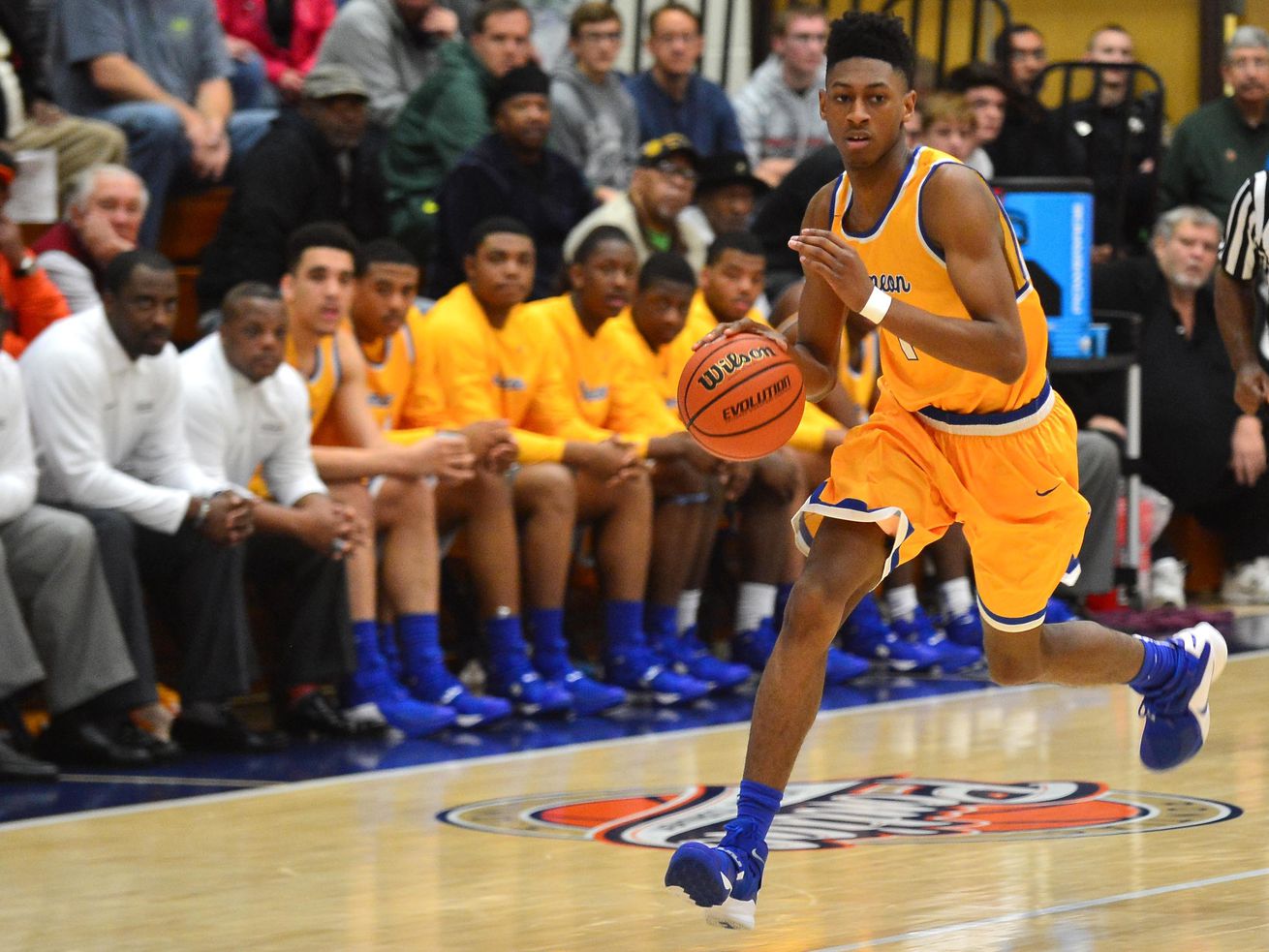
Simeon’s Ben Coupet Jr. (1) drives down the court against Bloomington. | Sun-Times file photo
Coupet entered high school as the top prospect in the state of Illinois way back in 2012. He signed with SIU on Wednesday.
Ben Coupet Jr. has always had the name.
Coupet entered high school as the top prospect in the state of Illinois way back in 2012. He headed to powerhouse Simeon which was coming off its third straight state championship.
Simeon was also where his father, Ben Coupet, Sr., became a Public League star before he went off to play collegiately at Illinois and, eventually, at Bradley.
Coupet, Jr., was expected to be the next big thing at Simeon. As a 6-7 freshman with the type of talent, upside and pedigree that Coupet possessed, the hyperbole surrounding him as a young player was probably too much, even unfair.
Coupet did have his moments –– he shined as a senior in the city semifinals when he scored a career-high 24 points in a win over Morgan Park –– but overall it was an up-and-down career at Simeon.
Coupet signed with UNLV. He played minimal minutes as a freshman, then redshirted as a sophomore. The minutes were even fewer the following year. He scored a total of 35 points in 26 games over two seasons of action. His three years at UNLV, playing so little, was extremely tough on Coupet.
“I’m not going to lie, it was a dark time for me,” said Coupet of his first three years of college. “I went to UNLV with a lot of high hopes. Everything was there for me to succeed –– the weight room, the training, all that you get with college basketball at that level.”
But not playing and sitting out an entire year proved to be a battle he was not ready to deal with.
“The not playing, sitting on the bench for that long just kind of crushed my dreams,” said Coupet. “I really thought about giving up basketball. But I knew in the end I couldn’t do that.”
Coupet turned to his roots at Simeon to help get out of his personal basketball darkness. He watched his former Simeon teammates and classmates thriving in the sport.
When Coupet was a sophomore he saw Jabari Parker play at Duke and become the No. 3 pick in the 2014 NBA Draft. While he was toiling on the bench at UNLV, he watched Zach Norvell become an instant star Gonzaga. And recently he’s watched Kendrick Nunn turn into a bonafide NBA starter with the Miami Heat while averaging 15 points a game.
Sun-Times file photoSimeon’s Ben Coupet Jr. (1) gets a block shoot on Evanston’s Dylan Mulvihill (32).
Coupet plays and competes against the three when they are all in Chicago. And being around that trio helped keep the fuse lit.
“Watching all the success those guys from Simeon have had in front of me –– Kendrick, Zach and Jabari –– kept pushing me,” said Coupet. “I thought it just wasn’t my time yet. Through those struggles of mine, I needed to keep grinding, stay in the gym and keep working. I started to feel like I would find my own success in my own way if I kept doing that.”
But his childhood hero, Derrick Rose, was one who helped him mentally. Watching the former Simeon star return from devastating injuries and put together a great second act in the NBA was a blueprint for Coupet.
“I’ve looked up to Derrick Rose since I was an 8-year-old kid,” said Coupet. “He’s my all-time favorite player, and I just really admire his story –– all of it. To go from being the youngest player ever to become NBA MVP to coming back the way he has after the injuries when so many people said he was done and doubted him? I had that same mindset.”
While the UNLV days were his darkest, Coupet admits even the early years of his basketball career at Simeon weren’t easy. The hoopla surrounding him as the heir apparent to Jabari Parker wasn’t easy to handle.
“I feel like a lot of what Derrick Rose went through with the doubting, saying he was done, all the negativity, it was to some degree what I was going through in high school,” said Coupet. “And I was only 14 or 15 years old. Going through that at that age was difficult. And seeing Derrick Rose prevail the way he has? It just really helped me a lot these last few years.”
Like Rose, Coupet is rewriting –– or at least has altered –– the narrative of his career.
Coupet transferred from UNLV and found his way at Arkansas-Little Rock, producing in a way that showed the talent he possessed. He went from being a no-namer riding the bench to a legit difference-maker.
He started every game for UALR in his two years there, putting up 11.2 points and 4.7 rebounds as a junior and then averaging double-figures again with 10.3 points a game this past season. He’s made 81 three-pointers in two years while shooting 37 percent from beyond the arc.
With everyone in college basketball being granted an extra year of eligibility due to the pandemic, the biggest beneficiary of Coupet’s rise just might be Southern Illinois. Coach Bryan Mullins and the Salukis will be getting the best of Coupet for one year after the long, athletic forward announced he is transferring to SIU.
“I’m super excited,” said Coupet of his commitment to Southern Illinois. “I did have a lot of options this time around, even some bigger ones than Southern. But that wasn’t what I was looking for. It was about comfort and trust. With all that I’ve been through, I’m big on trust. I have that with that entire staff at Southern Illinois.”
The living up to expectations of others are a thing of the past; there is no longer any skepticism surrounding Coupet. He is both physically and mentally mature for the rigors of the Missouri Valley Conference. He is enjoying basketball more than he ever has and the production and consistency has followed.
With the many ups and downs throughout his career, Coupet is anxious to get to work and make one final big splash in college.
“I want to show that SIU is a place in-state kids can go to and have success, especially from the Chicago Public League,” said Coupet. “That’s a goal of mine. I’m hoping to make something truly special in this final year.”
Eleven rounds struck the man’s silver sedan Thursday morning on Congress Parkway, police say.
A driver was in serious condition after he was shot several times by people in another car Thursday morning in the West Garfield Park neighborhood.
At least two shooters opened fire from a maroon car at 6:45 a.m. in the 4100 block of West Congress Parkway, Chicago police said.
Eleven rounds struck the man’s silver sedan, and three of the bullets hit the 52-year-old man in the abdomen, police said. Media reports showed the man’s car crashed into a concrete barrier.
He was taken to Stroger Hospital in serious condition police said. No arrests have been made.
There is nothing like NFL Training Camp drama, and the ChicagoBears should have themselves plenty of it this year. Changes keep coming for this team as general manager Ryan Pace attempts to re-form the roster in some areas and put his Bears on the best possible path to winning as soon as this year. […]
Chicago singer-songwriter RJ Griffith has released a cover of his uncle’s old R&B band the Fabulous Turks.
Since 2004 Plastic Crimewave (aka Steve Krakow) has used the Secret History of Chicago Music to shine a light on worthy artists with Chicago ties who’ve been forgotten, underrated, or never noticed in the first place.…Read More
It’s been almost eight years since we’ve heard new music from local weirdos Paper Mice, but their brand-new 1-800-MONDAYS (Three One G) was worth the wait—it’s easily their best record yet. This time around, the trio blur the line between pop and herky-jerky math rock more thoroughly than ever before, stepping up the polyrhythms and bizarre time signatures that provide the foundation for their catchiest and most sophisticated melody making to date.…Read More
Cynthia Erivo, pictured in this screen shot during last month’s “A Grammy Salute to the Sounds of Change,” will make her CSO soloist debut at the Ravinia Festival this summer. | Getty
The Highland Park venue will reopen July 1 for 64 concerts through Sept. 26, highlighting Chicago artists, music by women, and Asian, Black and Latinx composers.
Cynthia Erivo, Kurt Elling, Brian McKnight, Ides of March, Madeleine Peyroux, Midori, Joshua Bell, Pinchas Zukerman, the Chicago Sinfonietta and the Joffrey Ballet are among the artists in addition to the previously announced Chicago Symphony Orchestra residency who will be participating in a season of music under the stars at the Ravinia Festival in Highland Park, it was announced Thursday.
After the pandemic forced the venue’s shutdown and the cancellation of the 2020 season more than one year ago, Ravinia will reopen July 1 for an abbreviated season this year — 64 concerts through Sept. 26, highlighting Chicago artists, music by women, and Asian, Black and Latinx composers.
New to the three-month schedule are Carousel Concerts, “a series of casual evening performances of jazz, folk, and bluegrass music at the carousel-styled rotunda on the North Lawn with general admission lawn seating only,” Thursday’s statement said.
“Programmatically, it needs to look like Ravinia,” festival CEO and president Jeffrey Haydon told the Sun-Times. “We want to have that full range. We want to have the Chicago Symphony Orchestra, however we can. We want to have pop shows. We want to have jazz. We want to have family programming. We want to hire and support the Chicago artist community that’s hit very hard during all this. So, let’s find all those things that make Ravinia a special gathering place and a support, and let’s put that together as best we can.”
The CSO concerts will feature roughly 50 people onstage, and only domestic soloists, Haydon said, noting “it’s impossible to get travel visas right now. And that’s fine, we have so many fantastic artists around here that we want to support.”
Other changes in place this season include reduced audience capacity; socially distanced seating in the pavilion sold in groups of two or four; shorter concerts with no intermission; shortened hours in the park prior to all shows; reserved, socially distanced pods for two, four or six people on the South Lawn; first-come, first-served seating in the North Lawn area (reduced capacity).
Getty ImagesChicago-born jazz singer-songwriter Kurt Elling is schedule to perform at Ravinia on July 13 with Charlie Hunter.
Here are some highlights of the 2021 season:
— Free events July 1-3 include a “Chicago Festival” on July 3 featuring performances by the Ides of March featuring Jim Peterik, Shemekia Copeland, Chicago Jazz Orchestra Sextet, South Shore Drill Team, and Mucca Pazza
— Chicago Symphony Orchestra led by Ravinia chief conductor and curator Marin Alsop and featuring pianist Jorge Federico Osorio, piano, July 9. The concert kicks off the CSO residency, continuing through Aug. 15 with Marin Alsop and seven guest conductors
— Cynthia Erivo, making her CSO debut on July 18 headlining the Ravinia Women’s Board’s annual gala
— Kurt Elling and Charlie Hunter July 13 (Carousel Concert)
— The Chicago Symphony Orchestra’s Ravinia premiere of CSO composer-in-residence Jessie Montgomery’s “Banner,” Marin Alsop, conductor, July 17
— Brian McKnight in his Ravinia debut July 30
— Judy Collins and Madeleine Peyroux, Aug. 10
— Fiesta Ravinia: Ana Bárbara, Las Cafeteras, Sept. 12
Getty Images for SiriusXMBrian McKnight will make his Ravinia debut on July 30.
— Willie Nelson & Family and Nate Smith, Aug. 14
— Gladys Knight, Aug. 18
— The Beach Boys, Aug. 21-22
— John Hiatt and the Jerry Douglas Band, Aug. 24
— Black Violin and Blind Boys of Alabama, Sept. 11
— Alan Cumming and Ari Shapiro in “Och & Oy! A Considered Cabaret,”July 20.
— The Zukerman Trio — violinist Pinchas Zukerman, cellist Amanda Forsyth and pianist Shai Wosner, July 28
— Collective Soul, Better Than Ezra, Tonic, Sept. 1
— The Joffrey Ballet in four contemporary pieces: “Beyond the Shore,” “Swing Low,” “The Sofa” and “The Times Are Racing,” Sept. 17
“One of the things that is important to me is that anything presented at Ravinia have a strong musical component to it, so the Joffrey will have live music,” Haydon said.
Tickets will go on sale at Ravinia.org on June 16 for concerts taking place July 1-Aug. 15, and July 21 for shows scheduled after Aug. 15.
The season schedule and complete information about this summer at Ravinia can be found at Ravinia.org.
A 19-year-old man was shot May 6, 2021, in the 4400 block of North Western Avenue, in a road-rage related shooting. | Adobe Stock Photo
About 1:40 a.m., he was a passenger of a vehicle and the driver got into an argument with the driver of a black BMW in the 4400 block of North Western Avenue, after the two vehicles almost collided.
A 19-year-old man was wounded in a road-rage related shooting Thursday morning in Ravenswood on the Northwest Side.
About 1:40 a.m., he was a passenger of a vehicle and the driver got into an argument with the driver of a black BMW in the 4400 block of North Western Avenue, after the two vehicles almost collided, Chicago police said.
The driver of the black BMW then pulled alongside him and fire a shot that went through the door and struck the 19-year-old in the leg, Chicago police said. He was driver to Weiss Memorial Hospital where he is in fair condition.

/cdn.vox-cdn.com/uploads/chorus_asset/file/22495802/BBKob_CST_022116_12.jpg)


/cdn.vox-cdn.com/uploads/chorus_asset/file/22492533/GettyImages_1146048608.jpeg)
/cdn.vox-cdn.com/uploads/chorus_asset/file/22492584/GettyImages_1160143950.jpeg)
