The American Medical Association, the nation’s largest association of and lobby group for doctors, says it’s taking on racial disparities in health care with a plan to dismantle structural racism in its own ranks and across the U.S. medical establishment.
Leaders of the AMA, whose headquarters is on North Wabash Avenue in River North, say they’re aiming to “pivot from ambivalence to urgent action” on health inequities.
Though the new, 83-page report has been in the works for more than a year, the group says the coronavirus pandemic, high-profile police brutality cases and recent race-based crimes have given the effort a sense of urgency.
Dr. Gerald Harmon, incoming AMA president.Provided
”We’re working very hard at AMA to increase not just diversity in the health care work force but in understanding of health inequities,” said Dr. Gerald Harmon, a family medicine specialist in South Carolina who begins his term as AMA president next month.
The AMA report — in the works for more than a year — says: “Our bold and necessary path forward seeks to pivot from ambivalence to urgent action; from euphemisms to explicit conversations about power, racism, gender and class oppression, forms of discrimination and exclusion; from passive to specific action supported by resource redistribution and infrastructure change; from rationalization and good intentions to a comprehensive analysis of structures, systems, policies and practices leading to real improvement and impact; and from lack of accountability to an active embrace of equity as a core mission and strategy.”
U.S. physicians are overwhelmingly white. AMA membership reflects that. Most of the group’s 21 trustees are white. With roughly 270,000 members, the group represents little more than a quarter of U.S. doctors.
The AMA plan in part calls fir diversifying its own staff and adding members who are from Black, Hispanic, Indigenous and LGBTQ communities as well as embedding anti-racist activities and education at every level of the organization.
Dr. Aletha Maybank, the AMA’s chief health equity officer: ”We’re going to be holding ourselves accountable.”LinkedIn
The influential advocacy group also plans to use its clout to push for health equity government policies and to create and deliver anti-racist training for medical students, doctors and health systems.
In recent years, the 174-year-old AMA has acknowledged its own racist past — which has included efforts to bar Black physicians from joining and fighting against desegregating hospitals. Last November, it declared racism a public health threat.
But it also has come under fire just this year over a Journal of the American Medical Association podcast. The podcast’s host, who is white, questioned whether structural racism exists, and a promotional tweet said, “No physician is racist.”
A deputy editor at JAMA, one of the nation’s leading medical journals, ended up resigning. And the journal’s chief editor was suspended. An oversight committee’s review is ongoing.
Dr. David Ansell of Rush University Medical Center: a “landmark document.”Rich Hein / Sun-Times file
Still, Dr. David Ansell, a senior vice president for community health equity at Rush University Medical Center in Chicago, called the 83-page plan ”a landmark document” for the usually conservative AMA and a road map for others to follow.
”It really should be taught widely across medicine because it’s language that has not been central to the organization or the practice of medicine in the United States and needs to be,” said Ansell, who is a primary-care physician.
Dr. Brittani James: “a great first step.”University of Illinois at Chicago
Dr. Brittani James, an anti-racism activist and family practitioner at the University of Illinois Hospital at Chicago, called the AMA plan ”a great first step” and said its goals are impressive.
Dr. Raymond Givens, a New York physician who has been a critic of the AMA, said the group’s slow response to the mishandled February podcast doesn’t offer much hope for its broader plans.
”People are dying on a daily basis from the same structural racism that they are now acknowledging,” Givens said. ”Given that, there’s a need to act as quickly as is responsible.”
Leave it to Naperville, IL to become one of only four places in the world to have a Starbucks Reserve restaurant. The much-maligned suburb is the home to many things, including 27 high schools, more traffic than 294, and a downtown area that rivals most major metropolis in the country. And now, also home to a Starbucks Reserve restaurant that sells its normal assortment of fan-favorite coffee alongside sandwiches and pizza, beer, wine, and cocktails.
Naperville joins Seattle, New York City, and Shanghai as the only cities in the world to have a Starbucks Reserve restaurant. It is located at 203 S. Main St. Naperville, IL 60540.
Advertisement
Chicago, thank you for welcoming us to your city and making this our home. This week we invite you to join us in…
Just over a year ago Chicago opened up a Starbucks Roastery, one of only six locations, that roasts the coffee in-house. The downtown Naperville location does not roast the signature Seattle coffee, however, it does feature the reserve blend in the beverages. In fact, the menu looks to go one further than a standard Starbucks menu, offering items such as coffee and ice cream drinks barrel-aged coffee, flights, and frozen, sparkling, and other teas. We’re unsure if you’re able to order of Starbucks’ secret menu at the new location.
Advertisement
The alcoholic beverage section of the menu includes cocktails such as an espresso martini and a whiskey cloud, take-home beer, and seasonal offerings like a pineapple rum float. Food items include the standard Starbucks breakfast items like sandwiches, pastries, and egg bites; but the inclusion of charcuterie boards, different types of freshly baked breads, soups, salads, and pizza is what makes this experience truly unique.
It makes sense for Naperville, after all. It’s a suburb that truly deserves something as extra as a Starbucks where you can get a triple soy caramel Frappuccino for your dog and a sausage pizza with a pineapple rum float for yourself. The Starbucks Reserve in downtown Naperville is open 6 a.m. to 11 p.m. Friday and Saturday and from 6 a.m. to 10 p.m. Sunday through Thursday.
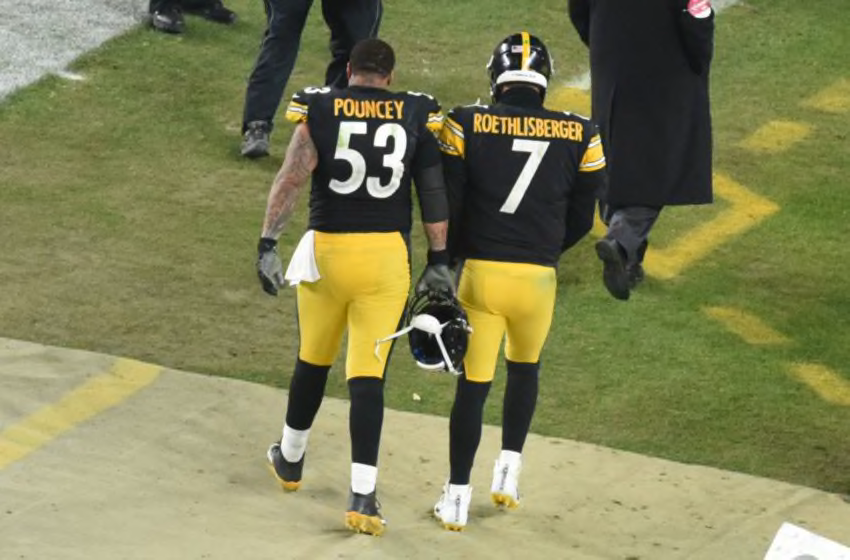
Jan 10, 2021; Pittsburgh, PA, USA; Pittsburgh Steelers quarterback Ben Roethlisberger (7) and center Maurkice Pouncey (53) walk off the field after the AFC Wild Card playoff game against the Cleveland Browns at Heinz Field. Mandatory Credit: Philip G. Pavely-USA TODAY Sports
The 2021 NFL Regular Season schedule leaks are proving one thing and that is that the Chicago Bears will be primetime darlings during the regular season.
On Wednesday morning, it had already leaked that the Bears were going to have to at least four primetime games for the 2021 NFL Regular Season. Those games were: Week 1 at Los Angeles Rams for Sunday Night Football; Thanksgiving day at Detroit Lions; December 12 at Green Bay Packers for Sunday Night Football; and December 20 hosting the Minnesota Vikings for Monday Night Football.
The Bears now have a fifth primetime game on tap for the 2021 regular season. Danny Parkins of 670 The Score reported that the Bears will be on Monday Night Football for their Week 9 matchup on the road against the Pittsburgh Steelers.
The NFL is clearly showcasing the Bears for the 2021 regular season given the 5 primetime games that are currently on the schedule. Perhaps more interesting than the five primetime games in themselves is that four of the games will occur during the second half of the 2021 NFL Regular season.
After selecting Justin Fields in the first round of the 2021 NFL Draft, Bears’ head coach Matt Nagy and general manager Ryan Pace have insisted that the plan has not changed and that veteran Andy Dalton is expected to be the Week 1 starting quarterback.
That certainly may be the case but leaks of the Bears’ 2021 NFL Regular Season schedule would seem to indicate that the NFL believes that Fields will be the team’s starting quarterback sooner rather than later.
For the Bears’ Week 9 game against the Steelers, it is their second matchup during the 2021 regular season where they will be playing against a quarterback they potentially had interest in earlier this off-season. Prior to Steelers’ quarterback Ben Roethlisberger signing a new contact to remain in Pittsburgh in February, the Bears reportedly had internal conversations about making a run at the veteran quarterback according to Jason La Canfora:
Chicago needs a major upgrade, and the options are limited. League sources said the Bears were in fact pretty serious about Carson Wentz, and had internal discussions about Big Ben as well and were primed to be perhaps the only landing spot for him had he not agreed to take a significant pay cut to stay in Pittsburgh.
Fortunately for the Bears, the narrative has changed since then. The Chicago Bears now have a quarterback in Justin Fields that has the potential to be their franchise quarterback for at least the next seasons as opposed to an aging veteran in Roethlisberger with diminishing skills.
We didn’t need the death of architect Helmut Jahn to bring the plight of the James R. Thompson Center to our attention. The state’s May 3 request for proposals to buy the iconic structure—minus any stipulation that it not be torn down—had already drawn widespread notice.…Read More
Torrey DeVitto who stars as Dr. Natalie Manning on “Chicago Med” is exiting the popular NBC drama series. | Copyright Ryan West
The rest of the “Chicago Med” major cast member lineup, including S. Epatha Merkerson, Oliver Platt, Nick Gehlfuss, Brian Tee and Marlyne Barrett, are expected to return for Season 7
Hot on the heels of confirming her relationship with Cubs manager David Ross, “Chicago Med” actress Torrey DeVitto is making news headlines of a less happy nature for fans of “Chicago Med.”
According to a report on Deadline.com, DeVitto (who stars as Dr. Natalie Manning), and co-star Yaya DeCosta (who stars as nurse April Sexton) are exiting the hugely popular NBC series after Season 6 for new gigs. DaCosta, according to the report, is headed to a starring role on the Fox series “Our Kid of People,” while DeVitto is now among the cast of the indie feature film “Skelly.”
Getty ImagesYaya DaCosta attends the National Women’s History Museum’s 8th Annual Women Making History Awardsat Skirball Cultural Center on March 8, 2020 in Los Angeles.
The rest of the “Chicago Med” major cast member lineup, including S. Epatha Merkerson, Oliver Platt, Nick Gehlfuss, Brian Tee and Marlyne Barrett, are expected to return for Season 7 of the “One Chicago Wednesday” family of Dick Wolf, Chicagocentric series later this year. The show airs at 7 p.m. locally.
DeVitto on Sunday confirmed the news of her relationship with Ross via Instagram, posting a Ross-taken smooch selfie, kissing his cheek in the black-and-white photo.
“Love him madly,” she wrote with a red heart emoji. Ross, 44, liked the photo via his Instagram account.
By the end of the day on Wednesday, the ChicagoBears will know their full 18-week schedule for the 2021 NFL Regular Season. Leaks of the Bears scheduled have already surfaced and the latest is a pair of primetime games against NFC North rivals in December. Danny Parkins of 670 The Score is reporting that […]
The Chicago Police Department started a secretive drone program using off-budget cash to pay for the new technology, the Sun-Times has learned.
Details of the police department’s drone program were included in an email sent last summer by Karen Conway, director of police research and development. In the email, Conway told other high-ranking police officials that the department’s counter-terrorism bureau “utilized 1505 funds for a pilot Drone program that operates within the parameters of current laws.”
The drones “have been purchased and the Electronic & Technical Support Unit (Counter-terrorism) is in the process of creating a training to start a pilot. Some of the Drone uses will be for missing persons, crime scene photos, and terrorist related issues,” Conway said in the June 12, 2020, email to former Deputy Supt. Barbara West and Michele Morris, the department’s risk manager.
The department’s “1505” fund is made up of forfeiture proceeds — money and other assets seized in connection to criminal investigations. The money isn’t included in the department’s official budget and has reportedly been used in the past to purchase other controversial technology, like Stingrays, which mimic cell towers and send out signals to trick phones into transmitting their locations and other information.
A state law that went into effect in July 2018 requires law enforcement agencies to report seizure and forfeiture information to the Illinois State Police.
Over the past two years, the department reported taking in seized or awarded assets valued at an estimated $25.9 million. That haul stems from investigations into alleged drug crimes and money laundering, but the reports don’t give the full scope of the department’s take because details about seized vehicles were redacted.
The reports state that roughly $7.7 million was spent over that period on operating expenses, witness protection, informant fees and controlled drug buys, as well as travel, meals, conferences, training and continuing education. The spending isn’t itemized, but the reports state that operating expenses can cover vehicles, guns and equipment, such as drones.
Conway’s message about the drone program was among a cache of hacked city emails that were leaked online last month by Distributed Denial of Secrets, a transparency nonprofit likened to WikiLeaks. Other emails show the Chicago Fire Department owns drones worth at least $23,000, though a spokesman clarified on Wednesday that it hasn’t yet earned permission to start a drone program.
Details of the police department’s drone program were included at the bottom of an email sent last summer by Karen Conway, director of police research and development.
Asked about the police department’s drone program, a spokesman said it “regularly investigates new technology and strategies.”
“The Department considers every tool available when it comes to maintaining public safety and actively searches for innovative opportunities,” spokesman Don Terry said in a statement without specifically mentioning drones.
“CPD has strict guidelines for all tools and programs to ensure individual privacy, civil rights, civil liberties and other interests are protected,” Terry added. “We also meet with community partners to make certain that all enforcement efforts meet the highest standards and have support among the individuals Chicago police officers are sworn to serve and protect.”
Terry and other spokespeople for the police department and the mayor’s office didn’t respond to specific questions about the emails. Kristen Cabanban, a spokeswoman for Chicago’s Law Department, issued a statement Friday saying city agencies wouldn’t answer questions about the contents of the hacked emails.
Ed Yohnka, spokesman for ACLU-Illinois, has concerns about the drone program.Maudlyne Ihejirika/Sun-Times
ACLU raises alarms
Over the course of multiple emails about the drone programs, Susan Lee, the former deputy mayor of public safety, twice noted there were concerns over the expected response from privacy advocates. However, city employees included in the discussions never independently raised alarms over privacy issues.
Ed Yohnka, a spokesman for the American Civil Liberties Union of Illinois, told the Sun-Times the emails show the city “continues to pursue the invasive technologies without any public disclosure, oversight or publicly adopted privacy policies,” undercutting Terry’s claims.
“We should not be surprised. This behavior goes back more than two decades when Chicago first began to place surveillance cameras all across the city,” Yohnka said. “To this day, residents of the city have never seen a privacy policy for the use of those cameras.”
In 2018, the ACLU accused former Mayor Rahm Emanuel of being the heavy hand behind legislation in Springfield that would have allowed police officers to use drones equipped with facial recognition technology to monitor protests. Versions of the legislation passed both the state house and senate but a final bill was never signed into law.
“Given that the city not so long ago sought legislation to permit using drones to surveil public gatherings, including those engaged in First Amendment activity, it is worth questioning its motivations,” Yohnka said of the new revelation.
In a report issued in February lambasting the city’s response to the protests and unrest that broke out in the wake of the police killing of George Floyd last year, city Inspector General Joseph Ferguson noted that drones were likely flying overhead at some demonstrations.
On May 30, the day an early downtown protest devolved into chaos, Ferguson said CPD officials contacted the Illinois State Police “to request its deployment, and ISP made determinations about which resources to deploy, including crowd control teams, canine units, videographers, drones and SWAT teams.”
“By ISP’s accounting of their deployment in Chicago and their operating procedures, they used videographers and/or drone footage to capture records of potential uses of force and arrests,” Ferguson wrote. “However, a review of ISP’s force reporting obligations and compliance was out of the scope of this report.”
Use of drones in car chases discussed
Karen Conway, director of police research and development for the Chicago Police DepartmentLinkedIn
Conway’s comments about the police department’s drone program were included in an email discussing a new vehicle pursuit policy.
The memo also included other technology options the department was considering to apparently minimize the risk of engaging in chases: a device to shut down a fleeing vehicle’s engine and a system for remote tracking. The latter option, StarChase, is a mechanism that allows cops to shoot a GPS-equipped dart at a suspect’s car.
Last August, the police department issued revised directives on pursuits, but the general order bears no mention of the technologies.
An email sent on Aug. 16, 2019 by Tamika Puckett, the city’s former chief risk officer, presented drones as a potentially cheaper alternative to StarChase, which reportedly charges $5,000 for each cannon and another $500 for every GPS dart.
“StarChase might be too costly of an option for our needs. If so, then we should research the drone issue, especially the city ordinance and what changes need to be made to it in order to even consider this an option,” Puckett wrote to Morris and other staffers.
Chicago’s drone ordinance is highly restrictive, though law enforcement agencies operating in the city are afforded an exception to its prohibitions if their drone use complies with state law. That law allows police to use drones for a variety of purposes, namely countering terrorism, searching for missing persons, photographing crime scenes and even pursuing crime suspects.
While the conversations about drones apparently happened in fits and starts, the high-level correspondence stretched on for months. Many of the emails related to the city’s need to purchase drone insurance.
In an email chain on that topic dated March 5, 2020, Lee expressed her intention to hold a meeting “because all three public safety agencies want drones.” Although her email doesn’t name the agencies, later emails show the police and fire departments both ultimately bought drones. It’s unclear whether the Office of Emergency Management and Control also purchased drones.
Fire department owns multiple drones but program’s in limbo
Over the course of those emails, Keith Wilson, a former deputy district fire chief, reported on Sept. 22, 2020, that the department owned four drones worth $23,000. Two days earlier, Angela Weis, Lightfoot’s senior adviser on public safety policy and operations, told Lee that the fire department planned to use the drones for search and rescue operations.
The Chicago Fire Department Foundation, a nonprofit that supports firefighters and paramedics and their families, previously published a blog post last April reporting that Wintrust Financial had donated three other drones to the department.
“For the CFD, the use of drones has the potential to make a large impact in how effectively the Department can mitigate fires, disasters or large-scale incidents, offering an aerial perspective and helping to identify areas of evacuation and most urgent needs for response,” according to the post. “Equally important is the utilization of images and videos post-incident to assist in fire investigations, critiques and training purposes.”
On October 5, 2020, Puckett ultimately told former Chicago Fire Commissioner Richard Ford II that “the city purchased drone property and liability insurance coverage for our drone programs citywide,” apparently closing the loop on a conversation that stretched nearly a year.
On Wednesday, Larry Langford, a spokesman for the fire department, confirmed it purchased an additional drone but is currently only using the donated drones for training purposes.
“We do not have permission yet to implement a drone program,” said Langford. “We have many members now certified to fly a commercial drone but we do not use them in regular operations until the actual program is blessed and in place.”
LOS ANGELES — Norman Lloyd, whose role as kindly Dr. Daniel Auschlander on TV’s “St. Elsewhere” was a single chapter in a distinguished stage and screen career that put him in the company of Orson Welles, Alfred Hitchcock, Charlie Chaplin and other greats, has died. He was 106.
Lloyd’s son, Michael Lloyd, said his father died Tuesday at his home in the Brentwood neighborhood of Los Angeles.
His credits stretch from the earliest known U.S. TV drama, 1939?s “On the Streets of New York” on the nascent NBC network, to 21st-century projects including “Modern Family” and “The Practice.”
“If modern film history has a voice, it is Norman Lloyd’s,” reviewer Kenneth Turan wrote in the Los Angeles Times in 2012 after Lloyd regaled a Cannes Film Festival crowd with anecdotes about rarified friends and colleagues including Charlie Chaplin and Jean Renoir.
The wiry, 5-foot-5 Lloyd, whose energy was boundless off-screen as well, continued to play tennis into his 90s. In 2015, he appeared in the Amy Schumer comedy “Trainwreck.”
His most notable film part was as the villain who plummets off the Statue of Liberty in 1942?s “Saboteur,” directed by Hitchcock, who also cast Lloyd in the classic thriller 1945’s “Spellbound.”
Norman Lloyd poses before a 50th anniversary screening of the film “The Sound of Music” at the opening night gala of the TCM Classic Film Festival on March 26, 2015, in Los Angeles. Chris Pizzello, AP
His other movie credits include Jean Renoir’s “The Southerner,” Charlie Chaplin’s “Limelight,” “Dead Poets Society” with Robin Williams, “In Her Shoes” with Cameron Diaz and “Gangs of New York” with Daniel Day-Lewis.
On Broadway, Lloyd played the Fool opposite Louis Calhern’s King Lear in 1950, co-starred with Jessica Tandy in the comedy “Madam, Will You Walk” and directed Jerry Stiller in “The Taming of the Shrew” in 1957.
He was also part of Welles’ 1937 modern-dress fascist-era production of “Julius Caesar” that has gone down in history as one of the landmark stage pieces in the American theater. Norman played the small but key role of Cinna the Poet, opposite Welles’ Brutus. Stage magazine put Welles on its June cover and proclaimed the production “one of the most exciting dramatic events of our time.”
Born Nov. 8, 1914, in Jersey City, New Jersey, Lloyd jumped into acting as a youngster in the 1920s. On stage, he was a regular with Welles’ Mercury Theater, the groundbreaking 1930s troupe that also featured Joseph Cotton and Agnes Moorehead and formed the basis of Welles’ classic film debut, “Citizen Kane.”
His other plays included “Crime,” directed by Elia Kazan and featuring his future wife, Peggy Craven. The couple were married for 75 years, until Peggy Lloyd’s death in 2011 at age 98.
TV viewers knew him best as the memorable calm center of St. Eligius hospital on the 1982-88 NBC drama series “St. Elsewhere.” His Dr. Daniel Auschlander was originally only supposed to appear in a few episodes, but Lloyd became a series regular and stayed with the show for the entire run. The series would inspire such shows as “E.R.” and “Grey’s Anatomy.”
Lloyd worked steadily as a TV actor and director in the early 1950s, but the political liberal found his career in jeopardy during the Hollywood blacklist period aimed at communists or their sympathizers.
In 1957, Hitchcock came to his rescue, Lloyd told the Los Angeles Times in 2014. When the famed director sought to hire Lloyd as associate producer on his series “Alfred Hitchcock Presents” but was told “There is a problem with Norman Lloyd,” Hitchcock didn’t back down, Lloyd recalled.
“He said three words: ‘I want him,'” Lloyd said. He was immediately hired and eventually worked as executive producer on another series, “The Alfred Hitchcock Hour.”
His other TV credits include roles in “Star Trek: The Next Generation,” “Murder, She Wrote,” “The Paper Chase,” “Quincy M.E.,” “Kojak” and “The Practice.”
In 2014, in recognition of his 82 years in show business, and reaching the age of 100, the Los Angeles City Council proclaimed that his birthday of Nov. 8, would be honored as “Norman Lloyd Day.”
Chicago mayors have a long and documented history of filling key vacancies with interim appointments only to strip away that “acting” title and make those temporary appointees permanent.
That’s what happened Wednesday at World Business Chicago, the public-private job growth agency that will play a pivotal role in rebuilding a local economy decimated by the coronavirus and devastated by two rounds of looting.
Michael Fassnacht, the $1-a-year chief marketing officer who has held down the fort at World Business Chicago since Andrea Zopp stepped down as president and CEO on Dec. 31, was anointed as Zopp’s permanent replacement.
Fassnacht could not be reached for comment. Whether his salary will change, and by how much, was not immediately clear.
A press release announcing the permanent appointment quoted him as saying that “history has proven over and over” that Chicago is a “resilient and imaginative and innovative” city capable of bouncing back.
“I look forward to … supporting an equitable and inclusive recovery. Chicago should become a role model for any global large city of how to enable and drive economic growth for all of its residents,” Fassnacht was quoted as saying.
Mayor Lori Lightfoot was quoted as saying that “getting through and beyond” economic recovery “requires a steady grip, focus and expertise.”
“Michael brings that and more to the city of Chicago. Time and time again, Michael has demonstrated his passion for inclusive economic development and investment while simultaneously creating eye-catching and memorable marketing initiatives that center the authenticity of our residents,” the mayor was quoted as saying.
“I am thrilled that he will continue supporting our city in his dual roles as my chief marketing officer and president and CEO of World Business Chicago.”
When Zopp announced her retired in early December, Fassnacht hinted strongly he would not be a candidate for the permanent job.
At the time, he said his goal was to attract new companies and foster an “open, transparent frank conversation” between the mayor and the business community.
“I’m very bullish on the second half of 2021 and 2022 [because of the] pent-up demand for people to have experiences outside the home, outside maybe their city,” Fassnacht said on that day.
“Leisure travel . . . will come back better than before as long as we can position Chicago as an amazing place for one of the most diverse experiences — not just in downtown, but across all neighborhoods.”
Fassnacht takes the permanent reins at World Business Chicago as the city is beginning to reawaken from its pandemic-induced slumber, thanks to increased vaccination rates and a declining number of coronavirus cases.
Downtown office employees are beginning to trickle in after more than a year of working remotely.
McCormick Place is reopening to reduced capacity, beginning with the July return of a revamped and reimagined Chicago Auto Show.
Chicago hotels devastated by the pandemic are hoping to attract stay-cationers and out-of-town visitors this summer, thanks to the return of festivals, concerts and theaters.
Fassnacht’s job will be to make the most of that comeback by persuading companies to bring their employees back downtown full-time. He will also be called upon to use his extensive marketing experience and creativity to help market Chicago to the Midwest, the nation and the world.
The new president and CEO of World Business Chicago is uniquely positioned to do just that.
He is a former commercial advertising whiz who, while serving as CEO and president of FCB, donated his time to work on former Mayor Rahm Emanuel’s failed pitch to attract Amazon’s corporate headquarters.
Last fall, Fassnacht told the Sun-Times that Mayor Lori Lightfoot and her “authentic” personality would be a cornerstone of the plan to “rebrand” Chicago and help the city recover from the economic havoc wreaked by the coronavirus.
“If you look at the mayor and what she represents — her history, her background, her personality — people are very intrigued by that. They might not agree with everything. But they’re intrigued and believe she’s authentic,” Fassnacht said then.
For decades, Chicago was known around the world as the home of mobster Al Capone. That was thankfully supplanted by Chicago Bulls superstar Michael Jordan and the two three-peats he engineered during the 1990s.
Fassnacht said then that the rebranding of post-pandemic Chicago would highlight the city’s diversity without sweeping under the rug its ugly underbelly as one of the nation’s most segregated cities.
“I really would love to be known for [being] a creative, innovative city that has honestly addressed the sins of its past to build a much more equitable city that everyone can enjoy,” he said.
I would never call myself an athlete. It’s true that a few years ago I rode a bicycle a hundred miles in one day, but that was powered more by naive optimism than a natural inclination toward cycling. I’ve done enough Pilates to know what “navel to spine” means but still get nervous when it’s time to plank. I can’t do a pushup, and the one time I tried to run the Shamrock Shuffle, I was literally shuffling down State Street because I’d peed my pants in front of the Chicago Theatre. In my subsequent race photo, it looks like I’ve been shot.
So when I walk into Vibez Fit, a new fitness studio in River North that uses the Power Plate, the “leading technology in whole-body vibration training,” I’ve left my “Slay” tank top at home because I don’t want anybody to get the wrong idea. While I’m smiling and saying hello to my perfectly fit instructor, Asia, I’m under no illusion that I’m going to be good at this, and as I gaze down the gangway of purple-lit machines, inside I feel like 11-year-old Adrienne whose gym teacher won’t stop screaming “C’MON GUNN!” when she can’t magically levitate from the floor onto a four-foot wooden box.
I’m looking for a spot in the back when I’m informed this will be a private class in which I’m the only student. Oh. Good. But it’s only 30 minutes, so things are looking up. I’m told that the Power Plate was developed for Russian cosmonauts, that it “stimulates the body’s natural reflexes, causing an involuntary muscle contraction,” and that this is going to burn more calories, lead to detoxification, and reduce the appearance of cellulite. To be honest, worrying about cellulite feels like a luxury; I’m still figuring out how to lose the COVID 19.
Asia directs me to a Power Plate right next to her. She turns it on, and I swear to God, my teeth are rattling. It’s not vibrating so hard that I think I might fall off, but it is vibrating so hard that I suddenly have an awareness of my eardrums. The only muscle that’s ever experienced this much vibration is my vagina. I’m doing Fusion Vibez, which is a mix of cardio, barre, and Pilates, and very quickly I’m breathless. We’re working with a small rubber stability ball — holding it between our legs while we squat, holding it in the crook of our knee while we squat, making ballet arms while we squat. We’re doing leg lifts and triceps dips and planks, and I’m glad no one can see my face under my mask because I know it’s all twisted up and grunty like an Olympic powerlifter’s, except they’re just asking me to hold up my own body weight. But afterward I feel energized and happy, like I’m digging the vibez. Until the next day, when my quads hurt so bad I can barely walk and my vibez are lie down on the couch forever.

:no_upscale()/cdn.vox-cdn.com/uploads/chorus_asset/file/22509947/Harmon.jpg)
:no_upscale()/cdn.vox-cdn.com/uploads/chorus_asset/file/22509871/merlin_73208255.jpg)
:no_upscale()/cdn.vox-cdn.com/uploads/chorus_asset/file/20078026/Dr.BrittaniJames.png)


/cdn.vox-cdn.com/uploads/chorus_asset/file/22509542/GettyImages_1211197317.jpeg)
:no_upscale()/cdn.vox-cdn.com/uploads/chorus_asset/file/22507812/Screen_Shot_2021_05_11_at_5.07.56_PM.png)
:no_upscale()/cdn.vox-cdn.com/uploads/chorus_asset/file/22507814/Screen_Shot_2021_05_11_at_5.08.13_PM.png)
:no_upscale()/cdn.vox-cdn.com/uploads/chorus_asset/file/16045946/edyohnka030717.jpg)
:no_upscale()/cdn.vox-cdn.com/uploads/chorus_asset/file/22507879/Image_from_iOS__6_.png)
:no_upscale()/cdn.vox-cdn.com/uploads/chorus_asset/file/22509288/merlin_97579138.jpg)