
What’s New
‘Jonathan Toews eats his vegetables’: Billet family helps young Chicago Steel players navigate hockey, lifeNeil Steinbergon May 22, 2021 at 1:00 pm

Marcy and Brian Gravenhorst do more than billet for Chicago Steel — they help players through a crucial part of their hockey careers.
Even with no one in it, the kitchen in Marcy and Brian Gravenhorst’s Aurora home gives away the game: Something unusual is going on here. One big bowl is filled with protein bars. Another with Goldfish crackers. A third with clementines. Two large bottles of honey, plus jumbo jars of Nutella and peanut butter. In the fridge, Gatorade. In the oven, lasagna is baking for dinner. Lots of lasagna.
“I made two pans,” says Marcy.
A lot of food for a retired couple: Brian is 70, a retired computer programmer. Marcy is 69, a retired special ed teaching assistant. But they are not alone.
“Should I call the munchkins to dinner?” Marcy asks Brian.
“Call the troops!” he decrees.
Downstairs clomp Lukas Gustafsson, Jack Bar and Simon Latkoczy, three members of the Chicago Steel hockey team. They are the Gravenhorsts’ dinner guests tonight and every night; the three players have lived with the couple for almost nine months.
“Three 18-year-olds,” elaborates Brian, letting that sink in. “Hockey players are always hungry.”
Welcome to the world of hockey billet families. The public is so enamored with professional sports, parsing every detail of the National Hockey League’s teams and stars, they might not even be aware of the modest traditions of the United States Hockey League. Here, players are paid literally nothing — which is a step up for them, because before they were paying for the privilege of playing the sport. The USHL is a place to hone their skills, get accepted to a good college and maybe, just maybe, catch the attention of the pros.
A salary of $0 doesn’t leave much for living expenses, however. This is where billet families step in, to house them, feed them and mother them, performing various practical tasks, like taking a pair of Finns to the Finnish consulate to vote for the first time.
The Gravenhorsts are the oldest of the Steel’s 15 billet families — sometimes referring to themselves as “hockey grandparents” — hosting for their sixth year. Like many grandparents, the couple sweats the details. Three flagpoles next to their garage display the national flag for each player, greeting them when they arrive, plus the American flag over the front door. The players are supposed to do their own laundry, but Marcy won’t allow that — that would involve teenage males fiddling with her washing machine. They are expected to get their dirty clothes and linen into a clothes hamper which, as any parent of boys knows, is already placing the bar pretty high.
The Gravenhorsts do this . . . why exactly?
For Marcy, it is all about hockey.
“I’m a rabid Chicago Blackhawks fan and have been since forever,” she says. They’d hosted foreign exchange students — for at most a few weeks at a time. Then the Chicago Steel moved to Geneva.
“They were looking for billet homes,” says Marcy. “We’re not that far from the Fox Valley Ice Arena.”
And Brian, well, he’s married to Marcy, and then there is the joy of keeping the boys fed.
“I do grilling, I do ribs, I do pulled pork,” says Brian, “I also do a brisket from time to time, Texas style. We introduce spice to these kids. A lot of ’em have eaten a bland diet all their lives. They really love a brisket.”
Dinner conversation centers around — any guesses? — hockey.
“How was practice?” Marcy asks. “What did you guys do?”
“Good,” they reply in chorus.
There’s a fresh bruise on the face of Canadian Jack Bar — the Steel announcer calls him “Kit Kat” — and he shows off his scabbed knuckles and a cellphone with video of the on-ice fight against Muskegon’s Quinn Hutson is passed around, appreciatively.
Simon Latkoczy (nicknamed “Chimp,”
for his athleticism) is a top goalie from Slovakia, which brings up another appeal of billet hosting.
“Having these boys in the house for nine months, I get to ask questions,” says Marcy. “The last few seasons, we’ve had goalies, which are few and far between. What do they do? Why they do it. How they do it. When watching a game, I see something and can ask, ‘Why do you do that? It doesn’t make sense.’ ”
Such as?
“Sometimes you see a goalie in the goal. Play is going on on the other end of the ice, and all of a sudden the goalie takes the stick and starts slapping on the ice. What does that mean? He is signaling to his team; the penalty on the other team ends in approximately five seconds.”
The Gravenhorst cats are named Brandy and Mac, for Macallan, Brian’s favorite tipple. But the only beverage is lemonade. Players are forbidden to drink alcohol and rigorously abide.
“They never even ask,” says Brian.
Really? Never?
“The boys are that nice,” says Brian. “We’re not gilding the lily here. They are that nice, polite, well-mannered human beings.”
Generally. In six years, the Gravenhorsts have lost two players, at the same time, to disciplinary problems. What was it: Crime? Drugs? Fighting?
No. Overly boisterous indoor soccer.
“It wasn’t malicious, they were just getting out of hand, the rockers were poking holes into the wall,” says Marcy “They would play around a lot in the bedrooms” — each player has his own — ‘‘and started doing damage to the house. I called the coach and said, ‘These guys gotta go.’ He said, ‘Why didn’t you tell us sooner?’ ”
Without billet families, the Steel would have trouble putting a team on the ice, and they know it.
“There are horror stories throughout our league of players in billets that have gone wrong,” says Steel president Dan Lehv. “We’ve been fortunate in Chicago. Our housing coordinator meets with families, tours homes, goes a layer deeper, surveying the players, the families.”
Most players are self-policing.
“First of all, hockey players are notoriously known as being good guys,” says Lehv. “When they get to this level, there’s so much at stake for them, there’s a college scholarship sitting in front of them. This league is a ticket for 96% of them. They don’t want to screw that up. But more than that, they do come here, their parents did a really good job. They know this is part of the hockey culture, to go and live in someone else’s home.’’
Even with COVID shortening the season, there was still a waiting list of families eager to host players.
“We were overwhelmed that the families were still lined up to accept players for this season,” said Lehv. “At the same time, our players have done an incredible job of taking care of themselves and taking the proper precautions so they don’t bring COVID home to our housing families.”
Though teens are still teens, and during dinner, when Brian leaps up to show off his collection of bobbleheads, the trio politely suppress snickers and flash “Oh, that dad . . .” grins at each other. A reminder that not only do the families have to adjust to the players, but the players must adjust to the peculiarities of family life, like the naughty gnome figurines that the Gravenhorsts liberally scatter around their dining room.
Decorum is important; their professional fate can pivot on the Gravenhorsts’ good opinion.
“Our Finnish player, the Red Wings are watching him,” Marcy says of a player from the past. “I had an agent from the Red Wings call and talk about Victor.” The St. Louis Blues also had inquired about a player’s character, and, yes, she answered positively, despite the urge, as a loyal Blackhawks fan, to deny their hated rival a potential asset.
“If someone gets drafted by the Blues, I’m in real trouble,” says Marcy. “I always tease them, ‘I don’t care what team you play for, but I draw the line at the St. Louis Blues.’ ”
Besides hockey, there is much talk of food: the molten lava cupcakes for dessert. Gustafsson, a dual Swedish/American citizen nicknamed “Goose,” passes the salad.
“You have to eat vegetables at every dinner meal,” says Brian. “Even if you only take a little bit, you HAVE to take some.”
Marcy is the enforcer when it comes to greens.
“I say, ‘Look, you’re hockey players,’ ” she says. “ ‘What you eat affects your health later in life. Jonathan Toews eats his vegetables.’ ” (Indeed he does. “So much more satisfying to eat food that you’ve grown yourself,” tweeted the Blackhawks’ captain, promoting his Green Bronx Machine project, which encourages healthy eating and gardening in Chicago Public Schools.)
Once a newcomer missed the unsubtle eat-your-peas message, and a more seasoned player unceremoniously spooned vegetables onto his plate, earning a scowl.
“He said, ‘If I gotta eat ’em, you gotta eat ’em,’ ” Brian recalls. “And that was it.”
Food costs money, and billet families do get paid by the Steel: $300 per month per player.
“That pretty much covers the meat budget,” says Brian. “We do it because these kids are wonderful human beings. They are working so hard to live their dream. They know they’re not all going to make it, but they’re working hard for it.”
Which brings up another important role for the families.
“Families are providing these players, not just a room and a bed to sleep on, not just nourishment in the form of a family dinner,” says Lehv. “This is the level where the cream rises to the top. Players get weeded out if they’re just not good enough to move on. They’ve been the best players — they haven’t gone through lengthy slumps where they haven’t scored a goal in months, haven’t been scratched from the lineup consistently. This is where hardships happen. These families play such a crucial role, in terms of the psyche of our players, helping them manage a situation that’s completely new to them. They are a shoulder to cry on. They are there for our players in good times and in bad, for everything that happens in the lives of a 16- to 21-year-old over a nine-month period.”
“We know it’s hard for them even though they’re in contact with their families,” says Marcy, who’ll tweet their actual parents updates during games.
Many billet families do not stop being close after players move on.
“What I found out is there are so many
relationships that are developed, lifelong,” says Lehv.
And indeed the Gravenhorsts keep photos of players who’ve lived with them previously on the walls of the living room (where they have a pool table for the boys; there’s also a hot tub), and keep up on their current status and careers.
So what have they learned, hosting Europeans?
“One thing we’ve learned over the years, they’re not used to the American friendliness,” says Marcy. “Normally people don’t chitchat. If you’re outside, people will say hello. They don’t do that. We’ve had a couple people ask, ‘How do I respond?’ I tell them, ‘You can wave, you can speak if you want. Smile.’ ”
The Gravenhorsts certainly do. They plan to remain billet grandparents for as long as they are able.
“It brings a lot of laughter and a lot of life into the house,” says Marcy. “We’ve had nothing but fun.”
She has an adult daughter.
“Now I’m raising sons,” she says. “The boys keep us young and it’s fun, and I highly recommend being a billet.”
The Steel, by the way, won the Anderson Cup for the second year in a row by scoring the most points this season: 81. Which gives them home-ice advantage facing the Fargo Force in the five-game championship series for the Clark Cup.
“We’re getting ready for Fargo,” Marcy says. “This is it, the finals. They’re really excited about the season. They swept Dubuque. They swept Muskegon. And now they’re getting ready to play Fargo.”
The two teams split the first two games, and the series continues this weekend.
The three were not so focused on winning that they overlooked something also very important: They sent Marcy flowers and made a charitable donation in her honor for Mother’s Day.
“That touched me so much,” she says. “It’s bittersweet. I want them to win the Cup, but it’s a sad time for me. This is when I have to say goodbye. It’s with tears of joy.”
Contributing: Ashlee Rezin Garcia
Fire spending on salary but seeing little successBrian Sandalowon May 22, 2021 at 1:00 pm

The Fire’s issue isn’t available cash, but how sporting director Georg Heitz has handed out contracts and whether coach Raphael Wicky can make the pieces function together. So far, the indications aren’t promising.
The MLS Players Association salary data released last Thursday confirmed what many thought about the Fire.
Their salary investments aren’t paying off.
According to the union’s numbers, the Fire (0-4-1, one point) have the 27-team league’s seventh-highest payroll at $13.6 million. The Fire aren’t the only team in the top seven struggling — FC Cincinnati (0-3-1) is fifth at $15.5 million — but their pattern of paying big money for mediocre results has carried over from the end of the Andrew Hauptman/Nelson Rodriguez era.
As anyone who follows the franchise knows, spending isn’t a problem under owner Joe Mansueto. They’re laying out $65.5 million to amend their lease with the Village of Bridge-view to move to Soldier Field, and the club is looking for land to build a training facility.
Twenty-eight games into their tenure, the issues are how sporting director Georg Heitz has handed out contracts and whether coach Raphael Wicky can make the pieces function together. Entering Saturday’s game against Inter Miami, which owns the league’s highest payroll but is just 2-2-2 (eight points), the indications aren’t promising.
Production from designated players is a key for success in MLS, and the Fire aren’t getting enough from the trio Heitz signed after his hire deep into the 2019-20 offseason. Robert Beric, the team’s highest-paid player at $2,703,164 in guaranteed compensation, delivered 12 goals last year but has one this season. Midfielder Gaston Gimenez ($2,358,667) hasn’t been the same player he was in 2020, while attacker Ignacio Aliseda ($821,501) only has played 24 minutes in 2021 because of injuries.
Heitz, who inherited a handful of tough contracts, chose last October to pick up the option on captain Francisco Calvo. A Rodriguez acquisition making $902,600, Calvo is the highest-paid player on a perpetually struggling back line.
Meanwhile, shrewd 2019-20 Heitz signings such as midfielder Luka Stojanovic ($373,400), defender Boris Sekulic ($643,900) and goalkeeper Bobby Shuttleworth ($125,750) haven’t been enough to avoid the worst five-game start in team history that has followed up 2020’s 11th-place finish.
Another concern is getting key parts to perform well together. One example of that Alvaro Medran, the Fire’s top overall player last year, has been quiet in the first five games, though his best moments have come with Stojanovic on the bench. Obviously, the Fire are tougher to handle if both contribute at the same time.
Even with an underwhelming injury-riddled roster, it’s Wicky’s job to get the most out of what he has been dealt and correct recurring mistakes. That hasn’t happened, even though the team believed continuity would bring progress.
If things don’t turn around after the team gets healthier, the Fire can opt to restart again this offseason. Among others, Beric, Gimenez and Calvo have club options for 2022, which could mean increased roster flexibility.
But If the Fire choose to tear it down and they’re still in charge, Heitz and Wicky would have to get considerably more from Mansueto’s money. They aren’t getting much now.
Notre Dame needs these five to thriveMike Berardinoon May 22, 2021 at 1:00 pm

Irish looking for RB Chris Tyree, OL Jarrett Patterson, CB Cam Hart, DE Isaiah Foskey, WR Braden Lenzy to step up.
SOUTH BEND, Ind. — After sending a program-record nine NFL draftees to the next level, opportunity abounds at Notre Dame.
If the Fighting Irish are to reach the College Football Playoff for the third time in the last four seasons, coach Brian Kelly knows he and his staff must unlock individual skills and production previously unseen at the college level.
A combined 43-8 record in the last four seasons suggests that is more than possible in 2021. Here’s a look at five players who must step up for Notre Dame to continue its string of 10-victory seasons:
CHRIS TYREE, RB/KR
The former five-star recruit flashed his speed as a freshman, averaging 6.8 yards per carry and coming within a step of breaking several kickoff returns, but he still left fans wanting more.
With 1,100-yard rusher Kyren Williams expected to be featured as a slot receiver at times, the floor is open for Tyree to expand on his dual-threat capabilities. He also could be the salve for an underwhelming punt-return unit, but his spring was uneven in that area.
‘‘We recognize how good a football player Chris Tyree is,’’ special-teams coordinator Brian Polian said. ‘‘But if Chris is not yet comfortable — and there are times when he articulates [that] to us — I’m not going to roll him out there on national television.’’
JARRETT PATTERSON, OL
Offensive line coach Jeff Quinn must replace four starters from a Joe Moore Award finalist group, including second-round picks Liam Eichenberg and Aaron Banks and third-rounder Robert Hainsey.
That marked only the second time since 1982 that any program had three offensive linemen drafted in the first three rounds.
Now the spotlight falls squarely on Patterson, a two-year starter at center who missed spring practice while recovering from a season-ending injury to his left foot. With replacement Zeke Correll slated to stay at center, Patterson could float to any of the other four slots, depending on need.
The redshirt junior won’t just be expected to anchor an inexperienced line; he’ll have to be nearly perfect for the revamped group to avoid a significant drop-off.
‘‘Where does Jarrett play?’’ Kelly said after the spring game. ‘‘Is he a tackle, guard or center? We’ve got work to do, but we’re going to get there.’’
CAM HART, CB
After bouncing between receiver and cornerback his first two seasons, he has found a home on new coordinator Marcus Freeman’s defense.
Wiry-strong and hopeful of putting a history of shoulder injuries behind him, Hart could start opposite fellow underclassman Clarence Lewis. At 6-2 and 207 pounds, he has warmed to a press-heavy coverage scheme.
‘‘Coach Freeman has taken a lot of the thinking out of it,’’ Hart said. ‘‘I feel a lot more comfortable in this defense. It’s about being in the right position, using the right techniques. I can just focus on denying my man.’’
ISAIAH FOSKEY, DE
Four Irish defensive ends have been taken in the last two NFL Drafts. Foskey is on track to join that group once it’s his turn.
‘‘When I first got here, everybody said, ‘Hey, man, he’s the potential first-round pick of the future,’ ’’ Freeman said. ‘‘Foskey hasn’t played a whole bunch of football. We need to continue to get his football intelligence up.’’
At 6-5 and 257 pounds, the freakish athlete has shown his game-changing ability on special teams. The next step for the redshirt sophomore is to impose his will up front, especially as a pass rusher.
BRADEN LENZY, WR
The much-hyped Jordan Johnson transferred to Central Florida, and injuries continue to slow Kevin Austin Jr.
That leaves the floor open for speedsters Lenzy and Lawrence Keys III to replace the physical combo of Ben Skowronek and Javon McKinley.
Lenzy, a former Oregon sprint champ who has been slowed by hamstring injuries the last two seasons, had 88 receiving yards in the spring game. Kelly noted during the spring that Lenzy and Keys had made a renewed commitment in the weight room.
‘‘You can see it in the way they’re translating that on the field,’’ Kelly said. ‘‘They’re explosive, they’re running out, they’re breaking tackles.’’
Notre Dame needs these five to thriveMike Berardinoon May 22, 2021 at 1:00 pm Read More »
Illinois still not on board when it comes to betting on local college sports teamsRob Miechon May 22, 2021 at 1:30 pm

Illinois among states where fans can’t bet on local college teams — for no good reason.
LAS VEGAS — In a hush-hush 2000 rendezvous, legendary sports bettor Lem Banker broke bread with Brian Sandoval, chairman of the Nevada Gaming Commission (NGC).
In a Ruth’s Chris steakhouse booth, they discussed the state’s longtime betting ban on Nevada and UNLV games, a topic that resonates today in Illinois, neighboring states and elsewhere.
Back then, Arizona’s John McCain and fellow senators Jon Kyl (Arizona) and Sam Brownback (Kansas) sought a national collegiate-sports-betting ban, their crosshairs firmly on Nevada.
Jim Livengood, a longtime collegiate administrator who had invited McCain to many Arizona basketball games in Tucson when Livengood served as the Wildcats’ athletic director, recalled that era.
“When those games were off the board . . . that [did] raise questions,” Livengood said. “If it’s so regulated and so above-board, why wouldn’t you have those games on there? That’s why your column will be important.”
In the 1950s, Nevada had made it verboten to wager on Wolf Pack and Rebels games. Late in his life, Banker told me — for a book — that those chalkboard omissions, conspicuous by their absence, would have fueled the McCain faction and the NCAA.
Banker said U.S. Sen. Harry Reid, D-Nev., a former NGC chair, was his conduit to Sandoval. Banker implored Sandoval that odds on Nevada and UNLV were no more cause for concern than Notre Dame or Syracuse.
In October 2000, the NGC first discussed the measure in Carson City. Four hearings later, by a 5-0 vote in late January 2001, it became legal to bet on Nevada and UNLV games in the Battle Born State.
No NCAA officials attended a single -hearing.
“That was huge,” said Banker, who died at 93 in November. “Thanks to me!”
Livengood believes having legalized sports betting but barring certain aspects of it only arouses suspicion.
“Much of the thinking has been so archaic,” said the 76-year-old Livengood, “with regards to yesterday and today, as we look to tomorrow. It’s yesterday’s thinking for today’s model.
“I’m not sure there are a lot of people who even know that UNLV and Nevada games weren’t on the board, or the McCain thing.”
NO HALFWAY
Livengood also served as the athletic director at Washington State and UNLV, and he once chaired the NCAA Tournament selection committee. That Nevada-UNLV history, he said, is pertinent today in Illinois.
Its residents must drive to Indiana, or Iowa, to place a bet on a Northwestern football game, or an Illinois or DePaul basketball tilt. Such wagers are illegal in the Prairie State.
Someone in Ames, Iowa, must drive to Illinois to make a proposition bet — a player to run for so many yards, say, which is not legal in Iowa — on Iowa State football.
“It raises many questions,” Livengood said. “Is there something we need to be worried about or we should be worried about by not having those local [options] on the board?”
Art Manteris, in his 1991 “SuperBookie” biography, wrote that the Hilton, whose book he ran, and every other Vegas property would have been “slaughtered” in 1990 by a voracious public eager to bet on UNLV, at any spread, against Duke in the NCAA title game.
The Rebels blasted the Blue Devils 103-73. Manteris added that illicit bookies in town regularly put out a UNLV line and took “heavy action” on the Rebels.
Politicos fear cheating scandals, but people seeking action will find it, legally or otherwise, with those nefarious bookies or off-shore sites.
Any restrictions — dubbed “carve-outs” in industry lingo — nullify a legalized sports-betting edict to bring the activity out of the shadows, to legitimize it and earn tax dollars for the state.
Arkansas, Mississippi and Montana, to name a few states, have no such carve-outs.
Jill Dorson, managing editor at industry watchdog SportsHandle, notes that athletic directors have testified about the potential pressures of legal wagering on their student-athletes.
“But the truth is that they’re being wagered on anyway, on the black market or in other states,” she said. “So whatever state it is might as well keep the money at home.”
A bill in the recent Illinois Legislature seeking to remove that in-state ban failed.
“If the goal of legalizing sports wagering is to stamp out the black market, then legalizing wagering on all sports has to happen for the black market to go away,” Dorson said. “There is no halfway.”
NOTHING OFF THE BOARD
For the 21 states and Washington, D.C., that have legal sports betting, business is booming. In March, for the seventh time in eight months, a national record was set when $4.61 billion in sports wagers were recorded.
According to Livengood, though, stark differences will continue to invite speculation.
Several veteran Vegas sportsbook operators have long been amazed how so few politicos from other states, with sports betting on their dockets, have visited their shops to actually learn how they operate.
One said officials from Illinois, Indiana, Mississippi and New Jersey might have visited Vegas to conduct such investigations, but that might be a stretch.
“A large number [of politicos] have no idea how regulated Nevada is, how regulated Las Vegas is,” said Livengood, retired and living in Tucson. “They have no idea because they’ve never been there. But it’s going to be everywhere, and nothing will be off the board.
“Everything will be on the board.”
To whatever degree of his influence, a nod of gratitude to the forward-thinking Lem Banker will be justified.
Stefanie Dolson ready to make history with Team USAAnnie Costabileon May 22, 2021 at 1:30 pm
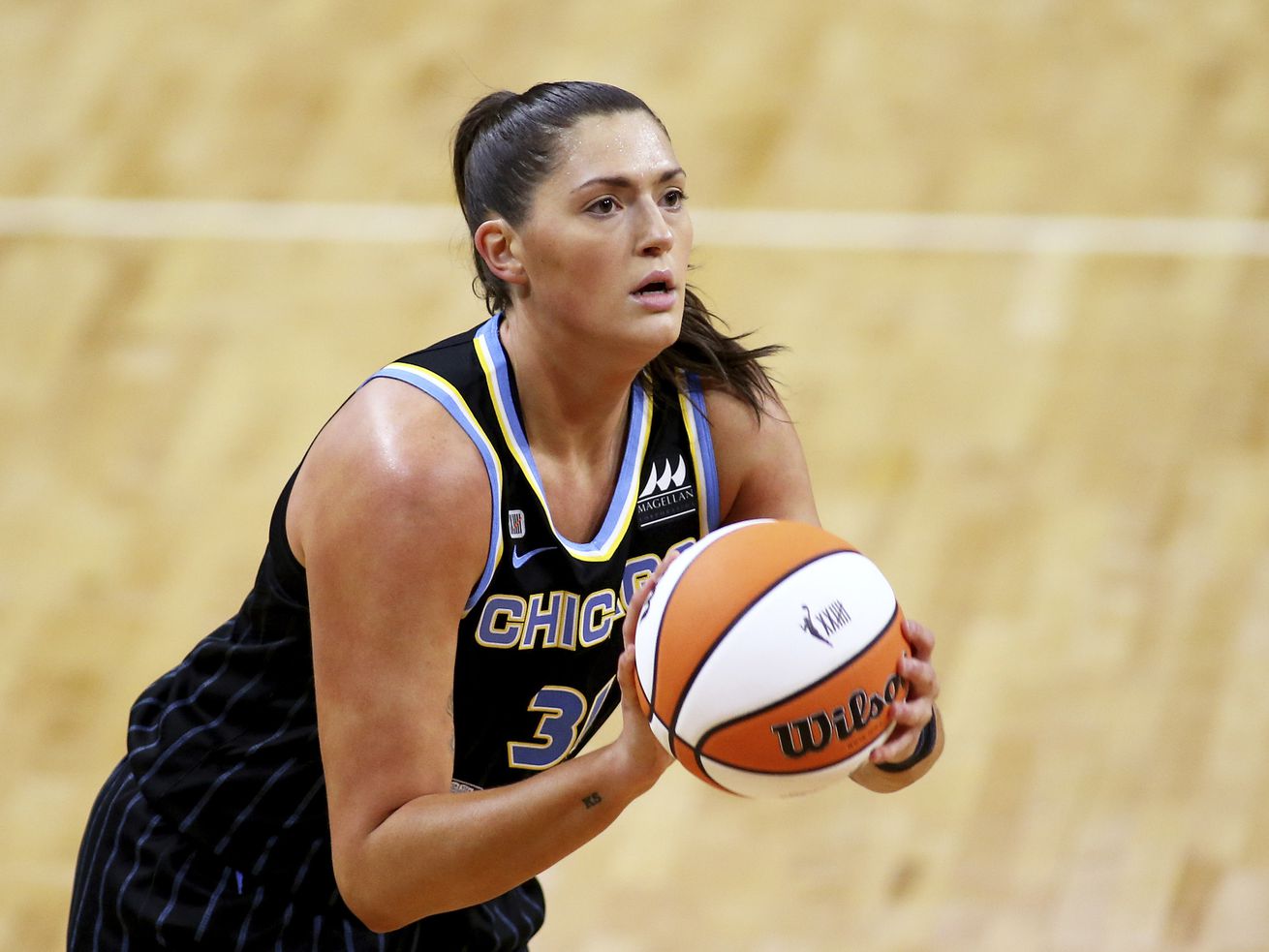
Dolson leaves Sky to participate in 3×3 basketball Olympic qualifier
Sky center Stefanie Dolson always wanted to win gold with Team USA.
She envisioned it would be playing five-on-five, but USA Basketball had other plans for her.
“When [Team USA] brought this opportunity to me, I had to take it,” Dolson said. “It’s always been a goal of mine to go to the Olympics.”
The dynamic with her 3×3 teammates is one she has needed to get used to.
Kelsey Plum (Las Vegas Aces), Katie Lou Samuelson (Seattle Storm), Allisha Gray (Dallas Wings) and Dolson are all in a group chat together. This week they were talking about their travel plans for the upcoming qualifying tournament.
Plum and Samuelson played against each other in a WNBA game Tuesday night before they got on a flight together from Seattle to France.
Dolson said the group is always rooting for each other. The key to successfully transitioning from competitors to teammates is having a good sense of humor. Dolson said they’re always joking with each other about past games.
As far as how the transition from a traditional five-on-five game goes, Dolson said it’s a lot easier than people might expect. The only significant adjustment is the speed of play. The ball comes out of the net, and play continues once the defending team dribbles or passes the ball behind the arc.
Physicality is a large component of success in this style of play. Dolson said there’s a lot more fouling that isn’t called.
“We were able to have a mini three-on-three tournament with the five-on-five team during training camp in San Antonio,” Dolson said. “That was fun because none of them knew the rules. It made it interesting and exciting for us.”
The tradition surrounding U.S. women’s basketball is present but not in the same way for the 3×3 team.
Dolson and her teammates are clearly aware of the winning culture established by Team USA. The U.S. women’s basketball team’s eight gold medals are more than any other nation since the sport was added to the Summer Olympics in 1976. This is the first-ever 3×3 Olympic qualifying tournament. Dolson and her teammates are looking to establish a new winning culture.
Heading into the qualifying tournament, Dolson said confidence isn’t an issue. Although, it isn’t easy to determine how they’ll stack up against their opponents because it is the team’s first official competition.
The U.S. plays Indonesia and France in the first day of preliminary games on Thursday. They finish up preliminary play against Germany and Uruguay next Saturday.
The quarterfinals, semifinals and finals all will be played on May 30 in Austria.
“It doesn’t matter to me how I get it,” Dolson said. “Being an Olympian and reaching that goal is so special.”
Leaving the Sky is always a challenge, especially during a season that carries championship expectations. Dolson has confidence that when she is competing with Team USA, the Sky’s other bigs like Astou Ndour-Fall and Azura Stevens will seamlessly fill her starting role.
Stevens was out Wednesday against the Atlanta Dream, and Sky coach and general manager James Wade has said they are taking their time easing her back into action. In the meantime, the Sky have signed rookie Natasha Mack after pursuing a hardship exception.
Mack will remain with the team until Dolson returns the first week of June.
“When I’m gone, I’ll watch every game the Sky has over here,” Dolson said. “But at the same time, I’ll be making sure I’m mentally prepared for the games I have in Austria.”
Red Stars search for cohesion following 5-0 loss to Thorns in season openerAnnie Costabileon May 22, 2021 at 1:30 pm

“In my seven years here this is the worst loss we’ve taken as a team,” defender Arin Wright said.
Ahead of the Red Stars’ opening match of the 2021 NWSL season against the Portland Thorns on Sunday night, coach Rory Dames said his team was always able to stay even-tempered regardless of results.
He credited that fact to the leadership within the team.
After their 5-0 loss to the Thorns, disappointment was the collective emotion felt amongst the Red Stars.
“In my seven years here, this is the worst loss we’ve taken as a team,” defender Arin Wright said.
What’s hard to understand for players and fans is that this team had two months of preseason training and an entire month of competition to get ready. Pair that with the depth on this roster, and there aren’t many excuses that explain the team’s inability to contain the Thorns’ attack.
Wright and fellow defender Sarah Gorden agreed that the team still is developing cohesion.
“It can be difficult when you have this many talented players,” Gorden said. “It takes longer to find that chemistry on the field.”
The team started the week with a day off Monday before diving back into training ahead of its game against Gotham FC on Saturday. Gotham is coming off a Challenge Cup finals appearance in which it lost to the Thorns in a penalty shootout after a 1-1 draw.
The Red Stars will be without midfielder Julie Ertz who suffered a right knee MCL sprain after colliding with Thorns midfielder Rocky Rodríguez in the 28th minute of the season opener. She is currently rehabbing and is expected to be back for the U.S. women’s national team’s Olympic send-off games.
Following the home opener, the team will play two matches on the road in four days.
First, the Red Stars visit Kansas City at 7 p.m. Wednesday, then they head to Houston next Saturday. It’s the Red Stars’ first match in Houston since the NWSL announced there would be no disciplinary action following the investigation into Gorden’s claim that a BBVA Stadium security guard racially profiled her and her boyfriend.
Before the opener against the Thorns, the Red Stars opted not to come out on the field for the playing of the national anthem.
This decision was sparked by a video the NWSL published in April promoting a documentary on the 2020 Challenge Cup in Utah. In it was a clip of an emotional embrace between Casey Krueger and Julie Ertz during the anthem ahead of the team’s match against the Washington Spirit.
That moment went viral, but many outlets failed to acknowledge the trauma at the root of it. The Red Stars collectively felt the league exploited Krueger.
The Red Stars did not play the anthem ahead of their two Challenge Cup matches at SeatGeek Stadium, and some players opted to stay in the locker room for the anthem while they were on the road.
Before the opener in Portland, Oregon, the players decided that they would remain in the locker room as a team.
Get your popcorn ready
This is the story of the 2020 NWSL Challenge Cup.
️: Tuesday, April 6th
⏰: 7pm ET
: CBS Sports Network pic.twitter.com/8MIfI3XAG3— National Women’s Soccer League (@NWSL) April 3, 2021
Moving forward, Gorden said she anticipates the Red Stars will be on the field for the anthem. Gorden and Wright both said it’s important to take a stance publicly against police brutality and systemic racism. Kneeling for the anthem is one way they plan to do that.
“What the league did is not OK,” Gorden said. “You can’t use Black trauma for a pump-up video or to bring in views.”
Chicago Bulls: Chandler Hutchison attempts worst troll job in historyRyan Heckmanon May 22, 2021 at 1:03 pm
While the Chicago Bulls will be watching the 2021 NBA Playoffs from home, a couple of former Bulls will be in the mix with their new team. After the Washington Wizards tore up the Indiana Pacers to earn the Eastern Conference’s eighth and final playoff seed, they will be facing the no. 1 seeded Philadelphia […]
Chicago Bulls: Chandler Hutchison attempts worst troll job in history – Da Windy City – Da Windy City – A Chicago Sports Site – Bears, Bulls, Cubs, White Sox, Blackhawks, Fighting Illini & More
16 shot, 5 fatally, since Friday night in Chicagoon May 22, 2021 at 12:01 pm
At least sixteen people have been shot, five fatally, since Friday night in Chicago, including a 15-year-old boy killed in Lawndale on the West Side.
About 11:50 p.m., Dajon Gater was on a front porch in the 3900 block of West Lexington Street when two males approached and began firing shots at him, according to Chicago police and the Cook County medical examiner’s office.
He suffered a gunshot wound to the head was taken to Mount Sinai Hospital where he was later pronounced dead, police said.
Two people were fatally shot following an incident at an East Garfield Park convenience store Friday night.
About 10:25 p.m., a male was in an argument with a 23-year-old woman in the 500 block of North Kedzie Avenue when he began shooting at her and an 18-year-old man she was with, police said.
The woman suffered a gunshot wound to the torso and was transported to Stroger Hospital where she was pronounced dead, Chicago police said. She was identified as Destiny Nunez of Aurora.
The man was struck multiple times in the torso and leg and transported to Norwegian Hospital where he was pronounced, police said. He has not yet been identified.
The incident began in a convenience store and ended in the parking lot, according to police.
About four hours later, two more people were killed in a shooting in West Garfield Park.
The men were standing outside about 2 a.m. in the 4000 block of West Wilcox Street when someone approached them on foot and fired shots, police said.
One man, 24, suffered gunshot wounds to the head, neck, chest and leg, police said. He was transported to Loretto Hospital where he was pronounced dead, police said.
The second man, 28, was struck in the chest, torso and arm, according to police. He was taken to Stroger Hospital where he was also pronounced dead, police said.
At least 11 more people have been wounded in shootings since 5 p.m. Friday.
Last weekend 48 people were shot citywide, including a 2-year-old girl, a 13-year-old boy and two Chicago police officers.
16 shot, 5 fatally, since Friday night in Chicagoon May 22, 2021 at 12:01 pm Read More »