A woman was shot May 24, 2021, in West Garfield Park. | Sun-Times file photo
The woman was struck in the foot and refused medical treatment at the scene, police said. No other injuries were reported.
An 86-year-old woman was struck by a stray bullet while watering her lawn Monday in West Garfield Park.
She was outside about 9:46 p.m. in the 4300 block of West Monroe Street when someone fired shots from a dark-colored Dodge Charger, Chicago police said.
The woman was struck in the foot and refused medical treatment at the scene, police said. No other injuries were reported.
Police said the 86-year-old was not the intended target of the shooting.
Chicago police work a crime scene where a man was shot in the head and his vehicle stolen in the 6400 block of South Cicero Avenue, Monday May 24, 2021. The man was helping change a friend’s flat tire when he was shot. | Tyler LaRiviere/Sun-Times
The 28-year-old was in critical condition at Christ Medical Center in Oak Lawn, police said.
A man helping a friend with car trouble was shot and critically wounded during a struggle with a carjacker Monday in West Lawn, police said.
The 28-year-old had just finished changing his friend’s flat tire about 6:25 p.m. in the 4700 block of West 64th Street when a male approached and tried to take the man’s car keys, Chicago police said.
A struggle ensued, and the carjacker pulled out a gun, police said, but the man knocked the gun from the carjacker’s hand.
The carjacker retrieved the gun and fired a shot, striking the man in the head, police said.
He was taken to Christ Medical Center in Oak Lawn in critical condition, police said.
The suspect fled in the man’s dark-blue Nissan Altima, police said. He was described as 18 to 25 years old and about 6-foot-1. He was wearing dark clothing and a ski mask.
The FBI’s Chicago office issued an alert for the Altima after the shooting, warning residents not to approach and to call 911 if they spot it.
Have you seen this vehicle? Law enforcement is searching for this Nissan (IL CA 91727) involved in a violent carjacking in which 1 person was shot. Your tip could be worth a reward. Call 1-800-CALL-FBI or report anonymously at https://t.co/5KoqNDuLO3. pic.twitter.com/NlmRi8oNjV
A teen was killed and another wounded in a shooting May 24, 2021, in Tri-Taylor. | Sun-Times file photo
They were on the sidewalk about 9:10 p.m. in the 500 block of South Oakley Boulevard when someone in a silver-colored BMW opened fire, Chicago police said.
Two 17-year-old boys were shot, one fatally, Monday in Tri-Taylor on the Near West Side.
They were on the sidewalk about 9:10 p.m. in the 500 block of South Oakley Boulevard when someone in a silver-colored BMW opened fire, Chicago police said.
One boy was shot in the chest and taken to Stroger Hospital, where he was pronounced dead, police said. His identity has not been released.
The other was struck in the shoulder and taken to the same hospital in fair condition, police said.
Police investigate the scene of a shooting May 24, 2021, near 64th and Cicero in West Lawn. | Tyler LaRiviere/Sun-Times
The 28-year-old was in critical condition at Christ Medical Center in Oak Lawn, police said.
A man helping a friend with car trouble was shot during a struggle with a carjacker Thursday in West Lawn, police said.
The 28-year-old had just finished changing his friend’s flat tire about 6:25 p.m. in the 4700 block of West 64th Street when a male approached and tried to take the man’s car keys, Chicago police said.
A struggle ensued, and the carjacker pulled out a gun, police said, but the man knocked the gun from the carjacker’s hand.
The carjacker retrieved the gun and fired a shot, striking the man in the head, police said.
He was taken to Christ Medical Center in Oak Lawn in critical condition, police said.
The suspect fled in the man’s dark-blue Nissan Altima, police said.
At the scene, officers placed several evidence markers around a wrench and what appeared to be a weapon magazine.
The suspect was described as 18 to 25 years old and about 6-foot-1. He was wearing dark clothing and a ski mask.
Sox left-hander Carlos Rodon has struck out 5.17 batters for every walk he has allowed this season. | Frank Franklin II/AP
Baseball by the Numbers: The Sox’ Carlos Rodon and the Cubs’ Adbert Alzolay are part of a growing trend.
As strikeouts continue to soar in baseball, so do strikeout-to-walk ratios. White Sox left-hander Carlos Rodon and Cubs right-hander Adbert Alzolay have joined the trend.
In the American League-National League era starting in 1901, the top 11 seasons for K/BB ratio are the last 11. The 2019 season leads the parade with 2.69 strikeouts per walk. The ratio is a tad higher in 2021 — 2.70 — through Sunday.
With 62 strikeouts and 12 walks, including 13 strikeouts and no walks in six innings Friday against the Yankees, Rodon’s ratio stands at 5.17. Alzolay, who struck out six and walked none in seven innings Saturday against the Cardinals, has an even better ratio at 6.43 (45 strikeouts, seven walks).
Neither has quite enough innings to be listed among the leaders, but if innings are set at 42, Alzolay ranks eighth and Rodon 16th in the majors.
Gerrit Cole (11.50), Zach Eflin (11.40) and Julio Urias (10.00) are on paces that would break Curt Schilling’s modern-era (1901 and later) record of 9.58 in 2002.
At his pace, Rodon would rank high in Sox history. Among Sox pitchers with enough innings to qualify for the ERA title, only Chris Sale has exceeded five strikeouts per walk three times. Sale set a club record at 6.52 strikeouts per walk in 2015 and was at 5.33 in 2014 and 5.18 in 2016.
The Cubs’ record is held by Hall of Famer Ferguson Jenkins, who struck out 7.11 per walk in 1971 (263 strikeouts, 37 walks).
Jenkins had exceptional walk rates throughout his career, but the current trend is driven by the strikeout explosion, not by a reduction in walks.
In 2010, pitchers struck out 7.1 batters per nine innings. The strikeout rate has increased every season since, reaching 8.9 in 2020 and 9.1 so far in 2021.
Walks stood at 3.3 per nine innings in 2010, were at 3.5 in 2020 and are at 3.4 in 2021. They declined to 2.9 in 2014 and 2015 but have recovered since.
The result is that there are more walks now than there were in 2010, but the K/BB ratio that hit a record 2.17 in 2010 has mushroomed to the 2.69 and 2.70 of 2020-21 because there are so many more strikeouts.
The walk rate has waxed and waned within a narrow range for nearly 90 years. Except for 2014-15, it has been at 3.0 or higher every season since 1923 and reached four only twice, with 4.1 in 1949 and 1950.
But strikeouts climb higher and higher, confounding fans who want to see balls in play and baserunning. Turning around the trend will require teams to see benefit in giving roster space to contact hitters. That could require rules changes under consideration, such as moving the mound back, lowering the mound and restricting defensive shifts.
For now, rising K/BB ratios are part of the game, with Alzolay and Rodon ahead of the curve.
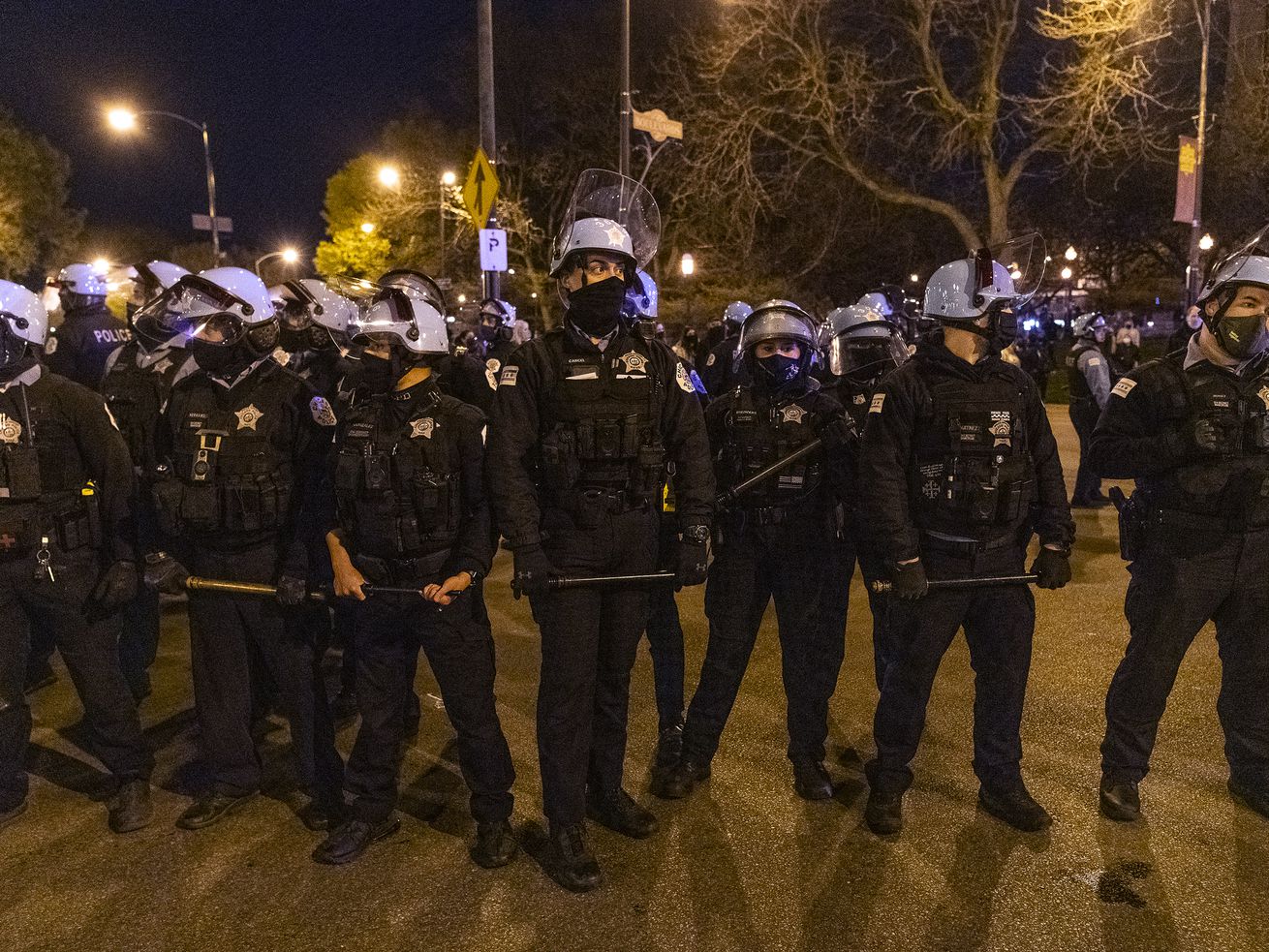
Chicago police form a line with batons out after an earlier clash with protesters near Logan Square Park in Chicago on April 16. | Tyler LaRiviere/Sun-Times
Instead of allowing the seven-member commission to choose Chicago’s police superintendent, Lightfoot would retain that coveted power for herself and future mayors.
Mayor Lori Lightfoot finally delivered her own plan for civilian police oversight on Monday, but it does not include the sweeping policymaking, budgeting and hiring and firing powers she promised during the mayoral campaign.
Instead of allowing the seven-member commission to choose Chicago’s police superintendent, Lightfoot would retain that coveted power for herself and future mayors.
The civilian panel would have the power to “assess performance of and set goals for” the police superintendent, chief administrator of the Civilian Office of Police Accountability and the Police Board president, under the mayor’s proposal.
If the police superintendent’s job becomes vacant, the civilian oversight panel would essentially do what the Police Board does now: Conduct a nationwide search and recommend candidates from which the mayor would choose.
That same process would be followed in filling vacancies in the jobs of as chief administrator of COPA and police board members.
The panel would also be empowered to “introduce and adopt a resolution of no-confidence on the fitness of the superintendent, chief administrator and police board president.
Also, the panel would not have the final word on disputes over police policy.
Rather, the civilian representatives would “review and approve by majority vote any proposed new or amended policy” and “review and provide input” on the “police accountability system, police services and department policies and practices of significance to the public.”
Prior to a City Council vote on the city budget, the panel would “prepare and submit to the budget director a detailed and factually-supported budget submission, then review and, if warranted, recommend changes” to the Chicago Police Department’s budget.
The panel would also have the right to “direct” COPA’s chief administrator” to “investigate complaints of police misconduct consistent with COPA’s defined jurisdiction.”
It remains to be seen whether the mayor’s long-awaited plan satisfies the Council’s Black, Hispanic and Progressive caucuses.
A plan endorsed by those caucuses would ask Chicago voters in the 2022 primary to approve a binding referendum empowering an 11-member civilian police oversight commission to hire and fire the police superintendent, negotiate police contracts and set CPD’s budget.
Lightfoot would lose the power to hire and fire the police superintendent. Her Law Department and hand-picked negotiators would no longer negotiate police contracts.
And Lightfoot and aldermen would lose their power to establish the CPD budget, ceding that power as well to the civilian commission, which would have nine elected members and two appointed by the mayor.
Even if voters reject the referendum, the commission would have the final say in disputes over police policy unless two-thirds of the Council decides otherwise. The commission also would be empowered to take a vote of no-confidence in the superintendent and hire and fire the chief administrator of the Civilian Office of Police Accountability.
Lightfoot said again Monday she “wears the jacket” for Chicago violence and she’s not about to “outsource” control of CPD to a civilian police oversight commission.
“Public safety is one of the most critical responsibilities of any mayor — me and anybody who will come” after her, Lightfoot said.
“The relationship between the mayor and the police superintendent is critically important. So we have a process by which the candidates will be vetted through the commission. The commission will make recommendations. But yes, because the buck stops with me, I will ultimately, as mayor … be making that decision.”
Lightfoot said her ordinance includes a “process for creating a temporary commission, then getting to an elected commission.” And it “allows for and does not disenfranchise” undocumented Chicagoans to serve.
“Public safety is something that every resident of the city has a stake in. And we want to make sure that the undocumented community also has the ability to participate,” she said.
Transitional Mali President Bah N’Daw arrives at the Grand Palais Ephemere for the Financing of African Economies Summit, in Paris, Tuesday May, 18 May 2021. | AP
In a statement issued along with the West African regional bloc known as ECOWAS, the African Union called for the immediate release of President Bah N’Daw and Prime Minister Moctar Ouane.
BAMAKO, Mali — Mutinous soldiers arrested Mali’s transitional president and prime minister Monday hours after a government reshuffle left out two members of the junta that had seized power in a coup nine months earlier, the African Union said.
In a statement issued along with the West African regional bloc known as ECOWAS, the African Union called for the immediate release of President Bah N’Daw and Prime Minister Moctar Ouane, who were taken to the Kati military headquarters.
“They strongly condemn this extremely serious act, which can in no way be tolerated,” the statement said, calling on the soldiers to return to their barracks.
The developments raised new alarm about whether the transitional government would be able to move ahead freely with plans to organize new democratic elections as promised by next February in Mali, where the U.N. is spending $1.2 billion a year on a peacekeeping mission.
The two leaders were sworn in last September after the ruling military junta agreed to hand over power to a civilian transitional government under growing international pressure.
The junta had grabbed power a month earlier after mutinous soldiers encircled the home of President Ibrahim Boubacar Keita and fired shots into the air. He later resigned on national television under duress, saying he did not want blood to be shed in order for him to stay in office.
The soldiers then went on state television hours later calling themselves the National Committee for the Salvation of the People and promising a swift return to civilian rule. However, Monday’s developments appeared to throw that promise into question.
The arrests came just an hour or so after a new government Cabinet was announced. Notably it did not include Interior Security Minister Modibo Kone or Defense Minister Sadio Camara, both junta supporters. No reason was given for their exclusion, but the move suggested mounting divisions within the transitional government.
There has been widespread concern the upheaval in Mali over the past year has further set back efforts to contain the militants linked to al-Qaida and the Islamic State groups.
Islamic extremists took control of major towns in northern Mali after the 2012 coup. Only a 2013 military intervention led by the former colonial power France pushed extremists out of those towns. France and a U.N. force have continued to battle the extremist rebels, who operate in rural areas and regularly attack roads and cities.
___
Associated Press writer Krista Larson in Dakar, Senegal contributed to this report.
Dajon Gater was a precocious student of the after-school program Guitars over Guns. Dajon, 15, was killed in a shooting last Friday in Lawndale. | Provided by Andre Daniels
“He was very lyrical. He was good with words. He’d say profound things.”
Even in grade school, Dajon Gater had clear musical talent.
The normally quiet 15-year-old would transform himself while performing in the after-school program Guitars over Guns.
“He was a really chill, laid-back guy. And he would get on stage and turn into the coolest, smoothest dude,” said his mentor Andre Daniels.
“His voice was always really laid back, but then he’d turn on the swag,” said Daniels, who performs as Add-2 and helped run the organization’s rap program in Bronzeville in 2017 and 2018.
Dajon was shot and killed last Friday on the porch of his Lawndale home. Police said two gunmen approached and opened fire shortly before midnight in the 3900 block of West Lexington Street.
Dajon was shot in his head and taken to Mount Sinai Hospital, where he died three hours later. He was among 54 people shot over the weekend in Chicago, the deadliest of the year with at least 12 dead.
Police said Dajon’s shooting may have been retaliation for an “earlier altercation,” but did not elaborate. Two shell casings were recovered at the home. No one was arrested.
Dajon’s older cousin said he was a “good kid” who sometimes would be goofy and crack jokes. Dajon moved to Lawndale a year or two ago with his mother and two sisters, according to the cousin, who asked not to be named.
Dajon’s music teacher recommended him to the after-school program when he was in the sixth grade because he was reserved and was unlikely to join on his own, according to Andrew DeMuro, regional director of Guitars over Guns.
“He was a quiet, young man, but was uniquely sweet and gentle, and wise beyond his years,” DeMuro said.
Another after-school mentor, rapper Marisol Velez, remembers him as “kind of cocky, but also kind.”
“Dajon was tinier than most of his peers, but was bigger than them in a sense,” said Velez, who raps as Pinqy Ring.
Dajon and his peers began every session with an “emotional check-in,” with each member listing one word to describe their day. Dajon’s was always positive.
“I don’t recall him in that circle saying he felt a negative way. He was literally a ball of energy,” she said.
Velez said she was devastated by Dajon’s death and has been rewatching videos from the after-school program. “The music and the videos sort of immortalize him,” she said.
The after-school program taught Dajon how to compose songs and raps, as well as the basics of sound engineering, Daniels said. Dajon learned to set up microphones and record tracks to a computer. His class wrote a five-track EP in the program at Beethoven Elementary in Bronzeville.
“He always had catchy hooks,” Daniels said of Dajon, who was precocious with a surprising breadth of musical knowledge.
“He was so structured with his raps and always further ahead that there was only so much we could teach him,” Daniels said. “He had his own swag, very chill and laid back, but he was also very lyrical. He was good with words. He’d say profound things.”
Dajon had a unique writing style.
“You can’t really forget certain people,” Daniels said. “Like when it was time to write raps, he would go over to a corner and hide behind a bookshelf and write his raps at a little desk. And I remember saying, you can’t have this little cubby by yourself. You’ve got to share that stuff. He was like, nah nah nah, that’s my spot.”
Daniels, who runs his own safe space, Haven Studios, said the after-school program gave Dajon and others a creative outlet.
“That’s why it was so successful. The kids really enjoyed having a space that they could call their own — that they could have community with each other and talk about certain things… life in general,” Daniels said. “That’s what kept them coming back — that community.”
After Dajon died, DeMuro pulled up his 2017 exit questionnaire, which asked the students for the one thing they’d remember from the program.
“When asked what he’d always remember, he said: ‘When (my mentors) taught us how to believe in ourselves whenever we were in doubt. That was really uplifting and inspiring. It taught me how to be confident in myself at anytime.’”
This June 1921 photo shows the aftermath of the the Tulsa Race Massacre in Tulsa, Oklahoma. – | Photo from Library of Congress/Getty
One hundred years later, no one has been held responsible for the Tulsa massacre that left hundreds of Black people dead and their prosperous community in ruins.
Memorial Day marks one year since the murder of George Floyd by the hands of the Minneapolis police. This week also marks the 100-year anniversary of the Tulsa Race Massacre, a brutal government-aided leveling of a prosperous African American community for which there still has been no accounting and no justice. Few even know about the massacre. It hasn’t even been taught in the Tulsa public schools until this year. Although 100 years old, the massacre poses questions of justice and of decency that America cannot avoid.
After World War I, a neighborhood in Tulsa, Oklahoma, named Greenwood grew to be among the wealthiest Black communities in the country. Booker T. Washington called it the “Black Wall Street.” Here were successful entrepreneurs, doctors, and lawyers who through hard work and good minds were building a prosperous Black community. The district was lined with Black-owned shops. restaurants, a 54-room grand hotel and the Dreamland Theater. It supported two newspapers and a hospital.
Then on the day after Memorial Day, a white mob gathered to lynch a young Black 19-year-old who had startled a 17-year-old white girl, an elevator operator, in an elevator. Rumors inflated the incident into an alleged rape. Black veterans of World War I rushed to the jail to try to protect the young man from the mob. A shot was fired, and the enraged white mob chased blacks back into Greenwood.
Then the massacre began. The police and National Guard joined the mob rather than enforce the peace. Planes circled overhead to drop turpentine bombs on homes and businesses. As Rev. Robert Turner, pastor of the historic Vernon African Methodist Episcopal Church that was torched in the massacre, notes, “The first time in American history that airplanes were used to terrorize America was not in 9/11, was not at Pearl Harbor, it was right here in the Greenwood District.”
The 2001 report of the Oklahoma Commission to Study the Race Riot of 1921, created by the state legislature, found that the city of Tulsa conspired to destroy Greenwood. According to the commission’s report, the massacre destroyed some 40 square blocks. Nearly 10,000 people were left homeless as 1,256 homes were looted and burned down. So too was the thriving commercial district, including the Black hospital.
White hospitals turned away Greenwood’s wounded. Many bled to death, including Greenwood’s most prominent surgeon. The number of dead is estimated to be as many as 300, but went uncounted. Many were simply dumped in unmarked graves. Ten thousand African Americans were left homeless; some 6,000 were herded into internment camps for weeks. Government officials committed no public money to help Greenwood rebuild. Instead, they opposed any revival, even rejecting offers of assistance from outside of Tulsa.
No one was held responsible for the deaths and injuries, or the millions in property losses. Not one insurance company honored a claim by an African American. City and state officials covered up the crime for decades.
As Dreisen Heath, author of a Human Rights Watch report on the massacre summarized, “The Greenwood neighborhood in Tulsa was destroyed, but survivors of the massacre and their descendants are still suffering the consequences. Decades of Black prosperity and millions of dollars in hard-earned wealth were wiped out in hours, but nobody was ever held accountable, and no compensation was ever paid.”
Legacy of discrimination
That history lives today. Tulsa is still one of the most segregated cities in the country. The current mayor acknowledges “the history of racial disparity that exists in our city. A kid that’s growing up in the predominantly African American part of our city is expected to live 11 years less than a kid that’s growing up in a whiter part of the city.” Tulsa still suffers from discrimination, institutionalized in the police, zoning laws, housing policies and more.
One hundred years later, the African American community still seeks justice. Rev. Turner marches each week to the city council to demand repair, reparations for the damage done. The state-created commission called for reparations such as direct payments to “riot survivors and descendants,” a scholarship fund and a memorial. The Human Rights Watch report on the massacre calls on the Tulsa and Oklahoma governments to provide reparations, including “direct payments to the few massacre victims still living and the descendants,” efforts to recover remains from mass graves, and a “comprehensive reparations plan,” including targeted investments in health, education and economic opportunities.” A House subcommittee has opened an inquiry into what can be done.
The issue of reparations always meets with resistance. Why should this generation pay for the crimes of those who lived 100 years ago? Yet once the massacre is admitted, the violation done to people can’t be simply ignored. And the damage incurred — erasing a prosperous Black community and enforcing racially discriminatory policies through the decades — is real.
The mark of history scars Tulsa today. There, and elsewhere in America, there needs to be a process that can officially recognize the injustice, act to repair the damages done, and bring us together, so that our society can continue to make its difficult way to an inclusive, and better America.