A woman was killed in a house fire early Friday in Englewood on the South Side.
Firefighters found the woman inside the home about 5:20 a.m. in the 6900 block of South Stewart Avenue, Chicago police and Chicago Fire officials said.
She was pulled out of the home and was pronounced dead, police said. She hasn’t been identified.
Four other adults and two children, 2 and 11, were displaced by the fire, police said.
All smoke detectors were present and working at the time of the blaze, according to fire officials.
The cause of the fire is unknown, fire officials said.
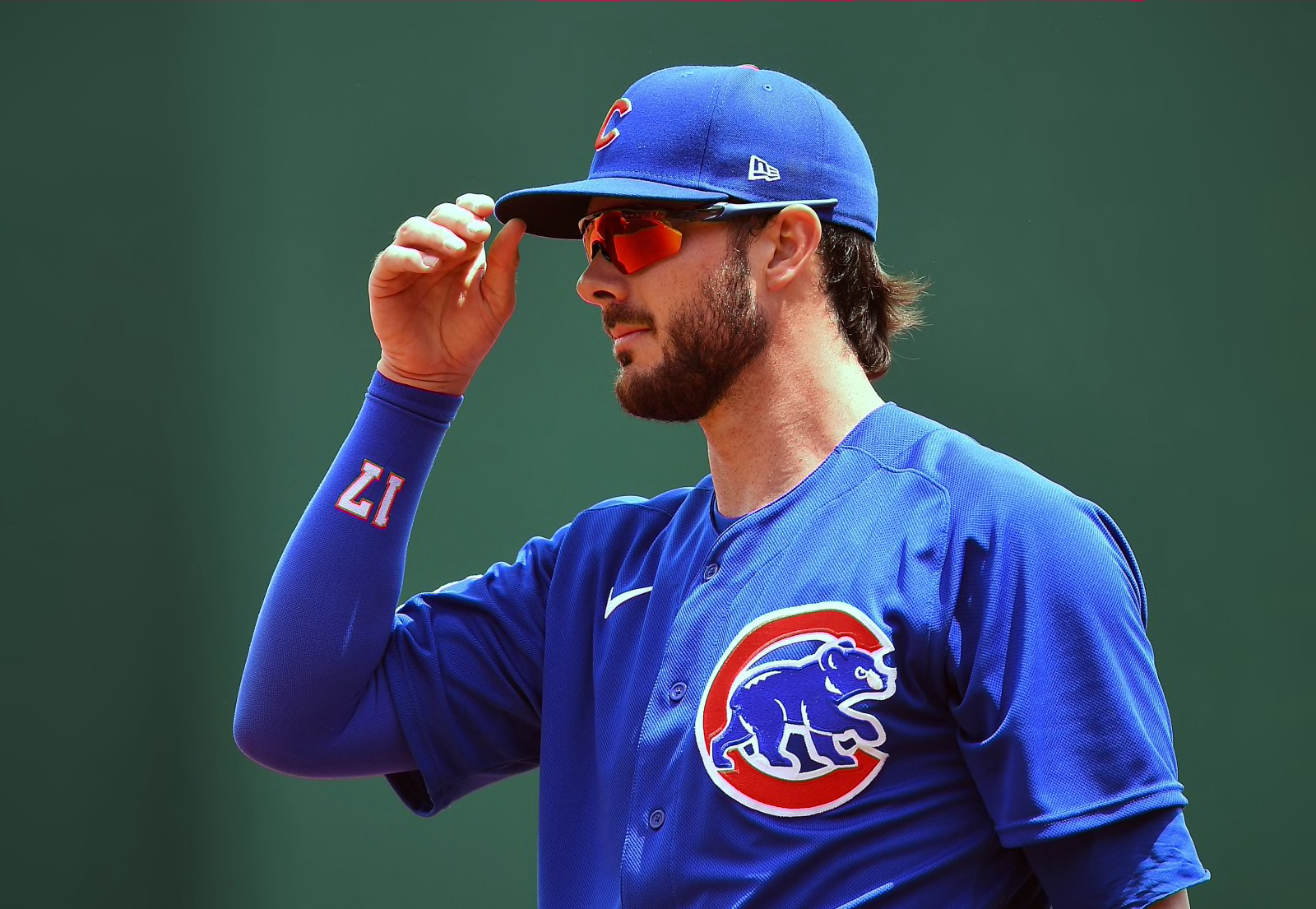
The Chicago Cubs are one of the biggest surprises of the 2021 MLB season so far. At 32-24, they are first in the NL Central, two games ahead of both the St. Louis Cardinals and the Milwaukee Brewers. It’s completely changed the outlook for the team’s future.
The Chicago Cubs cannot rebuild right now based on the way 2021 is going.
Coming into the 2021 season, many fans and analysts alike sensed that the Cubs were planning a teardown of the current roster and a rebuild. The team traded ace pitcher Yu Darvish to the San Diego Padres for an underwhelming group of prospects.
There were multiple players from the 2016 World Series run that were let go on expiring contracts. It was clear that ownership was willing to shred payroll to make the team more profitable. Some long-held fears of Cubs fans were coming true.
The team didn’t make a big splash in free agency. They picked up some journeymen to fill out the roster like outfielder Joc Pederson, infielder Eric Sogard, and pitcher Zach Davies (who was part of the Darvish trade). It was an underwhelming winter for the team.
However, the Cubs are on a hot streak right now and defied have defied expectations. A team that’s struggled with hitting for the past three seasons has suddenly found their stroke again. The team’s core of stars are all playing well.
If the plan for this offseason was for the Ricketts family to gut the team’s core and use their underwhelming performance as an excuse, it won’t work so well anymore. Here are three reasons the Cubs simply can’t be sellers at the trade deadline in 2021:
A quick note before I begin with the recap of last night’s action: I am going to be travelling all weekend so there may be no recaps the next few days. I will at least try to get out a cursory recap with some scores and stats, but no guarantees.
Burl Carraway extended his career-opening no-hit streak to 8.2 innings. The left handed reliever has walked 12 batters over that span, but has also struck out 15. He’s attempted to expand his repertoire beyond his plus fastball and curve to include a slider, which has caused some issues at times. I didn’t catch last night’s game, so I can’t tell you if that contributed to his two walks.
Low-A
Myrtle Beach SUSP (0-0 in T6th)
Game Recap
Stop me if you’ve heard this one: D.J. Herz was dominate last night.
Four innings, no hits, one walk, nine Ks. They’ve ramped his pitch limit up to 65, so we’ll start seeing him go 75+ soon, and with it he will be able to go 5-6 innings and begin qualifying for some wins.
The game was suspended in the top of the 6th, with a score of 0-0. Each team recorded just one hit.
Injuries, Updates, and Trends
Infielders Luis Verdugo (.113/.130/.189 in 54 PA) and Ryan Reynolds (.211/.250/.337) were activated from the IL and got the start last night. Verdugo’s numbers are poor right now, but I’ve seen some impressive swings and at bats from him. He’s been a slow starter at every level, and while the lack of plate discipline (0 BB/22 K) should be noted, I think by the end of the year his May struggles will be forgotten. The 20-year old is a potential plus defender at 3B (and can pick it at SS too), and there is pop in his bat to go with it. He’s shown a willingness to use the whole field thus far as well.
The two fired at each other and the teen was hit in the abdomen, police said. He was transported to the University of Chicago Medical Center, where he was pronounced dead, police said. His name hasn’t been released.
Other shootings:
— A 15-year-old girl was critically wounded in a shooting on Lake Shore Drive Thursday night.
She was in a car with relatives when they stopped at a light about 11:45 p.m. in the 500 block of Lake Shore Drive, police said. When the light turned green, someone in a red Ford Expedition began firing at their car.
One of her relatives told officers they had not interacted with anyone in the Ford, according to police.
The girl was hit in the stomach and a relative took her to MacNeal Hospital in Berwyn, police said. She was transfered in critical condition to Loyola University Medical Center in Maywood.
— A 17-year-old boy was wounded in a shooting in Archer Heights on the Southwest Side.
The boy was driving in the 5000 block of South Pulaski Road about 8:25 p.m. when he was grazed in the head. He was transported to Mount Sinai Hospital, where his condition was stabilized, police said. He was unable to provide any further details, according to police.
— Minutes earlier, a 36-year-old man was shot in Washington Park on the South Side.
Just after 8 p.m., the man was parked on the street in the 5600 block of South Wabash Avenue when someone shot him in the left hip, police said. He was taken to the University of Chicago Medical Center in fair condition, according to police.
— Thursday morning, a 14-year-old boy was shot in the foot in Lawndale on the West Side.
Two gunmen in their 20s exited a gray car and one of them opened fire about 7:50 a.m. in the 3900 block of West Fillmore Street, near Pulaski Road, according to Chicago police. The boy was taken to Mount Sinai Hospital in good condition, police said. The gunmen left in the car and were not in custody.
— In the day’s first reported shooting, a man was shot during a robbery on the Near North Side.
The man was walking in the 500 block of North Wabash Avenue when he was approached by a robber about 2:10 a.m., Chicago police said. The man complied and the robber run off.
The man chased him and the robber fired several shots before getting into a silver sedan, police said. The man was struck once in the hip and was brought to Northwestern Memorial Hospital, where his condition was stabilized.
13 people were shot, 2 fatally, Wednesday in Chicago. One of them was a 14-year-old girl attacked in Back of the Yards.
A 15-year-old girl was shot and critically wounded when someone fired at her family’s car on Lake Shore Drive downtown Thursday night.
The shooting happened around 11:45 p.m. after the car stopped at a red light in the 500 block of Lake Shore Drive, Chicago police said. When the light turned green, someone in a red Ford Expedition began firing at their car.
The girl was hit in the stomach and a relative took her to MacNeal Hospital in Berwyn, police said. She was transfered in critical condition to Loyola University Medical Center in Maywood.
One of her relatives told officers they had not interacted with anyone in the Ford before the shooting, according to police.
EDMONTON, AB – DECEMBER 26: Goaltender Jesper Wallstedt #1 of Sweden skates against the Czech Republic during the 2021 IIHF World Junior Championship at Rogers Place on December 26, 2020 in Edmonton, Canada. (Photo by Codie McLachlan/Getty Images)
The Chicago Blackhawks were handed the 11th overall pick in the 2021 NHL Draft as a result of staying put in the Draft Lottery. There are a lot of interesting players to consider with the pick. There are a lot of forwards and a few defensemen that will be available with that pick. They might even trade up or down to get someone depending on how things go for their big board which would certainly make things interesting. They could also consider the big-time goalie that is available.
The ChicagoBlackhawks could also consider going in a different direction in the draft.
It was a norm for a while to not consider goalies in the first round unless they are magnificent. Well, there is some good to that logic because you always want the players who are most likely to help your franchise move forward. You also can’t win in the NHL without good goaltending so it is nice to see teams get their guy in the draft.
You have seen teams like the Tampa Bay Lightning and Florida Panthers make big goalie decisions in the first round and it has paid off for them. The Hawks might be a team to consider doing that if Jesper Wallstedt is available to them at pick 11. This is a kid who might get drafted even higher but you never know based on his position.
Wallstedt is a stud goalie who comes from Sweden. He currently plays for Lulea HF of the Swedish Hockey League. Of course, he also played with Team Sweden on the national stage multiple times, including the 2020-21 World Junior Classic. He is learning to become a very good goaltender and some NHL team is going to get very lucky with him.
If he fell to the Hawks and they selected him, it may be seen as a surprise at first but it could pay off in the long term. He is going to take a few years to be fully NHL ready but that pretty much fits what should be Chicago’s time frame perfectly.
Of course, the Hawks already have Kevin Lankinen. He was great in 2020-21 but there are still questions as to whether or not he is the guy going forward. He certainly is going to get plenty of opportunities to do so but it would be nice to have another goalie there with him. This isn’t to say that they should take Wallstedt if he is there either, it is just something that the Blackhawks should consider for obvious reasons.
Jesus “Chuy” Negrete performed songs and stories of Chicano pride. | Jesús Macarena / Instituto de Nuestra Cultura
‘He told our stories,’ actor Edward James Olmos says of the Chicago writer of corridos some called the ‘Chicano Woody Guthrie.’
Jesus “Chuy” Negrete composed hundreds of corridos — Mexican folk ballads.
“Some people used to say he was the Mexican Bob Dylan,” said U.S. Rep. Jesus “Chuy” Garcia, D-Ill., for whom he once wrote a corrido urging people to vote for him for mayor of Chicago.
Others “called him the Chicano Woody Guthrie,” said actor Edward James Olmos, a friend who said Mr. Negrete “was like a brother” to him.
“His ability to make you laugh and make you cry was superb,” Olmos said. “He told our stories.”
Mr. Negrete, 72, died May 27 of congestive heart failure at Glenbrook Hospital in Glenview, according to his wife Rita Rousseau.
He would write his ballads for any occasion. He composed one in 1983 for the funeral of slain Chicago activist Rudy Lozano.
“Your death has not been in vain,” he sang. “The ideas you left are in my hands. . . . Your people continue with you.”
Al Seib / Sun-Times fileJesus Negrete and Teresita Delatorre led songs as mourners gathered at Farragut High School in 1983 to honor slain activist Rudy Lozano.
Another, ”La Tragedia de Tucson” told the story of the 2011 mass shooting in Arizona in which six people were killed and more wounded, including former U.S. Rep. Gabby Giffords.
A folklorist and folksinger, the Rogers Park resident was a teacher and administrator at Chicago–area schools. But he traveled widely, using his guitar and harmonica to share stories of Mexican history.
“He was an educator of the highest extreme,” Olmos said. “He would go to prisons. He would go to schools. He would go to universities.”
In 1988, Mr. Negrete sang at the Smithsonian Institution’s National Hispanic Heritage Week celebration.
He’d often perform for prospective students at the University of Houston. After listening to his stories and songs of pride and resilience, many enrolled, said Lorenzo Cano, retired associate director of the school’s Center for Mexican American Studies.
“That kind of sewed it up for a lot of students,” Cano said.
In 1993, the Tucson Citizen described college audiences cheering as Mr. Negrete shouted: “You are Olmeca, Tolteca, Azteca, Chichimeca! You are Mestizo!”
He told students there that, in pre-Columbian days, “We were architects, engineers, mathematicians, botanists, surgeons, philosophers. Yeah, we had a lot going for us, not just frijoles and tortillas.”
Barry Jarvinen / Sun-Times fileJesus “Chuy” Negrete performing.
“He sang these corridos he wrote, walking you through 500 years of history,” said Sarah Zenaida Gould, interim executive director of the Mexican American Civil Rights Institute in San Antonio. “It was a story of colonial power, a story of oppression, but also a story of resistance and resilience. I suspect his performances were part of many Mexican American university students’ political awakening.
“He was actually the very first person to explain my middle name to me,” Gould said of the name that’s been handed down for generations. “In Mexico, ‘Zenaida’ is part of a resistance corrido associated with the Mexican Revolution.”
“Chuy Negrete introduced thousands of people to the history and the experience of Chicanos in the U.S. through his innovative delivery of corrido ballads and bilingual storytelling, which were at once humorous and deeply critical of our society,” said Juan Díes, co-founder of the Sones de Mexico ensemble. “Chuy’s legacy will be reaching scores of young Latinos who felt lost in American society.”
Garcia said he met the folksinger in 1974 while attending what’s now called the University of Illinois at Chicago. Mr. Negrete worked at the Rafael Cintron Ortiz Latino Cultural Center there and “always had his guitar in his office and his ranchero hat,” the congressman said.
People often asked him to compose corridos about their loved ones for funerals. He wrote and performed the elegies for free.
Mr. Negrete’s more lighthearted ballads might name-dropped a local personality or describe “a love story or an elder lecturing you about your bad Spanish,” Garcia said. “He was masterful at the Spanglish idiom, and he would always make people laugh.”
Mr. Negrete was born in San Luis Potosí, Mexico, the only boy of five children of Melesia and Bernardo Negrete. When he was a year old, the Negretes undertook a perilous crossing of the Rio Grande into the United States.
His mother “told us they got in a little boat with us kids, and she was worried the boat would tip over,” he once told the Chicago Tribune.
His parents toiled as migrant workers, his wife said, before his father landed a job at Republic Steel. They settled in South Chicago.
Young Chuy graduated from Chicago Vocational High School and got a bachelor’s degree in education at UIC and a master’s in education from Chicago State University. He was a bilingual teacher for the Chicago Public Schools and a teaching assistant at the University of Illinois at Urbana–Champaign. He worked in Chicano studies at Malcolm X College. He also taught as an adjunct faculty member at what was then Robert Morris College, Roosevelt University, Indiana University Northwest in Gary and the University of California, Berkeley, according to his wife.
His music was influenced by the civil rights movement and by California’s El Teatro Campesino, which started with farm workers performing street skits to dramatize their struggles. Later, Luis Valdez, the theater’s artistic director, created “Zoot Suit,” a stage sensation that incorporated Mexican American history and indigeneous symbolism. Olmos’ career took flight after he starred in the play.
In the 1970s Mr. Negrete helped found Teatro del Barrio, often performing in the street theater troupe with three of his sisters. Its musical presentations included one on the women of the Mexican Revolution and another about Cesar Chavez, the labor leader who fought for better conditions for farm workers.
They performed at culture festivals, including one staged at the Pyramids of the Sun and Moon near Mexico City, according to his sister Rosa Negrete Livieri.
His work on the road led to his friendship with Olmos.
Later, Mr. Negrete performed with Livieri and others in the group Flor y Canto — Flower and Song.
In 1988, he met his future wife at the National Museum of Mexican Art. He was moving from exhibit to exhibit, singing.
“He caught my eye, and I followed him,” she said. “And I caught his eye, and he said, ‘Stick around.’ ”
Both were in their 40s and had never married.
“We were thrilled to find each other,” Rousseau said.
In addition to his wife and his sister Rosa, Mr. Negrete is survived by his sons Joaquin and Lucas Negrete-Rousseau and sisters Martha N. Bustos, Juanita Negrete-Phillips and Santa Negrete-Perez.
A memorial service is being planned for the fall at the National Museum of Mexican Art.
“He could wind you up, are you kidding me?” Olmos said. “Tell you stories about the revolution and the difficulties of what had been done to the people, our ancestors, our culture, his guitar never stopping. He was a real troubadour.”
The Prairie State coal plant would shut down under a proposal being considered in Springfield that environmental groups support. But municipalities, including some in the Chicago area, that have long-term deals to buy electricity from Prairie State could end up being hit with higher prices even as they’re still on the hook to pay off bonds they issued to buy in to the plant. | Provided
If the Prairie State coal plant owned by municipal utilities in Winnetka, Naperville, Batavia and other towns is forced to shut down, it would be the end for a big source of air pollution.
After more than a decade of controversy, a move to force the closing of a Southern Illinois coal plant owned by municipal utilities in Winnetka, Naperville, Batavia and dozens of other towns across the state is one of the final sticking points in Springfield over a major energy bill.
If the Prairie State plant is forced to shut down by 2035, as Illinois legislators have proposed, it would begin the final chapter of a saga that led to the construction of one of the country’s last new coal plants, one that became a major source of air pollution.
“Prairie State, by itself, makes up a significant portion of the power-sector emissions in our state,” says J.C. Kibbey, a clean energy advocate for Natural Resources Defense Council in Illinois.
Beside being dirty, the plant left the operators of some locally owned electric utilities in the Chicago area furious over unfulfilled promises of competitive prices. In exchange for the guarantee of reliable power with predictable pricing, the utilities took ownership in the massive plant, signing up for decades of debt.
If the plant is forced to close, they, as owners, will have to continue repaying the debt even as they have to find and pay for replacement sources of electricity that could lead to much higher electricity bills.
Over the past week, the plant emerged as an obstacle to passage of key energy legislation in Springfield, a bill that would include an expansion of subsidies for nuclear plants, more funding for renewable energy projects and a ramping-up of climate targets that would include a phaseout of coal power.
Going beyond a May 31 deadline to finish their work, lawmakers are trying to find a way to respond to concerns about the financial ramifications of closing Prairie State.
Environmental advocates say the state can’t afford to let the plant continue to operate if Illinois is to meet climate goals. Lawmakers backed by environmental groups are considering a state bailout of more than $600 million of three Exelon nuclear plants.
Prairie State has been the single biggest source of carbon dioxide emissions in Illinois, 12.7 million metric tons of carbon dioxide equivalent in 2019, the most recent year for which federal data are available. The plant ranks ninth in the country for carbon dioxide releases.
No other power plant in the state comes close to Prairie State’s emissions. And most of the other coal-fired plants already are scheduled to close, including all five plants owned by Vistra Corp, which has said it will shut them down by 2027.
“It’s not particularly a surprise that this plant wasn’t going to live out a typical lifespan,” says Emily Grubert, an energy systems researcher at Georgia Tech.
The plant’s combination of high emissions and high costs means it’s difficult to justify keeping it open, Grubert says.
It cost about $5 billion for construction, including about $1 billion in cost overruns.
Prairie State, which began operating in 2012, was one one of the last large, coal-fired power plants built in the United States before market forces shifted against coal because other sources of electricity — like natural gas, wind and solar energy — were becoming less expensive and because of the rising likelihood that the state or federal government would pass stricter emissions limits.
Among this last generation of coal-fired electric plants, Prairie State is in a category of its own because it initially was developed by a coal company, Peabody Energy. The idea was to buy coal from an adjacent mine, with Peabody selling the electricity through long-term contracts with municipalities and rural electric cooperatives that might have been less well equipped to assess the risks than large energy companies would be.
The plant’s customers and co-owners include about 200 communities in a footprint that stretches from Missouri to Virginia. In the Chicago area, they also include Geneva and St. Charles.
Environmental advocates warned early onthat Prairie State was almost certain to be an environmental and financial disaster.
ProvidedPrairie State’s backers told local utilities that an investment in the coal plant would provide a hedge against volatile market prices for electricity.
The Illinois Municipal Utilities Association, a trade group for utilities that signed up with Prairie State, says the state still needs coal “until technology can support fully renewable energy.”
The plant’s customers have paid prices nearly double the equivalent prices they’d have paid in regional markets, according to an analysis last year by the Institute for Energy Economics and Financial Analysis, which does research to advocate for a transition to clean energy. Prairie State customers are paying down billions of dollars in principal and interest on the bonds used to buy their ownership shares.
“The power from the plant is way too expensive and is causing financial hardship for the communities,” says Sandy Buchanan, executive director of the institute.
Buchanan previously was executive director of Ohio Citizen Action, a role in which she warned local government officials in the 2000s of the risks of investing in the plant.
Prairie State Generating Co. executives say they’re committed to providing “reliable and environmentally responsible electric power..”
“Prairie State and its owners have been engaged with lawmakers for years about how to ensure the best path forward,” company spokeswoman Alyssa Harre says in a written statement.
In 2007, Naperville signed a deal with Prairie State for electricity that ends in 2035, which is also the schedule for paying off the bonds. So closing the plant by that date would have less of an impact than it would on, say, Batavia, which took one of the biggest stakes in the coal plant.
Batavia is on the hook until 2042 to keep paying off the debt it incurred through bond sales to buy in to Prairie State. Batavia officials are unhappy with the deal struck years ago. But they say any legislative mandate to close the plant should also include provisions to help the governments that would be affected.
Even if the plant is closed, local utilities are on the hook for millions of dollars a year in bond debt, says Laura Newman, Batavia’s city administrator.
“We tried to get out,” Newman says, referring to past legal attempts to be freed from the agreement. “We left no stone unturned to find out if we can undo this.”
For the city of Rochelle, about 80 miles west of Chicago, a benefit of having a contract with Prairie State has been that it kept electricity rates predictable, according to Jeff Fiegenschuh, the city manager there.
If the state forces the shutdown of Prairie State, Rochelle wants state compensation for its costs because it can’t spread its expenses over a large customer base the way larger utilities can, according to Fiegenschuh.
“We are in favor of more renewables, no question about it,” he says of transitioning to renewable energy sources. “But we participated in this project for electricity reliability and long-term stability.”
Brett Chase’s reporting on the environment and public health is made possible by a grant from The Chicago Community Trust.
The male took out a handgun and threatened the teen who also took out a handgun and began shooting, police said. The male then returned fire striking the teen in the abdomen, police said.
The male fled the scene and the teen was transported to the University of Chicago Medical Center, where he was pronounced dead, police said. His name hasn’t been released.
In other shootings, a 15-year-old girl was critically wounded in a shooting on Lake Shore Drive Thursday night.
The teen girl was traveling in a vehicle with her relatives about 11:45 p.m. in the 500 block of Lake Shore Drive, police said. They were stopped at a red light and as the light turned green someone inside a red Ford Expedition began firing shots at their vehicle.
One of her relatives told officers they did not interact or had any altercations with the people inside the Ford, according to police.
The girl was struck in the stomach and her relative took her to MacNeal Hospital in Berwyn, police said. She was later transfered in critical condition to Loyola University Medical Center in Maywood.
A 17-year-old boy was wounded in a shooting in Archer Heights on the Southwest Side.
The boy was traveling in his vehicle in the 5000 block of South Pulaski Road about 8:25 p.m. when he heard several shots and felt pain, police said.
He suffered a graze wound to the head and was transported to Mount Sinai Hospital where his condition was stabilized, police said. He was unable to provide any further details on the incident, according to police.
Minutes earlier, 36-year-old man was shot in Washington Park on the South Side.
Just after 8 p.m., the man was inside a vehicle parked on the street in the 5600 block of South Wabash Avenue when someone shot him in the left hip, police said.
He was taken to the University of Chicago Medical Center in fair condition, according to police.
Thursday morning, a 14-year-old boy was shot in the foot in Lawndale on the West Side.
Two gunmen in their 20s exited a gray car and one of them opened fire about 7:50 a.m. in the 3900 block of West Fillmore Street, near Pulaski Road, according to Chicago police.
The boy was taken to Mount Sinai Hospital in good condition, police said. The gunmen left in the car and were not in custody.
In the day’s first reported shooting, man was shot during a robbery on the Near North Side.
About 2:10 a.m., the man, who is between 20 and 30-years-old, was walking in the 500 block of North Wabash Avenue, when he was approached by a male who demanded his personal belongings, Chicago police said. The man complied, and the robber attempted to run away.
The man gave chase and the robber fired several shots before getting into a silver sedan, police said. The man was struck once in the hip and brought to Northwestern Memorial Hospital where his condition was stabilized.
A man, 18, was shot to death June 3, 2021 in Park Manor. | Archivos Sun-Times
The teen got into an argument with a male Thursday in the 6700 block of South Cottage Grove Avenue.
A 18-year-old man was killed in a shooting with a male who returned fire Thursday night in Park Manor.
About 8:50 p.m., the teen got into an argument with a male in the 6700 block of South Cottage Grove Avenue, Chicago police said.
The male took out a handgun and threatened the teen who also took out a handgun and began shooting, police said. The male then returned fire striking the teen in the abdomen, police said.
The male fled the scene and the teen was transported to the University of Chicago Medical Center, where he was pronounced dead, police said.
His name hasn’t been released.
No one is in custody as Area One detectives investigate.




/cdn.vox-cdn.com/uploads/chorus_asset/file/22555316/merlin_36822153.jpg)
/cdn.vox-cdn.com/uploads/chorus_asset/file/22555421/merlin_38048311.jpg)

/cdn.vox-cdn.com/uploads/chorus_asset/file/22529513/Screen_Shot_2021_05_20_at_6.42.51_PM.png)
/cdn.vox-cdn.com/uploads/chorus_asset/file/22635922/IMG_1465.jpg)


Leave a comment