Rescue workers in Linville Gorge in North Carolina on Thursday are shown responding to a report of a hiker falling. They eventually discovered that Michael Ryva of Forest Park did not survive the fall. | Burke County (N.C.) Search and Rescue
Michael Ryva, 30, had fallen approximately 80 feet from a ledge, officials said.
MARION, N.C. (AP) — A hiker from Illinois is dead after a fall at Linville Gorge in the western North Carolina mountains, according to local officials.
News outlets report that Burke County Emergency Management officials received a call midday Thursday for an injured hiker off Rock Jock Trail in the gorge.
More than three hours later, rescuers found Michael Ryva dead. The 30-year-old from Forest Park, Illinois, had fallen approximately 80 feet from a ledge, officials said.
Crews were still working to extricate him at 9 p.m. Thursday, Michael Willis of the county fire marshal and emergency management offices said.
It’s the second fatal fall of the season in the wilderness area about 65 miles northeast of Asheville. A hiker died after a long fall in the area of Babel Tower on April 17.
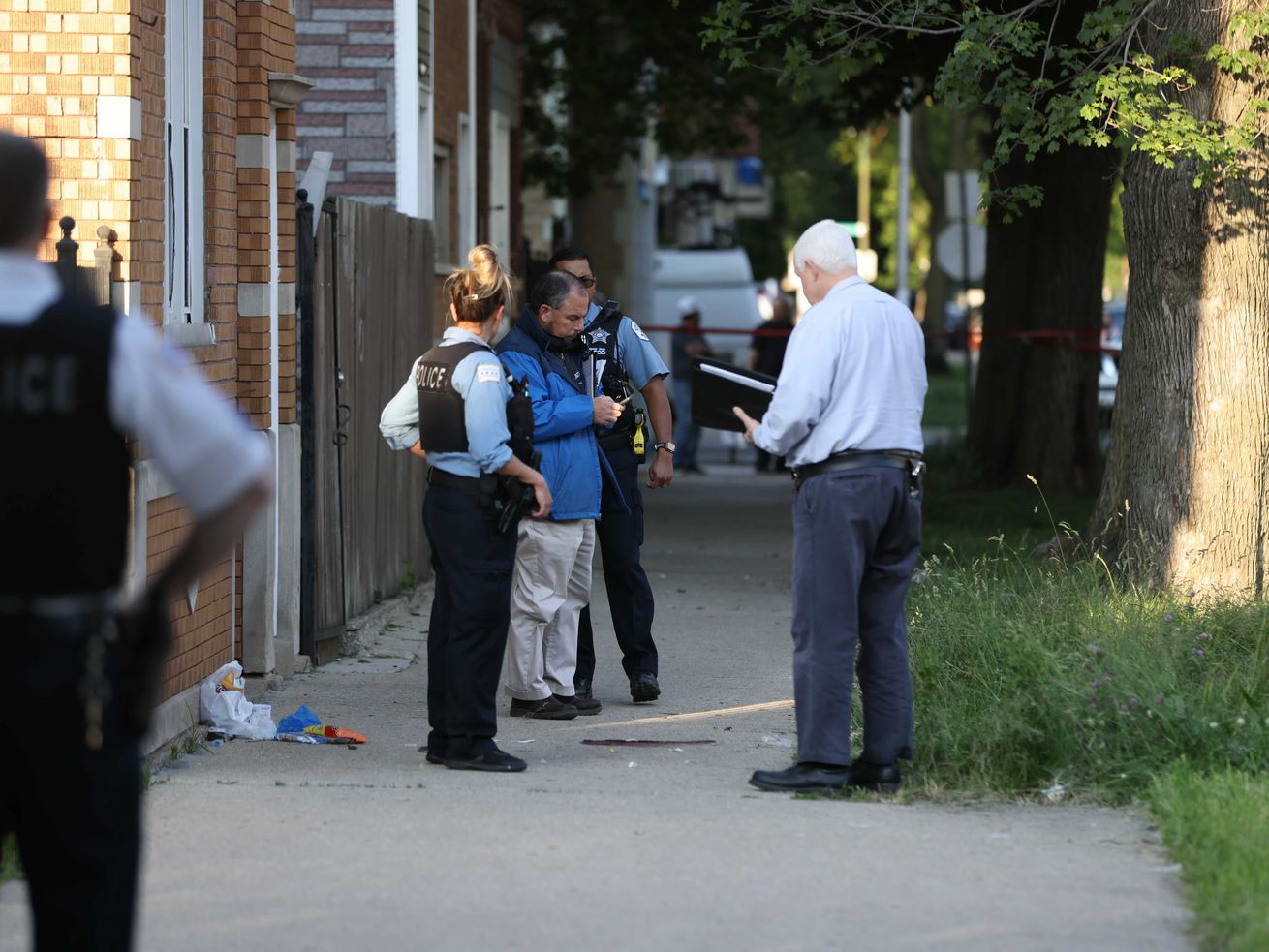
Chicago police work the scene where a 27-year-old man was shot and killed in the 5600 block of S Marshfield Ave, in the West Englewood neighborhood, Friday, June 4, 2021. | Tyler LaRiviere/Sun-Times
The 27-year-old was on the sidewalk about 9:20 p.m. in the 5600 block of South Marshfield Avenue when someone fired shots at him from a white sedan, Chicago police said.
A man was fatally shot Friday in West Englewood on the South Side, police said.
The 27-year-old was on the sidewalk about 9:20 p.m. in the 5600 block of South Marshfield Avenue when someone fired shots at him from a white sedan, Chicago police said.
The man was struck in the head and taken to the University of Chicago Medical Center, where he was pronounced dead. His identity has not been released.
Area One detectives are investigating.
A woman who lives on the block said she was working on fixing a light in her home when she heard “at least 20” loud pops. She thought they were fireworks.
Tyler LaRiviere/Sun-TimesChicago police work the scene where a 27-year-old man was shot and killed in the 5600 block of S Marshfield Ave, in the West Englewood neighborhood, Friday, June 4, 2021.
“When I found out that it was actually gunshots, I got goosebumps,” she said.
The woman, who declined to give her name, said she usually goes on a walk around the block at this time, because its generally quiet.
“But, I’m starting to get scared,” she said.
The block has seen at least one other fatal shooting incident recently.
In February 2020, 15-year-old Marlin Gaines was killed in the 5600 block of South Marshfield Avenue when three males jumped out of a white SUV and shot him, authorities said.
After strong May, center fielder Ian Happ feels good things are around the corner.
SAN FRANCISCO – There isn’t one path for development in the big leagues and while there are players around the game who have thrived since they were first called up to the big leagues, that is rarely the case for most players. It’s a grind to get to the big leagues, but staying there and thriving is another story.
Center fielder Ian Happ has seen all sides of the development during the early portion of his Major League career. After breaking onto the scene in 2017 with 24 homers as a rookie, things took a turn.
After not making the roster out of camp in 2019, the Cubs’ center fielder’s strong end of 2019 carried over into last season when he was the team’s best offensive player.
Happ has had a slow start to the 2021 season, but after returning from the injured list on May 15, he finished the month slashing .292/.387/.585 with four doubles, five homers and a 164 wRC+.
“It’s part of the game,” Happ told the Sun-Times. “That’s why we love playing and competing. Being a lefty at Wrigley in April is tough, but hit .290ish last month with a .900 OPS, I had a great May.
“You can only claw back so much after what happened in April and so you have to be able to put that behind you and continue moving on. I know that there’s four months left in the season and you continue to do things the right way, like in May, at the end of the year the results will be there.”
Happ knows firsthand that the adjustment the league makes to young players comes quickly and continues as players evolve. Whether it’s mechanics, timing, different pitches or even pitch shapes, the constant back-and-forth between a team’s scouting report and how to battle against that doesn’t stop.
“There’s always things that you work on throughout the season for mechanics and timing,” Happ said. “Timing is everything in this game, so we’re always trying to maintain that. And I’m making sure my timing is where I want it.
“I think it’s more as preparation and getting in the box and just really focusing on what’s happening on the field, the opposing pitcher, that’s always the focus. That’s always trying to work on mechanics early and eliminate as much of that going.
Happ’s quest for growth as a player after experiencing the highs and lows of the game isn’t an uncommon story. In fact, several Cubs players who have been called up recently have also encountered.
While players like third baseman Patrick Wisdom and outfielder Rafael Ortega aren’t young players, after different stops on their baseball journey, trying to be a new version of themselves with the Cubs is still the goal.
“I learned so much about myself one early on and just fine trying to find a routine,” manager David Ross said. “I think that that’s always changing and evolving. You’re always learning more. … I don’t think that ever changes. Guys are constantly learning. The game is changing, the game’s evolving, you have to do that as well.
“I think you get to a point where you’re established and you understand your routine and your role. And I think that’s where a lot of guys that have come up, those guys that have been up in the big leagues understand. They just need to come up, compete and play their game and they’re very comfortable in that.”
A man was killed in a shooting June 4, 2021, in the 5200 block of West Le Moyne Street. | Sun-Times file photo
He was in a backyard about 7:25 p.m. in the 5200 block of West Le Moyne Street when someone approached and opened fire, striking him in the head, Chicago police said.
A man was killed in a shooting Friday in Austin on the West Side, police said.
He was in a backyard about 7:25 p.m. in the 5200 block of West Le Moyne Street when someone approached and opened fire, striking him in the head, Chicago police said.
The 23-year-old was taken to a hospital, where he was pronounced dead, police said. His identity has not been released.
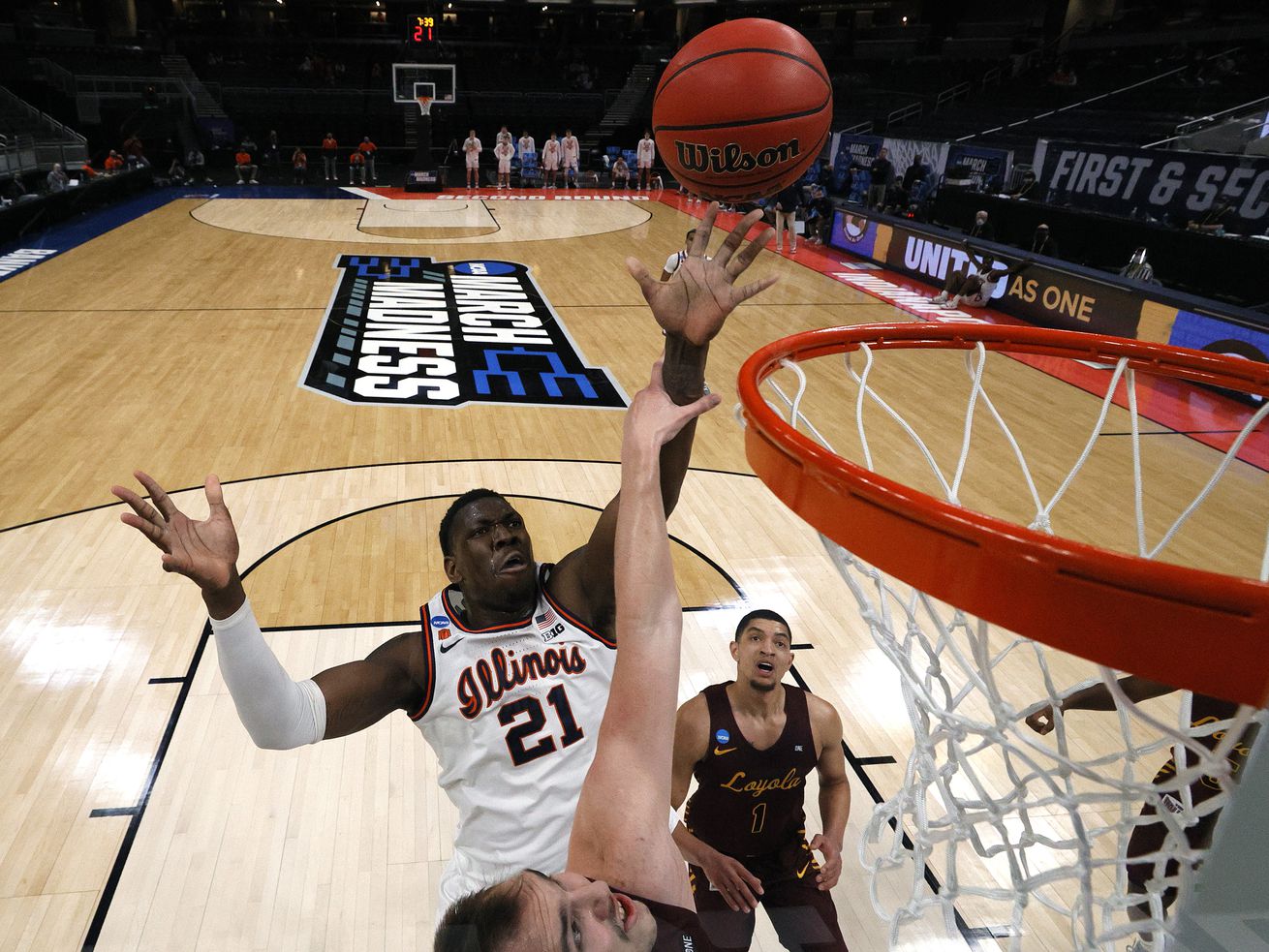
Kofi Cockburn (21) of the Fighting Illini shoots the ball against Loyola Chicago Ramblers in the second round game of the 2021 NCAA Men’s Basketball Tournament earlier this year in Indianapolis. Bettors weren’t allowed to wager on the game in Illinois, but a new bill could change that rule. | Getty
Bettors haven’t been able to get in on any action involving Illinois college teams since wagering became legal last year, but they might be able to soon — despite the objections of athletic leaders.
Illinois sports bettors were boxed out from betting on the Illini and Ramblers in March Madness, but there’s a good chance they’ll be able to get some legal action on the Wildcats, Huskies and other in-state teams when the college football season kicks off this summer.
State lawmakers advanced a bill earlier this week that would do away with parts of a controversial provision of Illinois’ sports wagering law that prohibits sportsbooks from laying odds on games involving Illinois college teams.
Critics say the in-state ban is preventing a fast-growing industry from reaching its full potential, especially while such bets are there for the taking just across the border in Indiana, not to mention on illegal offshore betting websites.
But leaders of some college programs say it’s the only thing protecting student-athletes from further barrages of online harassment and undue pressure — potentially coming from the student wagering in the dorm room across the hall.
That’s why lawmakers settled on a “middle ground” with the new gaming bill that would require in-state college bets to be placed in person at a casino, racetrack or off-track betting parlor, according to state Rep. Mike Zalewski, the Riverside Democrat who has played point on sports wagering legislation.
The provision limits wagers to the outcomes of games, not individual performances, and it would sunset after two years.
“I think it’s a great compromise,” the Riverside Democrat said in a phone interview the day after the bill passed the Illinois House 96-11 during a marathon session early Tuesday. ”If student-athletes are being harassed, we’ll revisit it. If we’re not making enough revenue, we can revisit it.”
AP PhotosState Rep. Michael Zalewski, D-Riverside, speaks on the Illinois House floor May 28.
The state Senate would still have to approve the measure before it’s sent to Gov. J.B. Pritzker’s desk.
University of Illinois athletic director Josh Whitman urged lawmakers to keep the ban in place during an April 28 hearing, saying its removal threatens the “physical and mental health and wellbeing of our student-athletes,” especially given the social media vitriol many athletes already face on a daily basis.
“The commentary is vile, it’s abusive, it’s threatening and in some cases it directly references gambling losses,” Whitman said. “By allowing people in our state to bet on our own student-athletes, we’re only opening the door and inviting people to have those intense, threatening, abusive interactions.”
Whitman, who played tight end at Illinois in the late 1990s, said the fact that residents have to travel to Indiana or Iowa to wager on in-state teams is still “a pretty strong disincentive for people to bet on our team.”
AP PhotosUniversity of Illinois athletic director Josh Whitman, pictured at Memorial Stadium in Champaign in 2017.
Zalewski said the rule “simply makes no sense when Indiana and Iowa have fully operational sports betting,” but added that he followed Whitman’s logic in requiring bettors to travel to a brick-and-mortar sportsbook if they want a piece of the Illinois college action.
“It takes an extra effort. I think we’ve met him half way,” said Zalewski, who initially pushed to lift the ban completely.
Through a spokesman, Whitman declined to comment on the watered-down bill that passed the Illinois House.
Either way, it’ll hardly be a boon to a gambling market that has already drawn almost $1 billion in bets on college teams from outside the state since sports wagering went live in Illinois just before the pandemic hit. About 97% of those dollars were wagered on cellphones and other mobile devices.
Because the vast majority of bets are placed online, critics say the state is leaving millions of dollars in potential tax revenue on the table by prohibiting mobile wagers on Illinois college teams — but “any loosening of the ban on in-state collegiate betting will ultimately be beneficial for the industry,” according to Joe Boozell, an analyst for the betting website PlayIllinois.com.
“Any change that only affects retail betting will by nature be limited in its impact. Ideally, though, this move will represent an incremental step toward lifting the ban entirely, including online,” Boozell said.
The in-state college betting provision is part of a gaming bill that would also allow for a sportsbook at Wintrust Arena in the South Loop. Other larger sports venues such as Wrigley Field and the United Center are eligible to open books, but have not yet applied to do so with state gambling regulators.
The state Senate could take up the bill later this month, when legislators are expected back in Springfield.
A 14-year-old girl was shot June 2, 2021, in Back of the Yards. Sources say the shooting was linked to an ongoing conflict between two gangs. | Anthony Vázquez / Sun-Times
‘Seeing them graduate to shootings is unfortunate,’ Ald. Raymond Lopez (15th) said of the younger rival.
The shooting of a 14-year-old girl in the Back of the Yards is believed to be linked to an ongoing conflict between a long-entrenched gang and one that is relatively new to the area, according to Chicago police sources.
The girl, who remains in critical condition, was with her boyfriend in the 1700 block of West 48th Street when members of the Party People walked up Wednesday evening and asked what gang she belonged to, according to Ald. Raymond Lopez (15th), who said he got those details from police.
The seventh-grader said she was not in a gang but a relative belonged to the rival Almighty Saints, Lopez said. One of the gang members fired twice, hitting her in the head.
“It was 100% gang-related,” the alderman said.
A classmate of the girl said the Party People had been moving into the area recently, with members in high school and middle school in the Southwest Side neighborhood.
The classmate said she has seen them on the block where the girl was shot, talking to young people about the new gang.
“She was friends with everyone and tried to be if she could, even people who were affiliated with the old and the new gang,” the classmate. “I think it’s related to that.”
Lopez said the Saints have decades-long roots in Back of the Yards and are believed to be responsible for much of the violence, including the 2018 shooting of an agent with the U.S. Bureau of Alcohol, Tobacco, Firearms and Explosives who was doing surveillance of a house near 43rd and Wood streets.
Saints member Ernesto Godinez is serving a 200-month federal prison sentence for the shooting.
Lopez said the Party People are relatively new to the area, with a stronghold at 47th and Damen, a half-mile from where the 14-year-old was shot. A video posted on YouTube about a year ago showed Party People members taunting the Saints.
The members are young and have been involved in vandalism, the alderman said. “They’ve been a nuisance more than anything,” he said. “Seeing them graduate to shootings is unfortunate.”
While the Back of the Yards neighborhood has seen a sharp drop in homicides from last year, residents said there have been more shootings recently. Lopez said officers are keeping a close eye on the neighborhood to prevent retaliatory violence.
Police have released few details of Wednesday evening’s shooting, including a description of the gang members and the SUV they fled in. It may have been a Chevy Tahoe, a police spokesperson said.
The girl was taken to Comer Children’s Hospital in critical condition with a gunshot wound to the head, police said. She underwent surgery that night.
In this Aug. 5, 2019, file photo, sections of a USA Today newspapers in Norwood, Mass. The FBI issued a subpoena demanding U.S. newspaper giant Gannett provide agents with information to track down readers of a USA Today story about a suspect in a child pornography case who fatally shot two FBI agents in February. | AP
The subpoena, served on the company in April, came to light this week after the media company filed documents in federal court asking a judge to quash the subpoena.
WASHINGTON — The FBI issued a subpoena demanding U.S. newspaper giant Gannett provide agents with information to track down readers of a USA Today story about a suspect in a child pornography case who fatally shot two FBI agents in February.
The subpoena, served on the company in April, came to light this week after the media company filed documents in federal court asking a judge to quash the subpoena. The Justice Department’s actions were immediately condemned by press freedom advocates.
The news comes as the Justice Department has disclosed in recent weeks that it seized the email and phone records of reporters in at least three separate instances during the Trump administration. It raises questions about what liberties federal authorities are taking in using news organizations, journalists and their work as investigative tools.
The subpoena asks for information about anyone who clicked on the article for a period of about 35 minutes on the day after the shooting. It seeks the IP addresses — which can sometimes be used to identify the location of a computer, the company or organization it belongs to, and where it was registered — along with mobile phone identification information of the readers.
While the subpoena doesn’t ask specifically for the names of those who read the story, such identification information could easily lead federal agents to the readers.
It is unclear why the FBI was seeking information about the USA Today story in particular, even though numerous others news organizations, including The Associated Press, had reported extensively on the Florida shooting, one of the bloodiest days in the FBI’s history.
The suspect opened fire on the agents when they arrived to serve a federal search warrant in a child exploitation case. The two agents, Daniel Alfin and Laura Schwartzenberger, were killed and three others were wounded.
Maribel Perez Wadsworth, the publisher of USA Today and president of the USA Today Network, said the government wants the news organization to hand over “private information” about its readers and said it was fighting the subpoena to protect the relationship between its readers and journalists. The company also contacted the FBI before asking a judge to quash the subpoena but did not receive “any substantive reply nor any meaningful explanation of the asserted basis for the subpoena,” she said.
“We intend to fight the subpoena’s demand for identifying information about individuals who viewed the USA Today news report,” Wadsworth said in a statement. “Being forced to tell the government who reads what on our websites is a clear violation of the First Amendment.”
The FBI agent who signed the subpoena to Gannett has worked for years on child exploitation cases and has testified in several criminal cases related to child pornography offenses, newspaper accounts and other public records show.
The subpoena — first reported by Politico — says the information is needed as part of an ongoing criminal investigation. Federal officials would not provide additional details about the investigation.
“This is an extraordinary demand that goes to the very heart of the First Amendment. For good reason, the courts have generally refused to give the government access to this kind of sensitive information except in the most unusual circumstances,” said Jameel Jaffer, executive director of the Knight First Amendment Institute at Columbia University.
The Justice Department in recent weeks disclosed that investigators secretly obtained call records of journalists at The Washington Post, The New York Times and CNN in an effort to identify sources who provided national security information that was published in the early months of the Trump administration. President Joe Biden has said the Justice Department would not seize reporters’ phone records, though it remains unclear if that promise can be kept.
“This subpoena, especially when viewed alongside the subpoenas that the Justice Department served under the Trump administration in an effort to obtain journalists’ records, strongly suggests we need more robust protection for records that implicate the freedoms of speech and the press,” Jaffer said.
The Justice Department — in both Republican and Democratic administrations — has struggled to balance the media’s constitutionally protected rights against the government’s interests in safeguarding classified information and collecting information for criminal cases.
During a 2007 investigation, an FBI agent impersonated an Associated Press journalist while investigating bomb threats at a high school in Washington state. The agent portrayed himself as an AP journalist when he communicated with the suspect online and then sent a link to a fabricated AP news article that, when clicked, allowed the FBI to pinpoint the suspect’s location.
The ruse was made public in 2014 and two years later the FBI imposed restrictions on the ability of agents to masquerade as reporters — but it stopped short of ruling out the practice.
In 2013, federal investigators secretly seized two months of phone records for Associated Press reporters and editors that included 20 telephone lines of both AP offices and the journalists, including their home phones and cellphones.
After that, the Justice Department, under then-Attorney General Eric Holder, announced revised guidelines for leak investigations, which require additional levels of review before a journalist could be subpoenaed.
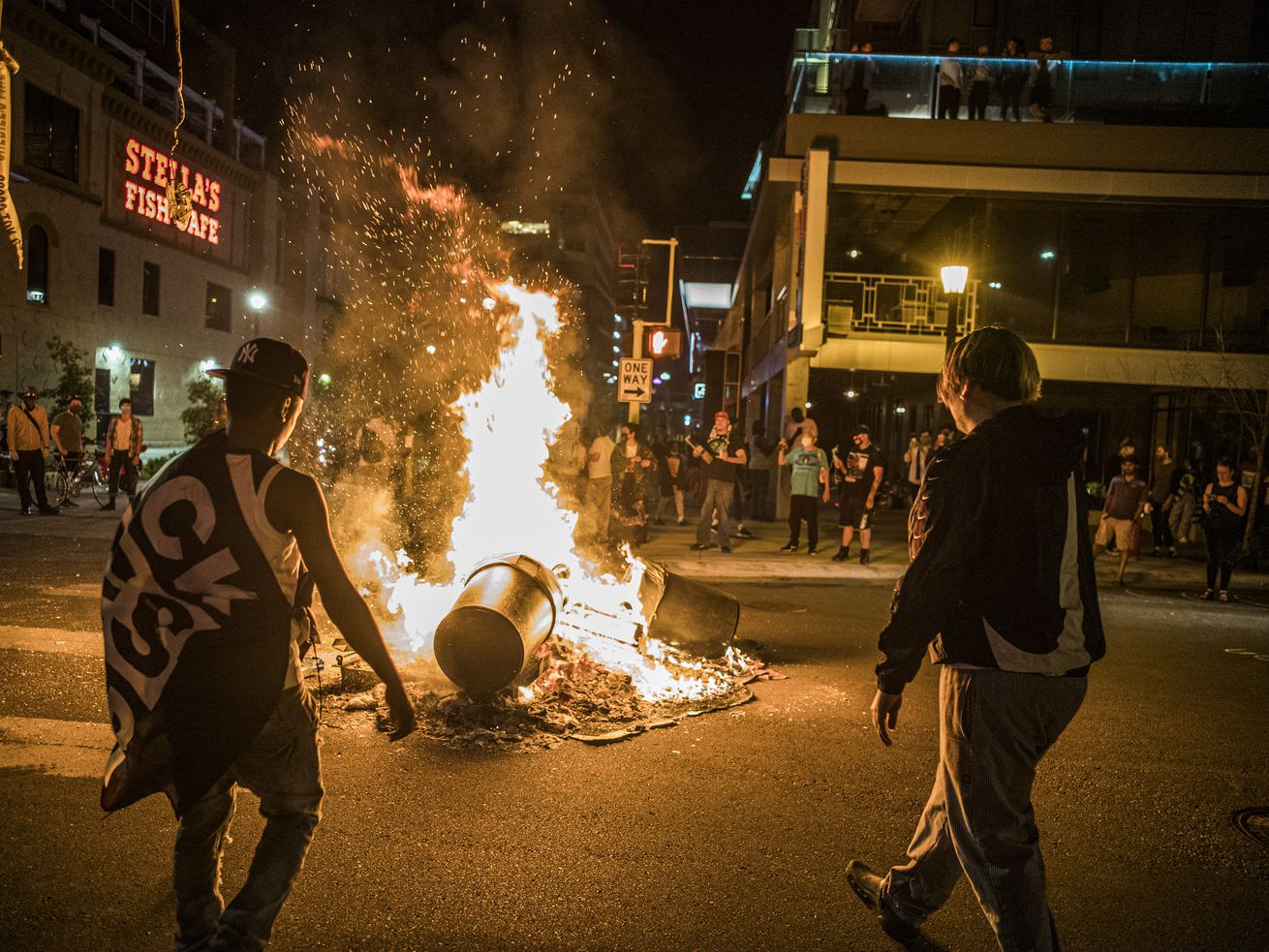
Protesters set a dumpster on fire after a shooting on Thursday, June 3, 2021 in Minneapolis. Crowds vandalized buildings and stole from businesses in Minneapolis’ Uptown neighborhood after officials said a man wanted for illegally possessing a gun was fatally shot by authorities. | AP
Family and friends identified the man killed Thursday as Winston Boogie Smith Jr., a 32-year-old father of three.
MINNEAPOLIS — Authorities said Friday that a man wanted on a weapons violation fired a gun before deputies fatally shot him in Minneapolis, a city on edge since George Floyd’s death more than a year ago under an officer’s knee and the more recent fatal police shooting of Daunte Wright in a nearby suburb.
Family and friends identified the man killed Thursday as Winston Boogie Smith Jr., a 32-year-old father of three. Shelly Hopkins, who was in a longtime relationship with Smith, told The Associated Press that despite any mistakes Smith has made, he didn’t deserve to be killed.
“I wasn’t there.” she said of Thursday’s shooting. “I don’t know exactly what happened. But I know him. And he didn’t deserve that… He had the best heart out of anybody I’ve ever met in my life.”
Members of the U.S. Marshals Fugitive Task Force were trying to arrest Smith on a warrant for allegedly being a felon in possession of a gun, authorities said. The Marshals Service said in a statement Thursday that Smith, who was in a parked vehicle, didn’t comply with law enforcement and “produced a handgun resulting in task force members firing upon the subject.”
The Minnesota Bureau of Criminal Apprehension said Friday that two sheriff’s deputies — one from Hennepin County and one from Ramsey County — fired their weapons, striking Smith. The state investigators also said evidence indicates Smith fired his gun, saying a handgun and spent cartridge were found inside the car.
Smith died at the scene. State investigators said Smith’s passenger, a 27-year-old woman, was treated for injuries from glass debris.
The Bureau of Criminal Apprehension said the U.S Marshals Service does not allow body camera usage for officers on its North Star Fugitive Task Force and there is no squad camera footage of the shooting. But the U.S. Marshals Service said that while deputy marshals do not wear body cameras, the Department of Justice permits state, local and tribal task force officers to do so.
Waylon Hughes, a close friend of Smith, told reporters that Smith loved music, writing comedy skits and posting them on social media. Hughes said he didn’t know Smith to carry a gun, and Hopkins also said she didn’t know that he had one.
Family and friends called for the release of all footage from security and surveillance cameras in the area along with information about the officers involved. Department of Public Safety spokesman Bruce Gordon said no surveillance video has been identified, but authorities are still investigating.
“This man had a family, and he’s just like anybody else,” said Kidale Smith, Winston Smith’s brother. ”(People) always try to pin something on a man and try to identify him as a criminal, especially if he’s Black.”
Smith also questioned the police account of what happened.
“You’ve got seven unmarked cars and you shoot a man in his car. You don’t even give him a chance to get out… You’re the U.S. Marshals,” he said. “You’re supposed to be highly trained men, and you can’t handle a simple situation?”
According to online court records, Smith was wanted for allegedly being a felon in possession of a firearm in 2019.
The felony stems from a 2017 assault and robbery of Smith’s ex-girlfriend. Smith pleaded guilty to one count of aiding and abetting first-degree aggravated robbery for attacking his ex-girlfriend while another woman took her purse. Smith was sentenced to two years in prison, but the prison sentence was stayed for three years, provided he didn’t break the law.
With the felony conviction, Smith was barred from possessing a firearm. In December 2019, he was charged in Ramsey County with two counts of illegally possessing a firearm. According to the complaint, officers arrested Smith on a probation violation and found a handgun under the driver’s seat of the car he had been in earlier.
Smith was also charged with fleeing police in Hennepin County last year. According to the complaint in that case, officers in Bloomington began chasing Smith at a high speed, but stopped when he started driving the wrong way on a highway.
Hopkins said Smith was a spiritual man who prayed before every meal. “The two biggest things he cared about in this world was making people happy and being there for his kids,” she said.
Hopkins said she knew Smith had some court issues, but said police “tried to make a case against him that didn’t exist.” She said Smith had been harassed by police for years and had numerous cars impounded. She said he suffered from post-traumatic stress disorder from his interactions with police.
After Thursday’s shooting, some people vandalized buildings and stole from area businesses, police said. Nine people were arrested on possible charges including suspicion of riot, assault, arson and damage to property. Graffiti reading “Mpls still hates cops” and “No trial for them” marked the building next to the parking ramp where Smith was shot.
There has been tension between police and residents since the deaths of Floyd, a Black man who died last year after he was pinned to the ground by Minneapolis officers, and Wright, a Black motorist who was fatally shot in April by an officer in the nearby suburb of Brooklyn Center.
Tensions in Minneapolis already had risen Thursday after crews removed concrete barriers that blocked traffic at a Minneapolis intersection that has become a memorial to Floyd. Crews cleared artwork, flowers and other items from 38th Street and Chicago Avenue where Floyd was killed, informally known as George Floyd Square, but community activists quickly put up makeshift barriers.
___
Mohamed Ibrahim is a corps member for the Associated Press/Report for America Statehouse News Initiative. Report for America is a nonprofit national service program that places journalists in local newsrooms to report on undercovered issues.
A 14-year-old girl shot in the head Wednesday in Back of the Yards is another victim of Chicago’s gang violence. Sources say the shooting was linked to an ongoing conflict between two gangs | Anthony Vázquez / Sun-Times
While the nation focuses on a racial reckoning, communities of color are still losing too many lives to gang shootings.
If a child were drowning in Lake Michigan, an adult would jump in to help without a second thought.
Nothing is more urgent than saving the lives of our children.
But we can’t figure out how to save children growing up in neighborhoods in the grip of gang violence?
That seems absurd.
At this moment, when the nation’s focus — at least the focus of those people who want to change the world for the better — is on healing the racial wounds inflicted on Black and Brown people, we are still losing too many lives in communities of color due to gang violence.
And before you go there, it’s not Mayor Lori Lightfoot’s fault or the Chicago Police Department’s fault or the alderman’s fault that the gang structure still exists in Chicago.
During the past three decades, the city has tried targeting gang members with measures including the passage of the Chicago Gang Congregation Ordinance, which the U.S. Supreme Court ruled was unconstitutional, finding that it violated the 14th amendment and due process.
After the feds’ sweeping prosecution of Chicago’s gang leaders on drug conspiracy charges in the early 1990s, things seemed to get worse, not better.
With open-air drug markets flourishing on the West Side and South Side and territorial disputes being settled with guns, the city’s aggressive policing strategy led to taxpayers being out millions of dollars to settle police brutality lawsuits.
Now, children as young as toddlers are getting caught in gang crossfire.
The latest victim of this gang violence is a 14-year-old girl who was with her boyfriend walking her dog Wednesday in Back of the Yards when three gang members confronted her, asking whether if she was in a gang.
When she answered no but that a relative is in what turned out to be a rival gang, they chased her down, and one of them shot her in the head. The girl remained hospitalized in critical condition Friday.
Is this really the best we can do?
Young people trying to navigate the pitfalls in their neighborhoods too often are at risk because of other young people who have chosen a different path.
What about them? What more can be done to help them? Don’t they deserve more of a chance to reach their dreams?
We’ve heard enough about gang culture to know that neglected or abused children are at risk for joining a gang.
Unfortunately, some children are growing up in homes where the gang culture is passed down as an inheritance, and others join a gang for the street protection it offers.
But like poor housing, lack of jobs and bad schools, gang violence is turning people away.
On Wednesday evening, I celebrated my granddaughter’s 14th birthday with family at an excellent restaurant in the suburbs. A couple of years ago, the celebration would have taken place at a downtown or neighborhood restaurant.
But when something as horrible as the 14-year-old girl being shot in the head happens, it brings you face to face with your own vulnerability.
I have never heard of gang members shooting a girl over a gang affiliation, let alone one who said she’s not a gang member.
Throughout the dinner, I kept thinking about how blessed I am. My granddaughter is safe. But I worry: For how long?
I don’t have the answers to ending gang violence. The only people who might are the people involved.
What I do know is that when children feel they are loved and protected at home, they are less likely to pick up a gun in the street.
I salute Ald. Ray Lopez (15th), who has stood up and confronted gang violence in his ward even though that could put him in the line of fire.
It takes courage to put your own well-being at risk to save someone else.
Blues musician Muddy Waters’ former home, 4339 S. Lake Park Ave., has been granted preliminary landmark status. | Provided
Chicago’s landmarks commission has broadened its mandate in recent years by designating structures of historical as well as architectural importance. That has helped draw attention to overlooked sites within the city’s Black neighborhoods,
The late bluesman Muddy Waters — who he was and the music he created — is as much a part of Chicago as the writings of Carl Sandburg or the comedic legacy of Second City.
To that end, the Commission on Chicago Landmarks deserves a hearty blues shout for granting a preliminary designation this past week to the North Kenwood neighborhood home where Waters once lived — and jammed.
“This uniquely significant structure was an epicenter of Chicago’s contributions to modern blues, serving as Muddy Waters’ home for nearly two decades and providing temporary lodging and rehearsal space for countless household names that defined the art form,” Mayor Lori Lightfoot said in a statement.
Waters, born McKinley Morganfield in 1913, owned the two-story brick Victorian home at 4339 S. Lake Park Ave., from 1954 to 1973. He created much of his best-known music while living there, including “Hoochie Coochie Man,” “I’m Ready” and “Mannish Boy.”
Musicians Otis Spann, Howlin’ Wolf and Chuck Berry walked his home’s wooden floors.
The home was already protected from demolition, at least in theory, because it sits in the existing North Kenwood Chicago landmark district. But singling out the building for an individual designation undoubtedly adds a level of protection — the vacant and somewhat rundown home still wound up on the city’s demolition list years ago — while bringing attention to its important cultural history.
City landmarks officials now will work out a permanent designation for the home, to be presented before the City Council later this year.
The move is also a vital assist to efforts by Waters’ great-granddaughter Chandra Cooper to turn the house into the MOJO Museum, honoring the famed bluesman.
We applaud Cooper’s effort, and that of the landmarks commission and staff, which is equitably broadening its mandate by designating structures of historical as well as architectural importance. That pivot has helped draw attention to overlooked sites within Chicago’s Black neighborhoods, especially, such as the modest Woodlawn two-flat where Emmet Till and his mother, Mamie Till Mobley, lived.
“Oftentimes, our history does get erased,” landmarks commissioner Tiara Hughes told Block Club Chicago after giving Waters’ house the thumbs-up. “It means a lot to me that these modest structures are being saved and shared, so that we can educate and continue to pass our stories down.”



/cdn.vox-cdn.com/uploads/chorus_asset/file/22639043/merlin_98072898.jpg)


/cdn.vox-cdn.com/uploads/chorus_asset/file/22633879/Illinois_Legislature.jpg)
/cdn.vox-cdn.com/uploads/chorus_asset/file/22633925/Western_Kentucky_Illinois_Football.jpg)