Charlotte (Cynthia Nixon) and Steve (David Eigenberg) on a 2004 episode of “Sex and the City.” | HBO
David Eigenberg of ‘ChicagoFire’ is set to revive his role as Miranda’s bartending husband.
Even after his nine seasons on “Chicago Fire,” David Eigenberg for some viewers will forever be Steve Brady, Miranda Hobbes’ ardent admirer, baby daddy and eventual husband on “Sex and the City.”
Soon he will return to the role on “And Just Like That …,” the “SATC” sequel series on HBO Max, the streaming service announced Wednesday.
Most of the “Sex and the City” cast is returning for the new chapter, including Cynthia Nixon as Miranda, Sarah Jessica Parker as Carrie, Kristin Davis as Charlotte and Chris Noth as “Mr. Big.” A notable exception is Kim Cattrall, who played Samantha on the series and its two big-screen movies. who has been vocal about her unhappy memories of the show and said she outgrew the role.
Eigenberg was one of several cast members whose comebacks were announced Wednesday, including Mario Cantone as Anthony, Willie Garson as Stanford and Evan Handler as Charlotte’s husband Harry.
Production on “And Just Like That…” is scheduled to begin this summer in New York
On “Chicago Fire,” Eigenberg plays longtime firefighter and family man Christopher Herrmann. Like Steve, he owns a fictitious bar, the first-responder hangout Molly’s in Bucktown.
R. Kelly walks with supporters out of the Leighton Criminal Courthouse, Thursday morning, June 6, 2019. | Ashlee Rezin Garcia/Sun-Times
Kelly’s leading defense attorneys threw a wrench into the case earlier this week when they asked to withdraw from the case two months before trial. Other members of the legal team say they were fired.
R&B superstar R. Kelly confirmed for a judge Wednesday that he wants to move forward with his federal racketeering trial in New York without the Chicago-based attorneys who had been leading his defense.
U.S. District Judge Ann Donnelly did not immediately rule during a status hearing Wednesday on a request from defense attorneys Steve Greenberg and Mike Leonard to withdraw from the case.
However, the judge asked Kelly directly whether he wanted to move forward with two other members of his legal team, Thomas Farinella, of New York, and Nicole Blank Becker, of Michigan.
“Absolutely, yes ma’am, your honor,” Kelly said.
The singer began to say more, telling the judge, “I apologize for the confusion. I’m thankful that you’re giving me a chance to say something about it.”
But the judge decided to cut off the conversation, telling lawyers to instead file paperwork further explaining the situation.
Meanwhile, Farinella told the judge, “We’re prepared to move forward with trial,” which is set for Aug. 9.
Greenberg and Leonard threw a wrench into the case earlier this week when they asked Monday to withdraw two months before the trial date. Other members of the legal team say the men were fired, though.
Greenberg wrote in a letter to the judge that, “Our reasons for withdrawal are significant and it is impossible, in our belief, for us to be able to continue to properly represent Mr. Kelly under the current circumstances.”
Though Greenberg didn’t go into further detail in his letter, a dispute over trial responsibilities apparently played a role in the conflict. Greenberg told the Chicago Sun-Times that Farinella and Becker had sought greater roles in Kelly’s Brooklyn trial.
During Wednesday’s hearing, Greenberg said, “Frankly, everyone wants to be first chair.”
Greenberg and Leonard also wrote in text messages to the Sun-Times this week that they only felt comfortable giving significant trial responsibilities to lawyers who had substantial jury trial experience in federal court.
Farinella and Becker declined to comment Monday other than to say Kelly had fired Greenberg and Leonard before their letter to the judge was filed. Greenberg said he’d given prosecutors a heads up about the move earlier in the day.But Wednesday, he acknowledged that Kelly sent him an email after the Monday letter saying he did not want Greenberg and Leonard to continue their work on the case.
Kelly is charged in Brooklyn with racketeering. His indictment there alleges he led an “enterprise” made up of his managers, bodyguards, drivers and other employees who helped him recruit women and girls for sex.
A separate indictment in Chicago charges Kelly with child pornography and obstruction of justice. It alleges he thwarted his 2008 prosecution in Cook County with threats, gifts and six-figure payoffs.
Kelly, 54, has been held in Chicago’s downtown Metropolitan Correctional Center since his arrest in July 2019, though authorities have recently said they would be preparing to move him to New York for trial.
Assistant U.S. Attorney Elizabeth Geddes said Wednesday that paperwork had been filed, but she said Kelly’s attorneys “would like him to remain in Chicago for as long as possible.”
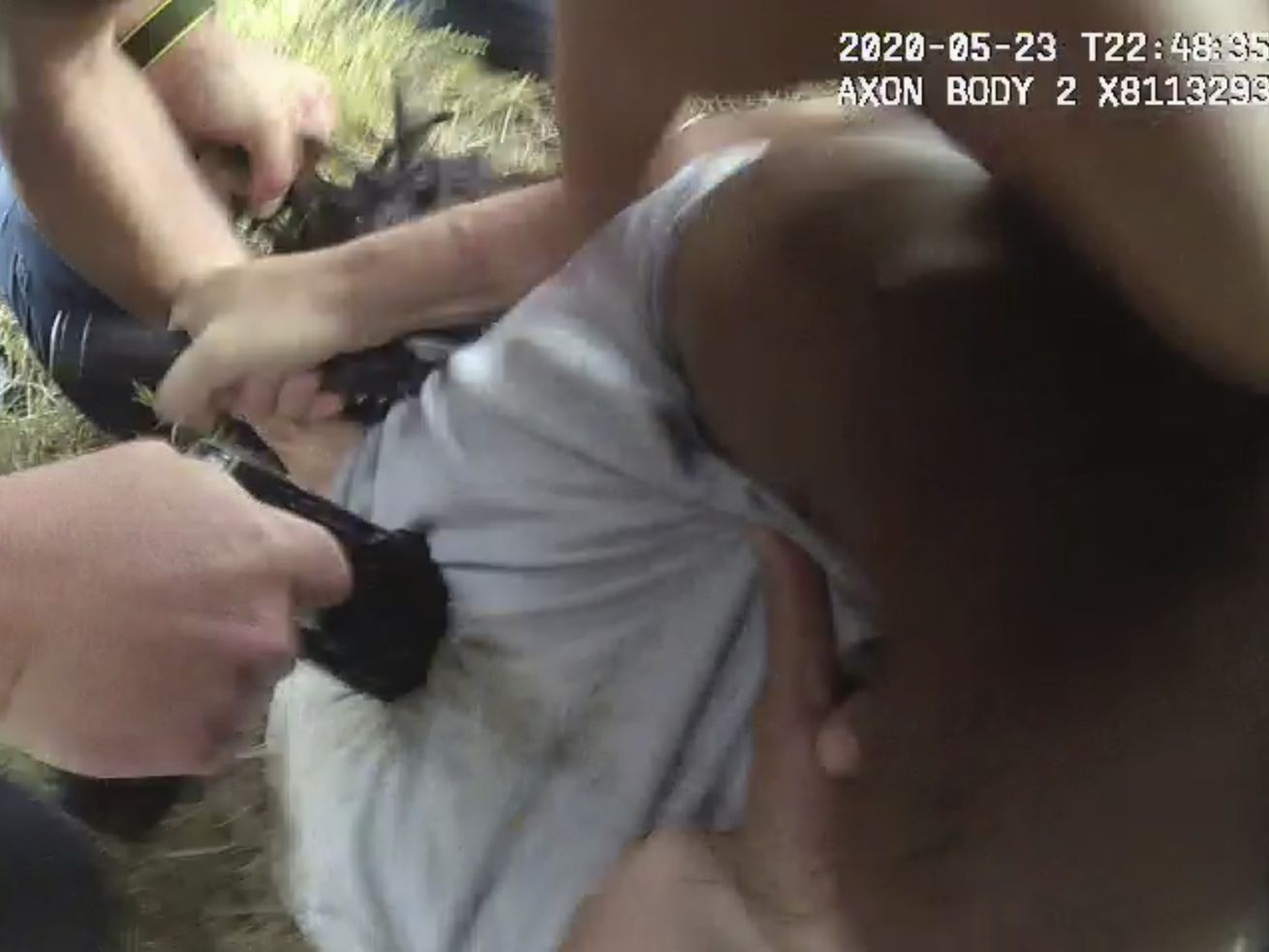
In this Saturday, May 23, 2020 image from Louisiana State Police body camera video, an unidentified law enforcement officer applies an electric weapon to the back of motorist Antonio Harris as he and other officers restrain him on the side of a road after a high speed chase in Franklin Parish, La. Troopers exchanged 14 text messages peppered with “lol” and “haha” responses in which they boasted about the beating. | AP
The panel, whose existence was confirmed to The AP by four people familiar with it, was set up in response to Ronald Greene’s death as well as three other violent stops of Black men.
BATON ROUGE, La. — The same Louisiana State Police unit whose troopers stunned, punched and dragged Ronald Greene on video during a deadly 2019 arrest is now under internal investigation by a secret panel over whether its officers are systematically targeting Black motorists for abuse.
The panel, whose existence was confirmed to The Associated Press by four people familiar with it, was set up in response to Greene’s death as well as three other violent stops of Black men: one who was punched, stunned and hoisted to his feet by his hair braids in a body-camera video obtained by the AP, another who was beaten after he was handcuffed, and yet another who was slammed 18 times with a flashlight.
“Every time I told him to stop he’d hit me again,” said Aaron Bowman, whose flashlight pummeling left him with three broken ribs, a broken jaw, a broken wrist and a gash to his head that required six staples to close. “I don’t want to see this happen to nobody — not to my worst enemy.”
The panel began working a few weeks ago to review thousands of body-camera videos over the past two years involving as many as a dozen white troopers, at least four of whom were involved in Greene’s arrest.
The review is focused on Louisiana State Police Troop F, a 66-officer unit that patrols a sprawling territory in the northeastern part of the state and has become notorious in recent years for alleged acts of brutality that have resulted in felony charges against some of its troopers.
“You’d be naïve to think it’s limited to two or three instances. That’s why you’re seeing this audit, which is a substantial undertaking by any agency,” said Rafael Goyeneche, a former prosecutor who is president of the Metropolitan Crime Commission, a New Orleans-based watchdog group. “They’ve got to identify these people and remove them from the organization.”
Other than the federal civil rights investigation into Greene’s death, the state police panel is the only known inquiry into possible systemic abuse and racism by its troopers.
Its seven members, drawn from officials from across the State Police, are not only scouring the videos for signs of excessive force, the people told the AP, but also examining whether troopers showed racist tendencies in their traffic stops and pursuits, and whether they mislabeled body-camera videos, turned off their cameras or used other means to hide evidence from internal investigators.
It’s not clear if the panel has a deadline or if it plans to expand the inquiry to the eight other troops in the 1,200-officer state police.
The State Police did not immediately respond to a request for comment.
Secrecy has permeated the Greene case from the beginning.
Soon after Greene’s May 10, 2019, death, troopers told his relatives he died in a crash following a chase on a rural road near Monroe. Later, State Police issued a one-page statement saying that troopers struggled with Greene during his arrest and that he died on the way to the hospital.
For more than two years, Louisiana officials from Democratic Gov. John Bel Edwards down rebuffed repeated requests to release the body-camera video of Greene’s arrest.
But that changed last month after the AP released footage it obtained showing troopers converging on Greene’s car, repeatedly jolting the 49-year-old unarmed man with stun guns, putting him in a chokehold, striking him in the head and dragging him by his ankle shackles. Greene can be heard apologizing to the officers, telling them he is scared and moaning and gasping for air.
One 30-minute clip, which a supervisor denied having for two years, shows troopers ordering the heavyset Greene to remain facedown with his hands and feet restrained for more than nine minutes — a tactic use-of-force experts criticized as dangerous and likely to have restricted his breathing.
An autopsy report obtained by AP lists Greene’s cause of death as “cocaine induced agitated delirium complicated by motor vehicle collision, physical struggle, inflicted head injury and restraint.”
No troopers have been charged in Greene’s arrest. Trooper Kory York, who was seen dragging Greene, was suspended without pay for 50 hours. Master Trooper Chris Hollingsworth, who was recorded on his body camera bragging that he “beat the ever-living f—” out of Greene, was told he would be fired last year just hours before he died in single-vehicle car crash.
While none of the other beatings that prompted the broader review of Troop F resulted in deaths, all led to felony charges against some of the troopers involved. And like Greene, all the suspects were driving alone, were unarmed and didn’t appear to resist after troopers closed in.
State police have not released body-camera video of any those cases, but AP obtained footage from the May 2020 arrest of Antonio Harris, who sped away from a traffic stop and led troopers through rural Richland Parish at speeds topping 150 mph before his car was finally stopped with a spike strip.
He can clearly be seen on the video surrendering next to a cornfield by lying on the ground with his arms and legs outstretched before at least seven officers converged.
Dakota DeMoss, a trooper involved in the Greene arrest, can be seen striking Harris in the face and later, after he was handcuffed, yanking him onto his feet by his dreadlocks. Another trooper, George Harper, uses a fist reinforced by his flashlight to punch Harris in the head and threatens to “punish” him while Trooper Jacob Brown pulls the man’s hair.
An unidentified officer also can be seen in the footage shocking Harris with a stun gun.
“I hope you act up when we get to the f——— jail,” Harper can be heard saying. “What the f—— is wrong with you, stupid motherf——-.”
Internal investigators found that troopers produced “wholly untrue” reports saying Harris resisted and that they sought to conceal the existence of body-camera video. Troopers also exchanged 14 text messages peppered with “lol” and “haha” in which they boasted about the beating.
“He gonna be sore tomorrow for sure,” Brown texted. “Warms my heart knowing we could educate that young man.”
State police arrested Brown, Harper and DeMoss on charges of simple battery and malfeasance in Harris’ case.
Another beating happened in late May 2019 — 20 days after Greene’s death — when a Ouachita Parish deputy sheriff tried to pull over Bowman for a traffic violation a block from his Monroe home. The deputy reported that Bowman failed to pull over and continued into his driveway, where he was ordered out of his vehicle.
Brown, the trooper charged in the Harris incident, quickly responded to the arrest and, according to court documents, can be seen on his own body-camera video pummeling Bowman with a flashlight designed for shattering car glass, striking him 18 times as he was being handcuffed and not resisting.
“I thought I was going to die that night — I bled so much,” Bowman told the AP. “It’s hard to deal with. I can’t function half of the time. It’s just hard for me to think now.”
For months, state police were not aware footage of Bowman’s arrest existed because Brown misclassified it and failed to document any use of force, according to court records. Brown was charged with aggravated battery and malfeasance.
Brown also faces charges in yet another beating of a Black motorist — the July 2019 arrest of Morgan Blake, who was pulled over for a traffic violation on Interstate 20 in Ouachita Parish.
Troopers said Blake had 13 pounds of marijuana concealed in a locked compartment of the vehicle and was taken into custody. At some point, he complained that his handcuffs were too tight, and Brown took him to the ground.
Body-worn camera captured Trooper Randall Dickerson punching Blake five times and kneeing him. State Police determined that Blake “was not resisting, attempting to escape or being aggressive,” and that the troopers failed to document their use of force in any reports.
Dickerson and Brown were charged with simple battery and malfeasance.
The American Civil Liberties Union of Louisiana on Wednesday called for a “top-to-bottom federal investigation” of the State Police.
“This is not a matter of a few bad apples,” the group said, “this is a systemic issue that demands a systemic and transparent response.”
In this June 1, 2020, file photo President Donald Trump holds a Bible as he visits outside St. John’s Church across Lafayette Park from the White House in Washington. An internal investigation has determined that the decision to clear racial justice protestors from an area in front of the White House last summer was not influenced by then-President Donald Trump’s plans for a photo opportunity at that spot. The report released Wednesday by the Department of Interior’s Inspector General concludes that the protestors were cleared by U.S. Park Police on June 1 of last year so new fencing could be installed. | AP
The report released Wednesday by the Interior Department’s inspector general concludes that the protesters were cleared by U.S. Park Police last June 1 so that a contractor could get started installing new fencing.
WASHINGTON — An internal government investigation has determined that the decision to forcibly clear racial justice protesters from an area in front of the White House last summer was not influenced by then-President Donald Trump’s plan to stage a Bible-toting photo opportunity at that spot.
The demonstrators were protesting the death of George Floyd, who died after a then-Minneapolis police officer knelt on his neck and pinned him to the ground for about 9 1/2 minutes. A half-hour after the Washington protesters were forced from the area with pepper pellets and flash-bangs, Trump walked across Lafayette Park amid the lingering scent of pepper spray and delivered a short speech while holding a Bible in front of St. John’s Church.
Park Police officials had already planned to clear the area and “had begun implementing the operational plan several hours before they knew of a potential Presidential visit to the park,” Inspector General Mark Lee Greenblatt said in a statement accompanying the report.
The report documents Trump’s attorney general, William Barr, encouraging commanders shortly before the push to clear the protesters because of Trump, but being dismissed.
In a remarkable exchange, the report recounts the testimony of an unnamed Park Police operations commander: “The Attorney General asked him, ‘Are these people still going to be here when POTUS (President of the United States) comes out?’ The USPP operations commander told us he had not known until then that the President would be coming out of the White House and into Lafayette Park. He said he replied to the Attorney General, ‘Are you freaking kidding me?’ and then hung his head and walked away. The Attorney General then left Lafayette Park.”
The report determined that the decision to clear the protesters was justified, but that law enforcement agencies on the scene failed to effectively communicate with each other and failed to communicate warnings to the protesters about the impending crackdown. Several different law enforcement agencies moved ahead of schedule and started engaging with protesters before the protesters had been sufficiently warned.
The confrontation and church photo-op capped several days of escalating tension and scattered violence. Nights of protests over Floyd’s death had resulted in scattered vandalism through the downtown area. Trump declared that Washington’s mayor, Muriel Bowser, was incapable of maintaining the peace and he called in his own security response.
The report details how on June 1, a contingent from the Bureau of Prisons arrived to the scene late, didn’t receive a full briefing and used pepper pellets on protesters “contrary to the USPP incident commander’s instructions.”
The conclusions, which deny any political influence on decisions and cite fog-of-war confusion for any missteps, are likely to be dismissed as insufficient by critics of last summer’s crackdown.
Lafayette Park, the Washington nexus of the last summer’s national wave of racial justice protests, is under Park Police jurisdiction; that agency falls under the Interior Department.
The new report focuses on the Park Police decision-making and its complicated interactions with various law enforcement entities, including the Secret Service and the Metropolitan Police Department.
It points out that “the USPP and the Secret Service did not use a shared radio channel to communicate” and determines that “weaknesses in communication and coordination may have contributed to confusion during the operation.”
The report tries to explain one of the main points of lingering contention: who used tear gas and when? It concludes that members of the city’s police department, who were stationed down the block, used CS gas near the corner of 17th and H Street.
In the aftermath of that day, the Park Police repeatedly insisted that its officers never used tear gas, while the the police insisted that its officers were not involved in clearing protesters away from the church. Just last month, lawyers for the police department stated in federal court that its officers had used CS gas and other chemical irritants, claiming protesters had become violent and that one officer had his arm burned by a firework.
Much of the criticism of the clearing, and the accusations of political influence, stem from the decision to move in before the 7 p.m. curfew that Bowser had set. The push surprised protesters and was criticized as unnecessarily confrontational after two nights of clashes and property damage.
The report concludes that Park Police commanders viewed the curfew as irrelevant. It cites an incident commander as saying, “We were not enforcing the Mayor’s curfew. We’re a Federal entity. We don’t work directly for the Mayor.”
It continues that commanders on the scene ”did not believe protesters would comply with the Mayor’s June 1 curfew order or that waiting would necessarily reduce unrest.”
Visiting friends or family out in the suburbs? Heading out of the city over the weekend? Leaving Chicago doesn’t mean leaving great food behind― you still have plenty of great restaurants in Hoffman Estates to enjoy!
This “Burger, Pizzo & Beer Company” in South Barrington offers its own house brews in addition to a wide selection of other beers from around the world. Balance out your booze with a Margherita pizza or a Peppercorn Bleu burger and you’re all set.
Summon your crew for a night at this American bar and cafe. Along with gourmet burgers, sandwiches, and an assortment of “house favorites,” diners can also partake of The Assembly’s extensive beer and wine menu.
With a culinary history tied closely to its origins in Japan, Kitakata Ramen Ban Nai’s ramen is characterized by a “flat, wide and hand-crumpled curly noodle” as well as a “clear but flavorful broth.” Start off with gyoza or a Ban Nai bun before you try the main event― a bowl of ramen.
For those of us who want the option to eat breakfast at all times, there’s Apple Villa. This traditional breakfast restaurant serves omelettes, skillets, pancakes, waffles, crepes, french toast, and more(!).
This Japanese restaurant offers noodle dishes and other dinner entrees, but one particular attraction here is the sushi list. Bring your friends and order rolls or pieces à la carte to go with some sake.
Built on the expertise of longtime chef Dave Perlick, Region’s goal is “to exceed your gastronomic expectations every visit.” With a variety of small plates (like lobster mac n cheese) and large plates (including the Kansas beef short rib), Region is always ready to bring something surprising to the table.
Describing itself as “Greek food with a kick,” QP serves ribs and chops “the Greek way,” as well as a bevy of starters and “QP Greek Secrets”― a section of its menu which includes spinach pie, baked Greek meatballs, and more.
Korean restaurant Go Goo Ma not only serves authentic Korean food, but also has pictures of its dishes on the wall for the new and uninitiated diner. Favorite meals of Go Goo Ma customers have included the Kimchi Jjigae and Chicken Dole-Sote Bibimbap.
The ChicagoBears continued the voluntary portion of their off-season program on Wednesday and the attention still remains on the quarterback position and the position battle between veteran Andy Dalton and rookie Justin Fields. The Chicago Bears are going to have to make a tough decision with their quarterbacks. While there is no question that Fields […]
Chicago’s most important news of the day, delivered every weekday afternoon. Plus, a bonus issue on Saturdays that dives into the city’s storied history.
This afternoon will be mostly sunny with a high near 85 degrees. Tonight will be partly cloudy with a low around 65. Tomorrow will be mostly sunny with a high near 84.
Talk of a potential elected Chicago school board has been dominated by its expected size — 21 members, the most of any major urban district in the nation — plus the decentralizing of accountability and the seemingly inevitable influence of big money elections.
As advocates’ longtime dream of a fully elected board for Chicago Public Schools looks closer than ever to reality, critics and supporters alike can look to other major cities’ boards for lessons — and warnings — on how to implement a new system.
While the state legislature might address many of those questions by the time the city’s first school board elections roll around in late 2024, experts who follow other districts say Chicago has an opportunity to launch its elected board on good footing if new processes and safeguards are created and norms are established.
“Elected boards are kind of a core of democracy” and fundamental to giving families a voice, said Duncan Klussmann, a former superintendent at a Houston-area district and now a clinical assistant professor at the University of Houston.
But getting a bill over the finish line — as long as it has taken — is only one hurdle, he said.
A 30-year-old dancer who co-founded the Era Footwork Crew, a group that uses “footworking,” a uniquely Chicago-style dance, to bring communities together.
The 40-year-old co-founder of Black Lives Matter’s Chicago chapter, now working with survivors of police brutality at the Chicago Torture Justice Center.
A 26-year-old organizer who shepherded a four-year project by the Invisible Institute to document the torture of more than 100 Black men, making their stories publicly accessible.
These are among the 10 winners of $50,000 each from “Leaders for a New Chicago,” an initiative of the Field Foundation and MacArthur Foundation to support individuals and organizations addressing systemic racism in underserved South and West Side communities.
The Field and MacArthur foundations’ 2021 Leaders for a New Chicago cohort includes LaSaia Wade (top row, from left), Aislinn Pulley, Meida Teresa McNeal, Damon A. Williams and Grace Pai. Also, Monica Haslip (bottom row, from left), Brandon “Chief Manny” Calhoun, Tony Alvarado-Rivera, Malik Gillani and Maira Khwaja.Provided
Launched in 2019, the award — a no-strings-attached $25,000 grant for each winner, plus another $25,000 for their organizations — is a more accessible spin on MacArthur’s lauded “genius grants” awarded annually to nationally known figures boasting lofty achievements.
This third cohort being acknowledged and celebrated are folks diligently working in their individual trenches, some lesser known, others more familiar — including Generation X members and Millennials. All have been dedicated to uplifting hurting communities of color.
“The Leaders for a New Chicago Award continues to find where power lives inside our communities, and provides the support and funding these folks need to dream bigger so they can continue to create change,” said Field Foundation Leadership Investment Program Officer Hilesh Patel.
What is the best part about your neighborhood? Tell us why.
Reply to this email (please include your first name and where you live) and we might feature your answer in the next Afternoon Edition.
Yesterday, we asked you: In light of National Best Friend Day, how did you meet yours? Here’s what some of you said…
“My best friend and I grew up on the same block on the South Side of Chicago. We became friends at 6 years old, and are in our late fifties, are still best friends.” — Tony Williams
“I met Osprey when I opened up my package from Amazon. My Osprey backpack traveled with me to Hawaii, Arizona, Utah, California and many national parks. So many memories.” — AJ Vee
“I met him in high school. We were waiting for a class to start and I noticed he was wearing Hush Puppies and I had always wanted a pair of those shoes. I told him, we laughed about it, and we’ve been best buddies for 42 years now.” — Chris Vaughn
“She moved next door to an adjoining house. We raised our kids together. Hers and mine are the same age.” — Genevieve Poeticlady Williams
“In Girl Scouts when I was like 11. We’re in our mid-40s now.” — Adrienne Taylor
“Heidi and I met playing softball for Niles Park District just before High School around 1989. We are Best Friends to this day.” — Jodi Lynn
“Well, one rainy day about four years ago, I found her just sitting next to my house by a small tree that’s next to the gate, trying to hide from the rain. I brought her some food and water, and the next day, she was there again and again and again. Until one day, I just decided to keep her. Now she’s the happiest dog around the neighborhood. My best friend: my dog ‘Chispas,’ which means ‘Sparks’ in Spanish. I named her that because she’s all black with a bunch of yellowish spots that look like sparks.” — Enockk Antonio Cobos
Thanks for reading the Chicago Afternoon Edition. Got a story you think we missed? Email us here.
Now that the Major League Baseball season is well underway, with fans like me relieved and happy to have our absorbing summer pastime back, spectators returning to the ballpark and interesting playoff races in all six divisions, it’s time for the annual spate of “baseball is doomed” articles presaging the game’s inevitable decline and fall.
“Baseball Is Broken,” reads a prototypical headline in The Atlantic, of all places, not normally known for sports writing. “Once a generation,” according to author Devin Gordon, “the game of baseball suffers through a fun crisis, and the story of this MLB season so far is how alarmingly not fun baseball has become.”
In-depth political coverage, sports analysis, entertainment reviews and cultural commentary.
The big complaint is that pitchers — bigger, stronger and throwing harder than ever — have gotten the upper hand over batters, leading to an MLB-wide decline in batting averages and a whole lot of strikeouts. Also a decline in situational hitting, i.e. hit-and-run plays, hitting behind base runners to move them along, bunting, etc.
Many fans have been complaining, particularly in New York, where the Yankees have been whiffing at prodigious rates. I can’t say I was personally disappointed to see eight of the last nine Yankees batters fan during a taut contest against the Red Sox last week. Boston pitchers threw some unhittable stuff. When it’s 97 mph on the black edge of the plate at the knees …
Well, you try to hit it.
As a one-time pitcher during the Late Middle Ages — we played with rounded stones and cudgels — I found it thrilling. The Red Sox won zero games at Yankee Stadium during last year’s COVID-shortened season.
Besides, the two teams will square off another 18 times during the regular season. Part of the beauty of the game for serious fans is that they do it almost every day. You know how your grandma used to watch her daily TV soap opera? For me, that’s MLB baseball: an entertainment, an ongoing saga and a refuge from …
Well, what have you got? For me it’s mainly politics, a couple or three blessed hours without a word about Democrats, Republicans or even the happy peregrinations of “The Second Gentleman.”
It’s definitely a TV show. Due to a combination of circumstances, I watched four consecutive Red Sox broadcasts last week with four different announcing crews: Houston’s, Boston’s, Fox Sports and ESPN.
Regardless of which team you support, it makes a big difference. The Astros need a serious energy transfusion in the broadcast booth. For all his star power, ESPN’s Alex Rodriguez was droning on like a priest celebrating 6 a.m. mass until he hit upon the topic of the 2021 Yankee team’s deficiencies. That earned him a well-deserved headline in The New York Times.
Good pitching really plays on TV, especially with an expert commentator (and unabashed flake) like Hall of Fame pitcher Dennis Eckersley calling them. “If he throws this guy another piece of high cheese,” Eck will say, “he’ll miss it by a foot.” And most often, that’s exactly what happens.
But back to The Atlantic and baseball’s “fun crisis.” What apparently set author Gordon off was a seeming misunderstanding. His piece appears with the following correction: “This article previously misstated that Tyler Duffey beaned Yermin Mercedes. In fact, he threw behind Mercedes.”
That is, instead of assault with a deadly weapon, the Minnesota Twins pitcher made a symbolic gesture to Mercedes of the White Sox to convey the message: “We didn’t like you showing us up yesterday. You need to show more respect.”
Duffey was suspended for three days, and his manager for one.
What precipitated the whole kerfuffle was slugger Mercedes ignoring a take sign from his manager, the venerable Tony La Russa, and hitting a 3-0 meatball from a position player, catcher Willians “La Tortuga” Astudillo, 420 feet for a home run in the ninth inning of a 15-4 game.
See, by bringing in a position player, Minnesota was conceding the game, and by hitting what amounted to a batting practice home run, Mercedes was rubbing it in. Baseball’s unwritten rules can be subtle. Had the count been 3-1, it would presumably have been OK.
La Russa said his player had a lot to learn; several of his White Sox players said their manager himself was out of line, and then the Twins “retaliated.” In short, as Gordon comments, “pretty standard big-league macho posturing.”
Even if La Russa himself had made the ultimate rookie mistake of playing the “Do you know who I am?” card during a DWI bust last October and flashing his World Series ring. (He eventually pled guilty.)
The only serious baseball issue here is Mercedes ignoring a sign and White Sox players basically saying nobody needs to pay attention to Grandpa. If so, then the 76-year-old Hall of Famer (and baseball’s second-winningest manager ever) may have lost control of his team. And that wouldn’t be funny at all.
SAN ANTONIO — An Air Force base in San Antonio was placed on lockdown for about an hour Wednesday after military officials said gunfire was reported near a base gate.
Two gunshots were reported heard coming from outside Joint Base San Antonio-Lackland onto the base about 11:50 a.m., said Lt. Col. Brian Loveless, 802nd Security Forces Squadron commander. Investigators were trying to determine whether the gunfire report was true or a false alarm, Loveless said.
It was unclear whether anyone saw a shooter or whether more than one shooter may have been involved, he said.
“We’re trying to investigate a couple of leads right now to confirm that gunshots actually did take place on the installation.
No injuries were reported, Loveless said.
Lackland is on San Antonio’s southeast side and is where the Air Force conducts all of its basic training.
“There’s a lot of facilities on this installation that are very important to the Air Force. I would rather overreact (to a gunfire report) than underreact,” Loveless said.
The base issued an alert midday, telling all Lackland Air Force Base personnel to go into lockdown. An alert on Twitter said: “Real World, LOCKDOWN, LOCKDOWN, LOCKDOWN.”
Officials said the shots were reportedly fired near the Valley Hi gate on the western side of the main base, just east of Interstate 410 and near a shopping center.
After an hour, the lockdown was lifted except for the Valley Hi gate.
San Antonio police said they were assisting in the investigation. In a statement, police spokeswoman Jennifer Rodriguez said officers were looking for the spot from which gunfire might have originated.
Lukas Reichel played for Germany in the World Championships. | AP Photo/Sergei Grits
Reichel, the Hawks’ 17th overall pick in last year’s draft, signed his NHL entry-level contract shortly after the World Championships.
Lukas Reichel will officially make the Atlantic leap and join the Blackhawks organization next season.
Reichel signed his three-year NHL entry-level contract with the Hawks on Wednesday, shortly after Germany’s run at the World Championships ended Sunday — as the Chicago Sun-Times reported last month he would.
His new contract carries a $925,000 cap hit through 2024.
“Lukas made tremendous strides in his second year as a professional,” Hawks general manager Stan Bowman said in a statement. “The game appeared to slow down for him this past season, which allowed his play-making skills to be on full display.
“Bringing him over to North America is the logical next step for his continued development and we’re excited to be able to add such a young, dynamic player to our forward group.”
The 19-year-old forward — the Hawks’ top prospect and 17th overall pick in last year’s draft — followed up an excellent season with Eisbaren Berlin with another strong performance in the World Championships.
Germany went 4-3 in the group stage and eliminated Switzerland in the quarterfinals before losing to Finland in the semifinals and to USA in the Bronze Medal game. Reichel recorded six points (two goals and four assists) in nine games, good for third on the team.
Reichel will arrive in North America next season having bulked up to 176 pounds and counting and showed potential to transition to a center. His Berlin coach, Serge Aubin, moved him to center for much of this past season and saw him thrive there, scoring 27 points in 38 regular-season games and five points in nine postseason games en route to the German league title.
“I used him as a [first]-line player,” Aubin said last month. “His skating this year was even better than last year. He’s really an elite skater. And his decision-making was also better. We could see a lot of growth.”
Reichel’s agent, Allain Roy, described Reichel’s development as like “a boy playing in a men’s league” in 2019-20 versus “a man against men” in 2020-21.
Roy also said in May he and Bowman expected to settle Reichel’s first contract after the World Championships concluded, and he clearly wasted no time.
Whether Reichel will start the 2021-21 season in the fall immediately playing in the NHL remains to be determined, though. He’ll be given every opportunity to prove he should stick with the Hawks, but his acclimation could be aided by at least a couple months in the AHL.




:no_upscale()/cdn.vox-cdn.com/uploads/chorus_asset/file/22648298/CHRON2.jpeg)
