The all-female-identifying Moonwater Dance Project explores water-as-metaphor in its newest piece.
The low rumble of the double bass slides up and down with the rise and fall of a tumult of waves to begin the piece. The dancers’ movements manifest a calm sea, storms, and the ebb and flow of the tide.…Read More
Allen Robinson has 3,151 yards receiving in three seasons with the Bears. | Tim Ireland/AP
He’s unlikely to get a new deal before training camp, but Robinson won’t let that interfere with his preparation for the 2021 season.
Allen Robinson is unhappy with his contract as he plays the upcoming season on the franchise tag, but he won’t allow that frustration to interfere with his preparation.
Robinson showed up for mandatory minicamp after skipping two weeks of voluntary organized team activities and said Wednesday he won’t hold out from training camp despite the likelihood that he won’t have a contract extension by then.
“That’s not in my control,” Robinson said. “That is what it is. I’m comfortable with that. Obviously that’s a possibility. My main focus right now is to continue to get better.”
Robinson has been the Bears’ best receiver the last three seasons and had some of the best statistics in the NFL over the last two when he was fully healthy. In 45 games with the Bears, he has 255 catches, 3,151 yards and 17 touchdowns.
He finished a three-year, $42 million deal last season and will play for $17.9 million on the franchise tag this season. He and the Bears have until July 15 to agree to an extension, otherwise he’ll be an unrestricted free agent in March, but there doesn’t appear to be any momentum for that.
“I don’t have any updates,” Robinson said of the negotiations. “That’s out of my control.”
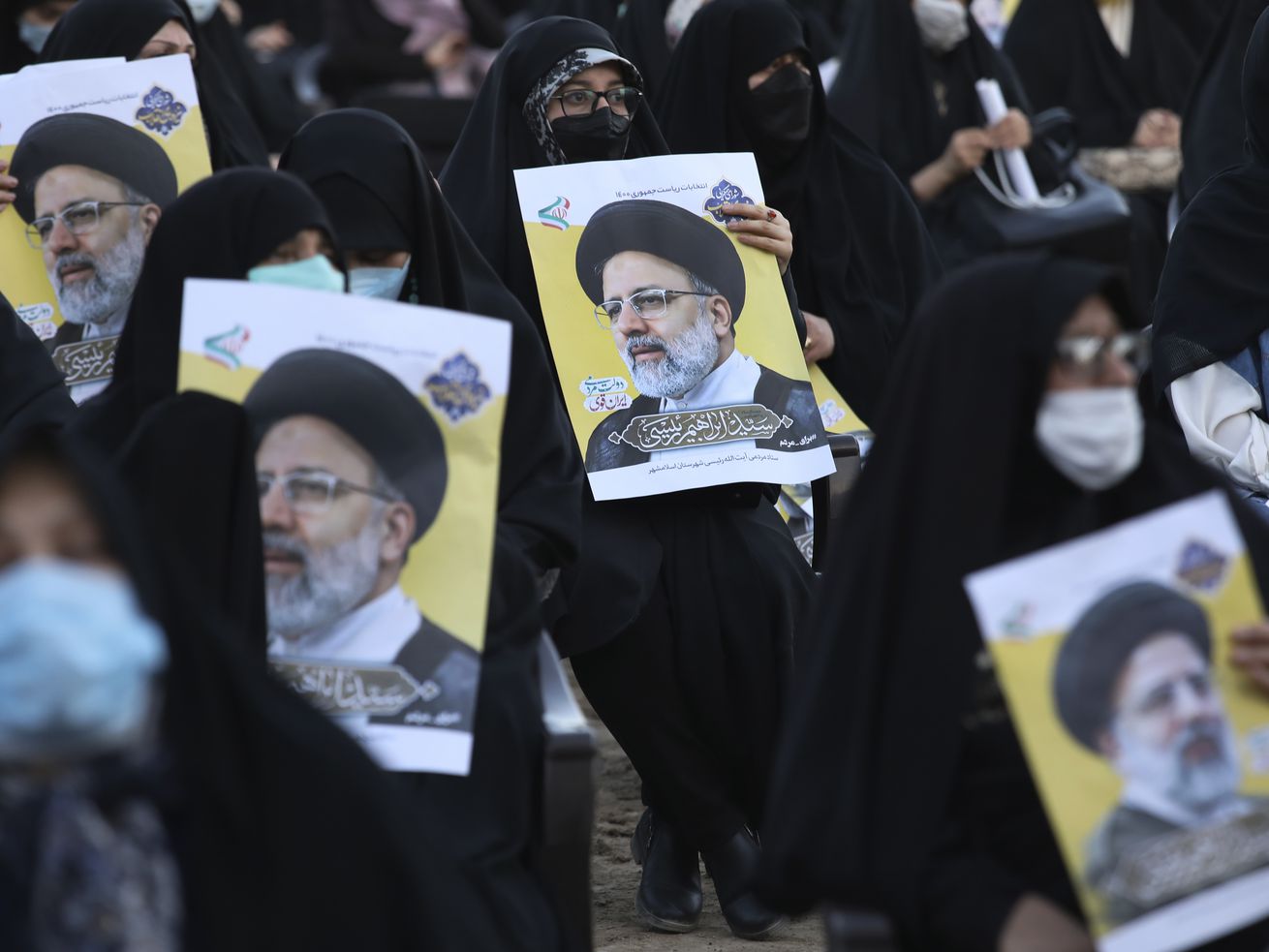
Supporters of the presidential candidate Ebrahim Raisi, currently judiciary chief, hold his posters during a campaign rally in town of Eslamshahr southwest of the capital Tehran, Iran, Sunday, June 6, 2021. Iran will hold presidential elections on June 18 with 7 candidates approved by the Guardian Council. | AP
Supreme Leader Ayatollah Ali Khamenei warned of a foreign conspiracy to undermine the vote while the country’s Interior Ministry acknowledged a startling lack of competition that was turning the election into a coronation for Khamenei’s protégé, hard-liner Ebrahim Raisi.
DUBAI, United Arab Emirates — Iran grappled with fears of low voter turnout two days ahead of its presidential election as the race narrowed on Wednesday into a showdown between the country’s hard-line judiciary chief and moderate former Central Bank chief.
Supreme Leader Ayatollah Ali Khamenei warned of a foreign conspiracy to undermine the vote while the country’s Interior Ministry acknowledged a startling lack of competition that was turning the election into a coronation for Khamenei’s protégé, hard-liner Ebrahim Raisi.
In an extensive televised speech, Khamenei railed against the media’s grim portrayal of the poll and tried to cajole people into voting, warning of “increased pressure” from Iran’s “enemies” if citizens stay away from the polls on Friday.
Iran’s clerical vetting body had barred a range of prominent reformists and key allies of relatively moderate President Hassan Rouhani to run in this election, giving the green light to just Raisi and several low-profile candidates, mostly hard-liners with little popular support. The Guardian Council’s evisceration of any viable challengers has sparked widespread criticism and fueled calls for a boycott.
Voter apathy was running deep even before the disqualifications, due in part to the devastated economy and subdued campaigning amid a surge in coronavirus cases. The state-linked Iranian Student Polling Agency most recently projected a 42% turnout from the country’s 59 million eligible voters, which would be a historic low.
At a press conference, the interior minister admitted it was no real contest.
“The actual competition in the elections is not a very serious one … considering the actions of the Guardian Council,” said Abdolreza Rahmani Fazli. “We can say that the reasons are the weak competition and the coronavirus situation.”
That left Khamenei and top officials the task to try lure the disillusioned public back to the polls. Iranian authorities have promoted voter turnout as validation for their style of governance after the 1979 Islamic Revolution installed the clerically overseen system that endures today.
Khamenei lashed out against Iran’s “enemies” for discouraging people from voting. He accused “American and British media and their mercenaries” of “killing themselves to question the elections and weaken popular participation.”
He also acknowledged that many ordinary Iranians, impoverished and battered by years of heavy American sanctions, may not see the benefit of political participation.
“But not voting because of (economic) complaints is not correct,” Khamenei said.
Meanwhile, two hard-line candidates withdrew Wednesday, throwing their support behind presumed front-runner Raisi. The only reformist candidate in the vote also dropped out, making former Central Bank chief Abdolnasser Hemmati the main moderate contender. Such dropouts are common in Iranian presidential elections in order to boost the chances of similar candidates. No campaigning is allowed on Thursday, 24 hours before polls open.
Within Iran, candidates exist on a political spectrum that broadly includes hard-liners who want to expand Iran’s nuclear program and confront the world, moderates who hold onto the status quo and reformists who want to change the theocracy from within.
Alireza Zakani, a conservative lawmaker who became known for his vocal opposition to Tehran’s 2015 nuclear deal with world powers, dropped out and said he would vote for Raisi. Soon after, Saeed Jalili, the top nuclear negotiator for former hard-line President Mahmoud Ahmadinejad at the height of Western concerns over Tehran’s nuclear program, followed suit. Over 200 lawmakers in parliament, which is dominated by hard-liners, urged the remaining hard-line contenders to withdraw and back Raisi’s bid.
Mohsen Mehralizadeh, the pro-reform candidate who served as governor in two provinces and previously in reformist President Mohammad Khatami’s administration, also announced his departure, apparently to boost Hemmati’s chances.
In remarks Wednesday, Hemmati sought to rally the pro-reform vote and position himself as a stand-in for Rouhani, who is term-limited from running again. He announced that he’d select current Foreign Minister Mohammad Javad Zarif to join his administration as either vice president or foreign minister, embracing the top diplomat who was an architect of Tehran’s now-tattered nuclear deal.
“The economic development of Iran is not possible without strong diplomatic engagement abroad,” Hemmati tweeted, explaining his choice of Zarif. “My administration is after the removal of sanctions and use of foreign policy to achieve political development.”
Zarif, among the best-known political figures in Rouhani’s administration, has come under fire from the political establishment recently, following the leak of a contentious audiotape in which he offered a blunt appraisal of power struggles in the Islamic Republic.
There was no immediate word from Zarif on Hemmati’s announcement, but the minister has previously indicated a willingness to join the incoming administration.
Polling and analysts indicate that Hemmati lags behind Raisi, the current judiciary chief cultivated by Khamenei.
Raisi has drawn deep skepticism from the West, in part for running a judicial system that remains one of the world’s top executioners and sees the Revolutionary Courts operate many trials behind closed doors. His alleged involvement in human rights abuses dates back to a mass execution of political prisoners at the end of the Iran-Iraq war in 1988.
Raisi’s ascendancy would come at a delicate time for the region, as Iran and the United States negotiate a return to Tehran’s historic atomic accord with world powers that gave Iran sanctions relief in exchange for curbs on its nuclear program.
But even as the narrowing of the field boosted his bid, the country appeared most concerned with whether Iranians would vote at all — or defy the leadership and stay home.
Rouhani, who had publicly protested the Guardian Council’s rejection of high-profile nominees from his own administration, pleaded with people to vote nonetheless.
“The way of expressing our complaints is not turning our backs on ballot boxes. … Some may say that the situation has become so tough for us. I tell them to cast their votes despite the troubles,” he said. “Going to polling stations in present circumstances … makes us more powerful.”
In video widely shared on social media Wednesday, former reformist President Khatami also asked pro-reform Iranians to “make an effort, show up and vote” despite their disappointment in the approved candidate list.
___
Associated Press writer Nasser Karimi in Tehran, Iran, contributed to this report.
Frank, a homeless man sits in his tent with a river view in Portland, Ore., on Saturday, June 5, 2021. Until a year ago, the city was best known nationally for its ambrosial food scene, craft breweries and “Portlandia” hipsters. Now, months-long protests following the killing of George Floyd, a surge in deadly gun violence, and an increasingly visible homeless population have many questioning whether Oregon’s largest city can recover. | AP
The Pacific Northwest city had best been known nationally for its ambrosial food scene, craft breweries and nature-loving hipsters. But last year, as a portion of its downtown was consumed by nightly protests that often turned violent and resulted in clashes with federal agents, former President Donald Trump and his administration labeled Portland an “anarchist jurisdiction.”
PORTLAND, Ore. — The smell of fresh empanadas wafted through the stands at Portland’s Saturday Market. People talked through their masks with artists as others sifted through fork windchimes, crystal necklaces, tie dye dresses and clay mugs.
The weekly event was smaller than in years past, but longtime attendees say it was a sign of life being breathed back into downtown.
Nine blocks away, past businesses still shuttered with plywood boards — the names of Black people killed by police painted onto them — a panhandler leaned against a fence outside the federal courthouse in an area that was choked with tear gas last summer as thousands of protesters seized the streets. It’s now overwhelmed by a makeshift homeless camp.
The scenes are from a city trying to emerge from one of its most wrenching periods, one that saw its reputation go from quirky “Portlandia” to violent dystopia in the minds of many on the outside looking in.
The Pacific Northwest city had best been known nationally for its ambrosial food scene, craft breweries and nature-loving hipsters.
But last year, as a portion of its downtown was consumed by nightly protests that often turned violent and resulted in clashes with federal agents, former President Donald Trump and his administration labeled Portland an “anarchist jurisdiction.”
“It does feel kind of like someone dropped a bomb in some areas (of Portland), but I think they’re very contained areas,” said Ocean Howell, a professor at the University of Portland who teaches urban history and planning. “I think there’s likely some businesses that are gone and aren’t coming back. And there are just some people, generally, who are kind of spooked from everything.”
City officials insist Portland is resilient as they launch a revitalization plan — in the form of citywide cleanups of protest damage, aggressive encampment removals, increased homeless services and police reform — to repair its reputation.
But even the city’s famously liberal locals grew weary of months of racial justice protests, increased shootings, a more noticeable homeless population and strict COVID-19 restrictions.
When the pandemic reached Portland in March 2020, businesses boarded up, turned off neon “open” signs and sent employees home.
“A year ago, when we were at the end of the longest economic expansion in post World War history in this country. We had 100,000-plus individuals coming in and out of downtown daily,” said Andrew Hoan, president and CEO of the Portland Business Alliance. “And then, overnight, they disappeared.”
Portland’s signature events, such as its Rose Festival, brew fests and drag shows, were canceled, postponed or held virtually. Tourists shied away. No other part of the city was so obviously altered as downtown, which saw an 80% decrease in foot traffic, based on a study conducted by the Portland Business Alliance.
A year later there are still “pockets” in the city that seem frozen in a scene from six months ago. However, officials say there is hope and already noticeable signs of recovery.
Gov. Kate Brown has begun to lift some of the country’s strictest COVID-19 restrictions, and restaurants and bars have expanded capacity. The state has set a goal to completely reopen the economy by the end of June or early July.
“We’re in a virtuous cycle now, where one element feeds the other,” Hoan said, noting customers are again lining up outside the famous Powell’s Books and fans are returning to Timbers’ soccer games.
“Office workers start to breathe life into the retail scene and hospitality scene, and that sends a signal to other retailers and hospitality owners,” he said.
While all cities have dealt with the impact of COVID, Portland faced additional challenges over the past year — from a large homeless population, to nearby “once-in-generation” wildfires, to winter ice storms that left tens of thousands without power. But the events that challenged the city’s reputation the most was political violence on top of racial awakening.
The Rose City was thrust into the national spotlight over the summer as people attended nightly racial justice protests. Photos of thousands of people laying on the historic Burnside Bridge for eight minutes and 46 seconds in remembrance of George Floyd captivated the nation.
But as time passed, scenes of chaos emerged: violent clashes between protesters and federal agents sent by Trump. In late August, a Trump supporter was shot and killed downtown when a large caravan of Trump supporters and Black Lives Matter protesters clashed in the streets.
Even with most protests taking place within a few blocks, news of the mayhem stretched across the country.
Hoan said participants who were violent or damaged businesses negatively affected the city’s reputation.
“And we’re dealing with the consequences now,” he said.
Protests continue in the city and sometimes turn violent, but that activity is concentrated in small areas.
“I get the impression that some people from outside the area, from some of the news coverage, get the impression that the whole city is just a warzone between antifa and Proud Boys, and that’s really not the case,” Howell said.
Based on a survey conducted by the city last month, 68% of people said their top reason for not visiting was due to riots and protests.
In recent months, Portland officials have committed millions of dollars to cleaning up downtown — removing graffiti, clearing large homeless encampments and restoring damaged buildings.
In addition, the mayor’s office has launched a reputation and rebranding effort.
“We’re doggedly determined to recover,” Mayor Ted Wheeler said in his State of the City address this year. “Our community has what it takes to move forward to a much greater future.”
“I know I’m playing 365 days, and it’s a lot at times,” the Sky’s Courtney Vandersloot said. “At the same time, that’s what’s growing my career. You don’t get to play basketball your whole life.” | Ethan Miller/Getty Images
Vandersloot became the fourth player in WNBA history to record 2,000 career assists following Sue Bird (2,961), Ticha Penicheiro (2,599) and Lindsey Whalen (2,348).
The top three picks in the 2011 WNBA draft are league changers.
No. 1 overall was Maya Moore, Liz Cambage went No. 2 and Courtney Vandersloot, as we all know, went to the Sky with the third overall pick.
Since being drafted 10 years ago, Vandersloot estimates she’s taken about a month off from basketball each year.
Not a consecutive month off, but one month each year total. That’s 10 months off in 10 years that she’s given her body, and she’s not complaining.
“I know I’m playing 365 days, and it’s a lot at times,” Vandersloot said. “At the same time, that’s what’s growing my career. You don’t get to play basketball your whole life.”
Vandersloot became the fourth player in WNBA history to record 2,000 career assists, following Sue Bird (2,961), Ticha Penicheiro (2,599) and Lindsey Whalen (2,348). All of whom she said inspired her career in different ways.
Her double-double with 10 points and 13 assists against the Minnesota Lynx Tuesday night put her at 2,003. She passed Diana Taurasi in career assists against the Mercury on June 3, finishing with nine that night and 1,971 total. Taurasi is fifth on the leaderboard with 1,968.
Lucky number 2,000 came on a pick and roll pass to Candace Parker for an easy layup. Vandersloot is used to playing with “bucket getters” in her career but none like Parker.
The pair have only played in four games together this season, but the pressure release Parker provides Vandersloot has been unmatched compared to previous seasons. Opponents have always keyed in on Vandersloot, and if they were able to disrupt her, they disrupted the Sky.
With Parker on the court, another passing threat, teams have struggled to lock them both up defensively. The Sky are 4-0 with Parker on the floor. Against the Lynx, the Sky finished with 32 assists on 40 made field goals for 105 points. Parker was the second in assists with seven.
Vandersloot’s commitment to the game of basketball is hard to compare to other WNBA players because fewer are playing all year. It’s not comparable to any in the NBA. The NBA’s shortest offseason of 72 days ahead of the 2020-21 season is still double what Vandersloot takes off a year.
That brings up a critical point because while Vandersloot strongly expressed the joy she gets playing basketball almost 365 days a year, women in the WNBA haven’t had a choice for a long time. The supplemental income from playing overseas was necessary to make a sustainable living.
The new eight-year collective bargaining agreement, which commenced with the 2020 season and goes through the 2027 season, provided a 53% increase in total cash compensation. The minimum player salary in 2021 is $57,000 for a player with two years or less of experience. The league maximum in 2021 is $221,450.
The addition of performance bonuses, prize pools for newly created in-season competitions like the Commissioner’s Cup, and league and team marketing deals means players could earn upwards of $500,000.
The previous CBA, which players opted out of, had a league minimum of $41,965 in 2019 and a maximum salary of $117,500.
“Playing all year was just how it was when I first got in the league,” Vandersloot said.
Her passing efficiency continues to improve. Vandersloot’s first 500 assists in the WNBA took her 106 games. The next 500 came in 90 games and the following in 57. The most recent 500 took her just 53 games.
Vandersloot credits her experience overseas with teaching her a team style of basketball versus the fast-paced one on one game we see in the WNBA. Her early years overseas playing for different coaches and teams allowed her to pick up different tidbits from everyone, which advanced her basketball IQ and ability to read the game.
The Sky are currently second in the league behind the Storm in the percentage of field goals made assisted with 70.2% and 11th in field goals made unassisted with 29.8%. This unselfish offense is what coach and general manager James Wade has established as the team’s identity.
In his first two seasons with the Sky, the team was second and fourth in the league in offensive rating. After 12 games this season, they are 10th in the league. The team has acknowledged that injury and inability to establish cohesion without their full roster has presented challenges offensively.
Against the Lynx, the Sky looked like the team Wade had envisioned when he went after Parker in the offseason.
Vandersloot is confident in the progression of this team and their ability to move the ball and exploit teams with their offensive weapons. As far as her personal accomplishments go, she acknowledges them but hasn’t celebrated anything yet.
“The celebration will happen post-career,” Vandersloot said. “It hasn’t happened yet.”
In this Dec. 1, 2020 file photo, Chairman of the Federal Reserve Jerome Powell appears before the Senate Banking Committee on Capitol Hill in Washington. | AP
The Fed’s policymakers forecast that they would raise their benchmark short-term rate, which influences many consumer and business loans, twice by late 2023.
WASHINGTON — The Federal Reserve signaled Wednesday that it may act sooner than previously planned to start dialing back the low-interest rate policies that have helped fuel a swift rebound from the pandemic recession but have also coincided with rising inflation.
The Fed’s policymakers forecast that they would raise their benchmark short-term rate, which influences many consumer and business loans, twice by late 2023. They had previously estimated that no rate hike would occur before 2024.
In a statement after its latest policy meeting, the Fed also said it expects the pandemic to have a diminishing effect on the economy as vaccinations increase, thereby allowing for more growth.
“Progress on vaccinations has reduced the spread of COVID-19 in the United States. Amid this progress and strong policy support, indicators of economic activity and employment have strengthened,” the Fed said.
The central bank raised its forecast for inflation to 3.4% by the end of this year, from 2.4% in its previous projection in March. Yet the officials foresee price increases remaining tame in the following two years. That outlook reflects Chair Jerome Powell’s view that the current inflation spikes stem mainly from supply shortages and other temporary effects of the economy’s swift reopening from the pandemic.
In addition to having pegged its key rate near zero since March of last year, the Fed has been buying $120 billion a month in Treasury and mortgage bonds to try to hold down longer-term rates to encourage borrowing and spending.
The Fed officials are widely believed to have begun discussing a reduction in those monthly bond purchases at the policy meeting that ended Wednesday — a first step in pulling back on its efforts to stimulate the economy.
There was no mention of paring those bond purchases in the written statement the Fed issued after the meeting. But the topic is sure to come up at Powell’s news conference later Wednesday.
The Fed is grappling with a dilemma: Inflation is rising much faster than it had projected earlier this year. And America’s increasingly vaccinated consumers are now comfortable venturing away from home to travel, go to restaurants and movie theaters and attend sporting events. Solid consumer spending is accelerating economic growth, and manufacturing and housing have significantly strengthened.
Yet hiring hasn’t picked up as much as expected. Monthly job growth has remained below the 1 million-a-month level that Powell had said in April he would like to see, though employers are clearly interested in hiring more, having posted a record number of available jobs.
Since December, the Fed has said it wants to see “substantial further progress” toward its goals of full employment and inflation modestly above 2% before it would begin tapering its bond purchases.
With inflation having spiked in the past two months, the Fed is under rising pressure to consider slowing those bond purchases. But with the unemployment rate at a relatively high 5.8% and the economy still 7.6 million jobs short of its pre-pandemic level, Powell and many other Fed policymakers have suggested in recent weeks that the economy is still far from achieving that progress.
Economists generally expect the Fed to continue discussing tapering its bond purchases and then — by late August or September — to outline specifically how and when it would begin. That would set the stage for a reduction in bond purchases to actually begin near the end of this year or in early 2022.
Last week, the government reported that inflation jumped to 5% in May compared with a year earlier — the largest 12-month spike since 2008. The increase was driven partly by a huge rise in used car prices, which have soared as shortages of semiconductors have slowed vehicle production. Sharply higher prices for car rentals, airline tickets, and hotel rooms were also major factors, reflecting pent-up demand as consumers shift away from the large goods purchases many of them had made while stuck at home to spending on services.
Prices for such services, which had tumbled at the outset of the COVID-19 outbreak, are now regaining pre-pandemic levels. With more people gradually returning to work in person, the reopening of the economy has also forced up prices for clothing. Yet such price increases may not last.
Another key consideration for the Fed is whether inflation persists long enough to affect the public’s behavior. If Americans begin to expect price increases, those expectations can trigger a self-fulfilling cycle as workers demand higher wages, which, in turn, can lead their employers to keep raising prices to offset their higher labor costs.
So far, bond yields and consumer surveys suggest that while higher inflation is expected in the short term, investors and most of the public expect only modest price gains in the long run. Powell has long maintained that the public’s perceptions of future inflation evolve only slowly.
Tuesday was the deadliest day in Chicago this year with eight people killed by gunfire, including four victims of a mass shooting in an Englewood home and a man found shot several times in a car on Lake Shore Drive along the Gold Coast.
Five other days have been close to that mark this year: Seven homicides on Jan. 7; seven on April 4; six on April 6; six on May 21; and five on June 11.
Tuesday’s homicides happened across the city, both in areas that have seen some of the worst gun violence this year and those that have seen some improvement. The victims were among 26 people hit by gunfire during the day.
The deadliest attack was in Englewood, which ranks number two in murders with 23 so far, just behind Austin which has recorded 26 and ahead of North Lawndale which has had 20, according to Sun-Times data.
Four people were killed and four others were seriously wounded when an argument apparently broke out inside a home in the 6200 block of South Morgan Street around 5:40 a.m., according to Chicago police.
It was the city’s third mass shooting in little more than a week. Two of the wounded remained in critical condition Wednesday as police reported no new developments. They wouldn’t say whether anyone was in custody.
Earlier in the morning, a man was found shot to death, and another seriously wounded, in a car that had crashed into a light pole on Lake Shore Drive in Gold Coast. The silver Nissan Sentra was in the northbound lanes when it crashed in the 1100 block of North Lake Shore Drive around 12:45 a.m., police said.
Two of the three people inside had been shot. German Villalobos, 32, was struck twice in the torso and was taken to Illinois Masonic Medical Center, where he was pronounced dead. A 20-year-old man was struck twice in the arm and taken to Northwestern Memorial Hospital, where his condition was stabilized.
The shooting happened in the Near North police district, which had recorded no other homicides before Tuesday.
In Gage Park, a 16-year-old boy was killed and a man was wounded as they walked in the 5200 block of South Artesian Avenue about 10:10 p.m., police said. Juan Chavez was struck multiple times and taken to Mount Sinai Hospital, where he was pronounced dead. The man, 20, suffered three gunshot wounds to the back and was taken to the same hospital in critical condition. Police said the attacker was wearing a gray hooded sweatshirt and blue jeans.
Gage Park has seen only two homicides so far this year, according to Sun-Times data. It is located in the Deering Police District, which has seen a 7% drop in shootings this year although shootings have increased in the last two weeks, according to police statistics.
In Bronzeville, a woman was fatally shot about 6:15 a.m. The 21-year-old was found in an alley in the 4500 block of South Wabash with one gunshot wound to the head, police said. A witness told police they heard a gunshot and found the woman. She was pronounced dead at the scene.
The neighborhood has recorded at least 10 homicides this year, ranking it among the 15 deadliest neighborhoods in Chicago. Bronzeville saw only one homicide during the same time last year.
A few hours later, police officers found a 26-year-old man on the sidewalk in the 3800 block of West Flournoy Street with gunshot wounds to his head and abdomen, police said. He was pronounced dead at the scene.
He was shot in the Harrison police district, traditionally one of the most violent in the city. Shootings have spiked in the district in the last week or two, according to police statistics. It covers three main neighborhoods: Humboldt Park, West Garfield Park and East Garfield Park.
Humboldt Park has had 10 homicides so far this year, West Garfield Park 13 and East Garfield Park 15, according to Sun-Times data.
Tuesday also recorded one of the highest number of people shot in a single day this year, 26.
Among the shootings was an attack that wounded five people in West Garfield Park. The group was outside in the 3800 block of West Monroe Street when they were shot, possibly by more than one gunman, about 9:20 p.m., according to police.
A 29-year-old woman was struck in the back, a 39-year-old man was shot in the shoulder and leg, and a 40-year-old man was struck in the shoulder. They were all taken to Mt. Sinai Hospital, where they are all in good condition. A 38-year-old man and a 33-year-old man were both shot in the legs and taken to Stroger Hospital, where the older man is in critical condition and the younger man is in good condition.
The holes in the walls in the exhibit spaces at the South Side Community Art Center tells the story of a venue that continues to withstand the test of time — and the COVID-19 pandemic.
Those holes are the remnants of the work of artists, musicians, muralists, sculptors, painters and photographers, among others, over an 80-year span.
The Bronzeville-based venue, founded in 1941 by legendary educator and historian Dr. Margaret Burroughs, Eldzier Cortor, Charles White, Bernard Goss, William Carter, Archibald Motley and Joseph Kersey, is a longtime space for Black creatives to showcase their work when other spaces overtly and covertly told them no.
This year, pandemic and ongoing structural repairs be damned, the SSCAC aims to kickoff its 80th anniversary on Thursday with a virtual event beginning at 6:30 p.m.
“We are one of 100-plus, WPA-founded [Works Progress Administration Federal Art Project] arts institutions. We, however, are the only remaining WPA institution that is still operating in its original location,” said Monique Brinkman-Hill, the SSCAC’s executive director. “The 1940s and 1950s, you think about that period of time — very segregated — particularly around the country and especially here in Chicago. When you think about the [SSCAC], it’s rife with history. … And we have made sure that we are continuing to elevate this institution.”
South Side Community Art Center executive director Monique Brinkman-Hill poses for a portrait at the South Side Community Art Center in Bronzeville.Anthony Vazquez/Sun-Times
The SSCAC, which is currently open by appointment-only, continues to be the home for generations of Black creatives such as singer Nat King Cole (the piano he played at the SSCAC sits in one’s of the exhibit spaces), photographer Gordon Parks had a darkroom in the SSCAC’s basement, and Pulitzer Prize-winning author Gwendolyn Brooks.
Various exhibits and community outreach over the decades has garnered the SSCAC a lofty status in the annals of Chicago Black history. Local urban historian Shermann Thomas added the SSCAC to his sold-out Juneteenth tour highlighting Bronzeville cultural institutions.
Brinkman-Hill, who took over the SSCAC in 2019 just months before the COVID-19 pandemic shut everything down, says the restoration andrebuilding has been a long process.
“When you look at when people come here, I think it’s always important when they look at the walls because you see these panels, you’re thinking maybe we should get some new panels. But if you run your hand [over them], every panel is a place where a piece of art has gone,” said Brinkman-Hill. “That’s part of our story. There’s a sense of energy and synergy when you think about this space, and that [muralist] Charles White might have hung his pieces in one of these holes. [Artist] Kerry James Marshall was here. He and his wife got married at the center. There’s just so much history here.”
Holes from the numerous pieces of artwork hung on the walls of the South Side Community Art Center over the course of 80 years are a testament to the history of the cultural institution.Anthony Vazquez/Sun-Times
South Shore-based muralist Dorian Sylvain, who began to hang out at the SSCAC as an art student in the 1980s, says its greatest strength is in its flexibility in terms of meeting the needs of the artists over time.
“As a young artist, there really weren’t many places to go, especially for young Black artists on the South Side,” said Sylvain. “And the South Side Community Art Center was one of those early places that became one of my creative homes of sorts. I would say, fundamentally, the value of the SSCAC for me as a young artist was being able to locally connect with other artists, and not only other young artists, but all three tiers — young, up-and-coming, to masters.
“The [SSCAC] is such a melting pot, and it also represents the full plethora of artistic disciplines that were going on. Sometimes, it’d be a rehearsal space; it would be a studio. So it’s been flexible throughout all these decades to what the needs of the artists are. I think its flexibility has been part of its charm.”
Muralist Dorian Sylvain (left) and Ron OJ Parson, a director, attend the 2017 unveiling and ribbon-cutting ceremony for a mural by Kerry James Marshall, honoring 20 women who have shaped the city’s arts and culture landscape, on an alley outside the Chicago Cultural Center.Ashlee Rezin-Garcia/Sun-Times
Brinkman-Hill and the rest of the SSCAC staff aim to add structural upgrades in order to keep their hallowed halls existing for another 80 years and beyond.
“We have a state grant that will probably be able to launch in 2022, and we’re going to look at doing a lot of projects that are overdue,” said Brinkman-Hill. “One of them is adding an elevator in order to add accessibility to the building. One of the things that needs to be done is to restore the windows. As a historic building, we can’t, in many cases, rip out the windows. We can’t replace them; we have to restore them.”
That ongoing restoration over time allows for artists such as Minneapolis native Faheem Majeed to come to Chicago, and spend most of his time at the SSCAC’s top floor working on his art and soaking up knowledge from established artists. He says that opportunity is why the institution continues to shine.
Arthur Brown (left) and Arthur Cockrell take photos at an African art exhibit at the South Side Community Art Center in 1968.Bob Black/Sun-Times
“I didn’t really have any real networks when I came to Chicago,” said Majeed, who worked his way up the ranks at the SSCAC from volunteer to curator and executive director (2005-2011). “So many artists have come through there, and found a home. It’s a home, and a temple that needs to be honored and propped up and acknowledged for all of its contributions over these past 80 years.
“Black institutions don’t have the luxury of just being a museum. Our Black spaces, especially, had to be all things. So that means they not only had to have a collection, it had to be able to create a space for young people to learn art, for emerging artists to show their art, to have a space to meet.”
Chicago House AC Will Open On The Road On August 7th and play their inaugural home game at SeatGeek Stadium on August 21st vs. New Amsterdam FC. The National Independent Soccer Association (NISA) today released the 2021 Fall Season schedule which features the table debut of Chicago House AC, Chicago’s new professional soccer team.
Ten clubs will play in a single-table format of nine home and nine away matches. NISA’s Fall Season schedule kicks off on August 6th, with Chicago House AC playing their first NISA match on August 7th vs. Detroit City FC at Keyworth Stadium in Detroit, MI.
Advertisement
Chicago House AC’s full schedule can be found HERE.
“The competitiveness of our league has been on full display this spring and is fueling our excitement for an expanded table in the fall,” says NISA Commissioner John Prutch. “The Maryland Bobcats FC has been a great addition this spring, and we are eager to see Chicago House AC add to the momentum we’ve been building over the last year.”
While most matches are scheduled for Fridays and Saturdays, each NISA club will play at least one mid-week match, as well. All Chicago House AC home matches will be played at SeatGeek Stadium in Bridgeview, IL. Venues for a handful of matches across NISA are still to be determined as facilities continue to emerge from pandemic-induced restrictions.
Advertisement
Chicago House AC is in the process of finalizing their inaugural roster as they go into their preseason campaign beginning next month.
“We’ve been working hard to build a team that will make all Chicagoans proud,” says Chicago House AC Managing Partner, President and CEO Peter Wilt. “We’re excited to debut this team at Detroit City FC August 7th and at home August 21st at SeatGeek Stadium in Bridgeview against New Amsterdam.”
Advertisement
The NISA season runs through November 20th. Chicago House AC will host their final match of the Fall Season at SeatGeek Stadium on this date, hosting Cal United Strikers FC. Full 2021 fall schedule details can be found at https://www.nisasoccer.com/fall-season. Match broadcast and streaming programming will be forthcoming.
The systemic racism of Chicago’s public school system, as explained by John Kass.
Charter public school students, parents and advocates rally in 2014 at U.S. Cellular Field in Chicago in support of choice. Hear them. (Anthony Souffle / Chicago Tribune)
If you want to talk about “systemic racism”, you need look no further than the Chicago Public School system and its overseer, the Chicago Teachers Union, Chicago Tribune columnist John Kass argues in his brilliant column this morning. (“Want to end urban hopelessness? Support real school choice.”)
The CTU virtually runs the system (and will be even a more powerful overseer when the school board gets elected). I suppose that wouldn’t matter if Chicago public schools were a howling success.
Far from it. If you think that disproportionately alone defines racism, then look at the disproportionate negative results for black children who pass through this racist system: The disproportionate number of failing students, the students who don’t graduate or go on to college, the absent students and the dropouts.
And the declining enrollment, the result of families trying to escape the violence and the number of parents finding a better educational experience for their children.
It’s a school system run for all of its “stakeholders” (teachers, administrators, vendors, contractors, etc.) except for the main one–the students. And those in control are making damn sure that only a few can escape. For example, the CTU has successfully “negotiated” a cap on the number of charter schools that are offering that escape.
Kass introduces the idea of the CPS and the CTU as a part of a systemic or institutionally racist system. He successfully and insightfully turns the tables on progressives/liberals/Democrats who detect systemic racism wherever you look in America. It’s one of Kass’ best columns and I urge everyone to read the entire piece.
Taxes are paid to provide America’s children a quality education. Taxes should not paid to support any particular way of doing it, especially one that harms children. The taxes should follow the children to wherever they and their parents find quality education. To the secularists who find it unconstitutional, I refer them to the federal aid (e.g. loans) that follow the students, to whatever school they choose to attend.
Haven’t we done enough to punish these children by keeping them unnecessarily out of the classroom? Parents need to rise up and demand better. You can start by joining other fed-up parents in the Illinois Parents Union.
To subscribe to the Barbershop, type your email address in the box and click the “create subscription” button. My list is completely spam free, and you can opt out at any time.





:no_upscale()/cdn.vox-cdn.com/uploads/chorus_asset/file/22657565/71788071.jpg)
:no_upscale()/cdn.vox-cdn.com/uploads/chorus_asset/file/22658386/merlin_98191108.jpg)
:no_upscale()/cdn.vox-cdn.com/uploads/chorus_asset/file/22658389/merlin_98191148.jpg)
:no_upscale()/cdn.vox-cdn.com/uploads/chorus_asset/file/22658392/mural_120417_04.jpeg)
:no_upscale()/cdn.vox-cdn.com/uploads/chorus_asset/file/22658409/merlin_38159334.jpg)


Leave a comment