Bears quarterback Justin Fields hands the ball off to Ryan Nall during practice Wednesday. | Nam Y. Huh, AP Photos
As the Bears take their summer break, the Sun-Times’ Patrick Finley answers their biggest questions:
As the Bears begin their summer break, the Sun-Times’ Patrick Finley answers their biggest questions:
How did Andy Dalton look this spring?
Serviceable on the field and like a leader off of it. His mentoring of Fields — Dalton and his wife even took him to dinner — is just as important as Dalton’s performance during spring practices with little defensive resistance. Fields said Dalton “has completely taken me under his wing” and that “any question I have for him, he’s going to answer.”
What surprised me the most about Justin Fields in practice was …
He’s bigger, broader and faster in person than you’d think he’d be. There were some plays Thursday when that combination made him look like a young Cam Newton. Fields’ deep ball is as advertised, too, and brings an element to the Bears playbook they haven’t had in years.
Matt Nagy’s quarterback plan is …
What a coach is supposed to say in June. If Fields is clearly better than Dalton in training camp, no one will hold Nagy to the declaration he made two months earlier — not even the coach himself.
The Bears’ defensive starters no-showing OTAs was ….
Acceptable, so long as inside linebacker Danny Trevathan and outside linebacker Robert Quinn don’t replicate their terrible starts to the 2020 season.
What is the Bears’ biggest concern heading into camp?
Getting their players vaccinated. Outside of the obvious public health benefits to both the players and their community, there’s a real competitive advantage to having a strong vaccination rate. Unvaccinated players will have travel restrictions and won’t be able to eat with their teammates indoors. They’ll be tested daily, wear masks and practice physical distancing. If they’re exposed to the virus, they’ll have to quarantine and possibly miss games. Vaccinated players, though, can mostly return to pre-coronavirus life. Football is predicated on getting 53 players to sacrifice for the good of the team; it’s surprising some players don’t view getting the vaccine as doing precisely that.
Will Allen Robinson get his contract extension by the July 15 deadline?
They’re not close to a deal now. But this is a deadline business, and things can change — and often do — as the date approaches. Both sides will have to budge after a stalemate that has lasted over a year.
Lakefront or Arlington Heights?
Lakefront. It’s the most impressive stadium location in the NFL — and one of the least impressive stadiums. If the Bears can find a way to upgrade Soldier Field and gain control over revenue streams — Better advertising opportunities inside and outside the park? A year-round gift shop? Museum? — staying at the museum campus is the better option for Chicago residents and visiting fans alike. But that’s a gigantic “if.”
It didn’t matter to my dad what kind of coat he wore. What mattered to him was what kind of coats his children wore.
“There was a robbery at the plant today, “ my father told us at dinner one very cold winter day.
He rarely talked about his job at Ford Motor Company on Pulaski Road so this was unusual.
“Someone stole everyone’s coat — except mine,” he laughed. “Everyone else had to go out in the cold without a coat except me.”
This was the 1950s and I was just a little girl, but I was old enough to feel shame. Even thieves didn’t want my father’s coat, which was a hand-me-down from my brother.
After my brother graduated from St. Bruno grammar school, he enrolled at St. Mel High School and bought a winter jacket with the school’s name on the back. It was what everyone did in 1953. But after one year, he decided to transfer to Gordon Tech to play football. There was no way he could wear the St. Mel jacket to Gordon Tech.
My mother pulled off the St. Mel name from the back, but you could still see where the letters used to be. It was such a good winter coat that my father started wearing it with St. Mel clearly visible on the back. It was a short, bomber-style jacket and seemed to be on the wrong person, but I guess it was better than the faded blue jacket with the fake fur collar I remember my father wearing year after year.
So I knew why a thief wouldn’t want the coat but I didn’t understand why it didn’t upset my father.
As an adult, I read Nikolai Gogol’s short story “The Overcoat,” about a man who is socially isolated because he is judged by his appearance and especially his threadbare coat but then he gets a beautiful new coat that changes his life and he becomes popular. I’m sure my father never read this story but he intuitively knew the significance of it.
It didn’t matter to my father what kind of coat he wore; what mattered was what kind of coat his son wore. My father didn’t care that a thief had rejected his coat because what was important was that my brother was not judged by his apparel.
Late in life, as a parent myself, I figured out that my father didn’t wear the coat with shame. He wore it with love.
My father, John Golec, was a kind and gentle man who never finished high school and was doomed to low-paying factory jobs for his entire life. But he was always happy because he spent his life doing what he wanted to do: being a husband, a father, a brother, a friend, a neighbor, a co-worker. He has passed on but those of us who knew him were blessed by his presence and I am so very proud of my dad and how he chose to live his life.
He had little formal education but he had a lot to teach me.
He showed me that I don’t need to be rich or famous or accomplish anything grand. What matters is that I live each day as best as I can, and I thank my father for teaching me this timeless lesson.
Gloria Golec is an emeritus professor of English at College of DuPage.
This image released by Warner Bros. Pictures shows a scene from “In the Heights.” | AP
Colorism — or discrimination against darker-skinned people within their same ethnic group — lurks deep among pretty much all communities with varying levels of melanin. But it doesn’t get talked about, and that could be a setback for the racial justice efforts that intensified after the police killing of George Floyd last year.
Every year, Hollywood inevitably comes under criticism for its lack of racial diversity. But another lesser-known yet still pervasive problem also resurfaces: the lack of diversity in skin tone.
It happened again with “In the Heights,” a big-budget film based on the musical created by Lin-Manuel Miranda, which was called out this week for its dearth of dark-skinned, Black Latinos in leading roles.
Colorism — or discrimination against darker-skinned people within their same ethnic group — lurks deep among pretty much all communities with varying levels of melanin. But it doesn’t get talked about, and that could be a setback for the racial justice efforts that intensified after the police killing of George Floyd last year.
Avoiding the conversation will hinder the battle for racial justice because the two are “fully and inextricably linked,” said Ellis P. Monk, Jr., a sociology professor at Harvard University who has been researching colorism for years.
Monk says the issue is prevalent in all communities of color and has been taboo in part because it’s uncomfortable to talk about internal strife while also fighting against broader discrimination based on race and ethnicity.
“In a way, colorism and skin stone stratification is an even more difficult problem to fix because you could make the argument that everyone is involved in the system of colorism,” Monk said. “If we think about race and racial inequality without taking these skin tone differences seriously, then we’re actually missing how this system of racial inequality works.”
Miranda, best known as the creator of the Broadway musical “Hamilton” and a longtime champion of including Latinos in the arts, recognized his own short-sightedness in addressing colorism and issued an apology.
“I can hear the hurt and frustration, of feeling still unseen in the feedback,” Miranda wrote. “I hear that without sufficient dark-skinned Afro-Latino representation, the work feels extractive of the community we wanted so much to represent with pride and joy.”
The legendary Rita Moreno likewise turned introspective on colorism after she faced backlash in her defense of Miranda when she implied that Latinos should be grateful they’re being represented in any fashion. She has since apologized.
There is little data that tracks discrimination based on skin tone, and therefore it is hard to quantify just how pervasive colorism is. But the studies that do exist show that people with darker skin have higher incarceration rates, lower access to health care and education and live in poorer neighborhoods, several experts say.
Nayeli Chavez, a clinical psychologist and faculty at The Chicago School of Professional Psychology, has spent a decade looking into racial differences between ethnic groups.
“We have been socialized from childhood to look down on darker skin, on indigenous features,” Chavez said.
As a psychologist who has dedicated her career to helping people heal from racial trauma, Chavez sees how avoiding the topic of colorism is detrimental and says there is a false assumption in Latin America that because those places were colonized and its people are of mixed races, there is no racism.
The key to changing behavior is by teaching history accurately and admitting that those biases exist.
“Racial justice begins with our own community. It literally begins in our own families,” Chavez said. “This is an area that there’s so little about. We are barely like touching the tip of the iceberg.”
Nancy López, a professor of sociology at the University of New Mexico, said one way Latinos and other communities of color can begin to address colorism is by asking themselves a simple question: what is your “street race?”
Street race refers to the race someone assumes you are when you’re walking down the street and they know nothing else about you. Take former President Barack Obama, who is half-white. Someone who saw him in the street would likely see him as Black — his street race.
López, who also directs and co-founded the Institute for the Study of “Race” and Social Justice at UNM, said the concept of street race affects family dynamics, too. Two siblings from the same parents may have different skin tones and therefore different experiences in how they’re perceived and treated, López said.
“Reflecting on your street race is one way of practicing solidarity with those siblings, cousins, partners, relatives who may be racialized very differently than you, may be experiencing racializing in a very different way,” she said.
While some may find calling attention to colorism divisive, López says it’s the opposite. If communities don’t talk about it, they’re not in total solidarity, she said
In this June 15, 2021, file photo, people arrive at Universal Studios in Universal City, Calif. Many Americans are relaxing precautions taken during the COVID-19 pandemic and resuming everyday activities, even as some worry that coronavirus-related restrictions were hastily lifted, according to a new poll from The Associated Press-NORC Center for Public Affairs Research. | AP
The poll from The Associated Press-NORC Center for Public Affairs Research finds that majorities of Americans who were regularly doing so before the pandemic say they are returning to bars or restaurants, traveling and attending events such as movies or sports.
MEMPHIS, Tenn. — Many Americans are relaxing precautions taken during the COVID-19 pandemic and resuming everyday activities, even as some worry that coronavirus-related restrictions were hastily lifted, a new poll shows.
The poll from The Associated Press-NORC Center for Public Affairs Research finds that majorities of Americans who were regularly doing so before the pandemic say they are returning to bars or restaurants, traveling and attending events such as movies or sports.
Just 21% are very or extremely worried about a COVID-19 infection in their inner circle — the lowest level since the pandemic began — and only 25% are highly concerned that the lifted restrictions will lead to additional people being infected in their community.
Andrea Moran, a 36-year-old freelance writer and mother of two boys, said she feels both relief and joy at the chance to resume “doing the little things,” such as having drinks on a restaurant patio with her husband.
“Honestly, I almost cried,” Moran said. “It’s such a feeling of having been through the wringer, and we’re finally starting to come out of it.”
Still, 34% of Americans think restrictions in their area have been lifted too quickly, while somewhat fewer — 27% — say they were not lifted quickly enough. About 4 in 10 rate the pace of reopening about right.
The way Americans approached their daily lives suddenly changed after COVID-19 spread through the U.S. in early 2020. Following the advice of health officials and governments, people isolated in their homes — either alone or with families — to avoid exposure to the virus, which has sickened more than 33 million people and killed 600,000 people in the U.S.
During the height of the pandemic, restaurants, movie theaters and stores either closed or continued operating with limited occupancy; church services, schools and government meetings went virtual; and many employers made working from home an option or a requirement. Mask wearing in public became the norm in most places, with some states and cities making it mandatory.
The emergence of the vaccine has helped slow down rates of infection and death, allowing state and local economies to reopen and leading Americans to return to activities they once enjoyed.
The Centers for Disease Control and Prevention advised last month that vaccinated Americans don’t have to wear a mask in most scenarios, indoors or out. The latest CDC data shows 53% of all Americans — 65% of those 18 and older — have received at least one dose of the vaccine.
According to the AP-NORC poll, American adults who have not yet rolled up their sleeves for the shot remain hesitant to do so. Just 7% of those who have not been vaccinated say they definitely will get a COVID-19 vaccine, and 15% say they probably will.
Forty-six percent of Americans who have not been vaccinated say they will definitely not get a vaccine, and 29% say they probably will not. Young adults, Americans without a college degree, white evangelicals, rural Americans and Republicans are most hesitant to get vaccinated.
The poll finds many Americans are still wearing masks and taking precautions to avoid contact with other people, but the percentage of those doing so is down significantly from just a few months ago.
In late February, 65% said they were always wearing a mask around people outside their households. Now, just 37% say so, though 19% say they often wear one.
Forty percent of Americans say they are extremely or very likely to wear a mask when participating in indoor activities outside their homes, while just 28% say the same about outdoor activities.
Aaron Siever, 36, of New Market, Virginia, said he and his wife have consistently worn masks and taken other precautions, including getting vaccinated. But Siever said virus-related restrictions were not lifted quickly enough, lamenting that some precautions were politicized and caused an “inherent panic.”
“I think with masks being worn and people getting vaccinated, I think we could have opened a little earlier,” said Siever, who maintains the grounds of Civil War battlefields in Virginia. “We started focusing on the politics of reopening, rather than the health.”
Now that most states have lifted restrictions, the poll finds about two-thirds of Americans who used to travel at least monthly say they will do so in the next few weeks. About three-quarters of frequent restaurant or bar-goers before the pandemic say they will now return. A year ago, only about half said they would travel or go to restaurants if they could.
Likewise, more are returning to activities such as visiting friends and family, seeing movies or concerts, attending sporting events and shopping in-person for nonessential items.
In Cookeville, Tennessee, Moran said her family still regularly wears masks in public, especially when they are indoors or around a lot of people. Both she and her husband have been vaccinated. Moran said she has eaten at outdoor restaurants, but she is avoiding indoor dining.
“Even if the air conditioning circulation is good, I just don’t feel comfortable right now going inside, where there’s a lot of people in fairly close proximity who I don’t know,” Moran said.
Moran said her family avoided nonessential travel during the height of the pandemic, canceling a trip to see her brother in Fort Lauderdale, Florida. But last weekend, the family traveled for the first time in more than a year — a roughly 3 1/2-hour road trip to Asheville, North Carolina, to visit a childhood friend.
“I felt a little bit nervous just because being around people is such a surreal thing after so long,” Moran said. “I was really excited and I was thrilled for my kids that they were able to get out and get back to some semblance of normality.”
___
Fingerhut reported from Washington.
___
The AP-NORC poll of 1,125 adults was conducted June 10-14 using a sample drawn from NORC’s probability-based AmeriSpeak Panel, which is designed to be representative of the U.S. population. The margin of sampling error for all respondents is plus or minus 4.2 points.
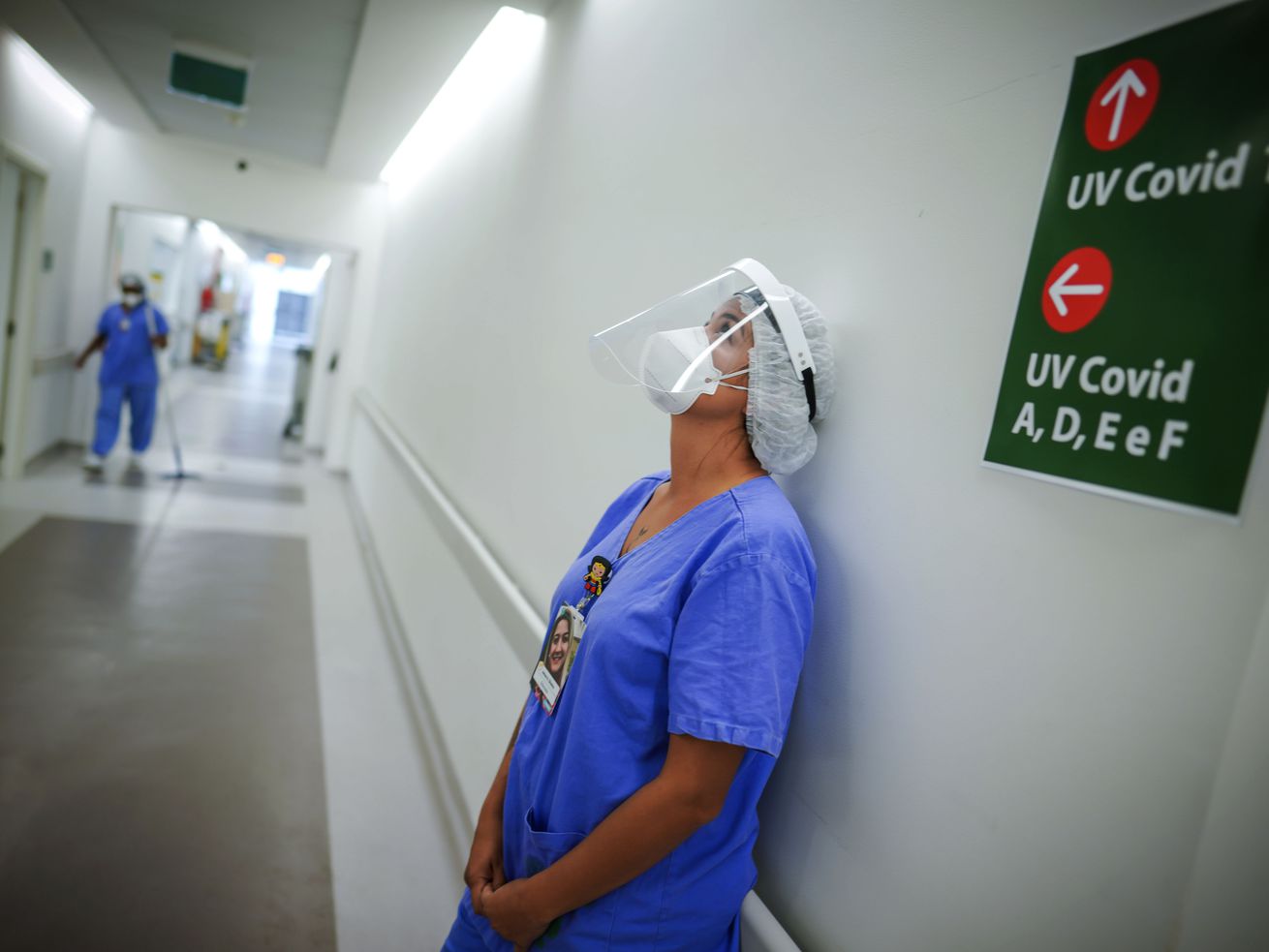
In this March 19, 2021 file photo, a health worker pauses in the ICU unit for COVID-19 patients at the Hospital das Clinicas in Porto Alegre, Brazil. As Brazil hurtles toward an official COVID-19 death toll of 500,000 — second-highest in the world — science is on trial inside the country and the truth is up for grabs. | AP
With the milestone likely to be reached this weekend, Brazil’s Senate is publicly investigating how the toll got so high, focusing on why President Jair Bolsonaro’s far-right government ignored opportunities to buy vaccines for months while it relentlessly pushed hydroxychloroquine, the malaria drug that rigorous studies have shown to be ineffective in treating COVID-19.
BRASILIA, Brazil — As Brazil hurtles toward an official COVID-19 death toll of 500,000 — second-highest in the world — science is on trial inside the country and the truth is up for grabs.
With the milestone likely to be reached this weekend, Brazil’s Senate is publicly investigating how the toll got so high, focusing on why President Jair Bolsonaro’s far-right government ignored opportunities to buy vaccines for months while it relentlessly pushed hydroxychloroquine, the malaria drug that rigorous studies have shown to be ineffective in treating COVID-19.
The nationally televised hearings have contained enough scientific claims, counterclaims and outright falsehoods to keep fact-checkers busy.
The skepticism has extended to the death toll itself, with Bolsonaro arguing the official tally from his own Health Ministry is greatly exaggerated and some epidemiologists saying the real figure is significantly higher — perhaps hundreds of thousands higher.
Dr. Abdel Latif, who oversees an intensive care unit an hour from Sao Paulo, said the fear and desperation caused by the coronavirus have been compounded by misinformation and opinions from self-styled specialists and a lack of proper guidance from the government.
“We need real humane public health policy, far from the political fight and based on science and evidence,” he said.
Brazil’s reported death toll is second only to that of the U.S., where the number of lives lost has topped 600,000. Brazil’s population of 213 million is two-thirds that of the U.S.
Over the past week, official data showed some 2,000 COVID-19 deaths per day in Brazil, representing one-fifth the global total and a jump public health experts warn may reflect the start of the country’s third wave.
Bolsonaro has waged a 15-month campaign to downplay the virus’s seriousness and keep the economy humming. He dismissed the scourge early on as “a little flu” and has scorned masks. He was not chastened by his own bout with COVID-19. And he kept touting hydroxychloroquine long after virtually all others, including President Donald Trump, ceased doing so.
As recently as last Saturday, Bolsonaro received cheers upon telling a crowd of supporters that he took it when infected.
“The next day,” he declared, “I was cured.”
He pushed hydroxychloroquine so consistently that the first of his four health ministers during the pandemic was fired and the second resigned because they refused to endorse broad prescription of the medicine, they told the Senate investigating committee.
The World Health Organization stopped testing the drug in June 2020, saying the data showed it didn’t reduce deaths among hospitalized patients. The same month, the U.S. Food and Drug Administration revoked emergency authorization for the drug amid mounting evidence it isn’t effective and could cause serious side effects.
Nevertheless, the notion that medicines like hydroxychloroquine work against COVID-19 is one of the main things the fact-checking agency Aos Fatos has been forced to debunk continually for the past year, according to Tai Nalon, its executive director.
“This didn’t change, mostly because there is a lack of accountability of doctors and other medical authorities who propagate this sort of misinformation, and the government supports it,” Nalon said. “Basically it takes only the president to make any fact-checking efforts not useless, but less effective.″
In fact, the Senate hearings that began in April have turned into a forum for dueling testimony from doctors who are either pro- or anti-hydroxychloroquine, creating what some experts fear is a misimpression that the drug’s usefulness is still an open question in the international scientific community.
A Health Ministry official who is a pediatrician told the Senate that there is a much anecdotal evidence of its effectiveness and that the ministry provided guidelines for its use without explicitly recommending it. Fact-checkers cried foul, saying the ministry’s own records show it distributed millions of the pills nationwide for COVID-19 treatment.
A cancer specialist and immunologist who has been one of the drug’s biggest champions — and is said to be an informal adviser to the president — also testified, decrying demonization of a drug she said has saved lives. But fact-checkers proved her wrong when she claimed Mexico is still prescribing it for COVID-19.
Still, the drug is celebrated across social media, including Facebook and WhatsApp. And other misinformation is circulating as well.
Bolsonaro told a throng of supporters on June 7 that the real number of COVID-19 deaths in 2020 was only about half the official death toll, citing a report from the national accounting tribunal — which promptly denied producing any such document.
The president backtracked but has publicly repeated his claim of mass fraud in the death toll at least twice since.
Epidemiologists at the University of Sao Paulo say the true number of dead is closer to 600,000, maybe 800,000. The senators investigating the government’s handling of the crisis ultimately hope to quantify how many deaths could have been avoided.
Pedro Hallal, an epidemiologist who runs the nation’s largest COVID-19 testing program, has calculated that at least 95,000 lives would have been spared had the government not spurned vaccine purchase offers from Pfizer and a Sao Paulo institute that is bottling a Chinese-developed shot.
When the U.S. recorded a half-million COVID-19 deaths, President Joe Biden held a sunset moment of silence and a candle-lighting ceremony at the White House and ordered flags lowered for five days. Bolsonaro’s government plans no such observance.
The Health Ministry is instead trumpeting the 84 million doses administered so far. The number is mostly first shots; just 11% of Brazil’s population is fully vaccinated.
The Senate committee will name at least 10 people as formal targets of its investigation by next week, members told The Associated Press on condition of anonymity. That could lead to a recommendation of charges by prosecutors. The list includes the pediatrician and cancer specialist who testified, the current health minister and his predecessor.
For his part, Bolsonaro has said the investigation amounts to persecution.
Last week, microbiologist Natalia Pasternak, who presides over the Question of Science Institute, a nonprofit that promotes the use of scientific evidence in public policies, went before the committee and decried the government’s “denialism.” She lamented that the myth of hydroxychloroquine won’t seem to die.
“In the sad case of Brazil, it’s a lie orchestrated by the federal government and the Health Ministry,” she said. “And that lie kills.”
Biller reported from Rio de Janeiro. AP videojournalist Tatiana Pollastri contributed from Valinhos, Sao Paulo.
Heath Ledger (left) and Jake Gyllenhaal play ranch hands with a connection in “Brokeback Mountain.” | Focus Features
Set in 1920s Denmark, in 1960s New York, in 1970s San Francisco and elsewhere, these absorbing stories make for perfect Pride Month viewing.
In recent years, we’ve seen more LGBTQ+ characters in movies and on streaming series and films and on broadcast TV than ever before and more actors and filmmakers who are open about their identity.
As a mirror of society, Hollywood is a long ways from perfect, and the conversations will be ongoing and the road to equality might never be 100% complete. But the progress is real, and that’s a wonderful thing.
To commemorate and celebrate Pride Month, here’s my list (in alphabetical order) of some of the best LGBTQ+ movies of all time.
‘The Boys in the Band’ (original and remake)
The great Chicago treasure William Friedkin (“The Exorcist,” “The Conversation”) directed the 1970 adaptation of Mart Crowley’s groundbreaking play about a group of gay men gathering for an unforgettable evening in an apartment on the Upper East Side. This was one of the first major films centering exclusively on gay characters. A half-century later, the remake starring openly gay actors Jim Parsons, Zachary Quinto and Andrew Rannells, among others, worked as a reminder of a time when even in New York City in the times-are-changing 1960s, most gay men felt free to be themselves only behind closed doors and among their own ranks.
‘Brokeback Mountain’ (2005)
Heath Ledger posthumously won the best supporting actor Oscar for his portrayal of the Joker in “The Dark Knight” and rightfully so, but his best performance came a few years earlier as the ranch hand Ennis Del Mar, who shares a long and complicated and hearbreaking love affair with Jake Gyllenhaal’s Jack Twist. “Brokeback Mountain” won Oscars for Ang Lee (director) and Diana Ossana and Larry McMurtry (adapted screenplay), but somehow the best-directed and best-written film of the year lost best picture to “Crash,” a decision controversial to this day.
‘The Celluloid Closet’ (1996)
Hollywood holds a mirror to itself in this comprehensive, sly, funny and beautifully rendered documentary about the history of gay characters — identified or implied — in cinema. We see clips of gay characters in silent movies (Thomas Edison made a short depicting two men dancing in 1895), later eras when they were almost always portrayed as villains or weak-willed, and keen insights from actors and filmmakers. Setting up a clip from “Gentlemen Prefer Blondes,” the brilliant writer Paul Rudnick (“In & Out,” “Jeffrey”) notes the dancers are “a gym full of body builders who have absolutely no interest in Jane Russell.”
‘The Danish Girl’ (2015)
Loosely inspired by the true story of one of the first recipients of sex reassignment surgery, Tom Hooper’s sensitive and quietly powerful period piece film set in the early 20th century stars Eddie Redmayne as Einar, who becomes Lili, and Alicia Vikander as Gerda, Einar/Lili’s supportive wife. Both performances were lovely and resonant and garnered Oscar nominations, with Vikander winning best supporting actress.
‘Love, Simon’ (2018)
The easy shorthand I’ve employed to describe Greg Berlanti’s irresistibly funny and sweet story is that it’s a John Hughes high school comedy/drama, only this time the main character is gay. Nick Robinson is a 21st century Matthew Broderick — handsome and self-deprecating and smart and likable — as the title character, who knows he’s gay and is trying to find the right moment to share that with the world. With Josh Duhamel and Jennifer Garner as the kind of parents every gay teenager deserves.
‘Milk’ (2008)
Sean Penn is magnificent as the legendary and groundbreaking Harvey Milk, the first openly gay individual elected to public office in the state of California, and James Franco delivers one of his most memorable performances as Milk’s partner, Scott Smith. Directed by the versatile and gifted Gus Van Sant (“My Own Private Idaho,” “Drugstore Cowboy”), “Milk” is a powerful slice of 1970s/1980s political history, and an empathetic biography.
‘Moonlight’ (2016)
Writer-director Barry Jenkins’ Oscar-winning adaptation of a play by Tarell Alvin McCraney is really three films in one, chronicling the life and times of Chiron, who is played by Alex Hibbert as a child, Ashton Sanders as a teen and Trevante Rhodes as an adult, as he endures a hardscrabble life and wrestles with his identity. It’s a gorgeous, tough, gritty, emotionally impactful film that will make your heart soar one moment and shatter the next. “Moonlight” is showing at several AMC and Regal theaters this week in observance of Juneteenth.
‘Personal Best’ (1982)
Writer-director Robert Towne celebrates the physicality of athleticism and sexuality in the story of an up-and-coming track-and-field athlete (Mariel Hemingway) who becomes romantically involved with an established star (real-life track and field competitor Patrice Donnelly). This is an underseen gem that deserves a new audience.
This exquisitely rendered, dreamlike, 18th century lesbian love story set on the western coast of France has Adèle Haenel and Noémie Merlant turning in simmering and great work as Heloise and Marianne, respectively, who become friends and eventually more. Their romance is a slow, sultry, intense build, and director Celine Sciamma paints each frame with the unmistakable signature of an original artist.
‘Tangerine’ (2015)
Shot entirely on iPhone 5s smartphones (relics!), director Sean Baker’s fast-paced, furiously funny, screwball indie comedy/drama stars transgender actresses Kitana Kiki Rodriguez and Mya Taylor as Sin-Dee and Alexandra, respectively, sex workers who get involved in a series of madcap adventures on the streets of Los Angeles on Christmas Eve. A wild, raunchy, profane and farcical buddy comedy, with Rodriguez and Taylor making for an explosively hilarious and original duo.
Conference leaders continue to make progress on a plan to expand the college football playoff from four to 12 teams. | Ross D. Franklin/AP
There is no announced timeline and the earliest expansion would be possible is likely 2023 if there are no big snags.
College Football Playoff expansion took another step forward as the full group of commissioners who manage the postseason system spent about six hours over two days digging into a proposed plan for a 12-team format.
“This is the beginning of a long, ongoing process,” Big 12 Commissioner Bob Bowlsby said Friday as he departed Big Ten headquarters in Rosemont. “It’s going to be months before we come to any closure on any of this.”
There is no announced timeline and the earliest expansion would be possible is likely 2023 if there are no big snags.
Last week, the CFP unveiled a plan to expand from four to 12 teams. Six spots would be reserved for the highest-ranked conference champions and and the other six would be at-large spots. The plan calls for first-round games played on campuses and quarterfinal and semifinal games played in bowls.
The detailed proposal was developed over two years by four members of the CFP management committee: Bowlsby, Southeastern Conference Commissioner Greg Sankey, Notre Dame athletic director Jack Swarbrick and Mountain West Commissioner Craig Thompson.
“You can imagine how many pages of notes I have on two years of work. And that’s what we’re trying to bring everybody else up to speed with,” Bowlsby said.
This week’s meeting was the first chance for the entire 11-person management committee to discuss the proposal in person. The other members include the commissioners of the Big Ten, Pac-12, Atlantic Coast Conference, American Athletic Conference, Conference USA, Sun Belt and Mid-American Conference.
“Four of us were at one place. Now I think we have 11 of us at that place,” Bowlsby said. “Now, we move to talk to the presidents and see if we can get them at that place.”
Next week, the group reconvenes in Dallas to present the plan to the CFP’s Board of Managers, the university presidents who have final say on what would be a momentous change in college football, with financial ramifications for bowls and conferences alike.
Before anything becomes a done deal, the commissioners want to hear from their local constituents: athletic directors, coaches and players. What do they think about all this?
“This is an enormous undertaking with dozens and dozens of moving parts and it’s not going to be a rapid process,” Bowlsby said. “This is going to be at least (this) fall before we have the necessary conversations and possess the necessary information to make informed decisions.”
The Committee on Public Safety on Friday refused to consider an eleventh-hour compromise that would give a civilian oversight panel the final say on police policy disputes. | Scott Olson/Getty Images file
The mayor was poised to suffer another bitter political defeat after a compromise was hammered out that would give a civilian oversight panel the final say in disputes over police policy.
Mayor Lori Lightfoot was spared a bitter political defeat Friday on the pivotal issue of civilian police oversight by the narrowest of margins.
By a 10-9 vote, the Committee on Public Safety refused to consider an eleventh-hour compromise hammered out without the mayor’s input that would give a civilian oversight panel the final say on police policy disputes.
About an hour before the vote, Ald. Carlos Ramirez-Rosa (35th) predicted that the votes would be there to approve the stronger oversight ordinance over Lightfoot’s strenuous objections after proponents agreed to “split out” a binding referendum that, if passed, would give the civilian panel even broader powers.
“We know we don’t have the votes in the Public Safety Committee to pass that referendum. But we do have enough votes to pass the portions of the ordinance that do not include the referendum,” Ramirez-Rosa said.
“So, we agreed this morning to remove the referendum from the ordinance being voted on today. And that should secure us more than a majority in the committee to pass this.”
But Public Safety Committee Chairman Chris Taliaferro (29th) refused to consider the compromise distributed to aldermen only 30 minutes earlier.
When Ald. Nick Sposato (38th) made a motion to table consideration of the new compromise, Taliaferro called for a vote. The roll was called. The vote was 10 to 9 in favor of the motion not to consider the compromise.
“We’ve waited four years to vote on this matter. … A majority of the City Council is on board,” said a disappointed Ald. Harry Osterman (48th), City Council champion for civilian oversight.
Sun-Times fileAld. Chris Taliaferro (29th)
Taliaferro said he objected to immediate consideration of the compromise because he “screamed from the rooftops” for supporters to “pull the referendum and you would have support.”
“No one listened” until Friday, Taliaferro said.
Taliaferro also condemned what he called the “threats, intimidation and harassment” by proponents of civilian police oversight who show up at the homes of Chicago aldermen “plaster things in front of their doors” and put their spouses and children “in harm’s way.”
“I can’t support that type of conduct. … That’s not democracy at its best. Democracy is protesting peacefully,” Taliaferro said.
The committee then voted on a motion to adjourn the meeting until Monday at 1 p.m., when the compromise would be considered. The vote was 9-to-8 not to adjourn. That set the stage for aldermen to consider the mayor’s ordinance, which lacks support, and the old version of civilian review that has been supplanted by the compromise.
But Ald. Jason Ervin (28th) made another motion to adjourn that was accepted.
Lightfoot finally has delivered her own plan for civilian police oversight, but it did not include the sweeping policymaking, budgeting and hiring and firing powers she promised during the mayoral campaign.
Instead of allowing the seven-member commission she offered to create to choose Chicago’s police superintendent, Lightfoot would retain that coveted power for herself and future mayors.
Sun-Times fileAld. Carlos Ramirez-Rosa (35th)
Ramirez-Rosa championed the more extreme version of civilian oversight proposed by the Civilian Police Accountability Council before helping to forge the compromise with the Grassroots Alliance for Police Accountability.
The new compromise gives the civilian oversight commission the final say in disputes over police policy.
The panel would also be empowered to take a vote of no-confidence in Chicago’s police superintendent that could set the stage for the top cop’s removal if the City Council agrees by a two-thirds vote, he said.
“The mayor was not part of these conversations. She had her opportunity to work with the coalition on meaningful civilian oversight. The ordinance that she introduced was not a serious proposal for civilian oversight,” Ramirez-Rosa said.
“Her staff reached out to us earlier this week and put nothing on the table. All they said was, ‘Will you postpone the vote?’ The vote’s been postponed how many times? How many years? It’s time to pass this ordinance.”
Like Lightfoot, Taliaferro has argued that the mayor “wears the jacket” for public safety and needs to have the final say on police policy disputes and the fate of the police superintendent.
“It should be within the authority of the mayor to hire and fire the superintendent, the Police Board and the COPA administrator. If she’s gonna wear the hat for any good or bad that happens within the police department, she needs to be able to hire and fire the chief executive of those offices,” Taliaferro told the Sun-Times last month.
“I can’t imagine being the mayor of a municipality and you have no say-so in the direction of the police department.”
Lightfoot campaigned on a promise to empower a civilian oversight panel to hire and fire the police superintendent and have the final word in disputes over police policy.
Civilian oversight was a pivotal recommendation by the Task Force on Police Accountability she co-chaired in the furor that followed the court-ordered release of the Laquan McDonald shooting video.
After the election, Lightfoot changed her tune, just as she has on her support for an elected school board bill approved by the Illinois House this week over her strenuous objections.
Here comes the bride! Wedding season is BACK and we couldn’t be more excited to celebrate love in the Windy City. Depending on your budget, there are plenty of amazing local talent that will capture your big day in the best way. Here’s a quick roundup of the top wedding photographers in Chicago.
Cue the heart eye emojis. Born in São Paulo, Brazil, award-winning photographer Layla Eloá has been photographing weddings since 2007. Her work has been featured on The Knot, bridal magazines and conferences as well as many online publications. Layla’s authentic style sparks joy and happiness in every photo she captures.
During her 14 years in business, Victoria Sprung has shot over 550 weddings! She’s an animal lover and one of the official photographers of the Tree House, a humane society based in Chicago. Victoria and her team have won several awards from WeddingWire and they’ve made The Knot’s prestigious Hall of Fame.
Looking for something different? Award-winning photographer Christopher says, “Defining my style can be difficult. I try to create a unique and creative portrait session for each couple.” He enjoys experimenting and trying new things. And the best part? Everything is done in camera, no Photoshop tricks here.
Michelle is an expert photographer based in Chicagoland. For over 15 years, she’s worked with 500+ couples documenting and preserving moments of their special day. Recently, she has enjoyed turning her camera on her own family as she raises her two children along with her wife, Robyn.
Sometimes your photographer just blends in with your family. That’s Noelle in a nutshell. She likes to see how you interact with your loved ones to capture those special moments. Whether you’re wild and carefree or more calm and lowkey, Noelle will adjust her style to match your vibe.
How would you describe Lauren Ashley’s style? One word: stunning. Lauren and her team work hard to create timeless photography with emotion and romance. No need to worry about overly posed or mundane photos. When you choose Lauren Ashley Studios, your photographs will make you laugh, cry, and maybe even scream in delight.





/cdn.vox-cdn.com/uploads/chorus_asset/file/16189847/west_cst_03xx_15_7_52497685.jpg)
/cdn.vox-cdn.com/uploads/chorus_asset/file/19870130/CPSSTRIKE_102419_21.jpg)
 (@laurenashleystudios)