What’s New

PopCultivator wants to lead comic book creators in the right directionon June 29, 2021 at 5:30 pm

As the pandemic disrupted the comic book industry in April 2020, Devil’s Due Comics founder Josh Blaylock could see changes on the horizon. Creators previously resistant to experimenting with technology or crowdfunding sites suddenly needed income as publishers called for “pencils down.”

“COVID forced a lot of creators to start using platforms like Kickstarter and Patreon, and they found out they could be successful,” Blaylock says. “It was a great ripping off of the veil of any gatekeeper model or barrier that had existed before.”

Out of this destruction, Blaylock’s self-described “hybrid agency/studio” PopCultivator was born. To be clear, PopCultivator is not a comic book publisher. Instead, it exists as a crowdfunded management entity that gives fans part-ownership stake in the business while connecting comic book creators with publishers.

“We’re not beholden to any publisher, and we’re not trying to create our own universe. We’re artists,” Blaylock says. “We look at each comic on a case-by-case basis and decide what’s the best route for that title to take.”

For the modern comic book creator, the number of those routes alone can be overwhelming. One path is creating an independent webcomic. Another is taking three completed issues to a publisher like Image Comics. PopCultivator’s potential strength lies in its ability to approach comics that creates a win-win situation for both comic creators and publishers.

“From the creative side, PopCultivator can fund the artist being able to produce the rest of the book without any stress. We bring in an entire team with expertise in different areas to help develop the property,” Blaylock says. “From the publishing side, PopCultivator is bringing a book that’s ready to go, with a vetted creator that’s already being funded and marketed.”

In this new venture, Blaylock is acting as CEO. His surrounding team–which he describes as “the Avengers of the comic book/pop culture world”–includes chief business development officer Michael Horn, COO Stuart Bernstein, director of all-ages content Jose Garibaldi, talent management director/contributing editor Kit Caoagas, events director Alma Silva, entertainment development director/story editor Shawn DePasquale, accounting vice president Debbie Davis, and consulting editor Mark Powers.

Each person brings a range of experience with them. Garibaldi has worked in animation on Nickelodeon’s Teenage Mutant Ninja Turtles and Dav Pilkey’s The Epic Tales of Captain Underpants. Powers is a former senior editor from Marvel Comics. Horn has previously licensed merchandise with properties such as South Park and G.I. Joe.

Like the rest of the PopCultivator team, Horn says he has “been in and out of the comic-book business my entire career.” When approached by his longtime friend Blaylock, Horn was intrigued by the crowdfunded model.

“We’re rewriting the rules, and saying, ‘We can do whatever we want with this,'” Horn says. “At the end of the day, it’s about creating great content. What you do with that content is unlimited.”

To date, PopCultivator has raised nearly $100,000 through its WeFunder website. That money will be spent on four books, including Blaylock’s Arkworld and The Encoded, as well as Garibaldi’s kid-friendly Gabby G.E.A.R.S. and History as Written by Victor.

click to enlarge
Sketches of characters from the all-ages comic book Gabby G.E.A.R.S. - JOSE GARIBALDI

For Garibaldi, the creative freedom piqued his interests. Throughout his career, the creator-artist has worked for brands and companies tied to shifting trends, budgets, and creative pipelines. For example, while working as a character designer for Teenage Mutant Ninja Turtles, he couldn’t create elaborate creatures. Instead, executives, editors, and producers would make notes on designs, keeping an eye on budgets and if the content would track well with certain age groups. Working with PopCultivator, he has certain standards he’ll follow due to the nature of his books being available for all ages. Other than those guidelines, Garibaldi has free reign.

“PopCultivator gives me freedom and more space to work on my characters,” Garibaldi says. “Working on a creator-owned project and having it crowdfunded, it’s nice to be able to see how far I can take some ideas.”

The next six months will be devoted to “buckling down and making comics,” Blaylock says. Fans who donated will get updates through the WeFunder page. If PopCultivator isn’t making good on what has been promised, Blaylock hopes fans will keep everyone in check.

“At the end of the day, if we’re not doing good deals with those creators or not monitoring the situation, we’ll hear about it from our investors,” Blaylock says. “These aren’t random stockholders. All the people involved in the company are true comic book fans, making this a true check-and-balance-type system.”

How far PopCultivator can go will be a matter of time. Horn, the optimistic entrepreneur, is already imagining a world full of the company’s brands.

“I’d love to see it become an IP powerhouse where the business creates brand after brand after brand, and the comics are simply the launching point,” Horn says. “I’d love to go sit in a movie theater and see the PopCultivator logo on the screen, or go into Target and see action figures for sale . . . That’s the goal.” v

Read More

PopCultivator wants to lead comic book creators in the right directionon June 29, 2021 at 5:30 pm Read More »

‘The dawn of a new day:’ New Illinois law allows student athletes to be compensated for use of name, imageon June 29, 2021 at 6:08 pm

Student athletes soon can be compensated for the use of their name or image under legislation signed into law by Gov. J.B. Pritzker on Tuesday.

The Student-Athlete Endorsement Rights Act allows athletes at colleges and universities to retain agents. The law, which goes into effect Thursday, also outlines when a student athlete may be compensated.

The legislation allows student athletes to “take control of their destiny when it comes to their own name, image likeness and voice,” Gov. J.B. Pritzker said at the bill-signing ceremony at the State Farm Center on the campus of the University of Illinois at Urbana-Champaign.

“With this law, Illinois is at the forefront of taking some pressure off of talented kids who are torn between finishing their degree or cashing in on the big leagues,” Pritzker said. “But to be clear, the benefits of this law don’t stop with kids bound for the NFL, or the NBA.

“Any student athlete can partner with businesses in their college towns, as well as brands big and small, to see a financial benefit from the hours they pour into their craft … This isn’t just a win for student athletes, it’s a win for the future of our entire state.”

Pritzker was joined by state legislators and the athletic directors from U of I, as well as Northwestern University and DePaul University.

State Rep. Kam Buckner, D-Chicago, said the bill is about “autonomy” and fairness.

A former defensive lineman on the football team at Illinois, Buckner sponsored the legislation in the House and said the “long overdue” law modernizes the college athletics landscape.

“This is not just a win for the star quarterback or the star point guard. This gives the women’s tennis player an opportunity to be compensated for teaching lessons back in her hometown during summer breaks. This creates an apparatus for the women’s softball player to lend her image to the local pizzeria for fair market value,” Buckner said.

“This is the dawn of a new day, and today we have created the change that our student athletes deserve.”

The law also bars organizations, such as the National Collegiate Athletic Association, from preventing student athletes from being paid for the use of their name or image.

It also allows higher education institutions to set “reasonable limitations” on the dates and times that a student competitor might participate in endorsement or promotional activities.

Eva Rubin, who plays on U of I’s women’s basketball team, said as a student athlete she and others spend many hours in class and on the sport “that you get to watch us play on television.”

The new law will likely allow her to do more for her community.

“I’m actually a Type 1 diabetic and, with my small platform that I’ve been able to kind of build for myself here at the University of Illinois, I’ve had many opportunities to work with diabetes research foundations,” Rubin said. “With the [bill] being passed, I can only imagine the opportunities that I’ll be able to create for myself and build for myself and ways that will help me give back to my community.”

Last week, the U.S. Supreme Court decided in a 9-0 opinion that the NCAA can’t enforce rules limiting education-related benefits — such as computers and paid internships — that colleges offer to student athletes but didn’t make a ruling on whether students can be paid salaries.

Buckner said that decision is a sign that things are changing for college athletes.

“I think we don’t know what everything will look like in the coming months and years, but I think what this signals is that we’re poised and ready to be at the vanguard and be at the front of the charge” for making things more equitable for college athletes, the South Side Democrat said.

Read More

‘The dawn of a new day:’ New Illinois law allows student athletes to be compensated for use of name, imageon June 29, 2021 at 6:08 pm Read More »

Activists urge Biden to rethink anti-violence strategyon June 29, 2021 at 6:13 pm

A group of Chicago-area activists is urging President Joe Biden to rethink his plan to send a strike force to help local police stem the flow of illegal guns into the city.

“In Chicago, the problem is not the end result of the person who pulls the trigger on the gun, as much as it is the system that allows him to have the gun,” said the Rev. Marvin Hunter, the senior pastor at Grace Memorial Baptist Church in the North Lawndale neighborhood and a great-uncle of Laquan McDonald, the 17-year-old murdered by a Chicago police officer in 2014.

Hunter and other activists are calling for, among other things, a congressional hearing in the city — with testimony from local mothers who have lost children to gun violence.

Hunter said sending federal forces into violence-plagued neighborhoods on the West and South sides would only make things worse.

“We do not need to be attacked. We need to be heard. We need to be helped,” Hunter said.

Activist Paul McKinley urged Biden to come to Chicago.

“The only way you can solve this problem: you’ve got to talk to the victims of the problem,” McKinley said. “You can no longer sit in the White House — in his ivory tower — and say, ‘I know what the answer is.'”

The Justice Department earlier this month announced the launch of “five cross-jurisdictional firearms trafficking strike forces to help reduce violent crime by addressing illegal gun trafficking in significant firearms trafficking corridors.”

The five strike forces will “focus on significant firearms trafficking corridors that channel guns into New York, Chicago, Los Angeles, the San Francisco Bay Area and Washington, D.C.,” the Justice Department said, to be led by U.S. attorneys “who will coordinate with the Bureau of Alcohol, Tobacco, Firearms, and Explosives and with state and local law enforcement partners in places where firearms originate and where they are used to commit crimes.”

Geneva Reed-Veal, the mother of Sandra Bland, speaks at a press conference responding to President Biden's dispatching a federal task force to Chicago to stem gun violence. Tuesday, June 29, 2021. | Brian Rich/Sun-Times
Geneva Reed-Veal, mother of Sandra Bland.
Brian Rich/Sun-Times

Sandra Bland’s mother, Geneva Reed-Veal, was also among those who spoke. Bland, 28, of Naperville was in Texas for a job interview in 2015 when she was pulled over by a state trooper for failing to signal a lane change. The traffic stop quickly escalated; police dashcam video shows trooper Brian Encinia drawing his stun gun and Bland laying on the ground screaming. She was found hanged three days later while still in custody; her death was ruled a suicide.

“People are pissed, people are tired and we are not playing games,” Reed-Veal said.

She also urged the president to come to the city.

“Mr. Biden, you know you need to be here. You’re going to send a task force to do what? How about you send a task force and tell the [U.S. Department of Justice] to do what they’re supposed to be doing in these cases,” Reed said.

Read More

Activists urge Biden to rethink anti-violence strategyon June 29, 2021 at 6:13 pm Read More »

Chicago Comics: MCA & Chicago Culture Center exhibits take a serious look at the funnieson June 29, 2021 at 5:59 pm

Show Me Chicago

Chicago Comics: MCA & Chicago Culture Center exhibits take a serious look at the funnies

Read More

Chicago Comics: MCA & Chicago Culture Center exhibits take a serious look at the funnieson June 29, 2021 at 5:59 pm Read More »

Princess Diana legacy lives on as fans mark late royal’s 60th birthdayon June 29, 2021 at 5:44 pm

LONDON — Most people wouldn’t volunteer to walk through a minefield. Princess Diana did it twice.

On Jan. 15, 1997, Diana walked gingerly down a narrow path cleared through an Angolan minefield, wearing a protective visor and flak jacket emblazoned with the name of The HALO Trust, a group devoted to removing mines from former war zones. When she realized some of the photographers accompanying her didn’t get the shot, she turned around and did it again.

Later, she met with a group of landmine victims. A young girl who had lost her left leg perched on the princess’s lap.

The images of that day appeared in newspapers and on TV sets around the globe, focusing international attention on the then-languishing campaign to rid the world of devices that lurk underground for decades after conflicts end. Today, a treaty banning landmines has 164 signatories.

Those touched by the life of the preschool teacher turned princess remembered her ahead of what would have been her 60th birthday on Thursday, recalling the complicated royal rebel who left an enduring imprint on the House of Windsor.

Diana had the “emotional intelligence that allowed her to see that bigger picture … but also to bring it right down to individual human beings,” said James Cowan, a retired major general who is now CEO of The HALO Trust. “She knew that she could reach their hearts in a way that would outmaneuver those who would only be an influence through the head.”

In this March 21, 1983 file photo, Diana, Princess of Wales is pictured amid a large group of schoolchildren during her visit to Alice Springs, Australia.
AP

Diana’s walk among the landmines seven months before she died in a Paris car crash is just one example of how she helped make the monarchy more accessible, changing the way the royal family related to people. By interacting more intimately with the public — kneeling to the level of a child, sitting on the edge of a patient’s hospital bed, writing personal notes to her fans — she connected with people in a way that inspired other royals, including her sons, Princes William and Harry, as the monarchy worked to become more human and remain relevant in the 21st century.

Diana didn’t invent the idea of royals visiting the poor, destitute or downtrodden. Queen Elizabeth II herself visited a Nigerian leper colony in 1956. But Diana touched them — literally.

“Diana was a real hugger in the royal family,” said Sally Bedell Smith, author of “Diana in Search of Herself.” “She was much more visibly tactile in the way she interacted with people. It was not something the queen was comfortable with and still is not.”

Critically, she also knew that those interactions could bring attention to her causes since she was followed everywhere by photographers and TV crews.

Ten years before she embraced landmine victims in Angola, she shook hands with a young AIDS patient in London during the early days of the epidemic, showing people that the disease couldn’t be transmitted through touch.

In this Jan. 15, 1997 file photo, Diana, Princess of Wales, wearing protective gear, watches a land-mine clearing demonstration in Huambo, central Angola, one of the most densely mined areas in the country.
AP

As her marriage to Prince Charles deteriorated, Diana used the same techniques to tell her side of the story. Embracing her children with open arms to show her love for her sons. Sitting alone in front of the Taj Mahal on a royal trip to India. Walking through that minefield as she was starting a new life after her divorce.

“Diana understood the power of imagery — and she knew that a photograph was worth a hundred words,” said Ingrid Seward, editor-in-chief of Majesty magazine and author of “Diana: An Intimate Portrait.” “She wasn’t an intellectual. She wasn’t ever going to be the one to give the right words. But she gave the right image.”

And that began on the day the 20-year-old Lady Diana Spencer married Prince Charles, the heir to throne, on July 29, 1981, at St. Paul’s Cathedral.

Elizabeth Emanuel, who co-designed her wedding dress, describes an event comparable to the transformation of a chrysalis into a butterfly, or in this case a nursery school teacher in cardigans and sensible skirts into a fairytale princess.

“We thought, right, let’s do the biggest, most dramatic dress possible, the ultimate fairytale dress. Let’s make it big. Let’s have big sleeves. Let’s have ruffles,” Emanuel said. “And St. Paul’s was so huge. We knew that we needed to do something that was a statement. And Diana was completely up for that. She loved that idea.”

But Emanuel said Diana also had a simplicity that made her more accessible to people.

Twenty-year-old Lady Diana Spencer married Prince Charles, the heir to British throne, on July 29, 1981, at St. Paul's Cathedral in London.
Twenty-year-old Lady Diana Spencer married Prince Charles, the heir to British throne, on July 29, 1981, at St. Paul’s Cathedral in London.
AP

“She had this vulnerability about her, I think, so that ordinary people could relate to her. She wasn’t perfect. And none of us are perfect, and I think that’s why there is this thing, you know, people think of her almost like family. They felt they knew her.”

Diana’s sons learned from their mother’s example, making more personal connections with the public during their charitable work, including supporting efforts to destigmatize mental health problems and treat young AIDS patients in Lesotho and Botswana.

William, who is second in line to the throne, worked as an air ambulance pilot before taking on full-time royal duties. Harry retraced Diana’s footsteps through the minefield for The HALO Trust.

In this Monday, Nov. 2, 1987 file photo, Britain's Diana, the Princess of Wales, is pictured during an evening reception given by the West German President Richard von Weizsacker in honour of the British Royal guests in the Godesberg Redoute in Bonn, Germany.
In this Monday, Nov. 2, 1987 file photo, Britain’s Diana, the Princess of Wales, is pictured during an evening reception given by the West German President Richard von Weizsacker in honour of the British Royal guests in the Godesberg Redoute in Bonn, Germany.
AP

Her influence can be seen in other royals as well. Sophie, the Countess of Wessex and the wife of Charles’ brother Prince Edward, grew teary, for example, in a television interview as she told the nation about her feelings on the death of her father-in-law, Prince Philip.

The public even began to see a different side of the queen, including her turn as a Bond girl during the 2012 London Olympics in which she starred in a mini-movie with Daniel Craig to open the games.

More recently, the monarch has reached out in Zoom calls, joking with school children about her meeting with Russian cosmonaut Yuri Gagarin. What was he like, ma’am?

“Russian,” she said flatly. The Zoom filled with chuckles.

In this June 5, 1996 file photo, Princess Diana pauses at the bed of a seriously injured man as she visits Cook County Hospital in Chicago.
AP

Cowan, of HALO, said the attention that Diana, and now Harry, have brought to the landmine issue helped attract the funding that made it possible for thousands of workers to continue the slow process of ridding the world of the devices.

Sixty countries and territories are still contaminated with landmines, which killed or injured more than 5,500 people in 2019, according to Landmine Monitor.

“She had that capacity to reach out and inspire people. Their imaginations were fired up by this work,” Cowan said. “And they like it and they want to fund it. And that’s why she’s had such a profound legacy for us.”

Read More

Princess Diana legacy lives on as fans mark late royal’s 60th birthdayon June 29, 2021 at 5:44 pm Read More »

NHL commissioner unsure on players going to Beijing Olympicson June 29, 2021 at 5:06 pm

TAMPA, Fla. — NHL Commissioner Gary Bettman cast doubt Monday on whether the league will send its players to the 2022 Winter Olympics in Beijing, citing safety and logistical concerns as well as a tightening time frame.

“We have real concerns about whether or not it’s sensible to be participating,” Bettman said during his annual pre-Stanley Cup Final session with the media.

“We’re already past the time that we hoped this would be resolved,” he added, in noting the league still intends to release its schedule for next season — with or without an Olympic break — before holding the draft on July 23. “We’ll deal with it, just as we’ve managed to be agile and flexible over the last 15 months. But we’re getting to be on a rather short time frame now because this can’t go on indefinitely.”

Bettman said one of the only reasons the NHL is still in discussions with Olympic officials is because the league made a commitment to make every effort to participate in the 2022 Games as part of extending its collective bargaining agreement with the NHL Players’ Association last summer.

The NHL participated in five consecutive Olympics beginning in 1998 before skipping the 2018 Games in South Korea.

NHL Deputy Commissioner Bill Daly called discussions with Olympic officials a work in progress. The outstanding issues include health questions regarding the coronavirus pandemic, and including COVID-19-related insurance issues.

“There’s a lot of uncertainty and unknowns that we’re trying to grapple with, and that takes time,” Daly said.

Previous issues that led to the NHL balking at competing were health insurance and travel costs, as well as access to marketing rights. The NHL also expressed concern over the benefit of shutting down its regular season for two weeks when the Olympics are held in Asia. Games are played in the early morning hours in North America because of the time difference.

International Ice Hockey Federation president Rene Fasel told The Associated Press he hoped a resolution can be reached with the NHL and its players to compete in Beijing. He said the NHL currently has two schedules in place for next season, one featuring an Olympic break and another one not.

“Things are going back and forth, but no stress. We’ll see,” Fasel said by phone. “I cannot speak for the NHL and I just hope they will say they will come. That’s it.”

WOMEN’S HOCKEY

Bettman confirmed the economic hit the NHL sustained as a result of the pandemic has led to the league altering its approach toward supporting a women’s professional hockey league in North America. Bettman urged the National Women’s Hockey League and Professional Women’s Hockey Players’ Association to bridge their differences first.

“If you’re going to make a go of a new league, you’ve got to have all ducks in a row,” Bettman said. “And our hope is the women’s professional landscape can be more unified going forward.”

That’s a switch from Bettman’s previous stance in which he said the NHL would only step in to support a pro women’s league should the two entities — the NWHL and now-defunct Canadian Women’s Hockey League — step aside.

Bettman said the NHL has “been a little distracted” over the past 15 months, in referring to the scheduling and economic challenges raised by the pandemic.

“We are extraordinarily supportive of women’s hockey going forward,” Bettman said. “And at the right time and under the right circumstances we see a role for us to the extent we’re invited.

DIVERSITY WATCH

The NHL pledged to spend $5 million over the next 18 months on diversity and inclusion efforts in a league that remains primarily white and has no Black coaches or general managers. Daly also said a hotline established for players, coaches and staff to report racist behavior after Akim Aliu shared his story about former coach Bill Peters has been “up and running” for several months.

“Part of the dynamic of introducing a hotline like this is making potential people who want to engage with it comfortable in engaging with it, so that is by definition a process of time,” Daly said. “I do think it’s been well-received.”

2021-22 SCHEDULE

The league announced it will hold All-Star Weekend in Las Vegas in 2022, with exact dates to be determined.

The Minnesota Wild will host St. Louis in the 13th Winter Classic at Target Field, the home of Major League Baseball’s Twins, on Jan. 1. The Wild had been awarded the 2021 showcase but the schedule was shortened to 56 games and play didn’t begin until late January. The Wild hosted an outdoor game in 2016, against Chicago at the University of Minnesota’s football stadium.

The NHL Stadium Series will see Nashville host Tampa Bay on Feb. 26 at Nissan Stadium, the home of the NFL’s Tennessee Titans.

Read More

NHL commissioner unsure on players going to Beijing Olympicson June 29, 2021 at 5:06 pm Read More »

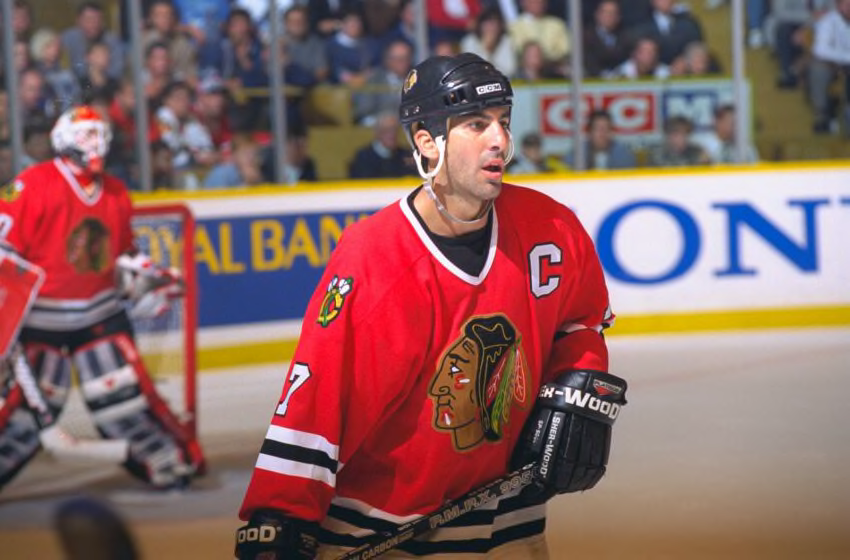
Former Chicago Blackhawks superstar joins ESPN as analyston June 29, 2021 at 5:43 pm

Read More

Former Chicago Blackhawks superstar joins ESPN as analyston June 29, 2021 at 5:43 pm Read More »

Greg ‘Da Bull’ Noll, legendary big-wave surfer, dies at 84on June 29, 2021 at 4:34 pm

LOS ANGELES — Greg “Da Bull” Noll, who became a surfing legend by combining a gregarious, outsized personality with the courage and skill to ride bigger, more powerful waves than anyone had ever attempted, has died. He was 84.

Noll, who had lived in the picturesque, seaside town of Crescent City, California, died Monday of natural causes, according to an Instagram post from his son’s company, Noll Surfboards. Requests for comment from the Noll family were not immediately returned, and it was not clear where he died.

One of the first and arguably one of the greatest big-wave riders, Noll was much more than a surfer. He was also an entrepreneur who helped transform the sport with his Greg Noll surfboards, which were among the first to be built from balsa wood, a substance that made them more maneuverable and light enough for most people to use.

He also appeared in numerous surfing documentaries, worked as a photographer on the 1967 film “Surfari” and was the stunt double for James Mitchum in the 1964 film “Ride the Wild Surf.” In 2010, he and his son Jed launched a surf apparel line.

It was the towering waves he caught, coupled with a blunt but friendly manner, that made Noll’s reputation.

From the early 1950s through the 1960s, he traveled from Southern California to Mexico, Australia and the North Shore of Hawaii’s island of Oahu in search of the biggest waves.

It was in October 1957, at Waimea Bay on Oahu’s North Shore, where he led a handful of surfers to a place where the waves can reach three stories high in the winter. The bay was said to be impossible to surf, and residents claimed nobody had tried since a young California surfer, Dickie Cross, had been killed there in 1943.

Grainy footage shows Noll catching a wave perhaps as high as 30 feet (9 meters), then somehow managing to stay standing as it pitches him some 10 feet (3 meters) or more straight down its face. From there, he moves outside and rides it nearly to the shore.

Years later, Noll would let out a cackle and an expletive as he recalled his first thought after finishing that ride: “I’m still alive!”

From then on, there was no stopping the surfer who was instantly recognizable in his distinctive black-and-white “jailhouse” shorts. He started wearing them, he once said, so people would know it was him on a wave and get out of his way.

In 1964, Noll was credited with being the first person to ride a wave at Oahu’s Third Reef Pipeline. In 1969, at Hawaii’s Makaha Beach, he rode what surfers who saw it asserted was the biggest wave anybody ever caught up to that point.

There was no definitive film footage taken that day, however, and in recent years, others have said the wave was no more than 20 feet (6 meters), not even as big as the ones Noll had surfed at Waimea. Still, no one who questioned the wave’s size doubted Noll’s skill or bravery in hauling his board into the pounding surf that day.

Soon after the Makaha Beach ride, Noll left surfing, closing his surfboard factory in Hermosa Beach and moving to Northern California, where he became a successful commercial fisherman and later a sport fishing guide.

He was unhappy, he said years later, with what the popular “Beach Party” movies of the 1960s had done to surfing. The films flooded the Southern California shoreline, he said, with people who couldn’t surf, got in the way of those who could and didn’t understand or appreciate the sport.

“That whole Hollywood scene at that particular time was just a mess when it came to doing anything meaningful with the surf community,” Noll told The Associated Press in 2013. “They lived in their own little bubble and thought surfing was all about beach parties and people jumping around dancing in the moonlight to funny music.”

By the late 1980s, however, commissions started coming in for custom-made surfboards. Noll opened a little shop in his garage to make them, putting his son Jed, then a teenager, to work with him.

In 2009, his son opened Noll Surfboards in San Clemente and put the father to work designing a line of customized boards for collectors that commemorate historical surfing events or honor legendary surfers.

“It gives me a chance to work with my son and share what I know about the ocean and the boards and the history,” Noll told the AP in 2018.

“Da Bull” was born Greg Lawhead in San Diego on Feb. 11, 1937, later taking the last name of his stepfather, Ash Noll. He moved to the surf town of Manhattan Beach with his mother when he was 3 and soon developed an affinity for the water.

As a young man, Noll had a bodybuilder’s physique, and it was that, along with what fellow surfers described as his hard-charging, bull-headed surfing style, that earned him his nickname.

Although he disdained the “Beach Party” movies, Noll acknowledged that out of the water, he could be a hell-raiser and a good-time party guy himself. He took to surfing, he once said, because it was more fun than working.

As he told the AP in 2008: “People always ask, ‘What is it that makes people want to give up their friends, their family, their jobs and just go surfing?’ Those people always categorize surfing as a sport. But it’s not. It’s a lifestyle.”

A complete list of survivors was not immediately available. Noll and his wife, Laurie, had daughter Ashlyne and sons Jed, Tate and Rhyn.

Read More

Greg ‘Da Bull’ Noll, legendary big-wave surfer, dies at 84on June 29, 2021 at 4:34 pm Read More »

‘Summer of Soul’ is a treasure trove of iconic performances in a festival that history forgoton June 29, 2021 at 4:00 pm

In the summer of 1969, Sly and the Family Stone took the stage in front of a massive crowd at an outdoor music festival and killed with a funk/soul/psychedelic rock set highlighted by the showstopping “I Want to Take You Higher.” The group featured the charismatic and unpredictable and enormously talented frontman/keyboardist Sylvester Stewart, a white drummer and saxophonist, and Black females on piano, trumpet and vocals. They were revolutionary, and they were great, and they gave a performance for the ages.

And six weeks later, they’d do it again at Woodstock.

Some 50+ years after the fact, the Woodstock gathering in upstate New York remains the most famous, the most celebrated, the most legendary outdoor concert in modern history. But before Woodstock, on consecutive weekends in June, July and August of 1969, there was another memorable music festival playing about 100 miles away, at Mount Morris Park in Harlem, with all-star lineups including the aforementioned Sly and the Family Stone, as well as Gladys Knight and the Pips, Stevie Wonder, Nina Simone, BB King, The Fifth Dimension, The Staples Singers, Mahalia Jackson, and the list goes on and on. Whereas Woodstock was immortalized by an Academy Award-winning documentary, bestselling soundtrack album and countless anniversary celebrations, the concerts at the Harlem Music Festival were largely forgotten to history — until now, with the arrival of director Ahmir “Questlove” Thompson’s brilliant and invaluable and stirring documentary “Summer of Soul.”

A local New York TV station broadcast highlights every Sunday night throughout the festival back in ’69, which was also filmed by the late producer/director Hal Tulchin for a possible network special or movie — but we’re told there was no commercial interest in a “Black Woodstock,” so the footage was boxed up and stored away.

Thank the cinematic and music gods it was never destroyed or lost, as “Summer of Soul” is an absolute found treasure of golden onstage moments, interspersed with interviews from participants such as Gladys Knight as well as attendees and cultural commentators, along with celebrity artists such as Chris Rock and Lin-Manuel Miranda. One of the many highlights is when Billy Davis Jr. and Marilyn McCoo of the Fifth Dimension (who have been married for a half century and look amazing) watch footage of themselves and the rest of the group onstage in Creamiscle-colored outfits, performing the “Aquarius/Let the Sunshine In” medley from “Hair” that became a No. 1 hit for them. They’re visibly moved, as McCoo recalls how important it was for them to play Harlem because a lot of people who had only heard them thought they were white.

Gladys Knight & the Pips are shown in their 1969 performance at the Harlem Cultural Festival, featured in the documentary “Summer of Soul.”
Searchlight Pictures

“Summer of Soul” is filled with chills-inducing performances, whether it’s a 19-year-old Stevie Wonder jamming on the drums, the amazing Gladys Knight and those wondrous Pips telling us they “Heard it Through the Grapevine,” or the gospel group the Edwin Hawkins Singers performing a rousing rendition of their crossover smash hit “Oh Happy Day.” We often cut to medium and close-up shots of the fans, and what a beautiful crowd it is: men, women and children, clad in the garb of the late 1960s, having the time of their lives, grooving and moving and nodding and singing along with the incredible music emanating from the stage.

Thompson sprinkles in news footage from the time, reminding of us all that was happening in the summer of 1969, from protests in the streets to a man on the moon. Arguably the most compelling sequence in the film comes when Jesse Jackson talks about how “Take My Hand, Precious Lord” was Martin Luther King’s favorite song and then hands the microphone over to Mavis Staples, who trades vocals with Mahalia Jackson. It’s a moment of pure glorious and authentic emotion and grace, equal to anything we’ve seen in “Woodstock” or for that matter any other concert film.

My only quibble with “Summer of Soul” is director Thompson’s tendency to cut away in the middle of a performance for a bit of historical context, whether it’s archival news footage or a quote from one of the participants or attendees. True, their insights are often moving and insightful, but it might have made for an even more incredible viewing experience had we been given the chance to see more of the numbers performed in their entirety, as they were witnessed by the crowds at the Harlem Cultural Festival in that unforgettable summer of 1969.

Read More

‘Summer of Soul’ is a treasure trove of iconic performances in a festival that history forgoton June 29, 2021 at 4:00 pm Read More »

Ruling in Chicago rioting ‘Joker’ case leaves some statements unusable by prosecutorson June 29, 2021 at 3:55 pm

A federal judge found Tuesday that a Pilsen man invoked his right to counsel when authorities tried to get him to identify himself as the person wearing a “Joker” mask during the May 2020 riots in Chicago, leaving some comments he made unusable by prosecutors.

U.S. District Judge Andrea Wood said Timothy O’Donnell sought the help of a lawyer when an FBI agent and a Chicago police detective asked him June 2, 2020, about a photo of a person in a clown mask sitting on a bridge above the spray-painted words, “KILL COPS.”

Prosecutors say O’Donnell set fire to a Chicago police vehicle while wearing that mask in the 200 block of North State Street on May 30, 2020. His case is among the most high-profile to result from last year’s rioting and looting in Chicago in the wake of George Floyd’s murder by then-Minneapolis police officer Derek Chauvin.

O’Donnell repeatedly denied setting the police vehicle on fire during his interview and told authorities, “I do not stand for the exploitation of me and using me as a puppet to create an image,” according to Wood’s 13-page order Tuesday.

The ruling amounts to a partial victory for O’Donnell’s defense attorneys, Michael Leonard and Steve Greenberg. But authorities had also tied O’Donnell to the incident through a “PRETTY” tattoo seen on the neck of the person wearing the mask, which matches a tattoo of O’Donnell’s. Prosecutors have also said investigators found a similar mask during a search of an apartment where O’Donnell lived.

Timothy O'Donnell
Timothy O’Donnell
Chicago Police Department

In addition, U.S. Magistrate Judge Gabriel Fuentes found last year that video of the incident “is indeed quite damning,” in part prompting him to rule that O’Donnell should be held in custody while awaiting trial. Fuentes also noted then that, in addition to allegedly wearing a “Joker” mask, O’Donnell “self-reported that he has gone by the name ‘The Riddler’ in the past.”

O’Donnell is set to go to trial Feb. 7. He remains in custody at the Metropolitan Correctional Center, according to comments made by Leonard during a status hearing in the case Tuesday.

Wood’s ruling revolved around O’Donnell’s comments during his June 2, 2020, interview after the FBI agent showed O’Donnell the photo of the man in the mask on the bridge above the words “KILL COPS.”

O’Donnell allegedly said, “Yes, that is me, and they so nicely got me um- with uh- it’s all exploitation of image. See ‘kill cops’ and then an image of me as the clown,” according to Wood’s order.

The FBI agent asked O’Donnell to initial the photograph, and O’Donnell asked, “You want to — you just want to make the correlation of me as that man in the — ?” When the FBI agent answered, “Yeah, just you saying that ‘Yes, this is me in the picture,” O’Donnell replied, “I would prefer not to sign any kind of documents.”

Though the FBI agent said he wouldn’t force O’Donnell to sign, a Chicago police officer asked O’Donnell, “But is that you?” And that’s when O’Donnell said, “I’m in fear. I’m not going to say anything further on that matter without a lawyer present.”

Wood’s ruling suppressed any statements O’Donnell made about whether he wore the “Joker” mask after he made that comment. The FBI agent went on to ask O’Donnell about a photo of a person in the mask standing next to the CPD vehicle with his hand close to the gas tank. O’Donnell said a photographer asked him to pose there.

A man alleged to be Timothy O'Donnell reaches toward the gas tank of a Chicago police vehicle in Chicago.
A man alleged to be Timothy O’Donnell reaches toward the gas tank of a Chicago police vehicle in Chicago.
U.S. District Court records

“This is an image with the — the — the man in question is being told, you know, by a photographer to check — to check this out, ‘Hey, look what’s going on,’ like, I mean, not ‘Look what’s going on,’ it’s — he wanted an image, and that’s the image he got. He wanted that specific image,” O’Donnell allegedly said.

The FBI agent asked O’Donnell, “What if we told you we have witnesses that say you’re dancing and having a good time and enjoying yourself and not moving in fear?” O’Donnell replied, “That’s all what an attorney and a court of law — when they are — to be brought up.”

O’Donnell denied setting the vehicle on fire, said “it was supposed to be a peaceful protest” that day, and he said he was there helping bandage people injured by other protesters.

Read More

Ruling in Chicago rioting ‘Joker’ case leaves some statements unusable by prosecutorson June 29, 2021 at 3:55 pm Read More »