Kahleah Copper has been making an impact on the Sky’s starting five since she was traded to the team in 2017.
In her first season with the Sky, Copper averaged 6.7 points in 14.2 minutes off the bench. It wasn’t the same impact she’s having now as a starter, but she came in and made her presence known immediately.
”I started doing the handshakes for the starting five,” Copper said.
Amber Stocks was the coach at the time, and players such as Cappie Pondexter and Tamera Young were still part of the organization. The energy of that team was completely different, and Copper committed herself to playing her role.
Part of that role was being the Sky’s energizer. So she turned what formerly was a ”blah” introduction for the starting five into what fans see today. She even persuaded veteran guard Courtney Vandersloot to showcase her latest and greatest dance moves.
It was a way for Copper to lighten the mood right before tipoff and to emphasize that having fun is just as important as playing well.
The Sky are doing both right now, and Copper’s offensive and defensive production is a large factor in their success.
However, they lost to the Wings 100-91 on Friday night. Copper finished with 11 points, four assists and two rebounds.
On Wednesday, Copper was named a first-time WNBA All-Star. The grind it took to play at an All-Star level isn’t something she will forget. Two of the teammates who have had the biggest effect on her growth are Vandersloot and guard Allie Quigley.
”[Vandersloot] would call me ‘Zero,’ ” Copper said. “She would say, ‘Every time you come in the game, we’re running this iso.’ ”
Vandersloot gave Copper an added level of confidence in her first two seasons with the Sky, running plays for her every time she came off the bench. Quigley added to that by telling Copper early on that she could start on any team in the league, but the Sky needed her here.
Fast-forward to the 2020 season. In Copper’s fifth year in the league, she went from being a role player to a starter and was more than ready for the opportunity. Her production more than doubled in almost every stat during the Sky’s bubble season.
This season, she was ready to take on even more. After working as an assistant coach for the Purdue Northwest women’s team, she had a whole new skill set to add to her repertoire.
She was seeing the game from a coach’s perspective and told coach James Wade before the season that she never would mess up another scouting report.
In 19 games, Copper leads the Sky in scoring at 13.9 points per game. She’s one of the most athletic guards in the WNBA, and her speed and court vision have allowed her to dominate in transition.
Defensively, she’s in opponents’ faces and typically picks up the toughest defensive assignment of the night.
These are all factors that have contributed to her first All-Star selection and to a team chemistry demonstrated by the fact that six players are averaging in double figures in scoring. From top to bottom, Copper thinks the Sky are the best team in the league.
Less than 24 hours before the All-Star team was announced, Copper wasn’t sure she would see her name on the Team WNBA roster. The outward confidence she had been exuding, telling fans to vote for ”Kahleah Freaking Copper” in more than one news conference, had given way to a more reflective attitude. She said she thought she deserved to make the roster.
Fans, fellow WNBA players, league coaches and a panel of sports journalists agreed.
Wade said it was a great moment when he told Copper the news that she had made her first All-Star team because it was a dream they shared.
CHICAGO — The note sat on the back of Tracey Bradley’s couch when she returned home from work late that morning.
Written by her 10-year-old daughter, Tionda, the note said she and Diamond, her 3-year-old sister, had run by the store and to a park on Chicago’s South Side.
But something was off about the note: Everything — the spelling, the grammar — was too perfect for a girl attending summer school to improve her reading and writing.
It was also unlike Tionda to leave a note. Even if the girls had left the apartment, Tionda would have called her mom’s cell phone.
The Bradley sisters were gone.
Twenty years ago this summer, Chicago launched what investigators say may be the city’s largest missing persons investigation to date.
The police superintendent ordered the city turned upside-down to find them. Over the course of months, nearly every abandoned building in Chicago — some 5,300 of them — was mapped and searched. Sewers, dumpsters, forests, lakes and rivers were dredged and scoured. More than 100 sex offenders were interviewed. And about 42 tons of garbage was picked over by law enforcement, including new police recruits.
Everyone was on duty.
In the hunt for the girls, leads took investigators and journalists across the country, even to Morocco, chasing possible sightings, psychics’ visions and fraud, with enough tips to fill 25 filing cabinets. But as the time stretched to weeks, months and years, no sign of the girls has ever turned up.
It was an odd case to catch the city’s attention. Two young Black girls had gone missing from a high crime and impoverished area of Chicago.
Tracey Bradley, the mother of Diamond and Tionda Bradley, holds balloons during a gathering on July 6, 2020, to commemorate the 19th year that the Bradley family has been looking for Diamond and Tionda.Tyler LaRiviere/Sun-Times
Often when young Black children are missing, authorities write them off as runaways, and their cases are unlikely to grab high-profile investigator and media attention, according to investigators and missing persons experts and organizations. So when the Chicago Police initially labeled the Bradley girls’ case as “missing” — not abducted — the family was irate. The case was immediately reclassified as “missing/endangered,” as it remains now.
“I didn’t want the community to overlook it like, ‘Oh, it’s two kids who ran away,'” Shelia Bradley-Smith, the girls’ great-aunt, told USA TODAY. “No, these kids were taken.”
Black children, then as now, are reported missing more often than children of other races. More than 300,000 juveniles are reported missing in the U.S. every year, and while Census Bureau data suggests Black kids make up just 16% of the population under 18, more than 36% of missing juveniles in 2020 were Black, the latest FBI data shows.
For the Bradley sisters, pressure from family members, along with the girls’ ages, changed the narrative. What could have been a short mention on the evening news was soon leading the front pages of city papers and making national news and crime shows.
With each airing of the story, more tips would come in. Some leads seemed promising. Some still do. But no arrests have ever been made and no charges have ever been brought in the case.
The investigation into the girls’ vanishing seemed to move quickly at the start, zeroing in on a man close to the family who gave detectives reasons to suspect him. But the case against him is too circumstantial and the probe remains with the cold case and homicide unit in the same headquarters where it began.
Still, two decades later, a family and a city ask: Where are they?
USA TODAY interviewed a dozen people familiar with details of the case, including detectives, officers and other law enforcement officials who previously worked — or are now working — the investigation. Many sources, fearing for their safety or their careers, asked not to be named in the story.
When the girls went missing on July 6, 2001, Tionda and Diamond were living with their mother and two sisters — Victoria, then 9, and Rita, 12 — in the multi-building Lake Grove Village Apartments complex in the Oakland neighborhood on the South Side. The girls’ school, a handful of parks and Lake Michigan were all within a few blocks.
Tracey Bradley, their mother, is the eldest of nine siblings, and dozens of family members lived in the area, near what was once the largest stretch of public housing in the United States: the Robert Taylor Homes. The project was later demolished, and new residential and commercial structures took its place.
Because of their proximity to one another, the family took turns caring for one another’s kids. Tionda and Diamond primarily split their time between their mom’s place and their grandmother’s apartment in the Robert Taylor Homes.
One of their aunts, April Jackson, would bring them to work with her at Robert Taylor Park, where they took dance and gymnastics classes along with their cousins and other kids from the community.
Tionda wanted nothing more than to become a dancer. Helpful, smart, responsible and a little sassy, she was “like little mama caretaker” to Diamond, Bradley-Smith said.
Diamond, meanwhile, was “a quiet, humble little girl who always had a sweet little smile,” said Faith Bradley-Cathery, the girls’ aunt. Victoria, their sister, recalled how Diamond used to curl up under their mother at home or jump from couch to couch.
The day the girls disappeared, they had planned to go on a camping trip to Lake Shafer in Indiana with their mother and her boyfriend, according to family and investigators. Victoria and Rita weren’t going on the trip and had been dropped off at their grandmother’s place the evening before.
Tracey says she left early that morning for work and returned around 11:30 a.m. to find Tionda and Diamond gone. Before calling police around 6 p.m., Tracey borrowed $20 from a neighbor so she could buy food at the nearby Jewel store. A receipt from the store is stamped 12:21 p.m. Then, she searched the neighborhood, and called family, friends, the school and other places where the kids could have been.
Security cameras at the entrance of the apartment complex didn’t catch anything: The cameras had been pushed upward, according to the family’s private investigator, who goes by the name P Foster and has been working the case pro bono for 20 years. He said some residents may have wanted to hide criminal activity.
Foster does not provide his full name for fear of his family’s safety.
The night before the girls went missing, they were seen by many people. The sisters were at the apartment when Tracey had two friends over to drink and watch the Cubs baseball game. The friends were questioned twice, and they both said the girls were at the home when they left around 10 p.m.
There are also reports that a neighbor in their building came by after the friends left, but that he never went past the front of the apartment and never saw the girls, according to police.
Tracey’s boyfriend came to the apartment around 3 a.m., stayed for a bit, then took Tracey to work around 6:30 a.m., according to investigators.Tionda and Diamond were left alone, with strict orders from their mother not to let anyone — no matter who they were — into the apartment.
Classmates said they saw Tionda and Diamond at the nearby Doolittle Elementary School playground that morning, according to family, who believe the girls slipped out that morning but returned home once the other children headed in for the start of summer school.
According to family, Tionda left a voicemail on her mother’s cellphone around 8:17 a.m., asking if she had permission to let a man in. Tionda used a first name in the message that both Tracey’s boyfriend and the neighbor shared. The girls, however, regularly called the neighbor by a nickname instead.
The boyfriend confirmed to USA TODAY he took Tracey to work that morning but denied showing up at the apartment later when the girls allegedly called their mom to say someone was at the door.
Family allege Chicago police accidentally deleted the voicemail off the cellphone when they brought it down to the station. Law enforcement sources say they’ve never heard it and could not confirm that an officer deleted the message.
Relatives say family, friends and law enforcement came in and out of the apartment before investigators cleared the space to take fingerprints and gather other evidence several days after the girls were gone.
“It wasn’t taped off at all,” the girl’s great aunt, Bradley-Smith said. “That, to me, was a valuable mistake.”
Police investigators familiar with the case could not confirm that the scene was not cleared and searched earlier.
Initially, investigators honed in on Tracey Bradley’s boyfriend at the time, who was close to the girls.
That day, July 6, police took Tracey and her boyfriend in for about 22 hours of separate questioning. They both took lie-detector tests and passed, police sources say.Foster, the family’s detective, said the boyfriend’s test was inconclusive.
Tracey and her boyfriend quickly got lawyers, closing opportunities for investigators to talk openly with them. But police and the FBI still remain in periodic touch with both.
USA TODAY is not naming the man because he has not been charged in the case. Tracey Bradley has not returned calls from USA TODAY.
Several pieces of evidence have pointed investigators in the boyfriend’s direction. For one, investigators found hair matching Tionda and Tracey’s DNA in his vehicle’s trunk. He told police he would sneak the girls into drive-ins in the city, although investigators said the closest drive-ins at the time were in the suburbs.
The boyfriend has offered law enforcement conflicting stories about his actions on the day the girls went missing. Four teenagers and three neighbors said they saw him setting fire to something in a 55-gallon drum in his backyard garage, about 10 miles south of the girls’ home, then putting the barrel into his trunk and driving away, according to sources.
The man, who worked as a machinist and welder, claimed he never burned anything in the drum — or even had a drum, according to police. But he did say he was doing refurbishments on his home and that he dumped debris in garbage containers in Chicago’s Washington Park. Police searched the South Side park but found nothing.
Tyler LaRiviere/Sun-Times
Family pressed prosecutors under then-Cook County State’s Attorneys Richard Devine and Anita Alvarez to charge the boyfriend, but the circumstantial evidence was simply not enough at the time to go further, according to two sources involved in the investigation.
In an interview with USA TODAY in June, the boyfriend denied any involvement with the girls being missing or that he ever took a DNA test to see if he fathered one of Tracey’s children. He claimed he tried to help investigators find them at the beginning.
“I don’t know who did anything; I just know that I had nothing to do with it,” he said of the girls’ disappearance.
The man, who is now 50, said he gave investigators his pictures and videotapes of the girls and surrendered the keys to his car and house. In the garage, he and sources said, investigators found recently purchased rubber gloves, contractor trash bags and bleach from Home Depot that investigators think could have been a way of cleaning up after the girls went missing. Police have the receipt for the purchase.
“That was 20 years ago, and everyone tried to blame me,” he said, adding that “all three of them” — the family, investigators and the media — ganged up on him because they couldn’t solve it.
The family and investigators have also had other suspects.
A man who is a registered sex offender and spent time around the girls later dedicated a book to them, Bradley-Smith says. Some family members say Tracey gave $5 to a relative that day to go watch the girls at the apartment. Others allege the neighbor who the girls had a nickname for once suggested something bad would happen to them if Tracey kept leaving them alone.
And then there’s the theory a Moroccan man, rumored to be Tionda’s father, had something to do with it. According to family, the children who reported seeing the girls on the playground that morning also said they saw a fair-skinned man in a trench coat approach the girls and speak briefly with Tionda. The tip led a local reporter to travel to Morocco to search for the girls, to no avail.
The family also has suspicions about the note Tionda wrote.
According to forensic tests by the FBI in 2001, Tionda did indeed write the note found on the couch, and not under duress. That’s why the family believes Tionda was coached by someone she trusted in writing the note.
“Her writing a full letter with correct grammar? It’s not appropriate for her,” said Jackson, the girls’ aunt. “I’m quite sure whoever took them, she was very comfortable with them.”
Bradley-Smith said she’s hoping the new state’s attorney, Kim Foxx, will revisit the case and bring charges.
A spokesperson for the Cook County State’s Attorney’s Office sent an email to USA TODAY in late June saying it has not been asked to review criminal charges related to the girls’ disappearance but was “open to reviewing any information that is brought to us by law enforcement.”
While police said they never asked the office to bring charges, the office was kept regularly apprised of developments.
The Chicago Police Department, which remains the lead agency in the Bradley sisters’ missing persons case, declined official interviews through the head of the department’s News Affairs, saying the investigation remains open and there are no new leads.
But as recently as Wednesday, a source told USA TODAY the FBI office in Chicago is coordinating with out-of-state authorities about a new tip.
July 6 marks 20 years since Tionda and Diamond disappeared. In those two decades, the number of detectives working the case has dropped from more than 100 to one person working it part time as he handles other cases. Three of the five lead detectives on the case have died.
But many in this city never forgot. The family — who held vigils for the first 40 nights after the girls went missing — now holds an annual one.
A former police detective started writing a book about the case as a sort of therapy to deal with the lack of answers. “There’s very few cases in my career when I didn’t know who did it,” he said. “It was the most frustrating thing I worked on in my life.”
Foster, the private detective, said he’s spoken to a family member every day since soon after the girls went missing. He becomes emotional when talking about the case. “I am so dedicated to the cause, if it takes my grandchildren’s children to find out what happened to Diamond and Tionda, I’m willing to put that at stake,” Foster said.
The two decades of searching has worn on members of the large family and, at times, caused rifts.
Faith Bradley-Cathery, the girls’ aunt and now the mother of four adult children, became so paranoid that she had her landlord put up a 7-foot fence around her property when her children were young.
April Jackson, another of the girls’ aunts, partners with schools to host safety assemblies and help kids craft personalized ID cards. She worked with Walmart to put up a missing children board in each of its stores nationwide. Throughout the COVID-19 pandemic, she printed face masks with the sisters’ faces on them.
Victoria Bradley, the sister whose birthday is the day after the girls disappeared, said she hasn’t celebrated in 20 years. Her mother, Tracey, suffers from panic attacks and often calls her daughter crying, Victoria Bradley said.
Tracey Bradley has been described by multiple sources involved in the investigation as reserved and somewhat suspicious of police. She did talk with some detectives working the case, but sources say her prolonged questioning immediately following the girls’ disappearance forever made her less willing to cooperate with law enforcement.
Bradley-Smith, the girls’ great-aunt and now a missing persons advocate, has spearheaded most of the family’s efforts to raise awareness about the girls. She has lost several jobs and was temporarily homeless in part because of her quest to find the girls.
In 2015, she went looking for a missing Minnesota boy who disappeared three blocks from her home, 10-year-old Barway Collins, and helped find his body on the banks of the Mississippi River. “I did feel like, ‘God, why? Why you gonna let me find somebody else’s? What about ours?'” Bradley-Smith said.
Tens of thousands of dollars in reward money was offered at the time the girls went missing, and the FBI is still offering $10,000. Family set up several online and social media pages dedicated to the girls. Tips — and false hopes — poured in.
Psychics based in New York led the family to the site of animal bones. A MySpace photo that a world-renowned facial recognition expert determined was Tionda turned out not to be. A Dallas woman who claimed to be, at times, both of the girls, was a fraud.
As recently as eight months ago, Bradley-Smith got a tip about alleged bones buried in a backyard, and police and members of the nonprofit Community United Effort Center for Missing Persons went to the South Side to investigate.
“I’ve stressed and worried and searched and hoped and prayed and been disappointed,” Bradley-Smith said. “But all I can do is keep going.”
That Tionda and Diamond have remained an investigative — and media — focus over the last 20 years is due largely to the outspoken family members, who have kept pressure on law enforcement to find the girls, on prosecutors to consider or bring charges against suspects, and on the media to draw the spotlight to the case.
They’re fighting a decades-long uphill battle against a system that tends not to give missing Black children much attention, according to investigators and missing persons organizations.
Social scientists have long noted missing white children — particularly white girls — receive a disproportionate amount of news coverage compared to missing children of color.
Multiple studies in the past two decades have documented the so-called Missing White Woman Syndrome in online, print and television news outlets reaching national and regional audiences. Less news coverage can lead to a greater chance that young Black children are never found or recovered much later.
When a child of color is reported missing by their family members, they’re more likely to be classified as a runaway by law enforcement and receive little media coverage, said Natalie Wilson, co-founder of Maryland-based Black & Missing.
Children classified as a runaway also don’t receive Amber Alerts — messages with information about the missing child broadcasted on radio, displayed on television, sent as text alerts and more.
“Our children are adultified and they are not seen as children,” Wilson said. “We’re trying to change these narratives to say that these are valued individuals missing from our communities, our neighborhoods, and we need to find them.”
Frequently, Wilson said, Black families “feel as though law enforcement just believes that their child ran away, and we’re telling them, ‘You know what — you know your child better than anyone else. If this isn’t what they do, this isn’t characteristic of them, you need to speak up.'”
And the Bradley family spoke up. They knew the girls wouldn’t leave their large family — let alone venture out of the apartment to the store.
In mid-June, Bradley-Smith walked into the third-floor, three-bedroom apartment where the sisters lived, for the first time since July 2001. She traced her fingers along the walls as she walked from room to room, conjuring images of the old layout and pointing to where Tionda and Diamond used to sleep.
“It still feels like yesterday,” Bradley-Smith said after she got back into her car and looked up at the apartment through her window.
Twenty years later, she hopes time will be on her side.
“People talk. People get old. People go to jail. I’m just praying someone will come forward with the information,” Bradley-Smith said. “The world will know Tionda and Diamond Bradley by the time I’m done.”
The FBI asks anyone with information about the disappearance of Tionda and Diamond Bradley to contact Chicago Police Department detectives at 312-747-8380, your local FBI office or the nearest American Embassy or Consulate. You can submit an anonymous tip online here. The family’s private detective can be reached at 847-579-9771.
Police are looking for three suspects in connection with a fatal shooting in May in Chatham on the South Side.
The incident happened about 5:20 p.m. May 11 in the 8600 block of South State Street, Chicago police said.
The three fired shots from a silver-colored Nissan Altima with Illinois license plate FP127379, police said.
The suspects were described as three males. One had short hair and was wearing glasses, a tan baseball hat, dark pants and blue shoes. Another was wearing a black mask, black baseball hat, black and red jacket, black shoes and dark pants.
The third was wearing a blue mask, tan pants, white shirt and a blue, red and white jacket.
Anyone with information was asked to call Area Two detectives at 312-747-8271.
When assessing the 2021 Chicago Cubs season, one can definitely come to the conclusion that this was bound to happen.
What exactly was inevitable? This implosion — that’s what. The Cubs began the season significantly overachieving, at one point holding a few game lead in the NL Central. However, the tires quickly fell off and the Cubs reverted back to the type of team we thought we were going to see at the beginning of the year.
A team doesn’t just sell their top pitcher for marbles during the offseason and allow another savvy vet like Jon Lester walk away. Dealing Yu Darvish was the wrong move, but it was a move that signaled the Ricketts do not care about winning.
The Cubs aren’t going to spend money anytime soon, if things continue the way they have gone over the past couple of years. They are closer to a retool, or even a rebuild, than ever sniffing a title run. The New York Yankees, on the other hand, don’t have that type of humility — or should we say, stupidity.
The Chicago Cubs will be selling at the 2021 MLB trade deadline, and the New York Yankees just might buy.
While the Yankees are dancing around .500 at the moment, general manager Brian Cashman may not be ready to give in just yet. Yankees fans probably want the team to sell, but the Yankees aren’t exactly they type of team to put their pride aside.
If New York wanted to add a couple of big time pieces before the deadline and try to make a push, the Cubs would be a perfect team to do business with. For a little while now, the question of whether to break up this core has tormented fans. It hasn’t been a question of whether they’ll do it, but rather when.
Will the Cubs break up the core this year with one of these types of trades involving the Yankees?
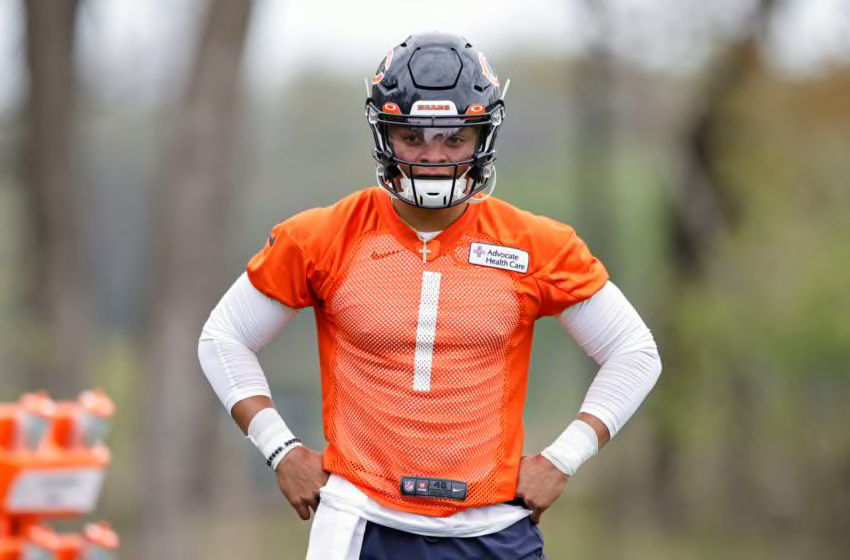
Since the day Justin Fields was drafted by the Chicago Bears, he has been locked in.
Whether it be connecting with new teammates and putting in work on his own time or being the first one in and last one out at team activities, Fields has taken on every ounce of responsibility he possibly can.
The first-round rookie out of Ohio State doesn’t appear to be treating his job like he’s a rookie. From every account, he has taken this opportunity as seriously as possible.
Fields has posted a photo or video from time to time since he was selected by the Bears, giving fans a taste of his offseason workouts and whereabouts. Recently, Fields posted a photo to his Instagram story showing off the strong physique he was lauded for coming out of college.
You can see the photo from Fields’ Instagram here.
Physical traits aren’t everything, but by the looks of it, Chicago Bears rookie Justin Fields won’t be easy to bring down.
From the photo Fields posted, one can tell he has put in some serious work over the years. A lot of fans have compared Fields’ physique to that of Cam Newton, but just a bit shorter. The combination of strength and athleticism is rare in a quarterback these days, but Fields certainly has it.
Speaking of putting the work in, Fields also plans to report to Bears training camp two weeks early. For those who missed it, he told the media he will be studying the playbook even further on his own and meeting with head coach Matt Nagy via Zoom before everybody else arrives.
It is certainly safe to say Fields is not only disciplined in the gym, but mentally strong as well. His discipline with learning and absorbing everything he possibly can as a rookie is impressive.
By the time training camp rolls around, Fields should have a decent grasp on the playbook and enough knowledge to give Andy Dalton a run for his money. Although, it won’t matter in the end if Nagy keeps his word. Dalton is the starter for Week 1.
Don’t be surprised if the Bears’ prized rookie sees all of his offseason work pay off sooner rather than later if Dalton struggles. This kid is here to win at all costs, and it shows thus far. Fields is ready to play in the NFL, and it’s only a matter of time.
MAYOR LIGHTFOOT ANNOUNCES JULY 3RD FIREWORKS TO CELEBRATE CHICAGO’S REOPENING AND INDEPENDENCE DAY WEEKEND
Fireworks will be visible from multiple locations along the lakefront
In a last minute announcement yesterday, Mayor Lightfoot said the city will have have an Independence Weekend Fireworks Celebration on July 3rd.
“Putting on a grandiose fireworks display to celebrate both our city’s reopening and Independence Day is an excellent way to kick off the summer we’ve all been waiting for,” said Mayor Lightfoot. “Thanks to the hard work of our residents, who followed public health guidelines and did their part to slow and stop the spread of COVID-19, we are now able to bring back exciting summer traditions like these. As our newly reopened city continues adapting to a new normal, I want to urge our residents to continue getting vaccinated so we can bring back even more of our favorite outdoor events.”
Here’s what you need to know
The Event
The event will also act as a celebration for Chicagoans whose diligence in following public health guidance has allowed City leaders to safely and fully re-open under Mayor Lightfoot’s “Open Chicago” initiative.
Where
In place of Navy Pier Fireworks, the fireworks display will illuminate Chicago’s skyline from Grand Avenue to the north to at least 55th Street to the south.
Viewing
The fireworks will be visible from multiple locations along the lakefront from Grand Avenue to the north to at least 55th Street to the south.
Getting There
For those who choose to view the fireworks in person, the City recommends travel on public transit. For more information, visit transitchicago.com.
WBBM Newsradio 780 AM & 105.9 FM will provide a music simulcast, broadcasting the music soundtrack to accompany the fireworks display.
Safety
The City of Chicago wants to ensure a safe and enjoyable holiday weekend. The City’s public safety departments along with state and federal agencies will monitor events and activities throughout the weekend. Our top priority is public safety, and the City reminds residents to be aware of their surroundings and report suspicious activity by calling 9-1-1.
Six people have been killed and at least eleven others wounded since Friday night in shootings across Chicago.
In the latest fatal shooting, a man was killed while riding in a car in Lawndale on the West Side.
About 4:40 a.m., the 39-year-old was traveling in the back seat of a vehicle in the 4400 block of West Cermak Avenue when the rear window was shattered, according to Chicago police. He suffered a gunshot wound to the back of the head and was pronounced dead at Stroger Hospital, police said.
Earlier Saturday, a 19-year-old man was found shot to death early Saturday in Belmont Cragin on the Northwest Side.
About 1:25 a.m., officers responded to a call of shots fired in the 2200 block of North Lockwood Avenue and found the teen lying unresponsive on the sidewalk with gunshot wounds to the back and abdomen, police said. He was transported to Illinois Masonic Medical Center where he was pronounced dead, according to police.
A 40-year-old man was fatally shot Friday night during an altercation in an Englewood apartment after he was playing music and a neighbor made several noise complaints, police said.
About 11:20 p.m., the man was playing music in his apartment in the 7400 block of South Emerald Avenue when a neighbor in the building made several noise complaints, police said.
The man then came to the front door of his apartment and began arguing with a person who shot him several times in the torso, police said. The person fled and the man was pronounced dead at the scene, police said.
About three hours earlier, a man was shot to death outside his home Friday night in Roseland on the Far South Side.
The 28-year-old was in his backyard about 8:30 p.m. in the 11200 block of South Vernon Avenue when he was shot in the head, police said. He was taken to Christ Medical Center in Oak Lawn, where he was pronounced dead, police said.
A man was killed and another wounded in a shooting Friday evening in Lawndale on the West Side.
The men, both 20, were in a vehicle that was stopped at a red light about 6:30 p.m. in the 3900 block of West 16th Street when a person approached them on foot and fired shots, police said.
The driver suffered multiple gunshot wounds to the back and torso and was taken to Mount Sinai Hospital, where he was pronounced dead, police said.
The other, a passenger in the vehicle, was struck in the leg and was transported to Stroger Hospital, where his condition was stabilized, police said.
A 22-year-old man was fatally shot about an hour earlier in Hermosa on the Northwest Side.
The man was standing on the sidewalk about 5:30 p.m. when a person stepped out of a light-colored vehicle and fired shots in the 2700 block of North Kilbourn Avenue, police said.
He suffered gunshot wounds to the head and body and was taken to Illinois Masonic Medical Center, where he was pronounced dead.
In nonfatal shootings, a woman was critically hurt in an attack on the Dan Ryan Expressway.
The 55-year-od woman was traveling south on I-94 just after 7 p.m. when her vehicle was struck by gunfire near 49th Street in the Fuller Park neighborhood, according to Illinois State Police.
She suffered a gunshot wound to the chest and was taken to the University of Chicago Medical Center in critical condition, fire officials said.
At least nine other people were wounded in shootings citywide since 5 p.m. Friday.
DETROIT, MICHIGAN – APRIL 15: Duncan Keith #2 of the Chicago Blackhawks celebrates his first period goal while playing the Detroit Red Wings at Little Caesars Arena on April 15, 2021 in Detroit, Michigan. (Photo by Gregory Shamus/Getty Images)
The ChicagoBlackhawks could make a trade along with their expansion loss.
The 2021 NHL Expansion Draft is set to take place so that the Seattle Kraken can build a roster. The Blackhawks are going to have to lose a player (or more) to Seattle depending on what they do. They can use a Duncan Keith trade as a way to control who they lose to the Kraken if they want to. They also fit his request to be in the Pacific Northwest.
There are rumblings Chicago is working on a potential Duncan Keith trade to either the Pacific Northwest or Western Canada. Word is Keith and team are working together to get him to a place he wants to go. We will see where this goes.
If the Hawks and Kraken made a trade, it could be good for Keith as he would be able to end his career helping to build up a new team. Being the brand new NHL franchise, the Kraken might want a leader that has done so much in his NHL career and Duncan Keith fits that mold. He has won everything there is to win so the Kraken would be smart to be one of the teams in the mix. If the Kraken acquired Keith, the deal (and expansion pick) might look something like this:
A few years ago, I was having a discussion about the Traffic album, “The Low Spark of High-Heeled Boys.” The person I was talking with claimed it was the best album of the 1970s decade. Although I loved the band and the album, I was more than a little skeptical. I did the research to put together a post of the greatest albums of the 70s. “Low Spark” turned up on my honorable mention section. Not bad, but certainly not the best of an amazing decade.
Since January, I’ve been writing about classic albums from 1971 to see if they hold on to their greatness after fifty years. Most have needed a new listen or two because I hadn’t heard them in their entirety in many years. That wasn’t the case with “Low Spark.” It’s been a regular on whatever music listening device I’ve used since its release. It’s also one of my go-to records when I’m looking to kill an hour on a long plane flight or car road trip.
However, I did play it a couple of times this week to get ready for writing this piece. I also played it because I love the music. The songs sound as fresh today as they did in 1971. Steve Winwood still plays four of the six songs from the record in his live sets. After fifty years, that tells you what he thinks of the album.
The highlight of the album is the title track. At more than eleven minutes long, it’s still a great listen. It never bores you. The sax parts from Chris Wood are eerie. The drumming of Jim Gordon is spectacular. The piano playing and vocals from Winwood are impeccable, as always.
So yes, the album holds up well and is still great after five decades. I knew that was going to be the case going in. The bigger question is this: what the Hell do the lyrics to Low Spark actually mean?
I’ve thought about this occasionally over the last half-century, but I never cared enough to actually check it out. A friend once mentioned it had something to do with drugs and drug dealers, but he didn’t explain what and how he knew this. Someone else said it had to do with folks who have nothing to do with the making of music stealing money and credit from the musicians who do the actual work. I don’t know…maybe…maybe not.
I think the best way to figure it out is to see what the lyric writer, Jim Capaldi, has to say:
“Pollard and I would sit around writing lyrics all day, talking about Bob Dylan and the Band, thinking up ridiculous plots for the movie. Before I left Morocco, Pollard wrote in my book ‘The Low Spark of High Heeled Boys’. For me, it summed him up. He had this tremendous rebel attitude. He walked around in his cowboy boots, his leather jacket. At the time he was a heavy little dude. It seemed to sum up all the people of that generation who were just rebels. The ‘Low Spark’, for me, was the spirit, high-spirited. You know, standing on a street corner. The low rider. The ‘Low Spark’ meaning that strong undercurrent at the street level.“
Pollard is the actor Michael J. Pollard. While we’ve known he was the one who came up with the song title, the explanation doesn’t really answer the question of the song’s meaning. Thanks, Jim.
I then dug a little deeper and found this:
The song is about drug culture and the relationships between users and suppliers. Low spark is injection, and high heeled boy is speedball, a mixture of cocaine and heroin. The first verse is about shooting up. The second verse is about a dealer that got overdosed. The man in the suit making profits on the dreams of his customers is the dealer. The third verse waxes philosophical and asks what you would do in a life and death situation, and if you haven’t been in a life and death situation, assures you that one day you will be, if not already. That what bothers you is that you know you are already in a life and death situation.
Okay…it’s a drug culture song. Good to know. But, I’ve heard there’s another explanation. I found this one:
It could be, about their agents. Low Spark refers to the low creativity of their High Heeled Boys who profit from the songwriter’s and musician’s dreams, their muse, while the artists live way too high and beyond all their means.
Hmmm….this makes sense, too. Musicians have always had issues with record label executives who cheat artists out of residuals and managers who steal their money. This wouldn’t be the first time a situation like this would be captured in a song.
Hmmmm again….both of them make sense and are possibilities, but we’ll never really know. Jim Capaldi died in 2005 and with that, he took the actual meaning of the words to his grave. Maybe we just have to accept and enjoy it for what it is….a great song and album in 1971 and still a great song and album in 2021.
My so called friends think it’s time to edit this section. After four years, they may be right, but don’t tell them that. I’ll deny it until they die!
I can’t believe I’ve been writing this blog for four years.
It started as a health/wellness thing and over the years has morphed to include so many things that I don’t know how to describe it anymore.
I really thought this was going to be the final year of the blog but then Donald Trump came along. It looks like we’re good for four more years..God help us all!
Oh yeah…the biographical stuff. I’m not 60 anymore. The rest you can read about in the blog.
Most thoughts about the Bears shifted to the future the moment they drafted quarterback Justin Fields, but the team still believes it can scrap for a playoff berth in the meantime as it prepares to open training camp at the end of the month.
The Bears don’t have to be great to get in, as they showed by sneaking into the seventh seed last season at 8-8. With the 17-game schedule starting this season, they’d probably get in at 10-7.
But it’ll take a lot to pull off even that. This is a team that had a sputtering offense and declining defense, then had no salary-cap space to fix those problems. So for general manager Ryan Pace’s plan to succeed, he’ll have to get substantial improvement from within.
He’s hoping for breakthroughs by young players like cornerback Kindle Vildor (a fifth-round pick last year) and rookie offensive linemen Teven Jenkins (second round) and Larry Borom (fifth), but he’s also betting on resurgences from veterans who have played below expectations.
Here are five who need to be big contributors, not just big names, for the Bears to be viable this season:
OLB Khalil Mack
Mack is still good. Very good, in fact. But the Bears paid a colossal price for him to be elite, and his combined total of 17.5 sacks over the last two seasons was far from great. T.J. Watt had nearly that many just last season. Mack was 13th in sacks the last two seasons, 22nd in pressures last season and goes into the upcoming season as the NFL’s third-highest paid defensive player.
There are several rationalizations to be made, such as constant double- and triple-teams he faces because of the lack of another consistent pass rusher, but explaining and excusing shouldn’t be necessary for a player of Mack’s caliber. The Bears gave up two first-round picks and offered a six-year, $141 million contract for a pass rusher who will be fearsome regardless of what happens around him.
At 30, Mack is still capable of turning in some prime seasons. The Bears need something close to what he gave them in his debut season, when he was arguably the most disruptive defensive force in the league.
S Eddie Jackson
Much like Mack, Jackson has been good, but greatness is the bar to clear.
Two years ago, he had Hall of Famer Ed Reed telling him he was “on deck” as the next dominant safety and looked fully capable of pursuing that honor. There’s been a bit of a dip since.
After a decent season in 2019, Jackson signed a four-year, $58.4 million contract to become the highest-paid player at his position and followed with this line in 2020: 82 tackles, no interceptions, five pass break-ups and three forced fumbles. Opposing quarterbacks posted a 110.4 passer rating when throwing at him in coverage, and he missed a career-high 13 tackles, according to Pro Football Reference.
If Jackson gets back to being a turnover machine, he gives the Bears a threat at the back end that’s just as scary as Mack up front.
OLB Robert Quinn
Very little needs to be said here. Quinn signed the second-biggest contract of the 2020 offseason at $70 million over five years, then delivered two sacks in 548 snaps.
This was an extremely questionable signing at the time and it looks shakier than ever after Quinn bypassed Organized Team Activities and was out of minicamp with an injury. He’s going into his 11th season. He prefers to play as a hand-in-the-dirt defensive end rather than standing up at outside linebacker.
It’s looking increasingly unrealistic that the Bears are going to get good value out of this deal, which will cost them $9.3 million in dead-cap space to escape after this season.
CB Desmond Trufant
Picking up a cornerback who was cut by the Lions is risky — not as risky as scooping up a Jaguars’ castoff to play quarterback, but still something a general manager does with a wince and a prayer.
Trufant, who turns 31 before the opener, is six years removed from his lone Pro Bowl appearance. The Bears likely will have him compete with Vildor for the starting spot opposite Jaylon Johnson. That’s a shaky plan after cutting reliable lockdown corner Kyle Fuller to get under the salary cap.
He played just 15 games over the last two seasons, and the opponent passer rating against Trufant jumped from 87.6 in 2019 to 100.2, then 111.3. The Bears signed him because he was affordable, not because he’s a standout. But if Trufant can be simply a legitimate starting-caliber cornerback, it’ll be a huge boost.
QB Andy Dalton
Oh yeah, the quarterback. The perspective on Dalton flipped once the Bears landed Fields. The fear that the team actually believed he was the answer dissipated, and now everyone knows he’s just a stop-gap until Fields is ready.
Oddly, Bears coach Matt Nagy seems to have already decided that time won’t come until 2022. But given that Dalton’s career can best be described as decent, while Fields is an electric playmaker who tore through college football at the highest level, it seems like a safe bet that he will surpass Dalton sooner rather than later.
But if the Bears are bent on proceeding with Dalton, they’ll need him to be better than Mitch Trubisky and Nick Foles. Over the last two seasons, he wasn’t. They need a late-career flash like Jay Cutler gave them in 2015, when he posted a career-high 92.5 passer rating at age 32. Dalton has topped that mark just once, by the way, in his decade as a starter.
Last season, he threw for just 197.3 yards per game–below Trubisky and Foles. Not only would that be pure drudgery to watch, it certainly won’t be enough to give the Bears a functional offense.

:no_upscale()/cdn.vox-cdn.com/uploads/chorus_asset/file/22697071/BRADLEYS_070720_5.jpeg)
:no_upscale()/cdn.vox-cdn.com/uploads/chorus_asset/file/22697074/BRADLEYS_070720_7.jpeg) Tyler LaRiviere/Sun-Times
Tyler LaRiviere/Sun-Times