Among the classic American diner fare at Uncle Mike’s Place, you’ll find a second menu featuring silog, or Filipino breakfast combos. In 2008, co-owner Lucy Serrano made herself one, catching the attention of nearby Filipino customers. Her husband, co-owner Mike Grajewski, added a few components, and the rest was history. Their silog comes with a bowl of lugaw (chicken rice porridge), a plate filled with sinangag (garlic fried rice), eggs, and your choice of longanisa (anise-cured sweet sausage), tocino (anise-tinged grilled pork), Spam, bangus (butterflied milkfish), or skirt steak (pictured). Dip the meat into the vinegar or eat it with the tomato, green onion, and cilantro served on the side (you can also mix the vinegar and veggies together for a chunkier dip). The meal ends with champorado, a chocolate rice porridge, to send you on your way with a kiss of sweetness. From $9.25; 1700 W. Grand Ave., West Town
You’re going to have to forgive Kaufman’s its high-gloss update and shelves of gourmet packaged goods. Look deep into the menu and you’ll find a through-line to a much older vision of what Eastern European Jewish immigrants wanted — endless choice. How much fat do you want on your corned beef? What about the pickles? Half sours or full? Regular egg salad or just the whites? Similarly, the lox comes in three speeds: The belly is so old-country salty you’ll need a thick schmear of cream cheese on the bagel to balance the salinity. The Scottish salmon is luscious and rich, while the nova, the least salty of the three, comes closest to modern tastes. Also this: Whichever you choose, if you don’t order the bagel and lox — ideally with you and your S.O. going halfsies on it and an overstuffed pastrami sandwich — you’re doing Kaufman’s wrong. From $11; 4905 W. Dempster St., Skokie
Let New Orleans have its Mardi Gras parade. We celebrate Fat Tuesday here by actually getting fat — eating as many pączki as we can. If you’re planning to pig out on this Polish filled doughnut, first learn to pronounce the name: “punch-key.” Then try one at the nearly 100-year-old Dinkel’s, which sells them on the six days leading up to the big day. The pączki here are pillowy and stuffed with exactly the right amount of filling, with flavors ranging from strawberry and lemon to Boston cream. $2.09; 3329 N. Lincoln Ave., Lake View
The namesake item at this iconic drive-in, which Maurie and Flaurie Berman opened in 1948 (that’s them, in hot dog form, on the restaurant’s roof), is a Chicago-style hot dog — just a bit bigger and better. The oversize all-beef wiener is served on a poppy seed bun and comes topped with mustard, onions, a dill pickle, a hot pepper, and the genius addition of pickled green tomatoes, which solve the out-of-season tomato problem and add some piquancy. It’s lovingly tucked in a box with crinkle-cut fries and served via carhop. The experience is enough to make you nostalgic, even if you didn’t grow up coming here. $6.75; 6363 N. Milwaukee Ave., Norwood Park East; 333 S. Milwaukee Ave., Wheeling
For the past four decades, this butcher shop and restaurant has been turning out Chicago’s best gorditas — griddled disks of masa stuffed with meaty fillings. The gorditas here come filled with cheese and beans along with your choice of al pastor, nopalitos (cactus), arrachera (skirt steak), carnitas, or chicken, but the Doña Cuca is what locals order. Named after former owner Andres Macias’s mother (the business is now run by his son and daughter-in-law), it’s stuffed with both carnitas and buche (pork stomach) and punched up with a housemade salsa verde. $4.25; 3132 W. 26th St., Little Village
Chicago’s most famous 24-hour eatery has been a part of Little Italy for more than 80 years, and you know you’re close when you can smell grilled onions in the air. Tourists might be quick to order a Polish sausage, but picky locals go down the street for one of those (see Polish Sausage at Express Grill), because they know the tender bone-in pork chop sandwich, topped with those grilled onions, is the star of the show. The sandwich comes dressed with yellow mustard and spicy sport peppers, and it’s all nestled into a bun, bone and all. Don’t fear that bone: Use it as a handle and carefully bite your way toward it. $6.60; 1250 S. Union Ave., Little Italy
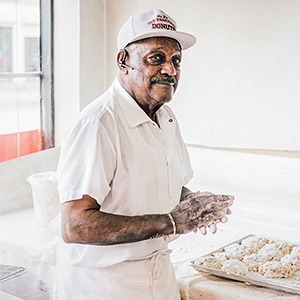
When this South Side doughnut shop opened in 1972, the apple fritter wasn’t even on the menu. But over the last decade, the now-beloved treat has become synonymous with the neighborhood institution (that’s owner Buritt Bulloch left). The fritters are made fresh every morning using leftover dough scraps, resulting in a mammoth confection — each one clocks in at around a pound — that’s stuffed with warm chunks of apple, flavored with cinnamon, sweetened with a glaze, and, if you ask for it, sprinkled with chopped pecans. $4; 11248 S. Michigan Ave., Roseland
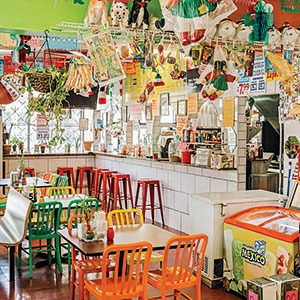
Visiting this Mexico City–style taqueria, which is attached to a corner grocery store, is a joy, from the colorful papel picado decorations to the housemade pineapple tepache. But all that is just a preamble to the food, and while it’s hard to argue against any of the tacos on the menu, the lengua is justifiably the standout. Taquero Cesar Castillo serves up thin slices of beef tongue that nearly cover the entire El Milagro tortilla. The meat is fatty and tender, topped with a shower of chopped white onions and cilantro, and finished with a squeeze of lime. The trio of salsas on your table add a final worthy accent. $3; 2500 S. Whipple St., Little Village
Images of the World Trade Center towers collapsing in New York were still fresh in the minds of the first American troops arriving in Afghanistan, as the United States launched an invasion targeting the Afghanistan-based al-Qaida leaders who plotted the attacks of Sept. 11, 2001.
More than 800,000 U.S. troops have served in the Central Asian country since then in a war that quickly expanded to confronting Afghanistan’s Taliban and to nation-building.
Now, the top U.S. commander in Afghanistan, Gen. Scott Miller, has relinquished his command in Kabul, underscoring the winding down of America’s longest war.
One-third of the roughly four million troops who served in the post-9/11 wars in Afghanistan and Iraq served multiple tours, some in well-secured bases in times of comparative quiet, others facing improvised explosive devices on the roads, mortar and rocket attacks on their positions, and firefights. While the United States quickly succeeded in quelling the al-Qaida fighters behind the 9/11 attacks, Americans leave with the Taliban rapidly claiming fresh territory. Many Afghans fear the return of civil war,or strict Taliban rule with the Western troops’ departure.
Here’s what some U.S. veterans of the war with Afghanistan say as the United States withdraws after nearly 20 years:
ANDREW BRENNAN
ARMY VETERAN
U.S. Army veteran Andrew Brennan.Julio Cortez / AP
For Andrew Brennan, 36, of Baltimore, it’s the days the painful memories subside that bother him.
A former Army captain who flew combat missions, Brennan lost one of his closest friends, pilot Bryan Nichols, when his Chinook helicopter was shot down in 2011, killing 30 Americans, seven Afghan soldiers and one interpreter. It was the single deadliest day for U.S. troops during the war.
Brennan spent a week helping recover the bodies.
“As much as I hate admitting it, there are days that go by when I don’t think about Bryan, our crew and the team guys on the back of that aircraft,” Brennan says. “And if I don’t think about it and I was that close to it, what do most Americans think?”
Brennan honors those who gave their lives in the war. He has worn a “Killed in Action” bracelet in honor of Nichols for nearly a decade. And he has worked to get a memorial wall built for 9/11 veterans.
Still, he says he believes it was a senseless war.
“What have we ended up with at the end of it, other than trillions spent, 7,000-plus Americans dead and more than two broken generations of warriors?
“The only stakeholder group that learned anything through this entire period were politicians: They learned that the American population is so removed from their modern-day ‘legions’ that they can do anything with our nation’s all-volunteer military, and no one will pay attention or care enough to change it.”
JENNIFER BROFER
MARINE VETERAN
Marine Corps veteran Jennifer Brofer outside her apartment in Los Angeles.Damian Dovarganes / AP
Marine veteran Jennifer Brofer will never forget the loud, popping noise.
It was on a hot July afternoon in 2010 when her convoy rolled over an IED on a road in Helmand Province four months into her deployment to Afghanistan. Her heart froze as she and her fellow Marines stopped and realized what had happened. But what followed were only the sounds of daily life.
This was a lucky day.
“For some reason, it did not detonate,” the former staff sergeant says.
It was a defining moment to be that close to death, says Brofer, who was one of the comparatively few female Marines to serve in America’s longest war and now is a producer and actress in Los Angeles.
As a Marine Corps public affairs officer, Brofer’s job was to document the stories of troops.
“Those moments in Afghanistan really put everything into perspective for me. Because I really didn’t fully appreciate all of the luxuries that I had been afforded prior to my deployment,” she says — like hugs from loved ones, hot showers and driving down a road without fear of her vehicle exploding.
Brofer, 38, who works in the television and film industries in Hollywood, says she’s proud to have served “shoulder-to-shoulder with my male Marine counterparts” in a time of war.
Still, Brofer says she can’t say whether the war was worth it.
“War is ugly,” she says. “And sometimes it’s necessary. And it’s not like we can go back and change anything. We can only change how we respond in the future.
“When I was deployed, it was already considered then the longest war. And I think it’s about time that our men and women came home.”
ERAN HARRILL
NATIONAL GUARD
The names of servicemen who died when their Chinook helicopter was shot down in 2011 in Afghanistan are seen on a liquor bottle.Julio Cortez / AP
After the United States launched a second war, in Iraq, in 2003, Oklahoma National Guard Sgt. Eran Harrill was one of hundreds of thousands of guard members called to duty as an all-volunteer U.S. military strained to fight two wars simultaneously.
Harrill fought in 2011 as part of a combat unit in Afghanistan’s Laghman Province, as the United States surged troops in hopes of crippling Afghanistan’s Taliban. A marketing director and business development executive in Oklahoma City, he patrolled alongside a mechanic, a K-9 police officer, students and other Oklahomans.
“The very first firefight we got in was certainly an ‘aha’ moment” for the citizen soldiers, says Harrill, 38, who had always wanted to serve in the military, even as some guard colleagues had seen it just as a way to bring in money for college. “I think we did some good there, maybe helped some people and prevented some loss of life. Was it worth the loss of life we had? I don’t know. That’s for someone else to answer.”
Back home, Harrill leads Oklahoma City’s Black Chamber of Commerce. He’s developing a directory aimed at identifying which employers are most suitable for members of the military, like National Guard members.
That’s after seeing guard members struggle with bosses unhappy over time away for training and deployment, including managers who reached out to a deployed guard member in the field to threaten him with firing if he didn’t return.
“We have a bad habit in this country of putting little yellow ribbons, ‘support our troops,’ in the window,” Harrill says. “But we don’t really support our troops as to how it affects us when the rubber hits the road.”

:no_upscale()/cdn.vox-cdn.com/uploads/chorus_asset/file/22714489/merlin_98994184.jpg)
:no_upscale()/cdn.vox-cdn.com/uploads/chorus_asset/file/22714457/merlin_98994202.jpg)
:no_upscale()/cdn.vox-cdn.com/uploads/chorus_asset/file/22714507/merlin_98994192.jpg)