What’s New

Nekia Nichelle Reveals What It Was Like Being On The Dr. Phil Showon July 23, 2021 at 3:44 pm

Just N

Nekia Nichelle Reveals What It Was Like Being On The Dr. Phil Show

Read More

Nekia Nichelle Reveals What It Was Like Being On The Dr. Phil Showon July 23, 2021 at 3:44 pm Read More »

Cleveland’s baseball team announces name changeTom Withers | APon July 23, 2021 at 2:04 pm

CLEVELAND — Known as the Indians since 1915, Cleveland’s Major League Baseball team will be called Guardians.

The ballclub announced the name change Friday with a video on Twitter narrated by actor Tom Hanks, ending months of internal discussions triggered by a national reckoning by institutions and teams to permanently drop logos and names considered racist.

The choice of Guardians will undoubtedly be criticized by many of the club’s die-hard fans.

The organization spent most of the past year whittling down a list of potential names that was at nearly 1,200 just over a month ago. But the process quickly accelerated and the club landed on Guardians.

Team owner Paul Dolan said last summer’s social unrest, touched off by the killing of George Floyd in Minneapolis, spurred his intention to change the ballclub’s name.

In 2018, the Indians stopped wearing the contentious Chief Wahoo logo on their jerseys and caps. However, the team continues to sell merchandise bearing the smiling, red-faced caricature that was protested for decades by Native American groups.

Read More

Cleveland’s baseball team announces name changeTom Withers | APon July 23, 2021 at 2:04 pm Read More »

Can a Hawthorne ‘Racino’ Keep Horse Racing Alive in Chicago?Whet Moseron July 23, 2021 at 2:00 pm

My first day at Arlington Park was one of the most momentous of my life.

It was July 1, 1996. My father’s wife was in town for a conference, and he needed to kill an afternoon. He suggested the track.

Even before we walked inside, I was awed by Arlington. From Northwest Highway, the grandstand resembled a splendid resort hotel. Its roof, a cowl painted the green of ancient copper, floated above the summer trees. Outside the gate, a garden spelled out A-R-L-I-N-G-T-O-N in red begonias.

Inside, the very worst thing that can happen to a novice gambler happened to me: I won a lot of money. First I bet a fin on Flash Light, and a two-dollar exacta: Flash Light and A Sunny Delight. As the horses charged past my seat, Flash Light took the lead and hurtled down the stretch like a running back headed for the end zone. A Sunny Delight was right behind him. I won $48, and felt confident enough to attempt a trifecta. A beginning horseplayer picking a cold trifecta is like a guy who’s never held a dart shooting three straight bullseyes, but my horses ran 1-2-3, for a $100 score.

Just like that, a sport I had paid attention to once a year—Kentucky Derby Day—became the central focus of my life. I started going to the track or the State Street OTB (which has since been declassed to a Chick-Fil-A) every weekend. Then I started going every day, fantasizing about earning my living as a handicapper. I watched the race replays on TV every night. I clipped the results charts from the Sun-Times. I turned down a job promotion because it would have interfered with my gambling time.

A horseplayer is a guy who’ll bet $200 on a race, but won’t spend $20 on a pair of pants. For awhile, in my late 20s and early 30s, I was that guy. Eventually, I made the track pay. I wrote my first cover story for the Chicago Reader about my tutelage by a broken-down horseplayer at Sportsman’s Park. My first book, Horseplayers: Life at the Track, was about a year spent playing the horses. Getting hooked on gambling turned out to be great for my career.

Last Saturday, I spent what may be my last day at Arlington Park. The track is scheduled to close forever at the end of this meet. My press pass was labeled “2021 Race Season: The Final Turn.” Arlington’s owner, Churchill Downs, Inc., thinks placing a casino there—the only financially viable model for a modern racetrack—would compete with Rivers Casino in Des Plaines, in which it owns a majority stake. On this trip to Arlington, I won $15, by picking Bizzee Channel to win the Arlington Stakes.

I thought more, though, about what I and every other horseplayer in Chicago will be losing. Before the last race, I stood in the paddock and photographed the horses as the hotwalkers led them around the ring. The mellowing sun was declining over the Clubhouse Gate. A cool evening wind slid through the trees. Arlington is as serene as any public space in Chicagoland. It’s like the Botanic Gardens, with the bonus that you can win money.

When I first became a racetrack junkie, Chicago horseplayers followed four seasons: Sportsman’s, Arlington, Hawthorne and winter. After this year, it looks as though Hawthorne will be the last track standing. (Sportsman’s closed in 2002, after its owners made the disastrous decision to transform it into a combination horse racing/auto racing facility.) Hawthorne, on Cicero Avenue in Stickney, was the least glamorous of the three tracks, with a dank underground paddock and a minor league baseball-style grandstand overlooking the world’s largest sewage treatment plant. 

My first visit to Hawthorne was also unforgettable: standing on the poured concrete floor, on a Thursday afternoon, was the governor of Illinois, the Honorable Jim Edgar. Perfectly groomed and suited, the governor was clutching a race program and chatting with a broken-down horseplayer in a flannel shirt and baggy jeans. I knew why he was there: to watch his father-in-law’s horse, Lady Doc. I also knew that every time Edgar was at the track, Lady Doc won. I’d seen them together at Arlington. Coincidence? The governor’s presence was, as we say in handicapping, an angle. I bet on Lady Doc. She won.

Chicago has always been a second-tier racing circuit, not quite on the same level as New York, Florida, Kentucky or California. In recent years, though, as horse racing has lost market share to other forms of gambling, Chicago’s prestige has declined steeply. (In an era of increasing concern for animal welfare, horse racing is also becoming an atavism.) The Illinois Derby, which was once a Kentucky Derby prep—War Emblem won both races in 2002—has not been run at Hawthorne since 2017. The Arlington Million used to attract Europe’s fastest turf thoroughbreds; His Highness the Aga Khan entered a horse in the race. This year, the Million has been discounted to $600,000, and renamed the Mister D. Stakes, after Dick Duchossois, Arlington’s former owner.

Hawthorne, though, is promising to revive horse racing in Chicago. The track is spending $400 million to turn the grandstand into a racetrack/casino, with slots, table games and sports betting to supplement the horse racing—a racino, in the industry lingo. It’s scheduled to open by the end of 2022. I’ve been to racinos in Des Moines and Cleveland, and horse racing was a floor show. I had to walk through acres of slot machines to find the holdout horseplayers, leaning over the rail and handicapping short fields of cheap claimers. Hawthorne will be different, promises spokesman Dakota Shultz. 

“It often becomes, the casino is the main thing,” Shultz said. “Anybody walking into our facility is going to know there’s racing. It’s our identity. It’s going to be front and center, even right down to the design.”

With money from casino gambling, Hawthorne can also resume running lucrative stakes races, including the Illinois Derby, which in its prime offered a $750,000 purse and was heralded by a baritone belting out “My Kind of Town.”

“Perhaps even more than that,” Shultz said. “It can become a million-dollar race.”

However, a veteran handicapper I know, Scott McMannis, is skeptical that Chicago racing will return to its former glory from Hawthorne alone. A casino in industrial Stickney isn’t going to attract suburban families looking to spend a wholesome day at the races.

“They’ll be able to do the rudimentary things—use casino money to subsidize the product,” he said. “But the location and the drawing radius aren’t great. How much money is around the casino? And when you go there, you see all those smokestacks and those semi-trailers waiting to be hooked up.”

Guys like me will still play the horses at Hawthorne. Me and my bachelor horse racing buddies: Bob the Brain, David the Owl, Blonde Jimmy, Bias Bill, The Stat Man. We always liked betting Hawthorne better than Arlington, anyway. Hawthorne shipped in cheap horses from leaky-roof tracks all over the Midwest. That allowed them to run 12-horse races, which offer better odds for gamblers. I once hit a $1,240 exacta at Hawthorne—my biggest score ever. We’ll still be watching the races, but without Arlington, and with most of Hawthorne’s customers playing the slots, horse racing will become an ever-more marginal sport in Chicago.

Read More

Can a Hawthorne ‘Racino’ Keep Horse Racing Alive in Chicago?Whet Moseron July 23, 2021 at 2:00 pm Read More »

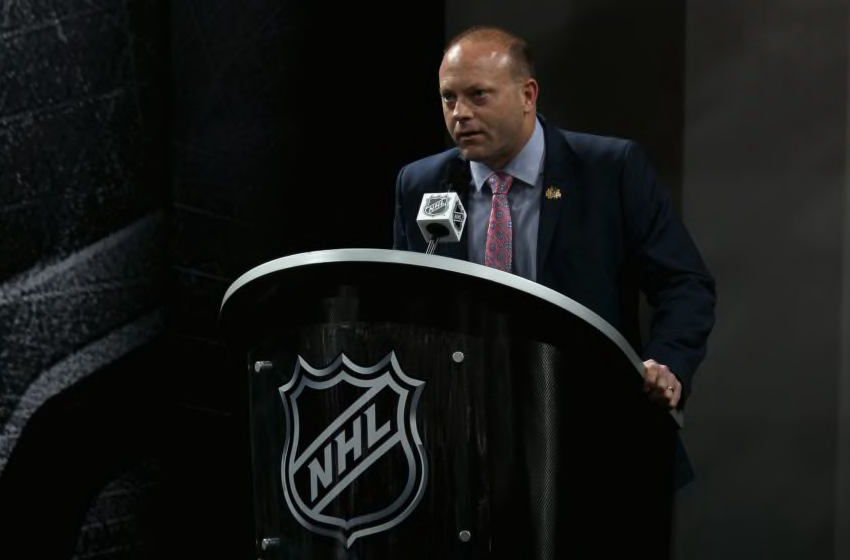
Chicago Blackhawks: 3 draft day trades to consider makingVincent Pariseon July 23, 2021 at 2:00 pm

Read More

Chicago Blackhawks: 3 draft day trades to consider makingVincent Pariseon July 23, 2021 at 2:00 pm Read More »

Christian theater company artist says he was forced out for being gayEvan F. Mooreon July 23, 2021 at 1:00 pm

During his 12 years working for Christian Youth Theater, Rockford man Andrew Mahan said he became an ally for students who didn’t always feel they fit in.

“I had countless students constantly sending me emails and messages saying: ‘Hey, I am gay, or I am trans or this or that. I always feel safe around you when I do shows. I always audition for shows because I know you’re on staff and I feel safer with you,'” said Mahan.

That ended in 2018 when, he said, CYT Chicago leaders gave him two options: resign or have his employment terminated.

From what Mahan was told, the parent of a student at CYT Rockford, a chapter of CYT Chicago, discovered a poster of a Rockford drag show that had his picture on it and notified a company area coordinator.

“One of the board members spoke to me and she said, ‘You know we are a Christian company and you know our standpoint on homosexuality, and the board is moving for your removal,’ ” said Mahan, a gay man. “I decided to bow out quietly.”

He said CYT Chicago drafted a statement to staff members saying he left the company for work opportunities in Chicago — a statement he flatly denies.

“They crafted a very beautiful lie as to why I was leaving the company,” Mahan said. “None of the staff that I’ve worked with closely for years who knew the actual reason spoke up — it was completely swept under the rug.”

CYT Chicago and Rockford officials did not return requests for comment.

Andrew Mahan (left) worked in various roles for two CYT chapters from 2007 to 2018.
Andrew Mahan

Mahan kept the reason for his departure secret until earlier this month, when went public in the wake of a new CYT Chicago policy toward LGBTQ+ students and staff, and hearing from former students he mentored.

A new contract from the Cary-based company aligned itself with “traditional beliefs of God, the Bible, sexuality, marriage, human identity and gender” and ordered, “Speech and behavior of students, parents and staff must comply with a biblical standard, at least while on site and for the duration of the CYT Chicago programs in which these families and students are participating.”

Mahon responded with a lengthy, passionate Facebook post criticizing the contract and breaking his silence about his exit.

“If a company is going to proclaim themselves Christian, which by definition means striving to be Christ-like, then love should be the first and foremost goal of the company in all things, period,” Mahan said in an interview. “And when I read the contract, the statement that they ended the contract with was ‘In his Sufficient Grace.’ I found it humorous and offensive that they would [use those words to] end a contract that is pretty blatantly unaccepting and a bit hateful toward groups and individuals.

“For a company that calls itself Christian to put that phrase after hate-mongering in a contract, I found that very, very, very telling of this company’s mentality. … I couldn’t stay quiet.”

Mahan worked for CYT Chicago and Rockford from 2007-2018, holding various roles for over 20 productions, including choreographer, costume designer, teacher, camp director, and — perhaps the most important job, he says — mentor.

Looking back at his time with CYT Chicago and Rockford, he says the theater company became less and less of a place for teens who don’t fit societal norms.

“When I joined the company it did not function as a ‘church’ theater company. It was not pushed on people the idea of faith and religion, or that you had to be a Christian,” said Mahan. “There was an unspoken unsettling tone when I started working there as an openly gay male. I knew I would have to be [careful] just because not all Christian and religious people are comfortable with the idea of homosexuality.

“During some of those staff meetings for camps or for shows, the conversation would turn to: ‘This student just came out.’ There was always that assumption of predatory behavior with those kinds of students and staff when it got out that a staff member was gay.”

These days, Mahan is running his own theater company in Rockford with his mother, Ellen, also a former CYT Chicago and Rockford employee, named Gateway Arts, which has the mission statement: “At Gateway, we see you. And we meet you where you are.”

“We’ve been going strong,” said Mahan, Gateway Arts’ artistic director. “After we both left, a lot of students left CYT and actually joined our theater company just because they didn’t feel accepted.”

Gateway Arts theater students perform “Sweeney Todd: The Demon Barber of Fleet Street.”
Gateway Arts

Read More

Christian theater company artist says he was forced out for being gayEvan F. Mooreon July 23, 2021 at 1:00 pm Read More »

Chicago Blackhawks Draft: 1 player is perfect for themVincent Pariseon July 23, 2021 at 1:00 pm

Read More

Chicago Blackhawks Draft: 1 player is perfect for themVincent Pariseon July 23, 2021 at 1:00 pm Read More »

What Business Owners Should Know About Fleet Maintenanceon July 23, 2021 at 12:59 pm

Small Business Blog

What Business Owners Should Know About Fleet Maintenance

Read More

What Business Owners Should Know About Fleet Maintenanceon July 23, 2021 at 12:59 pm Read More »

Tokyo Olympics begin with muted ceremony and empty stadiumFoster Klug | Associated Presson July 23, 2021 at 12:27 pm

TOKYO — Belated and beleaguered, the virus-delayed Tokyo Summer Olympics finally opened Friday night with a dazzling display of fireworks and soaring, made-for-TV choreography that unfolded in a near-empty stadium, a strangely subdued ceremony that set a striking tone to match a unique pandemic Games.

As their opening unfolded, devoid of the usual crowd energy, the Olympics convened amid simmering anger and disbelief in much of the host country, but with hopes from organizers that the excitement of the sports to follow would offset the widespread opposition.

Trepidations throughout Japan have threatened for months to drown out the usual carefully packaged glitz of the opening. Inside the stadium after dusk Friday, however, a carefully calibrated ceremony sought to portray that the Games — and their spirit — are going on.

An ethereal blue light bathed the empty seats as loud music muted the shouts of scattered protesters outside screaming for the Games to be canceled — a widespread sentiment here. A single stage held an octagon shape meant to resemble the country’s fabled Mount Fuji.

Organizers held a moment of silence for those who had died of COVID; as it ticked off and the music paused, the sounds of protests echoed in the distance.

Athletes marched into the stadium in their usual parade of nations, some socially distanced, others clustering together in ways utterly contrary to organizers’ hopes. They waved enthusiastically to thousands of empty seats, and to a world hungry to watch them compete but surely wondering what to make of it all.

Their shouts raise a fundamental question about these Games as Japan, and large parts of the world, reel from the continuing gut punch of a pandemic that is stretching well into its second year, with cases in Tokyo approaching record highs this week: Will the deep, intrinsic human attachment to the spectacle of sporting competition at the highest possible level be enough to salvage these Games?

Time and again, previous opening ceremonies have pulled off something that approaches magic. Scandals — bribery in Salt Lake City, censorship and pollution in Beijing, doping in Sochi — fade into the background when the sports begin.

But with people still falling ill and dying each day from the coronavirus, there’s a particular urgency to the questions about whether the Olympic flame can burn away the fear or provide a measure of catharsis — and even awe — after a year of suffering and uncertainty in Japan and around the world.

Outside the stadium, hundreds of curious Tokyo residents lined a barricade that separated them from those entering — but just barely: Some of those going in took selfies with the onlookers across the barricades, and there was an excited carnival feeling. Some pedestrians waved enthusiastically to approaching Olympic buses.

The sports have already begun — softball and soccer, for example — and some of the focus is turning toward the competition to come.

Can the U.S. women’s soccer team, for instance, even after an early, shocking loss to Sweden, become the first to win an Olympics following a World Cup victory? Can Japan’s Hideki Matsuyama win gold in golf after becoming the first Japanese player to win the Masters? Will Italy’s Simona Quadarella challenge American standout Katie Ledecky in the 800- and 1,500-meter freestyle swimming races?

For now, however, it’s hard to miss how unusual these Games promise to be. The lovely national stadium can seem like an isolated militarized zone, surrounded by huge barricades. Roads around it have been sealed and businesses closed.

Inside, the feeling of sanitized, locked-down quarantine carries over. Fans, who would normally be screaming for their countries and mixing with people from around the world, have been banned, leaving only a carefully screened contingent of journalists, officials, athletes and participants.

Olympics often face opposition, but there’s also usually a pervasive feeling of national pride. Japan’s resentment centers on the belief that it was strong-armed into hosting — forced to pay billions and risk the health of a largely unvaccinated, deeply weary public — so the IOC can collect its billions in media revenue.

“Sometimes people ask why the Olympics exist, and there are at least two answers. One is they are a peerless global showcase of the human spirit as it pertains to sport, and the other is they are a peerless global showcase of the human spirit as it pertains to aristocrats getting luxurious hotel rooms and generous per diems,” Bruce Arthur, a sports columnist for the Toronto Star, wrote recently.

How did we get here? A quick review of the past year and a half seems operatic in its twists and turns.

A once-in-a-century pandemic forces the postponement of the 2020 version of the Games. A fusillade of scandals (sexism and other discrimination and bribery claims, overspending, ineptitude, bullying) unfolds. People in Japan, meanwhile, watch bewildered as an Olympics considered a bad idea by many scientists actually takes shape.

“We will continue to try to have this dialogue with the Japanese people knowing we will not succeed 100%. That would be putting the bar too high,” said IOC President Thomas Bach. “But we’re also confident that once the Japanese people see the Japanese athletes performing in these Olympic Games — hopefully successfully — that then the attitude will become less emotional.”

Japanese athletes, freed from onerous travel rules and able to train more normally, may indeed enjoy a nice boost over their rivals in some cases, even without fans. Judo, a sport that Japan is traditionally a powerhouse in, will begin Saturday, giving the host nation a chance for early gold.

Still, while it’s possible that “people may come out of the Olympics feeling good about themselves and about Japan having hosted the Games against all odds,” Koichi Nakano, a political science professor at Sophia University in Tokyo, believes that such a scenario “is way too optimistic.”

The reality, for now, is that the delta variant of the virus is still rising, straining the Japanese medical system in places, and raising fears of an avalanche of cases. Only a little over 20% of the population is fully vaccinated. And there have been near daily reports of positive virus cases within the so-called Olympic bubble that’s meant to separate the Olympic participants from the worried, skeptical Japanese population.

For a night, at least, the glamor and message of hope of the opening ceremonies may distract many global viewers from the surrounding anguish and anger.

Read More

Tokyo Olympics begin with muted ceremony and empty stadiumFoster Klug | Associated Presson July 23, 2021 at 12:27 pm Read More »

Chicago Blackhawks Draft: 3 players to trade up forVincent Pariseon July 23, 2021 at 12:00 pm

Read More

Chicago Blackhawks Draft: 3 players to trade up forVincent Pariseon July 23, 2021 at 12:00 pm Read More »

DJ Manny centers love on his R&B-infused new album, Signals in My HeadJoshua Minsoo Kimon July 23, 2021 at 11:00 am

Manuel Gaines, who performs as DJ Manny, was ten years old when he first heard footwork music at a party. Before long, the Chicago-born, Brooklyn-based producer met two titans of the genre, DJ Spinn and the late DJ Rashad, with whom he eventually collaborated on a handful of tracks. Manny has multiple releases under his belt, but the new Signals in My Head (Planet Mu) is the first to be specifically focused on R&B and centered on love. That means some of these cuts have a softer edge than the jagged, raw music on his 2017 Teklife release Greenlight. Opener “Never Was Ah Hoe,” for example, combines hand drums, a shifting beat, a melancholy vocal sample, and a soft synth pad to create a spacious, intimate atmosphere. The sort of love DJ Manny aims to capture is true to life: messy, complex, and rooted in vulnerability. He works economically to capture its multifaceted nature. On “Wants My Body,” he flips the 1983 Class Action version of disco scorcher “Weekend,” zooming in on a single line: “Maybe I’ll find someone, somebody who wants my body, baby.” The original song sounds eager and expectant, but DJ Manny uses a stuttering footwork beat to reveal an underlying anxiety in the staccato-sung lyrics. “Good Love” does even more with less: vocal samples constantly reverberate as synths ring out like sirens, and then a drum ‘n’ bass beat anchors everything to inject an uneasy urgency. On “At First Site” DJ Manny doesn’t need words at all, conjuring up wistful longing with icy piano keys and a wonky synth melody. Best of all is the title track, which thrives on the interplay between layered synths and an evolving beat. It’s at once scattered and contented, like someone working through personal issues in order to wholly commit to a relationship. The capacity of DJ Manny’s songs to evoke such stark, specific images and moods is a testament to his craft: throughout Signals in My Head, you never doubt that he knows what he’s doing. v

Read More

DJ Manny centers love on his R&B-infused new album, Signals in My HeadJoshua Minsoo Kimon July 23, 2021 at 11:00 am Read More »