With Lollapalooza just days away, Mayor Lori Lightfoot is saying she won’t hesitate to return to a mask mandate — and implement “other tools” she’s been “compelled to use” — if Chicago’s daily rate of coronavirus cases is “consistently going over” 200.
“If we get back into an area where we feel like we’re in a red zone, which we are working very hard to make sure that our daily case rate is below 200, if we start to see consistently going over that, we’re not only going to look at a mask mandate, but we’re going to look back at other tools that we’ve been compelled to use,” the mayor told Kara Swisher on the New York Times’ “Sway” podcast, posted online Monday.
“I hope we don’t get there. What we’re going to keep focusing on is pushing the vaccine. But my number one priority is to keep people safe.”
The current daily case rate in Chicago is 130 — that’s up 76% from the 74 cases a day just a week ago.
Throughout the pandemic, Lightfoot has alternately implemented mitigations even tougher than Gov. J.B. Pritzker and criticized the governor for going too far at times, particularly when it comes to closing schools and banning indoor dining at restaurants.
More recently, Lightfoot has sounded the alarm about the Delta variant and the rise in cases among the large number of unvaccinated Chicagoans, while also saying she has no regrets about green-lighting Lollapalooza’s return to Grant Park this weekend without hundreds of thousands of young people jammed together in front of multiple stages dancing, singing and swaying to the music.
They will be required to show proof of vaccination or a negative COVID test before entering Grant Park.
Lightfoot told Swisher the Delta variant has her incredibly concerned. So does the fact that vaccine “uptake” in some South Side neighborhoods was “in the high-teens” not too long again and is still “under 40%.
“When I see statistics like 97% of the people that are getting sick or 97% of the people that are dying are folks who are unvaccinated, that is alarming. The southern part of our state is starting to really catch fire with new COVID infections. I’m worried about a surge there. So I’m concerned. We’re sounding the alarm. And we’re going to be looking closely at how the data progresses,” Lightfoot said.
Swisher noted that Los Angeles County has already restored an indoor mask mandate and that that county’s vaccination rate is “similar to” Chicago’s, with about 70% of eligible adults having received at least one dose. The mayor was asked whether she was considering reinstating a mask mandate.
“We’re not there yet, but I am very concerned about what we’re seeing in the uptick in our cases,” Lightfoot said. “We’re still in a good place as we are speaking. But we’re seeing an uptick in daily cases. We’re starting to see a slight uptick in hospitalizations. You know, the deaths are kind of a trailing indicator. That’s steady for now.”
This week 2Pac and the Fruit Bats top our new releases. I had been hearing rumors that Kanye West was releasing Donde, but, of course, the date was pushed back to August.
[embedded content]
A few months ago the Fruit Bats covered “Today” by the Smashing Pumpkins, which I thought was a cool idea. Then they went and covered Siamese Dream in its entirety. It’s hard not to be critical because this album holds a special place in my heart from childhood. I have to say, for the most part, they did a really good job and so far, “Rocket” is my favorite.
[embedded content]
Coldplay returns with a ten-minute song called “Coloratura.” They have been experimenting with different styles on their last few albums, so now is the perfect time for them to try long jam sessions, that include several different song ideas. I like this idea for Chris Martin and the crew.
[embedded content]
The second single from Liz Cooper brings us another week closer to the return of that gorgeous voice and towering figure. “Getting Closer” feels a bit Billie Holiday-like, and I love the prominent keyboard melody that drives this song.
[embedded content]
What’s the motto, “Keep your enemies closer than your friends?” Yeah, if anyone knows that, it’s PAC. “Fuck Friends” reminded me of his Makaveli phase: the beat, lyrics, and the fuck-em-all vibe. I was revisiting the album when I heard it was getting repackaged on a four-disc vinyl this week. I want to buy it, but I just can’t afford the entry fee.
[embedded content]
This is not Jerry’s greatest version of “Sugaree,” but it is a great jam session, nonetheless. “Sugaree” has always been one of my favorite Dead songs, so it’s worth a mention in this week’s Release Radar.
[embedded content]
I can’t leave you without a Jazz Cut Of The Week, so, here you go. “Invitation” is from Leif Shires, a California trumpet player who has worked with many different artists spanning a variety of genres, including Kelly Clarkson, Jack White, Shania Twain, and, the one and only, Barry Gibb.
The ChicagoBears are set to open their 2021 training camp on Tuesday, July 27th. Rookies, QB’s, and injured players reported to Halas Hall on Saturday and the rest of the roster will report tomorrow. The Bears open the first week of training camp with four practices, the first of which is closed to the public. Camp will run through August 30th with Family Night being scheduled for August 6th.
Excitement is in the air this year for training camp due in large part to two main factors. First, this will be the first training camp after the COVID-19 Pandemic and fans are craving any sense of normalcy after a rough 2020. The second reason is Bears rookie QB Justin Fields who was taken with the 11th pick in the 2021 draft out of Ohio State. Fields will be the player that attracts the most eyes on the roster as fans hope he can compete for the starting job sooner rather than later, despite the Bears staff trying to slow play those expectations.
Contenders in the Bassmaster Classic, frequently referred to as the Super Bowl of fishing, have many things to fear during the annual three-day tournament: a fish slipping the hook, a bass dying before the weigh-in (dead specimens draw a four-ounce penalty), the dreaded “goose,” as in a goose egg — catching no fish at all. But competitors in the tournament 21 years ago faced novel terrors: kids lining up on the shore to zing rocks at their heads, deafening noises from a waterfront metal-scrapping operation, container ships bearing down on them, and a persistent fear of boat-jacking. With, however, consolations: “You can say what you want about different places,” Kevin VanDam, one of the sport’s superstars enthused afterward, “but the best pizza there is is in Chicago.”
Pro fishing is a sport followed mostly in the South, but in 2000, its biggest event came here. The Illinois Department of Natural Resources, Tribune outdoors columnist John Husar, and city officials had worked diligently for years to recruit the Bassmaster Classic as a showcase for the ecological comeback of Lake Michigan in the decades following the 1972 Clean Water Act. For its part, the Alabama-based Bass Anglers Sportsman Society, or BASS, the for-profit organizing body of the then–$60 billion industry (it’s worth $129 billion now), saw a once-in-a generation opportunity to grow their sport above the Mason-Dixon Line, much as NASCAR had during the 1990s.
Local media provided blanket coverage in the weeks leading up to opening day, July 20. The dominant tone was defensive: Dagnabbit, Lake Michigan has bass! A professional angler from suburban Alsip, George Liddle Sr., made the rounds of news outlets, boasting to one, “This is going to be a top-notch fishery, probably third or fourth in the northern part of the country.” BASS’s CEO, Helen Sevier, trumpeted, “I don’t think most people think you can go fishing in big cities. But the availability may be right under their noses.”
Tournament fishermen keep score by weight: Their five biggest catches — sometimes out of dozens — are totted up at the end of each day; the angler notching the most pounds after three days wins. Chicago’s boosters promised her waters would yield four- or five-pounders in profusion (to put that in perspective, the world record is over 22 pounds), but by June, when contenders were invited to town for a week of practice, expectations were beginning to deflate. One angler, after an 11-hour day that yielded only four bass, none bigger than a pound and a half, declaimed, “These fish are so small they don’t even know they’re fish yet.”
Game day arrived, and competitors took to the “playing field,” as fishing tournament announcers like to put it, which covered the entire Illinois portion of Lake Michigan and considerable stretches of the rivers, creeks, and canals connecting to it. Emcee Fish Fishburne — he’d legally changed his name from Claude — boomed into the ESPN microphone: “When the Bassmaster decided to come to Chicago, what was the overall feeling? Well, let me tell you: Chicago is a fantastic city to host this year’s classic! However, Lake Michigan: Does it have fish in it? That was the number one question that the competitors were asking!”
Eight hours later, at the first day’s weigh-in, came the answer: sort of.
Photograph: istock
A Bassmaster weigh-in is one of the strangest rituals in sport. Think beauty pageant contestants sashaying across the stage one by one, only it’s pickup trucks towing $100,000 bass boats tricked out with twin-screen sonar fish finders, the boats’ occupants emerging to present a bag of fish to the weigh master after pulling out one or two prized “big ’uns” to brandish before a delirious throng of onlookers.
“Throng” may be too strong a word for the paltry 1,000 spectators who showed up at Soldier Field that first day to see leader Carl Maxfield of Summerville, South Carolina, pull only 10 pounds’ worth of palpitating piscine flesh out of his bag. He’d had to motor clear up to the Wisconsin border to find the spot that yielded even that disappointing catch.
The next day, Maxfield tried to return to the same waters, but things turned hairy. After 80 minutes, he’d made it only as far as Wilmette, a run that typically takes 20 minutes. Swells that day were topping six feet out on the open water, the preferred habitat of smallmouth bass. “Feels like we’re on the SS Minnow,” complained one angler, likely accustomed to the more placid waters of, say, the Arkansas River or the Louisiana bayou.
The Windy City would live up to its name — a circumstance not lost on commentators — for the remaining two days of the tournament. Which brings us to the fiasco of the auto-inflating life vests. They were a new innovation that year, and a hot item at the accompanying outdoors show at McCormick Place: Slender and unobtrusive, they were designed to inflate instantly after five seconds of submersion. At least that was the idea. Instead, like the Wicked Witch of the West in reverse, the things kept inflating — chawnk! — around fishermen’s necks every time a wave enveloped them in spray. Tournament favorite Shaw Grigsby described the jarring experience poetically: “The hands of God just reach out and snatch you by the chest!”
So on days 2 and 3, most anglers settled for the calmer riverine tributaries in search of the wilier largemouth. Which was why commuters bustling over the Michigan Avenue Bridge would have spied good ol’ boys in elaborate jerseys splattered with logo patches, if those commuters had bothered to look down, which most did not.
Largemouth bass prefer “structure,” a word that usually refers to submerged tree trunks and wooden docks, not the deep-sixed automobile carcasses and industrial debris that competitors had to navigate farther south, along the factory-lined waterways of the Calumet River system. “It’s not the bucolic kind of fishing they learned in small towns,” the Trib’s Husar delicately put it. Meaning: That was where the kids were chucking the rocks, and where the abandoned buildings were, and the cargo ships, and the scrap-metal cranes.
Also, in the estimation of one angler: “It was the smelliest place to fish.”
The city’s marinas supply plenty of structure, and the competitors could have plied them — if not for the elaborate restrictions. “I’ve got a book with off-limits areas,” one of them, um, carped. “I can’t throw at a dock? Docks are where bass live!” The pros took particular offense at the imprecation that their treble hooks might scratch a yacht. Did the people in charge in this strange city not understand that a true bassmaster could flick a mosquito off a jogger on the Lakefront Trail without the jogger being any the wiser?
It had been, after all, a dominant theme in the coverage introducing the sport to Chicagoans: These anglers were athletes. As, in fact, they are: You can’t watch a Bassmaster broadcast without marveling at the balletic grace of these guys dancing around the perimeter of the boat (while avoiding the onboard cameraman), following the path of the fish after a bite. The reason they do that, rather than just standing in place and cranking, is that they use as light a line as possible so the fish can’t see it, meaning the line can easily break unless they put as little pressure on it as possible, patiently tiring the beast as they gently guide it boatside, at which point they frequently pluck it out with their hand. “People have preconceived notions that it’s all about Bubbas and chewing tobacco and drinking beer,” one young star insisted. “It’s not about that.”
Light line proved challenging in Chicago, because zebra mussels — invasive mollusk accidentally introduced to the Great Lakes — acted like saw blades on anything less than 25-pound test. As it happened, the only guy to manage the challenge was not a slender, athletic, competitively cutthroat Adonis of the sort featured in all the articles in the local prints, but a stout, happy-go-lucky 54-year-old competing in his 15th Bassmaster whose first name was not Bubba, it’s true, but Woo. Hour after hour, Woo Daves had been patiently casting exquisitely delicate six-pound line into a single tiny underwater channel no more than a foot wide adjacent to a concrete breakwater in the shadow of downtown, balancing against the swells like a rodeo bull rider to do it, eking out victory at the final day’s weigh-in over a charismatic favorite with his own fishing TV show. In front of — not bad — 15,000 fans.
A happy ending — which in the two decades since has grown happier still: Even if it didn’t quite happen when the cameras were rolling and the pressure was on, anglers these days regularly pull five-pound smallmouth out of Lake Michigan. And they don’t even have to brave rock-throwing kids to do it.
Veteran outfielders Ian Miller (.278/.333/.354) and Nick Martini (.253/.388/.445) continue to swing hot sticks. Miller hit .343 in June and has followed it up with a .300 average in July. Martini spent the first couple of months getting inconsistent at bats in Iowa and Chicago, but he’s found his groove of late. Over his last 10 games he is batting .406 with a .536 OBP and 3 home runs.
Chicago fans have already seen a decent amount of Sergio Alcantara (.333/.474/.493) this season. They know he provides really good defense with a strong arm. He’s also got a decent eye at the plate and some unexpected pop in his bat (when he makes contact). The contact has not been as much of an issue at AAA (20 BB/20 K in 75 ABs). He’s picked up right where he left off when his excellent play at the AAA level prompted his promotion to Chicago (.171/.266/.354), as he’s reached base 7 times during his 3 games back with Iowa. It has only translated in spurts at the MLB level thus far, but Alcantara, who just turned 25, will undoubtedly get another shot after the trade deadline. Until then, he can regain some confidence.
Another player aligning himself for a post trade deadline call up is 1B/LF Alfonso Rivas (.284/.414/.474). Acquired from Oakland two offseasons ago, Rivas has finally gotten to show off the skills which made him appealing to the Cubs. He lacks the power profile of a typical first baseman, and his defense in left field is still an open question, but the 24-year old left-handed hitter does a few things at the plate the Cubs could use more of: he makes contact (< 20 K%), he uses the whole field, and he gets on base (21 BB/HBP compared to 23 K). He isn’t putting the ball in the air a lot, but since he opened the season a little rusty with 7 games in June (2-for-20), he’s gone on to hit .333/.468/.560 in July. Whether the Cubs move Anthony Rizzo or not, there should still be enough roster room after the trade deadline to begin letting Rivas get his feet wet in the Majors. He’s Rule 5 eligible, so they’ll need to make 40-man room regardless, and the Cubs will want to take a look at him with an eye toward 2022.
A complete no-show by the South Bend offense (3 hits, 4 walks). Good news did come out of this one in the form of Chris Clarke making his first start for the Cubs. He’d made one appearance in Mesa earlier in the week, and then in his first taste of full season affiliate ball on Sunday he did pretty darn good. I haven’t had a chance to watch it yet, but his line is kind of what I would expect from him at this level. Clarke features a fastball he can run up into the mid-90s, a really good curve, and has always managed pretty solid command and control. If he stays healthy, I’d expect him to make his way to AA at some point during the 2nd half, with an eye toward him competing for a slot in the Iowa rotation next spring.
Top Performers
Chris Clarke: 4 IP, 4 H, R, 0 BB, 3 K (L, 0-1, 2.25)
Jake Washer: 1-2, BB (.193)
Jake Slaughter: 1-2, BB, CS (3) (.244)
Injuries, Updates, and Trends
Rowan Wick completed his rehab assignment with South Bend. He looked ready to return to big league action.
Max Bain was placed on the developmental list. A big topic in the blogoshphere and social media over the offseason, Bain is a feel good story who went undrafted, lost more than 50 pounds, got big into the Driveline trend and started throwing mid-to-upper-90s with promising spin on his breaking balls. It’s been a rocky transition for him to take a turn pitching every 5 days in the South Bend rotation. There have certainly been flashes, his fastball in particular has popped at times, but the consistency just hasn’t been there.
Despite having the frame and stamina you look for in a starter, I’ve never been convinced he is the type of athlete capable of repeating his delivery to command his pitches well enough to be a starter. I certainly hope I am wrong, and there is still big reliever potential for Bain even if I’m right, but for the time being it appears they want to have him step back and worth through some things outside of game action. My guess is there is a mechanical issue they’ve identified which they want him to sort through before sending him back out.
Myrtle Beach also had a rough day at the dish, managing just 5 hits and a walk. They too received a solid start, in their case from Richard Gallardo, who had his power sinker working (9-to-1 GO-to-FO). A throwing error by Ed Howard led to three unearned runs in the 3rd.
Top Performers
Richard Gallardo: 5 IP, 5 H, 5 R, 2 ER, BB, 3 K (L, 2-6, 4.60)
Seventy-three people were hit by gunfire in Chicago this weekend. At least 11 of them died, including a 17-year-old boy.
The teen and a 15-year-old boy were in the backyard of a home in the 6800 block of South Peoria Street in Englewood when someone opened fire about 1:15 a.m., police said.
The 17-year-old was shot in the chest and was taken to the University of Chicago Medical Center, where he was pronounced dead, police said. He hasn’t been identified.
The 15-year-old was hit in the stomach and taken to the hospital in serious condition, police said.
Chicago police work the scene where a 44-year-old man was shot and killed in the 500 block of East 79th Street, in the Chatham neighborhood, Saturday, July 24, 2021.Tyler LaRiviere/Sun-Times
Around the same time, a man was shot to death in a drive-by in Austin on the Northwest Side.
The man, 37, was standing on the sidewalk with a group of people in the 1700 block of North Moody Avenue when someone in a blue car fired at them, police said.
He was hit in the head and taken to Loyola University Medical Center in Maywood, where he was pronounced dead, police said. The Cook County medical examiner’s office hasn’t identified him.
In Chatham, a man was shot and killed as he stood in front of a 24-hour convenience store on a busy street in Chatham on the South Side Saturday evening.
Someone walked up to Theodore Smith in the 500 block of East 79th Street and shot him in the chest about 8:15 p.m., according to Chicago police and the Cook County medical examiner’s office.
Smith, 44, was taken to the University of Chicago Medical Center, where he was pronounced dead, police said. Smith was an employee of the store and was smoking a cigarette when he was shot, a person at the scene told the Sun-Times.
In South Shore, a 19-year-old man was fatally shot Friday night. Janarrow Deberry was near the sidewalk in the 7000 block of South Merrill Avenuewhen someone opened fire, striking him multiple times, about 7:30 p.m., police and the medical examiner’s office said.
Deberry, of Plainfield, was pronounced dead at the University of Chicago Medical Center, police said.
At least seven other people were killed in shootings over the weekend.
Chicago police work the scene where 5 men were wounded in a shooting in the 4800 block of West Race Avenue in the Austin neighborhood, Sunday, July 25, 2021.Tyler LaRiviere/Sun-Times
Other shootings:
Five men were wounded in an attack early Sunday in Austin. They were gathered in the backyard of a home in the 4800 block of West Race Avenue when someone entered and opened fire, police said. The men — 23, 30, 36, 48 and 50 — suffered gunshot wounds to the lower body, police said. They were transported to Stroger and Mount Sinai hospitals, where they were all stabilized.
A 17-year-old boy and a man in his early 20s were shot Saturday in the Englewood neighborhood. The two were standing in the street in the 7100 block of South Ada Streetwhen someone in a black car fired shots, police said.
The teen was struck in the leg and was taken to Christ Medical Center in Oak Lawn in serious condition, police said. The man, 21, was also shot in the leg and was taken to the University of Chicago Medical Center in fair condition.
A man was shot early Saturday on the Eisenhower Expressway near the loop. The man, 26, was driving on the I-290 eastbound ramp to the Wacker Drive and Franklin Avenue split when someone in another vehicle fired shots, Illinois State Police said. He was taken to a area hospital with non-life-threatening injuries. A 26-year-old woman and four young children in the car were uninjured.
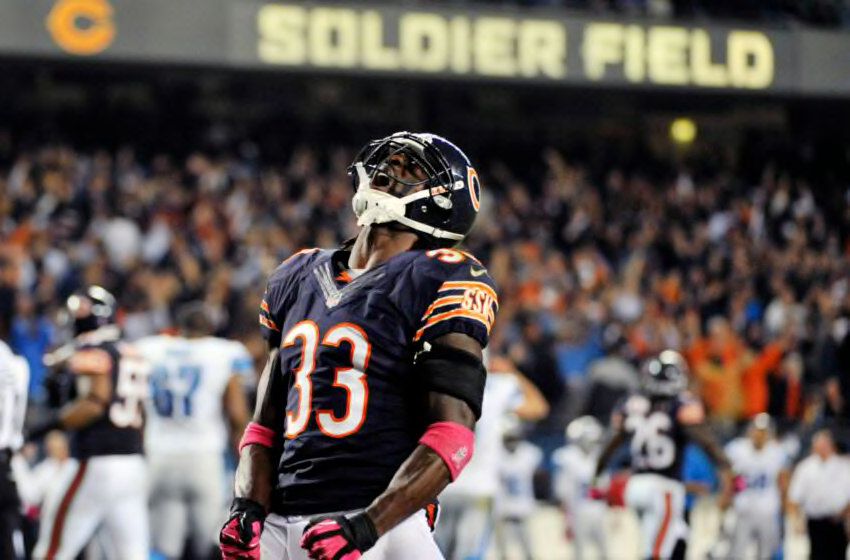
With NFL Hall of Fame festivities just around the corner, I wanted to take a look at the career of Charles Tillman, a cornerback for the Chicago Bears from 2003 to 2014. Over his career, he served as the ChicagoBears’ number one corner and anchored the secondary of numerous elite defenses that carried Chicago to a Super Bowl berth in 2006 and NFC Championship game in 2010.
Charles Tillman was an elite defensive back for one of the NFL’s founding franchises in the Chicago Bears but was often underappreciated. Nonetheless, he is worthy of enshrinement in the Pro Football Hall of Fame.
When he retired from the NFL in 2016, I was not sure of Tillman’s case for Canton. I figured he would (and should!) be enshrined in the Bears ring of honor. I did not think the Hall of Fame was in reach because of the national media’s tendency to focus on the Bears’ decades-long issues at quarterback instead of the players on defense that kept them relevant this entire millennium.
However, as more players retired and had their cases broken down in the national spotlight (i.e. Philip Rivers), I decided to take a deeper dive into Tillman’s career and see how strong his case was for the Pro Football Hall of Fame.
Charles Tillman deserves to represent the Chicago Bears in the Hall of Fame.
Ultimately, what I found is that while Tillman is most likely not going to be enshrined on an early ballot, there is a very strong case for him to be inducted into the Hall of Fame on a later ballot. What follows here are three reasons why Charles Tillman ultimately does deserve to end his career with a bust in Canton, Ohio.
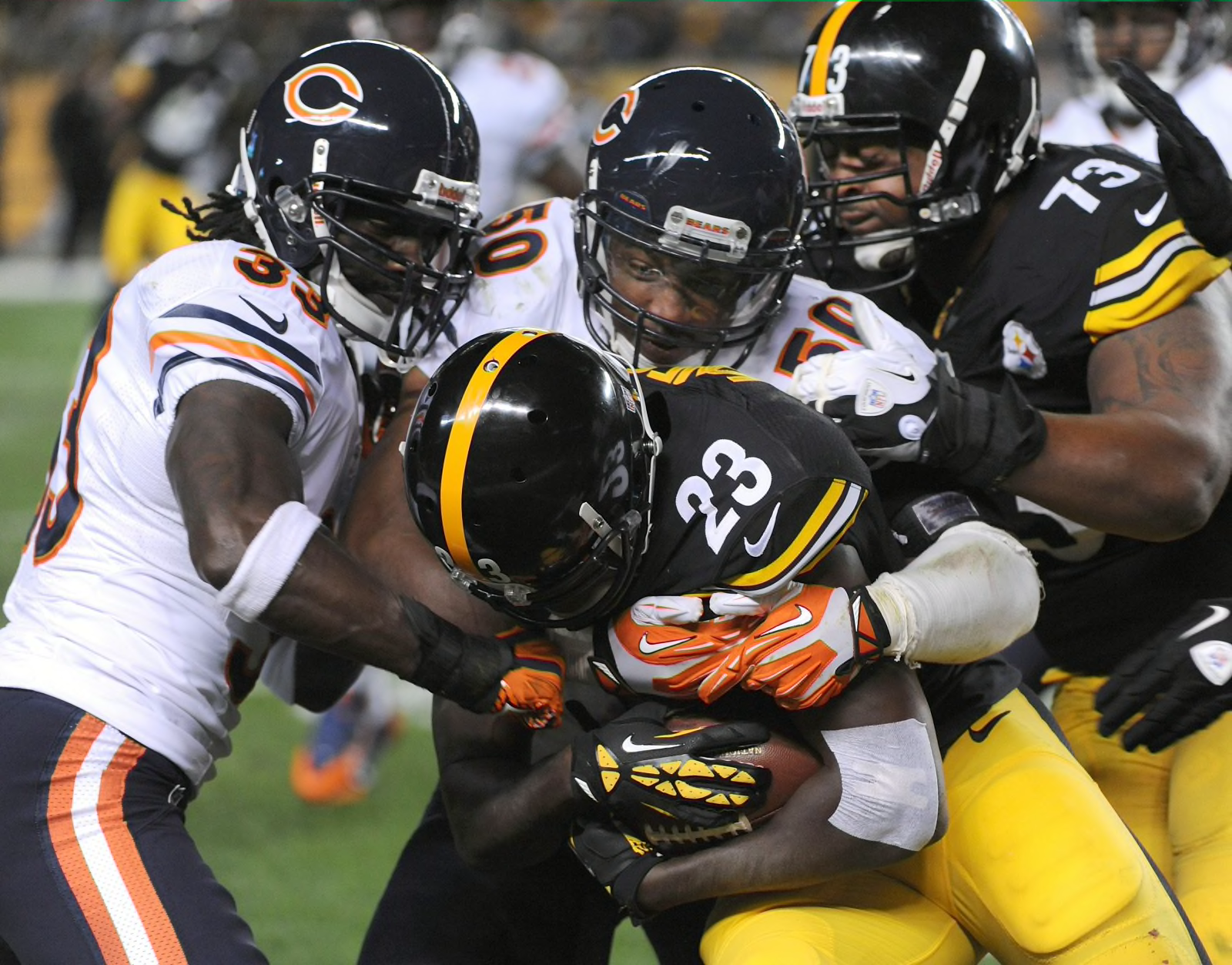
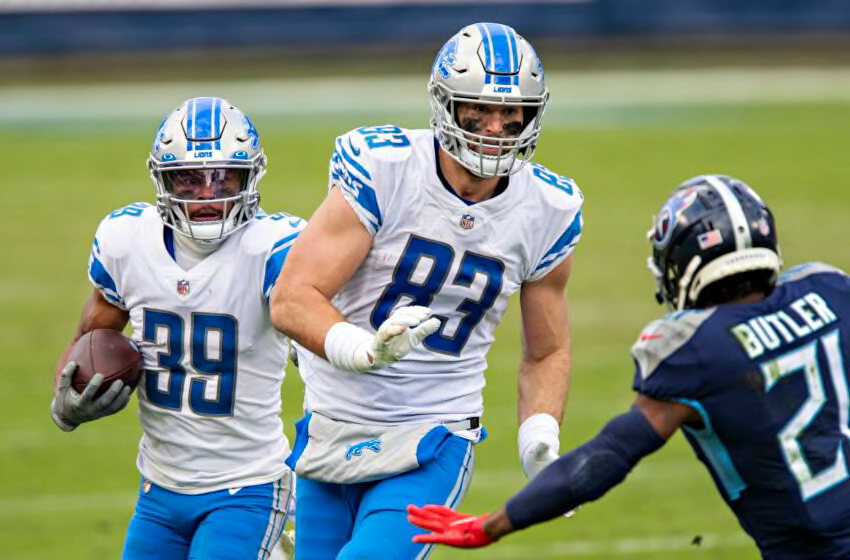
Jesse James, the former tight end for the Pittsburgh Steelers and the Detroit Lions, will join the Chicago Bears on a one-year deal, confirmed by multiple sources.
James, 27, played tight end at Penn State, where he racked up over 1,000 receiving yards and 11 total touchdowns in three years of college football.
He was drafted in the fifth round of the 2015 NFL draft by the Pittsburgh Steelers, where he ended up playing for the first four years of his career. With the Steelers, he started in 36 of the 56 games he played, recording three seasons with 300+ receiving yards and nine total touchdowns.
After playing with the Steelers, James signed a four-year $25 million deal with the Detroit Lions. He struggled in Detroit, never eclipsing over 200 yards in the two seasons he played with them.
The #Bears are signing former #Steelers and #Lions TE Jesse James to a one-year deal, source says.
Now, the veteran tight end will join a top-heavy crowd of tight end talent in Chicago. Led by Jimmy Graham and Cole Kmet, the Bears also have recently signed Jake Butt to add to the roster of Scooter Harrington, J.P Holtz, and Jesper Holsted.
James has similar characteristics to the two starters, Graham and Kmet, in terms of physicality. He is 6-foot-7 and weighs 250 pounds. James has great hands, can create space for himself, and can run deep routes downfield.
Signing a tight end to the roster at this point seems like a stereotypically arbitrary move for Ryan Pace & Co., considering they went into training camp with 10+ on the roster last season. However, James offers a certain depth at the position that the others behind Graham and Kmet can’t offer.
James’s size, athleticism, and starting job experience around the league make him an A+ signing for tight end depth.
It will be interesting for fans to see if Matt Nagy will use all three at the same time on the field. After seeing how often the Bears threw to Graham in the RedZone last season, it wouldn’t be surprising if Nagy tried to get fancy with tight ends built like NBA power forwards within reach of the endzone.
It appears Nagy is stirring the creative juices for the offense, especially following the reports that the Bears might implement Allen Robinson in the slot to allow deep threats Darnell Mooney, Marquise Goodwin, and Damiere Byrd to thrive on the outside.
Per a league source with reason to know, the Bears plan to deploy Allen Robinson more out of the slot in 2021 following the departure of Anthony Miller
Ran 25% of routes out of the slot in 2020
Would imagine he’s flanked by Darnell Mooney and Damiere Byrd on the outside
Bringing on James gives the Bears a cheap depth option for size in the passing game and blocking the outside lanes. His presence on the Bears should give Nagy more options to get creative with the playbook, leading to a more successful offense than last year’s 22 .4 points per game.
Either way, this signing attributes to the Bears’ offseason focus of rebuilding the depth of the offensive skill players and giving Nagy more options to use in the passing game behind their newly acquired gem, Justin Fields.
Attaching this signing as the rebuttal for trading away Anthony Miller for minimal cap space and a swap of late-round draft picks certainly seems like a positive. Unlike Miller, James should see quality playing time for the Bears and the ability to make an impact on the offense.
Well done front office, another great signing to cap off a beautifully executed offseason thus far.
Wildfire, Lincolnshire. The place where it happened!
You have helped me negotiate modern ethics before. You all gave me permission to accept a prize for being a top fundraiser for the annual SEABlue Prostate Awareness run*. Barb appreciates the very high-powered cordless electric broom. So I am hoping you all can help me out one more time.
As COVID and its aftermath have collapsed everyone’s world our dining-out choices have become more limited. A quick perusal of my credit card charges confirms that about 90% of our dining-out dollars are spent at one or another of Lettuce Entertain You Enterprises’ many restaurants.
And that is OK with us. Wildfire has been one of our favorite restaurants for years. Di Pescara and Saranello’s are just minutes away for tempting fish and Italian fare. I even chose to celebrate my last birthday at L Woods, the Lettuce restaurant a short hop down the Eden’s Expressway. I considered it a tribute to my late parents, who loved Sunday family dinners at Bones, the LEYE restaurant that preceded L Woods in that Lincolnwood location.
And…drumroll…Lettuce Entertain You restaurants give points. Their Frequent Diner Club awards bonus points for every dollar spent. Sometimes special deals award double points or more. Points add up to dollars off future visits. I usually accumulate enough points for a few macadamia nut-crusted halibut and horseradish-crusted filet dinners a year. Yum.
Which leads to my social dilemma. Some dear Florida friends of ours are spending the summer in Chicago and invited us out for dinner. The little celebration was a thank-you for Barb’s assistance in setting up our friend’s Chicago residence. A second helpful couple was also invited.
Our host’s restaurant choice for the evening? Wildfire.
It was a lovely evening. And as our hosts paid the substantial bill, I realized that being out-of-towners, they were not Frequent Diner members. All I could think about was those potential points floating away into the kitchen miasma!
I knew Lettuce is usually very lenient about letting anyone in the dining party claim the points. I knew all I would have had to do to get those award dollars would have been to ask our hosts if they minded my putting in a claim. But… I froze–I couldn’t do it.
So my question to you, my knowledgable readers–if I had asked for the Frequent Diner points to be credited to my account, even though I did not pay for the meal, would have I been committing a major social faux-pas? Or would it have been absolutely fine after a relaxed dinner with great friends? Yes, I know it is a typical “first world problem.” But I want the answer!
Let me know your thoughts–leave a comment here, or email me at [email protected].
Hi! I am Les, a practicing pathologist living in the North Suburbs and commuting every day to the Western ones. I have lived my entire life in the Chicago area, and have a pretty good feel for the place, its attractions, culture, restaurants and teams. My wife and I are empty-nesters with two adult children and a grandchild. We recently decided to downsize, but just a bit! I will be telling the story of the construction of our new home, but also writing about whatever gets me going on a particular day. Be sure to check out the “About” page to learn more about where we plan to go with this blog!
Since Leela James put out her debut album, 2005’s A Change Is Gonna Come, the soul siren has released a steady stream of music, exploring new stylistic elements while staying remarkably focused. In a press bio from 2010, she said, “My sound today may be different than where I was five years ago, but my core is always the same.” More than a decade later, that still rings true. On the new See Me (BMG), the production by Rex Rideout and Jairus “JMo” Mozee, which features lots of electronic samples, might be the most experimental yet on a Leela James record. The opener, “Break My Soul,” includes a rap by Mumu Fresh, and on the down-tempo “Trying to Get By,” James sings against ominous guitars about the seeming impossibility of making it from day to day, with layers of overdubbed vocals crooning in assent. She never lets the production dominate, though, and remains in the center of the action at all times–on the title track, a reflective ballad, she makes demands of an errant lover rather than pleading for a change or caving in and accepting bad behavior. Nearly two decades into her career, See Me shows that James is still making vital work. v





:no_upscale()/cdn.vox-cdn.com/uploads/chorus_asset/file/22739346/merlin_99288510.jpg)
:no_upscale()/cdn.vox-cdn.com/uploads/chorus_asset/file/22739344/merlin_99302012.jpg)


Leave a comment