What’s New

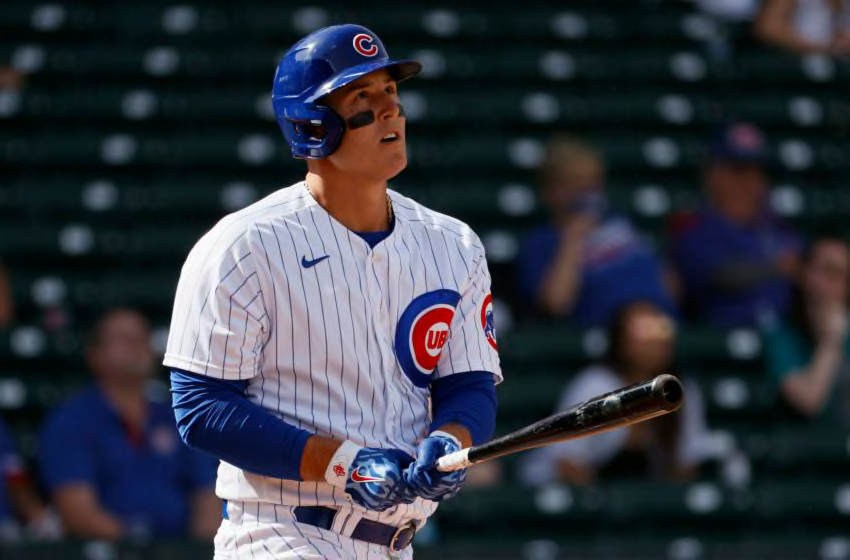
Chicago Cubs: 3 Anthony Rizzo to Boston Red Sox trades to considerVincent Pariseon July 27, 2021 at 8:23 pm

Read More

Chicago Cubs: 3 Anthony Rizzo to Boston Red Sox trades to considerVincent Pariseon July 27, 2021 at 8:23 pm Read More »

Mayor’s narrow focus on firearms won’t keep neighborhoods safe — but investment willLetters to the Editoron July 27, 2021 at 7:39 pm

To truly make our communities safe, we need to ramp up efforts to prevent violence before it happens, and before the police are ever involved.

This week, organizers and advocates celebrated as police accountability reform finally passed in the Chicago City Council after being stalled for two years by Mayor Lori Lightfoot. This long-overdue civilian oversight is a chance for Chicagoans to see under the hood and understand how the Chicago Police Department works and uses its $1 billion annual budget. It’s a chance to rethink how we classify spending on public safety, because police alone cannot keep Chicago safe.

SEND LETTERS TO: [email protected]. Please include your neighborhood or hometown and a phone number for verification purposes. Letters should be approximately 350 words or less.

The mayor’s violence prevention strategy has narrowly focused on getting illegal guns off the street, and her methods make for good headlines, but they are doomed to fail. Last week, the mayor announced a $1 million tip line for residents to report information on people in possession of firearms that are illegal or used in the commission of a crime, copycatting Ohio’s Republican governor, who tried and failed to peddle cash prizes to get more people vaccinated against COVID-19.

People who have witnessed crimes face serious threats to their safety if they snitch. No such threats exist for people getting vaccinated, yet this plan for guns is supposed to work? There is a cold cynicism motivating the idea that low income families will take such risks to help the police — who they very often distrust — and put themselves at great risk for the vague promise of cash. On top of that, CPD actually does a pretty good job getting illegal guns off the street, reporting an increase of 26% over this time last year.

Guns are the tool that inflicts violence, but they are not the source of violence. Northsiders have just as much access to illegal guns from Indiana as anyone on the South or West sides, but we don’t see the same level of violence in those wealthier communities. That’s because violence arises from a lack of investment in communities — a lack of good-paying jobs, affordable housing, access to quality medical care, childcare and a good education — not from access to guns.

We saw these same tactics in the failed Reagan-era War on Drugs, a racist policy that increased the severity of drug-related crimes, criminalizing a symptom of poverty instead of addressing root causes.

To start, we should be investing in a year-round, youth and young adult jobs program that’s funded by the city budget, with jobs that are accessible to the people who really need them. This means addressing transit equity in Chicago and appreciating that not everyone can easily get to the Loop.

That would be a real start to preventing violence in Chicago and keeping our communities safe.

Ald. Byron Sigcho-Lopez (25th)

Do you feel lucky about Lolla?

Mayor Lori Lightfoot, speaking of the risks of COVID-19 spreading at Lollapalooza, says she is “confident that the Lolla folks have a good solid plan in place. And we’re gonna obviously hold them accountable to make sure that plan is enforced.”

At the same time, though, the mayor has ignored the problem that people who ride the CTA — and those who work for the CTA — have no choice but to take crowded trains and buses in which people are not being made to wear masks. Is there some reason the mayor is not holding the CTA accountable for this?

Supposedly, masks are required on the CTA, but that seems to be only lip service. There is an obvious disconnect between stated policy and what’s actually taking place.

Attending Lollapalooza is going to be like playing Russian roulette with your health. As Clint Eastwood’s Dirty Harry asked, “Do I feel lucky? Well, do ya?”

Michael Pearson, Englewood

Read More

Mayor’s narrow focus on firearms won’t keep neighborhoods safe — but investment willLetters to the Editoron July 27, 2021 at 7:39 pm Read More »

Lollapalooza 2021: From Miley to Megan, 10 must-see acts to catch this weekendSelena Fragassi – For the Sun-Timeson July 27, 2021 at 7:30 pm

Thirty years ago, in the summer of 1991, Lollapalooza got its start as a touring event, originally intended as founder Perry Farrell’s way of bidding adieu to his rock act Jane’s Addiction. Yet, it soon proved successful and became one of the early American models for the thriving and popular festivals that have now become a cornerstone of contemporary culture across the globe.

In the past two years, the event has shown its resiliency and innovative spirit, quickly vaulting to a comprehensive virtual model amidst a global pandemic in 2020, and returning triumphant in 2021 as one of the first major music festival events hosted in Chicago (and the country for that matter).

Though a few things have changed this year — no Kidzapalooza stage and strict, new COVID-19 guidelines to be aware of before heading to the park — the stacked four-day lineup is an impressive feat to have pulled off in record time.

Here are the 10 acts people will be buzzing about when the weekend wraps:

Orville Peck

The always-masked country recording artist Orville Peck performs during his Summertime Tour at Red Rocks Amphitheatre on July 22, 2021 in Morrison, Colorado.
Getty

No one exactly knows who this incognito Canadian country singer is (his trademark look is a long, fringed mask and cowboy hat) but the boudoir-looking John Wayne has heaped tons of due praise in his few years on the scene. Both for crafting a highly contagious psychedelic outlaw sound that refreshes the genre and for being an LGBTQ iconoclast whose work with Trixie Mattel and Gaga will soon put him in a new league. (Thursday, 2:45 pm, T-Mobile Stage)

Black Pumas

In this screengrab, Musical group Black Pumas perform during the Celebrating America Primetime Special on January 20, 2021.
In this screengrab, Musical group Black Pumas perform during the “Celebrating America” primetime special on January 20, 2021.
Getty Images

The world needs a band like this Austin, Texas, neo soul-funk duo right now. Buoyed by their massive Otis Redding-style hit “Colors,” the potent act is a lyrical and literal show of unity, merging two distinct musical partners (one who grew up on gospel, another who played in every hip indie band in Texas) into this generation’s songwriting tour de force. They are the act to beat this weekend. (4:45 p.m. Thursday, T-Mobile Stage)

Miley Cyrus

Miley Cyrus (pictured earlier this year in Indianapolis) is scheduled to perform Thursday at Lollapalooza.
Miley Cyrus (pictured earlier this year in Indianapolis) headlines Thursday at Lollapalooza.
Getty Images

Coming out of her kid star shell over the course of the past decade, Miley Cyrus has been experimenting with her self image and music image in that time span, but where she’s landed recently with the glam rock album “Plastic Hearts” is a great place for that ballsy energy and unique voice. Cyrus’ constant state of flux also means anything goes in this set. Will she unleash her latest Metallica cover? Will former collaborators The Flaming Lips join her for a hamster ball ‘palooza? Will she do a duet with dad Billy Ray? Cyrus no doubt will bring the surprises in this festival opening night finale. (8:45 p.m. Thursday, T-Mobile Stage)

Black Pistol Fire

Lollapalooza gets in touch with more of its rock roots this weekend with a platter of next gen rising stars, among them White Reaper, Radkey, Hinds and the Austin blues-garage-rock duo Black Pistol Fire. The latter’s recent appearances at Riot Fest and Voodoo Fest still have jaws on the floor. Songs like “Bad Blood” and “Hope In Hell” are teething with all the implied grit and gumption that belies their small two-person stature — like The Black Keys on a case of energy drinks. (2 p.m. Friday, Tito’s Handmade Vodka Stage)

Elephant Heart

Married couple Jason and Victoria Evigan give major vibes of likewise weirdo duos The Ting Tings and Die Antwoord with their futuristic, multi-cultural, uncategorizable dance pop. But the really admirable thing about this project is its social arm, looking to spread Bob Marley levels of love and joy with their nonprofit Picture This, which has a mission to unite children across the world in friendship. This set will not only look and sound good — it’ll feel good, too. (4:30 p.m. Friday, BMI Stage)

Polo G

Chicago rapper Polo G is scheduled to perform at 5 p.m. Friday at Lollapalooza. | Michael Esposito
Chicago rapper Polo G is scheduled to perform at 5 p.m. Friday at Lollapalooza.
Michael Esposito

There’s no shortage of hip-hop talent booked for this weekend, but the rapper that all eyes and ears should be on is Polo G. Born and raised in Chicago, his pensive rhymes and melodic style are highly narrative and infused with real-life struggles and personal mea culpas. Though track “Finer Things” put him on the map in 2018, his newest No. 1 album “Hall Of Fame” and top single “Rapstar” is a foreshadowing of where he’s headed. (5 p.m. Friday, Bud Light Seltzer Stage)

Joy Oladokun

Singer & songwriter Joy Oladokun performs at 3rd & Lindsley on June 20, 2021 in Nashville, Tennessee. 
Singer-songwriter Joy Oladokun performs at 3rd & Lindsley on June 20, 2021 in Nashville, Tennessee.
Getty Images

If you need an excuse for the tears that may come from this set, just blame it on the sweat. This folk-pop star is one of the most heartfelt songwriters to debut in recent years who wears her soul on her sleeve with songs like “Breathe Again” that come alive like a scene in a movie. Others, like “Bad Blood” and “Lost,” give major Tracy Chapman vibes and show off her guitar prowess, too. (3:20 p.m. Saturday, BMI Stage)

Megan Thee Stallion

Though the schedule duel of the revived Limp Bizkit and Megan Thee Stallion may be one of the bigger conflicts of the weekend, our advice is to go for the “Savage” Stallion. We are currently living in a hip-hop matriarchy and MTS is one of the best to wear the crown with her writing second-to-none and slick confidence being the stuff that superstars are made of. Her inclusion in Time Magazine’s 100 Most Influential People of 2020 says everything you need to know about her impact. (6:45 p.m. Saturday, T-Mobile Stage)

Radkey

Made up of three brothers from Missouri, Radkey is the punk rock release you will need by Day Four. Creating some of the catchiest hooks in modern rock, their style finds that often unattainable level of radio-friendly earworm gems supported by a cache of cool. With inklings of The Ramones and vocals that give off an almost Danzig vibe, songs like “Dark Black Makeup” are good reason to get up early today. (12:50 p.m. Sunday, Grubhub Stage)

Foo Fighters

Dave Grohl of the Foo Fighters performs onstage during the taping of the “Vax Live” fundraising concert at SoFi Stadium in Inglewood, California, on May 2, 2021.
AFP via Getty Images

Stay hydrated for this one. Foo Fighters are notorious for packing in a massive three-plus-hour set stacked with hits like “Everlong,” covers of rock gems like “Under Pressure” and quippy bits from Dave Grohl and drummer Taylor Hawkins. After releasing the documentary “What Drives Us” earlier this year, penning essays about what is missing when we don’t have live music, and using their stature to help save stages and reopen venues like L.A.’s Forum and Madison Square Garden, there is no better or more goodhearted band than the Foos to help make us all feel in the zone again after a year gone dark. Let’s just hope the rain stays away from their set this time. (8 p.m. Sunday, T-Mobile Stage)

Selena Fragassi is a local freelance writer.

NOTE: According to the Lollapalooza website: “In accordance with City of Chicago requirements, full COVID-19 vaccination or negative COVID-19 test results will be required to attend Lollapalooza 2021. For patrons who are not fully vaccinated, a negative COVID-19 test result must be obtained within 72 hours of attending Lollapalooza.”

Read More

Lollapalooza 2021: From Miley to Megan, 10 must-see acts to catch this weekendSelena Fragassi – For the Sun-Timeson July 27, 2021 at 7:30 pm Read More »

Matt Nagy, Ryan Pace know that ‘right now, you’ve gotta win’Patrick Finleyon July 27, 2021 at 7:29 pm

One storm passed. Another one might await.

But Bears general manager Ryan Pace and coach Matt Nagy are experiencing a specific sensation on the eve of a season that will define their careers with the franchise. They talked to each other about it in the last week.

“Matt said this the other day, and I thought it was a good point — there’s a calmness right now that we just feel,” Pace said Tuesday as Bears players streamed into Halas Hall to check into training camp. “I think it’s because of our communication, communication with ownership, with [president/CEO Ted Phillips], throughout our staff.

“We’ve been together long enough. There’s a calmness along with an excitement going into the season.”

It was chairman George McCaskey, of course, who gave both men another season. That seemed unlikely at the nadir of last season, when the Bears lost their sixth-straight game to fall to 5-7. They then went 3-1 the rest of the way, backed into the playoffs and were blown out by the Saints.

Even as McCaskey decided to leave the power structure of Phillips, Pace and Nagy intact, he acknowledged in January that the decision “might not be the easiest or most popular.” Some frustrated Bears fans probably nodded in agreement.

Asked what he needed to do to justify the belief of his bosses, Nagy was straightforward Tuesday.

“Like a lot of teams, owners and head coaches in this league and general managers, is, right now, you’ve gotta win,” he said. “That’s keeping it really simple. That’s every team’s goal every year is to do that.

“We want to do it the right way. We’re extremely motivated in a good way in the fact that these are challenges. We look forward to these. We know that we have support from them, and that’s No. 1. We have support from them. Now it’s just a matter of putting it all together with the players and coaches.”

Nagy, who is entering the fourth year of a five-year contract, would likely earn an extension — and continue to be paired with Pace — if the Bears indeed put it all together this year. If the Bears struggle, or if there’s a glitch in the development of rookie quarterback Justin Fields, the Bears could fire them at the end of the season.

Pace said that Fields won’t be rushed into action because of any pressure surrounding he and Nagy’s job status.

“No, not at all,” he said. “What’s best for this organization, always.”

Human nature dictates that walking the line between winning now and prioritizing the future was difficult for Pace this offseason. Pace, though, insists it wasn’t.

Trading first round picks this year and next for the star Ohio State quarterback was seen by those around the league as a no-brainer, not an act of desperation. Pace pointed to his most recent trade — shipping receiver Anthony Miller, alongside a seventh-round pick, for the Texans’ fifth-rounder in 2022 — as proof that he is building for beyond this season.

“I’m always thinking about the long-term health of this team and this franchise,” Pace said. “And that’s my responsibility to always think long-term. We have a lot of those discussions because sometimes it is natural to kind of hone in on this myopic vision, but for me, it’s easy to think long term as we make these plans …

“It all goes into our bigger plan to make this thing successful long term.”

But first, it needs to be successful in the short term.

Read More

Matt Nagy, Ryan Pace know that ‘right now, you’ve gotta win’Patrick Finleyon July 27, 2021 at 7:29 pm Read More »

Prince’s ‘Welcome 2 America’ posthumous release is stunningScott Bauer | Associated Presson July 27, 2021 at 7:11 pm

Prince, “Welcome 2 America” (Legacy Recordings)

Anyone who feared that Prince’s vault was filled with nothing but Billy Joel covers, as the satirical website The Onion joked shortly after his death, need not worry.

“Welcome 2 America” is the first complete, previously unreleased record to come out since Prince died in 2016. And it’s a stunner.

Incredibly, “Welcome 2 America” manages to be as relevant, or maybe even more relevant, today than when it was recorded, and promptly shelved, in 2010. Most of the songs have been unheard until now.

This image released by Sony Music Entertainment shows “Welcome 2 America” by Prince.
AP

Confronting themes of racial justice, equality, big tech and just what it means to be human, “Welcome 2 America” feels like the soundtrack for the years since Prince’s untimely death. It’s almost as if Prince knew “Welcome 2 America” would mean more in 2021 than it might have when first recorded.

From the first song and title track, which starts off with Prince bemoaning the power of the iPhone and Google, the tone of “Welcome 2 America” is made clear.

“Land of the free/home of the slave,” Prince determines, and we’re off.

Oh, and it rocks too, in the genre-defying way that defined Prince’s career.

Just try not to get up and dance during “Hot Summer” or “1000 Light Years From Here.” There is one cover on the record, but it’s not from Billy Joel. Instead, Prince taps fellow Minneapolis musicians Soul Asylum, making their song “Stand Up and B Strong” sound like a Prince original.

But “Welcome 2 America” is also tinged with melancholy. As alive, relevant and fresh as Prince sounds, there’s no escaping the fact that he’s gone and the only reason we’re hearing this now is because of that.

Read More

Prince’s ‘Welcome 2 America’ posthumous release is stunningScott Bauer | Associated Presson July 27, 2021 at 7:11 pm Read More »

Woman dies after Dolton police open fire during confrontation at restaurant drive-thru windowDavid Struetton July 27, 2021 at 7:44 pm

A woman died after Dolton police shot into her car as she dragged one officer and struck another at a restaurant drive-thru early Tuesday, badly injuring both officers, officials said.

The woman was identified as Alexis C. Wilson, 19, of Homewood, according to the Cook County medical examiner’s office.

Dolton police were called around 1 a.m. Tuesday to Baba’s Famous Steak & Lemonade restaurant at Oak and Sibley Boulevard for a woman with a gun who was upset, Dolton spokesman Sean Howard told reporters.

Officers ordered the woman and a man inside the car to get out, Howard said. The man complied but the woman refused.

As one of the officers tried to remove her from the car, the woman sped off and dragged the officer with him hanging halfway out of the window, Howard said. Another officer then fired three times into the car, Howard said.

The woman ran over that officer and crashed into a squad car, Howard said. She continued to drive one block and crashed into an unoccupied bicycle shop on Sibley, he said.

The woman died at the scene, Howard said. It’s unclear if she died from gunshot wounds or from the crash. Her name hasn’t been released.

The two officers were taken to a hospital and were in serious condition, he said.

“This was unfortunate,” Howard said. He said witnesses were cooperating with police.

Illinois State Police were investigating the officers’ use of force, Howard said.

Read More

Woman dies after Dolton police open fire during confrontation at restaurant drive-thru windowDavid Struetton July 27, 2021 at 7:44 pm Read More »

How do blind people pick up after dogs?Neil Steinbergon July 27, 2021 at 6:08 pm

Four times a day, Leslie takes her black Lab for a walk outside her home in the northwest suburbs. “Get busy,” she commands.

If you’re wondering why you’re reading a third column in a week about picking up after dogs, well, stick with me, and you’ll see there is no choice here. Some threads simply must be pulled.

If you recall, Monday’s column quotes the Cook County animal law, Sec. 10.8 (r): “No person shall fail to remove feces deposited by the person’s cat or dog, except service animals…”

This drew an email from former Sun-Times book editor, Henry Kisor.

“Your column today, with all the poop about designer poo bags … was interesting — and shocking,” he wrote. “Shocking in your citation of the Cook County law about cleaning up after your dog. Why should handlers of service dogs be exempt from that? I use a service dog, and like all other service dog handlers I have ever known, I clean up after my dog.”

I replied that perhaps the clause is meant not for people who are deaf, like Henry, but for the blind. How could a blind person pick up after a dog?

“The way I pick up after my dog, first of all, feel for her movement,” said Leslie, who asked me not to use her last name. “I can tell she’s moving around in circles, or sniffing, through the leash.”

She also didn’t want me to use her dog’s name, lest someone read the article, see her on the street, and shout “Rover!” or whatever, and come over and pet the dog. You’re not supposed to do that. Service dogs are working.

“You don’t want to give someone a chance to distract the dog, for safety reasons,” she said.

Cleaning up after her dog requires the same sensitivity Leslie uses to navigate the world.

“You can definitely feel though the leash, the back and forth vibration, and when they stop spinning, you can tell through the leash the dog is staying in one place,” she said. “I trail down the leash and feel her back. If the back is in a C-shape, then she’s pooping. If her back is like a hill, she’s peeing.

“What I can do when my dog is going poop, feel back down toward her tail, plant one of my feet close to the tail, then use that as a marker. When she’s done, I have something tactile to help me go back to the place where she went.”

The 31st anniversary of the Americans with Disabilities Act was Monday, so this is a good moment to remember that while the law can require accessible bathrooms, designated parking spaces and such, it can’t affect the bigotry of low expectations in the minds of those who simply assume that people facing physical challenges are limited in ways they’re not.

“This is important to me because many laws crafted to serve people with disabilities often sound as if we are incapable of participating in society, including obeying its laws,” wrote Kisor. “That’s just not true.”

Leslie concurs.

“He is absolutely correct,” she said. “All service dog owners should be picking up after their dogs. Any guide dog training school teaches you how to do it. Not only are you being a good citizen, picking up after your dog, you can also tell by the consistency of the dropping — maybe it’s a little softer — whether the dog is sick. We’re going to keep an eye on it a couple days, and if it continues, take the dog to a vet.”

I don’t want to leave you with the impression that cleaning up after her dog is the most notable activity Leslie does. Blind since birth, she also teaches cello, and plays the instrument in the Elmhurst Symphony, memorizing braille versions of the musical scores that other musicians sight read.

“I do a lot of listening, and I do a lot of counting,” she said, of playing in an orchestra without seeing the conductor’s cues.

About 70% of blind people are unemployed, reflecting not so much their abilities as the limited vision of potential employers.

“I find that people underestimate what all blind people can do,” she said. “With opportunity and training, we as blind people can be successful.”

Read More

How do blind people pick up after dogs?Neil Steinbergon July 27, 2021 at 6:08 pm Read More »

Inside a KKK murder plot: Grab him up, take him to the riverAssociated Presson July 27, 2021 at 6:02 pm

PALATKA, Fla. — Joseph Moore breathed heavily, his face slick with nervous sweat. He held a cellphone with a photo of a man splayed on the floor; the man appeared dead, his shirt torn apart and his pants wet.

Puffy dark clouds blocked the sun as Moore greeted another man, who’d pulled up in a metallic blue sedan. They met behind an old fried chicken shack in rural north Florida.

“KIGY, my brother,” Moore said. It was shorthand for “Klansman, I greet you.”

Birds chirped in a tree overhead and traffic whooshed by on a nearby road, muddling the sound of their voices, which were being recorded secretly.

Moore brought the phone to David “Sarge” Moran, who wore a camouflage-print baseball hat emblazoned with a Confederate flag patch and a metal cross. His arms and hands were covered in tattoos.

A nervous, giddy chuckle escaped Moran’s mouth.

“Oh, shit. I love it,” he said. “Motherf—– pissed on himself. Good job.”

“Is that what y’all wanted?”

“Yes, hell yeah,” Moran said, his voice pitched high.

It was 11:30 a.m. on March 19, 2015, and the klansmen were celebrating what they thought was a successful murder in Florida.

But the FBI had gotten wind of the murder plot. A confidential informant had infiltrated the group, and his recordings provide a rare, detailed look at the inner workings of a modern klan cell and a domestic terrorism probe.

That investigation would unearth another secret: An unknown number of klansmen were working inside the Florida Department of Corrections, with significant power over inmates, Black and white.

___

Thomas Driver took a pull off a cigarette, and exhaled the smoke at Warren Williams. Driver, a white prison guard, and Williams, a Black inmate, faced each other.

It was a humid August day in 2013, about a year and a half before the clandestine murder photo reveal.

The two men stood in a sweltering prison dorm room in rural north Florida’s Reception and Medical Center, a barbed wire-encircled complex built among farmland an hour south of the Georgia state line. The RMC is the state’s prison hospital where new inmates are processed.

Williams, a quiet, 6-foot-1, 210-pound inmate, suffered from severe anxiety and depression. He was serving a year, records show, for striking a police officer. Williams agreed to plead no contest in exchange for a reduced sentence, and an order to receive a mental health evaluation and treatment under county supervision.

He found himself in front of Driver after he lost his identification badge, a prison infraction.

Williams told Driver to stop blowing smoke at him, he’d report later. Driver blew more, and Williams told him to stop again.

When Driver continued, Williams jumped him and they hit the ground. As they struggled, Williams bit Driver and gained an advantage, according to both men’s accounts of the fight.

A group of guards responded, and beat Williams so badly that he required hospitalization, his mother and lawyer said.

Driver, in turn, needed a battery of precautionary tests for HIV and hepatitis C because of the bite. They would all be negative, but the ordeal enraged him.

He wanted revenge.

___

More than a year later, in December 2014, a wooden cross ignited in a field hidden by tall trees.

Dozens of hooded klansmen gathered around for a “klonklave,” a meeting of the Florida Traditionalist American Knights of the Ku Klux Klan. Members of a biker club were being “naturalized” as citizens into the Invisible Empire of the Klan.

Security was tight. The bikers were worried about recording devices, and were checking people.

Driver, known by his fellow klansmen as “Brother Thomas,” was there with Sarge Moran, who was also a prison guard. Moran had worked for the Florida Department of Corrections for decades; he’d also been a klansman for years. He had been disciplined more than once by the corrections department for violent incidents, according to records obtained by The AP. Despite this, Moran had been kept in a position of power over inmates.

Moran and Driver wanted to discuss an urgent matter with Joseph Moore, the group’s “Grand Night Hawk,” in charge of security.

Moore was a U.S. Army veteran. When not in his klan “helmet,” he often wore a baseball hat pinned with military medals, including a Purple Heart. He commanded respect and fear from his klan brothers, and often regaled them with stories of his work killing targets overseas as part of an elite U.S. military squad.

The three men moved away for a private talk, and had another klansman keep watch nearby so they weren’t overheard.

The guards gave Moore a paper with a picture of Williams, his name and other information. Driver described the fight, and how he and his family had worried for weeks about a false positive test for hepatitis C.

“Do you want him six feet under?” Moore asked.

Driver and Moran looked at each other, then said yes.

___

The very existence of a plot to murder a Black man by Ku Klux Klan members working in law enforcement evokes past tragedies like the 1964 “Mississippi Burning? case, where three civil rights workers were slain by klansmen. Sheriff’s deputy Cecil Price Sr. was implicated in the deaths and was convicted of violating the young men’s civil rights.

Today, researchers believe that tens of thousands of Americans belong to groups identified with white supremacist extremism, the klan being just one. These groups’ efforts to infiltrate law enforcement have been documented repeatedly in recent years and called an “epidemic” by legal scholars.

FBI Director Christopher Wray said at a March Senate hearing that “racially motivated violent extremism,” mostly by white supremacists, accounts for the most rapidly rising share of domestic terrorism cases.

“That same group of people … have been responsible for the most lethal attacks over the last, say, decade,” Wray added.

During the Jan. 6 insurrection in the U.S. Capitol, “Thin Blue Line” flags flew alongside white supremacist signs and banners, and more than 30 current and former police officers from a number of departments around the nation were identified as attendees.

“White supremacist groups have historically engaged in strategic efforts to infiltrate and recruit from law enforcement,” said an FBI document released by a congressional committee in September, about four months before the Capitol riots. In the intelligence assessment, written in 2006, the FBI said some in law enforcement were volunteering “professional resources to white supremacist causes with which they sympathize.”

While the FBI would not confirm if it had produced a more recent assessment of the ongoing threat, recent cases have confirmed that the problem the agency described in 2006 continues.

In November, a Georgia deputy was caught on an FBI wiretap boasting about targeting Black people for felony arrests so they couldn’t vote, and recruiting colleagues into a group called “Shadow Moses.” In 2017, an interim police chief in Oklahoma was found to have ties to an international neo-Nazi group. In 2014, two officers in Fruitland Park, Florida, were outed as klansmen and forced to quit.

Despite repeated examples, white supremacists who are fired from law enforcement jobs after being discovered can often find jobs with other agencies. There is no database officials can check to see if someone’s been identified as an extremist.

In 2020, an officer in Anniston, Alabama, was hired by a county sheriff’s department just a few years after the Southern Poverty Law Center posted a video of him speaking at a white nationalist League of the South meeting.

“There’s no trail that follows them even if they’re fired. It’s spreading the problem around,” said Greg Ehrie, former chief of the FBI’s New York domestic terrorism squad, who now works with the Anti-Defamation League.

Domestic terrorism experts have been calling for better screening to help identify extremists before they’re hired. Some states, such as California and Minnesota, have tried to pass new screening laws, only to be prevented by police unions, whose legal challenges argued successfully that such queries violate free speech rights.

Without screening, white supremacists who get inside can operate with impunity, targeting Black and other people of color, and recruiting others who share their views.

“Unless your name ends up in an FBI wiretap” an officer will go undetected, said Fred Burton, a former special agent with the U.S. Diplomatic Security Service. “There are loopholes in the background investigative process.”

___

Warren Williams got out of prison a few months after his fight with Driver, the prison guard. It was just before Christmas, and he arrived at his mother’s single-story brick house in Palatka, a small town in north Florida. It was cramped with his three little sisters.

The street dead-ended at some railroad tracks, beyond which flowed the St. Johns River. The wide, rushing waterway runs through town on its way back out to sea to the northeast, near Jacksonville.

After months in a prison cell, Williams longed to fish the St. Johns again. He looked forward to spending days outdoors in his landscaping job, and to writing poems and music in his free time.

Palatka, with a population split almost equally between Black and white, had been devastated by the 2008 Great Recession. Many of its prized murals were fading, and there were more shuttered shops in the old downtown than open ones. A coal-fired power plant on the river is Palatka’s largest employer, as well as a paper mill that fills the air with a sour stench.

Williams struggled with anxiety, and sometimes had violent outbursts. His mother called these episodes his “protective mode.” But he was home, where she could watch him. He’d been adhering to his probation requirements, and made his mandated meetings.

And in the 21st Century, the klan was not among Williams’ list of worries. Images of burning crosses and klansmen targeting Black people for violence seemed anachronistic.

But the symbols of the group’s reign in Palatka endure. Each time Williams met with his probation officer, he passed the statue of a Confederate soldier in front of the Putnam County courthouse in downtown Palatka, the county seat. The gangly live oak trees in the court square are mesmerizing to some observers, but to others they’re a painful reminder of past lynchings.

Jim Crow Florida was one of the most dangerous places in the South to be Black. In that era, a Black man in Florida was more at risk of being lynched — an execution without trial, often by gun or hanging — than in any other state, according to a University of Georgia study of lynching records.

In 1925, the KKK controlled Putnam County. A klansman named R.J. Hancock was elected sheriff and he helped unleash a reign of terror, where lynch mobs dominated civic life. To stop it, Florida’s governor threatened to declare martial law in 1926.

But the klan and its ilk have endured. Today it’s just one group in a modern, decentralized white supremacy movement.

“It’s surprising that we’re even having a conversation about something that was prevalent in the 1920s, taking place 100 years later,” said Terrill Hill, Williams’ attorney and Palatka’s mayor. “It’s frustrating. It’s angering.”

___

It was a chilly and overcast January day when Joseph Moore, the klan’s Grand Night Hawk, arrived at a small house tucked behind tall trees. The air smelled like pine.

It was the home of Charles Newcomb, a stone-faced, chain-smoking former prison guard who was the klan’s Exalted Cyclops, a local chief. Newcomb had left his job at the prison, but he remained close to “Sarge” Moran. He wanted to discuss the “Brother Thomas issue” with Moore.

“I look at it this way brother. That was a direct … attempted murder on him,” Newcomb said, referring to Williams’ biting Driver. “I don’t care how you look at it.”

“We just need to do our deed, and where it falls, it falls,” Newcomb said. “Because he’s a piece of trash anyway.”

Because of Moore’s professed background as an elite government assassin, Newcomb trusted him to help execute the plan.

“I’d like to see things done in a professional manner,” Moore said, with the tone of an experienced hitman. “There are skills and techniques and things that survive the test of time. If you bury somebody in, say, an open field or whatever … it is going to be dug up.”

“But if you bury somebody in a graveyard over top of somebody that’s already been buried, it’s never going to be uncovered for a septic tank.”

Both agreed they should take a trip to Palatka to scope out Williams’ neighborhood.

“One night we find him out there and I can walk right up, put him out of his misery,” Newcomb said.

Newcomb wanted to ensure Driver had an alibi.

“What we need is Brother Thomas (Driver) to be at work,” Newcomb said. “And when we do it when Thomas is at work, (he) has an alibi.”

___

Joseph Moore was a husband and father, a veteran and klansman. He was also a confidential informant being paid to provide information to the FBI.

It’s life-threatening work. If his klan brothers found out, Moore had no doubt how it would end.

The relationship carried considerable risk for the FBI, too. Moore had suffered a mental breakdown and was hospitalized following an honorable discharge from the U.S. Army in 2002, where he’d been trained as a sniper.

He’d walked into a hospital in New Jersey, drunk, wearing a tactical vest. His pockets were stuffed with a few thousand dollars in cash. He was carrying a plane ticket to Jordan, and told police he’d planned to fight with the Peshmerga in the Kurdish region of Iraq. He would spend four months under medical observation.

The FBI and Bureau of Alcohol, Tobacco, Firearms and Explosives, or ATF, have long relied upon informants to investigate domestic extremist groups, with mixed results. Federal investigators have on occasion been fooled and manipulated by informants. And the effort is expensive. Informants often work in secret for years, and if they’re found out, placed into protective custody.

In 2008, Moore appeared at the FBI’s Gainesville office because he wanted them to investigate the local sheriff’s office. His brother-in-law had been arrested on a drug-related charge, and Moore thought that a crooked deputy had planted the drugs. An FBI agent met with Moore, and eventually recruited him to join an investigation into a member of a different Florida klan group suspected of planning a murder.

During that investigation, Moore’s wife had grown suspicious of his activities. She demanded answers. Eventually, he told her — and her family — about his FBI work. It was a basic violation of the rules and the FBI fired him.

A few years later, Moore’s cellphone lit up with an unknown number. The voice, however, was familiar. It was an agent who’d known him from his previous work with the FBI, asking to meet about a new investigation into another violent klan cell. Because of Moore’s success infiltrating the klan before, the agency recruited him again.

The FBI bought him a computer and phone so he could make contact online with the new klan group. Within a few weeks, Moore had scheduled a meeting with the Grand Dragon and second-in-command at a Dollar General parking lot in Bronson, Florida.

The klansmen checked Moore’s drivers license and tested him in an exchange of klan jargon.

Moore told them that he’d killed people before, including a hit in China in 2005. He was lying. He’d never seen a battlefield and the medals he wore were fakes.

But the leaders were impressed. They invited Moore to be “naturalized.” He filled out an application, paid a $20 fee along with $35 in annual dues.

He also signed a “blood oath,” part of which read, “I swear … to be Klannish in all things, to accept the life of the Brotherhood of Service, to regenerate our country and to the white race and maintain the white blood and natural superiority with which God has enabled it.”

The Grand Dragon told him that a violation of his blood oath was punishable by death.

___

On January 30, 2015, less than two years after Moore had signed his klan oath, the murder plot was in motion.

Moore’s tires crunched on Newcomb’s driveway as he pulled his SUV past a weathered sign on a fence post. It featured a pistol barrel pointed at would-be trespassers. WARNING: There is Nothing Here Worth Dying For.

Moore found Newcomb excited about a new idea he’d had for how to kill Williams.

“I have several bottles of insulin in here if you wanted to do it that way,” Newcomb said.

“Do we do it fast and get the hell out? Or do we want to grab him up and take him somewhere and shoot him with insulin?” Newcomb asked.

Moore masked his surprise. He’d thought they were just doing reconnaissance, and now Newcomb was planning to strike.

“It’d be quieter,” Newcomb said, “if we can grab him up, throw his ass in the car and take off with him somewhere. And we’ll just inject his happy ass with a bunch of insulin and let him start doing his floppin’.”

An insulin overdose is an excruciating death marked by uncontrollable tremors. For a medical examiner, it’s difficult to detect. A person’s blood sugar declines naturally when they die, whether the person is diabetic or not. And syringe pricks are so small that, unless you’re looking for them specifically, they’re nearly undetectable.

“I’ve got two full needles ready, and then I got two other bottles with us,” Newcomb said.

“Is that your wife’s meds?” Moore asked.

Newcomb said they were, but that she had plenty extra.

He went into his garage and returned with a child’s fishing pole, decorated with images of the cartoon character “Dora the Explorer.”

“If we was gonna grab him up and take him down towards the river he’ll need a fishing pole like he’s been fishin’ right?” Newcomb asked, rhetorically. “I wanna make it look realistic.”

They were looking at the fishing pole when “Sarge” Moran pulled into the driveway. He apologized for being late.

“Sarge. I brought some insulin. Me and Brother Joe (Moore) was talking, and if we can just kinda grab his ass up,” Newcomb said before Moran interrupted.

“Are we going to grab him now?”

“I mean, we’re going down to look at some things right now and see if a chance presents itself,” Newcomb said.

“I’m following y’all’s orders. Whatever orders are given,” Moran responded eagerly. “I’m here to serve. I’m at the will and pleasure of.”

The three klansmen piled into Moore’s SUV and pulled onto a two-lane highway, driving under Spanish-moss-draped tree branches.

They had the cooler of syringes, the Dora the Explorer fishing rod, and Newcomb’s handgun, which he rested between his legs.

They fell silent as they drove past dirt roads that led back into dense Florida brush.

Then Newcomb’s cell phone rang. His young daughter’s voice was at the other end of the line.

“Y’all don’t need to bother me today unless it’s very, very important. OK?” he scolded. His voice softened. “All right. I love you. Bye bye.”

Without missing a beat, Newcomb returned to his plans. A gun sat between his legs as he spoke.

“What I was thinking, though, is if we could grab that package up and take him to the river, which is not that far from him,” Newcomb said. “Put his ass face down and give him a couple of shots, because I’ve got two completely full and they’re already ready to go.

“If I set that fishing pole like he’s been fishin’, and give him a couple shots and we sit there and wait on him, then we can kind of lay him like he’s kind of tipping over into the water and he’s breathed in just a little bit.”

Moran had other logistical issues on his mind. What would they do with the body?

“If we’re going to do a complete disposal. If we’re going to chop up the body,” he said, before being cut off.

Newcomb said they had lots of options.

“I mean, if we have to do pow pow, we will,” he said, referring to shooting Williams.

Whatever they decided, Moran said, they needed to protect themselves. They’d brought face shields and coats to cover their skin in case things got messy.

After his initiation into the klan, the FBI had authorized Moore to start recording the group’s two main leaders. Initially, they did not know the klansmen included active law enforcement personnel.

After the klansmen brought Moore into the murder plot, however, the FBI widened the scope of the people he could record. The FBI had outfitted Moore’s SUV with recording devices that broadcast live to agents as they drove to Palatka.

Also, the FBI had made a number of moves to keep Williams safe. They held him in a safe house. They placed police vehicles around his neighborhood so when the klansmen arrived, the FBI agents, Florida Highway Patrol and Palatka police were clearly visible.

When the klansmen drove into Williams’ neighborhood, the sight of police patrol cars unnerved them. “Can’t make too many rounds with him sitting there,” Newcomb said, eyeing a squad car.

Moore tried to play it cool as he turned the car to head back to Newcomb’s house.

“I just hate that we didn’t get to achieve our goal today,” Newcomb said.

“We’ll catch that fish,” Moran reassured him.

Later Moore dialed his FBI contact, and described breathlessly what he’d recorded. “He actually loaded up a couple of insulin syringes and he was ready to grab him,” he said, panting. “It’s all on the recording.”

___

Williams lay on the floor of his mother’s house, pretending to be dead. The prior day he’d received a strange phone call from his probation officer, asking him to come to the office the next day.

Williams was confused. He’d met with the officer that very day, and hadn’t been in any trouble in the hours since.

He told his mother about the call, and she told him to go.

“If you didn’t do anything wrong, just head on down there and talk to him,” she said.

When he’d arrived at the mystery meeting there were unfamiliar faces in the room. They were federal domestic terrorism investigators.

They told him his life was in danger. He’d need to go into protective custody.

But first, they wanted to go to his house and take a photograph.

On the way, Williams saw his mother, Latonya Crowley, in a car at a stoplight on her way out of town for the weekend. The agents waved her down and she turned around and tailed their dark blue van back to her home.

Inside, the agents poured water on Williams’ pants. They’d torn his shirt to appear as if he’d been shot.

When they were done, the FBI placed Williams in a safe house. Not even his mother knew where he was. They would only speak by phone until the men who wanted to kill Williams were in custody.

___

A few weeks later, Moore waited for Driver outside a Starbucks in a strip mall parking lot.

He’d already shown Moran the staged murder photo of Williams lying on the floor, video recording his gleeful response. The day before, he’d done the same with Newcomb, who told Moore “good job” and hugged him.

Driver was his last assignment. In their last discussion about Williams, Driver had said he’d stomp Williams’ “larynx closed” if he had the chance. Moore had said either he or someone he contracted with would finish the job.

They greeted each other, and Moore told Driver to sit in his car.

“We remembered how emotional this was for you and wanted — thought you might want some closure.”

Moore handed Driver the phone with the photo of Williams’ supposedly lifeless body.

“Let us know what you think,” Moore said.

“That works,” Driver said curtly.

“That what you wanted?”

“Oh, yes,” Driver said, relaxing into a chuckle.

Sarge Moran was at home when a prison colleague called: Could he come in on his day off to get fitted for new uniforms? Authorities arrested him when he arrived, and held him in the prison where he’d spent decades as a guard.

Driver and Newcomb were arrested at their homes.

In August, 2017, Newcomb and Moran stood trial at the Columbia County Courthouse in Lake City. Joseph Moore was the state’s star witness, testifying against the men he’d spent years befriending. For a time, the government protected Moore’s family; his current whereabouts are unknown.

In the end, a jury convicted Moran and Newcomb of conspiracy to commit murder. They were each sentenced to 12 years. Driver received four years after pleading guilty, and is due out this year.

Because of threats in Florida prisons, Driver was moved secretly to another state to serve his time, according to a source with knowledge of the case. Even though they are in prison, neither Newcomb nor Moran were in Florida’s inmate locator system and could not be reached for comment.

Even though three current and former Florida prison guards were exposed as klansmen, the state’s Department of Corrections says it found no reason to investigate whether other white supremacists were employed in its prisons.

There were no other “investigative leads,” Michelle Glady, the department’s director of public relations, said in a statement to The AP. “However, any allegation of a staff member belonging to a group such as those mentioned, would be investigated on an individual basis.”

Those in violation of a “willful breach” of the department’s core values can be fired or face arrest.

On a recent visit to the prison where the three klansmen worked, numerous cars and trucks in the employee and volunteer parking lots were decorated with symbols associated with white supremacy: Confederate flags, QAnon symbols and Thin Blue Line flag decals.

___

Williams and his family live today with uncertainty and paranoia.

“My fears? That maybe some of the other klan members could come around, and try to find us and harm us,” his mother, Latonya Crowley, told The AP in her first interview about the ordeal.

Looking back, Crowley remembers weird occurrences around the house before the FBI got involved.

In one instance, a neighbor said they saw two white men — they looked like police — in Crowley’s yard at daybreak. “No police came to my house,” Crowley remembered replying to the news, dismissively.

A bag of her trash full of her empty insulin containers — she’s diabetic – also disappeared. She wonders if that’s why Newcomb thought to use insulin.

But Williams and Crowley are thankful, too. The FBI saved his life, and the state of Florida prosecuted the men who threatened him.

Williams has filed a lawsuit against the klansmen and the Florida Department of Corrections.

Williams’ attorney is frustrated that Florida hasn’t investigated more thoroughly to see if there are more white supremacists working for the state prisons, and wants them to take responsibility. Florida, for its part, has sought to have the case dismissed and declined further comment on it.

Williams is haunted by Driver’s imminent release and the specter of other klansmen have made it impossible for him to move on.

“In the state of mind that he’s in today, I don’t see him getting better,” Crowley said.

Eric Tucker in Washington and Randy Herschaft in New York contributed to this story.

Follow Jason Dearen on Twitter: http://www.twitter.com/@JHDearen

Read More

Inside a KKK murder plot: Grab him up, take him to the riverAssociated Presson July 27, 2021 at 6:02 pm Read More »

Bears GM Ryan Pace: All parties will benefit from trading Anthony Miller to TexansJason Lieseron July 27, 2021 at 5:52 pm

Bears general manager Ryan Pace was more invested in wide receiver Anthony Miller than anyone else at Halas Hall after trading up to draft him three years ago, but even he couldn’t keep waiting. Rather than holding out hope that he’d become more reliable, Pace packaged Miller and a seventh-round pick in a trade to the Texans for a 2022 fifth-rounder.

“It just became a situation where, hey, both parties can benefit,” said Pace, who added that he’d been talking to Houston all summer about the deal. “Once I realized we could get a fifth-round pick out of this… And we feel good about the receiver room that we have. There’s a lot of competition there. It all connected together where the timing was right, and we wish him nothing but the best and we’re moving forward.”

Pace took Miller in the second round (No. 51 overall) in 2018, but he did not play up to his draft status. Coaches talked publicly about not being able to trust him to run routes correctly, and he completely lost his composure and was ejected from the Bears’ playoff game last season.

Nagy was especially exasperated by that lapse because he devoted part of the week leading up to the game to showing examples of Saints safety C.J. Gardner-Johnson’s taunting antics and warning players to avoid being baited into an altercation. Miller couldn’t follow that directive, though, and was thrown out for punching Gardner-Johnson after a play.

He slipped to 49 catches, 485 yards and two touchdowns last season as rookie Darnell Mooney overtook him in the offense. Mooney played 73% of the snaps, while Miller got just 55%.

Read More

Bears GM Ryan Pace: All parties will benefit from trading Anthony Miller to TexansJason Lieseron July 27, 2021 at 5:52 pm Read More »

Black female aldermen finally get thearing on search warrant reform, but no vote held — or promisedFran Spielmanon July 27, 2021 at 6:48 pm

Police reform advocates on Tuesday made their case for more sweeping search warrant reforms aimed at preventing a repeat of the botched raid on the wrong home that forced a crying and pleading Anjanette Young to stand naked and humiliated before an all-male team of police officers.

Now that the City Council has approved a landmark civilian police oversight ordinance, Public Safety Committee Chairman Ald. Chris Taliaferro (29th) finally got around to honoring his promise to hold a hearing on the ordinance championed by Black female aldermen and embraced by Young.

Ald. Maria Hadden (49th), chief sponsor of the “Anjanette Young ordinance,” took full advantage of the opportunity even though it was only a “subject matter hearing” where no vote was taken.

Hadden argued the search warrant reforms Mayor Lori Lightfoot and Chicago Police Supt. David Brown have imposed by executive order are grossly inadequate.

She wanted people to know about “the frustration that our residents are feeling and, I can say, the frustration that I feel as a member of City Council, knowing that the special order is in effect and we’re still waiting on these changes,” Hadden said.

“What we’re asking for is for standards, for guidelines, for consistency. … You’re not seeing these raids happen in predominantly white neighborhoods. You’re seeing this disproportionate trauma” happen in Black and Hispanic communities, she added.

The ordinance would require search warrants to be conducted from 9 a.m. to 7 p.m., using the “least intrusive” tactics possible. Before executing a warrant, police would be required to wait 30 seconds and take “all available measures to avoid executing the warrant when children under 16 are present.” If children are present, police would be prohibited from pointing firearms at or handcuffing them.

Stella Park, researcher and law student at the University of Chicago’s Mandel Legal Aid Clinic, argued the Chicago Police Department’s decision to continue raiding homes in the middle of the night “undermines the entire purpose of prohibiting no-knock warrants.”

“It’s highly unlikely that a person who’s asleep would be able to wake up, get out of bed, get dressed and reach the front door before police break it down,” Park told aldermen.

“As the whole nation saw with the killing of Breonna Taylor in Louisville, police bursting in at night while people are asleep creates a very real risk that families believing an intruder [is trying to] break in will attempt to defend themselves. It’s a recipe for disaster putting families and police officers at serious risk.”

Park argued a 30-second wait before police break down the door would similarly “lessen the risk of confrontation.”

“Anjanette Young did not have 30 seconds to get dressed. She had gotten off of work, eaten dinner and was getting ready for the rest of her evening when police barged in, not allowing her to put her clothes on while they proceeded to search the wrong apartment. Allowing people to answer the doors in their clothes shows basic respect for their humanity,” Park said.

Brian McDermott, CPD’s chief of operations, said a 30-second wait “may seem pretty reasonable” to a non-criminal. But it “could seem like an eternity” to a criminal or an officer.

“Picture you’re a police officer serving a warrant. You come up to a house and you can see, visibly, weapons inside of a room and the target of the search warrant is moving toward those weapons. Under no circumstance could I think it would be reasonable for officers to wait 30 seconds to move in that situation,” McDermott said.

“You’d be placing the lives of every officer on the scene in danger, including the lives of every person in that house.”

McDermott was also dead-set against what he called a “cookie-cutter policy” prohibiting pointing guns at children.

“I can’t tell you how many different situations may come up where an officer may have to point a weapon at a child. Let’s just say we’re serving a warrant for weapons and there’s a child sitting there who’s not listening to commands of an officer. He may be reaching for something. Let’s just say, God forbid, it be a handgun and we’re not allowed to point a weapon at that child,” McDermott said.

“Let’s say it’s not a handgun. It’s a cell phone. If the kid reached for that, maybe pointing a gun at ’em would’ve prevented them from reaching for the cell phone and prevented a tragedy that way.”

A former CPD sergeant, Taliaferro noted how dangerous and deadly it can be for police officers to execute a search warrant and raid the home of someone believed to be a criminal suspect.

“We’re looking at four officers in the month of May alone who were shot during the execution of a warrant. Some people want to go out in a blaze of glory. Giving them 30 seconds before entry gives them time to arm themselves,” he said.

Taliaferro wrapped up the two-hour portion of the hearing dedicated to search warrant reform with no guarantee of a future vote on the long-stalled ordinance.

To Hadden and her co-sponsors, he said only: “I appreciate the honor to bring this before our committee. Keep up the good work, ladies.”

Read More

Black female aldermen finally get thearing on search warrant reform, but no vote held — or promisedFran Spielmanon July 27, 2021 at 6:48 pm Read More »