What’s New

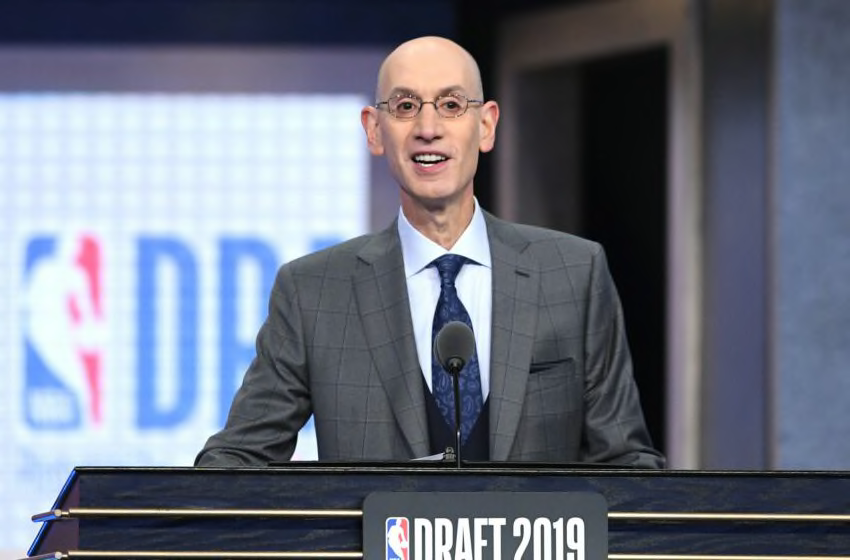
Chicago Bulls could move into first round of 2021 NBA DraftRyan Heckmanon July 29, 2021 at 4:35 pm

Read More

Chicago Bulls could move into first round of 2021 NBA DraftRyan Heckmanon July 29, 2021 at 4:35 pm Read More »

Big 12 claims ESPN is trying to ‘destabilize’ conferenceRalph D. Russo | Associated Presson July 29, 2021 at 3:25 pm

Big 12 Commissioner Bob Bowlsby accused ESPN of encouraging other conferences to pick apart the league so Texas and Oklahoma can move to the Southeastern Conference more quickly and without paying a massive buyout.

“I have absolute certainty that they (ESPN) have been involved in manipulating other conferences to go after our members,” Big 12 Commissioner Bowlsby told The Associated Press on Wednesday after sending a cease-and-desist letter to the network.

The letter addressed to ESPN executive Burke Magnus, President of Programming and Content, said the Big 12 had become aware the network had taken actions “to not only harm the Big 12 Conference but to result in financial benefits for ESPN.”

ESPN, which owns the SEC Network, signed a $3 billion deal with the SEC last year that will give the network the broadcast rights to all the conference’s football games starting in 2024.

The network also has a contract with the Big 12, though it shares those rights with Fox. Those deals expire in 2025.

In the letter, Bowlsby said that ESPN has “actively engaged in discussions with at least one other conference regarding that conference inducing additional Members of the Big 12 Conference to leave the Big 12 Conference.”

Bowlsby declined to name the conference in an interview with AP, but a person with knowledge of the situation said the commissioner was referring to the American Athletic Conference. The person spoke on condition of anonymity because the Big 12 didn’t authorize the release of that information.

The American agreed to a 12-year, $1 billion deal in 2019 with ESPN.

“The claims in the letter have no merit,” ESPN said in a statement.

Texas and Oklahoma informed the Big 12 this week they would not be renewing an agreement that binds them to the league and its eight other members until 2025. The grant of media rights runs concurrently with the Big 12’s billion-dollar television contracts with ESPN and Fox.

On Tuesday, Texas and Oklahoma submitted a request to the SEC to join that league in 2025. To join the conference earlier than that could cost the schools tens of millions of dollars — unless the Big 12 were to fall apart because some of the other members left as well.

“ESPN is incentivizing other conferences to destabilize the Big 12,” Bowlsby added.

In addition to the SEC and AAC, ESPN owns the rights to all Atlantic Coast Conference athletics and shares the rights to the Big Ten and Pac-12 with Fox.

Bowlsby told AP that Texas and Oklahoma have been working on a move to the SEC for months, doing so while taking part in Big 12 strategy meetings where proprietary information was shared.

Bowlsby said he suspects ESPN was involved behind the scenes when Texas and Oklahoma were in discussions with the SEC, but he has no proof of that.

“This whole thing has been a complete articulation of deception,” he said.

SEC university presidents and chancellors are scheduled to meet tomorrow, but it is unclear if they will vote on extending invitations to conference to Oklahoma and Texas. Eleven of the 14 members would need to vote in favor of inviting a new member, and it appears that won’t be a problem.

Texas A&M officials had voiced their displeasure last week with the possibility of rival Texas joining the SEC, but A&M’s board of regents on Wednesday directed University President Katherine Banks to vote in favor of the Longhorns and Sooners coming aboard.

Read More

Big 12 claims ESPN is trying to ‘destabilize’ conferenceRalph D. Russo | Associated Presson July 29, 2021 at 3:25 pm Read More »

Everything you need to know about Lollapalooza 2021Satchel Priceon July 29, 2021 at 2:55 pm

Lollapalooza officially returns to Grant Park this week for four days of music and good times despite concerns about how bringing together over 100,000 people each day will affect the ongoing pandemic.

The festival, which opens Thursday with vaccination or proof of a negative COVID-19 test required for entry, represents the largest public event to date held in Chicago since the emergence of the coronavirus last March. Despite worries over the virus’ Delta variant and rising caseloads nationally, the show will go on this weekend.

Huge acts will be in town luring giant crowds to the park, including Miley Cyrus, Foo Fighters, Post Malone and Tyler, The Creator. Many surrounding streets will be closed through Sunday night.

The Sun-Times will be there all four days covering the big shows and big crowds. Keep this page bookmarked for updates throughout the festival.

Must-see acts to check out

Some of the names on the Lolla lineup are a lot bigger than others. Selena Fragassi parses through the dozens of bands and artists to break down 10 must-see acts that attendees won’t want to miss this weekend. Here’s what Fragassi says about one of the festival’s earliest performers, Orville Peck:

No one exactly knows who this incognito Canadian country singer is (his trademark look is a long, fringed mask and cowboy hat) but the boudoir-looking John Wayne has heaped tons of due praise in his few years on the scene. Both for crafting a highly contagious psychedelic outlaw sound that refreshes the genre and for being an LGBTQ iconoclast whose work with Trixie Mattel and Gaga will soon put him in a new league.

Check out all of our recommended shows here.

How to watch performances live online

Unlike past years, Hulu is the exclusive live streaming partner for Lollapalooza 2021. All Hulu subscribers will be able to watch live performances for free as part of their subscriptions. Complete streaming schedules for all four days are already up on Hulu’s website, although they warn that set times are subject to change.

How will COVID-19 affect the festival?

With coronavirus case figures rising across the country amid lagging vaccination rates and the emergence of the Delta variant, Lollapalooza put in place security measures to help make the festival safer.

For those attending the festival, a vaccination card or proof of negative COVID-19 test will be required for entry. Get more information on how that’ll work here.

Chicago’s top health official, Dr. Alison Arwady, said Tuesday that the city’s virus situation is in “good control” ahead of the festival. However, Mayor Lori Lightfoot said recently that she would not hesitate to impose measures in Chicago such as face covering requirements if the city’s daily caseload keeps rising — and Arwady said she expects “some cases” of COVID-19 to result from the festival being held.

Lineup and schedule

Complete daily schedules for Thursday, Friday, Saturday and Sunday can be found here.

The after-show lineup includes Modest Mouse, Journey, Jimmy Eat World and Freddie Gibbs. Check out the complete list of official Lolla after-shows here.

Read More

Everything you need to know about Lollapalooza 2021Satchel Priceon July 29, 2021 at 2:55 pm Read More »

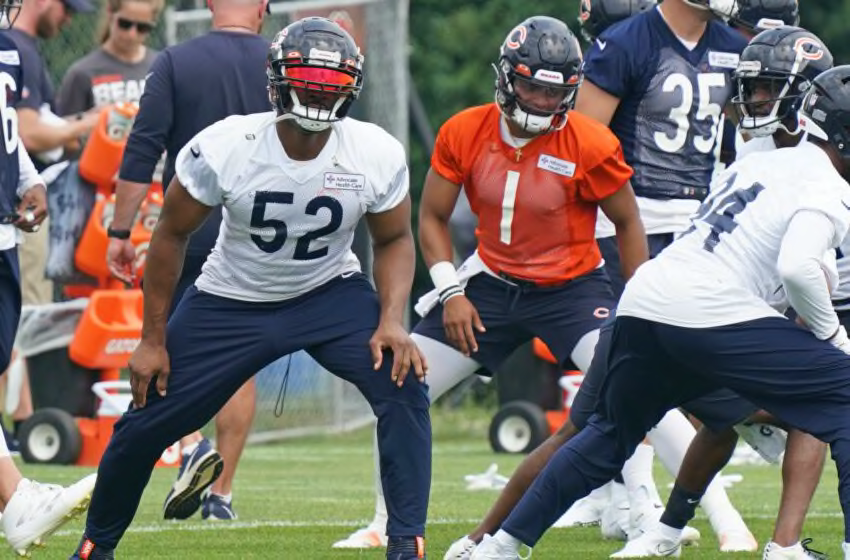
Chicago Bears: Khalil Mack gives a simple expletive to describe upcoming seasonRyan Heckmanon July 29, 2021 at 3:00 pm

Read More

Chicago Bears: Khalil Mack gives a simple expletive to describe upcoming seasonRyan Heckmanon July 29, 2021 at 3:00 pm Read More »

Can we have a rational discussion about Jan. 6?on July 29, 2021 at 2:53 pm

The Barbershop: Dennis Byrne, Proprietor

Can we have a rational discussion about Jan. 6?

Read More

Can we have a rational discussion about Jan. 6?on July 29, 2021 at 2:53 pm Read More »

Sunisa Lee wins gold in women’s Olympic gymnastics finalWill Graves | AP Sports Writeron July 29, 2021 at 1:37 pm

TOKYO — An American finished atop the podium in the women’s Olympic gymnastics all-around, just like always.

Sunisa Lee became the fifth straight American woman to claim the Olympic title on Thursday, edging Rebeca Andrade of Brazil in an entertaining and hotly contested final while defending champion Simone Biles watched from the stands.

Lee’s total of 57.433 points was just enough to top Andrade, who earned the first gymnastics all-around medal by a Latin American athlete but missed out on gold when she stepped out of bounds twice during her floor routine. Russian gymnast Angelina Melnikova earned bronze two days after leading ROC to gold in the team final.

Lee and the Americans earned a silver in that event, one in which Biles withdrew after one rotation when she decided she was not mentally prepared to compete.

Biles opted to pull out of the all-around final, too, leading to the jarring sight of the gymnast considered the greatest of all-time watching the biggest meet in five years from the stands alongside teammates Grace McCallum, Jordan Chiles and MyKayla Skinner.

The 24-year-old Biles’ absence created an opportunity the 24 women who took the floor at the Ariake Gymnastics Centre probably didn’t think possible when they landed in Tokyo earlier this month: a legitimate shot at the top of the podium. Biles had captured every major international competition since 2013 except the 2017 world championships, which came during the year she took off after her triumph in Rio de Janeiro five years ago.

Yet if Lee, Andrade and the rest of the contenders were nervous, it hardly showed. Andrade’s near-perfect Cheng vault gave her an early lead, but Lee used her spectacular uneven bars set — the hardest one currently being done in competition — to pull closer.

Lee, an 18-year-old Hmong-American from Minnesota, gutted her way through a nervy beam routine. She nearly came off while executing a wolf turn — basically a seated spin — and basically needed to suction cup her toes to the 4-inch slab of wood to stay on. Her score of 13.833 moved her in front of Andrade heading into the floor exercise.

Going first, Lee opted for a routine with three tumbling passes instead of four, hoping better execution would override any potential tenths she gave up by not doing a fourth pass. Her 13.700 was steady, but it left an opening for Andrade.

The 21-year-old Brazilian, two years removed from a third surgery to repair a torn ACL in her knee, had the best floor score of the contenders during qualifying. Yet she bounded out of bounds with both feet at the end of her first tumbling pass. And her right foot stepped off the white mat and onto the surrounding blue carpet.

Needing a 13.802 to win, she received a 13.666 instead, extending the U.S. dominance in one of the marquee events at the Olympics. The Americans have won each of the Olympic finals since Carly Patterson triumphed at the 2004 Athens Games.

Biles was heavily favored to extend that streak before opting out. Lee, who dealt with ankle injuries so painful she was limping at times during the U.S. championships last month, stepped into the void. She actually beat Biles during the second night of the Olympic Trials at the end of June.

A month later, she found herself standing atop the podium as one of the new faces of a sport that is becoming increasingly diverse in the U.S. She is the third straight woman of color to grab Olympic gold for the Americans, joining Biles in 2016 and Gabby Douglas in 2012.

Jade Carey, who replaced Biles in the finals for the U.S. team, finished ninth.

Read More

Sunisa Lee wins gold in women’s Olympic gymnastics finalWill Graves | AP Sports Writeron July 29, 2021 at 1:37 pm Read More »

Patti LaBelle lost three sisters to cancer; she’s urging adults to get health screeningsUSA TODAYon July 29, 2021 at 1:00 pm

At the height of the pandemic, Patti LaBelle engaged in a daily ritual.

Shortly after waking up, she’d get on her knees and thank God — “Again, and again and again,” she says — for her health.

This too shall pass, she would remind herself as the daily inundations of death and sickness pervaded the TV news.

She also felt “blessed,” at the time, for avoiding illness and “grateful” for the socially distanced contact she was able to maintain with friends.

On this day, she’s equally appreciative.

“I can’t complain, honey,” she tells USA TODAY. “You’ve just got to take the high road all the time.”

LaBelle’s status as one of the all-time great singers — soul, gospel, R&B, pop — is undiminished. And while she is working on new music, she’s currently focused on health. Not just her own, which, at 77, she maintains with regular activity. But adults, particularly those over 40, need a nudge to get screened for common cancers such as breast, colorectal, cervical, prostate, lung and skin.

So, she’s partnered with the Community Oncology Alliance and CancerCare, and through October, LaBelle will be seen in PSAs for the Time to Screen campaign.

Checking in from her home just outside of Philadelphia, LaBelle talked about how cancer robbed her of her sisters, how she stays healthy and what’s cooking in her famous kitchen.

LaBelle on staying fit: “Just before the pandemic I had gotten a treadmill. At 77 I need to keep as active as possible, so I would do [the treadmill]. I would walk the little dog. I would get in the pool and kick my legs. I cooked every day. On Mondays I would think about what I’d cook the whole week and go to the farmer’s market with my mask on. On Fridays, we would have a Pokeno game, a small group of four keeping our distance and eating crab and still having fun, but with 6 feet (of space) in mind. Everybody around me would make sure I didn’t touch this or that.”

The Time to Screen campaign is personal: “I have so many reasons to remind people what to do at this time of their lives. I was diagnosed with diabetes several years ago and I lost three sisters and great friends to cancer — lung, colon and so many types of cancer — who didn’t get screened as often as they should have. They all died before they turned 50 and when I turned 50 it was a milestone to me because I made it through without getting cancer. [At the start of the pandemic], people were afraid of going to doctors and let their health go by the wayside. It’s just so important for people to go and get screened … screening is the main thing we have to catch [disease] early.”

Focusing on health: “I started early, since I turned 50. After hearing and seeing my sisters go through so many awful changes, of course I’ve been [trying to stay healthy], not because I’m 77, but because I’d like to turn 78! I hope a lot of people in my life who know what I’ve dealt with take heed and get checked.”

Passing the torch: “I see it a lot out there, people who will carry on our Queendom [laughs]. Jennifer Hudson is doing it now with the Aretha (Franklin) movie (“Respect,” out Aug. 13). I love Pink. Billie Eilish. There are so many baby queens out there. We laid out the trail for you, now you come out there and do it.”

Her legacy: “Hopefully, people will say, she was so honest. She didn’t hold back about what she didn’t like about you the same as about why she loved you. She was not afraid to step on toes, because sometimes I had to. I get that from a lot of young girls — they thank me for pulling their coats and setting them on their way.”

What’s cookin’: “Yesterday it was sauteed chicken with spinach and garlic and salad with cilantro and Vidalia onions. Honey, I cook every day. Tonight we’re having leftovers — but I only keep them one night. I cook fresh as much as I can. I love being in the kitchen. It’s very cathartic to me. I’m thinking about songs and shows and costumes. It frees my mind.”

Read more at usatoday.com

Read More

Patti LaBelle lost three sisters to cancer; she’s urging adults to get health screeningsUSA TODAYon July 29, 2021 at 1:00 pm Read More »

Can’t make it to Lollapalooza? Watch it live on Hulu all weekendKatelyn Haason July 29, 2021 at 1:00 pm

Lollapalooza is back in person this weekend after a year of streaming-only in 2020, but music fans unable to make it in person can still watch sets online.

Hulu is the exclusive streaming partner for Lollapalooza 2021. It will stream the Chicago music festival to all its subscribers from Thursday through Sunday beginning at 1 p.m. CT each afternoon. A full streaming schedule for all four days — which is subject to change — is included here.

This is a change from the music festival’s partner throughout the last few years, YouTube.

Hulu subscribers don’t have to pay anything extra, and those who aren’t signed up already can get a free trial. All virtual concert-goers have to do is go to the Hulu home screen or go to the search bar and type in, “Lollapalooza.”

The catch of it all is, you have to watch it live. Hulu is streaming the music festival as a live-only event and will not have clips of the performances after they air.

Kicking off their live lineup schedule Thursday will be a performance by the popular former Disney darlings duo Aly & AJ at 1:10 p.m. Headliners this year include Miley Cyrus, Foo Fighters and Post Malone.

If you see an act you’ve never heard of but want to check out, you can do some research before each performance. The site has linked each one to Spotify so streamers can check out their music — you may even discover your new favorite band.

Hulu will regularly update its main Lollapalooza page throughout the weekend with the streaming times based on each time zone, so keep an eye out for any changes or updates.

Read More

Can’t make it to Lollapalooza? Watch it live on Hulu all weekendKatelyn Haason July 29, 2021 at 1:00 pm Read More »

Chicago’s Greatest OlympiansWhet Moseron July 29, 2021 at 1:16 pm

A swimmer who became Tarzan. A sprinter who became a congressman. Another sprinter who broke her leg in a plane crash after winning a gold medal, then recovered to win another gold, eight years after the first. The Chicago area has produced some of the most colorful and accomplished athletes in the history of the Games. Here’s our list of Chicago’s Greatest Olympians.

Frank Foss, track and field: Foss set a world record in the pole vault at the 1920 Antwerp games: 13 feet 5 inches. Foss vaulted with a bamboo pole, which was more flexible than ash and hickory, from which poles were constructed in the 19th century. The big revolution in pole technology occurred in the 1950s, when fiberglass poles enabled vaulters to fling themselves to greater and greater heights. The current world record, set last year by Sweden’s Armand Duplantis, is 20 feet 3-¼ inches. 

Johnny Weissmuller, swimming: Weissmuller isn’t just the most famous Chicago Olympian; he may have had the most star power of any Olympian in history. As a boy, Weissmuller, an Austro-Hungarian immigrant from what is now Romania, learned to swim in Lake Michigan, then joined the Illinois Athletic Club, which had already produced several Olympians. According to a club history, Weissmuller “was a high school drop-out, who probably never spent more than a year at his school, Lane Tech, and never swam on its championship swim team. He was basically a beach bum, who hung out at the Fullerton Avenue beach. What early formal swimming training he picked up was at the Stanton Park Pool at the Larrabee YMCA.”

The IAC’s coach, William Bachrach, turned the beach bum into the greatest swimmer of the first half of the 20th century. As an amateur, Weissmuller never lost a race. He won five gold medals: in the 100-meter freestyle, 400-meter freestyle, and 4×200-meter freestyle at the 1924 Paris Games, and the 100-meter freestyle and 4×200-meter freestyle at the 1928 Amsterdam Games.

It was Weissmuller’s good fortune that his swimming career ended just as the era of Hollywood’s sound pictures was beginning. In 1931, he was working out at the Hollywood Athletic Club — to keep fit for his post-Olympic gig as a BVD swimsuit model — when he was approached by Cyril Hume, a scriptwriter for MGM.

“Hume went on to explain that the studio had assigned him to create a script for a new film, Tarzan the Ape Man,” according to Michael K. Bohn’s Heroes & Ballyhoo: How the Golden Age of the 1920s Transformed American Sports, by Michael K. Bohn. “He described the producer’s criteria for the Tarzan role—‘young, strong, well-built and reasonably attractive.’ The ability to appear comfortable in a loin-cloth was also important.” (Weissmuller arguably owed his shapely figure, to some extent, to a vegetarian diet picked up from John Harvey Kellogg at Kellogg’s famous Michigan sanatorium.)

That was more important than the ability to act, since Tarzan’s dialogue was rarely more complicated than “Jane, Tarzan, Jane, Tarzan.” Weissmuller described the work as “like stealing money. There was swimming in it, and I didn’t have much to say. How can a guy climb trees, say ‘me Tarzan, you Jane’ and make a million?”

Betty Robinson, track and field: One day in April 1928, Betty Robinson was late for school at Thornton Township High. She sprinted to catch a train that would take her from her home in Riverdale to Harvey. Thornton Township’s track coach happened to be a passenger. Impressed with Robinson’s speed, he invited her to try out for the team.

Robinson trained with the boys and beat them. Later that spring, running for the Illinois Women’s Athletic Club, she tied the 100-meter world record at a track meet in Soldier Field. Then she finished second at the Olympic Trials in Newark. And so, barely three months after she’d been discovered chasing a train, 16-year-old Betty Robinson was on a ship bound for Amsterdam, where she won the gold medal in the 100 meters in the first Olympics in which women could compete in track and field. (You can watch the race here.)

Her next achievement was even more remarkable. In 1931, Robinson climbed into her cousin’s biplane for a pleasure flight over the south suburbs. The plane crashed. According to the book Fire on the Track: Betty Robinson and the Triumph of the Early Olympic Women, rescuers saw that Robinson “had suffered at the very least a broken leg, judging by the bone poking out, [and] appeared to be dead.” Robinson survived the crash, but “her chances of running again were highly improbable, given that the injured leg would likely remain shorter than the other one…. Her thighbone had fractured in numerous places, and a number of silver pins had been inserted.”

Robinson wouldn’t run again for two and a half years. Eventually, she regained her old speed, but there was still a barrier to resuming her track career: the pins in Robinson’s leg made it impossible for her to crouch into a four-point starting position. So at the Berlin Games, she ran the third leg of the 4×100 relay, winning a gold medal after the German team dropped the baton on the final pass.

Ralph Metcalfe, track and field: The Tilden Tech graduate was the silver medalist in the 100 meters at the 1932 Los Angeles Games and the 1936 Berlin Games, when he lost to Jesse Owens. Metcalfe did win a gold medal in Berlin as a member of the integrated 4×100-meter relay team—to the displeasure of Hitler, whose all-Aryan squad had to settle for bronze.

After the Olympics, though, Metcalfe led a much more successful life than Owens, perhaps because silver medalists aren’t defined by their athletic achievements. While Owens raced horses for money and went bankrupt as a dry cleaner, Metcalfe built a career in academia and politics. He was elected alderman of the Third Ward in 1955, and succeeded William Dawson as congressman for the historically Black 1st District in 1970. On the City Council, Metcalfe was a member of the “Silent Six”—Black aldermen who faithfully followed Mayor Richard J. Daley’s Machine line, in spite of Daley’s lack of interest in the well-being of their South Side constituents. As a congressman, though, Metcalfe defied the mayor, refusing to support the re-election of State’s Attorney Edward Hanrahan, who had ordered the raid that killed Illinois Black Panther Party Chairman Fred Hampton. (“It’s never too late to be black,” Metcalfe said.) Metcalfe also co-founded the Congressional Black Caucus.

Adolph Kiefer, swimming: “I learned to swim in Lake Michigan—my father took us swimming at Wilson Avenue beach every Sunday after church,” Adolph Kiefer once recalled. “I started when I was about nine or ten years old. We enjoyed it because we’d get an ice cream cone on the way home—black walnut ice cream.” He soon became such a fanatic that when his family vacationed at a resort in Michigan he swam all the way across a lake and back, a mile each way.

Kiefer’s father, a German-born candy maker, died when Kiefer was only 12, but before he passed away he told his son that he was going to be “the best swimmer in the world.”

Kiefer worked furiously to achieve the destiny his father had forecast. He swam six days a week in pools near his home in Albany Park, then on Sundays he rode his bike, sneaked onto streetcars, or hopped onto trucks to get to the Jewish Community Center on the near south side, which had the only pool open that day. In high school, Kiefer lied about his address so he could go to Roosevelt, which had the best pool. 

Although swimming historians disagree, Kiefer claimed to have invented the modern backstroke; according to an official from the International Swimming Hall of Fame, two swimmers were using a high-riding backstroke before Kiefer, but Kiefer mastered the style. “He was the king. He just had tremendous power. His strength overcame any technical flaw. His technique was not unique, but he perfected it.”

At the 1936 Olympic trials Kiefer broke the world record in the 100-meter backstroke three times. He was only a junior in high school when he sailed for the games in Berlin, but he was already recognized as one of the great swimmers of his generation, part of a U.S. swim team so talented even Hitler wanted to meet them. He showed up at a training session with filmmaker Leni Riefenstahl. “He was there with his cronies,” Kiefer said. “He was a little guy with a little mustache, with a hat over his head, and three or four of us shook his hand. Actually what I should have done is throw him in the pool! At my age, which was young, I didn’t realize the atrocities or the problems which were existing then.”

Kiefer won the 100-meter backstroke in 1:05.9, demolishing the eight-year-old Olympic record by 2.3 seconds. The 1940 and 1944 Olympics were canceled due to World War II, so he joined the Navy and developed a swim training program to prevent sailors from drowning. After the war, the strikingly handsome Kiefer turned down Hollywood’s offer to become the next Johnny Weissmuller—as a family man, he didn’t want to romance starlets onscreen—and instead founded a swimming supply company which introduced the first nylon bathing suits. It’s still doing business in Bloomington.

Terry McCann, wrestling: At Schurz High School, Terry McCann was the 1952 Illinois State Champion in the 112-pound division. At the University of Iowa, McCann was an NCAA champion at 115 pounds. Then, as a 26-year-old father of five with a full-time job as a production manager for the U.S. Chamber of Commerce in Tulsa, Oklahoma, he made the Olympic team.

“No 1960 Olympian earned his place on the Big Team harder than this 5 foot 4 inch, 125 pound blond alumnus of Schurz High School,” the Tribune reported in an article on McCann’s return to Chicago, where his children stayed with their grandparents during the Olympics. “Last April, McCann underwent a second operation for torn knee cartilage in Tulsa, Okla., his home for the last three years. Thus, he was unable to take part in the regular Olympic tryouts a week later in Ames, Ia. Thru unprecedented action by the American Olympic committee, he was permitted to come to the Olympic training camp in Norman and try his grip against other wrestlers of his weight. Terry finally pinned the No. 1 man, Dave Auble of Cornell university, twice.”

In Rome, McCann only lost a single match on his way to winning gold in the bantamweight division, making him Illinois’s only wrestling gold medalist. McCann retired from competition after the Olympics, but went on to help found USA Wrestling, the sport’s governing body, and served as the executive director of Toastmasters for three decades.

Bart Conner, gymnastics: The 1984 Los Angeles Olympics were the most red-white-and-blue display of Americanism ever seen on television. That year was the peak of Reagan-era Cold War patriotism. Bruce Springsteen’s Born in the U.S.A. was the #1 album. Team USA won 83 gold medals, the most by any country in any Olympics — because the Soviets and their Eastern Bloc allies didn’t show up, as retaliation for our boycott of the 1980 Moscow Olympics. Two of those gold medals were won by the most all-American Olympian of all time: blond Bart Conner, who got his start on a playground in Morton Grove.

“I would play in Austin Park when I was little, and from a very early age I was able to do a handstand on the monkey bars,” Conner once told the Niles West News, his alma mater’s school newspaper. “My parents realized my talent and I just went from there.”

Conner won a gold medal in the team competition, and as an individual in parallel bars. In 1996, Conner won an even bigger gymnastics prize: he married Romanian gymnast Nadia Comaneci—the first gymnast to score a perfect 10.0 at the Olympics, which she followed with six more en route to dominating the 1976 Games. The couple live in Norman, Oklahoma, where Conner operates the Bart Conner Gymnastics Academy.

Read More

Chicago’s Greatest OlympiansWhet Moseron July 29, 2021 at 1:16 pm Read More »

Chicago Bears: Justin Fields appears to have chance at starting jobRyan Heckmanon July 29, 2021 at 1:00 pm

Read More

Chicago Bears: Justin Fields appears to have chance at starting jobRyan Heckmanon July 29, 2021 at 1:00 pm Read More »