Multi-instrumentalist Liam Kazar has been so crucial to my evolving understanding of Chicago’s bustling, magnanimous music scene that I felt a little heartbroken when he moved to Kansas City in 2019. He’d risen to national fame in the early 2010s as part of the youthful fusion ensemble Kids These Days, whose idealistic collision of jazz, rock, and hip-hop worked thanks to the personalities involved, among them Macie Stewart of Ohmme and rapper Vic Mensa. Kazar has since established himself as a key player, helping the city’s music community thrive while doing his part to make sure the borders separating its microscenes stay porous; he cofounded underappreciated indie group Marrow, and he’s been part of live lineups for several nationally renowned rock bands, most notably Tweedy, the duo of Wilco’s Jeff Tweedy and his son Spencer. It seemed like Kazar was on the bill at every show I saw, and even when he wasn’t, I’d half-expect to catch him in the crowd. Before he moved away, Kazar worked at the Hungry Brain, and at the start of the pandemic he released a covers compilation to benefit the venue.
Kazar has long been a team player, so it’s a delight to finally hear him pour some of his considerable energy into his own material. His new solo debut, Due North (Woodsist/Mare), rests on the firm foundation of his pop know-how, but it also oozes with funk swagger and glam panache to spare. These songs glide so smoothly you’d almost believe Kazar is utterly relaxed, even though it’s clear he’s thought out every last one of the frizzled guitar riffs and squelching keyboard notes that he uses like pointillist brushstrokes on the technicolor “Shoes Too Tight.” Due North also showcases Kazar’s powers as a front man, and his subtly soulful voice guides you tenderly through the album’s easygoing highs and lows. On “Frank Bacon,” when he embellishes his pop-minded sound with a touch of southern-rock twang, it’s positively sublime. v
■ When I was young, my mother told me to go to the Detroit Public Library and check out Richard Wright’s Black Boy, and I refused to go because I hated myself. But she was very determined. So I went to the stacks, found the book, put it to my chest, walked into our people’s section, sat down, and began to read. I read two-thirds of it at the library that day and finished it at home that night. Then I went back the next day and checked out everything Richard Wright had published at that time. One of the most important books, which very few people have read, was his collection of essays titled White Man, Listen!, which included a major essay on Negro writing. After that, I read Margaret Walker, Langston Hughes, and so forth. And that gave me a kind of ammunition and fortified me against everything, because now I understood: If we can write and publish books, we are somebody.
■ At 13 or 14 years old, I’d take the Greyhound to Ann Arbor to liberate books from bookstores. That’s what poor people do on one level, and you know you’re poor if you’re wearing used underwear. But I wasn’t trying to steal clothes or shoes, I was going after books. Then I’d get back on the bus that evening with two bags of them, easily, and that’s how I started my library. Books and art pretty much saved my life.
■ I learned early on that if I was going to have any traction, I had to work harder than everybody else. So I never drank, never smoked, never partied off the charts.
■ My mother was murdered. She was in the sex trade and had turned a trick one weekend and never came home. I would go out looking for her with a lead pipe in my belt. When I found her, she had been beaten so badly that we couldn’t even open her casket. Beauty does not work for you unless you know how to use the beauty you’ve been endowed with, and she had not been taught how to use or contain it. The first man she had sex with was my father, and he was a dog. When we left Little Rock, Arkansas, he abandoned us. So she was left on her own and had to fall back on what all the men wanted.
■ I joined the military because that was my last option. It was the poor boy’s answer to unemployment. When I arrived at basic training, I was reading Paul Robeson’s autobiography, Here I Stand. The drill sergeant said, “What are you doing reading this Black communist?” Then he said, “All you women, against the bus!” It was a breakdown of our quote-unquote manhood. And he held my Paul Robeson book above his head and commenced to tear the pages out, give a page to each of the recruits, and tell them to use it for toilet paper. Eventually, I became a squad leader, and my whole squad was basically white men — all older than me and all from the South. So it was always a battle. But I learned in the military that if you live in the avenue of hate, you can’t think properly.
■ Gwendolyn Brooks was a major influence on my life. She stopped me from doing something that may have hurt me. After they murdered Fred Hampton, I was so hurt, I was gonna hook up with some brothers and just do some things. I had weapons. I had gone by Gwendolyn’s home to drop off some papers, and she saw this rage in my eyes. She said, “You’re not going anywhere,” and she sat down in a chair in front of her door. All night.
■ My name comes from the Kiswahili language in East Africa.Haki means “justice” and madhubuti means “precise.” One of the reasons I decided to seek a name that was more involved with my culture was because I had become too popular and couldn’t get anything done. When an Ebony article on me hit in March of 1969, my book Don’t Cry, Scream sold internationally. And from that point on, Don L. Lee was a known entity.
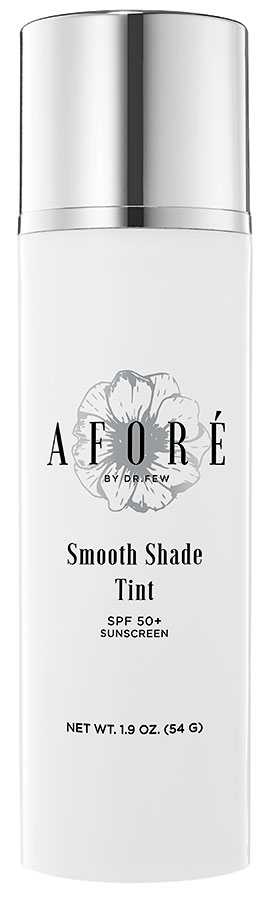
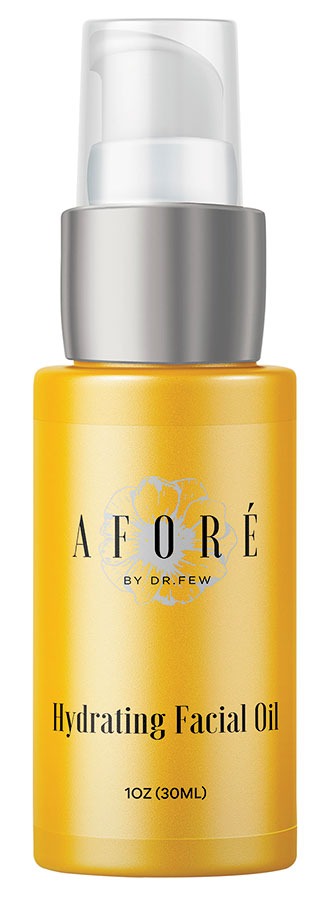
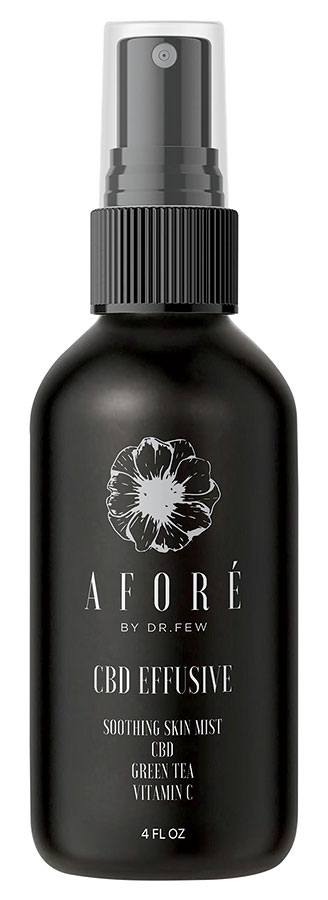
Preventive care for the skin arrives at last in Chicago — and the world — with the release of renowned plastic surgeon Julius Few’s line of cosmeceuticals, sold at his office, online, and at the wellness club Biân. “Aesthetics is the last frontier in medicine that considers prevention,” says the globetrotting doctor, who has Gwyneth Paltrow’s stamp of approval (he presented at her In Goop Health summit). “It’s always been about treating: If you have a sun spot, you lighten it. If you have sagging skin, you surgically fix it. But why can’t you do something to anticipate these things that we know will happen?” Enter Aforé, which translates to “before” — as in, before sun damage, before exposure to pollution, before signs of aging. This clinically tested line of topical treatments uses nontoxic ingredients (CBD, lactic acid, collagen) to bring the skin back to the state it was when you were barely out of undergrad. The gorgeously packaged scrubs, serums, and other potent potions practically promise visible results in six to eight weeks. As we scorch ourselves in the postpandemic summer sun, treat your face to a mask with lactic acid and pumpkin to smooth fine lines and fade age spots. Dr. Few may be a surgeon, but his ethos is that looking natural is always better than looking overproduced. aforebeauty.com
When local folk-pop artist Jessica Risker interviewed Chicago singer-songwriter and multi-instrumentalist Emily Jane Powers on her Music Therapy podcast in April 2020, Powers was halfway through recording an album. “I wanted to make a guitar-forward record,” Powers told Risker. “I wanted to let the guitar speak for me.” On the album in question, Isometry (which she self-released this past June), her guitars alternately howl and coo, sometimes snapping like gators fighting over a tantalizing fish. Powers says she drew inspiration from classic rock songs with dueling guitars, and she supercharges “Blue Black Grey White” with sprinting hammer-ons. Her playing isn’t all fireworks, though: she molds the sound of her six-string to fit whatever mood she wants, conforming to a Krautrock-like pulse on “Low Tide” and gently flowing through the spacious “PA Fog.” Those metamorphoses are ultimately what makes Isometry so captivating. v
When NBA free agency opens up today, things are going to get wild. From the get-go, expect the unexpected when it comes to the Chicago Bulls and rest of the league.
To some extent, we already know part of the Bulls’ plan. This team needs to figure out their point guard position if they are to move forward with playoff aspirations.
Vice President Arturas Karnisovas did a wonderful job in his first year with the Bulls, and followed through on his commitment to winning. He made the move to acquire All Star center Nikola Vucevic midway through the year, which came as music to fans’ ears.
Now, fans are expecting Karnisovas to make another significant move or two when free agency begins. Not only will point guard be an emphasis, but the Bulls could be looking at some of the more intriguing trade candidates.
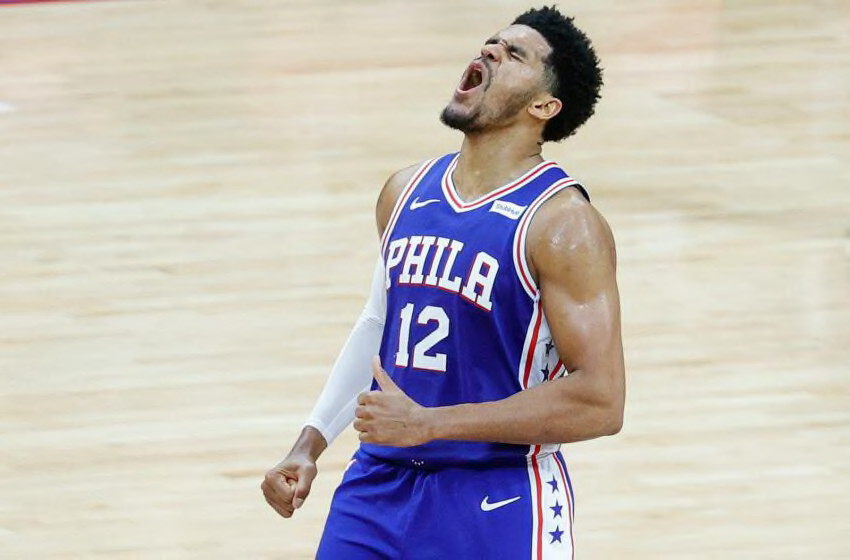
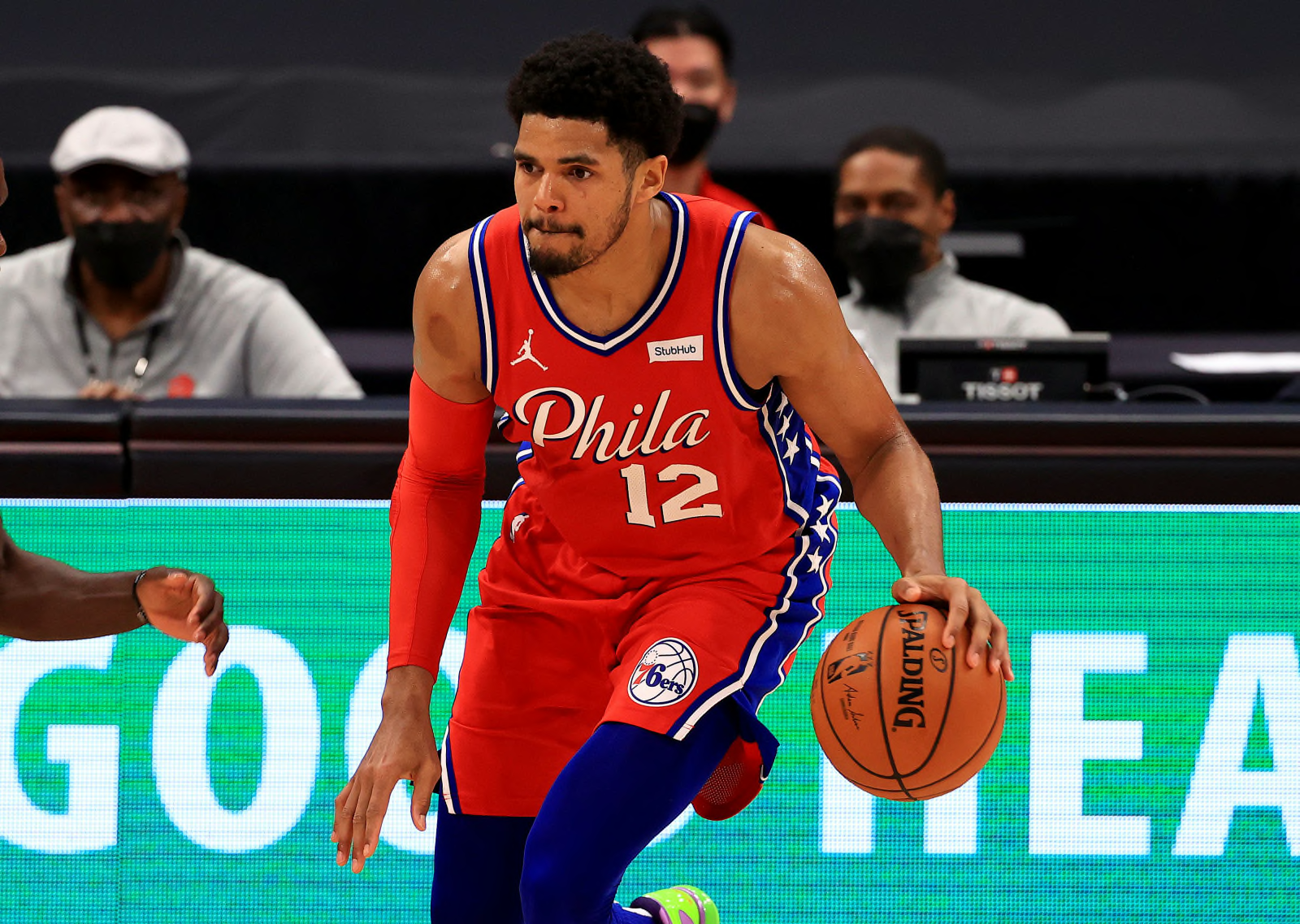
Tobias Harris has emerged as a trade candidate, and the Chicago Bulls should do their due diligence.
Besides trying to trade Ben Simmons, the Sixers are shopping Tobias Harris. The Rockets are one of the teams that turned down Harris, per sources.
Sirius XM NBA voice Mitch Lawrence gave us one heck of a report the afternoon before free agency begins. It appears the Philadelphia 76ers are looking to trade multitalented wing Tobias Harris.
Harris, 28, has yet to earn an All Star nod, but has played much like one over the last few years. He could join point guard Ben Simmons in exiting Philly as the Sixers could really be blowing things up going forward.
It’s been clear that Simmons and Joel Embiid can’t coexist on a championship team, so the Sixers have already been looking to deal the All Star point guard. But, to be in the market for trading Harris as well seems pretty wild. Yet, there are some sources who believe it’s possible.
Nevertheless, the Bulls could use someone like Harris, who is one of the better two-way players in the league. Harris can score at an efficient rate, including from beyond the arc, as well as provide strong defense and rebounding.
What would a potential trade look like for Harris to Chicago? Let’s look at a few scenarios.
The NBA free agency period starts Aug. 2 at 5 p.m. CST. Here’s what to expect from the ChicagoBulls once the free agency gates open up.
The Bulls have already made plenty of moves, to begin with, this offseason. Here’s a quick recap of how Arturas Karnisovas & Co. has steered the ship since the NBA draft.
The Bulls selected Illinois guard and Chicago native, Ayo Dosunmu, with the 38th pick in the NBA draft.
The team extended a qualifying offer to Lauri Markkanen, making him a restricted free agent.
The Bulls declined Ryan Arciadiacono’s $3 million team option.
The Bulls still need to decide on the partial guarantees of Thaddeus Young and Tomas Satoransky.
Going over the roster and potential moves, the Bulls have a lot of decision-making to do. Between the possible returners and the names they have been tied to in free agency, AKME will have their hands full once the free agency period begins.
The Chicago Bulls are serious about making themselves better before next season.
Lauri Markkanen
Markkanen seems to be the most entertaining piece of Bulls players heading out into the free agency market. The goal for the Bulls is clearly to sign-and-trade Markkanen to get a return on their initial investment in him back from the Jimmy Butler trade. The Minnesota Timberwolves, San Antonio Spurs, and Oklahoma City Thunder are all tied into having an interest in a sign-and-trade for Markkanen.
Sources: The Chicago Bulls and Lauri Markkanen are open to a sign-and-trade deal. Keep an eye on the Minnesota Timberwolves. Multiple teams with cap space, including the San Antonio Spurs and OKC Thunder also have interest in Markkanen. More on @hoopshype. https://t.co/LYSPVYoj6x
A move like this would be huge for the Bulls to retain assets in return for Markkanen. If this doesn’t happen, it’s unlikely the Bulls will match any offer that Markkanen receives in free agency. The Bulls have bigger free agent names on their mind.
The Point Guard Situation
According to sources, the Bulls and Lonzo Ball intend to work out a four-year contract worth around $80 million once free agency hits.
This would be ideal for the Bulls because Ball is a full-court, high-energy, playmaking point guard that could drastically enhance the offense and the perimeter defense of the team.
On the other side of the rumor mill, the Bulls are reportedly interested in signing Derrick Rose. Rose is obviously a staple of Bulls basketball and has been playing well enough in New York to draw interest back to Chicago.
There is even hearsay of the Bulls going after both Rose and Ball. However, according to Rob Schaefer of NBC Sports Chicago, the Bulls will only have around $24 million in cap space if they cut ties with all free agents and partial contracts. This probably isn’t enough to sign Rose, Ball, and fill the rest of the roster spots.
The best guess is that Ball is the main target in free agency. If suitors emerge with higher offers, like the Los Angeles Clippers, the Bulls will adhere to Rose as their solution to the point guard position.
The Partial Guarantees
Thaddeus Young and Tomas Satoransky have partial guarantee contracts that the Bulls have to decide whether or not to pick up for the upcoming season.
There could be free agency interest in Satoransky, which may help the Bulls make their decision. Sato would give the Bulls an additional $5 million in cap space this offseason if he were released. Because the Bulls are tied down to Coby White’s rookie contract and are set on spending top dollar for a new starting point guard, there is a low chance Sato returns as a Bull.
In terms of Young, he was tagged with the phrase “trade bait” all season long. His value skyrocketed after head coach Billy Donovan exposed Young as a gifted passer, averaging 4.3 assists per game, and an effective defender. At this point, the Bulls will more than likely bring back Young and let Sato walk in free agency.
Javale McGee
According to Chris B. Haynes on NBA TV, the Bulls have an interest in big man JaVale McGee. McGee averaged 5.5 points and 5.3 rebounds in 13 games with the Denver Nuggets at the end of this season. He shot just under 50 percent from the field and 75 percent within three feet of the rim. McGee is a solid rim protector, holding a 0.6 career defensive box plus/minus.
McGee could help the Bulls in defensive areas in the paint. The Bulls allowed the 22nd most points in the paint per game last season. Paint protection was a clear struggle for them.
The roster for big men is depleted for the Bulls. With the likely loss of Markkanen and the unknown future for free agent Daniel Theis and Young, the Bulls need some help in the paint.
What to expect
Expect the dynamic duo of Karnisovas and Marc Eversley to be aggressive in free agency. With plenty of the Bulls not guaranteed to come back to the team, the front office will be aggressive with filling roster spots in free agency. The Bulls will be hunting for a point guard, wing depth, and big men in free agency.
There are clear-cut names, like Ball, Rose, and McGee. However, if there is anything Bulls fans have learned from the first year of the AKME regime, it’s that the two are extremely unpredictable.
They shocked the NBA world by pulling off a trade for Nikola Vucevic early in the morning of the trade deadline. They also stayed put at their 38th spot in the draft and took Dosunmu, a truly unexpected outcome. The bottom line is to be prepared for a wild day of free agency come Aug. 2.
Just before dusk on a muggy night in late June, an SUV crept toward a crowd waiting outside a fast food joint on an otherwise quiet commercial strip in South Shore.
A hail of gunfire followed, striking six people before the shooter was whisked away in the passing vehicle.
“They knew who they were looking for,” remarked one person at the scene in the 2000 block of East 71st Street, where fresh blood spatters painted the sidewalk.
While police say the shooters were targeting members of a rival gang, 23-year-old Kristina Grimes — a bystander apparently caught in the fray — was the only one killed, her body riddled with six bullets.
Chicago police work the scene where at least 6 people were shot in the 2000 block of East 71st Street in the South Shore neighborhood, Sunday, June 27, 2021. Tyler LaRiviere/Sun-Times
About two hours after the shots rang out, an alarming dispatch pierced through police radio: Another mass shooting had just rocked the Marquette Park neighborhood, roughly six miles away.
Three alleged gang members had sprayed bullets at a crowd hanging out in the 6200 block of South Artesian Avenue, enjoying the summer night. Twelve people were hit, among them Nyoka Bowie, 37, who suffered a fatal gunshot wound to her chest. Like Grimes and many other victims of mass shootings — defined by the Sun-Times and some researchers as incidents in which four or more people are wounded — she apparently was not the intended target.
In both cases, there was a large number of witnesses and surviving victims, yet no arrests have been made. That is all too common in Chicago, where police say they do not prioritize the cases despite the especially harsh toll such shootings have on a community.
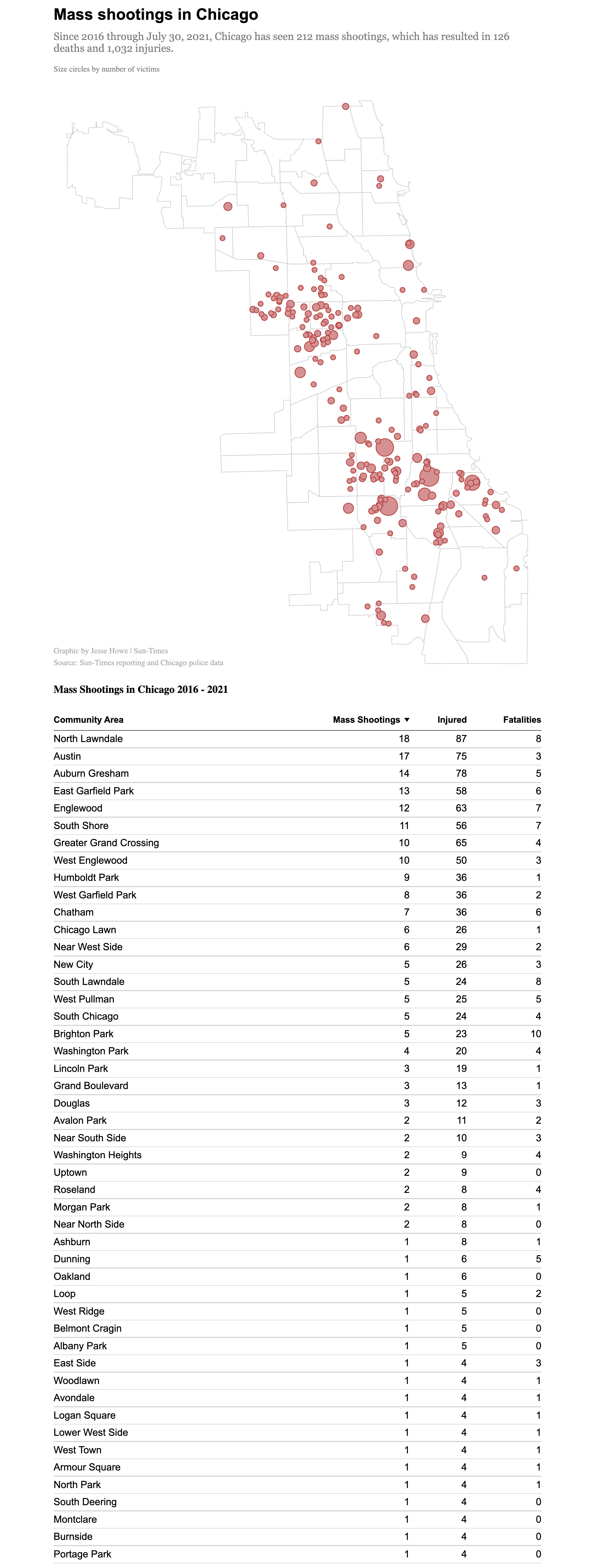
Only one person has been charged in any of the at least 39 mass shootings so far this year, according to a Sun-Times analysis of city data and court records.
That amounts to charges in just 2% of this year’s mass shootings — far below the police department’s dismal 13% clearance rate for shootings overall, which is the lowest of any big city in the nation.
Going back to 2016, the alleged shooters have been charged in just 21 of at least 212 mass shooting incidents — or less than 10% of the cases, the Sun-Times analysis found.
Just two men have been convicted in those attacks, which through Friday nighthave wounded 1,032 people, 126 of them fatally, records show. Two of the other 21 people who have been charged were ultimately found not guilty, while another suspected shooter had his case dropped, records show.
Year
Shootings
Wounded
Fatalities
Charging Info
2016
37
163
21
2 charged in shootings (cases ongoing), 1 charged in connection (pled guilty)
2017
29
135
28
7 charged in shootings (1 case dropped, 2 pled guilty, 4 ongoing)
2018
29
139
16
5 charged in shootings (2 not guilty, 3 ongoing), 1 charged in connection (pled guilty)
2019
30
148
12
3 charged in shootings (all ongoing), 6 charged in connection, including 1 charged separately in a shooting (1 pled guilty, 2 dropped, 3 ongoing)
2020
48
233
25
5 charged in shootings (all ongoing), 4 charged in connection (1 stricken, 3 ongoing)
2021
39
214
24
1 charged in shootings (ongoing), 1 charged in connection (ongoing)
All
212
1032
126
23 charged in shootings (1 dropped, 2 pled guilty, 2 not guilty, 18 ongoing), 13 charged in connection (1 stricken, 2 dropped, 3 pled guilty, 7 ongoing)
Source: Sun-Times analysis of city data and court records
The lack of charges this year is all the more ominous because the number of mass shootings far outpaces each of the last five years, according to the Sun-Times analysis.
This year’s toll through the end of July already surpasses the total number of mass shootings recorded each year between 2016 and 2019, records show. In each of the last two years there were five attacks in which more than 10 people were shot, including a pair of shootings that each wounded 15 people.
The lack of justice in the cases leaves the most reckless shooters out on the streets — and gives neighborhood residents all the more reason to look over their shoulder as many emerge from pandemic lockdowns.
“Go to the parks on the South and West sides on a beautiful day, and you’ll see it. There’s hardly anyone there,” said Steve Gates, a social worker who works in the Roseland and West Pullman neighborhoods for Chicago Beyond. “These are our public spaces, where we should gather. But people have to feel safe.”
A month after Bowie was killed, her friend Sameka Scaife said she doubts the police will ever find the gunmen responsible. “It’s like waiting for something that you know will never come,” Scaife said.
“It’s just gone cold. I don’t even think they’re looking,” she said of the investigation. “I believe the police know which gang is responsible for the shooting and that’s all. I trust the intel, but I don’t trust they’ll follow up and find out who did it.”
The daughter of a retired Chicago cop, Scaife said she’s lost all trust in the criminal justice system. Disillusioned by the lack of charges in Bowie’s killings, she has now abandoned her plans to follow in her father’s footsteps and pursue a career in law enforcement.
“I don’t see anything changing with the city of Chicago,” said Scaife, who left her hometown years ago due to the pervasive crime. “It’s almost like the police are stepping back and letting everybody kill each other. It breaks my heart so much.”
Nyoka Bowie was killed June 27 in a mass shooting in Marquette Park that left five others wounded.
Police: Mass shootings not prioritized over other cases
Chicago’s total number of mass shootings in the past five years is more than double that of the next closest city, according to the Gun Violence Archive, a nonprofit research group that catalogs shootings in the United States.
But the mass shootings here rarely resemble the typically more planned attacks that prompt national media attention, outrage and calls for gun control, like the Columbine High School massacre in Colorado or the Pulse nightclub shooting in Florida. Instead, Chicago’s mass shootings are usually sporadic street crimes that center around large outdoor gatherings, making the summer months particularly dangerous.
In an interview, Chief of Detectives Brendan Deenihan said many of the mass shootings in Chicago appear to stem from disputes or arguments, though he acknowledged some are clearly gang-related. Despite the increasing number of mass-victim events, Deenihan said they aren’t prioritized over other shootings.
“The detectives who are assigned to a mass shooting, and then if they’re assigned a shooting later on that week, they’re doing the same thing in order to solve that incident,” he said. “There aren’t any other different tools.”
He acknowledged, however, that investigating a mass shooting requires an “extraordinary” amount of time and more resources than other shootings. Detectives have to interview far more people, both victims and witnesses, and forensic technicians are needed to process sprawling crime scenes, often littered with dozens of bullets.
“It is a lot more work, but I just kind of defer to the detectives and the forensic guys and the beat guys who are out there,” he said. “Everybody is working as hard as they possibly can.”
Police reports obtained by the Sun-Times, though, reflect what appears to show different levels of police response and community cooperation in the incidents.
In a shooting at 4 a.m. June 6 that wounded eight in the 8900 block of South Cottage Grove, the narrative consisted of a handful of sentences with virtually no details.
“All victims related to r/o’s [responding officers] they heard gun fire and then felt pain. Not offender information was given to r/o’s by victims. Unknown witnesses related to r/o’s that they observed two male 1s shooting towards the crowd then fleeing in a silver sedan towards an unknown direction,” the report states.
Footage from the bar’s surveillance camera — which Mitchell turned over to police — shows officers dispersing a crowd of hundreds, issuing tickets and towing illegally parked cars. The camera also shows the two gunmen pulling on masks in an alley east of the bar before bursting into the crowd. Police reports show that cops had a fairly detailed description of the shooters’ clothes, the make and model of the vehicle they drove off in and the direction in which they fled.
Police told community members they have suspects in the shooting, which killed a mother of three and injured nine others, but so far have announced no arrests.
“I don’t know what else they could do,” said Mitchell, who estimated dozens of officers eventually arrived at the scene. “Police were already here when [the shooters] popped out.”
Experts agree urban mass shootings like the ones that take place in Chicago are among the hardest cases to solve.
Clearance rates have been falling across the country since the 1980s. And Mark Bryant, executive director of the Gun Violence Archive, noted that most mass shootings in other cities also go unsolved.
Tom Scott, a social scientist who has studied clearance rates and investigative practices across the U.S., said shootings where no one is killed — even when multiple people are wounded — tend to get less attention from police because murders are the most closely tracked crime statistic by the media and politicians. (In more than 60% of the 212 mass shootings recorded in Chicago since 2016, no one was killed.)
Mass shootings, he added, tend to lack “solvability factors,” including cooperative witnesses.
“Agencies … prioritize cases they are most likely to solve,” Scott said.
Yet law enforcement tends to respond to spiking violence by adding beat cops instead of detectives.
More robust investigations where officers make concerted efforts to find and interview witnesses can help foster the community trust needed to get more cooperation, Scott and other experts believe.
The Chicago Police Department’s efforts to crack cases have long been hampered by its strained relationship with the communities ravaged by gun violence, areas that have been over-policed and are predominantly Black and Hispanic. In those areas, fear of gangs and distrust of police has created an atmosphere that discourages cooperation, or snitching, striking fear in residents who may otherwise help investigators.
Chicago Police Supt. David Brown (right) and Chief of Detectives Brendan Deenihan say a lack of cooperation from witnesses and even victims has hampered police efforts to solve the shootings.Anthony Vazquez/Sun-Times
Deenihan, the chief of detectives, also noted the lack of cooperation from the “intended targets” of the shootings. Supt. David Brown asserted the culture of silence effectively perpetuates a cycle of violence and emboldens those carrying it out.
“That signals to us, when you don’t cooperate, when you are silent, that you prefer street justice,” Brown added. “Street justice is never-ending. The appetite for revenge is never satisfied. It only harms. It only ruins your community.”
Mass shootings traumatize residents of entire neighborhoods who either witness them, are victims or are related to the victims, said Sonya Dinizulu, a psychiatrist at the University of Chicago School of Medicine who has studied trauma.
“People say that communities ‘get used to’ this level of violence, that these shootings don’t faze them after a while,” Dinizulu said. “That is simply not the case, and we do not say that about sexual assault, or about car crashes or all other sorts of trauma.
“But the body remembers. People still have a physiological response, they have post-traumatic stress, and it is very difficult to heal that when the trauma repeats and repeats.”
Indeed, it fosters feelings of hopelessness and depression in young people, which lends itself to the kind of recklessness that might lead to firing into a group of people, heedless of innocents among them, Dinizulu said. That same hopelessness weighs on those who don’t become violent, and entire communities fray when residents are too wary to attend large gatherings or even be outside, she said.
“It’s a cycle. A very destructive and dangerous cycle,” she said. “We focus so much on healing. I think it’s surprising, encouraging, that people are focused on healing. But we know the drivers of violent crime — poverty, disinvestment, lack of educational opportunity — and we have to focus and invest in those as well.”
Police are recovering an increasing number of high-powered firearms, like this weapon police says was found after a report of shots fired in late May on the Southwest Side.Chicago police
More guns — and more powerful guns — recovered
Experts agree with police officials that another factor is more directly driving the spike in mass shootings: More guns — and more firearms that are high-powered — have flooded the streets.
Chicago police have recovered at least 7,289 total guns this year, up from 5,668 at the same point last year. The number of recovered assault weapons has climbed more dramatically over that same period, from 227 to 368.
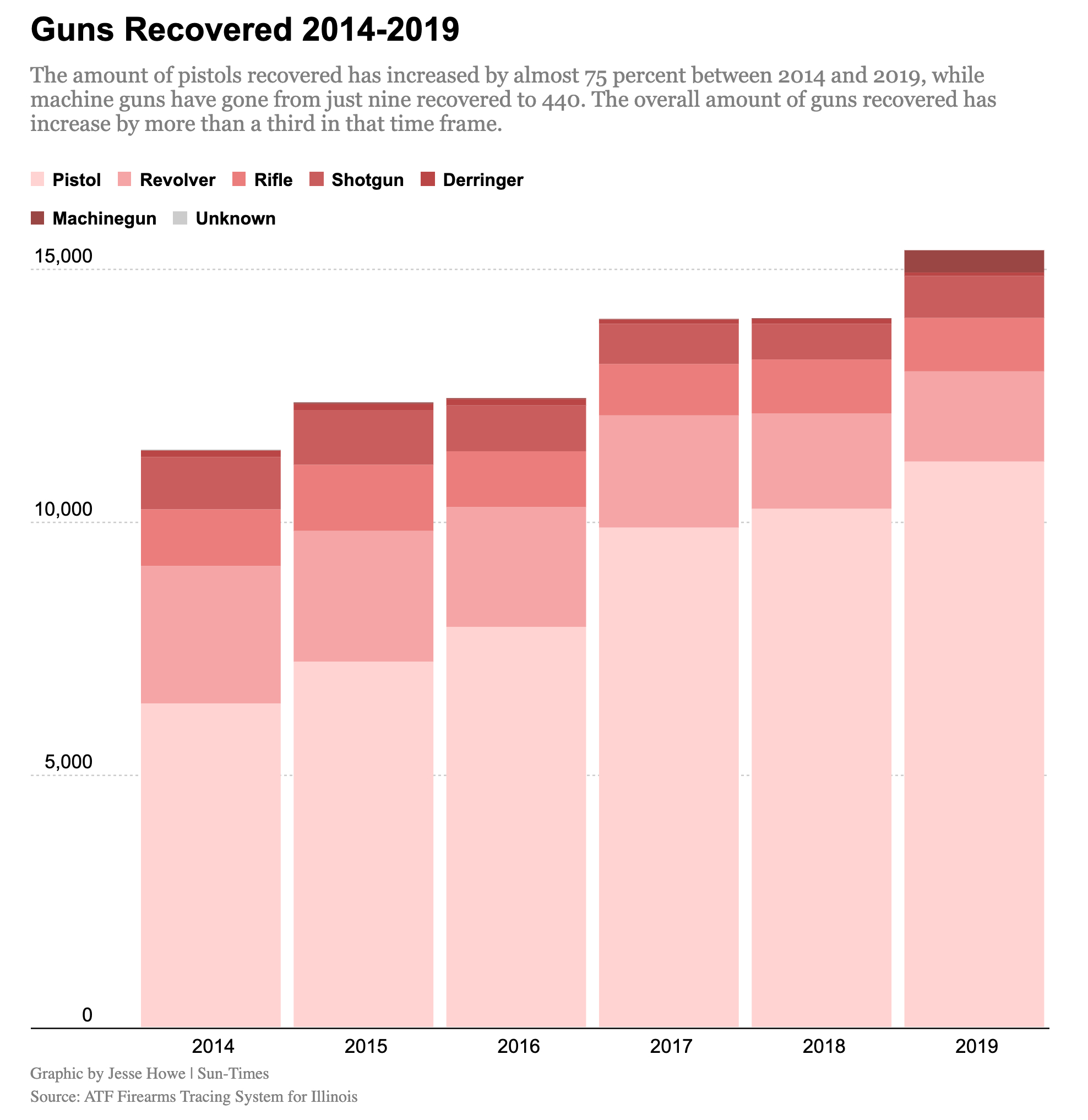
Statewide, the number of guns recovered steadily rose from 11,568 in 2014 to 15,486 in 2019, the last year of publicly available data compiled by the U.S. Bureau of Alcohol, Tobacco, Firearms and Explosives. More than half were pulled off the streets of Chicago.
CodePen – Weapons recovered Chart
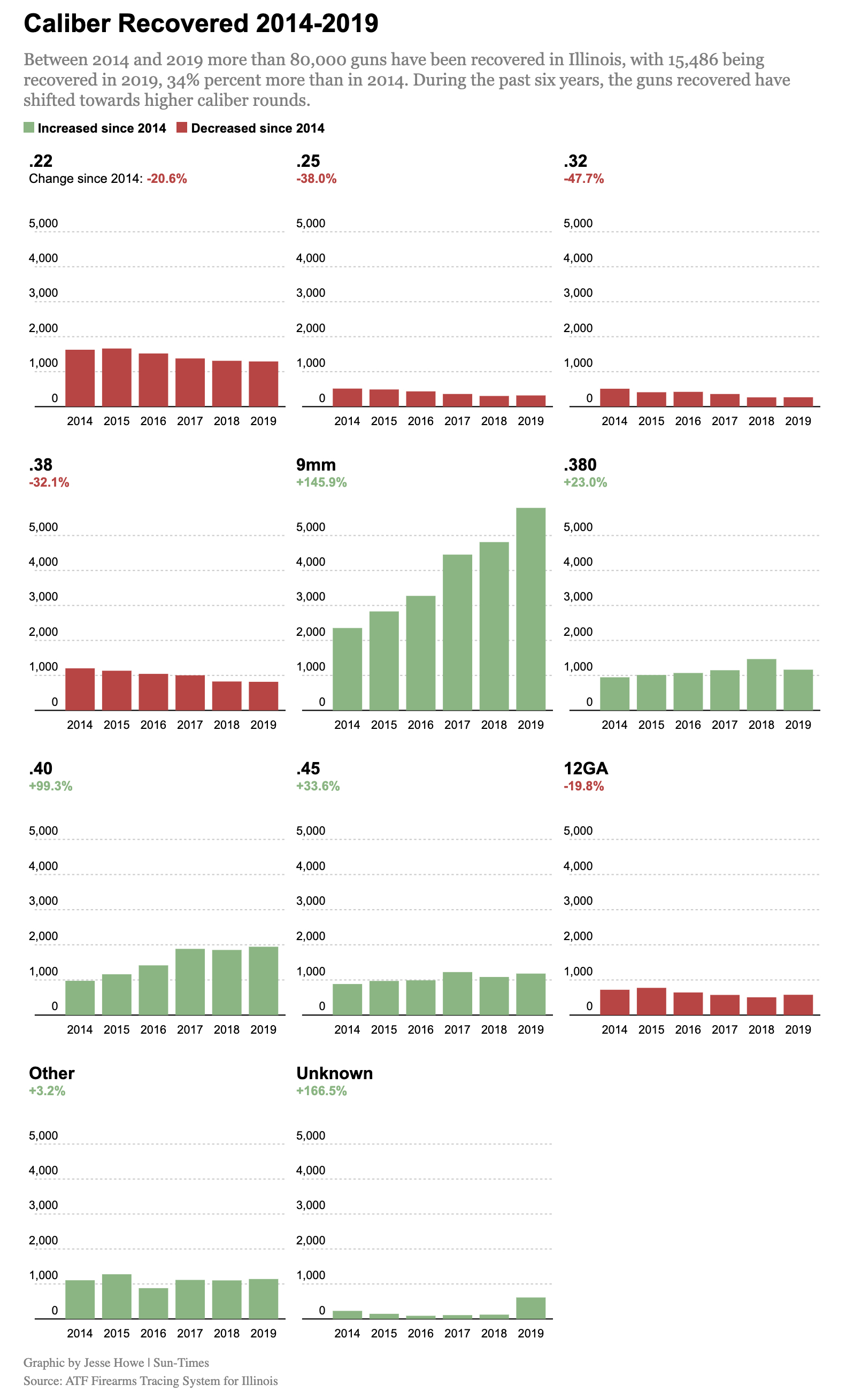
Among all those weapons, the number of high-powered, rapid-firing rifles has skyrocketed. There were an average of 18 “machine guns” recovered each year between 2014 and 2018. That number spiked to 440 in 2019 — and the following year the number of mass shootings jumped to 48.
Deenihan said shell casings from handguns have been found at every crime scene where a mass shooting took place, while rifles have been used in just under half of the crimes. In many cases, people in crowds have returned fire — leading to more victims, he said.
Cops investigating mass shootings are also finding extended magazines and switches, which can make semi-automatic pistols fully automatic.
“It’s remarkable firepower,” Deenihan said. “But it also is the fact that when you have that many people — 100, 150 people, 200 people out there — and somebody’s firing a gun, the likelihood of somebody catching one of those bullets goes up dramatically.”
CodePen – Caliber recovered Chart
Roseanna Ander, executive director of the University of Chicago Crime Lab, specifically noted that more people in Chicago are toting semiautomatic weapons that can hold high-capacity magazines, raising “the likelihood that you’re going to have multiple victims and that the injuries are going to be more serious.”
Mayor Lori Lightfoot last month lauded a federal initiative aimed at disrupting interstate pipelines for firearms, and her administration has recently launched new efforts to combat the city’s gun problem.
She announced a $1 million reward fund last month for information leading to the seizure of illegal firearms. And since then, a new police team of roughly 50 officers was announced to target gun traffickers and people whose state firearm permits have been revoked.
Will tougher enforcement help?
When Kristina Grimes was slain in the mass shooting in South Shore earlier this summer, her mother Cynthia Carr felt like she had to do something to keep other innocent people from dying.
Grimes, once a standout high school swimmer who dreamed of making it to the Olympics, was apparently on her way to get something to eat when she was fatally shot. “No one knew her. She didn’t know them. She was totally caught off guard and just didn’t see it coming,” her mother said.
She and her husband, Grimes’ stepfather Michael Carr, now want elected officials to get behind measures like implementing stricter bail requirements for some offenders and embracing controversial stop-and-frisk policies. In recent weeks, the grieving mother has started reaching out to policymakers, including members of the Legislative Black Caucus and the state’s two U.S. senators.
Kristina Grimes (center) poses with her stepfather, Michael Carr, and mother, Cynthia Carr, during a family vacation four years ago.
“I don’t believe the political will exists to deal with the problem as is,” Michael Carr said. “And there’s going to have to be some tough solutions and acknowledgment about who’s committing the vast majority of these shootings. And just even saying that will bring howl and outrage among the activist groups.”
A West Side native, Michael Carr was raised near the notorious Rockwell Gardens housing project in East Garfield Park. Fed up with the violence, he left Chicago in his mid-20s, vowing never to return. He and his wife, also a Chicago native, now live in suburban Romeoville and fear for the safety of family members in the city.
While they’re critical of the city’s leadership and deeply concerned about its violent crime, the Carrs said they sympathize with detectives who they believe are inundated with cases.
“How is it humanly possible for a detective to investigate a crime if they have to keep shifting to another crime?” Cynthia Carr asked.
As for the two cases where police made arrests that led to convictions, both took place in 2017 and wounded five people.
Dejuan Moore, now 23, was charged in an attack in South Austin that June. And Kriston Gordon, 29, was charged in a shooting at a West Rogers Park bar early on New Year’s Eve, records show.
They were both hit with multiple charges, including counts of attempted murder, but each pleaded guilty to aggravated battery. Moore was given 10 years in prison, while Gordon got six — relatively light sentences for such brazen shootings.
But enforcing stricter punishments likely won’t do much to decrease violence in the long run, said Linda Teplin, a Northwestern University psychiatrist who has studied urban violence. Mass shootings that take place in suburbs, like Columbine, draw massive attention and drive the national debate on gun laws, but the events themselves are less predictable and are often the acts of isolated, lone-wolf shooters with no criminal records.
But in Chicago and other cities, mass shooters fit a narrower profile: They’re mostly young black males involved in gangs who will have contact with the criminal justice system.
“The irony is, urban violence is more preventable, but we don’t invest the funds,” Teplin said. “What is needed is economic investment, jobs, access to educational opportunities, therapy. We know what needs to be done, but we won’t invest the funds.”
Contributing: Jesse Howe, Andy Boyle, Madeline Kenney, Sophie Sherry
The ChicagoBears have again floated the idea of moving to Arlington Heights. The club has made an offer, competing with several others, for Arlington International Racecourse, a once premier venue whose business is withering and whose owner wants out.
We’ve seen this movie before with Chicago sports teams, including when the Bears in the 1970s talked about Arlington Heights and Mayor Richard J. Daley famously, but probably without basis, said they’d never call themselves the Chicago Bears if they followed through. The Cubs and White Sox also played suburban gambits, and they stayed put, too. Is that going to happen once more?
It’s very early in a process of negotiations, bluster and head fakes, but three questions come to mind.
Are the Bears serious?
The prudent answer is they are, until they aren’t. With Soldier Field needing improvements to keep up with the rest of the league, as the Sun-Times’ Mark Potash has explained, the Bears have incentives to consider a fresh start at the racetrack property.
The site covers 326 acres, slightly more than Six Flags Great America, and it’s in the middle of a wealthy suburban market where the team has a substantial fan base. It could provide all the necessary parking, and there’s even a Metra stop.
Industry consultant Marc Ganis, president of Sportscorp, said based on conversations he’s had with the NFL, he believes the Bears are in earnest. Ganis, who said he has no role in this matter, said the Bears don’t need to purchase such a vast parcel. They could participate as tenants or as part of a group that the seller, Churchill Downs, puts together to develop the property.
Can the Bears anchor a large commercial development?
In considering so roomy a site, the Bears and the NFL may have in mind other recent stadium deals. Some have suggested a suburban baseball stadium built for the Atlanta Braves and surrounded by development as a template. But there’s a flaw in the logic. Major-league baseball teams bring in paying customers 81 dates per year. The Bears play about 10 dates, maybe a couple more with playoffs — we can dream, can’t we?
Allen Sanderson, an economics professor at the University of Chicago who has researched sports stadiums, has a maxim: “There are two things you should never put on a valuable piece of property: a cemetery and a football stadium. They’re closed all the time.”
His view reflects a consensus among economists that sports teams aren’t worth subsidizing because they don’t mean much to a local economy. It has to do with discretionary spending. The amount spent for tickets and concessions supports local jobs, but it otherwise would be spent at stores, restaurants, theaters, you name it.
Michael Leeds, an economics professor at Temple University, researched Chicago’s big five franchises — Bears, Bulls, Blackhawks, White Sox, Cubs — and in 2015 told public radio station KPCC they could all leave town and cost the economy less than 1%.
Sanderson said he believes the Cubs are the only team here with a measurable fiscal impact because they draw attendance from outside the Chicago area. He has another maxim: When stadium promoters estimate their economic benefits, move their decimal point one place to the left to get a truer picture.
A large commercial development in Arlington Heights will need more than the Bears as a trigger. “Something broader will work there whether or not the Bears are part of it,” Ganis said.
Arlington Heights officials have laid down basic rules for what gets built. The village in June approved a zoning overlay district covering the racetrack that prohibits uses it deems undesirable, such as car washes, adult businesses or warehouses.
Charles Witherington-Perkins, the village’s planning director, said the town needed to close loopholes and discourage piecemeal development. A stadium is allowed. Ganis said high-end retail could work there, even in the Amazon era. “Think of it as Oak Brook plus football,” he said.
Do the Bears have leverage?
Politically, yes, but it’s more than outweighed by money. A Chicago mayor doesn’t want to wear the jersey for a team move. Maybe a governor neither. But there are reasons the Bears sit with a generous lease on publicly owned land that can tap a go-to revenue source, hotel taxes, for upgrades. The Illinois Sports Facilities Authority is still using the hotel tax to pay off debt from the 2003 Soldier Field renovation.
A hotel tax wouldn’t amount to much in Arlington Heights. Witherington-Perkins said the village has not authorized a tax increment financing district for the racetrack, a common way to cover infrastructure improvements.
The cost of recent NFL stadiums has started at about $1 billion and spun far higher.
Look for the Bears to stay in Soldier Field and work out the expensive details of refurbishment. The city can open with this negotiating ploy: You get a retractable roof if you start beating Green Bay.
Avoid shopping or making important decisions from 2:30 to 4 a.m. Chicago time. After that, the moon moves from Taurus into Gemini.
Aries (March 21-April 19)
Something might hamper your social plans. Or perhaps, your responsibilities with children will increase for some reason. In fact, anything to do with the arts, sports and the entertainment world might make greater demands on your life. It’s just for today.
Taurus (April 20-May 20)
Your involvement with a parent might be more important or there might be increased responsibilities regarding taking care of a parent? Perhaps some kind of issue will arise at home in which you feel limited or held back because of certain restrictions. Work with what you’ve got.
Gemini (May 21-June 20)
Plans for a short trip or your involvement with daily contacts including siblings, relatives and neighbors might be hampered by something. Something might restrict you. Someone might tell you why you can’t do something. Hey, don’t let this get you down.
Cancer (June 21-July 22)
Financial matters might be a concern. Your access to finances might be restricted. You might be disappointed in your fair share of something or you might find it difficult to deal with banks, financial institutions or partners. Bide your time.
Leo (July 23-Aug. 22)
You might feel cut off from those who are closest to you. Don’t let this drag you down. Don’t be discouraged because many people feel a bit “removed” from others because the sun is opposite Saturn. (This does not promote cozy relations with anyone!)
Virgo (Aug. 23-Sept. 22)
Don’t be discouraged if you feel cut off from others or even lonely today. This isn’t an illusion but it is certainly a temporary dark cloud on your horizon. Many people feel this way today. It will be gone by tomorrow. Therefore, go with the flow.
Libra (Sept. 23-Oct. 22)
You might be disappointed when relating to groups, clubs and organizations today because something might thwart your attempts to deal with others or push through your ideas. This same minor difficulty might arise in a friendship? It’s temporary — no worries.
Scorpio (Oct. 23-Nov. 21)
This is a poor day to ask the boss or a parent for permission or approval for anything because very likely, their response will be, “Talk to the hand.” Knowing this, table your request for another day. Meanwhile, keep your head down and your powder dry.
Sagittarius (Nov. 22-Dec. 21)
Today you might encounter rules and regulations, which limit your plans or your activities. (This sort of goes with the territory of just being alive.) Go with the flow and don’t make a fuss. Don’t be discouraged. Tomorrow is another day. And a more promising one!
Capricorn (Dec. 22-Jan. 19)
Financial matters might discourage you today. You might especially be disappointed when dealing with partners or others regarding taxes, debt, inheritances and insurance issues. Red-tape limitations, rules and regulations might get in the way. Relax — this is temporary.
Aquarius (Jan. 20-Feb. 18)
Don’t be disappointed if you feel your relations with a close friend or a partner are a bit distant today. Conversations might feel like two ships passing in the night. This influence affects everyone and it is mildly limiting and possibly discouraging. But hey, it is brief!
Pisces (Feb. 19-March 20)
Something to do with your health, your job or even your pet might cause you concerns today. You might have to make an extra effort to get the results you want. Or perhaps you cannot do something because you are limited or you are restricted by some situation. Patience is your best ally.
If Your Birthday Is Today
Actress Mary-Louise Parker (1964) shares your birthday. You are witty and entertaining, which is why people enjoy your company. Personally, you value your independence and have strong opinions. Because of your excellent verbal skills, you are very convincing! This year is more lighthearted and sociable. You might explore pleasing changes to your appearance or your routine or where you live. Others might seek your advice this year.




:no_upscale()/cdn.vox-cdn.com/uploads/chorus_asset/file/22751715/merlin_98646234.jpg)
:no_upscale()/cdn.vox-cdn.com/uploads/chorus_asset/file/22749182/IMG_5823.JPG)
:no_upscale()/cdn.vox-cdn.com/uploads/chorus_asset/file/22752019/CPDPRESS_062320_06.JPG)
:no_upscale()/cdn.vox-cdn.com/uploads/chorus_asset/file/22754542/CPD_gun_photo.jpeg)
:no_upscale()/cdn.vox-cdn.com/uploads/chorus_asset/file/22749190/Screen_Shot_2021_07_29_at_3.09.16_PM.png)