What’s New

America’s brutal introduction to unsettled science.on August 2, 2021 at 7:51 pm

The Barbershop: Dennis Byrne, Proprietor

America’s brutal introduction to unsettled science.

Read More

America’s brutal introduction to unsettled science.on August 2, 2021 at 7:51 pm Read More »

Get to fixin that house! With All In! Game’s Tools Up!on August 2, 2021 at 7:47 pm

Jessi’s Media Review – A Chicks Point of View!

Get to fixin that house! With All In! Game’s Tools Up!

Read More

Get to fixin that house! With All In! Game’s Tools Up!on August 2, 2021 at 7:47 pm Read More »

Quin Kirchner puts a contemporary spin on mid-20th-century jazzBill Meyeron August 2, 2021 at 5:00 pm

Quin Kirchner blew into Chicago in 2005, after Hurricane Katrina devastated his old hometown of New Orleans. He wasted no time making himself essential as a drummer, and since then he’s played with a wide variety of acts: Afrobeat combo Nomo, tropical pop band Wild Belle, singer-guitarist Ryley Walker, and countless jazz ensembles. In all these settings, he’s supplied crisp grooves and percussive coloration that keep the music flowing. Kirchner didn’t release his first album as a bandleader, The Other Side of Time (Astral Spirits/Spacetone), till 2018, and it was worth the wait. The double LP contains an astutely selected program of tunes by Charles Mingus, Sun Ra, and Phil Cohran, as well as some Kirchner originals that are similarly tuneful, emotionally charged, and ingeniously constructed. All of them update a mid-20th-century understanding of the jazz band as a vehicle for sophisticated artisanship and impassioned communication–to that rarefied ideal, Kirchner brings electronic postproduction that borders on the psychedelic. The Shadows and the Light, another double album released last year by the same labels, further expands that sound with extra players, funky keyboards, and layered percussion. The quintet Kirchner will lead at the Hungry Brain, which consists of bassist Matt Ulery, trombonist Nick Broste, bass clarinetist Jason Stein, and woodwind player Nate Lepine, is the core band on both releases. You can expect material from each album plus some new tunes under development. v

Read More

Quin Kirchner puts a contemporary spin on mid-20th-century jazzBill Meyeron August 2, 2021 at 5:00 pm Read More »

Yasser Tejeda brings the Afro-Dominican quijombo to the LatiNxt FestivalCatalina Maria Johnsonon August 2, 2021 at 4:00 pm

The Dominican Republic is famous for merengue and bachata, but Yasser Tejeda prefers to focus on lesser-known varieties of Dominican roots music. He reimagines centuries-old Afro-Dominican styles, especially palo, a form of music traditionally played in the countryside that involves complex call-and-response rhythms created by drums called palos and voices. His elegantly polished compositions contain a fascinating, delicate interplay of past and present, and they’re underlain by raw ancestral music meant to move bodies and bring about communion. With his band Palotre, Tejeda does jazz- and rock-infused deep dives into rhythms (including palos) played by the Brotherhood of the Holy Spirit of the Congos de Villa Mella (an ensemble that’s been named part of the Intangible Cultural Heritage of Humanity by UNESCO). Palos are at the heart of secular and spiritual gatherings called quijombos, and Tejeda’s second album, Kijombo–a danceable, exhilarating fusion of Dominican roots rhythms with soulful, R&B-tinged jazz–takes its names from those celebrations. He also recently released a three-song EP called Interior, which strips down Kijombo tracks “Nuestras Raices” and “Amor Arrayano” and adds the new song “El Sol de la Madruga.” On the EP he uses just voice and guitar, and his nuanced, percussive chords echo the drumbeats of certain palos. I can’t wait to be enveloped in Palotre’s textured sound when they headline day two of the LatiNxt Festival on Navy Pier, where they’ll share the power of what Tejeda celebrates in the first lines of “Nuestras Raices” (“Our Roots”): “Siente este ritmo / Que es de esta isla / Palos caribenos / Fuente infinita” (“Feel this rhythm / It’s from this island / Caribbean palos / An infinite wellspring”). v

Read More

Yasser Tejeda brings the Afro-Dominican quijombo to the LatiNxt FestivalCatalina Maria Johnsonon August 2, 2021 at 4:00 pm Read More »

Michael Jordan says Luc Longley should have been in ‘The Last Dance’Sun-Times staffon August 2, 2021 at 5:54 pm

Michael Jordan says he does have one regret about the ESPN documentary “The Last Dance.”

“I can understand why Australia would say, ‘Well, why wouldn’t we include Luc [Longley]?’ And we probably should have. And if I look back and could change anything, that’s probably what I would have changed,” Jordan told the Australian Broadcasting Corporation.

According to the Australian broadcaster, series director Jason Hehir said it would have been too expensive to send a crew to Australia to interview Longley.

“I didn’t expect to be a heavy feature in it because they hadn’t interviewed me, but I did expect to be in it more than I was,” Longley said. “Sitting there on the couch and watching episode after episode where I wasn’t in it — yeah, I was bummed about that.”

“I know it hurt him,” says former Bulls teammate Steve Kerr. “I watched it with my kids and I thought about Luc’s omission from it and how much he lost from that, and I feel bad for Luc.”

“I think the worst part for Luc was that the phone was ringing all day and night,” says Longley’s wife, celebrity chef Anna Gare. “Everyone wanted to know, ‘Why aren’t you in it? … How are you feeling right now?’ Like, drama, drama, drama.”

“Why was I not in the doco? I don’t really know, to be honest,” Longley said.

Read More

Michael Jordan says Luc Longley should have been in ‘The Last Dance’Sun-Times staffon August 2, 2021 at 5:54 pm Read More »

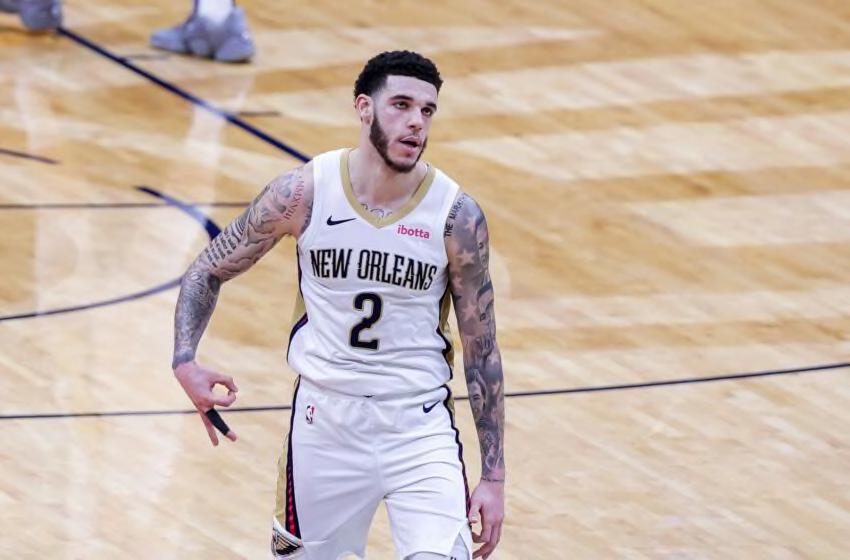
Chicago Bulls Rumors: Lonzo Ball, Tomas Satoransky trade possibleRyan Heckmanon August 2, 2021 at 6:14 pm

Read More

Chicago Bulls Rumors: Lonzo Ball, Tomas Satoransky trade possibleRyan Heckmanon August 2, 2021 at 6:14 pm Read More »

New endorsement laws could create pitfalls for college athletesSheldon H. Jacobsonon August 2, 2021 at 5:21 pm

Now that the Supreme Court has ruled that student-athletes are able to earn money from their name, image and likeness, more than a dozen states have enacted laws to govern the practice. These states include Illinois, Ohio and Pennsylvania.

For example, the name, image and likeness law in Illinois defines what compensation can be for and the role that colleges can play when student-athletes seek endorsement deals.

Other states have name, image and likeness laws that take effect in 2022 and later, including New Jersey, Maryland, California and Minnesota. All these state laws could help shape a federal name, image and likeness law in the near future.

This shifting landscape creates a wide range of revenue-generating opportunities for student-athletes. For example, companies and organizations can work to market their products and services to reach college students and college alumni via student-athlete endorsements, something that they were unable to do before.

There’s no shortage of examples of student-athletes who are already taking advantage of their newly won ability to do business. For instance, Bryce Young, the star quarterback at the University of Alabama, has signed deals estimated to be close to US$1 million dollars. Hanna and Haley Cavinder, women’s basketball players at Fresno State, signed deals with Boost Mobile and the nutrition supplements company Six Star.

Drew Gilbert, a University of Tennessee baseball player, inked a deal with Breaking T for a line of T-shirts.

As a data scientist with an interest in sports analytics – that is, the science of using data to analyze how athletes and teams perform – I am concerned about how these new laws might affect student-athletes both on and off the field or court.

For instance, will schools in states with more favorable laws for student-athletes use that as a way to entice the athletes to come to their schools? Will student-athletes be tempted to transfer from one state to another in order to enjoy a more favorable name, image and likeness law?

But perhaps most importantly, how will these new laws and policies affect college players? I see three potential pitfalls for student-athletes who might decide to use their visibility as athletes to make money.

Time management

Student-athletes are busy. Between classes and studying, and practice and competition, their schedules are packed. Their sports commitments can take up as much as 40 hours per week in-season. The temptation to earn money will add yet another demand on their time, which may lead them to shift their priorities.

Given all that they have on their plate, academics will likely suffer. Student-athletes are already saying they would like more time to study. So if making money comes into play, it could make time to study even more scarce. This could threaten student-athletes’ eligibility to play sports if they are unable to maintain their course credits and grades.

On-court performance

Organizations or businesses that pay student-athletes expect a return on their investment. They are not giving student-athletes money as charitable gifts. Responsibilities such as appearances or social media engagements may place additional time pressures on student-athletes. This could also serve as a mental distraction, which may affect their performance on the court or playing field.

Name, image and likeness contracts cannot depend on student-athlete performance directly. In other words, their endorsements cannot be tied to such matters as how many points they score. However, if student-athletes’ performance slumps, they may become less attractive to companies.

Eventually, data will become available to assess the relationship between endorsement opportunities and on-field performance. If there is a strong correlation, this would make the name, image and likeness revenue closer to the pay-for-play between colleges and athletes that the NCAA seeks to avoid. It’s not that the colleges are paying their players, but sponsors are paying players because they’re in college.

Money management

Revenue generated through endorsement opportunities makes student-athletes independent business proprietors. This requires them to file a specific type of tax form – known by the IRS as Schedule C – with places to record revenue and deductible expenses.

This, in turn, means it will be in the interest of professional service providers hired by the student-athletes, such as agents, tax advisers and marketing consultants, to help students deliver what the contracts stipulate, or risk losing out on future opportunities.

Student-athletes could benefit from being required to take a money management course. However, such a course may not be enough to help students manage themselves as essentially a financial enterprise. Some of these young people are coming into a sizable amount of money for the first time in their lives.

Not every student-athlete will have the benefit that incoming Tennessee State University freshman Hercy Miller has; his father, former NBA player and rap artist Master P, played a critical role in helping the young basketball player secure his $2 million ambassador deal with Web Apps America.

Student-athletes will now need an agent to help them with their business dealings. The NCAA may need to provide guidance for what such agents can and can’t do to guard against exploitation.

Student-athletes have much to gain from their new ability to do business, as do their sponsors. Unfortunately, without good agents and clear policies and rules, both student-athletes and their teams also have much to lose.

Sheldon H. Jacobson is a professor of computer science at the University of Illinois at Urbana-Champaign.

This article originally was published on The Conversation.

Send letters to [email protected].

Read More

New endorsement laws could create pitfalls for college athletesSheldon H. Jacobsonon August 2, 2021 at 5:21 pm Read More »

Lollapalooza arrests, ambulance transports down from 2019Sun-Times Wireon August 2, 2021 at 3:53 pm

Arrests at Lollapalooza this year were down from 2019, the last time the festival took place at Grant Park, city officials said.

A total of 19 people were arrested at the four-day music festival, a drop from 31 arrests in 2019 but up from the 12 in 2018, according to the Office of Emergency Management and Communications.

The city also recorded 102 ambulance transports this year, down from 116 in 2019 and 160 in 2018, officials said.

Police also issued fewer citations this year. Officials said seven people were ticketed this year, fewer than the 12 in 2019 and a fraction of the 34 recorded in 2018.

OEMC gave no details of the arrests, transports or citations.

In 2020, Lollapalooza shifted to an online-only event due to the pandemic. The festival went ahead this year despite a rise in coronavirus cases, with the highly infectious Delta variant sparking a surge nationwide.

A day into the festival, organizers announced that masks would be required at all indoor spaces on festival grounds following updated guidance from the Chicago Department of Public Health.

Read More

Lollapalooza arrests, ambulance transports down from 2019Sun-Times Wireon August 2, 2021 at 3:53 pm Read More »

Why white journalists need to stop focusing on ‘learning loss’on August 2, 2021 at 4:26 pm

The White Rhino: A Blog about Education and Latino Issues

Why white journalists need to stop focusing on ‘learning loss’

Read More

Why white journalists need to stop focusing on ‘learning loss’on August 2, 2021 at 4:26 pm Read More »

Community centers partner to create youth storytelling project on South SideCheyanne M. Danielson August 2, 2021 at 3:00 pm

Myra Hernandez has lived in Back of the Yards all her life, but for years was ashamed to admit it. Violence and crime gave it a reputation as a dangerous, gang-ridden neighborhood.

But Hernandez doesn’t focus on the violence. As an artist, she searches for beauty.

“I know a lot of young people that have a lot of amazing talent and skills and just don’t really have a space or an opportunity to be creative,” Hernandez said.

Hernandez wanted to provide that space for young artists across the South Side, so she went to her team at the Catholic community organization The Port Ministries, where she’s an administrative assistant.

They created Chicago Stories on the Block, a three-month-long community arts project on the Southwest Side, with community organizations including the Wilburn LUV Institute, the Firehouse Community Art Center and the ABJ Community Center.

“There’s so much attention to the violence, it’s almost oversaturated and romanticized,” said David Gonzales, executive director of Chicago Stories on the Block. “We keep on talking about stopping the violence and putting the guns down, but we’re really not focusing on what we should be picking up.”

Throughout the 12-week program, which began July 6, 40 people, ages 16 to 24, will create a mix of storytelling, visual and performance art. Through the city’s One Summer Chicago jobs program, the participants are paid $14 an hour for their 20-hour workweek.

Each month will have a different artistic component as the focus of workshops and projects. For July, participants focused on storytelling.

Fifteen-year-old painter Larryah Harris used the storytelling portion of the program to interview her mom about her struggles growing up on the South Side.

“She was talking about how having her father pass away at a young age and her mother being on drugs while she was young, she didn’t really have nobody,” Larryah said. “She had a mental health problem and she tried to get help for herself but all the clinics were on the North Side.”

For Larryah, the interview showed the disconnect the city has with the neighborhoods she’s lived in — Back of the Yards, Roseland, Englewood.

Hearing her mom share her story, Larryah said it’s “pretty obvious” the city thinks the struggles her communities face are unimportant.

“There’s a lot of medical problems in Black communities and Latino communities, but the resources are all on the North Side,” Larryah said. “I’m hoping that (the project) will shed a light on the root of the problem and help other people to see that our neighborhoods are not all bad, that we actually need help. That we’re important.”

For Gonzalez, Larryah’s hopes are his as well.

“I want young people to understand how important they are,” he said, adding that through their creativity, the youth can be the ones to change the narrative of which communities are violent neighborhoods.

In August, stories like the one Larryah heard from her mom will be used to create one of four murals around the Southwest Side. The murals will then be used to inspire music for September.

Larryah’s time in the program has inspired her to think of new ways she can help her community. She said she hopes to leave the project with an idea for a future program she can create to inspire others in her generation to uplift their communities.

No longer ashamed to admit she’s from Back of the Yards, Hernandez hopes the project will tell other young artists they don’t have to be ashamed either.

“Chicago Stories on the Block can … create a sense of pride so you can proudly say, “I’m from Back of the Yards, I’m from Englewood,” said Hernandez. “We can start changing the way that people see our neighborhood.”

The project’s works will be revealed in a special filmed event in October. The murals painted will include QR codes linking to the stories that inspired them, and a small book of poetry written by the participants also will be published.

Cheyanne M. Daniels is a staff reporter at the Chicago Sun-Times via Report for America, a not-for-profit journalism program that aims to bolster the paper’s coverage of communities on the South and West sides.

Read More

Community centers partner to create youth storytelling project on South SideCheyanne M. Danielson August 2, 2021 at 3:00 pm Read More »