Chicago mayors have talked for decades about putting more cops where calls for service are the highest, only to drop the issue.
No one’s been willing to take the heat for redeploying cops.
Now Chicago police Supt. David Brown is laying that groundwork — but in a politically timid way that will take years to accomplish.
In briefings last week, Chief of Operations Brian McDermott and First Deputy Supt. Eric Carter told aldermen high-crime districts would get more manpower as rookies graduate from the academy and begin 13-month probationary periods.
It would take about two years to get South and West Side police districts — where shootings and drug dealing are worst — the levels of manpower they need.
Sources said a model designed by the University of Chicago Crime Lab called for a more radical approach.
In a recently completed pro-bono study of police manpower, the U of C created a formula that includes calls for service, total violent crime in the area, population size and attrition of retiring officers.
The model called for reassigning veterans and rookies immediately, based on those and other factors. It concluded CPD has the manpower now to staff high-crime districts at proper levels, even after a recent wave of retirements.
The U of C Crime Lab declined to comment, referring questions to the Chicago Police Department. The police department did not respond to repeated requests for comment.
Chicago Police Department Supt. David Brown elbow-bumps Johnnetta Philpotts in South Shore in June 2020 after a weekend of protests, civil unrest and looting across the city. Philpotts had become emotional after officers clashed with hundreds of protesters outside a store that had been looted near East 71st Street and South Chappel Avenue.Ashlee Rezin/Sun-Times
Sources said Brown favors a go-slow approach that amounts to the political path of least resistance.
In a PowerPoint presentation distributed to aldermen, Brown’s approach is called “incremental change” in which “districts will not lose officers.”
“Units are ranked from ‘busiest’ to ‘least busy’ based on call-for-service data,” according to the presentation. “Additional officers are assigned to districts with the busiest units, considering relief factor and unit size.”
The department will continue assigning cops to districts with the busiest beats until “all units spend [less than] 60 percent of time on calls.”
Ald. Jason Ervin (28th), chairman of the City Council’s Black Caucus, said he’d prefer to see the long-awaited reallocation of police manpower accomplished more quickly to stop the gang violence plaguing the West Side.
But Ervin is also a political realist.
“I understand that we can’t just rob Peter to pay Paul. We’ve got to pay everybody. Based on the manpower that comes out [of the police academy] — I can understand them doing it that way,” Ervin said.
“We’re still keeping up with a massive rate of attrition and some other things that have to occur. The department has a huge challenge on its hands. And we can’t just take officers totally out of one place and put them all in another place. It doesn’t solve our challenges overall.”
Ervin said districts like Harrison, Austin, Englewood and South Chicago have “traditionally been training districts.”
“I don’t have an issue with probationary officers or officers fresh out of their probationary period coming into the districts as long as they’re properly supervised and adequately trained,” he said.
A video posted to social media in April 2020 shows dozens of West Side residents in a heated confrontation with Chicago police officers at Madison Street and Springfield Avenue in the Harrison District.Facebook
Ald. George Cardenas (12th), Mayor Lori Lightfoot’s assistant council floor leader, said it’s better to take the path of least resistance than to maintain the status quo.
“Whenever you siphon officers from one district and put ’em in another district, people are gonna cry foul and say, ‘Wait a second. What are you doing?'” Cardenas said.
Far South Side Ald. Anthony Beale (9th), former chairman of the Council’s Committee on Public Safety, has pushed for changes in how beats are staffed since he was first elected in 1999. He said Chicago’s violence requires a “massive reallocation” of officers immediately — not a go-slow approach.
“We can’t wait two years with people dying left and right in the city. We’re taking a very soft, meek approach to a problem that needs major surgery,” Beale said.
“You’re moving those officers around to put fires out here and there. But it won’t have a longstanding impact. They have to be stationed. They have to get to know the community. You can’t keep moving them around. It’s a band-aid approach.”
Beale was equally angry about using rookies to solve the shortage.
“We need officers with experience and knowledge of what’s going on. It needs to be a combination. Don’t just give us all recruits,” he said.
If the go-slow approach was supposed to mitigate opposition from aldermen representing predominately white wards on the North and Northwest Sides, it didn’t work with Ald. Nick Sposato (38th).
He’s already concerned that officers assigned to the overnight watch must ride alone in the 28.5-square-mile Jefferson Park District “because we don’t have the resources to put two-man cars out.”
Sposato added: “225 [officers] isn’t enough for our district. It’s way too big. Way too much ground to cover. Now we’re at 180, 190.”
“I’m gonna have to have a talk with the superintendent and say, ‘You just can’t keep forgetting about us.'”
North Side Ald. Tom Tunney (44th) said the Town Hall district he represents had “close to 400” officers when Mayor Lori Lightfoot took office. It’s down to 335 officers.
“We haven’t had a class since before COVID. And we’ve had retirements. And we’ve had strategic decisions by the superintendent to saturate high-crime areas. He has a new idea every couple months about citywide teams. They have been basically taking resources out of 19 and other safer districts,” the alderman said, referring to Town Hall by its CPD district number.
“How he rearranges the patrol people — that’s up to him,” Tunney said of Brown. “But we’ve been told we’re not getting less.”
Reallocating officers is a perennial issue in Chicago. One of the biggest hurdles to moving veterans from one district to another one is the union contract: based on seniority, cops have the ability to “bid out” of a district they don’t want to work in.
The last study of police manpower cost Chicago taxpayers $150,000, but it just gathered dust on a shelf. Alexander Weiss, former director of the Center for Public Safety at Northwestern University, and Paul Evans, former commissioner of the Boston Police Department, found more squad cars should be added to beats where the number of those calls is the highest.
“If 50% of the calls came in the afternoon shift, 50% of your officers would work on the afternoon shift,” Weiss told the Sun-Times last fall. “Some of the beats have twice as many calls as others.”
Presentation to aldermen by the Chicago Police Department:
The Chicago Bulls and restricted free agent Lonzo Ball came to terms on a 4 year, 85 million dollar deal immediately once free agency opened on Monday, August 2nd (per Shams Charania). The deal was a sign and trade in which the Bulls sent back Tomas Satoransky, Garrett Temple, and one second-round draft pick for Lonzo Ball.
Chicago Bulls basketball is officially back. Signing Lonzo Ball filled an immediate need at the point guard position.
Ball is the perfect running mate for Zach LaVine in the backcourt.
It’s been a while since Bulls basketball has been something to look forward to, but under the leadership of Arturas Karnisovas and Marc Eversley, the Chicago Bulls finally appear to be moving in the right direction – making me moves to contend instead of always “retooling.”
One of the most glaring issues the Chicago Bulls faced last season was having a true point guard to facilitate the offense. Zach LaVine’s natural role is to be a lethal, efficient scorer. While he can facilitate the offense, his talents are maximized when asked to put the ball in the basket as much as possible. Similarly, Coby White also excels as a scorer off the bench, but often showed his age and inexperience when asked to run the entire offense – even as part of the second unit.
These issues were especially apparent at the end of close, back and forth games, which the Bulls were typically on the losing side of. Without a true point guard to run Billy Donovan’s offense, the Bulls often resorted to hero ball – forcing LaVine to put the entire team on his back down the stretch countless times.
Signing Lonzo Ball will help the Bulls immediately as he’s a gifted facilitator – compared to the likes of Lebron James when he came out of UCLA. Lonzo is only 23 years old but has improved significantly each year in the league. He has become a more consistent scorer year over year, has been amazing at passing the ball, and has improved his three-point shot considerably from when he entered the league in 2017.
The Chicago Bulls were also very fortunate to not have to sacrifice Lauri Markannen or Thaddeus Young in the sign and trade for Lonzo Ball. These are two assets that could help them acquire yet another impact free agent in the coming days.
Ultimately, the Chicago Bulls have gotten off to an amazing start in free agency this year and it’s clear that management believes a strong supporting cast around LaVine, Vucevic, and an emerging Patrick Williams will be enough to be strong competitors in the Eastern Conference for years to come.
There are undoubtedly many moves the Bulls still need to make to create cap space, acquire other impact players, and also extend LaVine, but as of now, the signing of Lonzo Ball shows the arrow is pointed in the right direction.
He has seen his No. 1 jerseys spring up all over the bleachers at training camp, he understands that everything he says or does lights up Twitter and he’s very aware that this fan base is beyond starved for an electric, franchise-altering quarterback.
But he’s telling you the same thing the Bears are: Just wait.
“I’m constantly growing every day,” the rookie quarterback said Monday, trying to gauge where he stands at the moment relative to being ready to take over as the starter. “A lot of people are anxious to see me play, but greatness doesn’t happen overnight.”
His development requires more patience from a city that’s pretty much tapped out of it after decades of the Bears’ pleading. But Fields is progressing. His advances range from thrilling deep shots and wily scrambles to the finer points of perfecting his huddle calls and cadence at the line of scrimmage.
Those little details are boring, but they matter. Nobody cares about cadence until there’s a false start. Nobody cares about going through the proper progressions on a play until the quarterback misses the open receiver underneath on a key play. The Bears drafted Fields to launch rockets for touchdowns and spin through defenders as though their shoelaces are tied together, but those other things also are vital.
Those aspects, along with mastering split-second decisions under duress and decoding defensive disguises, are the difference between coach Matt Nagy declaring 11-year veteran Andy Dalton being ready to start a game right now and Fields acknowledging that he still has work to do before his likely debut in a preseason game against the Dolphins next week.
“That’s when things get real,” Nagy said. “You start putting the pads on and the tempo picks up, [and] now we want to see him execute plays and play fast. That’s probably the biggest thing.”
Fields did plenty of that at Ohio State, where he was the most dominant quarterback in college football other than Trevor Lawrence. But everything’s harder in the NFL, even in practices against second-string players.
Windows open and close much more quickly, and Fields can no longer count on a wide margin between his talent and that of his opponents. Some gambles that paid off in college would be imprudent at this level. The good thing, though, is that it’s easier to harness an aggressive mindset than to teach a cautious, checkdown-happy quarterback to take some shots.
“Yes, 100%” Nagy affirmed.
The good news for the Bears is that although Fields isn’t ready to supplant Dalton, he is absolutely on the right track. He is at or beyond where the team needs him to be at the moment. He said he’s “very happy” with his progress and has seen the value of being Dalton’s understudy.
He has gone from straining to remember plays when he gets the call to visualizing them immediately. And he has been exceptionally level and poised throughout the inevitable choppiness of a rookie quarterback’s first week of training camp.
“I don’t really get upset if I miss a throw because I know I can make that throw,” he said. “So right now I’m more focused on the mental part of the game. With the ups and downs, you can’t really dwell on those. With [mistakes], you just have to learn from them and move on.”
The next month or so is the ideal time for him to work through that turbulence on the field before the Bears shift into regular-season mode and Fields is relegated to mostly learning through observation.
Until then, every peek at his progress is priceless. While the Bears hope Dalton can help them make the playoffs this season, they believe Fields can vault them to championship contention for years. He doesn’t have to live up to that yet, but it’s reassuring to see evidence that he’s headed there.
The Blackhawks finally committed Monday to publicly releasing the findings of an ongoing sexual assault investigation.
CEO Danny Wirtz wrote in an internal memo that the results of the investigation — which began June 28 and is being conducted by the Chicago law firm Jenner & Block — will be shared with employees, partners and fans.
“[We] will promptly implement changes to address the findings and any shortcomings of our organization,” Wirtz added. “We are using this process to engage in the self-reflection necessary to better our organization and ensure that our workplace is safe and inclusive. And while we await the results, we will continue a process of self-evaluation and take important steps to better our organization.”
The investigation stems from two lawsuits claiming the Hawks grossly mishandled an alleged May 2010 sexual assault of a player by former video coach Bradley Aldrich.
The lawsuits claim Hawks management, including then-president John McDonough and current general manager Stan Bowman, was informed of Aldrich’s alleged assault but refused to report the incident to police. They also claim the Hawks later recommended Aldrich for a job at a Michigan high school where he went on to assault a 16-year-old student. The Hawks have filed pending motions to dismiss both lawsuits.
Several key witnesses, including the anonymous assault victim as well as outspoken 2010 defenseman Brent Sopel, had previously said they wouldn’t participate in the investigation unless its findings would be made public.
Bowman reiterated Monday he will “cooperate fully,” saying Wirtz was “very clear on the direction the organization is taking.”
Bowman also addressed his role as GM of the 2022 U.S. Olympic hockey team: “USA Hockey has been in close contact with the Blackhawks on a variety of topics, [but] I’m not really involved in those conversations.”
The old Bulls regime dropped the Ball back in 2019, only kicking the tires on acquiring then-Lakers point guard Lonzo Ball.
With the start of free agency on Monday, the new regime wasted no time getting it done.
The Sun-Times confirmed that the Bulls acquired Lonzo Ball in a sign-and-trade for four years, $85 million, giving them a play-making point guard they have desired for years.
Almost two years in the making.
Back in April of 2019, general manager Gar Forman and vice president of basketball operations John Paxson had made inquiries to the Lakers about Ball, after Ball’s camp leaked that the point guard wanted out of Los Angeles and the Bulls were one of a handful of team’s on his wish list.
Fast forward a few seasons and to a different regime, but the Bulls – and new executive vice president of basketball operations Arturas Karnisovas – then tried acquiring Ball at the trade deadline. When draft compensation couldn’t be agreed on, the Bulls went elsewhere and acquired Nikola Vucevic.
But Ball was always in the plans, especially with how well he fits with a Bulls roster also needing perimeter defenders in the starting lineup.
The U.S. on Monday finally reached President Joe Biden’s goal of getting at least one COVID-19 shot into 70% of American adults — a month late and amid a fierce surge by the delta variant that is swamping hospitals and leading to new mask rules and mandatory vaccinations around the country.
In a major retreat in the Deep South, Louisiana ordered nearly everyone, vaccinated or not, to wear masks again in all indoor public settings, including schools and colleges And other cities and states likewise moved to reinstate precautions to counter a crisis blamed on the fast-spreading variant and stubborn resistance to getting the vaccine.
“As quickly as we can discharge them they’re coming in and they’re coming in very sick. We started seeing entire families come down,” lamented Dr. Sergio Segarra, chief medical officer of Baptist Hospital Miami. The Florida medical-center chain reported an increase of over 140% in the past two weeks in the number of people now hospitalized with the virus.
Biden had set a vaccination goal of 70% by the Fourth of July. That figure was the low end of initial government estimates for what would be necessary to achieve herd immunity in the U.S. But that has been rendered insufficient by the highly contagious delta variant, which has enabled the virus to come storming back.
There was was no celebration at the White House on Monday, nor a setting of a new target, as the administration instead struggles to overcome skepticism and outright hostility to the vaccine, especially in the South and other rural and conservative areas.
The U.S. still has not hit the administration’s other goal of fully vaccinating 165 million American adults by July 4. It is about 8.5 million short.
New cases per day in the U.S. have increased sixfold over the past month to an average of nearly 80,000, a level not seen since mid-February. And deaths per day have climbed over the past two weeks from an average of 259 to 360.
Those are still well below the 3,400 deaths and a quarter-million cases per day seen during the worst of the outbreak, in January. But some places around the country are watching caseloads reach their highest levels since the pandemic began. And nearly all deaths and serious illnesses now are in unvaccinated people.
The surge has led states and cities across the U.S. to beat a retreat, just weeks after it looked as if the country was going to see a close-to-normal summer.
Health officials in San Francisco and six other Bay Area counties announced Monday they are reinstating a requirement that everyone — vaccinated or not — wear masks in public indoor spaces.
New York Gov. Andrew Cuomo said New York City airport and transit workers will have to get vaccinated or face weekly testing. He stopped short of mandating either masks or inoculations for the general public, saying he lacks legal authority to do so.
Denver’s mayor said the city will require police officers, firefighters and certain other municipal employees to get vaccinated, along with workers at schools, nursing homes, hospitals and jails.
Minnesota’s public colleges and universities will require masks indoors, regardless of vaccination status. New Jersey said workers at state-run nursing homes, psychiatric hospitals and other such institutions must get the shot or face regular testing.
North Carolina’s governor ordered state employees to cover up indoors if they are not fully vaccinated.
White House press secretary Jen Psaki said a nationwide vaccination requirement “is not on the table,” but noted that employers have the right to take such a step.
The U.S. Senate saw its first disclosed breakthrough case of the virus, with Republican Sen. Lindsey Graham of South Carolina saying he has mild symptoms.
In Florida, it took two months last summer for the number of people in the hospital with COVID-19 to jump from 2,000 to 10,000. It took only 27 days this summer for Florida hospitals to see that same increase, said Florida Hospital Association President Mary Mayhew.
She noted also that this time, 96% of hospitalized COVID-19 patients are unvaccinated and they are far younger, many of them in their 20s and 30s.
Amid the surge, Republican Gov. Ron DeSantis doubled down on his anti-mask, anti-lockdown stance, warning in a fundraising email over the weekend: “They’re coming for your freedom again.”
While setting a national vaccination goal may have been useful for trying to drum up enthusiasm for the shots, 70% of Americans getting one shot was never going to be enough to prevent surges among unvaccinated groups. And when he announced the goal, Biden acknowledged it was just a first step.
It’s the level of vaccinations in a community — not a broad national average — that can slow an outbreak or allow it to flourish.
Vaccination rates in some Southern states are far lower than they are New England. Vermont has fully inoculated nearly 78% of its adult population. Alabama has just cracked 43%.
___
Associated Press writers Kelli Kennedy in Fort Lauderdale, Florida, and Michelle Liu in Columbia, South Carolina, and Gary Robertson in Raleigh, North Carolina, contributed to this report.
Not everything has gone according to plan for Tony La Russa’s White Sox. Injuries are an expected part of a baseball season, but losing four key pieces of the offense before the All-Star break is not usually part of the script, at least not for a winning team. La Russa has yet to fill out the lineup card he must have envisioned in March.
But despite being without two outfielders, a second baseman and a catcher for large swaths of the first few months of the season, the Sox are in first place in their division.
That’s partly thanks to the performances of the players who have filled in for Eloy Jimenez, Luis Robert, Nick Madrigal and Luis Robert. Most recently, catcher Seby Zavala and outfielder Brian Goodwin.
Even in a losing effort Saturday, Zavala made major-league history by hitting his first three career home runs in the same game, including a fourth inning grand slam. Grandal is still working to rehab from a torn left knee tendon that has sidelined him since early July, so Zavala’s services will be required for a while.
“When he gets his stroke going, he can get some hits, and he’s got some carry,” La Russa said. “He had some home runs in Charlotte. But mostly, you just want to make hard contact, and he’s got the kind of stroke that can do that.”
Zavala currently has a modest .235/.316/.559 slash line, but he is trending up lately. Zavala has a 1.400 OPS in his last seven games.
“I always knew I could swing it,” Zavala said Saturday. “But [I’ve been] going through a rough patch for a couple of months. I knew if I kept working something would click, and I feel pretty good at the plate.”
Behind the plate, Zavala is earning the respect of the Sox pitching staff for his game-calling ability.
“We’re very blessed with some smart catchers,” pitcher Dallas Keuchel said. “Guys that really have a feel for not only the scouting report, but also in-game intuition, and he’s no different. He’s a very very quality catcher. You can’t really say enough good things about him behind the plate first and foremost.”
On Sunday, the Sox clinched a series win over the Indians when Goodwin hit a walk-off homer over the right field fence. Goodwin was released by the Pirates the day Robert went down with a torn right hip flexor, and Goodwin signed in Chicago two days later.
Since joining the Sox, Goodwin has been productive at the plate, hitting .248 with six home runs. In the series finale against the Indians with the score tied 1-1 and two outs left before extra innings, Goodwin smacked Nick Wittgren’s 3-1 fastball to give the Sox the win.
“It means the world to get the opportunity, to be able to play with these guys every day,” Goodwin said. “We just got dogs. We got a bunch of dudes that come out and give you everything you want and then some. And no backing down.”
There will be some tough roster decisions to be made, and soon. With Jimenez expected back in the lineup this week, Jake Lamb due to return from his IL stint, and Robert coming back not long after, some of the Sox’ backup heroes will be relegated back to part-time duties or even off of the 40-man roster.
Regardless, some credit is due to guys like Zavala and Goodwin for their roles in getting the Sox to where they are in the standings this late in the season.
“There have been a lot of stories to get to this position,” La Russa said. “We knew we were going to play here without their buddies, and they’ve continued to be productive. The guys who were brought into the organization late, they stepped up.”
Just before dusk on a muggy night in late June, an SUV crept toward a crowd waiting outside a fast food joint on an otherwise quiet commercial strip in South Shore.
A hail of gunfire followed, striking six people before the shooter was whisked away in the passing vehicle.
“They knew who they were looking for,” remarked one person at the scene in the 2000 block of East 71st Street, where fresh blood spatters painted the sidewalk.
While police say the shooters were targeting members of a rival gang, 23-year-old Kristina Grimes — a bystander apparently caught in the fray — was the only one killed, her body riddled with six bullets.
Chicago police work the scene where at least 6 people were shot in the 2000 block of East 71st Street in the South Shore neighborhood, Sunday, June 27, 2021. Tyler LaRiviere/Sun-Times
About two hours after the shots rang out, an alarming dispatch pierced through police radio: Another mass shooting had just rocked the Marquette Park neighborhood, roughly six miles away.
Three alleged gang members had sprayed bullets at a crowd hanging out in the 6200 block of South Artesian Avenue, enjoying the summer night. Twelve people were hit, among them Nyoka Bowie, 37, who suffered a fatal gunshot wound to her chest. Like Grimes and many other victims of mass shootings — defined by the Sun-Times and some researchers as incidents in which four or more people are wounded — she apparently was not the intended target.
In both cases, there was a large number of witnesses and surviving victims, yet no arrests have been made. That is all too common in Chicago, where police say they do not prioritize the cases despite the especially harsh toll such shootings have on a community.
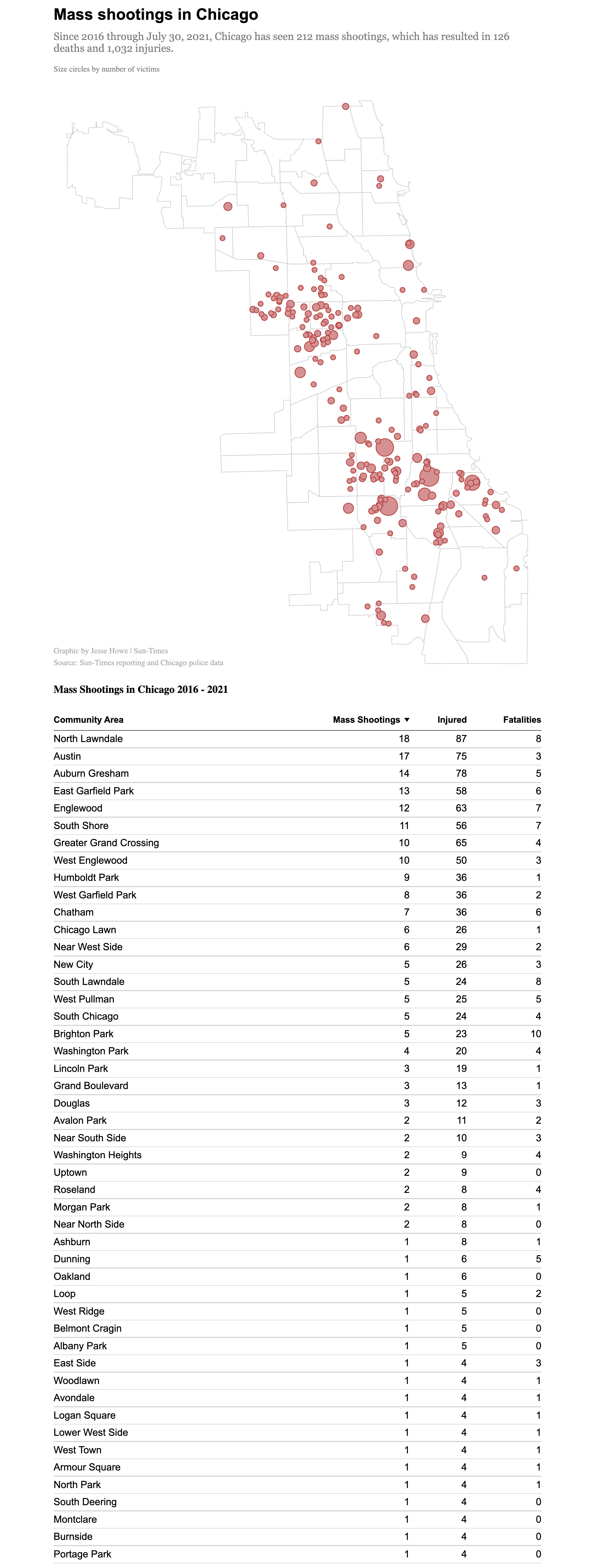
Only one person has been charged in any of the at least 39 mass shootings so far this year, according to a Sun-Times analysis of city data and court records.
That amounts to charges in just 2% of this year’s mass shootings — far below the police department’s dismal 13% clearance rate for shootings overall, which is the lowest of any big city in the nation.
Going back to 2016, the alleged shooters have been charged in just 21 of at least 212 mass shooting incidents — or less than 10% of the cases, the Sun-Times analysis found.
Just two men have been convicted in those attacks, which through Friday nighthave wounded 1,032 people, 126 of them fatally, records show. Two of the other 21 people who have been charged were ultimately found not guilty, while another suspected shooter had his case dropped, records show.
Year
Shootings
Wounded
Fatalities
Charging Info
2016
37
163
21
2 charged in shootings (cases ongoing), 1 charged in connection (pled guilty)
2017
29
135
28
7 charged in shootings (1 case dropped, 2 pled guilty, 4 ongoing)
2018
29
139
16
5 charged in shootings (2 not guilty, 3 ongoing), 1 charged in connection (pled guilty)
2019
30
148
12
3 charged in shootings (all ongoing), 6 charged in connection, including 1 charged separately in a shooting (1 pled guilty, 2 dropped, 3 ongoing)
2020
48
233
25
5 charged in shootings (all ongoing), 4 charged in connection (1 stricken, 3 ongoing)
2021
39
214
24
1 charged in shootings (ongoing), 1 charged in connection (ongoing)
All
212
1032
126
23 charged in shootings (1 dropped, 2 pled guilty, 2 not guilty, 18 ongoing), 13 charged in connection (1 stricken, 2 dropped, 3 pled guilty, 7 ongoing)
Source: Sun-Times analysis of city data and court records
The lack of charges this year is all the more ominous because the number of mass shootings far outpaces each of the last five years, according to the Sun-Times analysis.
This year’s toll through the end of July already surpasses the total number of mass shootings recorded each year between 2016 and 2019, records show. In each of the last two years there were five attacks in which more than 10 people were shot, including a pair of shootings that each wounded 15 people.
The lack of justice in the cases leaves the most reckless shooters out on the streets — and gives neighborhood residents all the more reason to look over their shoulder as many emerge from pandemic lockdowns.
“Go to the parks on the South and West sides on a beautiful day, and you’ll see it. There’s hardly anyone there,” said Steve Gates, a social worker who works in the Roseland and West Pullman neighborhoods for Chicago Beyond. “These are our public spaces, where we should gather. But people have to feel safe.”
A month after Bowie was killed, her friend Sameka Scaife said she doubts the police will ever find the gunmen responsible. “It’s like waiting for something that you know will never come,” Scaife said.
“It’s just gone cold. I don’t even think they’re looking,” she said of the investigation. “I believe the police know which gang is responsible for the shooting and that’s all. I trust the intel, but I don’t trust they’ll follow up and find out who did it.”
The daughter of a retired Chicago cop, Scaife said she’s lost all trust in the criminal justice system. Disillusioned by the lack of charges in Bowie’s killings, she has now abandoned her plans to follow in her father’s footsteps and pursue a career in law enforcement.
“I don’t see anything changing with the city of Chicago,” said Scaife, who left her hometown years ago due to the pervasive crime. “It’s almost like the police are stepping back and letting everybody kill each other. It breaks my heart so much.”
Nyoka Bowie was killed June 27 in a mass shooting in Marquette Park that left five others wounded.
Police: Mass shootings not prioritized over other cases
Chicago’s total number of mass shootings in the past five years is more than double that of the next closest city, according to the Gun Violence Archive, a nonprofit research group that catalogs shootings in the United States.
But the mass shootings here rarely resemble the typically more planned attacks that prompt national media attention, outrage and calls for gun control, like the Columbine High School massacre in Colorado or the Pulse nightclub shooting in Florida. Instead, Chicago’s mass shootings are usually sporadic street crimes that center around large outdoor gatherings, making the summer months particularly dangerous.
In an interview, Chief of Detectives Brendan Deenihan said many of the mass shootings in Chicago appear to stem from disputes or arguments, though he acknowledged some are clearly gang-related. Despite the increasing number of mass-victim events, Deenihan said they aren’t prioritized over other shootings.
“The detectives who are assigned to a mass shooting, and then if they’re assigned a shooting later on that week, they’re doing the same thing in order to solve that incident,” he said. “There aren’t any other different tools.”
He acknowledged, however, that investigating a mass shooting requires an “extraordinary” amount of time and more resources than other shootings. Detectives have to interview far more people, both victims and witnesses, and forensic technicians are needed to process sprawling crime scenes, often littered with dozens of bullets.
“It is a lot more work, but I just kind of defer to the detectives and the forensic guys and the beat guys who are out there,” he said. “Everybody is working as hard as they possibly can.”
Police reports obtained by the Sun-Times, though, reflect what appears to show different levels of police response and community cooperation in the incidents.
In a shooting at 4 a.m. June 6 that wounded eight in the 8900 block of South Cottage Grove, the narrative consisted of a handful of sentences with virtually no details.
“All victims related to r/o’s [responding officers] they heard gun fire and then felt pain. Not offender information was given to r/o’s by victims. Unknown witnesses related to r/o’s that they observed two male 1s shooting towards the crowd then fleeing in a silver sedan towards an unknown direction,” the report states.
Footage from the bar’s surveillance camera — which Mitchell turned over to police — shows officers dispersing a crowd of hundreds, issuing tickets and towing illegally parked cars. The camera also shows the two gunmen pulling on masks in an alley east of the bar before bursting into the crowd. Police reports show that cops had a fairly detailed description of the shooters’ clothes, the make and model of the vehicle they drove off in and the direction in which they fled.
Police told community members they have suspects in the shooting, which killed a mother of three and injured nine others, but so far have announced no arrests.
“I don’t know what else they could do,” said Mitchell, who estimated dozens of officers eventually arrived at the scene. “Police were already here when [the shooters] popped out.”
Experts agree urban mass shootings like the ones that take place in Chicago are among the hardest cases to solve.
Clearance rates have been falling across the country since the 1980s. And Mark Bryant, executive director of the Gun Violence Archive, noted that most mass shootings in other cities also go unsolved.
Tom Scott, a social scientist who has studied clearance rates and investigative practices across the U.S., said shootings where no one is killed — even when multiple people are wounded — tend to get less attention from police because murders are the most closely tracked crime statistic by the media and politicians. (In more than 60% of the 212 mass shootings recorded in Chicago since 2016, no one was killed.)
Mass shootings, he added, tend to lack “solvability factors,” including cooperative witnesses.
“Agencies … prioritize cases they are most likely to solve,” Scott said.
Yet law enforcement tends to respond to spiking violence by adding beat cops instead of detectives.
More robust investigations where officers make concerted efforts to find and interview witnesses can help foster the community trust needed to get more cooperation, Scott and other experts believe.
The Chicago Police Department’s efforts to crack cases have long been hampered by its strained relationship with the communities ravaged by gun violence, areas that have been over-policed and are predominantly Black and Hispanic. In those areas, fear of gangs and distrust of police has created an atmosphere that discourages cooperation, or snitching, striking fear in residents who may otherwise help investigators.
Chicago Police Supt. David Brown (right) and Chief of Detectives Brendan Deenihan say a lack of cooperation from witnesses and even victims has hampered police efforts to solve the shootings.Anthony Vazquez/Sun-Times
Deenihan, the chief of detectives, also noted the lack of cooperation from the “intended targets” of the shootings. Supt. David Brown asserted the culture of silence effectively perpetuates a cycle of violence and emboldens those carrying it out.
“That signals to us, when you don’t cooperate, when you are silent, that you prefer street justice,” Brown added. “Street justice is never-ending. The appetite for revenge is never satisfied. It only harms. It only ruins your community.”
Mass shootings traumatize residents of entire neighborhoods who either witness them, are victims or are related to the victims, said Sonya Dinizulu, a psychiatrist at the University of Chicago School of Medicine who has studied trauma.
“People say that communities ‘get used to’ this level of violence, that these shootings don’t faze them after a while,” Dinizulu said. “That is simply not the case, and we do not say that about sexual assault, or about car crashes or all other sorts of trauma.
“But the body remembers. People still have a physiological response, they have post-traumatic stress, and it is very difficult to heal that when the trauma repeats and repeats.”
Indeed, it fosters feelings of hopelessness and depression in young people, which lends itself to the kind of recklessness that might lead to firing into a group of people, heedless of innocents among them, Dinizulu said. That same hopelessness weighs on those who don’t become violent, and entire communities fray when residents are too wary to attend large gatherings or even be outside, she said.
“It’s a cycle. A very destructive and dangerous cycle,” she said. “We focus so much on healing. I think it’s surprising, encouraging, that people are focused on healing. But we know the drivers of violent crime — poverty, disinvestment, lack of educational opportunity — and we have to focus and invest in those as well.”
Police are recovering an increasing number of high-powered firearms, like this weapon police says was found after a report of shots fired in late May on the Southwest Side.Chicago police
More guns — and more powerful guns — recovered
Experts agree with police officials that another factor is more directly driving the spike in mass shootings: More guns — and more firearms that are high-powered — have flooded the streets.
Chicago police have recovered at least 7,289 total guns this year, up from 5,668 at the same point last year. The number of recovered assault weapons has climbed more dramatically over that same period, from 227 to 368.
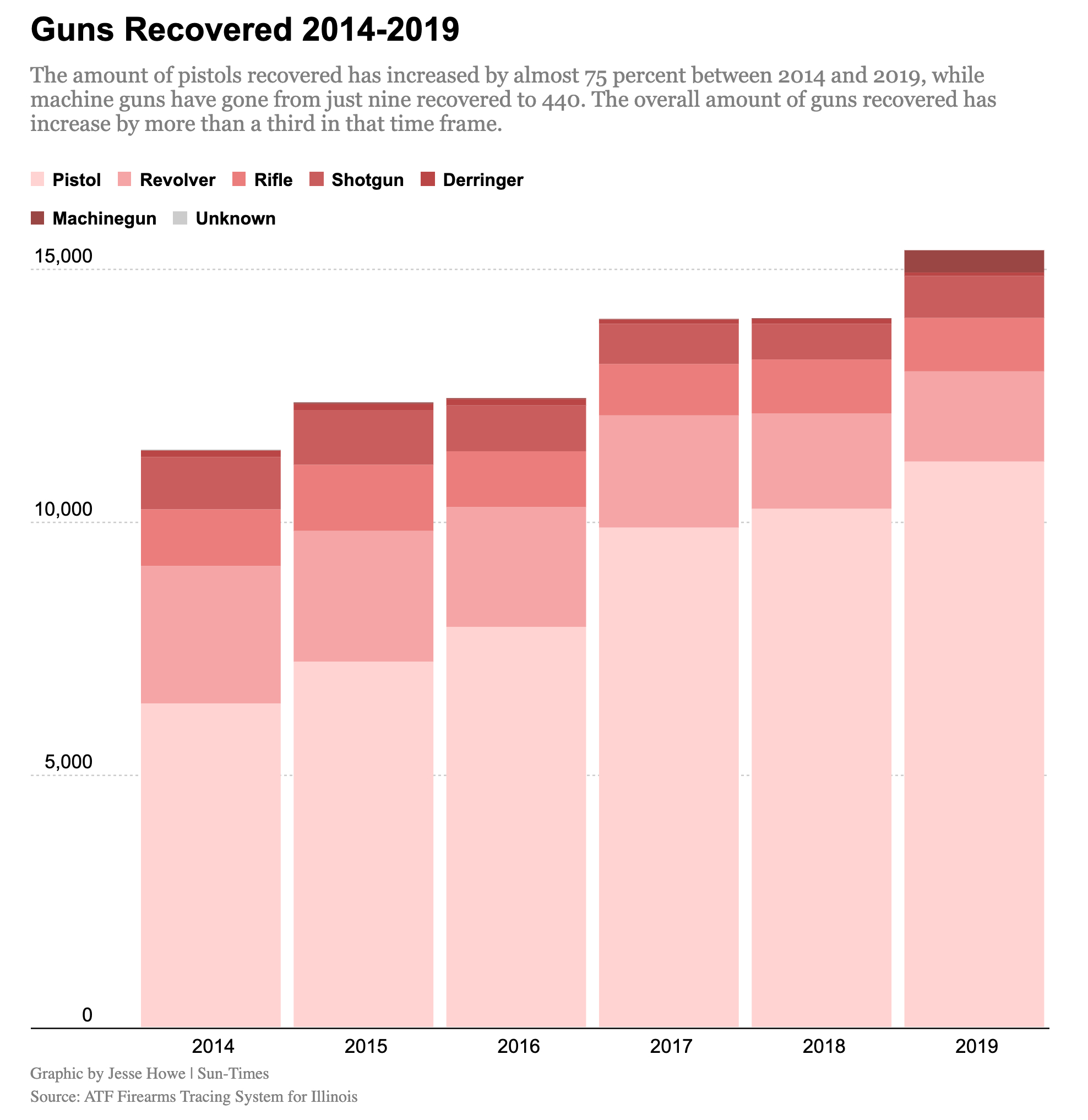
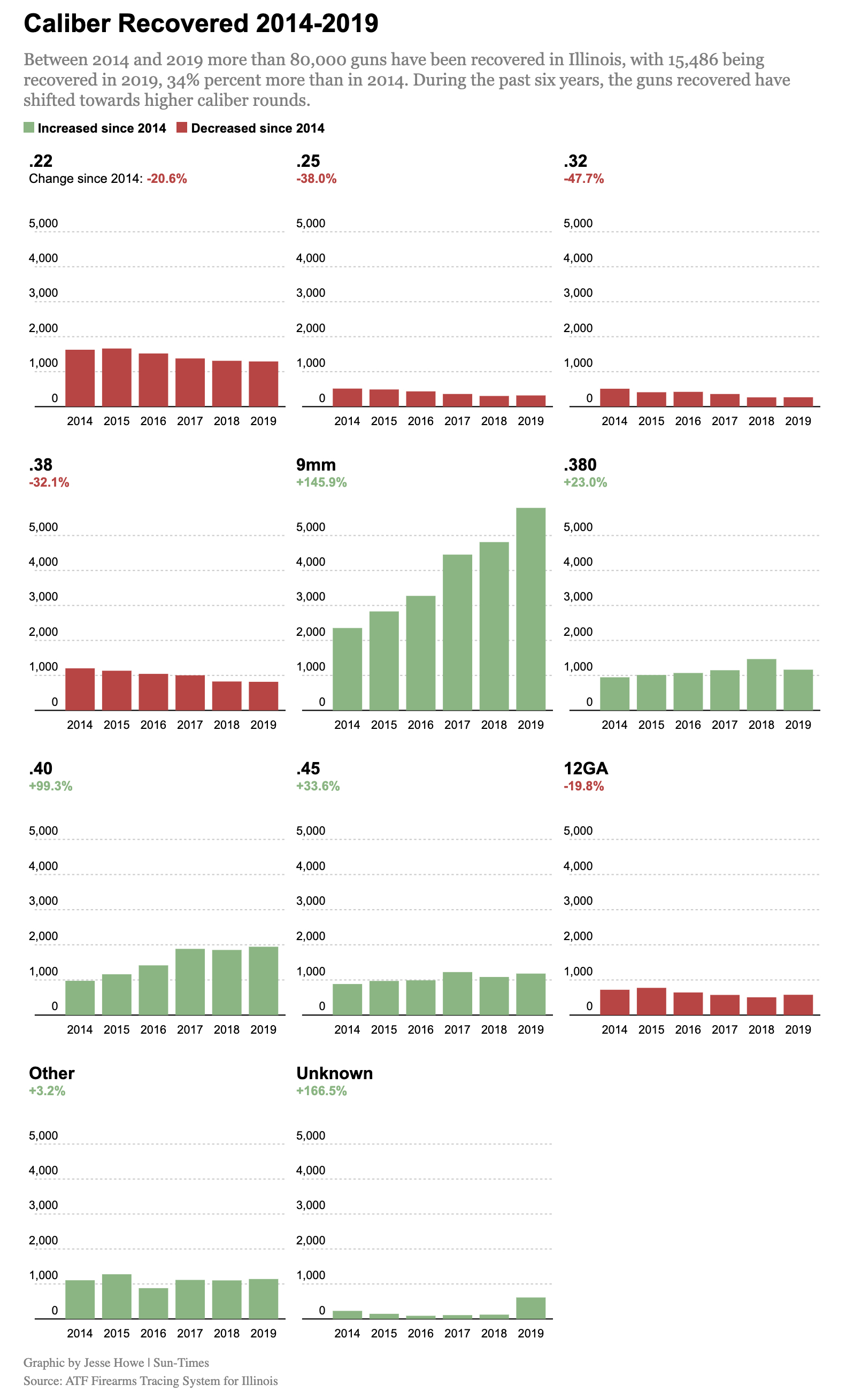
Statewide, the number of guns recovered steadily rose from 11,568 in 2014 to 15,486 in 2019, the last year of publicly available data compiled by the U.S. Bureau of Alcohol, Tobacco, Firearms and Explosives. More than half were pulled off the streets of Chicago.
CodePen – Weapons recovered Chart
Among all those weapons, the number of high-powered, rapid-firing rifles has skyrocketed. There were an average of 18 “machine guns” recovered each year between 2014 and 2018. That number spiked to 440 in 2019 — and the following year the number of mass shootings jumped to 48.
Deenihan said shell casings from handguns have been found at every crime scene where a mass shooting took place, while rifles have been used in just under half of the crimes. In many cases, people in crowds have returned fire — leading to more victims, he said.
Cops investigating mass shootings are also finding extended magazines and switches, which can make semi-automatic pistols fully automatic.
“It’s remarkable firepower,” Deenihan said. “But it also is the fact that when you have that many people — 100, 150 people, 200 people out there — and somebody’s firing a gun, the likelihood of somebody catching one of those bullets goes up dramatically.”
CodePen – Caliber recovered Chart
Roseanna Ander, executive director of the University of Chicago Crime Lab, specifically noted that more people in Chicago are toting semiautomatic weapons that can hold high-capacity magazines, raising “the likelihood that you’re going to have multiple victims and that the injuries are going to be more serious.”
Mayor Lori Lightfoot last month lauded a federal initiative aimed at disrupting interstate pipelines for firearms, and her administration has recently launched new efforts to combat the city’s gun problem.
She announced a $1 million reward fund last month for information leading to the seizure of illegal firearms. And since then, a new police team of roughly 50 officers was announced to target gun traffickers and people whose state firearm permits have been revoked.
Will tougher enforcement help?
When Kristina Grimes was slain in the mass shooting in South Shore earlier this summer, her mother Cynthia Carr felt like she had to do something to keep other innocent people from dying.
Grimes, once a standout high school swimmer who dreamed of making it to the Olympics, was apparently on her way to get something to eat when she was fatally shot. “No one knew her. She didn’t know them. She was totally caught off guard and just didn’t see it coming,” her mother said.
She and her husband, Grimes’ stepfather Michael Carr, now want elected officials to get behind measures like implementing stricter bail requirements for some offenders and embracing controversial stop-and-frisk policies. In recent weeks, the grieving mother has started reaching out to policymakers, including members of the Legislative Black Caucus and the state’s two U.S. senators.
Kristina Grimes (center) poses with her stepfather, Michael Carr, and mother, Cynthia Carr, during a family vacation four years ago.
“I don’t believe the political will exists to deal with the problem as is,” Michael Carr said. “And there’s going to have to be some tough solutions and acknowledgment about who’s committing the vast majority of these shootings. And just even saying that will bring howl and outrage among the activist groups.”
A West Side native, Michael Carr was raised near the notorious Rockwell Gardens housing project in East Garfield Park. Fed up with the violence, he left Chicago in his mid-20s, vowing never to return. He and his wife, also a Chicago native, now live in suburban Romeoville and fear for the safety of family members in the city.
While they’re critical of the city’s leadership and deeply concerned about its violent crime, the Carrs said they sympathize with detectives who they believe are inundated with cases.
“How is it humanly possible for a detective to investigate a crime if they have to keep shifting to another crime?” Cynthia Carr asked.
As for the two cases where police made arrests that led to convictions, both took place in 2017 and wounded five people.
Dejuan Moore, now 23, was charged in an attack in South Austin that June. And Kriston Gordon, 29, was charged in a shooting at a West Rogers Park bar early on New Year’s Eve, records show.
They were both hit with multiple charges, including counts of attempted murder, but each pleaded guilty to aggravated battery. Moore was given 10 years in prison, while Gordon got six — relatively light sentences for such brazen shootings.
But enforcing stricter punishments likely won’t do much to decrease violence in the long run, said Linda Teplin, a Northwestern University psychiatrist who has studied urban violence. Mass shootings that take place in suburbs, like Columbine, draw massive attention and drive the national debate on gun laws, but the events themselves are less predictable and are often the acts of isolated, lone-wolf shooters with no criminal records.
But in Chicago and other cities, mass shooters fit a narrower profile: They’re mostly young black males involved in gangs who will have contact with the criminal justice system.
“The irony is, urban violence is more preventable, but we don’t invest the funds,” Teplin said. “What is needed is economic investment, jobs, access to educational opportunities, therapy. We know what needs to be done, but we won’t invest the funds.”
Contributing: Jesse Howe, Andy Boyle, Madeline Kenney, Sophie Sherry
A 1-year-old boy and a 19-year-old man were listed in serious condition following a shooting Monday afternoon in Gary, Indiana.
Just after 1 p.m., officers responded to a call of shots fired in the 800 block of West 25th Avenue and found a female holding the child who had been struck by gunfire, Gary police said.
Witnesses told police the teen was supervising three small children playing in the yard of the home when someone opened fire, according to police.
The boy and the teen were transported to the hospital and listed in serious condition, police said.
This is a developing story. Check back for details.

:no_upscale()/cdn.vox-cdn.com/uploads/chorus_asset/file/22363219/protest_Brown_elbow.jpg)
:no_upscale()/cdn.vox-cdn.com/uploads/chorus_asset/file/19921010/Madison___Springfield_B.png)
:no_upscale()/cdn.vox-cdn.com/uploads/chorus_asset/file/22751715/merlin_98646234.jpg)
:no_upscale()/cdn.vox-cdn.com/uploads/chorus_asset/file/22749182/IMG_5823.JPG)
:no_upscale()/cdn.vox-cdn.com/uploads/chorus_asset/file/22752019/CPDPRESS_062320_06.JPG)
:no_upscale()/cdn.vox-cdn.com/uploads/chorus_asset/file/22754542/CPD_gun_photo.jpeg)
:no_upscale()/cdn.vox-cdn.com/uploads/chorus_asset/file/22749190/Screen_Shot_2021_07_29_at_3.09.16_PM.png)