A Campton Hills man plead guilty in his mother’s 2019 death Monday.
Thomas W. Summerwill, 23, agreed to four years of probation and 200 hours of community service in exchange for a guilty plea of involuntary manslaughter in the March 2019 beating death of his mother, 53-year-old Mary B. Summerwill, Kane County State’s Attorney Jamie L. Mosser said.
In addition to the probationary period and community service work, Summerwill cannot consume alcohol and must wear an alcohol-monitoring device for the duration of his probation, Mosser said. He also must undergo intensive alcohol and grief counseling, as well as a psychological evaluation.
On the morning of March 24, 2019, Summerwill was asleep when he awoke to what he believed was an intruder in his bedroom, not realizing it was his mother, Kane County Assistant State’s Attorney Greg Sams said in court. He grabbed a baseball bat and struck Mary Summerwill multiple times in the head.
An investigation revealed that Summerwill’s blood-alcohol concentration was .270 — over five times normal levels — and his blood contained tetrahydrocannabinol (THC) metabolites.
I was listening to one of Chicago’s sports-talk radio stations Friday, the day of the Great Cubs Sell-Off, and an 80-plus-year-old woman came on the phone line.
She was so angry, she told the hosts she would never watch another Cubs game. And, she added in a nasty tone, Cubs president Jed Hoyer had better get home security for safety.
That shocked me.
We’re all used to outrage from fans. They are passionate. They go up and down like elevators. Understood.
But even with hyperbole, after what we saw Jan. 6 at the Capitol in Washington with rioters calling for elected officials to be harmed, you don’t say this stuff about fellow citizens — even in a snit.
And in your 90th decade?
Maybe a little decompression is needed here. Starting with grandma. Maybe for all Cubs fans.
It’s a good time to remember how baseball — actually, all elite North American pro leagues — work. We’re talking Major League Baseball, the National Football League, the National Basketball Association, and the National Hockey League.
These leagues are closed entities, with 30 to 32 franchises, in all the major cities, with very little if any outside competition, essentially members of legal cartels.
There are rules, drafts, salary caps, players’ unions, trade deadlines, fines, revenue-sharing, etc.
And nobody else can get in. Leagues that try to compete — well, good luck. Check the United States Football League and its sad history for evidence.
It’s a contained and arbitrary business, in a sense, totally rigged. That is, somebody within each cartel is going to win the championship each year, and a bunch of teams are going to be mediocre, and some are going to be terrible, and no team from anywhere else has a chance.
The worst teams then get the highest draft choices and the best young players. And the top teams slowly (or rapidly) fall out and previous losers rise. (Who thought the Royals would win the 2015 World Series?)
It’s nice and certain and predictable. All leagues want the semblance of parity, and their rules guarantee it.
Teams take the names of their chosen cities — Miami, Boston, Detroit and so on — as if they belong to those cities. They don’t.
You invest in the franchises because they’re “your” teams, but their loyalty to you is paper-thin.
The Los Angeles Lakers started in Minneapolis, remember. Jazz in Utah? (Try New Orleans.) And the Raiders have called three cities home in the last three decades.
Cubs fans with Anthony Rizzo, Kris Bryant and Javy Baez jerseys surely are feeling that abandonment now. It hurts. It’s unfair.
But it’s the system. Rich star players almost always end up being traded. Partly because they’re so good, they bust the payroll.
If Jake Arrieta had been decent as a starting pitcher, if the Cubs hadn’t lost 11 consecutive games from June 25 to July 6, if Jason Heyward weren’t batting under .200, if pitcher Adbert Alzolay weren’t 4-11, if Rizzo were hitting more homers . . . maybe the Cubs would have gone for it all instead of folding.
That 11-game skid did it. The Cubs were tied for first in the National League Central on June 24, in fourth place on July 6.
We waited 108 years for the 2016 World Series crown, and here we go again.
Yeah, it’s sad. Yeah, it’s giving up. But for now, let’s assume this is Hoyer’s strategy, his disaster plan.
One fact: The Cubs’ title team that should have started a mini-dynasty lost its mojo. Most championship teams do. No excuse, but it’s a fact. Consider that in the last seven years, there have been seven different World Series winners.
The White Sox are now the hot Chicago team, general manager Rick Hahn the new genius. (Thanks, Cubs, for Craig Kimbrel!) But the Sox had five winning seasons in the last 15 years. And it’s funny how all those bad teams after the 2005 World Series championship are now forgotten by Sox pilgrims.
Try to win, tank, rebuild. It’s the baseball formula, done over and over. Yep, done even by the beloved Cubs just before that 2016 championship.
I remember talking with Leslie Epstein, Theo Epstein’s dad, back in 2014 in New York, when the Cubs were throwing out a 73-89 fifth-place club.
“Just wait,” Leslie said earnestly. “Give him time. It’ll happen.”
I certainly won’t say no to a drink when offered. So I took up the offer from Canteen Spirits to try their line of vodka sodas.
Unlike yer White Claw, and other malt beverages, this gets its kick from actual vodka, mixed to 5% abv with sparkling water, then natural fruit flavors. CEO Brandon Cason, got started in marketing for Deep Eddy Vodka, which ran a line of natural fruit-flavored vodkas. He and his partner began making fruit-flavored mixers, according to an interview in Forbes, and the concept took off with the “hard soda” craze. Their product is labeled as having no sugars, carbs or sodium, 99 calories, and gluten free.
[embedded content]
Canteen Spirits Black Cherry
One of the flagships of the line. I’m guessing because that was one of the flavor for which they sent two cans. The first impression I got under the tab was of a Grape Nehi. Okay, a general fruit-flavored soda. It’s a clear, fizzy water pour. Once I got it into the glass, it was more of a black cherry soda smell.
The mouthfeel is a little extra fizzy, like a club soda. It definitely has not much sweetness to it.
Canteen Spirits Watermelon
I have been smushing up watermelon chunks and pouring vodka over them to refreshing effect. So how does it taste pre-made?
Pous clear and fizzy. Watermelon smell is pretty light. Taste is also light watermelon, likely kept modest by the lack of added sugar. I found a splash of Angostura bitters gave it a little more character.
More flavors will be discussed here as I get through them. Stay tuned!
Fresh Beer Events, occasional bacon, but always spam free, opt out any time.
Meet The Blogger
Mark McDermott
Writer, trivia maven, fan of many things. I thought to learn all there is to know about beer as a way to stay interested in learning. It is my pleasure to bring Chicago’s craft beer scene to you.
In the last post, I gave an example of how listening to my gut saved my child’s life. The following is another example of the benefits of trusting my gut. My child may have had speech delays or been labeled had I just followed the first two opinions I received and did not continue to advocate on her behalf.
My Experiences Continued
Her Language
After adopting our daughter in China and bringing her home, several months pass and we could not possibly be more in love. At this point, my daughter is almost two. She is walking, running, playing, giggling, drinking from a cup, loves books, gets excited when we go to the playground where she enjoys the equipment, and developing normally. In other words, our daughter is developing beautifully. BUT, she is not saying any words.
Back to the pediatrician I go. I ask if this could it be due to her hearing or her tonsils (places to start) and could you recommend someone to test her. “Mom, you don’t know Chinese children,” he said, dismissing my concerns. I will never forget that statement.
Basically, he is suggesting I just let her ”grow out of it.” Maybe that would have worked, maybe not. I was NOT willing to take the chance.
So, I ask around and find a center that is highly recommended for testing for language issues. After a day of testing my child (who is a feisty young girl) we were taken into a conference room for the results. To make a long story short, after seeing my little girl their conclusion was that she is mute, and we are too busy to help you.
I remember going home and, after my daughter was settled in an activity, going to a private place to cry. My next reaction was to realize their information was ridiculous. They spent one day with my daughter, how dare they label her with something so conclusive. They did not even give me ideas of where to go next for help. (Maybe she was distracted…. maybe she had a cold…You know, sometimes children do NOT perform with new people).
I decided there was no way I was going to take the word of this center as definitive. I wanted another evaluation and good services. She was going to have services that supported her and were NOT going to be punitive in any way.
I was fortunate, I knew the system. I had her tested and we received an Individualized Family Service Plan (IFSP) that include a speech pathologist who did play therapy at our home. I would have gotten a new doctor, but we were moving.
When we arrived in the new state. The new pediatrician thought it was her tonsils and adenoids. We went to a specialist who concurred it was her tonsils and adenoids. Once they were out, language developed rapidly.
FYI, my daughter is a young adult now, who speaks beautifully. In fact, no language issues, at all.
By the way, if you are interested in getting an IFSP for your child, the process varies by state. To find out information for your state, do the following search:
I want an IFSP in __________ (Enter your state where the line is.)
Conclusion
My child benefited from my intuition. Parents/ guardians, I suggest you stick to the rule of AT LEAST THREE. If you feel there is something off for your child and you are not getting help, get at least three opinions.
For over a quarter of a century, Dr. Amy Sussna Klein has dedicated herself to just one vocation — early childhood education.
As an educator, she has taught a wide variety of Early Childhood courses in university and community college settings. In order to connect theory and practice she volunteered in classes when she was a professor. In addition, she was a toddler, preschool and primary school teacher for several years. When she was a teacher she loved working with parents and ran parenting groups. Now, as a parent, she strives to follow the approaches she taught as she raises her own child.
Amy has presented nationally and internationally. She has consulted for such prestigious companies as Pearson Education and Arthur D. Little, and has rendered professional and community service to various state and local educational communities. She has been a member of the National Association for the Education of Young Children (NAEYC) for over twenty years, and served 2 years as the president of its greater Kansas City chapter.
If you wish to contact Amy, please email her at ParentingSOS.Chicago@google.com.
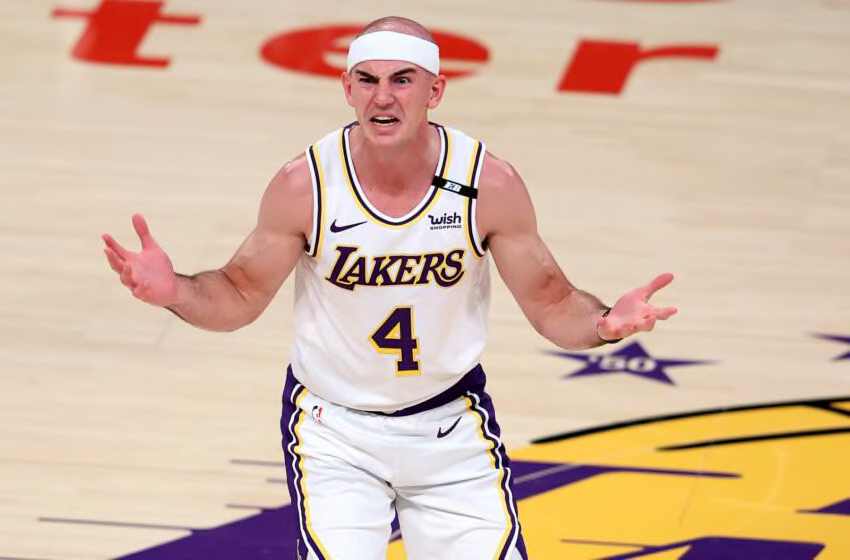
The Bulls inked Caruso using an MLE, or mid-level exception, allowing the Bulls to obtain Caruso without going over the cap space provided to them.
This is important for two reasons.
First, the Bulls can still go after big-name free agents this offseason, like DeMar DeRozan, who they have been linked to in multiple sign-and-trade rumors with Lauri Markkanen.
Second, the Bulls can use their BAE, or bi-annual exception, to sign free agents and can use multiple minimum contracts to fill out the rest of their roster.
Can confirm the Alex Caruso signing that @wojespn first reported, which is the majority of the full MLE over 4 years.
Bulls still have BAE and minimums to round out roster up front.
This deal seems confusing, considering the guard roster is full of freshly acquired talent like Lonzo Ball, newly drafted Ayo Donsunmu, and now Caruso.
However, it seems the Bulls have one goal in mind for which area of their team they want to improve most — defense.
Caruso is one of the most gifted defensive guards in the league. With multiple votes for second-team all-defense last season, Caruso held a 106 defensive rating and a 2.3 defensive box plus/minus.
AKME has its eyes set on improving the defense, which was a huge struggle for the Bulls last season. While they ended up 11th overall in points allowed per game, the defense was always a struggle for them.
Caruso is here for one reason and one reason only — defense. His offensive talents are pretty useless, considering he averages a career 5.9 points and takes just under five shots per game. Either way, Caruso’s new role will be boosting the Bulls’ perimeter defense, a much-needed area for the team.
The biggest takeaway from Caruso’s deal is that the Bulls are not done in free agency. The deal put the team in a bit of a hole for cap room to sign big men, but enough room to sign another big name while using Lauri Markkanen and Thaddeus Young as trade pieces to clear up cap room.
Currently, the Bulls have Nikola Vucevic, Thaddeus Young, and Markkanen as their big men. Markkanen and Young seem as good as gone in the trade market, and Daniel Theis has agreed to a four-year deal with the Houston Rockets.
The Bulls need to figure out how to wiggle cap room to fill the roster spots for their frontcourt. The backcourt is loaded with talent and money, but the frontcourt needs work. That will be the next task for AKME as free agency continues. Stay tuned, Chicago.
Watch Berkowitz w/Chicago GOP Chair Boulton discuss the challenges for “Ballot integrity,” especially in recent Presidential elections, due to the radical change in how we vote during the last 5 years.
Tonight’s City of Chicago edition of Public Affairs features Steve Boulton, Chair of the Chicago GOP, who has decades of expertise as a trial lawyer who also handles electoral disputes involving both the courts and Administrative hearings.
The focus of our show with Boulton is on ballot integrity– in terms of the vast difference between the ability of partisan observers to act as watchdogs to prevent fraud in the current, more challenging mail-in and early voting– as opposed to the more traditional one day, in-person voting, which was the dominant custom in America for centuries until the last two decades.
The show airs tonight in Chicago at 8:30 pm and midnight on Cable Ch 21 (CAN TV).
— in Aurora this Wednesday & Saturday at 6 pm on Cable Ch 10 and
— in Rockford this Thursday night at 8:30 pm on Cable Ch. 19
Additionally, the extremely close Presidential elections of 2016 and 2020, documented in detail during our show, has brought into question the legitimacy of the last President and the current one- and the potential impact of election fraud on those and other elections
How much corruption and fraud has there been and is still present in our elections? Is it likely there was a sharp uptick in voter fraud due to the big surge in mail in ballots in 2020?
People who claim there is no evidence of impactful fraud in the last two presidential elections must deal with the facts that there are virtually no state or federal agencies assigned to detect, investigate and prosecute fraud in national elections and that both elections were decided by very narrow margins in three or four battleground states.
Our show with Boulton was very timely in terms of the U. S. Supreme Court’s July 1, 2021 ruling (Brnovich v. Democratic National Committee) in the very important Arizona voting rights case (filed in 2016) and the DOJ voting rights lawsuit filed on June 25, 2021 against Georgia.
The Berkowitz- Boulton discussion was taped two days before the Brnovich Supreme Court ruling was issued- rejecting the DNC’s claims that the Arizona election law that significantly curtails ballot harvesting and requires votes cast outside of a voter’s precinct to be discarded was unconstitutional and violated the 1965 Voting Rights Act.
Attorney Boulton discusses in detail the major differences in fraud detection and prevention between an election as we had in America for centuries where most of the voting occurred on a single day and usually with no voting site alternatives and the current system where the great majority of the voting occurs over an “Election season,” of more than ten days (and some as many as 55 days), includes massive mail in voting and often offers voters multiple voting location choices, with opportunities to vote at drop boxes and curbside in addition to voting at the usual precinct polling facility.
Because our show discussion anticipated much of the Brnovichdecision, it should help viewers understand the Supreme Court’s opinion in that key voting rights case. That includes the implications for how the U.S. Supreme Court is likely to decide similar lawsuits challenging election laws that have been passed in Georgia, Florida and are likely to be passed within the next twelve months in Texas and other states.
Most Dem Party officials and operatives argue the Georgia and Florida laws are designed to discourage minority voting, are discriminatory against minorities and violate the Voting Rights Act of 1965.
Others, including the majorities in the Georgia and Florida legislatures and most other Republican Party officials disagree and argue the new election laws are designed to prevent fraud and insure ballot integrity and security.
The Biden Administration’s DOJ, in an apparent attempt to beat the release of the Supreme Court opinion in Brnovich and avoid the ackwardness of filing a lawsuit that it knew the basis of which was contradicted by a very recent Supreme Court opinion, filed its lawsuit on June 25, 2021 against Georgia arguing on similar grounds to those argued by the DNC in its 2016 lawsuit involving Arizona that the new Georgia election law violated the Voting Rights Act of 1965.
DOJ knew the ruling in the Arizona case was imminent and it also knew the Supreme Court would likely rule in a manner contrary to the DOJ’s legal position in the lawsuit it filed against Georgia in Federal Court about a week before the Court’s ruling.
Georgia will of course argue its law was constitutional and not illegal, in part because Georgia has a compelling need to prohibit voter fraud and moreover, the law had neither a racially discriminatory intent nor effect, all of which the Supreme Court found in its decision on July 1 holding the Arizona law (similar to that of Georgia on voting) constitutional.
We explore the above and other related issues with Boulton, an expert in voting laws, voting regulations and voting practices, and we provide a foundation for understanding some of the likely benign motivations of the Georgia legislators- as the Arizona law was found by the Supremes to be benign, i.e., not motivated by a racially discriminatory intent and it also did not have an illegal racially discriminatory impact.
Chicago Police have asked the public to provide information in a pair of killings, Chief of Detectives Brendan Deenihan said at a Monday news conference.
Detectives have few leads in the killing of a 50-year-old man who was struck by a bullet as he sat in his truck, heading to work, around 4:30 a.m. on July 31 in the 2600 block of West 23rd Place in Little Village. The man was in the truck with his son when the bullet “came down the block,” Deenihan said.
Area 4 detectives are investigating the shooting.
Police also are seeking tips in the fatal shooting of a 14-year-old who was gunned down as he sat in a car in the 1600 block of West Waseca Place in Morgan Park on the far South Side on July 29.
The teen was struck in the head by a gunshot fired by someone who was shooting from a car coming down the street, Deenihan said.
Anyone with information may submit tips anonymously using the department’s online tip portal, cpdtip.com.
Chicago mayors have talked for decades about putting more cops where calls for service are the highest, only to drop the issue.
No one’s been willing to take the heat for redeploying cops.
Now Chicago police Supt. David Brown is laying that groundwork — but in a politically timid way that will take years to accomplish.
In briefings last week, Chief of Operations Brian McDermott and First Deputy Supt. Eric Carter told aldermen high-crime districts would get more manpower as rookies graduate from the academy and begin 13-month probationary periods.
It would take about two years to get South and West Side police districts — where shootings and drug dealing are worst — the levels of manpower they need.
Sources said a model designed by the University of Chicago Crime Lab called for a more radical approach.
In a recently completed pro-bono study of police manpower, the U of C created a formula that includes calls for service, total violent crime in the area, population size and attrition of retiring officers.
The model called for reassigning veterans and rookies immediately, based on those and other factors. It concluded CPD has the manpower now to staff high-crime districts at proper levels, even after a recent wave of retirements.
The U of C Crime Lab declined to comment, referring questions to the Chicago Police Department. The police department did not respond to repeated requests for comment.
Chicago Police Department Supt. David Brown elbow-bumps Johnnetta Philpotts in South Shore in June 2020 after a weekend of protests, civil unrest and looting across the city. Philpotts had become emotional after officers clashed with hundreds of protesters outside a store that had been looted near East 71st Street and South Chappel Avenue.Ashlee Rezin/Sun-Times
Sources said Brown favors a go-slow approach that amounts to the political path of least resistance.
In a PowerPoint presentation distributed to aldermen, Brown’s approach is called “incremental change” in which “districts will not lose officers.”
“Units are ranked from ‘busiest’ to ‘least busy’ based on call-for-service data,” according to the presentation. “Additional officers are assigned to districts with the busiest units, considering relief factor and unit size.”
The department will continue assigning cops to districts with the busiest beats until “all units spend [less than] 60 percent of time on calls.”
Ald. Jason Ervin (28th), chairman of the City Council’s Black Caucus, said he’d prefer to see the long-awaited reallocation of police manpower accomplished more quickly to stop the gang violence plaguing the West Side.
But Ervin is also a political realist.
“I understand that we can’t just rob Peter to pay Paul. We’ve got to pay everybody. Based on the manpower that comes out [of the police academy] — I can understand them doing it that way,” Ervin said.
“We’re still keeping up with a massive rate of attrition and some other things that have to occur. The department has a huge challenge on its hands. And we can’t just take officers totally out of one place and put them all in another place. It doesn’t solve our challenges overall.”
Ervin said districts like Harrison, Austin, Englewood and South Chicago have “traditionally been training districts.”
“I don’t have an issue with probationary officers or officers fresh out of their probationary period coming into the districts as long as they’re properly supervised and adequately trained,” he said.
A video posted to social media in April 2020 shows dozens of West Side residents in a heated confrontation with Chicago police officers at Madison Street and Springfield Avenue in the Harrison District.Facebook
Ald. George Cardenas (12th), Mayor Lori Lightfoot’s assistant council floor leader, said it’s better to take the path of least resistance than to maintain the status quo.
“Whenever you siphon officers from one district and put ’em in another district, people are gonna cry foul and say, ‘Wait a second. What are you doing?'” Cardenas said.
Far South Side Ald. Anthony Beale (9th), former chairman of the Council’s Committee on Public Safety, has pushed for changes in how beats are staffed since he was first elected in 1999. He said Chicago’s violence requires a “massive reallocation” of officers immediately — not a go-slow approach.
“We can’t wait two years with people dying left and right in the city. We’re taking a very soft, meek approach to a problem that needs major surgery,” Beale said.
“You’re moving those officers around to put fires out here and there. But it won’t have a longstanding impact. They have to be stationed. They have to get to know the community. You can’t keep moving them around. It’s a band-aid approach.”
Beale was equally angry about using rookies to solve the shortage.
“We need officers with experience and knowledge of what’s going on. It needs to be a combination. Don’t just give us all recruits,” he said.
If the go-slow approach was supposed to mitigate opposition from aldermen representing predominately white wards on the North and Northwest Sides, it didn’t work with Ald. Nick Sposato (38th).
He’s already concerned that officers assigned to the overnight watch must ride alone in the 28.5-square-mile Jefferson Park District “because we don’t have the resources to put two-man cars out.”
Sposato added: “225 [officers] isn’t enough for our district. It’s way too big. Way too much ground to cover. Now we’re at 180, 190.”
“I’m gonna have to have a talk with the superintendent and say, ‘You just can’t keep forgetting about us.'”
North Side Ald. Tom Tunney (44th) said the Town Hall district he represents had “close to 400” officers when Mayor Lori Lightfoot took office. It’s down to 335 officers.
“We haven’t had a class since before COVID. And we’ve had retirements. And we’ve had strategic decisions by the superintendent to saturate high-crime areas. He has a new idea every couple months about citywide teams. They have been basically taking resources out of 19 and other safer districts,” the alderman said, referring to Town Hall by its CPD district number.
“How he rearranges the patrol people — that’s up to him,” Tunney said of Brown. “But we’ve been told we’re not getting less.”
Reallocating officers is a perennial issue in Chicago. One of the biggest hurdles to moving veterans from one district to another one is the union contract: based on seniority, cops have the ability to “bid out” of a district they don’t want to work in.
The last study of police manpower cost Chicago taxpayers $150,000, but it just gathered dust on a shelf. Alexander Weiss, former director of the Center for Public Safety at Northwestern University, and Paul Evans, former commissioner of the Boston Police Department, found more squad cars should be added to beats where the number of those calls is the highest.
“If 50% of the calls came in the afternoon shift, 50% of your officers would work on the afternoon shift,” Weiss told the Sun-Times last fall. “Some of the beats have twice as many calls as others.”
Presentation to aldermen by the Chicago Police Department:
Complaining about low bail for violent arrestees and an “historic” number of guns on Chicago’s streets, Supt. David Brown on Monday expressed frustration that the city’s violent crime remains at near-record levels for the second year in a row.
Chicago saw 105 murders in the month of July, just two fewer than in July 2020. Year to date, there have been four fewer murders in 2021 than during the first seven months of 2020– though there have been nearly 200 more shootings this year than last.
As he does at most of his weekly press briefings, Brown updated the tally for CPD’s gun-related arrests and offered the record-setting pace of gun seizures as evidence police are doing their part.
Police have made 3,477 firearm-related arrests and so far this year have taken 7,322 guns off the streets — some 1,500 more weapons than during the same period last year and on pace for more than 12,000 seized firearms by year-end.
Brown also noted the department’s efforts at community outreach in July: 143 “youth engagements” including a baseball camp and boat rides with the department’s marine unit; 105 charitable giveaways; and a live concert for seniors.
“You should not be running in place as far as homicides, and you should not be up 10% (in shootings) with all the work that the men and women of the Chicago Police Department have done in recovering guns, which are 90% of what’s happening in relation to violence,” Brown said.
“There are too many guns and too little consequences for repeat, violent offenders.”
Many cities are struggling to reverse dramatic increases in violent crime that began in 2020, a surge experts attribute to the combination of multiple factors: mass unemployment during the pandemic; closure of outreach programs; and lack of trust in law enforcement in the wake of George Floyd’s murder murder by a Minneapolis police officer.
Chicago’s 1% increase in homicides year-to-year is markedly better than the numbers in other large cities. According to data analyst Jeff Asher, who tracks crime data from public sources across the U.S., murders are up by nearly a third in Houston, 25% in Philadelphia, 29% in Los Angeles and 1% in New York.
Brown has frequently touted CPD’s “big swing” into community policing programs and the city’s new, holistic approach to fighting crime with a combination of new policing strategies, violence prevention programs, and outreach and support to those most likely to shoot others or be shot themselves.
Just as frequently, Brown has complained about a Cook County court system he says allows too many offenders back on the street after arrests for weapons or violence charges. Brown cited the example of a defendant in a double-homicide from 2017 who was released on electronic monitoring, one of more than 100 murder defendants who have been released from jail while outfitted with a GPS tracking device.
Chief Judge Timothy Evans has said that 99% of defendants on bond for violent crimes do not pick up a new arrest while free on bond, and 90% make scheduled court dates. State’s Attorney Kim Foxx has pointed to CPD’s dismal solve rate for shootings, noting that her office brings charges in nine out of 10 cases brought to prosecutors by CPD.
Brown compared the “mostly flat” levels of violence to the decline in murders that began after the city’s other recent spike in killings. In 2016, the number of murders reached more than 770, then dropped in each of the following years, with 650 murders in 2017, 561 in 2018, and 490 in 2019. Bond court was reformed in 2017 to allow more defendants to receive affordable bond amounts, and judges have been both more likely to assign lower bail amounts and to order defendants deemed too dangerous to be held with no bond at all.
Stan Bowman’s quadruple espresso somehow wore off just in time.
After a frenzied offseason of transforming the Blackhawks’ roster, the general manager appeared just as calm and stoic as usual Monday, discussing the many trades and signings as the action begins to subside.
“What we’re hoping for is a competitive team that’s pushing for playoffs,” Bowman said. “That’s why we all do this. Certainly, some years it’s more likely than others…[and] this year, we’re looking to take a step forward. There’s a lot of reason for excitement and optimism.”
Less than a year ago, Bowman spent a busy week waving the white flag on the team’s aimless 2017-to-2019 maneuverings and committing to a more cohesive, targeted rebuild.
He insists that rebuild is still happening, still building, still the plan. But there’s no denying it drastically changed tone this summer, flipping from the cautious, prospect-oriented method coach Jeremy Colliton led last season to an aggressive, acquisition-oriented, all-hands-on-deck approach moving forward.
Bowman admitted this summer’s spending spree — which has brought in Marc-Andre Fleury, Seth Jones, Caleb Jones, Jake McCabe, Tyler Johnson, Jujhar Khaira and counting — wasn’t exactly “mapped out back in October.” But the Hawks’ offloading then was apparently intended to “set up an environment” to make this possible now.
“We’ve been trying to position ourselves to have flexibility to be nimble enough to make strategic additions at the right time,” he said. “But it doesn’t really change the path we’re on. We still want to…continue to see our young players grow. If anything, we’re trying to surround those players with stronger players, to give our team more confidence that we can grow as a group.”
Indeed, most of those young players are still around — with the notable exception of Pius Suter, for whom Bowman said there “wasn’t really a match” in financial negotiations. But they won’t be the focal points, at least externally, of next season’s expected roster.
In one interesting response, Bowman described Jonathan Toews, Kirby Dach and Johnson as providing a “real solid foundation” of centers to build the forward lines around.
That raised a few follow-up questions. Has Toews’ status changed? It hasn’t, Bowman said, because “things are looking good” but he and the Hawks “don’t know where it’s going to be” in September.
And why wasn’t Dylan Strome, who ended last season disgruntled about his playing time and has spent much of the summer in trade rumors, listed among that group? Bowman admitted Strome has “played probably his best hockey at center” but the Hawks have “a lot of centers — some are going to be playing on the wing, and that’s OK.”
Bowman altogether shot down the theory that the Hawks will need to make a trade to clear salary-cap space now that Fleury’s $7 million hit officially sits on the books.
“We won’t have to make any moves,” he said. “We might make a move if we think it makes sense for the future of the team…but we’re in a good situation relative to the salary cap. We have some flexibility there with how we compose our roster for the opening night.”
He implied Andrew Shaw’s contract will indeed be placed on long-term injured reserve, and his comments also lent credence to the idea that Brett Connolly’s contract could be buried in the AHL — a transaction that would free up an additional $1.075 million.
The Hawks do still need to (and will) re-sign and fit in restricted free agents Brandon Hagel and Alex Nylander. Another move or two can’t be ruled out, either, even as the Hawks’ offseason switches to decaf. But Bowman clearly feels confident about the current state of the team.
“We’re going to have strong goaltending each night, and our defense is going to be much improved,” he said. “When you add that up, it bodes well for our team.”



 Chicago’s Favorite Food Critics and Bloggers




:no_upscale()/cdn.vox-cdn.com/uploads/chorus_asset/file/22363219/protest_Brown_elbow.jpg)
:no_upscale()/cdn.vox-cdn.com/uploads/chorus_asset/file/19921010/Madison___Springfield_B.png)
Leave a comment