Three people were critically hurt in a four-vehicle crash Friday morning in South Deering.
Firefighters responded to a call of a pin-in crash about 5:50 a.m. in the 13000 block of South Stony Island Avenue, according to the ChicagoFire Department.
The adults were pulled out of their vehicles and taken to the University of Chicago Medical Center in critical condition, fire officials said. A fourth person was taken in good condition to Roseland Hospital.
A 4-year-old girl was killed and 12 other people were wounded in shootings Thursday across Chicago.
In the day’s only fatal shooting, Makalah McKay, 4, was struck in the chest inside a home in the 6400 block of South Carpenter Street about 6 p.m., according to Chicago police. She was taken to Comer Children’s Hospital and pronounced dead.
Another child had found the gun and it accidentally discharged, hitting Makalah, police said.
She is the youngest child to die from gun violence in Chicago this year, according to Chicago Sun-Times data.
In other attacks, a man was shot Thursday morning in Gresham on the South Side.
The man, age unknown, was on the street in the 1600 block of West 79th Street when another man walked up and fired about 1:40 a.m., police said.
He was struck in the head and taken to Christ Medical Center in Oak Lawn in critical condition, police said.
Two men were wounded in a shooting in Back of the Yards on the South Side.
The men, 27 and 30, were standing on a sidewalk in the 5000 block of South Justine Street when someone in a black sedan opened fire just after 9:45 p.m., police said.
The 27-year-old was shot in his right leg, and the 30-year-old suffered a gunshot wound to his buttocks, police said. Both were taken to University of Chicago Medical Center where their conditions were stabilized.
At least nine others were hurt in citywide gunviolence Thursday.
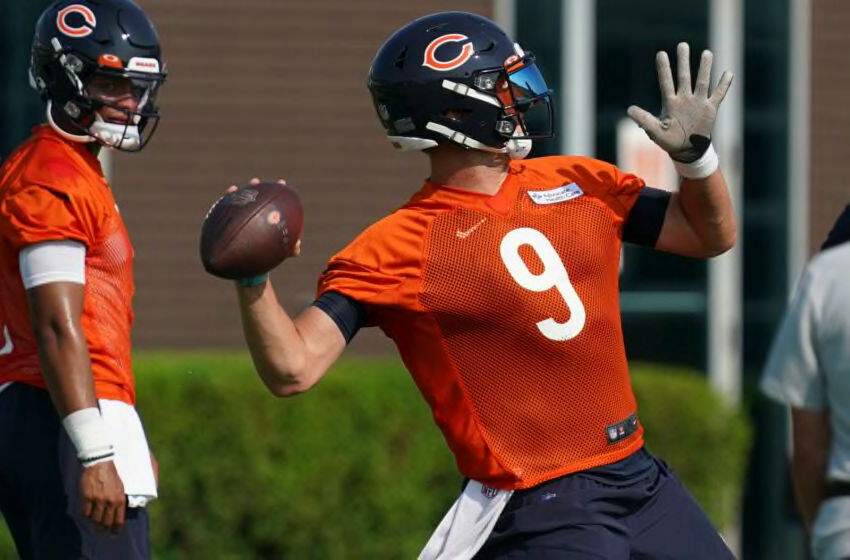
The Chicago Bears quarterback depth chart is a hot topic at Training Camp right now. Not only is it a hot conversation in Chicago, but it is also a hot topic nationally. People want to see Justin Fields be the starting quarterback but it feels like Andy Dalton is going to be the guy to start. They are both having good camps so far so it doesn’t feel like it is going to change anytime soon.
One thing that is all but a lock is the fact that Nick Foles is the number three. He went into 2020 in a battle with Mitchell Trubisky for the number one job but not Mitch is gone and Foles is getting reps with the third team. If he takes a single snap for the Bears in 2021 that means some bad things have happened.
It doesn’t seem likely that the Bears are going to be able to trade him or his contract to anyone but a new candidate has emerged recently. Coming into this year, the Indianapolis Colts acquired Carson Wentz from the Philadelphia Eagles. Unfortunately, he is going to be out for a fair amount of time due to the fact that he had foot surgery. His return should happen in 2020 but it could be anywhere from 5-12 weeks so nobody truly knows.
In the meantime, they could really use a quarterback. The Colts believe that they are a good quarterback away from being a contender. Nick Foles isn’t a good quarterback by any means but he seems to thrive in these situations. He has been known to be a very good franchise savior in crunch time. When he goes into a season as the main guy, he fails but that wouldn’t be the case in Indianapolis. He would be simply brought in to hold it down until Wentz comes back.
The Chicago Bears would accept literally anything for Nick Foles in a trade.
There are a lot of people that are adamant that it won’t happen and you can understand why. However, Foles has literally replaced Wentz before and led that team to a Super Bowl title. That season was an outlier but he could potentially fill in for Wentz again and get theme enough wins to tread water until their guy is back.
It isn’t like they have many other options anyway. They are going to be scrambling unless they really are okay with using Jacoby Brissett as their guy until Wentz comes back. If the Bears can get literally anything for Foles in a deal with the Colts, they will do it.
Jackie Hayes left behind a devout Christian upbringing in Waukegan to move to Logan Square at age 19 and pursue her music career on her terms. As a frequent opener at Schubas and other local clubs, she refined her attitude-heavy vocal melodies supported by simple, sludgy guitar lines and loose hip-hop drums. Hayes worked at a grocery store through the pandemic, and her new EP, There’s Always Going to Be Something, captures the malaise of young adulthood while depicting the residual burnout of a year without live music; though she’s just 22, she recently told NME that the pandemic left her “missing the drive and motivation of my younger self.” On “omg,” her voice curdles into a sneer as she sings, “It’s just not as fun as they advertised.” The song might be about failed romance or creative frustration or self-isolation–the lyrics are ambiguous, but her disappointment and disillusionment are crystal clear. The track “have fun,” set to a midtempo beat perfect for terrestrial rock radio, recalls Iggy Pop’s famous desire to, well, “have some fun”–it exudes the power of simple pleasures. The production on There’s Always Going to Be Something is by Billy Lemos, who also worked with Hayes on her previous EP, and he cleverly mimics the lineup of a full rock band. “Material” is generally sparse, but it blooms into overwhelming layers of feedback, solos, and barely scrutable vocals. Hayes’s lyrics describe a struggle to escape the past, but the energy of the song’s conclusion suggests that a breakthrough may just be a matter of turning up the volume on your guitar amp a few notches. v
Rylan Wilder stood inside the cavernous barn in southern Wisconsin, the sun slanting in between the weathered boards, and stepped to the mic.
“We’re Monarchy Over Monday,” the 17-year-old kid from Logan Square said to about 30 people there to hear his band. “It’s been a while since we’ve played. Getting shot puts you out of commission for a while.”
The howl and thrash of the music filled the air. Rylan’s dad Tom Wilder, teary, raised his camera to capture the moment. His mother Lucia Morales stood on a bench, swayed and beamed.
The performance last weekend was something his parents could only hope they’d ever experience after a Des Plaines police officer, on the trail of a bank robber, came into the Northwest Side music school where Rylan was an intern and opened fire with a semi-automatic rifle on Nov. 19, 2019, accidentally shooting the Chicago teenager. The bullet tore a playing-card-sized hole in the crook of Rylan’s left elbow, destroying an artery, shredding a nerve, obliterating bone, casting his dream of using his guitar to carve out his future in grave doubt.
Days after, Rylan’s mother spoke with reporters.
“No one can imagine what that’s like to see their child . . . like that,” Morales said of seeing him on the operating table. “The amount of doctors working on him, the amount of blood everywhere is unbelievable.”
Now, a year and a half later, Rylan’s dad is quick to tear up when he talks about what happened or even when a physical therapist kneads Rylan’s forearm in an effort to loosen unwilling muscles.
The Wilders still have questions — which they hope a lawsuit they’ve filed will help answer — about why the police officer was allowed to chase the bank robber into the city from Des Plaines and fire what their lawyer calls a “weapon of war” in a place filled with innocent bystanders.
“He’s from Des Plaines, and he comes to Chicago with an assault rifle — with a military assault rifle — and just starts blasting away, playing cowboy,” Tom Wilder says.
The Wilders — Rylan, his parents and his sister Kailey, 14 — live in a brick two-flat in Logan Square. It’s filled with Tom’s tiki mug collection, hundreds of LPs and artwork they’ve collected over the years from estate sales and elsewhere.
When they head out every day, they tell each other, “I love you.”
Rylan, broad-shouldered with curly chestnut hair, says he didn’t always want to be a musician. But rock ‘n’ roll was a constant at home.
“TV was on maybe an hour a week,” his father says. “And music was playing 15 hours a day.”
He and his wife took their kids to concerts and street festivals.
“We always had earplugs for them to make sure we didn’t damage their hearing,” says Lucia, an elementary school teacher.
At her urging, Rylan took violin lessons starting in second grade. Pretty quickly, though, he started setting aside his bow and strumming the instrument instead.
In time, he switched to guitar. To master it, he’d disappear into the basement to listen to his favorite songs over and over so he could nail the guitar parts.
At 10, he caught the eye of Alex White, the frontwoman for the Chicago rock band White Mystery. She was a volunteer mentor at a guitar school where Rylan took lessons.
“Rylan really demonstrated some serious talent on guitar, especially relative to other kids his age, where he’s playing complex solos, able to play very mature classic rock songs,” says White, who became friends with the family.
A year or so later, after one long day of practicing, Rylan says he realized: “I just want to keep doing this forever.”
At bars in the band’s early days, sometimes the only people who came to hear the kids play were their parents. To others there, the music was just background noise.
It didn’t matter.
“Even when you play to nobody, it’s still better than playing in your practice room,” says Jose Ceniceros, 18, the drummer.
At one place they played, Rylan says he was told he’d have to pay if he wanted a glass of water — tap water. The band’s take that night: $3.
But they kept at it.
Then, at one place they were playing, the bartender pulled out her phone and started recording.
“The bartender was, like, ‘Those kids are amazing. How old are they?’ ” says Tom, a real estate broker and day trader who manages the band. “I’m, like, ‘That’s my son. He’s 12.’ “
They started getting better gigs, drawing bigger crowds. In May 2019, they were one of six teenage bands invited to play the House of Blues.
“That show in particular was pretty surreal because, right before we went on, I was, like, ‘Wow, we’re about to play the House of Blues,’ ” Jose says. “It’s kind of insane.”
Tom sent a video of the House of Blues show to the organizers of Riot Fest. He also emailed them — a lot.
“Probably once a week, every week, for close to a year,” he says. “That’s what you have to do.
“Two or three weeks later, I got an offer to play Riot Fest, and I was, like, of course, we are going to play Riot Fest,” Tom says.
Rylan: “After Riot Fest, I definitely felt like we were going to do major stuff.”
Looking to the future, he thought: “If we blew up before we graduated, we’d probably try not to go to college.”
His father: “I didn’t see any reason why he wasn’t going to be able to get to that level. He had the ability, the talent, the drive to do it. It was something I just felt was going to happen.”
But his mother told him: You should have a backup plan. In case.
That’s why he went after an internship working at UpBeat Music in Old Irving Park.
“I told him it would look good on his resume,” Lucia says.
UpBeat is a music school for kids that proclaims, “Music is important, but treating each other with love and respect is first.” Rylan would check in students, update computer files, whatever was needed.
The evening of Nov. 19, 2019, Rylan was finishing his shift at Upbeat. Surveillance video from inside the school shows him with a bag of trash he’s about to take out. That’s when he turns toward the sound of sirens and the blue blur of police lights outside.
He had no idea two men had just held up a Bank of America branch in Des Plaines. Or that one of them, with police in pursuit, had gotten off the Kennedy Expressway at Irving Park and Pulaski.
Then, Christopher Willis, one of the men the police later said robbed the bank, runs in to the store.
“He runs toward me,” Rylan says. “I see that he’s holding a gun.”
Someone yells, “Oh!”
Then, a Des Plaines officer, James Armstrong, chasing Willis, a semi-automatic rifle at his shoulder, shouts to him: “Drop it!”
Rylan, then 15, can be seen on the video ducking and running for cover as Armstrong squeezes off a series of shots.
Willis slumps to the floor, to be pronounced dead not long after at Illinois Masonic Medical Center.
In an adjacent room at UpBeat filled with students and teachers, everyone scared, Rylan remembers feeling a “crazy amount of pain” in his left arm.
“At first, I thought I had just smacked my arm on the door — like I hit my funny bone,” he says. “I look down and see my shoes are just red. I see blood dripping everywhere.”
One of the teachers rushes Rylan and some students outside, where an officer applies a tourniquet to Rylan’s arm.
“I’m lying there, staring at the sky, and wondering if I’m going to die right there,” Rylan says. “I remember lying in the ambulance, and they are arguing about what hospital to take me to. Which I thought was kind of funny at the time.”
Tom had been on his way to pick him up. But traffic was so backed up on the Irving Park exit ramp that he had to find another way off the Kennedy.
And then the side streets were blocked by police cars.
His phone rang.
“It was the person,” Tom says. “It was the person in the ambulance. And she said that Rylan had been shot and that ‘he is still with us.’ “
And that they were taking him to Lurie Children’s Hospital.
He asked to talk with his son. Not now, the paramedic told him.
His wife texted him. She couldn’t reach Rylan. Tom called her right away. He told her what the paramedic said — that “he’s still with us.”
Lucia: “To me, that means my child is dying in this ambulance, and I don’t even know where he is or who he is with or if there is anyone holding his hand.”
Together, they raced to the hospital. In the emergency department, doctors and nurses surrounded Rylan, working on him.
Lucia: “You feel so helpless. You see your child gasping for air and having that mask on. The amount of blood, the amount of people around him.”
Rylan lost half of the blood in his body, they say they were told later.
The bullet that tore apart his left arm made a relatively small hole — about an inch in diameter — behind his elbow.
But as it exited, it blew apart bone, muscle, nerves and a major artery supplying blood to the hand.
And it fragmented. Pieces of it lodged in his abdomen. But none struck any vital organ, X-rays showed.
Doctors were able to stitch together the severed nerve and one of two arteries to keep the blood flowing to Rylan’s hand, while Dr. Vineeta Swaroop pieced together what could be salvaged of his elbow, holding it in place with a 10-inch-long titanium rod. In time, that would be replaced by a metal plate.
The work repairing the bone and joint was critical to keeping the nerves and arteries stable so they could heal.
Swaroop, at Lurie since 2008, says she sees bone fractures all the time but nothing like this.
“His case, his injury and this family will stay with me forever,” she says.
In the waiting area, Tom went to get water, his mind churning with confusion and worry over what the doctors told him and Lucia.
He says that’s when a police officer came up and told him in a voice just above a whisper: “You’re going to find out that the only person who did any shooting were police.”
He says he was too worried about Rylan then for the words to really register.
Despite the blood loss, Rylan never lost consciousness. When he saw his parents, he asked: Was anyone else at the music school hurt?
No.
And where was Kailey? He didn’t want his little sister to worry.
And: “Am I ever going to be able to play guitar again?”
Lucia hesitated.
“Anything is possible,” she finally said.
Rylan Wilder, then 15, in the hospital after being accidentally shot by a Des Plaines police officer pursuing a bank robber.Provided
In the year and a half since then, Dr. David Kalainov, a Northwestern University orthopedic and hard surgeon, has operated on Rylan twice.
“Luckily, Rylan is a teenager,” Kalainov says. “But he’s not expected to get the near full recovery you’d expect from a baby.
“The nerve never regains normal function the older we get for numerous reasons we understand and that we don’t understand,” he says.
But, as badly wounded as he was, Rylan had a couple of very important things working in his favor.
He was prepared to use his guitar to get his fingers moving again and help them recover.
And he wasn’t prepared to abandon his dream of being a professional musician.
He doesn’t remember precisely when he held a guitar for the first time after the shooting. His dad says it was at the hospital just before Christmas.
Rylan remembers this: “My fingers were crazy puffy. I was barely able to move them. I was definitely worried about never being able to play again.”
It wast about a month before he left the hospital. Tom would sleep on a sofa bed there, Lucia on a recliner.
“I remember just the amount of pain he was in,” Lucia says. “He would wake up in the middle of the night. I would sit there, trying to massage his fingers.”
Just before Christmas 2019, he came home.
“The first few weeks were really hard,” Tom says. “He couldn’t do anything on his own.”
Rylan Wilder, his scars visible on his left arm, at a physical therapy session at Northwestern Memorial Hospital.Ashlee Rezin / Sun-Times
Rylan Wilder plays the guitar for his father, doctor and physical therapist at Northwestern Memorial Hospital.Ashlee Rezin / Sun-Times
Rylan Wilder has had to work on his physical therapy on his left arm at home, too.Ashlee Rezin / Sun-Times
At first, Rylan carried around a “wound vac” — to suck fluid from the wound and help make sure the skin that was grafted from his inner thigh to his elbow could heal properly.
“You’re changing the dressings on something that looks like a war wound,” Lucia says.
For four hours a day, Rylan would try to move an arm that didn’t want to. Raising it above his head was agonizing and frustrating.
“It’s such simple stuff,” he says. “You’d never think you couldn’t do that.
“Playing the guitar is so many steps ahead of that. If I can’t even lift my arm up, then how am I ever going to be able to play a song?”
His parents also were dealing with their anger over the shooting, with a Des Plaines cop pursuing a high-speed chase on the expressway and firing inside the music school.
“The police are there to protect you,” Tom says. “They are not supposed to shoot you.”
This past April, David Anderson, the new Des Plaines police chief, said that, after viewing the UpBeat surveillance video multiple times, he wasn’t sure that Armstrong fired the shot that hit Rylan. He said it might have been the bank robber.
“If you listen to the video, what I hear is the potential of a shot being fired just prior to Officer Armstrong firing his weapon,” Anderson said.
Not true, the Chicago police quickly responded. “We did confirm that the 15-year-old victim and the offender were shot by Des Plaines police,” said Chicago police spokesman Tom Ahern
Tim Cavanagh, a lawyer who filed suit on the family’s behalf: “The suggestion that anyone other than a Des Plaines police officer shot Rylan Wilder is nonsense. The video makes very clear that the bullet that struck Rylan’s arm came from a military weapon held by Officer Armstrong.”
The family’s lawsuit, filed in Cook County circuit court, calls Armstrong’s use of force “excessive” and “reckless, willful and wanton conduct.”
Anderson, the police chief, said Armstrong, who remains with the department and wouldn’t comment, was trying to stop “a very violent, active shooter” and that he did the best he could under the circumstances.
For a time during his recovery, Rylan stopped even bothering to pick up the guitar, figuring it was probably just a waste of time.
But after months of physical therapy and surgeries that included removing scar tissue to take pressure off a key nerve and cutting away bone that had grown where it shouldn’t at the elbow joint, his range of motion had improved enough that he decided it was time.
Rylan: “All of a sudden, after a while, I picked up the guitar. There were a few more things that I could do. That motivated me to start playing again.
“Guitar is how I communicate,” he says.
Because of the nerve damage, Rylan’s left thumb still doesn’t bend the way it should. He says he doesn’t play as well, as a result, as he used to.
“All my playing was really accurate, really tight,” he says. “It’s a little more sloppy now.”
But somehow that created something unexpected.
“It’s kind of cool,” he says. “I’ve been able to make it sound more like me.”
Rylan’s doctors are amazed at the way he’s been able to compensate.
He took his guitar to a physical therapy session earlier this year and played a couple of cover songs for Kalainov and his therapist.
“He’s extremely determined to recover,” the doctor says. “And that’s a huge part of this.”
Monarchy Over Monday (from left) band members Jacob Padilla-Caldero, Jose Ceniceros, Daniel Jablo and Rylan Wilder. Jose, the drummer: “There is no band without Rylan.”Ashlee Rezin / Sun-Times
When Rylan couldn’t perform, Monarchy Over Monday didn’t, either. He’s the band’s lead guitarist and singer, and the others weren’t about to go on without him.
Jose, the drummer: “There is no band without Rylan.”
As Rylan improved, the band’s rehearsals returned over the past few months to his family’s basement — at times too loud for the neighbors but a cherished bit of normalcy for his parents.
Rehearsing in the Wilder family’s basement as Rylan’s dad Tom Wilder peeks in.Ashlee Rezin / Sun-Times
At the end of May, the band played in public for the first time since the shooting — at a barbecue in the backyard of one of Rylan’s old music teachers.
“It was definitely kind of awkward because it had been so long,” he says. “When I was singing, I was staring at the ground.”
Their real comeback show came, finally, last weekend at a farmhouse in southern Wisconsin at the annual Postock festival.
Lucia Morales captures the moment as her son Rylan Wilder performs with Monarchy Over Monday at the Postock music festival in Wisconsin.Ashlee Rezin / Sun-Times
The band had played there the summer before Rylan got shot. It’s two stages and print-making and home-cooked meals. Many of the people there are from Chicago and have known each other for years.
Rylan wore dark shades, a floppy, wide-brimmed hat and checkered sneakers. There were whoops as he started to play his Fender Pawn Shop Super-Sonic guitar.
If you looked closely, you could see the mottled skin on his arm.
You didn’t have to look as closely to see the smiles in the crowd.
The show ends, and Rylan’s mom says: “This is the kid who was told that — they didn’t know if he would ever play guitar again.”
“It was amazing,” Rylan says. “It was so much fun. It felt like I was back to normal — finally, after forever.”
Rylan Wilder and his floppy hat playing with Monarchy Over Monday during the teenage Chicago band’s comeback performance at the Postock music festival near Albany, Wisconsin, on July 30.Ashlee Rezin / Sun-Times
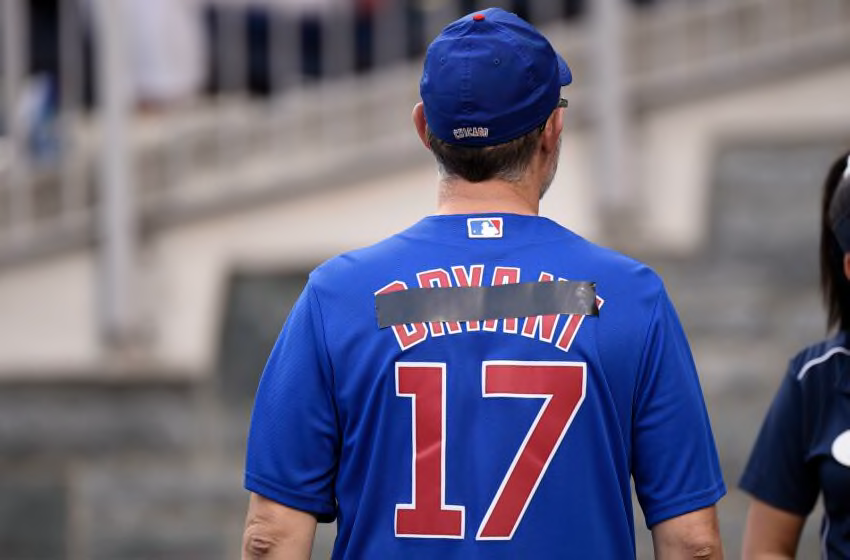
WASHINGTON, DC – JULY 31: A Chicago Cubs fan walks in the stands during the second inning of the game against the Washington Nationals at Nationals Park on July 31, 2021 in Washington, DC. (Photo by Greg Fiume/Getty Images)
The Chicago Cubs went from being a contender to a quitter in just a month’s span. At least, that’s what the Cubs’ front office wants the public to believe. Their unforgettable 11-game losing streak made their playoff hopes sink faster than the titanic. Core players: Anthony Rizzo, Kris Bryant, and Javier Baez no longer played with the inspiration and enthusiasm that made them beloved by Cubs fans everywhere.
The self-destruction and self-deflating state of the Cubs falls entirely upon ownership. The Ricketts family basically gave up on the team before this season even began by refusing to bring back players like Kyle Schwarber and Yu Darvish who could have no doubt helped prevent an 11-game demise.
Instead, they went cheap as usual by signing washed-up and struggling veterans like Jake Arrieta, Trevor Williams, and Zach Davies to marginal deals. No one looking to win would bank on three players who should all be starting in the minors to anchor an undermanned rotation.
Through nearly the end of June though, the Cubs surprised many onlookers by playing winning baseball. The players were blocking out all the outside noise of contract talks, trade deadline rumors, etc. that were amplified by ownership’s stubbornness and self-inflicted blunders over the years.
The Chicago Cubs organization gave up on their team during the 2021 season.
Once the Cubs started their west coast trip against the Los Angeles Dodgers, the wheels came off. They cooled off mightily on offense, overtaxed a once-dominant bullpen, and once the offense finally came to life, Jake Arrieta on cue made their offensive explosion look irrelevant with a couple of disaster performances.
General Manager Jed Hoyer acknowledged the harsh reality that the Cubs went from being buyers to sellers at the trade deadline, following 11 straight losses. In reality, though, the Cubs were already sellers before the losses piled up. They were quitters almost by default as they were content with losing for the next couple of years at minimum, at least in the eyes of ownership.
The players did an admirable job for nearly three months refusing to believe the organization had punted away the 2021 season. But deep down, the breadcrumbs originating from starting over from scratch left too much of a trail for the players to not avoid stumbling across on any given off-night.
The message had become loud and clear. Time’s up. Ownership and the front office can spin it any way they like, but the reality is that contending was never seriously considered in 2021. Hitting the “reset” button, rather than the “continue” button was more enticing. To everyone else though, the fans, and especially to both current and former players that gave it their all, it sure feels like the organization pressed “quit” as if no other option existed.
The first time we see Jennifer Hudson as a teenage Aretha Franklin in the sweeping and rousing biopic “Respect,” she’s singing in church. Much deeper into the story, after Franklin has been crowned the Queen of Soul and has been through every high and low imaginable through the decades, she’s singing … in church.
Faith and spirituality are a constant theme in “Respect,” which has sneak preview screenings Sunday before opening in theaters Thursday (full review coming soon) and is sure to have Hudson in the conversation for a second Academy Award. (She won best supporting actress for her feature debut in 2006’s “Dreamgirls.”)
“Faith is very important,” said Hudson in a recent conversation on a hotel terrace on a sunny summer afternoon in her hometown of Chicago. “It’s the base of her, and myself. It’s the thing that helped me get through the film and it’s the thing that felt most at home. When we were shooting that scene [with Aretha as a teenager], I felt like, ‘This is church.’ You can’t really script that. … That was the most important thing to me to maintain throughout the film: her faith, and the gospel in her music, no matter what genre she sang, no matter where she was in life, gospel was always the blueprint and her faith was always present.”
Hudson has been on the road for a multi-city tour to promote “Respect,” and it’s the first time she’s been out and about since the outbreak of the pandemic.
“I’ve lost count of how many cities it’s been,” she said. “I feel like I’ve been in it for a while. This is the first thing where I’ve been out. It was overwhelming at first, but I’m enjoying it. [But] I can’t help but think of how Aretha Franklin brought so many people together in life with her music. So, what better way to pay homage to her life than everybody seeing this movie in theaters.”
Jennifer Hudson plays Aretha Franklin in “Respect.” When singing in the movie, she often asked herself, “How I can approach this in a way that’s different from just Jennifer Hudson singing a tribute to Aretha Franklin?”MGM
When we think of biographical films about famous pop and rock and soul idols, it’s often performers who are actors first and musicians second, e.g., Jamie Foxx in “Ray,” Joaquin Phoenix and Reese Witherspoon in “Walk the Line,” Rami Malek in “Bohemian Rhapsody.” (Barbra Streisand and Lady Gaga played fictional characters in their respective star turns in “A Star Is Born.”) With “Respect,” we have an established music superstar playing a generational legend. Was that more of a challenge for Hudson, because we know her persona and her voice so well?
“You know what? Yes. It seems like it would be a plus, but it was just as much of a challenge. Like, how I can approach this in a way that’s different from just Jennifer Hudson singing a tribute to Aretha Franklin? And then, how do you even gather the essence of her that’s so familiar to people as well? During filming, that’s what stayed with me: Am I supposed to try to sound like her, or do I use more of my voice?
“I sat with a dialect coach and talked about how our vocal instruments are built differently. Our approaches are different. So yes, I’m singing it, but I’m using [Aretha’s] approach, her nuances and inflections, the place where she sings from.
“And then you have to consider the narrative, where we are along the timeline. For example, the song ‘Ain’t No Way.’ I, as Jennifer Hudson, know the song completely, I can sing it and I know every lick. Whereas, in the context of the film, she’s learning the song, so now I have to unlearn the song and approach it as if I’m just now discovering it.”
In addition to all the familiar Aretha Franklin hits, “Respect” features a new number, “Here I Am (Singing My Way Home”), co-written by Hudson with the great Carole King (who of course co-wrote Franklin’s classic “Natural Woman” with Gerry Goffin).
Aretha Franklin performs at Chicago’s Arie Crown Theater in 1972.Sun-Times file
“We did it via Zoom during the pandemic,” said Hudson. “She pulled from her experiences with Aretha, knowing her, and then also my church upbringing. She wanted me to be a part of the writing process. Imagine Carole King saying, ‘You go write this,’ and I’m like, ‘Oh my God, thank you!’
“This was the parallel I felt with Aretha. You can’t tell me she didn’t sing her way home. She sang to her last breath, and we all got to witness that. And I walk around thinking all the time, just to get home here to Chicago. I always find myself, every day, singing my way back home. Another note, another song to get there.”
Most of the songs in “Respect” were performed live, which gives the film an extra layer of authenticity but also means Hudson had to perform multiple takes of each number for different camera angles.
“Probably 14 of the 18 songs on the soundtrack were done live,” she said. “As an actor, I wanted to experience these songs as Aretha did in her life. So, anything that she sang live in concert, we’ll sing it live. If it’s a recording session, then we’ll record it.”
Multiple threads run through “Respect,” from the timeline of Franklin’s career to her problems with alcohol to her differences with her family to the abusive relationships she survived. But considerable time is also devoted to Franklin’s devotion to civil rights.
“That was so honorable of her, for her to take a stand when she was in a position where she didn’t necessarily have to,” said Hudson. “But that showed the heart of her, and how much she loved her people, and how conscious she was of her time. And it can’t help but make artists like myself think, ‘What I am doing with my platform? What CAN I do with my platform?’ “
As for being back home, Hudson said: “This is still home. There’s no place LIKE home. People are always like, ‘What are you doing here? Are you singing here?’ And I’m like, ‘I live here, I’m from here.’ People have this perception that all celebrities live in Hollywood or New York, but no. Chicago is my home and always will be.”
A man was shot to death early Friday in Back of the Yars on the South Side.
The 31-year-old man was sitting in the passenger seat of a vehicle with a female about 2:15 a.m. when a gunman approached on foot and opened fire in the 5200 block of South Ashland Avenue, Chicago police said.
After the shooting, the female drove to the 7600 block of South Chicago Avenue where he was picked up by paramedics, police said.
He suffered multiple gunshot wounds on the body and was transported to the University of Chicago Medical Center, where he was pronounced dead, police said. He hasn’t been identified.
No one is in custody as Area One detectives investigate.

:no_upscale()/cdn.vox-cdn.com/uploads/chorus_asset/file/22763992/BOY_SHOT_112619_08.JPG)
:no_upscale()/cdn.vox-cdn.com/uploads/chorus_asset/file/22763937/merlin_99808590.jpg)
:no_upscale()/cdn.vox-cdn.com/uploads/chorus_asset/file/22763961/merlin_99808608.jpg)
:no_upscale()/cdn.vox-cdn.com/uploads/chorus_asset/file/22763960/merlin_99808600.jpg)
:no_upscale()/cdn.vox-cdn.com/uploads/chorus_asset/file/22763964/merlin_99808568.jpg)
:no_upscale()/cdn.vox-cdn.com/uploads/chorus_asset/file/22763939/merlin_99808610.jpg)
:no_upscale()/cdn.vox-cdn.com/uploads/chorus_asset/file/22763962/merlin_99808536.jpg)
:no_upscale()/cdn.vox-cdn.com/uploads/chorus_asset/file/22762569/RylanWilder_08XX21_07.jpg)
:no_upscale()/cdn.vox-cdn.com/uploads/chorus_asset/file/22765180/respect_R_21163_RC_rgb.jpg)
:no_upscale()/cdn.vox-cdn.com/uploads/chorus_asset/file/22765196/Franklin__Aretha.JPG)